CASE
STUD
Y
Mailing address: Lavinia Teixeira-Machado – Rua Dom José Thomaz, 442 – São José – CEP: 49015-090 – Aracaju (SE), Brazil. – E-mail: [email protected]/[email protected]/ [email protected] – Presentation: Feb. 2013 – Accepted for publication: Mar. 2015 – Approval from the Ethics Committee of Universidade Federal de Sergipe under CAAE protocol no. 02238312.2.0000.0058/12
205
ABSTRACT | Autism is one of the most common
neurological disorders that afects the neurological development of children. Therapeutic interventions may intervene in communication disorders and stereotyped behaviors such as dancing, which as therapy can activate sensory pathways that enable gesture improvement. This study aimed to observe the efects of dance therapy in motor performance and gesture, body balance and gait, as well as in the quality of life of an adolescent with autistic disorder. It is a case study of a ifteen-year-old male who participated in 120 sessions of dance therapy, lasting 30 minutes, twice a week, on alternate days, over a period of one year. The assessment instruments used were the Motor Function Measure (MFM), Tinetti test and Childhood Autism Rating Scale (CARS). According to the MFM, the total score increased 27.08%; the Tinetti test regarding balance increased from 68 to 75%, and gait, from 16% to 66%. CARS changed from 41.5 to 34 points, changing the severe disorder to moderate within the proposed parameters. The dance therapy can optimize the psychomotor behavior of young people with autistic disorders.
Keywords | Autistic Disorder; Dance Therapy; Gait; Complementary Therapies; Motor Skills
RESUMO | O autismo é uma das desordens neurológicas mais comuns que afetam o desenvolvimento neuropsicomotor de crianças. Intervenções terapêuticas podem intervir nos transtornos de comunicação e nos comportamentos estereotipados, desse modo a dança, como terapia, pode ativar vias sensoriais que viabilizam o aprimoramento do gesto. Este estudo visou observar os efeitos da dançaterapia no desempenho motor e gestual, no equilíbrio corporal e na marcha, bem como na qualidade
This study was developed in Academia Sergipana de Ballet – Aracaju (SE), Brazil.
1Assistant Professor in the Science Education Department in Universidade Federal de Sergipe – São Cristovão (SE) – Brazil.
Dance therapy in autism: a case report
Dançaterapia no autismo: um estudo de caso
La danzaterapia para el autismo: estudio experimental
Lavinia Teixeira-Machado1
de vida de um adolescente com autismo. Trata-se de um estudo de caso de um jovem com 15 anos de idade, que participou de 120 sessões de dançaterapia, com duração de 30 minutos, duas vezes por semana em dias alternados, durante um ano. Os instrumentos de avaliação utilizados foram a Medida da Função Motora (MFM), Teste de Tinetti e Escala de Avaliação do Autismo Infantil (Childhood Autism Rating Scale – CARS). Segundo a MFM, o escore total aumentou 27,08%; o Teste de Tinetti referente ao equilíbrio aumentou de 68 para 75% e a marcha de 16% para 66%; o CARS foi alterado de 41,5 para 34 pontos, transferindo o transtorno de grave para moderado dentro dos parâmetros propostos. A dançaterapia pode otimizar o comportamento neuropsicomotor de jovens com transtornos autistas.
Descritores | Transtorno Autístico; Terapia através da Dança; Marcha, Terapias Complementares; Destreza Motora.
Rating Scale - CARS). De acuerdo a la MFM la puntuación total aumentó un 27,08%; la Prueba de Tinetti con respeto al equilibrio aumentó del 68% al 75% y la marcha del 16% al 66%; la CARS bajó del 41,5 al 34 puntos, pasando la clasiicación del trastorno, según los parámetros propuestos, de grave a moderado. Así, la danzaterapia
puede optimizar la conducta neurológica y psicomotora del joven con trastornos autísticos.no hay comprobación suiciente sobre la eicacia de la VNI en el aumento de la tolerancia al ejercicio.
Palabras clave|Trastorno Autístico; Terapia a través de la Danza; Marcha; Terapias Complementarias; Destreza Motora
INTRODUCTION
Autism spectrum disorder is one of the most common neurological disorders afecting neuropsychomotor development in children. his condition involves an array of neurological, behavioral disorders with three most evident factors: diiculty socializing, verbal and non-verbal communication disorders, and repetitive, stereotyped behavior patterns1,2. Moreover, autistic children have
signiicantly damaged imitation skills and spontaneous use of descriptive gestures which prevent complex behaviors and socialization from being achieved3,4.
A study that was conducted with purebred rats5
showed behavioral and social variations. Sensory diiculty is considered as one of the central problems in autism, as it is associated with barriers that are related to socialization and communication, and to a restricted repertoire of interests and activities6,7.
Autism is a disorder whose pathological base is unknown. Ramachandran and Seckel8 explain that the
main damage may be in the mirror-neuron system. Many cognitive neuroscience researchers consider that system provides the psychological mechanism for the interaction between perception and action. Mirror neurons may be important to understand the actions from other people, and to learn new motor acquisitions through imitation. Problems in that system are the base for cognitive disorders such as autism9.
Many autistic children have very early signs of sensory and motor damage. herapeutic interventions which operate in the sensory stimuli have been found to display positive efects, as well as visual and auditory interventions, sensory-motor management techniques, and physical exercises2,10,11.
Synchronous repetitive movements may improve stimuli in the mirror-neuron system8. Pectrus, et al.2
praise physical therapy as critical to ind ways which can minimize neuromotor damage. Music and dance, in turn, exist in all cultures and are part of a series of creative behaviors12.
Dance as a therapy may stimulate the integration of sensation and perception, and, thus, predispose action13,14. Coordinated activities are fundamentally
important for the progress of the neuromotor system10,15.
Motor therapy, when it is associated with music, may make social interaction and communication easier16, as
well as several systems which interfere in the perception of movement, and are fundamental for the social-emotional development and for the interconnection of areas which are responsible for the association of movement17-19.
hus, this study proposes that dance and physical therapy be united as a possibility to develop and modify an array of irregular and uncoordinated movement patterns. he lack of studies with the proposed design has inspired a need for researching the efects which are caused by dance in autistic people’s behavioral disorders through teleceptive stimuli which are imposed by music and dance.
herefore, this study seeks to observe the dance therapy efects in a teenager with autistic disorders, to evaluate motor and gesture performance in the autistic spectrum through the motor function measure (MFM), to analyze body balance and gait through Tinetti Test, and to investigate the efects in the autistic teenager’s quality of life through the Childhood Autism Rating Scale (CARS).
METHODOLOGY
he dance therapy sessions were conducted in a proper dance classroom, with mirrors, parallel bars, and sound equipment, at Academia Sergipana de Ballet, in Aracaju, Sergipe. Session comprised laterality, musical, and rhythmic perception tasks, with four series of eight repetitions for the following activities: anteroposterior and latero-lateral spreading of lower limbs; single-leg and double-leg squatting; weight shifting; spinning; anterior, lateral, and posterior gait. All activities are associated with movements and waving of upper limbs in ballroom dance styles. Choreographed sequences were changed, along with songs, at every 20 sessions, so that could result in changes in the teenager’s routine.
he evaluation scales allow measuring the behaviors from children with pervasive developmental disorders, in a way to establish a more reliable diagnose20,21.
MFM was used in order to evaluate motor and gesture performance, as it is a scale that comprises 32 static and dynamic items and it measures examined people’s motor skills. Items are tested in lying, sitting, or standing positions, and they are divided in three dimensions: standing position and shifting, with 13 items (D1); axial and proximal motor skills, with 12 items (D2); distal motor skills, with seven items (D3), six of which regarding the upper limbs. Each item is classiied in a four-point scale, as follows: unable to start the task or maintain the initial position (zero); performs the exercise partially (one); performs the required movement partially or performs it completely, albeit imperfectly (two) - ofsetting, insuicient time maintaining the position, slowness, lack of movement control; performs the exercise completely and normally, with a controlled, perfect, objective movement, at a constant speed (three). he values in each dimension are: D1, 39 points; D2, 36 points; D3, 21 points, the three dimensions totaling 96 points22,24.
Tinneti test was applied in order to evaluate body balance and gait abnormalities. he test consist of 16 items, of which nine regard body balance and seven refer to gait. Tinneti test classiies gait aspects such as speed, step distance, standing symmetry and balance, spinning, and shifts with eyes shut. Counting for each exercise ranges from 0 to 1, or from 0 to 2, with lower numbers indicating poor physical skills. he total score is the sum of scores for body and gait balance, and it adds up to 28 points. Total score is broken down in 12 points for gait and 16 for body balance25.
In order to analyze the efects from aspects regarding quality of life and severity of autism, CARS was used - it is a 15-item scale which helps identify autistic children
and distinguishes them from non-autistic children with developmental problems. Its importance consists of identifying mild and moderate from severe autism. It is brief, and its use is adequate for any child who is older than two years of age. he results deine the following scores: 15-30: non-autistic; 30-36: mild to moderate autism; 36-60: severe autism26,27. CARS was used at four moments:
before the intervention, after a six-month intervention period, after a twelve-month intervention period, and six months after the intervention was inished, in order to observe whether observed changes were going to last.
RESULTS
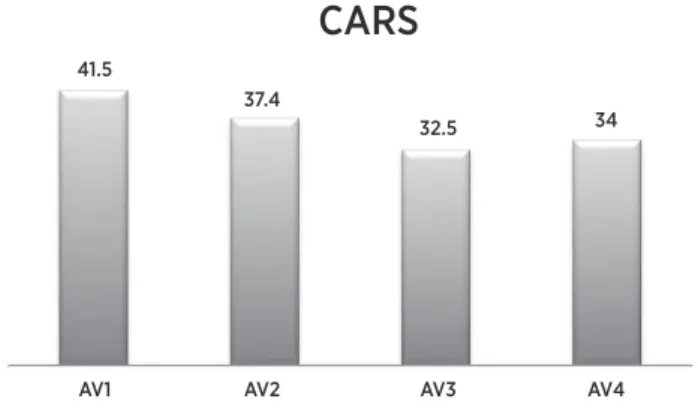
In the irst evaluation, the teenager was found to have a 41.5-point score, and he was classiied as been severely autistic, according to Pereira, et al.21. After a six-month
intervention, the teenager’s score was 37.5 points, and after twelve months of intervention, 32.5 points, causing him to fall into the mild to moderate autism classiication. After twelve months of intervention, the protocol was interrupted for six months, when data were collected again, and those data showed the teenager scored 34 points (Figure 1).
AV1 41.5
AV2 37.4
AV3 32.5
AV4 34
CARS
Figure 1. Values obtained through the Childhood Autism Rating Scale (CARS). At the beginning of the protocol (AV1), after a six-month intervention period (AV2), after a twelve-month intervention period (AV3), and a follow-up six months after the intervention was inished (AV4)
protocol, another evaluation (AV3) was conducted, in which D1 reached 21 points (53.84%), D2, 29 (80.55%), and D3 was not found to have changed, maintaining 7 points (33.33%), totaling 57 points (59,37%). Figure 2 shows the values that were obtained for the three dimensions at the moments of analysis and their respective total scores, which point towards a more marked increase in dimension 2 as compared to the remaining ones.
D1 100
80
60
40
20
0
D1
Motor Function Measure (MFM)
Sc
or
e (%)
D1
AV1 AV2 AV1
D1
Figure 2. Values (%) of dimensions (D1, D2, D3 , and Total D) of motor function measure (MFM). At the beginning of the protocol (AV1), after a six-month intervention period (AV2), and after a twelve-month intervention period (AV3)
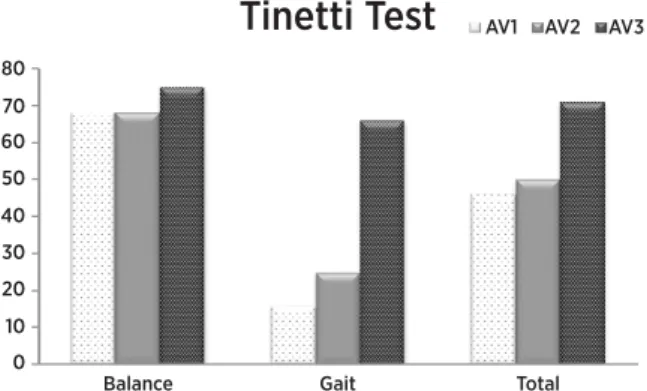
Figure 3 shows data as obtained by Tinneti test. In the irst evaluation (AV1), the dimension regarding balance revealed 11 points (68%), and the dimension regarding gait, in turn, only 2 points (16%), which makes up 13 points total (46%). After the six months (AV2), balance was found to reach 11 points (68%), and gait, 3 points (25%). he total was 14 points (50%). After the twelve month-intervention, the last analysis (AV3) was conducted, and the obtained data were: balance - 12 points (75%); gait - 8 points (66%); total - 20 points (71%).
Balance Gait
Tinetti Test
AV1 AV2 AV3Total 80
70
60
50
40
30
20
10
0
Figure 3. Data regarding the application of Tinetti Test at the beginning of the protocol (AV1), after a six-month intervention period (AV2), and after a twelve-month intervention period (AV3)
DISCUSSION
he teenager’s mother watched a public presentation of the extension group from Universidade Federal de Sergipe, comprising children and adolescents with various disabilities. he mother was touched, and she requested that her son be included in the dance classes.
As soon as the boy signed up to the program, the evaluation instruments were applied, and he was assessed to need individual dance classes, to be included in the group afterwards, thus preventing him to feel inhibited or unable to perform the tasks that were proposed in the group classes.
he results above corroborate the indings from Weber and Newmark28 regarding the eicient use
of alternative and complementary therapies in the autistic spectrum. Pectrus, et al.2 noted that
sensory-motor treatments are used well beyond holistic intervention plans, as alternative therapies seek to improve performance considering sensory and motor diiculties, including other essential components, such as cognitive and psychosocial functions.
It is interesting to observe the data that were obtained by CARS. he instrument assess factors that are related to quality of life and to autistic spectrum severity, and it encompasses issues concerning personal relationships, use of the body, senses, and objects, response to changes, verbal and non-verbal communication, and cognitive consistency19,26.
he data obtained by MFM show that the teenager had better results in the items corresponding to dimension 2 (D2), which is related to axial and proximal motor skills, including changes regarding head directions - they are essential to guide the desired movement10,18,19. here was little alteration in regards
to dimension 3 (D3), which involves distal motor skills - encompassing the handling of objects, for example. he teenager’s muscles are atrophied for lack of use, and the protocol involves global body movements. Besides that, he had trouble following the requests to execute the MFM tasks.
Autism leads to diiculties in the spontaneous process regarding imitation and description of gestures4,29.
participation efects of autistic people in their social contexts. Finally, the choreographed sequences were modiied at every 20 sessions, stimulating the symbolic frames of reference from songs in association with body movements. he teenager resisted strongly when the irst modiication took place, but in the following one he was already having fun with changes, as he noticed he was capable of adapting to the alterations in proposed sequences.
Dexterity and balance could be evaluated through Tinneti test, especially in regards to gait quality25.
he youngster used to neglect the following gait and walked in an asymmetric way, and that justiies the better response in the score involving gait criteria, as the teenager now executes the following gait fearlessly, even though with some help.
he beneits from physical activity in this population are widely documented in the literature4,11,17-19.
Dancing, as a physical activity, fosters the reduction of atypical behaviors, as it physiologically modulates stereotyped actions through the release of speciic neurotransmitters17-19. Such speculations generated
interest regarding the inclusion of regular physical education in autism treatment2. Although that is a
result from the commitment level, it is plausible that diminishing stereotyped behaviors may contribute for autistic people to participate more in their environments, in order to develop their skills.
he results from studies by Ingersoll, et al.4
reinforce the efectiveness of interventions including natural movements for learning and imitating gestures. Dancing really stimulates the imitation of gestures. Despite the sensory alterations not being speciically from autistic disorders, their prevalence is very high, and Dawson and Watling29 mention the prevalence
of abnormalities in the sensory integration, and that therapies which focus on approaching the training of sensory integrations that are focused on the auditory system may contribute to resolve abnormalities in the autistic spectrum.
he replacement of bizarre and repetitive movements that are peculiar to the autistic universe predisposes the annulment of those stereotyped behaviors, as those actions are performed with a purpose. herefore, the delayed behavioral maturity may be reversed through the intervention of activities which propose the integration of several attention systems, so they can contribute to develop the social communication ability in autistic people6.
Despite physical therapy using many exercises, it is necessary to investigate their efects in the development and in the application of proper treatments to the autistic spectrum2. his case report is just a draft of
a therapeutic program which may contribute to the investigations about the autistic spectrum. Our biggest diiculty was to try and minimize the stereotyped behavior, which interferes in the response actions from other appropriate behaviors.
he sequences proposed in our study interfered in these inadequate behaviors, above all. We used songs with lyrics in order to imply meaning for speciic actions, and that substantially afected the following stereotyped behaviors. Besides that, we contributed to movement coordination and dexterity, as the data that were obtained through MFM and Tinetti point out. he scores obtained in CARS showed the reduction of stereotyped movements in this teenager, as well as issues regarding social interaction, even after the dance therapy sessions had been inished.
he results that were obtained in this study stress the fundamental importance of dance therapy intervention in order to improve sensory-motor function, thus allowing autistic individuals to demonstrate their full cognitive, behavioral, social, and communicative behaviors.
CONCLUSION
Dance therapy favored motor and gesture performance, even in body balance and gait. Besides that, it contributed to improve the quality of life of the teenager with autistic spectrum.
Both his static and his dynamic motor skills were improved, which demonstrates the importance of the rhythmic movement in the development of the motor skill that had been neglected due to the autistic spectrum condition.
Body imbalance and gait abnormalities were minimized in the teenager after the dance therapy sessions, probably due to the stimuli that were proposed by the dance, such as alternated exercises and various directions.
improvements in the disorders that were visualized in the teenager who took part in this study.
CLINICAL IMPLICATIONS AND STUDY LIMITATIONS
he study showed the importance of using dance therapy, and how it can efectively operate in the autistic spectrum disturbances. his pragmatic judgment can only generate results that can be generalized in the clinical practice through a study with a more robust design.
In order to have that, a larger sample would be needed, and so would the formation of two groups in order to compare the efects from the interventions, to check whether dance, as a therapy, can contribute to the neuropsychomotor and quality of life enhancement in the autistic spectrum.
Interventions which operate in various systems which are based on rhythm and on dancing activities may be used to alleviate social communication impairments, as well as sensory, motor, and behavioral comorbidities in autism. However, future research must extend this study in order to examine the efects from the various systems dance can intervene in, thus solidifying the indings in this investigation.
REFERENCES
1. Assumpção Jr FB, Pimentel ACM. Autismo infantil. Rev Bras Psiquiatr. 2000;22(S2):37-39.
2. Pectrus C, Adamson SR, Block L, Einarson SJ, Sharifnejad M, Harris SR. Efects of exercise interventions on stereotypic behaviors in children with autism spectrum disorder. Physiotherapy. Canada. 2008;60(2):134-45.
3. Ingersoll B, Schreibman L. Teaching reciprocal imitation skills to young children with autism using a naturalistic behavioral approach: efects on language pretend play, and joint attention. J Autism Dev Disorder. 2006;36(4):487-505. 4. Ingersoll B, Lewis E, Kroman E. Teaching the imitation and
spontaneous use of descriptive gestures in young children with autism using a naturalistic behavioral intervention. J Autism Dev Disord. 2007;37(8):1446-56.
5. Bolivar VJ, Walters SR, Phoenix JL. Assessing autism-like behavior in mice: variations in social interactions among inbred strains. Behav Brain Res. 2007;176:21-6.
6. Whalen C, Schreibman L, Ingersoll B. The collateral efects of joint attention training on social imitations, positive afect, imitation, and spontaneous speech for young children with autism. J Autism Dev Disord. 2006;36(5):55-64.
7. Silva LM, Cignolini A, Warren R, Budden S, Skowron-Gooch, A. Improvement in sensory impairment and social interaction in young children with autism following treatment with an original qigong massage methodology. Am J Chin Med. 2007;35(3):393-406.
8. Ramachandran VS, Seckel EL. Synchronized dance therapy to stimulate mirror neurons in autism. Med Hypotheses. 2011;76(1):150-1.
9. Dinstein I, Thomas C, Behrmann M, Heeger DJ. A mirror up to nature. Curr Biol. 2008;18(1):13-8.
10. Iwabe C, Miranda-Pfeilsticker BH, Nucci A. Medida da função motora: versão da escala para o português e estudo de coniabilidade. Rev Bras Fisioter. 2008;12(5):417-24.
11. Kern L, Koegel RL, Dunlap G. The inluence of vigorous versus mild exercise on autistic stereotyped behaviors. J Autism Dev Disord. 1984;14(1):57-67.
12. Boso M, Politi P, Barale F, Enzo E. Neurophysiology and neurobiology of the musical experience. Funct Neurol. 2006;21(4):187-91.
13. Gunning S.V, Holmes T.H. Dance therapy with psychotic children. Deinition and quantitative evaluation. Arch Gen Psychiatry. 1973;28(5):707-13.
14. Siegel EV. Movement therapy with autistic children. Psychoanal Rev. 1973;60(1):141-9.
15. Miller LT, Polatajko HJ, Missiuna C, Mandich AD, Macnab JJ. A pilot trial of cognitive treatment for children with development coordination disorder. Hum Mov Sci. 2001;20(1-2):183-210. 16. Geretsegger M, Holck U, Gold C. Randomised controlled trial
of improvisational music therapy’s efectiveness for children with autism spectrum disorders (TIME-A): study protocolo. BMC Pediatric, 2012;12:2.
17. Srinivasan SM, Bhat AN. A review of “music and movement” therapies for children with autismo: embodied interventions for multisystem development. Front Integr Neurosci. 2013;7:22. 18. Hardy M, LaGasse AB. Rhythm, movement, and autism: using rhythmic rehabilitation research as a model for autism. Front Integr Neurosci. 2013;7:19.
19. Rosenblatt LE, et al. Relaxation response-based yoga improves functioning in young children with autism: a pilot study. J Altern Complem Med. 2011;17(11):1029-35. doi: 10.1089/acm.2010.0834.
20. Charman T, Howlin, P, Berry B, Prince E. Measuring developmental progress of children with autism spectrum disorder on school entry using parent report. Autism. 2004;8(1):89-100.
21. Van Waelvelde H, Oostra A, Dewitte G, Van Den Broeck C, Jongmans MJ. Stability of motor problems in young children with or at risk of autism spectrum disorders, ADHD, and or developmental coordination disorder. Dev Med Child Neurol. 2010;52(8):174-8.
22. Vuillerot C, et al. Monitoring changes and predicting loss of ambulation in Duchenne muscular dystrophy with motor function measure. Dev Med Child Neurol. 2010;52(1):60-5.
24. Russell D, Rosenbaum P, Cadman D, Gowland C, Hardy S.; Jarvis S. The gross motor function measure: a means to evaluate the efects of physical therapy. Develop Med Child Neurol. 1989;31:341-52.
25. Useros-Olmo AI, Collado-Vasquez S. Efects of a hydrotherapy program in the treatment of cervical dystonia: a pilot study. Rev Neurol. 2010;51(11):669-76.
26. Pereira AM. Autismo Infantil: Tradução e validação da CARS (Childhood Autism Rating Scale) para uso no Brasil [dissertação]. Porto Alegre: Universidade Federal
do Rio Grande do Sul, Curso de Pediatria, Programa de Pós-Graduação em Ciências Médicas; 2007.
27. Speigel, A. The dictionary of disorder: how one man revolutionized psychiatry. The New Yorker. Ann Med. 2005;23(1):1-11.
28. Weber W, Newmak S. Complementary and alternative medical therapies for attention-deicit/hyperactivity disorder and autism. Pediatr Clin North Am. 2007;54(6):983-1006. 29. Dawson G, Watling R. Interventions to facilitate auditory,