artigo original
Forensic neuropsychological assessment: clinical
case of depression and working incapacity
Avaliação neuropsicológica forense: caso clínico de
depressão e incapacidade para o trabalho
Camila Monti
1, Fabiana Sai
1, Daniel Martins de Barros
1, Alvaro Machado Dias
2, Henrique Teruo Akiba
3,
Antonio de Pádua Seraim
1,4aBStraCt
Issues related to mental health in relation to court matters have increasingly required the participation of the psychologist. We present the use of forensic neuropsychological assess-ment in a case of retireassess-ment reversal. Incapacity was attested due to disability resulting from depression of a 35-year-old attorney, and the case was forwarded from the courts to the Forensic Psychiatry and Psychology Unit at the USP Clinical Hospital. A clinical interview and application of cognitive tests was conducted. Despite the depression, signiicant cognitive losses that would prevent return to his professional assignments were not detected. The neu-ropsychological assessment has been shown to be an important tool in the forensic context, as it assists with diagnostic value for clariication of functional aspects in the various psycho-pathological areas in terms of disabilities or potentialities.
reSumo
Assuntos relacionados à saúde mental na corte vêm demandando crescente participação de psicólogos. Sob este mote, apresentamos uma aplicação de um assessment neuropsi-cológico em um caso de reversão de aposentadoria por invalidez. Trata-se do caso de um juiz de 35 anos, que chegou à nossa Unidade de Tratamento Forense Psicológico e Psiquiátrico, no Hospital das Clínicas da Universidade de São Paulo. Para suprir a demanda, inicialmente conduzimos uma entrevista clínica e, em seguida, aplicamos uma bateria neuropsicológica, a partir da qual foi revelada a inexistência de limitações do desempenho cognitivo, as quais recomendariam a reairmação do afastamento do proissional. Tal como revelado, o uso ade-quado do assessment neuropsicológico mostra-se uma importante ferramenta em contexto forense, auxiliando o esclarecimento de aspectos funcionais do diagnóstico, em vários con-textos psicopatológicos.
CaSe rePort
1 University of São Paulo (USP), Clinical Hospital, Institute of Psychiatry.
2 Federal University of São Paulo (Unifesp), Medical School, Clinical Neuroscience Lab. 3 USP, Institute of Psychology.
4 Methodist University of São Paulo (Umesp), Post-graduate Program in the Psychology of Health.
Address for correspondence: Alvaro Machado Dias Laboratório Interdisciplinar de Neurociências Clínicas (LiNC) Rua Pedro de Toledo, 669, 3° andar
Vila Clementino
05039-032 – São Paulo, SP, Brazil
Emails: [email protected]; [email protected]
Received in 5/26/2014 Approved in
1/11/2015
Keywords
Depression, disabling diseases, forensic neuropsychological assessment.
Palavras-chave Depressão, transtornos mentais incapacitantes, assessment
neuropsicológico.
87
CaSe rePort
introDuCtion
The impact of mental illness for personal and professional lives of the people has been investigated for a long time1.
Ceasing to work due to debilitating neuropsychiatric disease has increasingly required the participation of doctors and psychologists to clarify the facts, and with the development of neuropsychology this requirement has become more fre-quent2-5. This is a theoretical and practical shift, once not only
the symptoms, but also the cognitive changes and functio-nal disability are now being taken into account when attes-ting incapacity, as in episodes of depression, for example6.
Between the years of 2008 and 2012, 82.980 disabil-ity retirements due to mental or behavioral disorders were registered in Brazil, from which 39.63% were from depres-sive spectrum (i.e. F 31: Bipolar disorder type II, F 32: major depressive disorder (single episode) and F 33: major depres-sive disorder (recurrent) representing the amount of de R$ 37.607.918, 63 (nearly 17 million dollars), 42.87% of the total spent with disability retirements due to mental or behavioral disorders7. In Europe a 12 month neuropsychiatric disorders
prevalence study was conducted by Wittchen et al.8,
com-prising 167 millions of cases in 27 countries, showed that unipolar depression as the second most frequent mental disease, with 30.3 million cases, and has the highest disease burden, measured by disability adjusted life years (DALY). In Brazil, the frequency ratio is 36% larger for bipolar afective disorders and major depression (recurrent) and 9% for major depression (single episode). The same pattern was observed in the European study, in which the DALY rate per 10.000 persons regarding unipolar depression is 90% higher for women in comparison with men7.
Apart from the socioeconomic burden, related to dis-ability retirement, comprising expenses related to pensions, treatments and the loss of productive force, early retirement also have signiicant efects over the individuals mental health. Retired individuals present higher rates of anxiety and depression disorders than those with the same age who are still working, these discrepancies are gender related and more pronounced at earlier ages9-11. Retiring may afect also
cognitive functioning12. These aspects taken together show
the growing importance of accurate and comprehensive evaluations, a scenario in which the neuropsychological as-sessment may contribute.
The introduction of neuropsychology into forensics in-volves a fundamental diference in relation to clinical prac-tice. In the clinical setting, the objective of assessment is to determine the existence or not of a dysfunction of cognitive functions, considering a rehabilitation plan. Forensic neuro-psychology should respond to a legal questions, that is, if this dysfunction afects or does not afect the understanding and self-determination ability of that person in a forensic situa-tion, as well as his or her ability to perform speciic tasks, like the usual work5,13.
The use of forensic neuropsychological assessment has been highlighted in recent years given its ability to contrib-ute to the understanding of human conduct, whether crimi-nal or not, in the scope of participation in biological, psychic, social and cultural instances as modulators of the expression of behavior5,13.
In this article, we present an account of a case in which neuropsychological assessment in the area of forensics was used for reversal of disability retirement due to depression.
CaSe rePort
Mr. C. is 35 years old, and has a background in law and retired due to disability, in November 2008. He reports that in 2006 he left his role as public prosecutor due to cognitive com-plaints (diiculty concentrating and memory) resulting from depression. The clinical interview presented an appropriate level of consciousness and vigilance capacity. Attention was spontaneous and voluntary maintained and long-term me-mory was also preserved. He was capable of orienting self in time and space, and showed intact awareness of him-self and others. He presented preserved concrete thinking and abstract reasoning, without changes of course or speed of ideas of presenting delusional content, and showed mild depressed mood. No perception or psychomotor changes. Appropriate language with extensive vocabulary.
Mr. C. reported that he had always been a shy child, timid, who liked to read. His mother had a history of depression since his childhood. In adolescence he was a popular person, but from times to times got more reclusive and he studied intensely at university. After college, reports anxiety in re-lation to gaining inancial independence with the irst de-pressive symptoms emerging. Mr. C. felt anguished and had bouts of anxiety. These symptoms occurred during periods of the day, including in his work environment. In evaluation with medication professionals, he followed the indicated treatment, showing that he passed through diferent psychi-atrists and changed the treatment carried out until then. He used luoxetine (20/mg), sertraline hydrochloride (50/mg), amitriptyline hydrochloride (25/mg) and topiramate (200 mg) with little development that culminated with the dis-ability retirement. After four years away, he now realizes that he can return to his activities and requests reversal of his re-tirement, being forwarded to the Forensic Unit of USP Clini-cal Hospital. During the evaluation period he reported that he was not taking medication. Procedures: Clinical interview as a participant in question and signature of informed con-sent; assessment of intellectual level through the Wechsler Adult Intelligence Scale-III (WAIS-III) and copying and repro-duction memory test (Rey Complex Figures) and measure of mental lexibility and executive functions through the Wis-consin Card Test (WCST).
Forensic neuropsychology: depression and working incapacity
88 CaSe rePort
In relation to verbal functions (WAIS-III), he achieved superior performance in Vocabulary, Similarities, Arithmetic, Number and Letter Sequences subtests, and high average performance in the Comprehension subtest; and highly superior perfor-mance in Numbers and Information subtests that involves both the area of language understanding, and the memory as-sociated with the primary auditory cortex and angular gyrus in the posterior superior portion of the temporal lobe.
In the evaluation of executive functions (WAIS-III) in Com-pletion of Figures, Codes, Arrangement and Framing of Ob-jects subtests, Mr. C. presented high average performance, in the Matrix Reasoning subtest he showed superior perfor-mance. In the Block Design subtest, he achieved a highly su-perior performance, in this activity which requires the ability to reproduce something that has been learned or even visu-ally presented, related to the parietal lobe.
In a check of memory via the Rey Complex Figure Test, his performance in copying the igure fell in the high average range (70th percentile), while his ability to recall the igure
was in the low range (10th percentile), indicating his diiculty
in remembering the stimulus when prompted. It is known that the executive functions play an important role in plan-ning and decision-making processes, and are directly con-nected to the frontal lobe and can be substantially changed by anxiousness or depressiveness14-16.
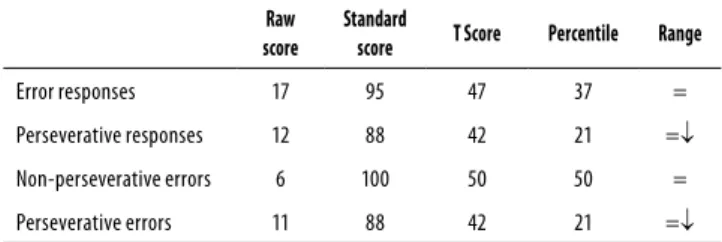
Table 1 contains results regarding lexibility and mental functions. It is observed that Mr. C. presented results in the lower middle range in for Perseverative Answers and Perse-verative Errors, and average performance for Error Answers and Non-Perseverative Errors. These results are related to the ability to formulate an objective, plan, execute plans directed at the objective in an efective way, with spontaneous self-monitoring spontaneous and with safety associated with frontal lobe functions.
table 1. Raw score, standard score, T score, percentile score and range for number of error responses, perseverative responses, non-perseverative errors and perseverative Errors – WCST
Raw score
Standard
score T Score Percentile Range
Error responses 17 95 47 37 =
Perseverative responses 12 88 42 21 =↓
Non-perseverative errors 6 100 50 50 =
Perseverative errors 11 88 42 21 =↓
Legend: = (middle); =↓ (lower middle).
DiSCuSSion
The spectrum of investigation into brain function and beha-vioral expression is part of a context that touches on history, psychology and neurology and, more recently, neurop-sychology.
The advances in psychiatry, psychology and in neuro-psychology, contributed a great deal for the justice system. When dealing with human beings, this knowledge is of great help for the lawmen to understand sometimes relevant de-tails, thus richly valuing the role of forensic sciences.These sciences are diferent in many ways, but in the forensic context it is central that they can work together, as the col-laboration among mental health professionals enhances the reliability of the documents, lending credibility to the justice decisions17.
For Brown18 by 2,020 depressive disorders are expected to
be the second highest cause of disease burden worldwide. Although cognitive deicits are the usual residual symp-toms19, they are mistakenly viewed as simple epiphenomena
of the disorder, once not always impair general function of depressed patients20.
This is illustrated in this case of the request for retirement reversal by Mr. C., who claimed to be able to return to his job despite the presence of mild depression. There were fa-vorable conditions for the use of neuropsychological assess-ment. The request iled by Mr. C. is ensured by the Brazilian social security law under article 46 of Decree 3.048/99 (Bra-zilian Law). If an individual judges that he is it for the job, he should request a new medical-forensic assessment. If re-covery for the labor activity is conirmed, retirement will be canceled.
The possibility of the depression leading to cognitive changes in many patients is undeniable. Several authors have reported on occurrence of cognitive failures linked to depression, even during periods in which the patients are euthymic15.
Therefore, in forensic contexts, a more functional assess-ment of the situation seems to have relevance for follow-up of the process. Mr. C. presented general intelligence func-tioning well above expected for his age and education, not showing laws or cognitive disability that could interfere in the quality of intellectual functioning, as well as in the inabil-ity to return to his work, result diferent from the literature indings14. The hypothesis can be raised that, compared with
his own results, the patient shows a better performance in his verbal functions than his execution functions, but with-out prejudice to these, difering from the literature in relation to the euthymic phase16.
Although studies show that patients with depression tend to have deicits when compared to normal individuals in regards to visual-spatial skills, short-term memory and at-tention, as well as mental lexibility and processing speed3,
such deicits were not perceived in the functioning of the patient described here.
In relation to the investigation of short-term memory (working memory), he presented results within the expect-ed range for his age/expect-education, diferent from the litera-ture4,13,14,16.
Monti C et al.
89
CaSe rePort
Mental lexibility, evaluated through the WCST, revealed that Mr. C. is able to change his mode of action in the envi-ronment through the response to his actions.
ConCluSion
The data suggested that despite the depression, Mr. C. showed no signiicant cognitive impairments that prevent him from resuming his professional duties. Thus, although psychiatric evaluation would consider him mildly depressed, the neuropsychological complementary evaluation ended up being relevant. Moreover, it highlights the critical impor-tance of a rigorous neuropsychological assessment in the forensic context, as it contributes value to diagnostic clari-ication of the functional aspects in various areas of psycho-pathology in terms of disability and potentialities. The possi-bility of having he working again is of economic and social importance to the country, as much as to himself.
That said, one thing that should be considered is the possibility of using neuroscientiic methods to assess men-tal impairments in such contexts. This case is “special” in the sense that the subject’s will was aligned with the public inte-rest; in opposed situations, one may consider that a subject could try to score as low as possible in the tests to provide evidences in favor of an absent disability. The use of neu-ral correlates of attention and preconscious responses to sensorial stimuli could overcome the limitations of present methods. Another alternative – which could and should be combined with this one – is the introduction of a new set of neuropsychological tools, constructed to hamper inferences about what is exactly being measured. We are working on the development of paradigms of the kind and will hopefully be able to release this new class of tests in the near future, for we believe the collaboration between psychiatrists and psychologists has the potential to increase both the credibi-lity and uticredibi-lity of forensic services to the courts.
inDiViDual ContriButionS
Camila monti – Contributed in study design, in data collec-tion, analysis of results, drafting of the article and approved its inal version.
Fabiana Sai – Contributed in study design, analysis of re-sults and preparation of the article and approved its inal version. Daniel martins de Barros – Contributed in study design, the preparation of the article and approved its inal version.
alvaro machado Dias – Contributed in designing the study, drafting of the article and approved its inal version.
Henrique teruo akiba – Contributed in designing the study, revising it and approved its inal version.
antonio de Pádua Seraim – Contributed in designing the study, revising it and approved its inal version.
reFerenCeS
1. Van Dongen CJ. Quality of life and self-esteem in working and nonworking persons with mental illness. Community Ment Health J. 1996;32(6):535-48.
2. Gierowski J. Complex expertise on the psychiatric health of a criminal. Psychiatr Pol. 2005;40(1):5-17.
3. Heilbrun K, Marczyk GR, DeMatteo D, Zillmer EA, Harris J, Jennings T. Principles of forensic mental health assessment implications for neuropsychological assessment in forensic con-texts. Assessment. 2006;10(4):329-43.
4. Hom J. Forensic Neuropsychology: are we there yet? Arch Clin Neuropsychol. 2003;18(8):827-45.
5. Verdejo A, Alcázar-Córcoles M, Gomez-Jarabo G, Pérez-García M. Guidelines for the scientiic and professional development of forensic neuropsychology. Rev Neurol. 2004;39(1):60-73.
6. Harvey PD. Cognitive impairments in major depression and bipolar disorders. Psychiatry (Edgmont). 2007;4(1):12-4.
7. Brasil. Ministério da Previdência Social. Base de Dados Históricos de Acidente do trabalho. Available at: <http://www3.dataprev.gov.br/aeat/>. Accessed on: 20 ago. 2014.
8. Wittchen HU, Jacobi F, Rehm J, Gustavsson A, Svensson M, Jönsson B, et al. The size and burden of mental disorders and other disorders of the brain in Europe 2010. Eur Neuropsy-chopharmacol. 2011;21(9):655-79.
9. Canizares JCL, Jacob Filho W. Senility risk factors upon retirement transition. Rev Bra Ge-riatr Gerontol. 2011;4(3):425-32.
10. Butterworth P, Gilla S, Rodgersb B, Ansteya KJ, Villamil E, Melzer D. Retirement and mental health: analysis of the Australian national survey of mental health and well-being. Soc Sci Med. 2006;62(5):1179-91.
11. Melzer D, Buxton J, Villamil E. Decline in Common Mental Disorder prevalence in men dur-ing the sixth decade of life. Evidence from the National Psychiatric Morbidity Survey. Soc Psychiatry Psychiatr Epidemiol. 2004;39(1):33-8.
12. Bonsang E, Adam S, Perelman S. Does retirement afect cognitive functioning? J Health Economics. 2012;31(3):490-501.
13. Fernández GS. Forensic neuropsychology: principal issues and applications. Rev Neurol. 2001;32(8):783-7.
14. Bhardwaj A, Wilkinson P, Srivastava C, Sharma M. Cognitive deicits in euthymic patients with recurrent depression. J Nerv Ment Dis. 2010;198(7):513-5.
15. Harvey PD. Mood symptoms, cognition, and everyday functioning: in major depression, bipolar disorder, and schizophrenia. Innov Clin Neurosci. 2011;8(10):14-8.
16. Malhi GS, Ivanovski B, Hadzi‐Pavlovic D, Mitchell PB, Vieta E, Sachdev P. Neuropsychologi-cal deicits and functional impairment in bipolar depression, hypomania and euthymia. Bipolar Disord. 2007;9(1‐2):114-25.
17. Seraim AP, Barros DM. Interdisciplinary evaluation: interface between psychiatry and fo-rensic psychology. J Bras Psiquiatr. 2014;63(1):86-7.
18. Brown P. Efective treatments for mental illness are not being used, WHO says. BMJ. 2001;323:769.
19. Pedrelli P, Baer L, Losifescu DV, Fava M. Relationship between residual symptoms of de-pression and self-reported cognitive impairment. CNS Spectr. 2010;15(1):46-51.
20. Austin MP, Mitchekk P, Goodwin GM. Cognitive deicits in depression possible implications for functional neuropathology. Br J Psychiatry. 2001;178:200-6.
Forensic neuropsychology: depression and working incapacity