563
Sarcomatoid Carcinoma with Osseous Differentiation Case Report
International Braz J Urol Vol. 32 (5): 563-565, September - October, 2006
Sarcomatoid Carcinoma with Osseous Differentiation in the
Bladder
Luis F. Arenas, Dercilio A. Fontes, Emilio M. Pereira, Flavio L. Hering
Portuguese Beneficent Hospital, Sao Paulo, SP, Brazil
ABSTRACT
Introduction: Bladder sarcomatoid carcinoma is a very rare variant of transitional cell carcinoma. With disputed
nomencla-ture, the tumor has been described previously under a variety of names such as sarcomatoid carcinoma, pseudosarcoma, malignant mixed mesodermal/Müllerian tumor, metaplastic carcinoma and spindle cell carcinoma. This malignancy repre-sents 0.3% of all bladder tumors and has an aggressive behavior yielding a poor prognosis despite radio and chemotherapy.
Case Report: An 81 y/o man presented with a transitional cell carcinoma and underwent a transurethral resection. Adjuvant
onco-BCG was introduced. After 9 months of follow-up, a local tumoral recurrence occurred and a new transurethral resection revealed sarcomatoid carcinoma with osseous elements. A radical cystoprostatectomy was then carried out.
Key words: bladder neoplasms; transitional cell; BCG vaccine; carcinosarcoma; cystectomy Int Braz J Urol. 2006; 32: 563-5
INTRODUCTION
Sarcomatoid carcinoma (SC) of the urinary bladder is a variant of Transitional Cell Carcinoma (TCC). SC contains sarcoma-like areas with either spindle or pleomorphic cells. The aggressive behav-ior of the tumor precludes radical therapy whenever possible, since adjuvant therapy seems to have little effect on the tumor natural history. We report on a case of SC with osseous element, with emphasis on the peculiar clinical and histopathological features.
CASE REPORT
A 81-year-old man presented with irritative lower urinary tract symptoms. Ultrasound showed thickening of the right posterior bladder wall and a
564
Sarcomatoid Carcinoma with Osseous Differentiation
chest X-ray showed multiple pulmonary nodules con-sistent with metastases and died 2 months after this diagnosis.
DISCUSSION
Bladder SC is an uncommon tumor. Fewer than 70 cases of primary heterologous carcinosarcoma of the urinary bladder have been reported. Terminol-ogy for this tumor has been varied and some authors define SC as a tumor that contains further mesenchy-mal elements in addition to spindle cells.
The presence of spindle cell in a urinary blad-der TCC warrants the designation of SC and some authors define carcinosarcoma as an admixture of malignant epithelial and malignant soft tissue ele-ments (1). Grossly these tumors tend to be polypoid and ulcerated. At histology, the cellular arrangement may have various patterns such as that of the fascicu-lar or storiform appearance of a leiomyosacoma or malignant fibrous histiocytoma. For a carcinosar-coma, the stem cell from which the epithelial and mesenchymal components are derived is expected to be more immature than the epithelial stem cell from which different components of sarcomatoid carci-noma originate, since in the latter, immunohistochemi-cal or ultrastructural epithelial characteristics are still detectable. However, comparative genomic hybrid-ization strongly suggests a monoclonal origin for all those tumors (2).
The tumor has poor prognosis. Records of Mayo Clinic (1936-1995) preclude that the tumors occur predominantly in male smokers, mean age of 72 years (1). Signs and symptoms include cloth he-maturia, dysuria, pollakiuria and urinary infection. At initial diagnosis, almost all patients have ad-vanced stage disease with muscularis mucosa in-volvement. Most patients died of local disease or of lymph node, lung, pleura, brain, liver and bone me-tastases.
Radical cystoprostatectomy should always be considered to bladder SC. Froehner et al. (3) reported a case of a metastatic SC remission of the bladder with cisplatin and gemcitabine, although, in the lit-erature, adjuvant radiotherapy or adjuvant chemo-therapy are apparently of no effect.
CONFLICT OF INTEREST
None declared.
REFERENCES
1. Lopez-Beltran A, Pacelli A, Rothenberg HJ, Wollan PC, Zincke H, Blute ML, et al.: Carcinosarcoma and sarcomatoid carcinoma of the bladder: clinicopatho-logical study of 41 cases. J Urol. 1998; 159: 1497-503.
2. Torenbeek R, Hermsen MA, Meijer GA, Baak JP, Meijer CJ: Analysis by comparative genomic
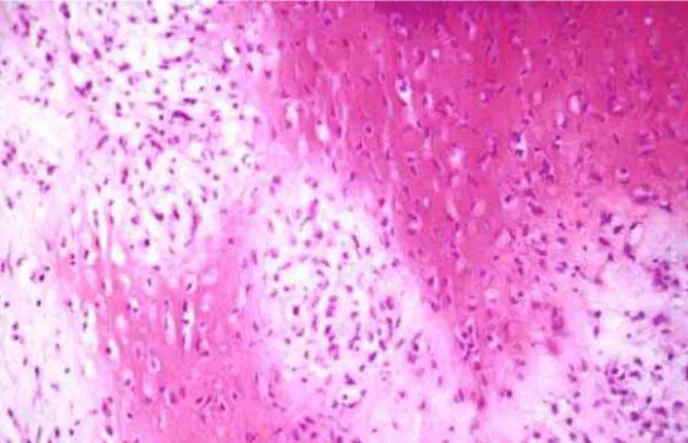
hybrid-Figure 1 – Area of high grade urothelial carcinoma of the uri-nary bladder (HE, X100).
565
Sarcomatoid Carcinoma with Osseous Differentiation
ization of epithelial and spindle cell components in sarcomatoid carcinoma and carcinosarcoma: histoge-netic aspects. J Pathol. 1999; 189: 338-43.
3. Froehner M, Gaertner HJ, Manseck A, Wirth MP: Du-rable complete remission of metastatic sarcomatoid carcinoma of the bladder with cisplatin and gemcitabine in an 80-year-old man. Urology. 2001; 58: 799.
Accepted after revision: February 10, 2006
Correspondence address:
Dr. Luis Fernando Arenas Urologisches Klinikum
Heinrich-Heine Univesität Düsseldorf Steinbrinkstrasse, 96a