Socioeconomic status is an independent predictor of biochemical
recurrence among patients with prostate cancer who undergo
radical prostatectomy
Victor Srougi, Alberto A. Antunes, Sabrina T, Reis, Marcos F. Dall´Oglio, Adriano J. Nesrallah,
Kátia R. M. Leite, Miguel Srougi
ABSTRACT
Division of Urology, University of Sao Paulo Medical School, Sao Paulo, Brazil
Purpose: Socioeconomic status (SES) may inluence cancer characteristics and behavior in several aspects. We analyzed
PCa characteristics and behavior among low income uninsured men, and compare them to high income patients with health insurance in a developing country.
Materials and Methods: A retrospective case-control study was performed on 934 patients with clinically localized PCa who underwent radical prostatectomy between March, 1999 and July, 2009. Patients were divided in two groups, accord-ing to their SES. In group 1 (n=380), all had low income, low educational levels and couldn’t afford medical insurance. In group 2 (n=554), all had higher income, higher education and had medical insurance.
Results: Patients from group 1 were older, had higher Gleason scores, higher rates of seminal vesicle and bladder neck involvement. The Kaplan Meier disease-free survival curve demonstrated that after a follow-up of four years, about 50% of uninsured patients had biochemical recurrence, versus 21% of insured patients (Log rank test: p < 0.001). A multivari-ate Cox regression analysis for the risk of disease recurrence demonstrmultivari-ated that only PSA levels, Gleason score, seminal
vesicle involvement and SES were statistically signiicant variables. Patients with a low SES presented 1.8 times the risk
of recurrence as compared to patients with a high SES.
Conclusions: Patients with low SES were older, presented more aggressive PCa characteristics and a high rate of disease recurrence. A low SES constituted an independent predictor for disease recurrence.
Key words: prostate-speciic antigen; prostate; neoplasms; socioeconomic factors; prostatectomy; survival Int Braz J Urol. 2011; 37: 507-513
INTRODUCTION
Prostate cancer (PCa) remains the most common non-cutaneous tumor in incidence and the second in mortality among North American men. It is estimated 192,280 new cases and 27,360 deaths in USA in 2009 (1). Being 13% of all cancers that affect men, it has a great socioeconomic
impor-tance. The widespread use of prostatic speciic anti -gen (PSA) in PCa screening during the last two de-cades has led to an increase in diagnosis of localized
disease, with mortality declining in synchrony with this risk migration (2).
Socioeconomic status (SES) may inluence
cancer characteristics and behavior in several
as-pects, mainly due to its inluences on lifestyle and
lung cancer and an increased incidence of distant-stage breast and PCa among low-income patients. Further data regarding PCa have reported higher mortality rates among patients in the low levels of SES (4). Likewise, recent studies have dem-onstrated that despite the widespread adoption of PSA screening, the diagnosis of low-risk PCa has not been increasing among men in lower socioeco-nomic status (6).
However, all studies to date regarding this issue were conducted in developed countries like
United States of America. The inluence of SES in
PCa characteristics and behavior in a developing country with high socioeconomic disparities and high levels of poverty had never been studied so far. Finding a different behavior in the extremes of socioeconomic layers could help to improve PCa screening and treatment among these patients.
The aim of the present study is to analyze PCa characteristics and behavior among low-in-come uninsured men and compare these data to high-income patients with health insurance, in a developing country.
MATERIALS AND METHODS
A retrospective case-control analysis was performed on 934 patients with clinically local-ized PCa who underwent radical prostatectomy be-tween March, 1999 and July, 2009. Patients were divided in two groups, according to their SES. In group 1 (study group) (n = 380), all had low-in-come, low educational levels and couldn’t afford medical insurance. These patients were treated in the Brazilian public health system (SUS). SUS is supposed to provide free and comprehensive PCa treatment for Brazilians without medical insur-ance, but due to high demand the service offered is suboptimal. In group 2 (control group) (n = 554), all had high-income, higher education and medical insurance. The latter were treated in private hos-pitals. Radical prostatectomy was performed by the same surgeons in both groups. Patients who had received any previous treatment for PCa were not considered for analysis. To avoid any selec-tion bias, patients from both groups were offered the option of undergoing radiotherapy. Adjuvant
radiation therapy was indicated to those cases with a gross positive surgical margin.
Data analyzed included patient age, serum total PSA, pathological stage, tumor grade, seminal vesicle involvement, urethral margin and bladder
neck margin status. The 2002 TNM classiication
was applied for pathological staging (7). Preopera-tive clinical staging was performed through digital rectal examination, pelvic computerized tomogra-phy (CT) and bone scintighratomogra-phy in most patients. Patients from both groups considered to have a low-risk disease (PSA < 10 ng/mL and Glason score < 7 and a T1c disease) did not undergo imaging studies. For analysis of pathology grade, we used the Glea-son score (8). All the characteristics were compared in order to determine differences between the two groups. Staff pathologists with expertise in geni-tourinary pathology examined all specimens and margins, according to previous published protocols. Obturatory lymphadenectomy was performed only in intermediate and high-risk patients.
For statistical analysis we used the pro-gram SPSS version 15.0. Comparison of variables between the two groups, were performed through the Pearson Chi-square and Fisher’s exact tests. For analysis of disease free survival, we constructed a Kaplan-Meier actuarial curve. Biochemical
recur-rence was deined as a PSA of 0.4 ng/mL or greater
after radical prostatectomy. To determine the in-dependent variables related to the risk of disease recurrence, we used a Cox regression model. For
statistical analysis we considered a 5% signiicance
level to reject the hypothesis of a casual correlation (p < 0.05).
RESULTS
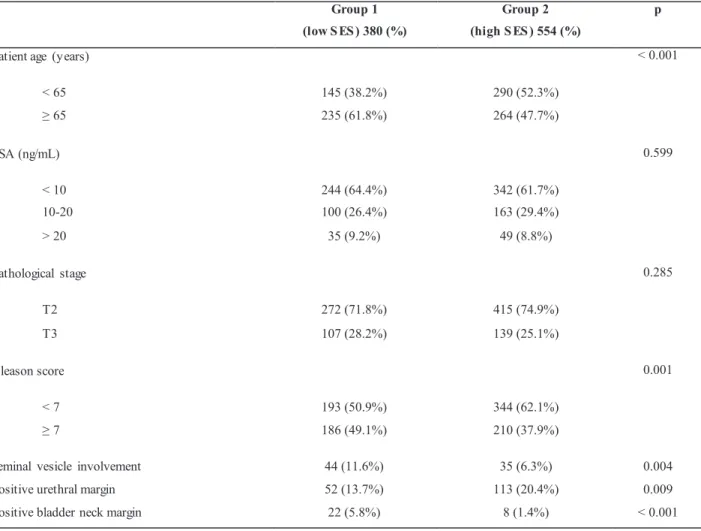
Table 1 - Clinical and pathological characteristics of patients.
6.3% of patients from group 1 and 2 respectively (p =
0.004). We didn’t ind signiicant difference regarding
PSA levels and pathological stage between the two groups, with the majority of patients from both groups
presenting PSA < 10.0 ng/mL and organ-conined dis -ease (T2). Positive urethral margins were more com-mon acom-mong patients from group 2 and positive blad-der neck margins were more common among patients
from group 1. In the irst case, we believe this fact was
rather due to efforts to spare external sphincter than to an advanced disease status. Thus, in most cases they were considered false positive margins. Characteris-tics of the two groups are described in Table-1.
The Kaplan Meier disease-free survival curve demonstrated that at four years, while 50% of patients from group 1 had biochemical recurrence, versus 21% of patients from group 2 (p < 0.001) (Fig-ure-1). A multivariate Cox regression analysis for the
risk of disease recurrence considering all the analyzed variables demonstrated that only serum PSA levels, Gleason score, seminal vesicle status and SES were independent variables. Patients in a low SES present-ed 1.8 times higher risk of recurrence as comparpresent-ed to patients belonging to high SES (Table-2).
DISCUSSION
In the present study, we demonstrated that a low SES is associated with more aggressive pathological characteristics of PCa. Patients in the low SES group were older, presented higher Glea-son scores and higher rates of seminal vesicle and bladder neck involvement. Biochemical recurrence rates were higher among low SES group. In the Cox regression model for the risk of recurrence consid-ering all the analyzed variables, only PSA levels,
–
Group 1 (low SES)380 (%)
Group 2 (high SES)554 (%)
p
Patient age (years) < 0.001
< 65
≥ 65
145 (38.2%)
235 (61.8%)
290 (52.3%)
264 (47.7%)
PSA (ng/mL) 0.599
< 10 10-20
> 20
244 (64.4%) 100 (26.4%)
35 (9.2%)
342 (61.7%) 163 (29.4%)
49 (8.8%)
Pathological stage 0.285
T2
T3
272 (71.8%)
107 (28.2%)
415 (74.9%)
139 (25.1%)
Gleason score 0.001
< 7
≥ 7
193 (50.9%)
186 (49.1%)
344 (62.1%)
210 (37.9%)
Seminal vesicle involvement 44 (11.6%) 35 (6.3%) 0.004
Positive urethral margin 52 (13.7%) 113 (20.4%) 0.009
Gleason score, seminal vesicle involvement and the SES were independent predictors. A low SES was associated with a risk of biochemical recurrence 1.8 times greater when compared to patients from the high SES group.
There are several studies correlating SES with cancer incidence and deaths, including all sites. In accordance to our results, Miller et al. (6), per-formed a retrospective cohort study of 570 disad-vantaged men with diagnosis of PCa in California. They showed that 51% of the enrollees had a PSA greater than 10ng/mL, 50% had a Gleason score of 7 or greater and 43% had a T2 or greater clinical stage. Metastasis at the diagnosis was present in 19% of the patients. The proportion of men with low-risk tumors was 24% and interestingly, this rate didn’t increase over time. A limitation of this study was the lack of a control group. Cheng et al. (4), showed that a high SES is associated with higher incidence, but lower PCa mortality rate. It is known that SES is linked with several environmental dependent fac-tors, including education, health care access and in-formation. All together these factors may lead to lack in early detection and delay between PCa diagnosis and treatment among low SES patients.
The present study was conducted in Brazil, a country where PCa is also the highest prevalent cancer with socioeconomic disparities (9). The
Bra-zilian health care system has two categories: private and public system. High-income population mainly uses the private system, which provides adequate screening and treatment against PCa for most pa-tients. PSA screening is not formally performed in Brazil, but most patients from higher SES group choose to have it annually. This fact is not usually observed among patients with a low SES, which may lead to a delay in diagnosis. Lower SES patients use the public health care system, which due to higher demand, lacks in continuous screening, early diag-nosis and may have delay in treatment. Despite these characteristics, in the present series serum PSA lev-els and pathological stages were similar between the groups. Additionally, it’s important to note that in the present series median time to treatment was only slightly longer for patients from the low SES group (three months) as compared to the high SES group (1.5 months). Considering a tumor with such a long time to progression, we don’t believe this small dif-ference could be the reason to explain such a worse outcome among patients from the low SES group. It’s possible that a longer time to diagnosis among
these patients have inluenced outcomes. However, since we received patients with conirmed PCa diag -nosis we could not estimate the time.
Additionally, the low SES group is less ex-posed to health care information and is unlikely to
undergo screening tests. This might be the reason why patients from the high SES group are usually diagnosed at an earlier age as we found in this series. All factors may lead to a more advanced disease at time of diagnosis, even among the clinically local-ized disease group.
It’s important to note that mean follow-up was not equivalent between the groups. Despite lon-ger follow up, the high SES group had better disease-free survival than the low SES group. Explanations for these observations are uncertain but further stud-ies controlling these variables should be made in or-der to conclude if the worst prognosis among patients
from low SES group is due to health care deiciency
or due to other factor. Another valuable study would be comparison of PCa stage at the moment of diag-nosis, among extremes of SES, with the intention to analyze the disparities of the screening tests applica-tion between these groups. A possibility that could explain our results is that environmental differences could explain the more advanced Gleason scores and greater rates of seminal vesicle involvement among patients from the low SES group.
Margin status was signiicantly different be -tween the two groups. While positive urethral mar-gins were more common among patients from group 2, positive bladder neck margins were more common among patients from group 1. It’s well described that margin status is an independent predictor of PSA re-currence and secondary cancer treatment in patients who underwent radical prostatectomy (10). How-ever, the location of positive surgical margins after
surgery may signiicantly affect disease progression.
Obek et al. (11), showed that a positive margin in-volving the bladder neck (which was more common among patients from low SES group) of the speci-men carried a higher risk of progression. Despite
these data, on multivariate analysis, margin status
wasn’t a signiicant predictor of disease recurrence.
Mean PSA levels were statistically simi-lar between the two groups as well as pathological stage. Previously Kato et al. (12) related that PSA level is proportional to prostate tumor volume, and since all cases selected had localized disease, PSA tend to be in the same range in both groups. Staging was a pre-selection variable, justifying the similari-ties between the two groups.
Some limitations of the present study must be commented. We didn’t have available data re-garding the racial/ethnic distribution of both groups. It’s well known that there is a higher PCa incidence and mortality among African Americans (13,14).
However, it remains poorly deined the reasons to
explain this phenomenon and to what extent racial/ ethnic differences in PCa result from differences in SES. Tewari et al. (15), showed that
socioeconom-ic factors are sufsocioeconom-icient to explain the disparity in
survival between white and black patients. While
in univariate analysis, black patients had a signii
-cantly increased cancer-speciic and overall mortal -ity, after adjusting for insurance status and income on multivariate analysis, the two groups revealed
no signiicant differences. It’s also important to em -phasize, that Brazil has a great variety of races and for this reason we believe that this variable could
not have inluenced the results. Another limitation is
that we analyzed only patients with clinically local-ized disease, and thus, we couldn’t compare those cases with locally advanced and metastatic disease between the two groups. Finally, due to the relative short follow-up period, we were not able to deter-mine whether other important measures of outcome (metastases-free survival or overall survival) were different amongst the two groups.
Table 2 - Postoperative Result Assessment Criteria.
Variable HR 95% CI p
SES 1.8 1.3 to 2.4 < 0.001
PSA 10-20 x PSA < 10 1.5 1.1 to 2.0 0.004
PSA > 20 x PSA < 10 2.4 1.7 to 3.6 < 0.001
Gleason score 1.3 1.2 to 1.5 < 0.001
American Indians and Alaska Natives. Cancer. 2007; 110: 2119-52.
3. Adler NE, Newman K: Socioeconomic disparities in health: pathways and policies. Health Aff (Mill-wood). 2002; 21: 60-76.
4. Cheng I, Witte JS, McClure LA, Shema SJ, Cock-burn MG, John EM, et al.: Socioeconomic status and prostate cancer incidence and mortality rates among the diverse population of California. Cancer Causes Control. 2009; 20: 1431-40.
5. Clegg LX, Reichman ME, Miller BA, Hankey BF, Singh GK, Lin YD, et al.: Impact of socioeconomic status on cancer incidence and stage at diagnosis:
selected indings from the surveillance, epidemiol -ogy, and end results: National Longitudinal Mortal-ity Study. Cancer Causes Control. 2009; 20: 417-35.
6. Miller DC, Litwin MS, Bergman J, Stepanian S, Connor SE, Kwan L, et al.: Prostate cancer severity among low income, uninsured men. J Urol. 2009; 181: 579-83; discussion 583-4.
7. Greene FL, Page DL, Fleming ID, et al.: AJCC Can-cer Staging Manual, 6th edn. New York: Springer-Verlag, 2002; pp. 3-15.
8. Gleason DF: Histologic grading and clinical stag-ing of prostatic carcinoma. In: Eble JN, Sauter G, Epstein JI, Sesterhenn IA (ed.), Pathology and Ge-netics of Tumours of the Urinary System and Male Genital Organs. Lyon, IARC Press. 2004: pp. 167-214.
9. Brasil: Ministério do Planejamento, Orçamento e
Gestão. Instituto Brasileiro de Geograia e Estatísti -ca [internet]. (cited april. 2009). Available from: http://www.ibge.gov.br.
10. Grossfeld GD, Chang JJ, Broering JM, Miller DP, Yu J, Flanders SC, et al.: Impact of positive surgical margins on prostate cancer recurrence and the use of secondary cancer treatment: data from the CaP-SURE database. J Urol. 2000; 163: 1171-7.
11. Obek C, Sadek S, Lai S, Civantos F, Rubinowicz D, Soloway MS: Positive surgical margins with
radi-cal retropubic prostatectomy: anatomic site-speciic
pathologic analysis and impact on prognosis. Urol-ogy. 1999; 54: 682-8.
12. Kato RB, Srougi V, Salvadori FA, Ayres PP, Leite KM, Srougi M: Pretreatment tumor volume esti-mation based on total serum psa in patients with localized prostate cancer. Clinics (Sao Paulo). 2008; 63: 759-62.
The present study is unique because it provides an insight concerning the epidemiology of PCa among Brazilian men in the extremes of socioeconomic conditions. As a developing coun-try, Brazil has great socioeconomic disparities, and
this is known to inluence many factors that are
related to cancer development and behavior, such as dietary habits, environmental exposures to risk factors, as well as access and utilization of health care services.
It’s well known that improving diagnosis tests and surgical methods have extreme impor-tance for public health management. However, only improving screening methods and training
surgeons may not be suficient to solve these prob -lems if the government does not provide equal health care access to different socioeconomic lay-ers of the population. In this way, the present study results could support the need to plan new strate-gies in PCa campaigns.
CONCLUSIONS
In a developing country, patients with PCa and a low SES were older, presented more ag-gressive disease characteristics and a high rate of biochemical recurrence. A low SES constituted an independent predictor for disease recurrence. Anal-ysis of larger series with more variables must be
performed to conirm theses results.
CONFLICT OF INTEREST
None declared.
REFERENCES
1. Jemal A, Siegel R, Ward E, Hao Y, Xu J, Thun MJ: Cancer statistics, 2009. CA Cancer J Clin. 2009; 59: 225-49.
13. Godley PA, Schenck AP, Amamoo MA, Schoen-bach VJ, Peacock S, Manning M, et al.: Racial dif-ferences in mortality among Medicare recipients after treatment for localized prostate cancer. J Natl Cancer Inst. 2003; 95: 1702-10.
14. Gilligan T: Social disparities and prostate cancer: mapping the gaps in our knowledge. Cancer Causes Control. 2005; 16: 45-53.
15. Tewari AK, Gold HT, Demers RY, Johnson CC, Ya-dav R, Wagner EH, et al.: Effect of socioeconomic factors on long-term mortality in men with clini-cally localized prostate cancer. Urology. 2009; 73: 624-30. Erratum in: Urology. 2009; 74: 239. Yood, Marianne Ulcickas [added].
_____________________ Submitted for publication: January 05, 2011
____________________ Accepted after revision:
May 05, 2011 ______________________
Correspondence address:
Dr. Alberto A. Antunes
Rua Peixoto Gomide, 502/ 174-B Sao Paulo, SP, 01409-000, Brazil Fax: + 55 11 3255-6372