ABSTRACT
Aims: Tamsulosin, a superselective subtype alpha 1a and 1d blocker, is used for the treatment of male Lower Urinary Tract Symptoms (LUTS) commonly caused by Benign Prostatic Hyperplasia (BPH). This prospective study evaluated the eficacy and safety of a new formulation, Tamsulosin OCAS® (Oral Controlled Absorption System), for LUTS as -sociated with BPH in Thai patients.
Materials and Methods: Fifty one patients over 40 years old with complaints of LUTS associated with BPH were re-cruited. Patients received an 8 week course of once daily 0.4 mg tamsulosin OCAS®, and were followed up at 2 (visit 3), 4 (visit 4) and 8 (visit 5) weeks post-treatment. At each visit, patients were assessed using the International Prostate Symptom Score (IPSS), Nocturia Quality of Life (N-QoL) Questionnaire, QoL Assessment Index (IPSS-QoL), and International Index of Erectile Function (IIEF). The primary outcome was eficacy of Tamsulosin. The secondary out -comes included change in the mean number of nocturia episodes, hours of undisturbed sleep (HUS) and urolowmetry measurements.
Results: Total IPSS signiicantly decreased at week 8 from baseline (from 19.52 to 6.08; p < 0.001). Similarly, the void -ing and storage subscores of IPSS also continued to improve signiicantly start-ing from the second and third visits, respectively (p < 0.001 versus baseline). The IPSS-QoL and N-QoL scores signiicantly improved at visit 3 through end of study. In addition, we observed signiicant nocturia and HUS improvement in their last clinic visit. Urolowmetry pa -rameters, Qmax and Qave, improved signiicantly at 3rd clinic visit . Three patients experienced mild dizziness.
Conclusion: Tamsulosin OCAS® treatment led to signiicant improvements in LUTS, HUS and QoL in Thai patients with bladder outlet obstruction from BPH with few side effects.
Key words: prostatic hyperplasia; bladder outlet obstruction; adrenergic alpha antagonists; prostate; outcome Int Braz J Urol. 2011; 37: 468-476
INTRODUCTION
Benign Prostatic Hyperplasia (BPH) is a common cause of male Lower Urinary Tract Symp-toms (LUTS). LUTS consists of voiding and storage symptoms, with the latter having a greater effect on quality of life. Nocturia, deined as important com -plaint patients interrupt their sleep to void (1).
Alpha blockers are the irst-line of medical treatment for BPH. The advantages of the newer al-pha blockers for BPH include quick improvement of symptoms and quality of life, and less side effects. Tamsulosin is a superselective subtype alpha 1a and 1d blocker used for the treatment of LUTS in BPH. Tamsulosin OCAS® (Oral Controlled Absorption System) is a new formulation of Tamsulosin which
The eficacy and safety of oral Tamsulosin controlled absorption
system (OCAS) for the treatment of lower urinary tract symptoms
due to bladder outlet obstruction associated with benign prostatic
hyperplasia: An open-label preliminary study
Bannakij Lojanapiwat, Sompol Permpongkosol
has consistent drug release independent of pH. This 24-hour sustained eficacy of Tamsulosin OCAS® leads to improvement in LUTS from BPH, such as voiding symptoms and nocturia, with less side effects (2-5). Asian patients have different char-acteristic from the western patients, especially, in regards to body mass index (BMI) that may affect the result of the treatment. We evaluated the efi -cacy and safety of tamsulosin OCAS® 0.4 mg in 51 Thai patients with LUTS associated with BPH over 8 weeks of treatment.
MATERIALS AND METHODS
The study was approved by the ethics committee of the Faculty of Medicine, Chiang Mai University and Ramathibodi hospital. Patients gave written informed consent before participating in the study.
Patients
Fifty-one male patients over 40 years old with complaints of LUTS associated with BPH were recruited from the outpatient departments of the study sites. LUTS associated with BPH were diagnosed by digital rectal examination or ultrasound. Prostate-speciic antigen (PSA) levels were within the normal range (< 4 ng/dL). All patients had a total Interna-tional Prostate Symptom Score (IPSS) greater than or equal to 13, and got up interrupting sleep to void at least 2 times per night during the week prior to recruitment. The maximum urinary low rate (Qmax)
was between 4 and 15 mL/s with the voided urine volume greater than 120 mL.
The exclusion criteria included (1) previous prostatectomy; (2) severe hepatic dysfunction; (3) severe renal dysfunction; (4) severe cardiovascular disorder; (5) orthostatic hypotension; (6) senile de-mentia; (7) other conditions which can cause void-ing dysfunction such as neurogenic bladder, bladder or urethral stone, recurrent urinary tract infection, bladder cancer, prostate cancer, urethral stricture and large bladder diverticulum; (8) history of hypersen-sitivity or allergy to tamsulosin; (9) symptomatic urinary tract infection in the preceding month (10) nocturnal polyuria; (11) use of 5-alpha-reductase
in-hibitors within the preceding 3 months; (12) use of diuretics and sleeping pills; (13) use of other pharma-cologic treatments for BPH, such as alpha blockers or plant extracts in the preceding month; (14) use of medications, such as alpha agonists, cholinergic or anticholinergic drugs, which may inluence the phar -macodynamic effects of Tamsulosin.
Study Design
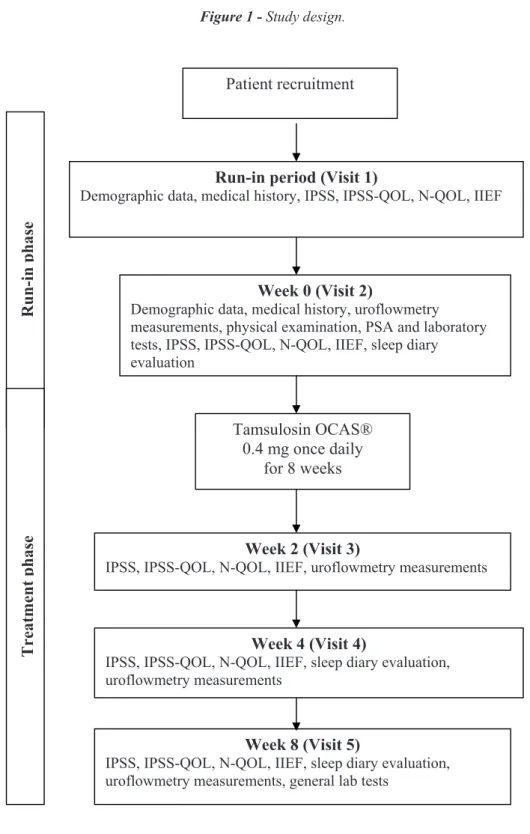
Figure-1 shows the design of the study. Visit 1 (week -2) evaluate all patients for eligibility for the study. Demographic data, medical history, con-comitant medications and vital signs were recorded. In addition, the IPSS, IPSS-Quality of life (QoL), Nocturia-QoL (N-QoL), International Index of Erec-tile Function (IIEF), sleep diary measurements in-cluding urolowmetry, and laboratory measures were also assessed before the start of treatment. Visit 2 (week 0) was the start of drug treatment. Patients who satisied the inclusion criteria were given 0.4 mg once daily doses of Tamsulosin OCAS® (Harnal OCAS®, Astellas Pharma Inc, Japan) for a period of 8 weeks. Patients were followed up at 2 (visit 3), 4 (visit 4) and 8 (visit 5) weeks after treatment. At each clinic visit, patients were assessed for concomi-tant medications, IPSS, IPSS-QoL, N-QoL, IIEF and urolowmetry parameters.
Clinical Evaluation
During the evaluation period, the medical history (underlying diseases), height, weight and concomitant medications were recorded. Physical ex-amination including vital signs, general exex-amination and digital rectal examination were done. PSA and general laboratory tests, including Complete Blood Counts (CBC), liver function tests, kidney function tests, electrolyte, blood sugar, uric acid, lactate dehy-drogenase (LDH) and Gamma-GTP, were conducted. During each visit, the blood pressure and heart rate were obtained while patients were seated. Laboratory tests were repeated at the last visit (week 8).
Symptom assessment IPSS questionnaires
Figure 1 - Study design.
IPSS, International Prostate Symptom Score; N-QOL, Nocturia Quality of Life, IIEF, International Index of Erectile Function; OCAS, oral controlled absorption system; PSA, Prostate-speciic antigen
Week 0 (Visit 2)
Demographic data, medical history, uroflowmetry measurements, physical examination, PSA and laboratory tests, IPSS, IPSS-QOL, N-QOL, IIEF, sleep diary evaluation
Tamsulosin OCAS® 0.4 mg once daily
for 8 weeks
Run-in period (Visit 1)
Demographic data, medical history, IPSS, IPSS-QOL, N-QOL, IIEF
R
u
n
-i
n
p
h
a
se
Tr
eatme
n
t
p
h
as
e
Week 2 (Visit 3)
IPSS, IPSS-QOL, N-QOL, IIEF, uroflowmetry measurements
Week 4 (Visit 4)
IPSS, IPSS-QOL, N-QOL, IIEF, sleep diary evaluation, uroflowmetry measurements
Week 8 (Visit 5)
IPSS, IPSS-QOL, N-QOL, IIEF, sleep diary evaluation, uroflowmetry measurements, general lab tests
symptoms. The answers were graded on a ive-point rating scale. The maximum values for total IPSS, voiding and storage scores are 35, 20 and 15, respec-tively. A high score indicates worse condition.
Sleep Diary (3-day frequency/volume chart)
Patients received full instructions on how to complete the sleep diary and counseled on the impor-tance of completing the diaries during their sleeping period for 3 consecutive working days (Monday to Thursday) in the week prior to the next clinic visit to provide accurate information.
Frequency, volume of each void and times going to bed and getting up were recorded in the sleep diary by the patient. Measuring jugs were used to determine the urine volumes of each void.
Sleep diaries were dispensed to patients at visits 1 (run-in), 3 (week 2), and 4 (week 4) and were evaluated at visits 2 (week 0), 4 (week 4) and 5 (week 8).
The sleep diary indicated the number of nocturia episodes and Hours of Undisturbed Sleep (HUS).
Quality of life assessment IPSS-QoL
Patients answered the disease-speciic QoL question contained within the IPSS questionnaire, “If you were to spend the rest of your life with your urinary condition just the way it is now, how would you feel about that?”. The score for this component ranges from 0 to 6. A high score indicates a worse condition.
N-QoL
Patients also answered the self-administered 13-item N-QoL questionnaire consisting of three do-mains: sleep/energy (7 questionnaires, score range from 0-28), bother/concern (5 questionnaires, score range from 0-20), and global QoL questionnaire con-sisting of “Overall, I would like to rate my quality of life to be?; the answer range of very good, good, fair, poor and very poor which score range from 0-4. All questionnaires are deal with daytime energy, wor-ry, productivity, sleep, and vitality. The total score ranged from 0 (poorest QoL) to 52 (best QoL).
Sexual function assessment IIEF
Patients completed the IIEF questionnaire which consisted of 5 items based on the ability to identify the presence or absence of erectile dys-function (ED) over the previous 6 months. The IIEF score is the sum of questions 1 to 5. ED was classiied into ive severity levels, ranging from none (22-25), through severe (5-7).
Urolowmetry
Urolowmetric parameters, such as Qmax,
average low rate (Qave), void volume and void time
were measured at visits 2 (week 0), 3 (week 2), 4 (week 4) and 5 (week 8). For these parameters, measurements at visit 2 were considered baseline.
Evaluation of primary and secondary outcomes
The primary outcome was eficacy of Tam -sulosin OCAS® 0.4 mg. Eficacy was evaluated by changes in the mean values for total IPSS and IPSS subscores, IPSS-QoL, N-QoL and IIEF. Success-ful treatment was deined as a signiicant change in the mean eficacy parameters of the last clinic visit (visit 5) from baseline values (visit 1). The onset of successful treatment was the comparison between the IPSS scores (total and subscore) at baseline and each clinic follow up visit.
The secondary outcome measures were change in the mean number of nocturia episodes, HUS and urolowmetric parameters.
In addition, the number of patients with a clinically signiicant response to Tamsulosin was determined, deined as those patients with a ≥ 25% decrease in total IPSS score, a ≥ 1 point decrease in IPSS-QoL score, or ≥ 20% increase in Qmax over
baseline.
Assessment of Safety
Statistical analysis
Statistical analysis was performed using SPSS 17.0 software. Analysis of variance (ANOVA) was used to assess the change in the mean of eficacy parameters and adverse events variations of each visit from the mean at baseline. For all comparisons, p < 0.05 was considered statistically signiicant.
RESULTS
Fifty-one patients were recruited into the study. Two patients did not complete the study due to development of urinary tract infection (one case) and loss of follow-up (one case). Thus, 49 patients were evaluated for treatment eficacy while all 51 patients enrolled were assessed for adverse reactions. The mean age of all patients was 63.71 years (range 48-80 years). Thirty-three patients (67.35%) had a body mass index (BMI) between 18.5-25 kg/m2 and 15 patients
(30.61%) had a BMI > 25 kg/m2. The average systolic
blood pressure and diastolic blood pressure at baseline were 135.97 ± 18.33 and 81.04 ± 10.12 mmHg, re-spectively. The most common underlying disease was hypertension, which was found in 13 patients (26%). Other underlying diseases included dyslipidaemia (8%) and diabetes (6%). Baseline characteristics of patients for total IPSS and IPSS subscores, IPSS-QoL, N-QoL and IIEF are shown in Table-1; number of noc-turia episodes and HUS are shown in Table-2; and uro-lowmetric parameters are shown in Table-3.
Primary outcomes
The results for the primary outcome mea-sures are presented in Table-1. The total IPSS score signiicantly decreased at week 8 compared to base -line (from 19.52 to 6.08; p < 0.001). A 25% improve-ment in total IPSS versus baseline was observed in 33 (67.35%), 48 (97.96%) and 49 (100%) patients at visits 3 (week 2), 4 (week 4) and 5 (week 8), respec-tively. The IPSS subscores for both voiding and stor-age symptoms also decreased signiicantly by week 8 (p < 0.001 versus baseline) (Figure-2). The onset of eficacy was demonstrated at 2 weeks following treatment. The IPSS-QoL score was signiicantly im -proved at clinic visit 3 (2 weeks post-treatment) and throughout the end of the study (Figure-3). At least a 1-point decrease in IPSS-QoL versus baseline oc-curred in 39 (79.60%), 46 (93.88%) and 48 (97.96%) patients at visits 3 (week 2), 4 (week 4) and 5 (week 8), respectively. The N-QoL scores (items (1-13)) sig-niicantly improved at visit 3 and throughout the end of the study compared with baseline (Figure-4). The IIEF score did not change throughout the study.
Secondary outcomes
The mean nocturia episodes improved sig-niicantly from baseline to week 4 (p < 0.001) and week 8 (p < 0.001). Signiicant improvements were also found in the HUS by week 8 (p = 0.01) (Table-2). Among the urolowmetry parameters, Qmax and Qave
improved signiicantly at clinic visit 3 (Table-3). At least a 20% improvement in Qmax versus baseline
Table 1 - Primary eficacy outcomes at baseline and after 2, 4 and 8 weeks of treatment.
n=49
Data are presented as mean ± SD
* p < 0.05 signiicant, Repeated measurement analysis of variance (ANOVA)
Variable Baseline Visit 3 (Week 2) Visit 4 (Week 4) Visit 5 (Week 8)
Total IPSS score 19.52 ± 4.92 12.58 ± 6.07 (p < 0.001)* 7.96 ± 4.47 (p < 0.001)* 6.08 ± 3.96 (p < 0.001)*
- Voiding score 12.38 ± 4.36 8.20 ± 5.02 (p < 0.001)* 4.79 ± 3.43 (p < 0.001)* 3.36 ± 3.06 (p < 0.001)*
- Storage score 7.14 ± 2.59 4.43 ± 2.60 (p < 0.001)* 3.28 ± 1.18 (p < 0.001)* 2.87 ± 1.95 (p < 0.001)*
IPSS-QOL 5.07 ± 0.39 2.56 ± 1.63 (p < 0.001)* 1.51 ± 1.07 (p < 0.001)* 1.20 ± 0.82 (p < 0.001)*
NQOL (1-13) 32.10 ± 9.17 35.67 ± 8.29 (p < 0.004)* 39.31 ± 5.51 (p < 0.001)* 42.89 ± 5.25 (p < 0.001)*
was observed in 20 (40.82%), 22 (44.90%) and 26 (53.06%) patients at visits 3 (week 2), 4 (week 4) and 5 (week 8), respectively.
Safety
Blood pressure, heart rate and blood chem-istry results at the last visit were not signiicantly dif -ferent from baseline values. Three patients (5.88%) out of the total 51 experienced mild dizziness, but all patients tolerated the medication during the treatment period.
DISCUSSION
The alpha adrenergic receptor antagonists have evolved from non-selective antagonists to short acting selective and then long acting selective and subtype selective antagonists. The alpha 1a, and to a lesser extent alpha 1d, receptors predominate in uro-logic tissues, whereas the alpha 1b receptors are found elsewhere, such as the vascular tissues (6,7). The ideal
alpha receptor antagonist should be uroselective with minimal side effects. Tamsulosin shows ten times higher afinity for alpha 1a than alpha 1b receptors (7-9).
Tamsulosin is a superselective subtype alpha 1a and 1d blocker for the treatment of LUTS associ-ated with BPH. The standard dose of tamsulosin for BPH is 0.4 mg (8) but a lower dose (0.2 mg) is also used in Asia (10,11). The conventional Tamsulosin formulation has an absorption proile that is dependent on food intake, and is associated with low levels of in-testinal absorption. The serum level is dependent on food and gastrointestinal transit time, resulting in 70% higher serum levels when taken on an empty stomach compared to after a meal (12). The new formulation, Tamsulosin OCAS®, which contains 0.4 mg active Tamsulosin hydrochloride, was designed to improve drug delivery compared to the previous formulations. The OCAS® formulation is a gel matrix comprising gel-forming and gel-enhancing agents (2,3). Follow-ing administration, the Tamsulosin OCAS® tablet Table 2 - Number of nocturia episodes and hours of undisturbed sleep (HUS) at baseline and after 4 and 8 weeks of treatment.
Table 3 - Urolowmetry outcomes at baseline and after 2, 4 and 8 weeks of treatment. n = 49
Data are presented as mean ± SD
* p < 0.05 signiicant, Repeated measures analysis of variance (ANOVA)
n = 49
Data are presented as mean±SD
* p < 0.05 signiicant, Repeated measures analysis of variance (ANOVA)
Variable Baseline Visit 3 (Week 2) Visit 4 (Week 4) Visit 5 (Week 8)
Qmax(mL/s) 11.04 ± 4.07 13.16 ± 6.17 (p = 0.004)* 13.03 ± 5.4 (p = 0.003)* 13.70 ± 5.87 (p < 0.001)* Qave(mL/s) 5.51 ± 2.42 6.46 ± 2.97 (p = 0.017)* 7.56 ± 5.52 (p = 0.002)* 7.05 ± 3.61 (p<0.001)*
Void urine
volume (mL)
239.40 ± 118.54 244.85 ± 130.72 253.89 ±1 20.37 280.00 ± 131.17
Void time (sec) 54.45 ± 27.73 47.36 ± 25.05 49.25 ± 28.69 46.77 ± 19.68
Time to Qmax
(sec)
10.62 ± 8.65 14.35 ± 10.96 13.95 ± 13.05 12.45 ± 8.16
Variable Baseline Visit 4 (Week 4) Visit 5 (Week 8)
Nocturia episode 3.12 ± 0.40 1.90 ± 0.83 (p < 0.001)* 1.72 ± 0.88 (p < 0.001)*
Figure 2 - Mean IPSS scores before and after treatment.
Figure 3 - Improvement in IPSS-QoL.
Figure 4 -Improvement in N-QOL (Items 1-13). IPSS, International Prostate Symptom Score
IPSS-QOL, International Prostate Symptom Score Quality Of Life
undergoes rapid gelation and complete hydration. The tablet carries water throughout the entire gas-trointestinal tract, including the colon, where water content is lowest, resulting in consistent drug re-lease independent of pH and gastrointestinal motil-ity (2,3). Thus, Tamsulosin OCAS® has a superior pharmacokinetic proile than conventional Tamsu -losin, allowing it to deliver consistent drug levels over 24 hours with lower maximum plasma con-centration (Cmax), irrespective of food intake. The 24-hour sustained eficacy extending over a longer period of time, even at night, leads to improvements in LUTS/BPH, such as nocturia with fewer side ef-fects. This effect can be explained by the speciic mechanism of alpha blockers (13).
Nocturia is one of the most bothersome LUTS in BPH, and is the most common cause of sleep disturbance in older men. The prevalence of nocturia as a cause of disturbed sleep increases with age. Nocturia and disturbed sleep are associated with a range of serious co-morbid conditions, increased risk for accidents at home and on the road, reduced daytime alertness and activity, reduced sense of well-being, depression, mood change, and increased dis-ease susceptibility and mortality (11).
Most of the restorative sleep occurs in the irst half of the night. Therefore, it is important to avoid awakening during the irst few hours of sleep. For good quality sleep, the HUS should be at least 3 to 4 hours. Increasing the HUS leads to improved QoL. Tamsulosin OCAS® represented a statistically signiicant 57% improvement in noc -turia control (14).
Alpha blockers not only inhibit alpha 1-ad-renergic receptors in the prostate and bladder neck, but also have an effect on the cardiovascular system. The randomized crossover study concluded that Tam-sulosin OCAS® had a lower incidence of positive stress test than conventional Tamsulosin (15).
Our study demonstrated that tamsulosin OCAS® 0.4 mg improves the IPSS total and sub-scores, nocturia, HUS and QoL in BPH patients. We use N-QoL questionnaires for evaluation of QoL, it is the self- administered questionnaire that has been proven to correlate with the energy/ vitality domains of the SF -36 questionnaire and with the sleep qual-ity of Pittsburgh Sleep Qualqual-ity Index (16). Total IPSS
signiicantly decreased at week 8 from baseline (from 19.52 to 6.08; p < 0.001). Similarly, the voiding and storage scores of IPSS also continued to improve sig-niicantly starting from the second and third visits, respectively (p < 0.001 versus baseline). The IPSS-QoL and N-IPSS-QoL scores signiicantly improved at visit 3 throughout the study. In addition, signiicant improvements also occurred in nocturia episodes and HUS at the last visit. Urolowmetry parameters, Qmax
and Qave, improved signiicantly at visit 3 through end of study. The response to treatment in these patients was evident within 2 weeks after treatment. All pa-tients had at least a 25% improvement in total IPSS score versus baseline, and 97.96% had more than a 1-point decrease in IPSS-QOL score and, therefore, can be considered responders of the treatment.
This study demonstrated the favourable car-diovascular safety proile of Tamsulosin OCAS® which helped BPH patients with cardiovascular co-morbidities and are taking antihypertensive medica-tions. Most patients with lower BMI generally tol-erate Tamsulosin OCAS® very well with only few side effects, which are usually mild and all patients tolerated the medication during the treatment peri-od. The speciic pharmacokinetic properties of Tam -sulosin OCAS® with its eficacy and safety proile in BPH patients provided the desirable therapeutic risk beneit ratio.
The limitations of this study are: 1) lack of control group either with placebo or with traditional Tamsulosin, 2) lack of urodynamic assessment pre-operatively and postpre-operatively, 3) under powered patient population. This is the preliminary report with small number of patients that will require larger co-hort study in the future study.
CONCLUSIONS
CONFLICT OF INTEREST
None declared.
ACKNOWLEDGEMENTS
We thank Ms Chichanok Ruengorn and Ms Wilaiwan Chongruksut for the statistical analysis.
REFERENCES
1. van Kerrebroeck P, Abrams P, Chaikin D, Donovan J, Fonda D, Jackson S, et al.bThe standardisation of ter-minology in nocturia: report from the Standardisation Sub-committee of the International Continence Soci-ety. Neurourol Urodyn. 2002; 21: 179-83.
2. Franco-Salinas G, de la Rosette JJ, Michel MC. Phar-macokinetics and pharmacodynamics of tamsulosin in its modiied-release and oral controlled absorption sys -tem formulations. Clin Pharmacokinet. 2010; 49: 177-88.
3. Nargund VH, Grey AD. Tamsulosin MR and OCAS (modiied release and oral controlled absorption sys -tem): current therapeutic uses. Expert Opin Pharmaco-ther. 2008; 9: 813-24.
4. Chapple CR, Chartier-Kastler E. Pharmacokinetic pro-ile of tamsulosin OCAS. BJU Int. 2006; 98: S9-S12. 5. Neill MG, Shahani R, Zlotta AR. Tamsulosin oral
con-trolled absorption system (OCAS) in the treatment of benign prostatic hypertrophy. Ther Clin Risk Manag. 2008; 4: 11-8.
6. Lepor H. Role of alpha-adrenergic blockers in the treat-ment of benign prostatic hyperplasia. Prostate Suppl. 1990; 3 :75-84.
7. Kenny BA, Miller AM, Williamson IJ, O’Connell J, Chalmers DH, Naylor AM. Evaluation of the pharma-cological selectivity proile of alpha 1 adrenoceptor antagonists at prostatic alpha 1 adrenoceptors: binding, functional and in vivo studies. Br J Pharmacol. 1996; 118: 871-8.
8. Roehrborn CG, Schwinn DA. Alpha1-adrenergic re-ceptors and their inhibitors in lower urinary tract symp-toms and benign prostatic hyperplasia. J Urol. 2004; 171: 1029-35.
9. Roehrborn CG, Siegel RL. Safety and eficacy of doxa -zosin in benign prostatic hyperplasia: a pooled
analy-sis of three double-blind, placebo-controlled studies. Urology. 1996; 48: 406-15.
10. Li NC, Chen S, Yang XH, Du LD, Wang JY, Na YQ, et al. Eficacy of low-dose tamsulosin in chinese patients with symptomatic benign prostatic hyperplasia. Clin Drug Investig. 2003; 23: 781-7.
11. Park CH, Chang HS, Oh BR, Kim HJ, Sul CK, Chung SK, et al. Eficacy of low-dose tamsulosin on lower urinary tract symptoms suggestive of benign prostatic hyperplasia: a nonblind multicentre korean study. Clin Drug Investig. 2004; 24: 41-7.
12. Lyseng-Williamson KA, Jarvis B, Wagstaff AJ. Tamsu-losin: an update of its role in the management of lower urinary tract symptoms. Drugs. 2002; 62: 135-67. 13. Koritsiadis G, Tyritzis SI, Koutalellis G, Lazaris AC,
Stravodimos K. The effect of alpha-blocker treatment on bladder hypoxia inducible factor-1 alpha regulation during lower urinary tract obstruction. Int Braz J Urol. 2010; 36: 86-94.
14. Stanley N. The physiology of sleep and the impact of ageing. Eur Urol Suppl. 2005; 3: 17-23.
15. Michel MC, Korstanje C, Krauwinkel W, Shear M, Davies J, Quartel A. Cardiovascular safety of the oral controlled absorption system (OCAS) formulation of tamsulosin compared to the Modiied release (MR) formulation. Eur Urol Suppl. 2005; 4: 53-60.
16. Buysse DJ, Reynolds CF 3rd, Monk TH, Berman SR, Kupfer DJ. The Pittsburgh Sleep Quality Index: a new instrument for psychiatric practice and research. Psy-chiatry Res. 1989; 28: 193-213.
_____________________ Submitted for publication: July 19, 2010
____________________ Accepted after revision:
December 21, 2010
______________________
Correspondence address:
Dr. Bannakij Lojanapiwat
Division of Urology, Department of Surgery Chiangmai University,
Chiangmai, 50200, Thailand Fax: + 66 53 945154