Abstract
Objectives: To estimate burnout prevalence among pediatric residents and to evaluate the impact of a brief intervention aimed at controlling burnout.
Methods: A randomized controlled trial was conducted on 74 pediatric residents. The Maslach Burnout Inventory was administered to all subjects, and demographic information was gathered (age, gender, children, cohabitants, and residency year). The experimental group (n = 37) participated in self-care workshops over the course of 2 months, and the control group (n = 37) did not receive any intervention. After the intervention, the Maslach Burnout Inventory was administered again to all participants. All potential predictors of burnout were included in a logistic regression model. The eficacy of the intervention was evaluated by the chi-square test. P values < 0.05 were considered signiicant.
Results: The burnout prevalence among pediatric residents was 66%. After controlling for age, gender, children, and cohabitants, the prevalence of burnout was signiicantly higher among third-year residents (odds ratio = 11.8; 95% conidence interval 2.3-59.3; p = 0.003). There were no signiicant differences regarding burnout prevalence in the experimental group between the baseline and post-intervention periods (p = 0.8) or between the two groups after intervention (p = 0.8). The only difference observed was an improvement regarding “depersonalization” in the experimental group (p = 0.031).
Conclusions: The burnout prevalence among pediatric residents was 66% and was higher among third-year residents. A brief intervention was not effective in reducing burnout prevalence, despite the achievement of an improvement in “depersonalization.”
J Pediatr (Rio J). 2011;87(6):493-8: Burnout, professional, internship and residency, quality of life.
ORiginAl ARtiCle
Copyright © 2011 by Sociedade Brasileira de Pediatria493 introduction
Burnout syndrome has been deined as a negative
response to chronic interpersonal and emotional stress in the workplace, characterized by physical, emotional, and mental exhaustion due to one’s exposure to emotionally demanding situations over a prolonged period of time.1 This syndrome principally affects people whose activities are centered on providing services, especially professionals in healthcare and education.2
Burnout syndrome becomes important among doctors because of the direct repercussions it could have on the health of both the professionals and their patients.3,4 Its
prevalence is extremely variable, depending on the type of
professional activity and how burnout is deined, but it can
reach 60% among doctors5 and can exceed 70% among
medical residents.6 Furthermore, this phenomenon begins
early in professional training; it has been described in medical
impact of a brief intervention
on the burnout levels of pediatric residents
Andrea e. Martins,1 María C. Davenport,1 María de la Paz Del Valle,1Sandra Di lalla,1 Paula Domínguez,1 laura Ormando,2 Adriana ingratta,3 Hector gambarini,3 Fernando Ferrero4
1. MD. Docencia e Investigación, Hospital General de Niños Pedro de Elizalde, Buenos Aires, Argentina. 2. Servicio de Salud Mental, Hospital General de Niños Pedro de Elizalde, Buenos Aires, Argentina. 3. MD. Servicio de Salud Mental, Hospital General de Niños Pedro de Elizalde, Buenos Aires, Argentina. 4. PhD. MD. Docencia e Investigación, Hospital General de Niños Pedro de Elizalde, Buenos Aires, Argentina.
No conflicts of interest declared concerning the publication of this article.
Suggested citation: Martins AE, Davenport MC, Del Valle MP, Di Lalla S, Domínguez P, Ormando L, et al. Impact of a brief intervention on the burnout levels of pediatric residents. J Pediatr (Rio J). 2011;87(6):493-8.
students (54%) and may be connected to abandoning university studies.7
As a result of high job and educational demands and a high level of work-home interference, residents may be particularly vulnerable to burnout. Factors such as lack of autonomy, supervisory support, and irregular working hours are characteristics of residency linked to burnout.8,9
Education about this subject and group supervision can be effective strategies to alleviate the emotional burden suffered by at-risk professionals.10,11 Nonetheless, the particular characteristics of the residency system, with its rotations through different areas, complicate the implementation of
long-term programs; therefore, brief interventions could
be more readily applicable.
The objectives of this study were to estimate the burnout prevalence among pediatric residents and to evaluate the impact of a brief intervention aimed at controlling burnout.
Methods
We conducted a study with medical residents in pediatrics from a tertiary care pediatric hospital. We excluded medical residents who were not working within the hospital at the time of the study. All participants completed the Maslach Burnout Inventory,12 which has been validated for use in Spanish among healthcare workers.13 The inventory
consists of a 22-item questionnaire that evaluates emotional exhaustion (nine items), depersonalization (ive items), and
personal accomplishment (eight items). For each item, one
must indicate the frequency with which one experienced the
situation described during the past year using a seven-point scale (from never [0] to every day [6]). High scores in the areas of emotional exhaustion and depersonalization and
low scores in personal accomplishment relect the presence
of burnout. According to the score obtained in each area, we considered low, moderate, or high involvement with the disease, following cutoff points suggested by Maslach & Jackson.12 In our study, we deined burnout as moderate or high scores in at least two of the three areas explored in the inventory.
After administration of the questionnaire, subjects
were randomly assigned to one of the two study groups. The experimental group received a brief intervention consisting of two 2.5-hour workshops directed by mental health professionals, which covered repercussions of burnout syndrome on professional activity, recognition of risk indicators for burnout syndrome, and tools to cope
(identiication of strengths, coping behaviors, preventive and
self-care behaviors). In the month in which the intervention
was completed, we asked participants to ill in the Maslach
Burnout Inventory again. At the end of this period, we also gave the inventory again to the members of the control group, who had not experienced any intervention.
We recorded data regarding age, sex, rotation area, year of residency, children, and cohabitants of each participant.
Ethical considerations
The project was conducted with the approval of the Institutional Review Board and the Ethics Committee of the institution. All study participants were offered information about the subject and asked for written consent prior to inclusion in the study. For those participants who presented high levels of burnout, the Mental Health Service offered assistance after the study.
Statistical analysis
Considering that the prevalence of burnout among medical residents can exceed 70%4 and that a brief
intervention could reduce this prevalence by 50%,5 and
considering a power of 80% and a 95% conidence level,
the necessary sample size was calculated at 72 subjects (36 in each group). Continuous variables (age and scores in each area of the Maslach Burnout Inventory) were expressed as means and standard deviations, and categorical variables (sex, year of residency, cohabitants, children) were expressed in nominal form. The level of burnout was expressed as a percentage with its respective 95%
conidence interval (95%CI). A t test was used to compare
means, and the chi-square or the Fisher’s exact test was
used to compare proportions. The variables related to year of residency, age, sex, cohabitants, and children were included in a logistic regression model to analyze the association of each of these variables with the presence of burnout, estimating the odds ratio (OR) and its corresponding 95%CI.
A signiicance level of p < 0.05 was adopted. Statistical analyses were performed with the SPSS program, version 11.5 (SPSS Inc., Chicago, 2002).
Results
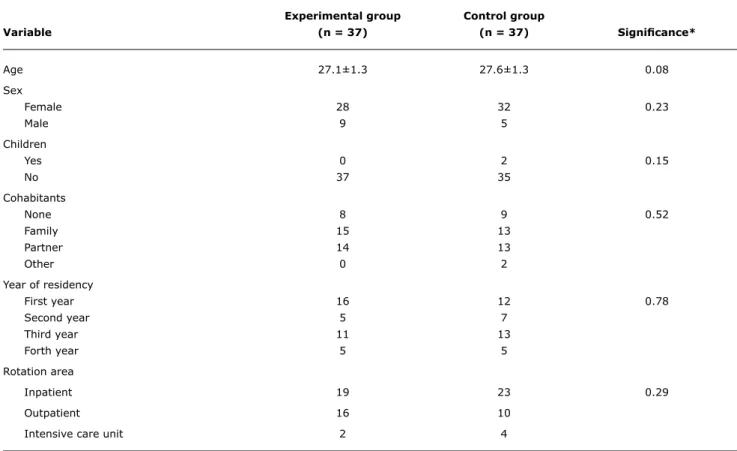
Of the 117 residents (83% female) in our program, the participants consisted of 74 residents (28 in the irst year, 12 in the second year, 24 in the third year, and 10
in the forth year) who were working in the hospital at the
time of the study. A total of 81% were female; the mean age was 27.3±1.4 years; 57% were working in inpatient areas, 35% in the outpatient clinic, and 8% in the intensive
care unit.
In total, 38% of the medical residents reported
living with their families, while 36% reported living with a partner, and the rest reported living alone. A large majority of the medical residents surveyed did not have children (97%). A comparison of the characteristics of both
experimental group Control group
Variable (n = 37) (n = 37) Signiicance*
Age 27.1±1.3 27.6±1.3 0.08
Sex
Female 28 32 0.23
Male 9 5
Children
Yes 0 2 0.15
No 37 35
Cohabitants
None 8 9 0.52
Family 15 13
Partner 14 13
Other 0 2
Year of residency
First year 16 12 0.78
Second year 5 7
Third year 11 13
Forth year 5 5
Rotation area
Inpatient 19 23 0.29
Outpatient 16 10
Intensive care unit 2 4
OR 95%CI Signiicance
Sex 0.599 0.13-2.63 0.49
Age 1.020 0.68-1.52 0.92
Cohabitants 1.166 0.57-2.37 0.67
Children 0.000 0.000 0.99
Year of residency
First year 1
Second year 4.924 0.99-24.49 0.05
Third year 11.856 2.36-59.36 0.003
Forth year 4.979 0.52-47.46 0.16
table 1 - General characteristics of the medical residents who participated in the study
* t test, chi-square test, or Fisher’s exact test, as appropriate
table 2 - Logistic regression analysis including potential predictors of burnout (n = 74)
95%CI = 95% confidence interval; OR = odds ratio.
Upon initial administration of the Maslach Burnout Inventory, a 66% prevalence of burnout was found (95%CI 55-76%), corresponding to 65% of the experimental group
and 68% of the control group.
After controlling for age, sex, cohabitants, and children, the year of residency proved to be an independent predictor of burnout, with third-year residents having a higher risk
of burnout than the others (OR = 11.8; 95%CI 2.3-59.3; p = 0.003) (Table 2). No differences in the prevalence of
burnout were found between the experimental and control
Initial Final Signiicance*
Emotional exhaustion 22.75 21.32 0.265
Depersonalization 7.27 5.54 0.031
Personal accomplishment 36.45 37.83 0.94
table 3 - Experimental group: average scores for each dimension of burnout, before and after the intervention (n = 37)
* t test.
Initial Final Signiicance*
Emotional exhaustion 22.03 23.27 0.41
Depersonalization 6.65 7.78 0.14
Personal accomplishment 34.78 34.03 0.38
table 4 - Control group: average scores for each dimension of burnout, before and after the intervention (n = 37)
* t test.
prevalence of burnout before and after the intervention in
either the experimental group (65% vs. 61%; OR = 0.89; 95%CI 0.3-2.5; p = 0.8) or the control group (68% vs. 72%; OR = 0.62; 95%CI 0.2-1.8; p = 0.3).
When each dimension of burnout syndrome was evaluated
in both groups before and after the intervention, signiicant
improvement was observed only in the experimental group,
in the scores corresponding to depersonalization (p = 0.031)
(Tables 3 and 4).
Discussion
In spite of producing a signiicant improvement in the
area of depersonalization, our brief intervention did not prove effective in reducing the prevalence of burnout in medical residents.
Our results contrast with experiences of other researchers. Krasner et al.5 performed a 1-year intervention
among primary care residents that focused on aspects
related to communication and included meditation exercises;
their program succeeded in reducing the levels of burnout, improving mood, and increasing emotional stability. Shapiro et al.14 achieved a decrease in stress and an improvement
in quality of life in less time (8 weeks). In spite of the good
results also obtained by relatively brief interventions, such as those by Ospina-Kammerer & Figley15 (4 weeks) and McCue & Sachs16 (4 hours), one ought to keep in mind that, in both cases, the intervention participants were not chosen randomly but rather by convenience (only
residents with free time attended the workshops), with the attendance bias that this may imply. It is possible that our intervention, although including content similar to that of Krasner et al.5, did not reach the same effectiveness due
to its short duration. Nonetheless, one should consider that longer-duration interventions can experience dificulties in
their implementation during residency, because of overlap with other training activities.
It is also important to consider that, according to Krasner et al.,5 we estimated that our intervention could reduce the
prevalence of burnout by half, a goal that was not achieved. Although a sample size calculated like ours could have underestimated the impact of the intervention, the small differences observed make it probable that the results would not be very different with a larger study population.
We found that 66% of residents showed burnout, which was similar to the numbers reported by Shanafelt et al. (76%),4 Martini et al. (50%),6 and Fahrenkopf et al.
(74%).17 However, these researchers have found it dificult
to agree on whether to deine burnout syndrome through
its dimensions (emotional exhaustion, depersonalization, and personal accomplishment) separately (unidimensional model) or together (multidimensional model).18
Although Maslach & Jackson12 recommend keeping the scores for each dimension separate and not combining them into a single score, many studies have combined the scores
with the intention of simply quantifying the phenomenon. Unfortunately, the lack of consensus on the deinition makes
References
1. Maslach C, Schaufeli WB, Leiter MP. Job burnout. Annu Rev Psychol. 2001;52:397-422.
2. Gil Monte P. Desgaste físico en el trabajo, el síndrome de quemarse. Madrid: Paidós; 1997.
3. McCue JD. The effects of stress on physicians and their medical practice. N Engl J Med. 1982;306:458-63.
4. Shanafelt TD, Bradley KA, Wipf JE, Back AL. Burnout and self-reported patient care in an internal medicine residency program.
Ann Intern Med. 2002;136:358-67.
5. Krasner MS, Epstein RM, Beckman H, Suchman AL, Chapman B, Mooney CJ, et al. Association of an educational program in mindful communication with burnout, empathy, and attitudes among primary care physicians. JAMA. 2009;302:1284-93. 6. Martini S, Arfken CL, Churchill A, Balon R. Burnout comparison
among residents in different medical specialties. Acad Psychiatry. 2004;28:240-2.
7. Dyrbye LN, Power DV, Massie FS, Eacker A, Harper W, Thomas MR, et al. Factors associated with resilience to and recovery from burnout: a prospective, multi-institutional study of US medical students. Med Educ. 2010;44:1016-26.
8. Prins JT, Gazendam-Donofrio SM, Tubben BJ, van der Heijden FM, van de Wiel HB, Hoekstra-Weebers JE. Burnout in medical residents: a review. Med Educ. 2007;41:788-800.
9. Thomas NK. Resident burnout. JAMA. 2004;292:2880-9. 10. van der Klink JJ, Blonk RW, Schene AH, van Dijk FJ. The beneits
of interventions for work-related stress. Am J Public Health. 2001;91:270-6.
11. Benson J, Magraith K. Compassion fatigue and burnout: the role of Balint groups. Aust Fam Physician. 2005;34:497-8.
12. Maslach C, Jackson SE. MBI: Maslach Burnout Inventory. Manual research edition. 2nd ed. Palo Alto: Consulting Psychologist Press; 1986.
13. Neira C. Cuando se enferman los que curan. Estrés laboral y burnout en los profesionales de la salud. Buenos Aires: Gambacop; 2004.
14. Shapiro S, Astin J, Bishop S, Cordova M. Mindfulness-based stress reduction for health care professionals: results from a randomized trial. Int J Stress Manag. 2005;12:164-76.
15. Ospina-Kammerer V, Figley CR. An evaluation of the Respiratory One Method (ROM) in reducing emotional exhaustion among family physician residents. Int J Emerg Ment Health. 2003;5:29-32. 16. McCue JD, Sachs CL. A stress management workshop improves
residents’ coping skills. Arch Intern Med. 1991;151:2273-7. 17. Fahrenkopf AM, Sectish TC, Barger LK, Sharek PJ, Lewin D, Chiang
VW, et al. Rates of medication errors among depressed and burnt out residents: prospective cohort study. BMJ. 2008;336:488-91. 18. Brenninkmeijer V, VanYperen N. How to conduct research on
burnout: advantages and disadvantages of a unidimensional approach in burnout research. Occup Environ Med. 2003;60: i16-20.
19. Álvarez-Hernández G, Medécigo S. Prevalencia del síndrome de desgaste profesional en médicos residentes de un hospital pediátrico en el Estado de Sonora. Bol Med Hosp Infant Mex. 2010;67:40-6.
20. Fonseca M, Sanclemente G, Hernández C, Visiedo C, Bragulat E, Miró O.Residents, duties and burnout syndrome. Rev Clin Esp. 2010;210:209-15.
Thus, when deining burnout among residents as being comprised of all three dimensions, Álvarez-Hernández & Medécigo19 reported a prevalence of 27%; when considering the involvement of only two dimensions, Fonseca et al.20
reported a prevalence of 69%; and, when considering only
a single dimension, Shanafelt et al.4 reported a prevalence
of 76%. Finally, Msaouel et al.21 applied a multidimensional model (high emotional exhaustion combined with high levels of depersonalization or low levels of personal accomplishment) and reported a prevalence of 49.5% among residents.
We considered burnout to be present when at least two of the Maslach Burnout Inventory dimensions were affected,
but, when we applied the same deinition as that of Msaouel
et al.,21 the prevalence fell from 66% to 55%. Moreover,
applying a more strict deinition as Alvarez-Hernández & Medécigo (maximal involvement of the three dimensions),
the prevalence fell to 27%. Although it is evident that a
stricter deinition decreases the prevalence of the syndrome,
it is also probable that it increases the risk of underdiagnosis in professionals with growing levels of burnout, a population
that would beneit from effective interventions.
We observed that third-year residents exhibited a higher risk of burnout. Similarly, Michels et al.22 reported that
third-year residents showed higher levels of depersonalization. We believe that this phenomenon could be explained by the characteristics of residency programs, in which the responsibilities increase as one advances through training. The third-year resident regularly coordinates and supervises younger residents, resolves complex clinical situations, and communicates information to peers and patients, activities that carry a high emotional burden and a self-imposed need to meet the demands of the environment.
Maslach & Leiter argue that the conditions for the development of burnout are more related to the characteristics of organizations than those of individuals, and identify some factors that may be present in the medical resident training system, which should be controlled in order to reduce burnout: excessively burdensome work
schedules, a lack of control over one’s own work, insuficient
recognition of one’s work, ambiguity in the division of roles, and a sense of injustice.23 In particular, evidence
exists of a relationship between a more burdensome work schedule and burnout.8,24,25 In this sense, our results are comparable to those obtained in the northern hemisphere, although local regulations for our residents establish a work schedule limit of 60 hours per week,26
midway between that established by the Accreditation
Council for Graduate Medical Education (80 hours per
week)27 and the European Working Time Directive (48
hours per week).28
Much work remains to be done in medical training to avoid, or at least limit, some of the complications of professional practice, such as burnout syndrome. One
ought not forget that the development and care of the doctor as an individual translates directly into better
quality of attention and care of patients, and this concept
21. Msaouel P, Keramaris NC, Tasoulis A, Kolokythas D, Syrmos N, Pararas N, et al. Burnout and training satisfaction of medical residents in Greece: will the European Work Time Directive make a difference? Hum Resour Health. 2010;8:16.
22. Michels PJ, Probst JC, Godenick MT, Palesch Y. Anxiety and anger among family practice residents: a South Carolina family practice
research consortium study. Acad Med. 2003;78:69-79.
23. Maslach C, Leiter M. The truth about burnout: how organizations cause personal stress and what to do about it. San Francisco: Jossey-Bass; 1997.
24. Landrigan CP, Fahrenkopf AM, Lewin D, Sharek PJ, Barger LK, Eisner M, et al. Effects of the accreditation council for graduate medical education duty hour limits on sleep, work hours, and safety. Pediatrics. 2008;122:250-8.
25. Boerjan M, Bluyssen SJ, Bleichrodt RP, van Weel-Baumgarten EM, van Goor H. Work-related health complaints in surgical residents
and the inluence of social support and job-related autonomy.
Med Educ. 2010;44:835-44.
26. Legislatura de la Ciudad Autónoma de Buenos Aires. Ley 601/01; 2001. http://www.buenosaires.gov.ar/areas/leg_tecnica/sin/
normapop09.php. Access: 27/12/2010.
Correspondence: Andrea Martins, MD
Comité de Docencia e Investigación, Hospital General de Niños Pedro de Elizalde,
Montes de Oca 40, Ciudad Autonoma de Buenos Aires - Argentina Tel.: + 54 (11) 4363.2100, +54 (11) 4363.2200 ext. 1013 E-mail: [email protected]
27. Accreditation Council for Graduate Medical Education. Common program requirements: VI. Resident Duty Hours in the Learning and Working Environment; 2007. http://www.acgme.org/acWebsite/ dutyHours/dh_ComProgrRequirmentsDutyHours0707.pdf. Access: 27/12/2010.