Abstract
Objective: To assess the incidence of periventricular/intraventricular hemorrhage (PIVH) in very low birth rate neonates.
Methods: This was a prospective cohort study conducted on a sample of very low birth weight infants over a 15-year period. Neonates who did not undergo cerebral ultrasonography, had malformations affecting the central nervous system, or died within the irst 24 hours of life were excluded. Ultrasonography was performed through the anterior fontanelle using an Aloka® 620 scanner with a 5 mHz probe, between days 1 and 3 of life, at 7 days, and at 28 days (or at discharge). Incidence was analyzed by means of the chi-square test for trend or Cochran-Armitage test and through a simple linear regression model with a logarithmic trendline as the output. For assessment of potential associated factors, a variety of obstetric, perinatal, and neonatal data collected between 1991–1994 and 2002–2005 were analyzed, using the chi-square and Fisher’s exact tests for statistical analysis. The signiicance level was set at 5%.
Results: Of 1,777 very low birth weight infants born during the study period, 1,381 (77.7%) were examined. Of these, 289 (20.9%) had PIVH. The yearly distribution of cases showed a progressive decline in incidence, from 50.9% in 1991 to 11.9% in 2005 (p < 0.0001). The incidence of PIVH decreased across all weight ranges as well as at grades I/II and III/IV. Signiicant differences in antenatal corticosteroid use, gender (male), weight (< 1,000 g), hyaline membrane disease, mechanical ventilation, administration of surfactant, patent ductus arteriosus, and sepsis were found.
Conclusion: The incidence of PIVH in very low birth weight infants declined signiicantly during the study period.
J Pediatr (Rio J). 2011;87(6):505-11: Cerebral hemorrhage, premature birth, ultrasonography.
O
RiginAlA
RtiCleCopyright © 2011 by Sociedade Brasileira de Pediatria
505 introduction
Intracranial hemorrhage remains the preeminent neurologic condition of newborn infants. Its most common manifestation is periventricular/intraventricular hemorrhage (PIVH), with other presentations, such as subdural, subarachnoid, and cerebellar hemorrhage, being
less frequent. PIVH occurs almost exclusively in preterm neonates, and is closely associated with a multifactorial hemorrhagic lesion of the germinal matrix. It is quite rare in full-term infants, and its pathophysiology in this group is poorly deined.1
incidence of periventricular/intraventricular hemorrhage
in very low birth weight infants: a 15-year cohort study
Sérgio t. M. Marba,1 Jamil P. S. Caldas,2 luís e. F. Vinagre,2 Mônica A. Pessoto3
1. Professor livre-docente, Departamento de Pediatria, Faculdade de Ciências Médicas (FCM), Universidade Estadual de Campinas (UNICAMP), Campinas, SP, Brazil.
2. Neonatologista. Mestre em Pediatria, FCM, UNICAMP, Campinas, SP, Brazil. Médico assistente, Hospital da Mulher Professor Doutor José Aristodemo Pinotti, Centro de Atenção Integral à Saúde da Mulher (CAISM), UNICAMP, Campinas, SP, Brazil.
3. Neonatologista. Doutora em Pediatria, FCM, UNICAMP, Campinas, SP, Brazil. Médica assistente, Hospital da Mulher Professor Doutor José Aristodemo Pinotti, Centro de Atenção Integral à Saúde da Mulher (CAISM), UNICAMP, Campinas, SP, Brazil.
No conflicts of interest declared concerning the publication of this article.
Suggested citation: Marba ST, Caldas JP, Vinagre LE, Pessoto MA. Incidence of periventricular/intraventricular hemorrhage in very low birth weight infants: a 15-year cohort study. J Pediatr (Rio J). 2011;87(6):505-11.
Manuscript submitted Jun 01 2011, accepted for publication Aug 19 2011.
The frequency of PIVH may vary, as it ultimately relects the local context of each intensive care unit and the interventions performed on high-risk neonates. In the literature, the incidence of this condition is reported to range between 3.7 and 44.68%,2-6 whereas Brazilian
sources report a range of 26 to 51%.7,8
Since the 1980s, PIVH cases have been on a signiicant downward trend, fostered by worldwide improvements in neonatal care and by the implementation of potentially better practices meant to prevent this condition, despite the growing number of liveborn very low birth weight infants.9-11
From 1990 onward, our Neonatology service has systematically screened high-risk neonates for PIVH and followed trends in the occurrence of this disease. The present study reports on our 15-year experience of tracking PIVH and points out certain measures that may have contributed to changes in its incidence over time.
Methods
This was a prospective cohort study of neonates with a birth weight < 1,500 g admitted to a neonatal intensive care unit (NICU) between April 1991 and December 2005 who underwent transfontanellar ultrasonography for diagnosis or screening of PIVH. Neonates were grouped into 250-g weight ranges (< 750 g, 751–1,000 g, 1,001–1,250 g, and 1,251–1,499 g) for comparison of incidence rates.
Neonates with cerebral malformations, those who did not undergo ultrasonography, and those who died before the 24th hour of life were excluded from the sample.
PIVH was deined as the presence of hyperechoic images in the periventricular or intraventricular region consistent with the condition on ultrasound examination. Severity was graded on a scale of I to IV, with grade I being hemorrhage conined to the germinal matrix; grade II, intraventricular hemorrhage with no ventricular dilatation; grade III, intraventricular hemorrhage with ventricular dilatation; and grade IV, intraparenchymal bleeding.2 Hemorrhage
was considered mild if grade I or II and severe if grade III or IV.
Diagnoses were established by means of bedside ultrasonography using an Aloka 620® scanner and a 5 mHz probe. The PIVH screening protocol followed at our facility consists of serial ultrasound assessment of all neonates with a birth weight < 1,500 g at 72 hours (or sooner), 1 week, and 28 days of age (or at discharge), with a maximum acceptable deviation of 24 hours.
Data were recorded in patient charts and later entered into the SPSS 7.5 for Windows software application. Sample size was not calculated, as this was a study of incidence and all children deemed eligible during the study period were included. The chi-square or Cochran-Armitage tests for trend were used to ascertain whether the incidence
of PIVH followed an upward or downward trend over the study period. Annual incidence was analyzed using a simple linear regression model, with a logarithmic trend line as the output. The level of signiicance was set at p < 0.05 with a 95% conidence interval.
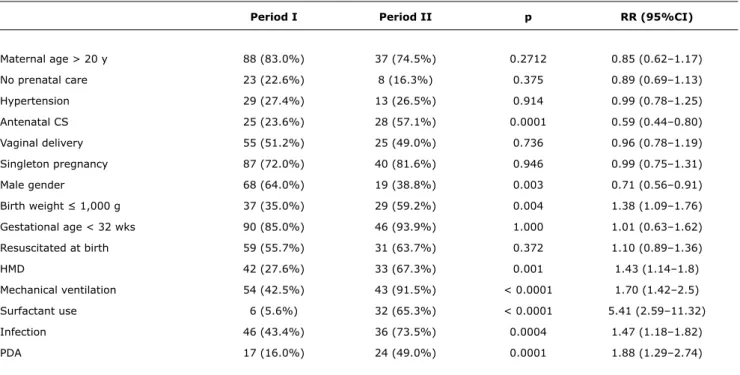
To investigate factors potentially associated with PIVH trends, we analyzed the occurrence of a variety of obstetric, perinatal, and neonatal events during two distinct timeframes, 1991–1994 and 2002–2005, strategically deined so as to characterize the extremes of the data collection period. The chi-square test or Fisher’s exact test were used as appropriate for statistical analysis and relative risk was calculated for between-group differences.
This study was approved by the Research Ethics Committee of the healthcare facility at which it was conducted.
Results
A total of 45,652 infants were born during the study period, 1,777 of whom with a weight of less than 1,500 g (3.9%). Of these, 17.5% were excluded from the sample due to early death, 0.9% due to cerebral malformations, and 3.8% who did not undergo ultrasound assessment, for a inal sample of 1,341 neonates.
Across the entire study period, 289 very low birth weight infants developed PIVH (20.9%). Analysis of the annual distribution of cases revealed a marked, statistically signiicant decline in the incidence of this condition, from 50.9% in 1991 to 11.9% in 2005 (p < 0.0001). The lowest PIVH rate was measured in 2001 (11.6%). Annual incidence data and a trendline for the incidence of PIVH over the 15-year study period are shown in Figure 1.
Analysis of the distribution of PIVH by weight range showed the incidence was highest in neonates with a birth weight < 750 g (32.6%), and lowest (11.6%) in those with a birth weight of 1,251–1,499 g.
The annual distribution of PIVH cases showed a signiicant decline across all weight ranges. Incidence rates declined most markedly in the < 750 g birth weight group, and remained most stable in the 1,001–1,250 g group (Figure 2).
Analysis of the distribution of PIVH by severity – mild (Grade I/II) or severe (Grade III/IV) – revealed a statistically signiicant decrease in frequency in both groups. This downward trend was more pronounced for the milder forms of PIVH, as shown in Figure 3. These milder forms of the condition were predominant in infants with a birth weight of > 1,000 g, while the more severe forms were more common in lower weight ranges.
Figure 1 - Overall incidence and trendline of periventricular/ intraventricular hemorrhage, 1991–2005
Figure 3 - Incidence and trend lines for mild and severe periventricular/ intraventricular hemorrhage, 1991– 2005
Figure 2 - Trendline of periventricular/intraventricular hemorrhage, by year, according to birth weight
Discussion
This study included a substantial number of infants at high risk of PIVH. Neonates who died before the 24th hour of life were excluded because some time must elapse between the onset of bleeding and its becoming visible on ultrasound examination, as ultrasonography actually detects clot formation. Although most cases of PIVH are known to occur within the irst week of life, the exact timing of bleeding is still a point of contention.1,12
The rate of sampling loss throughout the 15-year study period was quite low (3.8%), which may be explained by the fact that all ultrasound examinations were performed at the bedside, without interfering with the dynamics of neonatal care. Adequate training of two service neonatologists enabled systematic adherence to the study protocol without depending on other providers. It should also be noted that transfontanellar ultrasonography is an excellent method for
diagnosis of PIVH with sensitivity and speciicity comparable to those of magnetic resonance imaging for detection of cerebral hemorrhage in preterm neonates.12
The aforementioned loss rate does not appear to have skewed the study results, as it was relatively homogeneous over time. Furthermore, the subjects lost to follow-up were generally in higher birth weight ranges and at lower risk of PIVH; their ultimate inluence on incidence data may be considered negligible.
Our choice of birth weight as a parameter for stratiication is justiied by the unreliability of gestational age assessment. Theoretically, gestational age would be the most relevant variable, as the most intense proliferation of the germinal matrix (the site of PIVH) occurs between weeks 26 and 32 of development. This period is followed by involution of the matrix, which would decrease the risk of bleeding. However, assessment of gestational age in our setting is based on somewhat unreliable methods: menstrual history, fetal ultrasonography, and clinical examination. In light of this universal issue, birth weight is the variable most often used to deine groups at high risk of PIVH.
Over the study period, the incidence of PIVH in very low birth weight (< 1,500 g) neonates declined signiicantly, from 51% in 1991 to 12% in 2005. This decline occurred despite increased survival of preterm neonates at our service; the proportion of extremely low birth weight infants among all liveborn neonates remained practically constant throughout.
Analysis of the distribution of PIVH by weight range revealed it was markedly predominant in lower-weight infants; this is consistent with the current literature. The incidence of PIVH followed a downward trend across all weight ranges. However, comparison between these ranges
PIVH = periventricular/intraventricular hemorrhage.
PIVH = periventricular/intraventricular hemorrhage.
Period i Period ii p RR (95%Ci)
Maternal age > 20 y 88 (83.0%) 37 (74.5%) 0.2712 0.85 (0.62–1.17)
No prenatal care 23 (22.6%) 8 (16.3%) 0.375 0.89 (0.69–1.13)
Hypertension 29 (27.4%) 13 (26.5%) 0.914 0.99 (0.78–1.25)
Antenatal CS 25 (23.6%) 28 (57.1%) 0.0001 0.59 (0.44–0.80)
Vaginal delivery 55 (51.2%) 25 (49.0%) 0.736 0.96 (0.78–1.19)
Singleton pregnancy 87 (72.0%) 40 (81.6%) 0.946 0.99 (0.75–1.31)
Male gender 68 (64.0%) 19 (38.8%) 0.003 0.71 (0.56–0.91)
Birth weight ≤ 1,000 g 37 (35.0%) 29 (59.2%) 0.004 1.38 (1.09–1.76)
Gestational age < 32 wks 90 (85.0%) 46 (93.9%) 1.000 1.01 (0.63–1.62)
Resuscitated at birth 59 (55.7%) 31 (63.7%) 0.372 1.10 (0.89–1.36)
HMD 42 (27.6%) 33 (67.3%) 0.001 1.43 (1.14–1.8)
Mechanical ventilation 54 (42.5%) 43 (91.5%) < 0.0001 1.70 (1.42–2.5)
Surfactant use 6 (5.6%) 32 (65.3%) < 0.0001 5.41 (2.59–11.32)
Infection 46 (43.4%) 36 (73.5%) 0.0004 1.47 (1.18–1.82)
PDA 17 (16.0%) 24 (49.0%) 0.0001 1.88 (1.29–2.74)
table 1 - Obstetric, perinatal, and neonatal variables, 1991–1994 (period I) and 2002–2005 (period II)
CS = corticosteroids; HMD = hyaline membrane disease; PDA = patent ductus arteriosus; RR = relative risk.
shows that the decline in cases was most pronounced in lower-weight infants; in fact, PIVH tended to disappear in the > 1,250 g group. This downward trend has been observed worldwide since the 1980s.1,9,13 In 1998, Sheth14 described
a decline in the incidence of PIVH (from 29.7% to 14.4%) over a 10-year period, in a sample of 867 very low birth weight infants born between 1986 and 1995.
Analysis of potential risk factors associated with this decline in the incidence of PÌVH revealed that some factors usually associated with this disease, such as maternal age, prenatal care, and vaginal delivery, were not associated with signiicant between-group differences over the 15-year study period. On the other hand, we did detect an increase in the proportion of very low birth weight infants and a decrease in the number of male infants.
Therefore, this decline in PIVH incidence rates may be attributed to an overall improvement in neonatal care, although some practices are not directly related to development of this condition.
Over the 15-year study period, antenatal corticosteroid use became considerably more widespread at our facility. This practice has been reported in the literature as a protective factor against development of PIVH, both indirectly as an inducer of lung maturity and hemodynamic stability and due to its direct action on maturation of blood vessels in the germinal matrix.15,16 A Brazilian study found that antenatal corticosteroids signiicantly reduced the incidence
of severe PIVH in preterm neonates.17 However, in Brazil, this therapy has yet to be employed in a widespread, standardized manner. In data compiled by the Brazilian Neonatal Research Network (Dados da Rede Brasileira de Pesquisas Neonatais) from eight university centers, the rate of antenatal corticosteroid administration ranged from 12.5% to 87.5%.18
Administration of exogenous surfactant for treatment of respiratory distress syndrome was also implemented and widely used throughout the study period. As respiratory failure and mechanical ventilation are associated with PIVH, we expected surfactant use would reduce its incidence. Nevertheless, there is no clear evidence of any such protective effect in most studies. This holds particularly true for infants born at a gestational age of < 27 weeks, and is most likely related to the extreme pulmonary immaturity of this age group and to the multifactorial nature of PIVH. Prophylactic administration of surfactant has also not proved superior to rescue use of surfactant in prevention of PIVH and its severe manifestations, nor has the type of surfactant shown any association with protection against PIVH. As surfactant has received formal regulatory approval for the treatment of neonatal respiratory distress syndrome, placebo-controlled trials are unlikely to be conducted in future.19,20
widespread use of mechanical ventilation, sepsis, patent ductus arteriosus, and hemodynamic disorders – remained present. As PIVH rates declined signiicantly over time, we sought to determine which changes in the service where the study was conducted could have justiied this inding.
Over the 15 years of our investigation, the neonatology unit in which it was carried out underwent several major changes, both in terms of infrastructure and technological advances and in implementation of patient-centered care. The incidence of PIVH declined most markedly from 1996 onward. This period coincided with a renovation of the unit after a turbulent time of high occupancy rates and inadequate physical infrastructure, supplies, and personnel. Substantial investments were made toward the acquisition of new equipment, physicians and nurses were hired, and a program designed to regionalize neonatal care was implemented. In a study of 17 Canadian NICUs, Synnes et al. found that the incidence of severe PIVH was associated not only with the characteristics of the infants themselves, but also – and signiicantly so – with the structural aspects of how each unit was organized, including personnel, staff-to-bed ratios, and availability of specialty care.21
Handling and management of neonates, and particularly of extremely low and very low birth weight infants, has also undergone major changes. Since 1996, neonatal resuscitation in the delivery room has followed Brazilian Society of Pediatrics guidelines, and attending and resident physicians as well as the nursing staff receive training in recommended neonatal resuscitation skills. Resuscitation has thus become more effective; both hypo- and hyperthermia at birth are now avoided; and infusion of hyperosmolar luids and volume expanders has become much more judicious.
Furthermore, mechanical ventilation of newborn infants, when required, is now provided by more modern respirators, and measures are in place to mitigate the discomfort caused by ventilation, such as judicious administration of analgesics and use of restraints. It is well known that mechanical ventilation may induce signiicant increases in intracranial pressure (as estimated by monitoring of anterior fontanel pressure) and changes in heart rate and blood pressure.22
Furthermore, patient-ventilator asynchrony (a lack of coordination between the spontaneous respiratory efforts of the neonate and those delivered by the ventilator) also leads to signiicant changes in cerebral hemodynamics.
Likewise, the ventilation process has changed over time to become less aggressive and tolerant of a broader range of pCO2 levels than traditionally accepted, thus avoiding
extreme hypo- and hypercapnia alike, which induce acute reductions in cerebral blood low and are thus damaging to the developing brain of preterm infants.23
Routine tracheal aspiration has been ascribed a signiicant role in the pathogenesis of PIVH. It has been well documented that changes in blood pressure, cerebral blood low, and
intracranial pressure occur during this procedure. Although there is no high-level evidence to support this assertion, there is consensus that tracheal aspiration should be performed selectively and on a case-by-case basis.22 The hemodynamic
management of newborn infants has also undergone major changes, becoming individualized, particularly with regard to routine blood pressure measurement, more reined use and titration of vasoactive agents, and discouraging the use of volume expanders (especially repeated use), as both hypotension and hypertension in these patients are related to luctuations in cerebral blood low.11,24
From the year 2000 onward, our NICU expanded its care protocols to include a series of patient-centered, humanized practices meant to prevent cerebral hemorrhage and ischemic brain damage and promote proper neurodevelopment. Premature infants are born into an unfavorable environment and are subject to a variety of stimuli that are deleterious to their development.25,26 The hospitalization period of preterm infants corresponds to the critical period of rapid fetal growth and brain maturation – a unique time in the human life cycle. This stage is characterized by massive multiplication of glial cells, myelination, synaptogenesis, and development of the overall organization of the brain, as, at 20 weeks’ gestation, the process of neuronal proliferation and migration is mostly complete, and most neurons are at their deinitive locations within the cerebral cortex.
In accordance with the current literature, the following measures were adopted: noise and light reduction; judicious administration of analgesics and sedatives; judicious placement and positioning of infants within their incubators; and careful maintenance of hemodynamic status and use of gentler mechanical ventilation settings, as mentioned before.11,24-26
Als et al.25 have shown that extremely low birth weight infants entered into an individualized care program had a signiicantly lower incidence of intraventricular hemorrhage compared with those given standard care. They also spend less time on mechanical ventilation and supplemental oxygen, have a lower incidence of bronchopulmonary dysplasia and pneumothorax, start oral feeding earlier, experience greater daily weight gain, have shorter lengths of hospital stay and incur lower hospital costs. At age 9 months, neurodevelopment in these children was superior to that of controls.
Clinical and laboratory studies have suggested that preterm neonates exhibit increased sensitivity to pain, and that repetitive painful stimuli lead to the development of prolonged periods of hyperalgesia and continuous stress and physiological derangement. Acute physiologic changes induced by pain or other stressors may act as causative or aggravating factors of early intraventricular hemorrhage and of the ischemic lesions that lead to leukomalacia.27
References
1. Volpe JJ. Intracranial hemorrhage: germinal matrix-intraventricular hemorrhage of the premature infant. In: Volpe JJ. Neurology of the newborn. 5th ed. Philadelphia: Saunders Elsevier; 2008. p. 517-88.
2. Papile LA, Burstein J, Burstein R, Kofler H. Incidence and evolution of subependymal and intraventricular hemorrhage: a study of infants with birth weights less than 1,500 gm. J. Pediatr. 1978;92:529-34.
3. Gleissner M, Jorch G, Avenarius S. Risk factors for intraventricular
hemorrhage in a birth cohort of 3721 premature infants. J Perinat Med. 2000;28:104-10.
4. Heuchan AM, Evans N, Henderson Smart DJ, Simpson JM. Perinatal risk factors for major intraventricular haemorrhage in the Australian and New Zealand Neonatal Network, 1995-97. Arch Dis Child Fetal Neonatal Ed. 2002;86:F86-90.
5. Kadri H, Mawla AA, Kazah J. The incidence, timing, and predisposing
factors of germinal matrix and intraventricular hemorrhage (GMH/
IVH) in preterm neonates. Childs Nerv Syst. 2006;22:1086-90.
6. Fanaroff AA, Stoll BJ, Wright LL, Carlo WA, Ehrenkranz RA, Stark AR, et al. Trends in neonatal morbidity and mortality for very low birthweight infants. Am J Obstet Gynecol. 2007;196:147.e1-8.
7. Marba ST. Hemorragia periventricular-intraventricular: incidência em recém-nascidos vivos e sua associação com idade gestacional, peso, crescimento intra-uterino e óbito neonatal [dissertação]. Campinas, SP: Faculdade de Ciências Médicas, Universidade Estadual de Campinas; 1993.
8. Leone CR, Sadeck LS, Almeida MF, Draque CM, Guinsburg R, Marba S, et al. Brazilian neonatal research network (BNRN): very low birth weight (VLBW) infant morbidity and mortality. Pediatric Academic Societies Annual Meeting, 2001, Baltimore, MD, USA. Pediatr Res. 2001;49:405A.
9. Philip AG, Allan WC, Tito AM, Wheeler LR. Intraventricular
hemorrhage in preterm infants: declining incidence in the 1980s.
Pediatrics. 1989;84:797-801.
10. Cooke RW. Trends in preterm survival and incidence of cerebral
haemorrhage 1980-9.Arch Dis Child. 1991;66:403-7.
11. McLendon D, Check J, Carteaux P, Michael L, Moehring J, Secrest JW, et al. Implementation of potentially better practices for the prevention of brain hemorrhage and ischemic brain injury in very low birth weight infants. Pediatrics. 2003;111:e497-503. respiration and may reduce the incidence of Grade III/IV
PIVH in mechanically ventilated infants.28 Conversely, an investigation by Anand et al. on the effect of morphine in mechanically ventilated preterm neonates29 found no
reduction in the rates of severe PIVH, periventricular leukomalacia, and death. This particular study has sparked major controversy among experts; further investigations are needed to elucidate this issue, and current recommendations favor judicious, rather than generalized, administration of morphine, and withholding opioids altogether in patients with major hemodynamic instability.
All of the above practices share a common principle: correcting or attenuating hemodynamic changes, which lead to increased, decreased, or luctuating cerebral blood low and, ultimately, to the development of PIVH. These practices are part of what has been referred to as the implementation of best practices for prevention of cerebral hemorrhage and ischemic brain injury in very low birth weight neonates.11-26
In this study, the incidence of all grades of PIVH declined, with particularly marked decreases in the incidence of Grade I and II disease. Furthermore, the lowest the birth weight of the infant, the higher the rate of severe hemorrhage; therefore, the less severe forms of PIVH are predominant in children with a higher birth weight.
The distribution of PIVH grades by birth weight relects an overall decrease in the neonatal mortality rate of increasingly younger children (those at the highest risk of developing PIVH) due to technological advances.30
Reduction of PIVH (particularly its high-grade forms) in surviving neonates may be beneicial, as these more severe forms of the disease carry an unfavorable prognosis. Neurological sequelae are associated with motor, cognitive, and global impairment due to demyelination and a reduction in the number of axons, dendrites, neurons, and synapses.31
Although evidence of a certain degree of plasticity in long-term neurodevelopmental processes has led to a guardedly optimistic prognosis for neonates with high-grade PIVH, severe sonographic changes and altered neurologic examination indings suggest more serious brain injury and, therefore, a poorer potential for recovery.32
Several studies have provided ample evidence that severe (Grade III/IV) PIVH is associated with impaired neurologic development. Ment et al.31 reported that, at 12 years of
age, 60% of surviving neonates with Grade III/IV PIVH and a birth weight of 600–1,250 g had cerebral palsy, 70% had mental retardation, and 92% still required rehabilitation.
According to data provided by the Vermont Oxford Network and the National Institute of Child Health and Human Development Neonatal Research Network, an estimated 5,800 children with Grade III/IV PIVH were born in the U.S. in 2003. Assuming a survival rate of 70%,
3,045 children would go on to develop mental retardation secondary to PIVH, entailing a total treatment cost of over US$3 billion per child.33
No treatment cost estimates are available for Brazil, but a reduction in the number of patients with severe PIVH, as occurred in our sample, is certain to provide substantial cost savings – particularly in developing nations.
12. O’Shea TM, Counsell SJ, Bartels DB, Dammann O. Magnetic resonance and ultrasound brain imaging in preterm infants. Early Hum Dev. 2005;81:263-71.
13. Strand C, Laptook AR, Dowling S, Campbell N, Lasky RE, Wallin LA, et al. Neonatal intracranial hemorrhage: I. Changing pattern in inborn low-birth-weight infants. Early Hum Dev. 1990;23:117-28. 14. Sheth RD. Trends in incidence and severity of intraventricular
hemorrhage. J Child Neurol. 1998;13:261-4.
15. Stonestreet BS, Petersson KH, Sadowska GB, Pettigrew KD, Patlak CS. Antenatal steroids decrease blood-brain barrier permeability in the ovine fetus. Am J Physiol. 1999;276:R283-9.
16. Roberts D, Dalziel S. Antenatal corticosteroids for accelerating fetal lung maturation for women at risk of preterm birth. Cochrane Database Syst Rev. 2006;3:CD004454.
17. Meneguel JF, Guinsburg R, Miyoshi MH, de Araujo Peres C, Russo RH, Kopelman BI, et al. Antenatal treatment with corticosteroids for preterm neonates: impact on the incidence of respiratory distress syndrome and intra-hospital mortality. Sao Paulo Med J. 2003;121:45-52.
18. Martinez FE, Mussi-Pinhata MM, Linhares NJ, Marba S, Neto AA, Procianoy R, et al. Uso antenatal de corticosteróide e condições de nascimento de pré-termos nos hospitais da Rede Brasileira de Pesquisas Neonatais. Rev Bras Ginecol Obstet. 2004;26:177-84.
19. Soll RF. Synthetic surfactant for respiratory distress syndrome in preterm infants. Cochrane Database Syst Rev. 2000;(2): CD001149.
20. Soll RF, Morley CJ. Prophylactic versus selective use of surfactant in preventing morbidity and mortality in preterm infants. Cochrane Database Syst Rev. 2001;(2):CD000510.
21. Synnes AR, Macnab YC, Qiu Z, Ohlsson A, Gustafson P, Dean CB, et al. Neonatal intensive care unit characteristics affect the incidence of severe intraventricular hemorrhage. Med Care. 2006;44:754-9.
22. Friesen RH, Honda AT, Thieme RE. Changes in anterior fontanel pressure in preterm neonates during tracheal intubation. Anesth Analg. 1987;66:874-8.
23. Fabres J, Carlo WA, Phillips V, Howard G, Ambalavanan N. Both
extremes of arterial carbon dioxide pressure and the magnitude of luctuations in arterial carbon dioxide pressure are associated
with severe intraventricular hemorrhage in preterm infants.
Pediatrics. 2007;119:299-305.
24. Carteaux P, Cohen H, Check J, George J, McKinley P, Lewis W, et al. Evaluation and development of potentially better practices for the prevention of brain hemorrhage and ischemic brain injury in very low birth weight infants. Pediatrics. 2003;111:e489-96.
25. Als H, Duffy FH, McAnulty GB. Effectiveness of individualized neurodevelopmental care in the newborn intensive care unit (NICU). Acta Paediatr Suppl. 1996;416:21-30.
26. Vandenberg KA. Individualized developmental care for high risk newborns in the NICU: A practice guideline. Early Hum Dev. 2007;83:433-42.
27. Guinsburg R, Kopelman BI, Anand KJ, de Almeida MF, Peres C de A, Miyoshi MH. Physiological, hormonal, and behavioral responses to a single fentanyl dose in intubated and ventilated preterm neonates. J Pediatr. 1998;132:954-9.
28. Perlman JM. Morphine, hypotension, and intraventricular hemorrhage in the ventilated premature infant. Pediatrics. 2005;115:1416-8.
29. Anand KJ, Hall RW, Desai N, Shephard B, Bergqvist LL, Young TE, et al. NEOPAIN Trial Investigators Group. Effects of morphine analgesia in ventilated preterm neonates: primary outcomes from the NEOPAIN randomised trial. Lancet. 2004;363:1673-82. 30. Bassan H, Feldman HA, Limperopoulos C, Benson CB, Ringer
SA, Veracruz E, et al. Periventricular hemorrhagic infarction: risk factors and neonatal outcome. Pediatr Neurol. 2006;35:85-92.
31. Ment LR, Vohr B, Allan W, Westerveld M, Sparrow SS, Schneider KC et al. Outcome of children in the indomethacin intraventricular hemorrhage prevention trial. Pediatrics. 2000;105:485-91. 32. Hack M, Taylor HG, Drotar D, Schluchter M, Cartar L,
Wilson-Costello D, et al. Poor predictive validity of the Bayley Scales of
Infant Development for cognitive function of extremely low birth
weight children at school age. Pediatrics. 2005;116:333-41.
33. Ment LR, Allan WC, Makuch RW, Vohr B. Grade 3 to 4 intraventricular hemorrhage and Bayley scores predict outcome. Pediatrics. 2005;116:1597-8.
Correspondence:
Sérgio Tadeu Martins Marba