S U P P L E M E N T A R T I C L E
The MAL-ED Study: A Multinational and
Multidisciplinary Approach to Understand the
Relationship Between Enteric Pathogens,
Malnutrition, Gut Physiology, Physical Growth,
Cognitive Development, and Immune Responses
in Infants and Children Up to 2 Years of Age in
Resource-Poor Environments
The MAL-ED Network Investigatorsa
Highly prevalent conditions with multiple and complex underlying etiologies are a challenge to public health. Un-dernutrition, for example, affects 20% of children in the developing world. The cause and consequence of poor nutrition are multifaceted. Undernutrition has been associated with half of all deaths worldwide in children aged <5 years; in addition, its pernicious long-term effects in early childhood have been associated with cognitive and physical growth deficits across multiple generations and have been thought to suppress immunity to further in-fections and to reduce the efficacy of childhood vaccines. The Etiology, Risk Factors, and Interactions of Enteric Infections and Malnutrition and the Consequences for Child Health (MAL-ED) Study, led by the Fogarty Inter-national Center of the National Institutes of Health and the Foundation for the National Institutes of Health, has been established at sites in 8 countries with historically high incidence of diarrheal disease and undernutrition. Central to the study is the hypothesis that enteropathogen infection contributes to undernutrition by causing in-testinal inflammation and/or by altering intestinal barrier and absorptive function. It is further postulated that this leads to growth faltering and deficits in cognitive development. The effects of repeated enteric infection and undernutrition on the immune response to childhood vaccines is also being examined in the study. MAL-ED uses a prospective longitudinal design that offers a unique opportunity to directly address a complex system of exposures and health outcomes in the community—rather than the relatively rarer circumstances that lead to hospitalization—during the critical period of development of thefirst 2 years of life. Among the factors being evaluated are enteric infections (with or without diarrhea) and other illness indicators, micronutrient levels, diet, socioeconomic status, gut function, and the environment. MAL-ED aims to describe these factors, their interrelationships, and their overall impact on health outcomes in unprecedented detail, and to make individual, site-specific, and generalized recommendations regarding the nature and timing of possible interventions aimed at improving child health and development in these resource-poor settings.
Keywords. MAL-ED; diarrhea; malnutrition.
National and multinational investments into public health have greatly reduced child mortality from diar-rhea and undernutrition over the past 20 years. Between 1990 and 2013, overall child mortality rates decreased from 87 to 51 per 1000 live births, and the associated aMAL-ED Network Investigators are listed in the Appendix.
Correspondence: Mark Miller, MD, Fogarty International Center, 16 Center Drive, MSC 6705, Bethesda, MD 20892-6705 ([email protected]).
Clinical Infectious Diseases® 2014;59(S4):S193 –206
Published by Oxford University Press on behalf of the Infectious Diseases Society of America 2014. This work is written by (a) US Government employee(s) and is in the public domain in the US.
DOI: 10.1093/cid/ciu653
at Universidade Federal do Cear� on December 9, 2014
http://cid.oxfordjournals.org/
prevalence of children underweight fell from 25% to 16% [1]. The progress in decreasing mortality rates has increased atten-tion on childhood morbidity in low-resource areas and the potential, more insidious consequences of undernutrition and infectious diseases on long-term health outcomes.
Early childhood physical growth and cognitive development may be affected by a multitude of economic, biological, environ-mental, and possible genetic factors. Exposures to putative path-ogens at an early stage of physical, immunologic, and cognitive development may adversely disrupt the trajectory of a child’s potential development, resulting in long-lasting consequences. As economic achievement in adulthood has been linked to school performance, which is in turn associated with develop-ment during the earliest years of life, such long-lasting conse-quences are likely to have significantly deleterious effects on both individuals as well as their communities [2].
The causes of poor growth and development in early child-hood are complex, with a variety of direct and underlying con-ditions, including a lack of adequate amounts or quality of food [3]; early termination of or insufficient breastfeeding [4], with possible inadvertent introduction of putative pathogens in weaning foods; inadequate diversity of complementary foods, which may lead to specific micronutrient deficiencies [5–8]; diets that contain inhibitors of micronutrient absorption [9,10]; catabolic states due to infection [11–13]; the inadequate response of the host and the host’s gut microbial community to caloric insufficiency; and/or a configuration of the microbiota that is suboptimal for energy/nutrient harvest [14,15]. The availability of micro- and macro-nutrients for physical and cognitive develop-ment and a healthy immune system are a function of both their input and processing, but few studies have attempted to explore longitudinally the sufficiency of food intake alongside disease and infection history with measures of gut function.
Enteric pathogens and their potential role in developing mal-nutrition have been a focal point for research. Pathogens may be introduced early in life and may damage the absorptive capacity of the intestine, causing protein-energy and micronutrient mal-nutrition [16]. Enteric infections can compromise the intestinal barrier, increase inflammation, and lead to decreased function. Both micronutrient deficiencies and chronic immune stimula-tion have also been found to impair growth and to increase sus-ceptibility to infectious diseases [17].
Pioneering studies in Central America documented the im-pact of childhood infections and diarrhea on malnutrition [18]. Given the relatively high estimates of the prevalence of malnutrition and diarrhea episodes in much of the developing world, there is a great need for detailed data identifying specific enteric pathogens, age-specific incidence, and their association with growth faltering. Malnutrition also has been shown to in-crease susceptibility to infections and mortality due to diarrhea and other infectious diseases [19–22]. Repeated enteric
infections in adults living in unsanitary conditions damage the intestinal tract, which leads to a condition that has been termed“environmental enteropathy or environmental enteric dysfunction”(EE/EED). A description of the clinical character-istics, possible etiology, and diagnosis of EE/EED is included in this supplement [23].
Although EE/EED is thought to contribute to the develop-ment of undernutrition in older populations [24,25], the histol-ogy has not been adequately described in infants or young children living in areas of high exposure to enteric pathogens. Plausible mechanisms for how EE/EED may contribute to un-dernutrition and to growth faltering have been proposed. Re-peated exposure to pathogenic bacteria, viruses, and parasites may impact the nutritional status of an individual by competing for available micronutrients, and/or cause villus blunting and thus impair nutrient absorption [16] and compromise the intes-tinal barrier, leading to increased intesintes-tinal permeability to pathogens, endotoxins, and other macromolecules that can re-sult in the chronic stimulation of the immune system [26,27]. Serum concentrations of micronutrients have been shown to both increase (iron) and decrease (vitamin A and zinc) in re-sponse to infection, inflammation, or tissue injury [28]. Both micronutrient deficiencies and chronic immune stimulation have also been found to impair physical growth and to increase the susceptibility to infectious diseases [19]. Additionally, alter-ations in the gut microbiota, either as a result of enteropathogen infection or the administration of antimicrobials, may influence the structure and functions of the innate and adaptive arms of the immune system, which in turn may reduce the effectiveness of oral and mucosal vaccines [21,29–32].
To date, there have been few systematic, longitudinal, pro-spective studies that help define particular windows of vulnera-bility in infants and young children when infection by a specific pathogen or combination of pathogens could lead to greater deficits in developmental outcomes [33–35]. Definitive histo-pathological diagnoses of EE/EED in infants and children in de-veloping countries have yet to be made due to ethical challenges associated with obtaining gut biopsies from vulnerable popula-tions in areas with a high incidence of malnutrition. Further-more, conclusive studies that define associations of physical growth and cognitive development deficits with repetitive spe-cific enteric infections (controlling for dietary intake, levels of macro- and micronutrient deficiencies, and measures of inter-mediary indicators such as biomarkers of gut function) have not been conducted. There are also limited studies examining these factors on the immune response in children. To address these gaps in knowledge, the study of Etiology, Risk Factors, and In-teractions of Enteric Infections and Malnutrition and the Con-sequences for Child Health (MAL-ED) was established at research sites with a high incidence of diarrheal disease and malnutrition in 8 countries.
at Universidade Federal do Cear� on December 9, 2014
http://cid.oxfordjournals.org/
MAL-ED Aims
The aim of MAL-ED is to improve scientific understanding of the complex interrelationships between gut microbial ecology, enter-opathogen infection, dietary intake, nutritional status, gut phy-siology, growth, immune function and vaccine response, and cognitive development. Although existing evidence hints at the roles of individual factors, a holistic approach to quantify the in-teractions between these factors and their potentially synergistic role in multiple and diverse populations has not been explored previously. The primary health outcomes to be evaluated by MAL-ED are physical growth, cognitive development, and im-mune responses to oral and parenteral vaccines. It is anticipated that knowledge derived from MAL-ED will help the public health community better engineer interventions and their timing to min-imize those factors that may contribute to lost lifetime potential. The central hypotheses of the MAL-ED Network study are as follows:
1. Enteropathogen infection contributes to (i) stunting, (ii) wasting, and (iii) micronutrient deficiencies.
2. Enteropathogen infection causes intestinal inflammation and diminished barrier and adsorptive functions of the gut. 3. In children (≤24 months old), gut dysfunction associated with enteric infections and undernutrition results in (i) diminished nutrient absorption from the gut, (ii) growth faltering, (iii) cognitive impairments, and (iv) impaired responses to childhood vaccines.
Each hypothesis is at once superficially simple—with existing evidence—and intractable given the many factors that contrib-ute to the manifestation of the respective health outcomes and the many feedback loops that confound analyses. Underlying these hypotheses is a belief that enteric infections, malnutrition, and gut function interact, rather than act in isolation, to affect physical growth, cognitive development, and immune responses to vaccination (Figure1).
The MAL-ED Network
Through the MAL-ED study, an international, multidisciplin-ary collaborative network of researchers was established. Field sites for the study are located in resource-constrained areas (8 countries across 3 continents) and include both urban and rural communities with a history of high incidence of diarrheal disease and malnutrition. Thefield sites are located in Dhaka, Bangladesh; Fortaleza, Brazil; Vellore, India; Bhaktapur, Nepal; Loreto, Peru; Naushahro Feroze, Pakistan; Venda, South Africa; and Haydom, Tanzania. Collaborating investigators and institu-tions along with collaborators in the wider MAL-ED Consor-tium are shown in Table1.
The Scientific and Administrative Core, based at the Fogarty International Center (National Institutes of Health) and the Foundation for the National Institutes of Health, provides
leadership in coordinating the scientific activities across the net-work through technical subcommittees (TSCs) for surveillance, microbiology, cognitive development, nutrition, gut function, and vaccine immunogenicity. TSC membership is comprised of subject-matter experts across sites and collaborating institu-tions and includes epidemiological and statistical support. A common Manual of Procedures containing standardized oper-ating procedures and case report forms used in the study, as well as necessary training and quality assurance/quality control pro-cedures to ensure comparability of results across the sites, was developed following extensive discussion between experts at thefield sites and the TSC members. A protocol for real-time data transfer to and from each site to a centralized database was established to collate de-identified data for quality control review and cleaning. Thefirst study subject was enrolled in No-vember 2009 and data and sample collection from study sub-jects was completed at the end of February 2014.
This supplement describes the MAL-ED study by offering de-tailed descriptions of each of the 8field sites [36–43] and specific data collection methodologies for the following categories: sur-veillance for common infant and childhood illnesses and medi-cation usage, including antibiotics [44], and administered vaccines [45]; growth measurements [46]; breastfeeding and die-tary intake assessments [47]; stool collections for microbiological and gut functional assays and antigen detection [48,49]; blood collections for micronutrients [47] and serological responses to vaccines [45]; urine collections for micronutrients [47] and gut functional assays [50]; and cognitive testing at various ages [51]. Reviews of our current understanding of EE/EED and the scientific tools available to evaluate this condition are also included in the supplement to provide the context in which Figure 1. Components of the complex system of interactive relationships of health determinants and outcomes explored by the MAL-ED Study. Abbreviation: WASH, water, sanitary and hygiene interventions.
at Universidade Federal do Cear� on December 9, 2014
http://cid.oxfordjournals.org/
protocols for MAL-ED were established [23,52]. At present, there are limited choices of noninvasive methods to measure gut integrity appropriate for use in the MAL-ED study. Current methods assess the integrity of the intestinal barrier by measur-ing markers of inflammatory status [53], permeability [54], and absorptive capacity [55]. The relative balance of lactulose to the nonmetabolized sugar mannitol [56] excreted in urine gives an indication of the gut barrier function for both the absorptive ca-pacity (mannitol) and permeability of the gut (lactulose) [57,58].
METHODS
Overview of Cohort Study Design
The overall design of the project is described with greater detail in the relevant methods articles contained in this supplement [44–51].
Study Population
The MAL-ED study focuses on birth cohorts followed longitu-dinally (to 24 months of age) in each of the 8 study sites. Each site performed a census of their local community to obtain an assessment of the number of women of reproductive age and the number of children <5 years of age. Using these data, each site defined a catchment area where it was estimated that >200 infants (the target number of children to be enrolled per site) would be born within the enrollment period lasting 2 years.
The inclusion criteria were as follows:
1. Healthy infants enrolled within 17 days of birth. 2. Caregiver report that they had no plans to move out of the
catchment area for at least 6 months following enrollment in the study.
3. Willingness of caregiver to be visited in the home twice weekly.
Table 1. MAL-ED Consortium, Field Site, Collaborating Institutions, and Companion Project Principal Investigators
Institutions Principal Investigators
Fogarty International Center Mark Miller
Foundation for the National Institutes of Health Michael Gottlieb
Aga Khan University, Karachi, Pakistana Zulfiqar Bhutta
Christian Medical College Vellore, Vellore, Indiaa Gagandeep Kang and Sushil John
JHSPH Satellite Laboratory, Iquitos, Perua Margaret Kosek
Federal University of Ceará, Fortaleza, Ceará, Brazila,b Aldo A. M. Lima and Reinaldo Oria
Walter Reed/AFRIMS Research Unit, Kathmandu, Nepala Sanjaya Kumar Shrestha
Institute of Medicine, Kathmandu, Nepala Prakash Sunder Shrestha
University of Venda, Limpopo, South Africaa Pascal Bessong
International Centre for Diarrhoeal Disease Research, Dhaka, Bangladesha,b Tahmeed Ahmed and Rashidul Haque
Haydom Lutheran Hospital, Haydom, Tanzaniaa Erling Svensen
JHSPH, Baltimore, MD, USAc Laura Caulfield, Laura Murray-Kolb, and Robert Black
UVA, Charlottesville, VA, USAd,e Richard Guerrant, William Petrif,g, Eric Houpth, Patrick
Concannonf, Stephen Richf, Rebecca Dillinghamf
Walter Reed/AFRIMS, Bangkok, Thailandi Carl J. Mason and Ladaporn Bodhidatta
Center for Genome Sciences and Systems Biology, Washington University
School of Medicine, St Louis, MO, USAe Jeffrey I. Gordon
j
University of Colorado at Boulder, Boulder, CO, USAe Rob Knightj
University of Michigan, Ann Arbor, MI, USAe Felicia Wuk
Abbreviations: AFRIMS, Armed Forces Research Institute of Medical Sciences; CO, Colorado; JHSPH, Johns Hopkins Bloomberg School of Public Health; MD, Maryland; MI, Michigan; MO, Missouri; UVA, University of Virginia; VA, Virginia.
aLocation of birth cohort study site.
bLocation of case-control study site.
cJHSPH is collaborating with the Peru field site.
dUVA is collaborating with the Bangladesh, Brazil, South Africa, and Tanzania field sites. eLocation of a companion project.
fGenome-wide Association Scans for Undernutrition and Growth Impairment and Molecular Markers of Immunity and the Underperformance of Mucosal Vaccines
companion project.
gPROVIDE.
hNext-Generation Molecular Diagnostic Technologies for Developing Countries diagnostic companion project.
iRole of the Gut Microbiome in Nutritional Status companion project. jAflatoxin Exposure and Its Effect on Growth of Children companion project.
kAFRIMS is collaborating with the Nepal field site.
at Universidade Federal do Cear� on December 9, 2014
http://cid.oxfordjournals.org/
The exclusion criteria were any of the following:
1. The family had plans to move out of the catchment area for >30 consecutive days during thefirst 6 months of follow-up. 2. The mother was <16 years of age.
3. The mother had another child already enrolled in the MAL-ED cohort study.
4. The child was not a singleton (ie, twins, triplets). 5. The infant had any of the following indications of serious
disease:
a. Hospitalization for something other than a typical healthy birth;
b. Severe or chronic condition diagnosed by a medical doctor (eg, neonatal disorder; renal, liver, lung, and/ or heart disease; congenital conditions); or
c. Enteropathies diagnosed by a medical doctor. 6. The child’s guardian failed to provide signed informed
consent.
7. Weight at birth or enrollment was <1500 g.
Human immunodeficiency virus (HIV) infection of mothers or children was not determined in the study cohort. Although HIV infection is recognized as having impact on nutritional sta-tus, it was beyond the scope of the study design. The MAL-ED site descriptive articles in this supplement include information regarding rates of HIV in these populations [36–43].
To elucidate the role of seasonal variation related to pathogen exposure, disease etiology, and food availability, subject enroll-ment occurred at each site over a 2-year period (the earliest en-rollment was initiated in November 2009 and the latest enrollment occurred in February 2012). At least 200 children were enrolled per site and followed for 24 months. All sites re-ceived ethical approval, as appropriate, from governmental, local institutional, and collaborating institutional ethical review
boards. Signed informed consent was obtained from the guard-ian of each participating child.
Demographic Characteristics, Socioeconomic Status, and Food Access Insecurity
Prior to enrollment, each site conducted a pilot study in an area representative of the study population to determine household characteristics, socioeconomic status (SES), food access insecuri-ty, and general child health status within the MAL-ED catchment communities. At each site, 100 households were administered a standardized questionnaire about the household demographics (head of household, maternal age, marital status, educational at-tainment, and maternal parity), household environment, asset ownership, and food access insecurity. The questionnaire was based on questions used by the Demographic and Health Sur-veys and the Food and Nutrition Technical Assistance project [59] and input from the MAL-EDfield sites. Additionally, the height and weight of one child 24–60 months of age was mea-sured. This pilot study guided the development of a standard-ized questionnaire applicable to the MAL-ED cohorts.
Data Collection
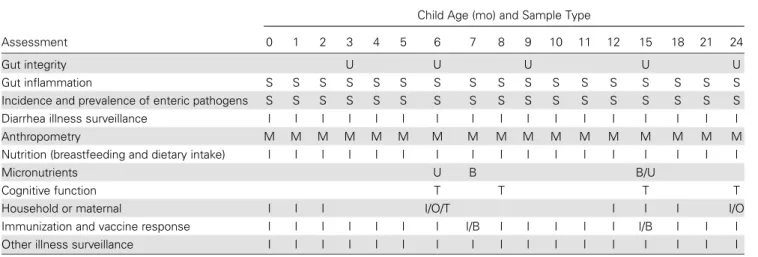
At enrollment, each child’s date of birth, sex, birth weight (if available) was recorded; information about initiation of breast-feeding was noted; and the child’s length, weight, and head cir-cumference were measured. Active surveillance for infectious diseases, general child health information, and basic dietary intake was undertaken by visiting each home twice per week. Additional visits to each household by trainedfield staff at var-ious intervals were made to collect data about health, vaccina-tions, and dietary intake, and to measure anthropometry, perform cognitive tests, and collect blood, urine, and monthly surveillance (nondiarrheal) and diarrheal stool samples. Mater-nal and household characteristics were also recorded (Table2).
Table 2. Measurement Collection/Questionnaire and Test Administration/Sample Collection Timeline for MAL-ED Cohort Studies
Assessment
Child Age (mo) and Sample Type
0 1 2 3 4 5 6 7 8 9 10 11 12 15 18 21 24
Gut integrity U U U U U
Gut inflammation S S S S S S S S S S S S S S S S S
Incidence and prevalence of enteric pathogens S S S S S S S S S S S S S S S S S
Diarrhea illness surveillance I I I I I I I I I I I I I I I I I
Anthropometry M M M M M M M M M M M M M M M M M
Nutrition (breastfeeding and dietary intake) I I I I I I I I I I I I I I I I I
Micronutrients U B B/U
Cognitive function T T T T
Household or maternal I I I I/O/T I I I I/O
Immunization and vaccine response I I I I I I I I/B I I I I I I/B I I I
Other illness surveillance I I I I I I I I I I I I I I I I I
Abbreviations: B, blood; I, interview; M, measurement; O, observation; S, stool; T, test administration; U, urine.
at Universidade Federal do Cear� on December 9, 2014
http://cid.oxfordjournals.org/
At enrollment, only the demographics and food access inse-curity portions of the SES questionnaire were collected from the households of MAL-ED study children. The complete SES and food access insecurity questionnaire was administered at 6, 12, 18, and 24 months.
Illness Surveillance and Stool Collection
During twice-weekly household visits, caregivers responded to a standardized questionnaire designed to collect a daily record of symptoms of cough, fever, vomiting, diarrhea and medication use. Stool samples were collected during diarrheal episodes (de-fined as≥3 loose stools in a 24-hour period and separated by≥2 diarrhea-free days) and during monthly home visits (nondiar-rheal specimens). Subjects experiencing moderate and severe ill-nesses (including severe diarrhea, dysentery, acute lower respiratory infections, dehydration, and fever) were referred to local health services [44].
Physical Growth
Anthropometric measurements were collected on all children monthly using standardized procedures. The weight-for-age (WAZ), length-for-age (LAZ), and weight-for-length (WLZ)z
scores are calculated using the World Health Organization (WHO) Multicentre Growth Reference Study Group program [60]. The height and weight of mothers was measured 2 months after delivery.
Microbiology
All stools were analyzed for the presence of bacterial, viral, and parasitic pathogens associated with diarrhea using tradition-al methods of microscopy, culture, enzyme-linked immunosor-bent assay (ELISA), and polymerase chain reaction (PCR) as appropriate to the pathogen [48]. These includeSalmonella,
Shigella,Vibrio,Yersinia,Aeromonas,Campylobacterand Ple-siomonas,Escherichia coli, rotavirus, norovirus, adenovirus, as-trovirus, Cryptosporidium, Giardia, Entamoeba histolytica,
Ascaris,Trichuris,Strongyloides, Cyclospora,Isospora, hook-worm, and others. PathogenicE. coliwas identified by multiplex PCR amplification of known virulence genes and included en-teropathogenic, enterotoxigenic, enteroaggregative, Shiga toxin (1 and 2)–producing, and enteroinvasive strains. Surplus stool samples were archived for use in future studies.
Cognitive Development
The cognitive development of each child was assessed through periodic administration of several validated instruments: the Bayley Scales of Infant Development [61] to assess global capac-ity (at 6, 15, and 24 months); the Infant Temperament Scale (T. Wachs, personal communication, 2010) to assess infant temperament (at 6 months); and the MacArthur Adapted Com-municative Development Inventory: Words and Gestures [62]
(at 8, 15, and 24 months) to assess language development [51]. The quality and quantity of stimulation and support avail-able to the child in his or her home environment was assessed with the HOME Inventory [63] (at 6 and 24 months).
Maternal Factors
Maternal factors including mood and reasoning ability, known to be associated with a child’s development, were assessed with the Self-Reporting Questionnaire–20 [64] (at 1, 6, 15, and 24 months). Maternal reasoning ability was assessed with the Ra-ven’s Combined Progressive Matrices instrument [65] (at 6–8 months) to control for these variables. Information about day and night blindness, and tobacco and alcohol use during preg-nancy, was collected at 2 months after delivery.
Nutrition (Breastfeeding Status and Dietary Intake)
Individual nutritional status in the MAL-ED study population was assessed through periodic quantitative and qualitative assess-ments of the food consumed during thefirst 2 years of life [47]. Information—organized with a controlled vocabulary—was entered into a searchable database. For thefirst 8 months, this information was gathered by questioning the caregiver about the extent and duration of exclusive breastfeeding and about the introduction of weaning foods collected during the twice weekly and monthly home visits. When a child was 9 months of age, the caregiver was asked monthly (until 24 months of age is reached) to recall food intake over the past 24 hours to estimate caloric intake of the child and inform assessments of dietary quality and diversity.
Micronutrients
Micronutrient levels were measured in blood samples collected at 7 and 15 months of age. Hemoglobin, ferritin, and plasma transferrin receptor were used to assess levels of iron, lead, zinc, retinol, argentine, and glutamine. Iodine levels were mea-sured in urine collected at 6 and 15 months. Because the acute-phase response to infections are known to affect micronutrient levels, the level ofα-1-acid glycoprotein present in blood was measured to serve as a control and enable accurate assessment of micronutrient status in child subjects [28].
Gut Function and Inflammation
The lactulose-mannitol test was administered to study children at 3, 6, 9, 15, and 24 months to evaluate gut permeability and absorptive capacity, respectively. Three additional proteins were also assessed to gauge aspects of gut function: α -1-antitrypsin for gut permeability, neopterin as a marker of T-helper 1 immune activation, and myeloperoxidase, which is indicative of neutrophil activity [66]. Quantitative ELISAs to detectα-1-antitrypsin, myeloperoxidase, and neopterin were performed on all stool samples.
at Universidade Federal do Cear� on December 9, 2014
http://cid.oxfordjournals.org/
Vaccine Response
During monthly home visits, caregivers provided information about the receipt of childhood vaccinations, including but not limited to those on the schedule of the WHO Expanded Pro-gram on Immunization (EPI). Vaccination records were also collected (at 3, 6, 9, 12, 15, 18, 21, and 24 months), and the in-formation source (eg, vaccine card, clinical report) was recorded. The MAL-ED study measured the response to selected paren-teral and oral vaccines administered as part of the EPI program in each country. Blood obtained at 7 and 15 months of age was used to evaluate (by ELISA) the level of immune response to pertussis toxin, measles, tetanus toxoid, poliovirus types 1, 2, 3, and rotavirus by ELISA. Poliovirus neutralization titers were also determined.
Case-Control Studies
MAL-ED intensive biweekly household surveillance and efforts to collect clinical specimens and to capture accurate data may create a“Hawthorne effect”that dramatically reduces diarrhea rates and malnutrition [67]. As an adjunct to the cohort study, 2 of the MAL-ED sites (Fortaleza, Brazil [39] and Dhaka, Bangla-desh [36]) conducted case-control studies measuring similar variables as described above. In these parallel studies, cases were defined as children from 6 to 18 months of age exhibiting a WAZ score of <–2 compared to community controls. These studies are more fully described in the site-specific articles of this supplement [36,39].
Data Management and Analysis
The Data Coordinating Center (DCC) of MAL-ED was estab-lished at the Fogarty International Center. Members of the DCC contributed to the study design and form development, and developed a double-entry database application, which simul-taneously collected and stored MAL-ED data at each site and centrally. In thefield and laboratory, data were collected on standardized forms; local data supervisors checked form completeness and accuracy prior to data entry. As an additional quality control measure, forms were double-entered into the local database; discrepancies betweenfirst and second entry were resolved by the site data entry supervisor(s).
Data from each site were transferred to a central server at the DCC using data synchronization software. The DCC provided feedback regarding data quality to site investigators through monthly data and quality control reports. In addition, site-specific “issue logs”were maintained in afile sharing Web site that provided real-time, site-specific feedback to identify er-rors and/or omissions in data entry and to facilitate corrections with minimal time delay. To standardize the definitions of ex-posure and outcome measures in MAL-ED, the DCC generated datasets that were made available across the MAL-ED Network of investigators. These datasets will serve to uniformly analyze
the exposure and outcome relationships of the MAL-ED population.
The MAL-ED Consortium and Companion Projects
The MAL-ED Network provided a scientific and administrative platform from which related projects have leveraged resources including hypothesis-based research and targeted intervention-al triintervention-als. MAL-ED companion projects—together with the cohort and case-control Network studies—constitute the larger MAL-ED Consortium. Companion project institutions and investigators have agreed to abide by the same Research Con-sortium Agreement (see below), as have all MAL-ED Network investigators. Current MAL-ED companion projects are briefly described below.
Role of the Gut Microbiome in Nutritional Status
Ancillary studies of the human gut microbiome and its role in nutrition are being conducted through a comparative metage-nomic study seeking to characterize features of the gut micro-biome associated with the development of undernutrition in children identified in the case-control study [36]:
1. Are there identifiable configurations of the gut micro-biome associated with undernutrition? If so, thefindings may have pathophysiologic and diagnostic implications. 2. How is the microbiome reconfigured with a therapeutic
food intervention, and does reconfiguration persist after cessation of the intervention?
3. What is the relationship between diet, the gut microbiome, and environmental enteropathy?
4. Can observations made in one human population be gen-eralized to another?
Answering these questions requires a detailed knowledge of the normal assembly of the microbiome in healthy children in a given cultural setting and an understanding of the variations that exist among these healthy children at given points during their postnatal development.
Genome-wide Association Scans for Undernutrition and Growth Impairment
Genome-wide studies aimed at identifying candidate human genes associated with undernutrition and growth impairment are additionally being conducted. The genetic basis for suscept-ibility to malnutrition has not been as rigorously studied as the genetic basis for susceptibility to diseases common in the devel-oped world. For obesity, the lipoprotein lipase,β-lactamase, and protein phosphatase 1–like genes have been implicated [68]. In a way, obesity and undernutrition can be considered as ex-tremes of the metabolic spectrum, and it is not unlikely that some of the genetic polymorphisms that predispose to obesity may protect from undernutrition [69]. In addition, genes that influence inflammation and infection may also impact
at Universidade Federal do Cear� on December 9, 2014
http://cid.oxfordjournals.org/
nutritional state [70,71]. The adipocytokine leptin not only controls appetite, but also promotes proinflammatory cytokine production, and variation in genes of the immune system can affect susceptibility to infections that contribute to malnutrition [72]. This study aims to narrow the gap in knowledge regarding genetic susceptibility to malnutrition through a genome-wide association scan of malnourished children.
Next-Generation Molecular Diagnostic Technologies for Developing Countries
The Next-Generation Molecular Diagnostic Technologies for Developing Countries project will advance development of en-teropathogen target–specific, quantitative, PCR-based assays capable of detecting all of the bacterial, viral, protozoal, and hel-minthic pathogens being studied in the MAL-ED project. Sam-ple extraction to amplification and detection will be tested on prototype platforms at some of the MAL-ED Networkfield sites and performance compared with results obtained by more traditional culture, microscopy, ELISA, and biochemical methods. The project deliverables are a series offield-ready pro-tocols for the diagnosis of major enteropathogens that can be deployed efficiently for future epidemiologic projects such as MAL-ED.
Molecular Markers of Immunity and the Underperformance of Mucosal Vaccines
In addition to the vaccine response analyses that will be con-ducted by MAL-ED for mucosal and parenteral vaccines, the Performance of Rotavirus and Oral Polio Vaccines in Develop-ing Countries (PROVIDE) study is usDevelop-ing state-of-the-art immu-nological methods to assess cellular immunity following vaccination and its association with protection. Additional out-come measures for the study include (i) differences in episodes of rotavirus diarrhea between rotavirus vaccinees and non-vaccinees; and (ii) change in polio plasma neutralizing antibody titer after immunization. The use of MAL-ED protocols and standardized operating procedures and resources at the MAL-ED Network site in Bangladesh are utilized in this project.
Aflatoxin Exposure and Its Effect on Growth of Children Aflatoxin exposure has been associated with growth decrements in observational studies. To better assess for this exposure in the context of many other possible growth factors, a subset of blood and urine samples from the MAL-ED study will be assessed for exposures to aflatoxins as an exploratory analysis to investigate the degree of association.
As the data collected from the MAL-ED study populations are explored, associations between factors measured, and health outcomes better defined, it is anticipated that additional oppor-tunities to leverage MAL-ED data and samples and the site’s ca-pacities will emerge from diverse research enterprises in the
public and private sectors for hypothesis-driven research and intervention studies.
Research Consortium Agreement
A Research Consortium Agreement (RCA) was developed and adopted by all collaborating investigators and their institutions in the MAL-ED Consortium prior to the onset of data collection and/or sharing. The RCA provides the organizational frame-work for the project including management and authorities, governance structure, methods of dispute resolution, and au-thority of the Network and its associated advisory committees. The RCA also provides guidance on publication; intellectual property; and data ownership, sharing, and release policies. The intent of these policies is to ensure that the importantfi nd-ings resulting from the study are used to benefit those in low-income countries who are most affected. Clearly delineating these issues, with input from the participating institutions and investigators prior to study initiation, was important to effec-tively establishing harmonization of the study; having the docu-ment in place has helped to facilitate the addition of other studies as companion projects.
DISCUSSION
The multiple interactions of enteric infections, malnutrition, and gut function and their synergistic effect on physical growth, cognitive development, and immune response provide the working hypotheses of MAL-ED. The structural components of this system of relationships and interactions are based on 2 lines of reasoning: (i) experiential expert knowledge of biolog-ical mechanisms and (ii) empirical evidence identifying key components, both risk factors and health outcomes. Together, it is possible to piece together hypothetical ways in which these components interrelate: the components explored by MAL-ED have been described in this introductory article (Figure1) and are explored in greater detail in the MAL-ED methodological articles of this supplement [44–51].
Empirical evidence to date has usually been derived from studies concentrating on a single outcome. Such a focus ignores the potentially reciprocal and interdependent relationships that we hypothesize exist between the components of this system. The incidence and prevalence of chronic undernutrition man-ifested as stunting is commonly observed, but the mechanis-tic causes are poorly understood. Studies to define and quantify the role of particular enteropathogens and their contri-bution to malnutrition or diminished immune response have been limited by small sample sizes, narrow geographic scope, and/or a lack of robust diagnostic tests [73, 74]. Often they have been predicated on a“one pathogen, one disease” as-sumption, attributing symptoms to the presence of individual pathogens without consideration for coinfection, timing, or
at Universidade Federal do Cear� on December 9, 2014
http://cid.oxfordjournals.org/
quantification of pathogens. By definition, pathogens cause damage to their host; however, the ambiguity over the detection, let alone role, of enteric pathogens means that their short- and long-term consequences—especially of chronic and recurrent infections—against the backdrop of this wider system of risks and exposures have not been well characterized to date. Indeed, some enteric pathogens may not cause diarrhea, and therefore are not readily measured or studied in clinical research. Thus the frequency of carriage or infection with these pathogens or their consequences (not associated with diarrhea)—particularly in young children—remains understudied. It is anticipated that the community-based, longitudinal design of MAL-ED will bet-ter capture the“average”exposure to enteric pathogens and other factors and more clearly elucidate the consequences of this system of interdependent exposures on child development. Whether considering single components of this system or the interdependencies, the dilemma with how these components are combined is that the underlying heterogeneity of different populations yields variable rankings of risks and health out-comes [75–89]. Any given case study typically focuses on singu-lar aspects of the system we have described—be that a study of diarrhea, a specific pathogen, socioeconomic status, or growth attainment [90–93]. Between populations, however, the evi-dence can vary and produce disparate results and expert opin-ion. Different populations, for example, experience both different pathogens and in different quantities. Add to this a range of diets and behaviors, and the resulting health outcomes of any single population may not be representative of another. In applying a harmonized protocol across 8 geographically, so-cioeconomically, and culturally diverse populations, MAL-ED expects to identify relationships between health determinants and outcomes that are both uniform across all sites and dispa-rate between sites. Improving the characterization of the simi-larities and divergence of these relationships would potentially inform decisions about how to most effectively apply as well as adapt interventions to achieve the desired improvements in health outcomes in variable settings. Furthermore, among the important relationships and pathways identified, we expect some to be more or less amenable to intervention. Demographic and socioeconomic characteristics along with general health indicators of each of the 8 MAL-ED research sites are included in the individual papers of this supplement. These papers also contain information about the recruitment and training strategies employed at the sites to implement the MAL-ED protocol [36–43].
As a central objective of MAL-ED, untangling the complicated web of malnutrition and enteric disease is considered a crucial factor in the development of interventions that will improve child health in resource-poor environments. These interventions will ideally account for the multiple and interacting risk factors affecting child development and, given likely limited resources,
include consideration of optimal timing and targeting for maxi-mal impact. Improvements in early childhood growth and devel-opment can have long-lasting impact, through improved school readiness, educational achievement, and, ultimately, improving the economic potential for individuals and their communities. MAL-ED may provide some insights into targeted interventions at this age.
Notes
Acknowledgments. The authors thank the staff and participants of the MAL-ED Network for their important contributions.
Financial support. The Etiology, Risk Factors and Interactions of En-teric Infections and Malnutrition and the Consequences for Child Health and Development Project (MAL-ED) is carried out as a collaborative project supported by the Bill & Melinda Gates Foundation, the Foundation for the NIH, and the National Institutes of Health, Fogarty International Center.
Supplement sponsorship. This article appeared as part of the supple-ment“The Malnutrition and Enteric Disease Study (MAL-ED): Under-standing the Consequences for Child Health and Development,” sponsored by the National Institutes of Health and the Foundation for the National Institutes of Health.
Potential conflicts of interest. No potential conflicts of interest. Authors have submitted the ICMJE Form for Disclosure of Potential
Con-flicts of Interest. Conflicts that the editors consider relevant to the content of the manuscript have been disclosed.
References
1. Stevens GA, Finucane MM, Paciorek CJ, et al. Trends in mild, moderate, and severe stunting and underweight, and progress towards MDG 1 in 141 developing countries: a systematic analysis of population represen-tative data. Lancet2012; 380:824–34.
2. Victora CG, Adair L, Fall C, et al. Maternal and child undernutrition: consequences for adult health and human capital. Lancet 2008; 371:340–57.
3. Briend A, Collins S. Therapeutic nutrition for children with severe acute malnutrition summary of African experience. Indian Pediatr2010; 47:655–9.
4. Nahar B, Ahmed T, Brown KH, Hossain MI. Risk factors associated with severe underweight among young children reporting to a diarrhoea treatment facility in Bangladesh. J Health Popul Nutr2010; 28:476–483. 5. Becquet R, Leroy V, Ekouevi DK, et al. Complementary feeding adequa-cy in relation to nutritional status among early weaned breastfed chil-dren who are born to HIV-infected mothers: ANRS 1201/1202 Ditrame Plus, Abidjan, Cote d’Ivoire. Pediatrics2006; 117:e701–10.
6. Bhandari N, Mazumder S, Bahl R, et al. An educational intervention to promote appropriate complementary feeding practices and physical growth in infants and young children in rural Haryana, India. J Nutr
2004; 134:2342–8.
7. Dewey KG. The challenges of promoting optimal infant growth. J Nutr
2001; 131:1879–80.
8. Caulfield LE, Richard SA, Rivera JA, Musgrove P, Black RE. Stunting, wasting, and micronutrient deficiency disorders. In: Jamison DT, Breman JG, Measham AR, et al., eds. Disease control priorities in devel-oping countries. 2nd ed. Washington, DC: Oxford University Press,
2006:413–32.
9. Berhe G. Tulimbe Nutrition Project: a community-based dietary inter-vention to combat micronutrient malnutrition in rural southern Malawi. SCN News1997; 15:25–6.
10. Bwibo NO, Neumann CG. The need for animal source foods by Kenyan children. J Nutr2003; 133:3936S–40S.
11. Gupta K, Gupta R, Atreja A, Verma M, Vishvkarma S. Tuberculosis and nutrition. Lung India2009; 26:9–16.
at Universidade Federal do Cear� on December 9, 2014
http://cid.oxfordjournals.org/
12. Macallan DC, McNurlan MA, Kurpad AV, et al. Whole body protein metabolism in human pulmonary tuberculosis and undernutrition: ev-idence for anabolic block in tuberculosis. Clin Sci (Lond)1998; 94:321–31.
13. Paton NI, Ng YM, Chee CB, Persaud C, Jackson AA. Effects of tuber-culosis and HIV infection on whole-body protein metabolism during feeding, measured by the [15N]glycine method. Am J Clin Nutr
2003; 78:319–25.
14. Deitch EA, Winterton J, Li M, Berg R. The gut as a portal of entry for bacteremia—role of protein-malnutrition. Ann Surg1987; 205:681–92. 15. Salvatore S, Hauser B, Devreker T, Arrigo S, Vandenplas Y. Chronic en-teropathy and feeding in children: an update. Nutrition2008; 24: 1205–16.
16. Solomons NW. Pathways to the impairment of human nutritional status by gastrointestinal pathogens. Parasitology1993; 107:S19–35. 17. Petri WA Jr, Miller M, Binder HJ, Levine MM, Dillingham R, Guerrant
RL. Enteric infections, diarrhea, and their impact on function and development. J Clin Invest2008; 118:1277–90.
18. Mata LJ, Urrutia JJ, Albertazzi C, Pellecer O, Arellano E. Influence of recurrent infections on nutrition and growth of children in Guatemala. Am J Clin Nutr1972; 25:1267–75.
19. Campbell DI, Elia M, Lunn PG. Growth faltering in rural Gambian in-fants is associated with impaired small intestinal barrier function, lead-ing to endotoxemia and systemic inflammation. J Nutr2003; 133: 1332–8.
20. Gadewar S, Fasano A. Current concepts in the evaluation, diagnosis and management of acute infectious diarrhea. Curr Opin Pharmacol2005; 5:559–65.
21. Scrimshaw NS. Historical concepts of interactions, synergism and antagonism between nutrition and infection. J Nutr 2003; 133: 316s–21s.
22. Sripaipan T, Schroeder DG, Marsh DR, et al. Effect of an integrated nutrition program on child morbidity due to respiratory infection and diarrhea in northern Viet Nam. Food Nutr Bull2002; 23:70–7. 23. Keusch GT, Denno DM, Black RE, et al. Environmental enteric
dysfunc-tion: pathogenesis, diagnosis, and clinical consequences. Clin Infect Dis
2014; 59(suppl 4):S207–12.
24. Lunn PG. The impact of infection and nutrition on gut function and growth in childhood. Proc Nutr Soc2000; 59:147–54.
25. Lunn PG, Northrop-Clewes CA, Downes RM. Recent developments in the nutritional management of diarrhoea. 2. Chronic diarrhoea and malnutrition in The Gambia: studies on intestinal permeability. Trans R Soc Trop Med Hyg1991; 85:8–11.
26. Ferraris RP, Carey HV. Intestinal transport during fasting and malnu-trition. Annu Rev Nutr2000; 20:195–219.
27. Sharp TM, Estes MK. An inside job: subversion of the host secretory pathway by intestinal pathogens. Curr Opin Infect Dis2010; 23:464–9. 28. Tomkins A. Assessing micronutrient status in the presence of infl
am-mation. J Nutr2003; 133:1649S–55S.
29. John TJ. Antibody response of infants in tropics tofive doses of oral polio vaccine. Br Med J1976; 1:812.
30. Armah GE, Sow SO, Breiman RF, et al. Efficacy of pentavalent rotavirus vaccine against severe rotavirus gastroenteritis in infants in developing countries in sub-Saharan Africa: a randomised, double-blind, placebo-controlled trial. Lancet2010; 376:606–14.
31. Madhi SA, Cunliffe NA, Steele D, et al. Effect of human rotavirus vac-cine on severe diarrhea in African infants. N Engl J Med 2010; 362:289–98.
32. Paul Y. Why polio has not been eradicated in India despite many reme-dial interventions? Vaccine2009; 27:3700–3.
33. Checkley W, Gilman RH, Epstein LD, et al. Asymptomatic and symp-tomatic cryptosporidiosis: their acute effect on weight gain in Peruvian children. Am J Epidemiol1997; 145:156–63.
34. Molbak K, Andersen M, Aaby P, et al. Cryptosporidium infection in in-fancy as a cause of malnutrition: a community study from Guinea-Bissau, West Africa. Am J Clin Nutr1997; 65:149–52.
35. Checkley W, Epstein LD, Gilman RH, Cabrera L, Black RE. Effects of acute diarrhea on linear growth in Peruvian children. Am J Epidemiol
2003; 157:166–75.
36. Ahmed T, Mahfuz M, Islam MM, et al. The MAL-ED cohort study in Mirpur, Bangladesh. Clin Infect Dis2014; 59(suppl 4):S280–6. 37. Bessong P, Nyathi E, Mahopo C, Netshandama V. Development of
the Dzimauli community in Vhembe district, Limpopo province of South Africa for the MAL-ED cohort study. Clin Infect Dis2014; 59(suppl 4):S317–24.
38. John SM, Thomas RJ, Kaki S, et al. Establishment of the MAL-ED birth cohort study site in Vellore, southern India. Clin Infect Dis2014; 59(suppl 4):S295–9.
39. Lima A, Oriá RB, Soares AM, et al. Geography, population, demogra-phy, socioeconomic, anthropometry, and environmental status in the MAL-ED cohort and case-control study sites in Fortaleza, Ceará, Brazil. Clin Infect Dis2014; 59(suppl 4):S287–94.
40. Mduma ER, Gratz J, Patil C, et al. The Etiology, Risk Factors and Inter-actions of Enteric Infections and Malnutrition and the Consequences for Child Health and Development Study (MAL-ED): description of the Tanzanian site. Clin Infect Dis2014; 59(suppl 4):S325–30. 41. Shrestha PS, Shrestha SK, Bodhidatta L, et al. Bhaktapur, Nepal: the
MAL-ED birth cohort study in Nepal. Clin Infect Dis2014; 59(suppl 4):S300–3. 42. Turab A, SoofiSB, Ahmed I, et al. Demographic, socioeconomic, and health characteristics of the MAL-ED network study site in rural Pakistan. Clin Infect Dis2014; 59(suppl 4):S304–9.
43. Yori PP, Lee G, Olórtegui MP, et al. Santa clara de nanay: the MAL-ED cohort in Peru. Clin Infect Dis2014; 59(suppl 4):S310–6.
44. Richard SA, Barrett L, Guerrant RL, et al. Disease surveillance methods used in the 8-site MAL-ED cohort study. Clin Infect Dis2014; 59(suppl 4): S220–4.
45. Hoest C, Seidman JC, Pan W, et al. Evaluating associations between vac-cine response and malnutrition, gut function, and enteric infections in the MAL-ED cohort study: methods and challenges. Clin Infect Dis
2014; 59(suppl 4):S273–9.
46. Richard SA, McCormick BJ, Miller M, Caulfield LE, Checkley W. Mod-eling environmental influences on child growth in the MAL-ED cohort study: opportunities and challenges. Clin Infect Dis2014; 59(suppl 4): S255–60.
47. Caulfield LE, Bose A, Chandyo RK, et al. Infant feeding practices, die-tary adequacy, and micronutrient status measures in the MAL-ED co-hort study. Clin Infect Dis2014; 59(suppl 4):S248–54.
48. Houpt E, Gratz J, Kosek M, et al. Microbiologic methods utilized in the MAL-ED cohort study. Clin Infect Dis2014; 59(suppl 4):S225–32. 49. Platts-Mills JA, McCormick BJJ, Kosek M, Pan W, Checkley W, Houpt
ER. Methods of analysis of enteropathogen infection in the MAL-ED cohort study. Clin Infect Dis2014; 59(suppl 4):S233–8.
50. Kosek M, Guerrant RL, Kang G, et al. Assessment of environmental en-teropathy in the MAL-ED cohort study: theoretical and analytic frame-work. Clin Infect Dis2014; 59(suppl 4):S239–47.
51. Murray-Kolb LE, Rasmussen ZA, Scharf RJ, et al. The MAL-ED cohort study: methods and lessons learned when assessing early child development and caregiving mediators in infants and young children in 8 low- and middle-income countries. Clin Infect Dis2014; 59(suppl 4):S261–72.
52. Denno DM, Van Buskirk K, Nelson ZC, Musser CA, Burgess DCH, Tarr PI. Use of the lactulose:mannitol ratio to evaluate childhood envi-ronmental enteric dysfunction: a systematic review. Clin Infect Dis
2014; 59(suppl 4):S213–19.
53. Guzy C, Schirbel A, Paclik D, Wiedenmann B, Dignass A, Sturm A. En-teral and parenEn-teral nutrition distinctively modulate intestinal perme-ability and T cell function in vitro. Eur J Nutr2009; 48:12–21. 54. Wildt S, Madsen JL, Rumessen JJ. Small-bowel permeability in
collage-nous colitis. Scand J Gastroenterol2006; 41:1044–9.
55. D’Antiga L, Dhawan A, Davenport M, Mieli-Vergani G, Bjarnason I. Intestinal absorption and permeability in paediatric short-bowel syn-drome: a pilot study. J Pediatr Gastroenterol Nutr1999; 29:588–93.
at Universidade Federal do Cear� on December 9, 2014
http://cid.oxfordjournals.org/
56. Barboza MS Jr, Silva TMJ, Guerrant RL, Lima AAM. Measurement of intestinal permeability using mannitol and lactulose in children with di-arrheal diseases. Braz J Med Biol Res1999; 32:1499–504.
57. Vilela EG, Torres HO, Ferrari ML, Lima AS, Cunha AS. Gut permeabil-ity to lactulose and mannitol differs in treated Crohn’s disease and celiac disease patients and healthy subjects. Braz J Med Biol Res 2008; 41:1105–9.
58. Andre F, Andre C, Emery Y, Forichon J, Descos L, Minaire Y. Assess-ment of the lactulose-mannitol test in Crohn’s disease. Gut1988; 29:511–5.
59. Coates J, Swindale A, Bilinsky P. Household Food Insecurity Access Scale (HFIAS) for measurement of food access: indicator guide. Available at: http://www.fantaproject.org/monitoring-and-evaluation/household-food-insecurity-access-scale-hfias. Accessed 23 April 2014.
60. World Health Organization Multicentre Growth Reference Study Group. WHO child growth standards based on length/height, weight and age. Acta Paediatr Suppl2006; 450:76–85.
61. Bayley N. Bayley scales of infant and toddler development. 3rd ed. San Antonio, TX: Psychological Corp,2006.
62. Fenson L, Dale P, Reznick JS, et al. The MacArthur Communicative De-velopment Inventories: user’s guide and technical manual. San Diego, CA: Singular Publishing Group,1993.
63. Agarwal DK, Awasthy A, Upadhyay SK, Singh P, Kumar J, Agarwal K. Growth, behavior, development and intelligence in rural children be-tween 1–3 years of life. Indian Pediatr1992; 29:467–80.
64. Ho-Yen SD, Bondevik GT, Eberhard-Gran M, Bjorvatn B. The preva-lence of depressive symptoms in the postnatal period in Lalitpur district, Nepal. Acta Obstet Gynecol Scand2006; 85:1186–92.
65. Raven J, Raven JC, Court JH. Manual for Raven’s progressive matrices and vocabulary scales. Oxford, UK: Psychologists Press,2003. 66. Kosek M, Haque R, Lima A, et al. Fecal markers of intestinal infl
amma-tion and permeability associated with the subsequent acquisiamma-tion of lin-ear growth deficits in infants. Am J Trop Med Hyg2013; 88:390–6. 67. Haggerty PA, Muladi K, Kirkwood BR, Ashworth A, Manunebo M.
Community-based hygiene education to reduce diarrhoeal disease in rural Zaire: impact of the intervention on diarrhoeal morbidity. Int J Epidemiol1994; 23:1050–9.
68. Chen Y, Zhu J, Lum PY, et al. Variations in DNA elucidate molecular networks that cause disease. Nature2008; 452:429–35.
69. St-Pierre DH, George V, Rabasa-Lhoret R, Poehlman ET. Genetic var-iation and statistical considerations in relation to overfeeding and un-derfeeding in humans. Nutrition2004; 20:145–54.
70. Matarese G, Sanna V, Fontana S, Zappacosta S. Leptin as a novel ther-apeutic target for immune intervention. Curr Drug Targets Inflamm Allergy2002; 1:13–22.
71. Manary MJ, Muglia LJ, Vogt SK, Yarasheski KE. Cortisol and its action on the glucocorticoid receptor in malnutrition and acute infection. Me-tabolism2006; 55:550–4.
72. Ondrak KS, Hackney AC. Body composition differences in normal weight, obese-overweight and anorexic adolescents: role of adipocyto-kines. Med Sport Sci2010; 55:32–42.
73. Al Jarousha AM, El Jarou MA, El Qouqa IA. Bacterial enteropathogens and risk factors associated with childhood diarrhea. Indian J Pediatr
2011; 78:165–70.
74. Neto UF, Toccalino H, Dujovney F. Stool bacterial aerobic overgrowth in the small intestine of children with acute diarrhoea. Acta Paediatr Scand1976; 65:609–15.
75. Checkley W, Buckley G, Gilman RH, et al. Multi-country analysis of the effects of diarrhoea on childhood stunting. Int J Epidemiol2008; 37:816–30.
76. Griffiths P, Madise N, Whitworth A, Matthews Z. A tale of two conti-nents: a multilevel comparison of the determinants of child nutritional status from selected African and Indian regions. Health Place2004; 10:183–99.
77. Biswas K, Carty C, Horney R, et al. Data management and other logis-tical challenges for the GEMS: the data coordinating center perspective. Clin Infect Dis2012; 55(suppl 4):S254–61.
78. Blackwelder WC, Biswas K, Wu Y, et al. Statistical methods in the Glob-al Enteric Multicenter Study (GEMS). Clin Infect Dis2012; 55(suppl 4): S246–53.
79. Boschi-Pinto C, Velebit L, Shibuya K. Estimating child mortality due to diarrhoea in developing countries. Bull World Health Organ2008; 86:710–7.
80. Farag TH, Nasrin D, Wu Y, et al. Some epidemiologic, clinical, micro-biologic, and organizational assumptions that influenced the design and performance of the Global Enteric Multicenter Study (GEMS). Clin Infect Dis2012; 55(suppl 4):S225–31.
81. Kotloff KL, Blackwelder WC, Nasrin D, et al. The Global Enteric Multicenter Study (GEMS) of diarrheal disease in infants and young children in developing countries: epidemiologic and clinical meth-ods of the case/control study. Clin Infect Dis2012; 55(suppl 4):S232–45. 82. Levine MM, Kotloff KL, Nataro JP, Muhsen K. The Global Enteric Mul-ticenter Study (GEMS): impetus, rationale, and genesis. Clin Infect Dis
2012; 55(suppl 4):S215–24.
83. Levine MM, Robins-Browne RM. Factors that explain excretion of enteric pathogens by persons without diarrhea. Clin Infect Dis2012; 55(suppl 4):S303–11.
84. Muhsen K, Levine MM. A systematic review and meta-analysis of the association betweenGiardia lambliaand endemic pediatric diar-rhea in developing countries. Clin Infect Dis 2012; 55(suppl 4): S271–93.
85. Panchalingam S, Antonio M, Hossain A, et al. Diagnostic microbiologic methods in the GEMS-1 case/control study. Clin Infect Dis2012; 55(suppl 4):S294–302.
86. Rheingans R, Kukla M, Adegbola RA, et al. Exploring household eco-nomic impacts of childhood diarrheal illnesses in 3 African settings. Clin Infect Dis2012; 55(suppl 4):S317–26.
87. Rheingans R, Kukla M, Faruque AS, et al. Determinants of household costs associated with childhood diarrhea in 3 South Asian settings. Clin Infect Dis2012; 55(suppl 4):S327–35.
88. Robins-Browne RM, Levine MM. Laboratory diagnostic challenges in case/control studies of diarrhea in developing countries. Clin Infect Dis2012; 55(suppl 4):S312–6.
89. Sommerfelt H, Steinsland H, van der Merwe L, et al. Case/control stud-ies with follow-up: constructing the source population to estimate ef-fects of risk factors on development, disease, and survival. Clin Infect Dis2012; 55(suppl 4):S262–70.
90. Ahiadeke C. Breast-feeding, diarrhoea and sanitation as components of infant and child health: a study of large scale survey data from Ghana and Nigeria. J Biosoc Sci2000; 32:47–61.
91. Checkley W, Epstein LD, Gilman RH, Black RE, Cabrera L, Sterling CR. Effects ofCryptosporidium parvuminfection in Peruvian children: growth faltering and subsequent catch-up growth. Am J Epidemiol
1998; 148:497–506.
92. El Taguri A, Betilmal I, Mahmud SM, et al. Risk factors for stunting among under-fives in Libya. Public Health Nutr2009; 12:1141–9. 93. Genser B, Strina A, dos Santos LA, et al. Impact of a city-wide sanitation
intervention in a large urban centre on social, environmental and be-havioural determinants of childhood diarrhoea: analysis of two cohort studies. Int J Epidemiol2008; 37:831–40.
at Universidade Federal do Cear� on December 9, 2014
http://cid.oxfordjournals.org/
APPENDIX
MAL-ED Network Investigators
Last Name First Name Institution Role in the MAL-ED Network
Acosta Angel Mendez A.B. PRISMA, Iquitos, Peru Data management
Chavez Cesar Banda A.B. PRISMA, Iquitos, Peru Laboratory
Flores Julian Torres A.B. PRISMA, Iquitos, Peru Laboratory
Olotegui Maribel Paredes A.B. PRISMA, Iquitos, Peru Study coordinator
Pinedo Silvia Rengifo A.B. PRISMA, Iquitos, Peru Nutrition
Trigoso Dixner Rengifo A.B. PRISMA, Iquitos, Peru Laboratory
Vasquez Angel Orbe A.B. PRISMA, Iquitos, Peru Psychologist, cognitive development
Ahmed Imran Aga Khan University, Naushahro Feroze, Pakistan Data management
Alam Didar Aga Khan University, Naushahro Feroze, Pakistan Laboratory, nutrition
Ali Asad Aga Khan University, Naushahro Feroze, Pakistan Vaccine response
Bhutta Zulfiqar A. Aga Khan University, Naushahro Feroze, Pakistan Pakistan site PI Qureshi Shahida Aga Khan University, Naushahro Feroze, Pakistan Laboratory, microbiology
Shakoor’ Sadia Aga Khan University, Naushahro Feroze, Pakistan Microbiology
Soofi Sajid Aga Khan University, Naushahro Feroze, Pakistan Operations, surveillance Turab Ali Aga Khan University, Naushahro Feroze, Pakistan Operations, surveillance, nutrition Yousafzai Aisha K. Aga Khan University, Naushahro Feroze, Pakistan Cognitive development
Zaidi Anita K. M. Aga Khan University, Naushahro Feroze, Pakistan Pakistan site co-PI, microbiology
Bodhidatta Ladaporn AFRIMS, Bangkok, Thailand Microbiology
Mason Carl J. AFRIMS, Bangkok, Thailand Nepal site PI, vaccine response
Babji Sudhir Christian Medical College, Vellore, India Microbiology supervisor
Bose Anuradha Christian Medical College, Vellore, India Nutrition
John Sushil Christian Medical College, Vellore, India India site co-PI
Kang Gagandeep Christian Medical College, Vellore, India India site PI
Kurien Beena Christian Medical College, Vellore, India Cognitive development supervisor
Muliyil Jayaprakash Christian Medical College, Vellore, India Epidemiology
Raghava Mohan Venkata Christian Medical College, Vellore, India Data management
Ramachandran Anup Christian Medical College, Vellore, India Biochemistry, nutrition
Rose Anuradha Christian Medical College, Vellore, India Epidemiology
Pan William Duke University, Durham, NC, USA DCC, biostatistician
Ambikapathi Ramya FIC, NIH, Bethesda, MD, USA DCC, nutrition
Carreon Danny FIC, NIH, Bethesda, MD, USA DCC, SES, and data management
Charu Vivek FIC, NIH, Bethesda, MD, USA DCC, data management
Dabo Leyfou FIC, NIH, Bethesda, MD, USA DCC, data management
Doan Viyada FIC, NIH, Bethesda, MD, USA DCC, data management
Graham Jhanelle FIC, NIH, Bethesda, MD, USA DCC, data management
Hoest Christel FIC, NIH, Bethesda, MD, USA DCC, vaccine response
Knobler Stacey FIC, NIH, Bethesda, MD, USA Senior scientific program director
Lang Dennis FIC, NIH, Bethesda, MD, USA Senior program coordinator
McCormick Benjamin FIC, NIH, Bethesda, MD, USA DCC, computational biology
McGrath Monica FIC, NIH, Bethesda, MD, USA DCC, QA/QC lead, microbiology,
epidemiology
Miller Mark FIC, NIH, Bethesda, MD, USA PI
Mohale Archana FIC, NIH, Bethesda, MD, USA DCC, data management
Nayyar Gaurvika FIC, NIH, Bethesda, MD, USA DCC, data management
Psaki Stephanie FIC, NIH, Bethesda, MD, USA DCC, SES
Rasmussen Zeba FIC, NIH, Bethesda, MD, USA DCC, cognitive development,
epidemiology
Richard Stephanie FIC, NIH, Bethesda, MD, USA DCC, surveillance, epidemiology
at Universidade Federal do Cear� on December 9, 2014
http://cid.oxfordjournals.org/
continued.
Last Name First Name Institution Role in the MAL-ED Network
Seidman Jessica FIC, NIH, Bethesda, MD, USA DCC program manager, gut function,
cognitive development, vaccine response
Wang Vivian FIC, NIH, Bethesda, MD, USA DCC, data management
Blank Rebecca FNIH, Bethesda, MD, USA Scientific program manager
Gottlieb Michael FNIH, Bethesda, MD, USA PI
Tountas Karen FNIH, Bethesda, MD, USA Scientific program manager
Amour Caroline Haydom Lutheran Hospital, Haydom, Tanzania Laboratory
Mduma Estomih Haydom Lutheran Hospital, Haydom, Tanzania Tanzania site co-PI, field site manager
Ahmed Tahmeed ICDDR-B, Dhaka, Bangladesh Bangladesh site PI, nutrition
Ahmed A. M. Shamsir ICDDR-B, Dhaka, Bangladesh Field supervisor
Dinesh Mondol ICDDR-B, Dhaka, Bangladesh Microbiology supervisor
Tofail Fahmida ICDDR-B, Dhaka, Bangladesh Cognitive development
Haque Rashidul ICDDR-B, Dhaka, Bangladesh Bangladesh site co-PI
Hossain Iqbal ICDDR-B, Dhaka, Bangladesh Coordinator, case control
Islam Munirul ICDDR-B, Dhaka, Bangladesh Nutrition
Mahfuz Mustafa ICDDR-B, Dhaka, Bangladesh Field supervisor
Chandyo Ram Krishna IOM, Tribuhvan University, Kathmandu, Nepal Field manager, nutrition Shrestha Prakash Sunder IOM, Tribuhvan University, Kathmandu, Nepal Nepal site co-PI
Shrestha Rita IOM, Tribuhvan University, Kathmandu, Nepal Psychologist
Ulak Manjeswori IOM, Tribuhvan University, Kathmandu, Nepal Clinical supervisor
Black Robert JHU, Baltimore, MD, USA Epidemiology
Caulfield Laura JHU, Baltimore, MD, USA JHU site PI, nutrition
Checkley William JHU, Baltimore, MD, USA DCC, epidemiology, statistician
Chen Ping JHU, Baltimore, MD, USA Data management
Kosek Margaret JHU, Baltimore, MD, USA Peru site PI, gut function
Lee Gwenyth JHU, Baltimore, MD, USA Nutrition, gut function
Yori Pablo Peñataro JHU, Baltimore, MD, USA Data management
Murray-Kolb Laura Pennsylvania State University, University Park, PA, USA Lead, cognitive development Schaefer Barbara Pennsylvania State University, University Park, PA, USA DCC, cognitive development,
psychometrics
Pendergast Laura Temple University, Philadelphia, PA, USA DCC, cognitive development,
psychometrics Abreu Claudia Universidade Federal do Ceará, Fortaleza, Brazil Study coordinator Bindá Alexandre Universidade Federal do Ceará, Fortaleza, Brazil Laboratory
Costa Hilda Universidade Federal do Ceará, Fortaleza, Brazil Psychologist
Di Moura Alessandra Universidade Federal do Ceará, Fortaleza, Brazil Nurse study coordinator Filho Jose Quirino Universidade Federal do Ceará, Fortaleza, Brazil DCC, data management
Leite Álvaro Universidade Federal do Ceará, Fortaleza, Brazil Pediatrician
Lima Aldo Universidade Federal do Ceará, Fortaleza, Brazil Brazil site PI
Lima Noelia Universidade Federal do Ceará, Fortaleza, Brazil Pediatrician
Lima Ila Universidade Federal do Ceará, Fortaleza, Brazil Laboratory
Maciel Bruna Universidade Federal do Ceará, Fortaleza, Brazil Nutrition
Moraes Milena Universidade Federal do Ceará, Fortaleza, Brazil Nutrition
Mota Francisco Universidade Federal do Ceará, Fortaleza, Brazil Pediatrician Oria Reinaldo Universidade Federal do Ceará, Fortaleza, Brazil Brazil site co-PI
Quetz Josiane Universidade Federal do Ceará, Fortaleza, Brazil Laboratory
Soares Alberto Universidade Federal do Ceará, Fortaleza, Brazil Data management
Svensen Erling University of Bergen, Norway; Haydom Lutheran
Hospital, Haydom, Tanzania
Tanzania site PI, cognitive development
Tor Strand University of Bergen, Norway Consultant, nutrition
Patil Crystal University of Illinois, Urbana-Champaign, IL, USA Nutrition
at Universidade Federal do Cear� on December 9, 2014
http://cid.oxfordjournals.org/
continued.
Last Name First Name Institution Role in the MAL-ED Network
Bessong Pascal University of Venda, Thohoyandou, South Africa South Africa site PI
Mahopo Cloupas University of Venda, Thohoyandou, South Africa Nutrition
Mapula Angelina University of Venda, Thohoyandou, South Africa Psychology supervisor, cognitive development
Nesamvuni Cebisa University of Venda, Thohoyandou, South Africa Nutrition
Nyathi Emanuel University of Venda, Thohoyandou, South Africa Data management
Samie Amidou University of Venda, Thohoyandou, South Africa Laboratory supervisor
Barrett Leah UVA, Charlottesville, VA, USA Study coordinator
Gratz Jean UVA, Charlottesville, VA, USA Laboratory, Tanzania site
Guerrant Richard UVA, Charlottesville, VA, USA UVA PI, surveillance, cognitive
development
Houpt Eric UVA, Charlottesville, VA, USA Microbiology, Tanzania site development
Olmsted Liz UVA, Charlottesville, VA, USA Financial manager
Petri William UVA, Charlottesville, VA, USA UVA co-PI, vaccine response
Platts-Mills James UVA, Charlottesville, VA, USA DCC, microbiology
Scharf Rebecca UVA, Charlottesville, VA, USA Cognitive development
Shrestha Binob Walter Reed/AFRIMS Research Unit, Kathmandu,
Nepal
Data management
Shrestha Sanjaya Kumar Walter Reed/AFRIMS Research Unit, Kathmandu,
Nepal Nepal site co-PI, gut function
Abbreviations: AFRIMS, Armed Forces Research Institute of Medical Sciences; DCC, Data Coordinating Center; FIC, Fogarty International Center; FNIH, Foundation for the National Institutes of Health; ICDDR,B, International Centre for Diarrhoeal Disease Research, Bangladesh; IL, Illinois; IOM, Institute of Medicine; JHU, Johns Hopkins University; MD, Maryland; NC, North Carolina; NIH, National Institutes of Health; PA, Pennsylvania; PI, principal investigator; SES, socioeconomic status; USA, United States of America; UVA, University of Virginia; VA, Virginia.
at Universidade Federal do Cear� on December 9, 2014
http://cid.oxfordjournals.org/