Human aging and somatic point mutations in mtDNA: A comparative study
of generational differences (grandparents and grandchildren)
Anderson Nonato do Rosário Marinho
1, Milene Raiol de Moraes
1,2, Sidney Santos
1and Ândrea Ribeiro-dos-Santos
11
Laboratório de Genética Humana e Médica, Instituto de Ciências Biológicas,
Universidade Federal do Pará, Belém, PA, Brazil.
2
Prefeitura Municipal de Belém, Belém, PA, Brazil.
Abstract
The accumulation of somatic mutations in mtDNA is correlated with aging. In this work, we sought to identify somatic mutations in the HVS-1 region (D-loop) of mtDNA that might be associated with aging. For this, we compared 31 grandmothers (mean age: 63±2.3 years) and their 62 grandchildren (mean age: 15±4.1 years), the offspring of their daughters. Direct DNA sequencing showed that mutations absent in the grandchildren were detected in a pre-sumably homoplasmic state in three grandmothers and in a heteroplasmic state in an additional 13 grandmothers; no mutations were detected in the remaining 15 grandmothers. However, cloning followed by DNA sequencing in 12 grandmothers confirmed homoplasia in only one of the three mutations previously considered to be homoplasmic and did not confirm heteroplasmy in three out of nine grandmothers found to be heteroplasmic by direct sequencing. Thus, of 12 grandmothers in whom mtDNA was analyzed by cloning, eight were heteroplasmic for mutations not de-tected in their grandchildren. In this study, the use of genetically related subjects allowed us to demonstrate the oc-currence of age-related (> 60 years old) mutations (homoplasia and heteroplasmy). It is possible that both of these situations (homoplasia and heteroplasmy) were a long-term consequence of mitochondrial oxidative phosphoryl-ation that can lead to the accumulphosphoryl-ation of mtDNA mutphosphoryl-ations throughout life.
Key words:aging, mtDNA, mitochondrial somatic mutations. Received: January 11, 2010; Accepted: July 26, 2010.
Mitochondrial DNA (mtDNA) is located in the mito-chondrial matrix, a highly oxidative microenvironment where oxidative phosphorylation (OXPHOS) generates the ATP required for cellular energy. The presence of free radi-cals (ROS), together with an inefficient repair system, makes mtDNA vulnerable to oxidative damage (Richteret al., 1988; Roseet al., 2002; Khaidakovet al., 2003) and
fa-vors the generation of somatic mutations (Heet al., 2010).
In mammals, the occurrence of these mutations in mtDNA is correlated with aging (Harman, 1981; Ortopassi and Arnheim, 1990; Corral-Debrinski et al., 1992; Wallace,
1992; Miquel, 1998). Khaidakovet al.(2003) recently
re-ported that mice 22 months old had a higher frequency of substitutions in the D-loop of the mtDNA control region than two-month-old mice; this frequency was ~1000 times greater than for nuclear genes. The authors estimated that at 22 months of age, which corresponds to three fourths of the normal life expectancy of laboratory mice, most mtDNA
molecules carried multiple point mutations, a situation possibly representative of other mammals.
In humans, mutations in the D-loop of mtDNA have been investigated in cultured fibroblasts from young and el-derly normal individuals (Michikawaet al., 1999). Point
mutations detected in elderly individuals were not present in youngsters. In particular, the transversion 16,414 (T®G) was observed in 57% of fibroblasts from elderly
subjects.
Parsonset al.(1997) compared the DNA sequences
of two hypervariable segments in the control region of closely related maternal relatives,i.e., mother:child,
grand-mother:grandchild and sibling pairs, from 134 independent mtDNA lineages in 327 generational events. The ten substi-tutions observed resulted in an empirical rate of 1 in 33 gen-erations (2.5/site/Myr), roughly 20 fold higher than estimates from phylogenetic studies. One of the processes that could account for this difference was the elimination of new substitutions by genetic drift or by selection over time. The authors also observed a tissue difference in substitution rates,i.e., wherase in blood samples the estimated rate was
eight substitutions/153 generations (0.052/generation or
www.sbg.org.br
Send correspondence to Ândrea Ribeiro-dos-Santos. Laboratório de Genética Humana e Médica, Instituto de Ciências Biológicas, Universidade Federal do Pará, Cidade Universitária Prof. José Silveira Netto, Avenida Augusto Corrêa 1, 66075-970 Belém, PA, Brazil. E-mail: [email protected].
4.3/site/Myr), in cell lines (DNA from CEPH pedigree cell lines) the estimated rate was two substitutions/174 genera-tions (0.011/generation or 0.94/site/Myr). This difference may possibly reflect enhanced selection in culture that would favor the original sequences.
In contrast to age, mental disease mental disease does not appear to affect the frequency of these mutations. For example, Chinneryet al.(2001) examined the frequency of
mutations in the D-loop region of mtDNA in 113 frozen brain tissue samples from 31 normal elderly individuals with no clinical evidence of dementia before death (mean age: 71.7± 10.2 years), 35 individuals with Alzheimer's
disease (mean age: 77.9 ± 9.6 years) and 47 individuals
with dementia (mean age: 79.1± 5.5 years). In none of
these three groups was there an accumulation of somatic point mutations in this mitochondrial genome region, indi-cating that neurodegenerative disease did not influence the frequency of mutations.
In this study, we compared the sequence of the mtDNA D-loop of healthy grandmothers and their daugh-ters’ children in order to examine the influence of age on the occurrence of somatic mutations. The use of genetically related subjects allowed us to differentiate between inher-ited and age-related mutations. The sample consisted of 31 unrelated grandmothers, (mean age: 63±2.3 years), and
their 62 grandchildren (mean age: 15±4.1 years), the
off-spring of their daughters. Most of the families had one grandmother and two grandchildren. These families were from in the metropolitan area of the city of Belém, in the state of Pará, northern Brazil. General information about the individuals' health was extracted from a standard ques-tionnaire. All of the participants or their legal guardians signed an informed consent form. The study was done in accordance with the Declaration of Helsinki (2000) issued by the World Medical Association.
Mutations were first screened in all 93 individuals by direct sequencing to allow grandmother vs. grandchild comparisons. Somatic mutations were subsequently vali-dated by sequencing cloned DNA.
DNA was extracted by a phenol-chloroform method and precipitated with ethanol (Sambrooket al., 1989).
Ini-tially, the mtDNA D-loop of all 93 samples was amplified by PCR and sequenced. PCR amplification was done in a GeneAmp PCR system 9700 (Life Technologies, Foster City, CA, USA) with forward primer 5’ CAC CAT TAG CAC CCA AAG CTA 3’ and reverse primer 5’ CCA GTT CCC TGG GGA TAG ACT 3’, which amplifed a 422 bp fragment located in the coding region (D-loop). The reac-tions were done in a final volume of 25mL, containing
100 ng of DNA/mL, 10 mM Tris-HCl, pH 8.5, 50 mM KCl,
1.5mM MgCl2, 1.25 mM of each dNTP, 1.25 mM of each
primer and 1 U of platinumTaqDNA polymerase. Thermal
cycling consisted of an initial amplification cycle at 95 °C for 11 min, 35 cycles at 94 °C for 1 min, 50 °C for 30 s and
72 °C for 1 min 20 s, and a final extension step at 72 °C for 45 min. The final PCR product was purified using a CONCERT kit (Life Technologies, Carlsbad, CA, USA) and sequenced in an automated 377 ABI Prism apparatus with an ABI PRISM Dye Terminator Cycle sequencing kit (Life Technologies, Foster City, CA, USA).
Precautions taken to prevent reading errors in the DNA sequences included: (i) sequencing each sample at least twice, using forward and reverse primers that covered the same target region in both directions, (ii) alignment of the sequences using the Bioedit program (Ayres et al.,
2007) and (iii) manual confirmation (by two independent observers) of the chromatogram sequences, individually and without resorting to the reading program. Thus, all mu-tations were confirmed four times: twice by forward and re-verse sequencing, and twice by two observers who determined the sequences individually. This first phase of the study generated 186 sequences for the 93 individuals (Table S1).
DNA from 12 grandmothers (three homoplasmic samples and nine randomly chosen heteroplasmic samples) was cloned using a pCR®2.1-TOPO® vector from the
TOPO TA cloning®kit (Life Technologies, Carlsbad, CA,
USA). Ten clones from each individual (total of 120 sam-ples) were sequenced, with two sequencing replicates for each clone (total of 240 sequences; Table S2). The plasmids with inserts were sequenced in an automated sequencer us-ing an ABI3130 PRISM Dye Terminator Cycle sequencus-ing kit (Life Technologies, Foster City, CA, USA).
In the 31 families investigated by direct sequencing (Table S1), three grandmothers from families 21, 27 and 30 (3/31 families, 9.7%) had homoplasmic point mutations that were not observed in their grandchildren. Two muta-tions were C®T transitions at nucleotide positions 16,111
and 16,188; the third was a T®C transition at position
16,131. In another 13 grandmothers (42%; families 1, 3, 5, 6, 7, 8, 9, 11, 13, 15, 19, 25 and 26), there was evidence of heteroplasmy (overlapping peaks in the electrophe-rograms). In family 25, in which five grandchildren were investigated (Table S1), there was a homoplasmic deletion at nucleotide position 16,384 in three grandchildren that was absent in the grandmother and in the other two grand-children investigated.
Direct sequencing revealed 16 families with possible mutations between generations 1 and 3, 12 of which were analyzed further by cloning and sequencing (families 1, 3, 5, 8, 9, 11, 13, 15, 19, 21, 27, 30; Table S2). The sequences obtained for grandmothers were aligned and compared with the reference sequence (Andersonet al., 1981, 1999) and
then compared with those of their grandchildren obtained by direct sequencing. This procedure allowed distinction between inherited and non-inherited mutations, as well as the identification of mutations present in one generation but not in the other. The results can be summarized as follows:
a) Nine grandmothers (29%) had one or more muta-tions (total of 31 mutamuta-tions in grandmothers) that differed from those in their grandchildren. Of these mutations, 29 were transitions (17 C®T, 8 T®C, 4 A®G) and two
were transversions (T®G and A®T).
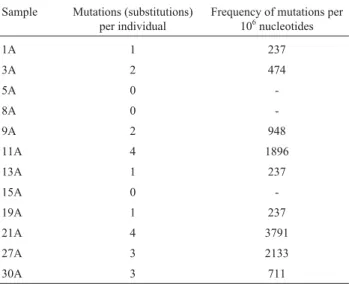
b) Of the three families (21, 27 and 30) in which an in-dication of homoplasmic mutations was detected in grand-mothers in the first phase of the study, only in the grandmother from family 27 was the homoplasmic status confirmed for mutation 16,111 CT. Despite its absence in her grandchildren, this mutation was probably present in the mitochondrial lineage by inheritance since all clones shared the same mutation. The absence of this mutation in the two descendants suggests its loss probably in the mito-chondrial lineage of generation 2. This grandmother was also heteroplasmic for three other novel mutations (16,062 AG, 16,109 AT and 16,351 AG) indicative of somatic alter-ations in the family. The grandmother of family 21 who was homoplasmic for the 16,188 CT mutation in the first phase of the study showed this condition in only 10% of the clones. In addition, she had three novel mutations at posi-tions 16,187 TC, 16,294 TC and 16,321 CT. In the grand-mother of family 30, mutation 16,131 TC was present in only 30% of the clones.
c) Cloning and sequencing confirmed the hetero-plasmic state in six (1, 3, 9, 11, 13, and 19) of the nine fami-lies in which the grandmothers were initially positive for this condition, with the mutations being present in 10%-40% of the clones analyzed. In the other three families (5, 8 and 15), a single mitochondrial lineage was present in the ten clones analyzed from each of them.
d) In the 120 clones investigated, there was an age of 0.1333 point mutation/422 bp sequence and an aver-age of 0.0003159 mutation/nucleotide (corresponding to 352 mutations per million base pairs), with mutation fre-quencies varying from 237 to 3791/106bp (Table 1).
Various studies in the last two decades have exam-ined the intricate mechanisms that govern aging (Richteret al., 1988; Ortopassi and Arnheim, 1990; Attardi, 2002;
Mandavilli et al., 2002; Rose et al., 2002; Liang and
Godley, 2003). However, to the best of our knowledge, most studies done so far have not used comparisons be-tween family generations to assess the effects of aging on mutations in mtDNA. In this work, we investigated the in-fluence of aging on the occurrence of somatic mutations in mtDNA by comparing mitochondrial lineages from grand-mothers (elderly women) and their daughters' offspring. Analysis of the D-loop region of mtDNA revealed that 29% (9/31) of the grandmothers had point mutations that were absent in their grandchildren, and 26% were heteroplasmic, with two or more mitochondrial lineages. It is possible that both of these situations were a long-term consequence of mitochondrial oxidative phosphorylation that can lead to the accumulation of mtDNA mutations throughout life. In addition, the occurrence of these mutations may have been
enhanced by the inefficiency of the mtDNA repair mecha-nisms in the presence of high levels of oxygen free radicals (Richteret al., 1988; Roseet al., 2002; Liang and Godley,
2003; Santoset al., 2005).
Most of the heteroplasmic grandmothers were > 60 years old, although somatic mutations were also observed in two women who were 40 and 55 years old. Of the 90 clones from grandmothers with altered sequences, 27 had = 1 mutation/clone. A 40-year-old grandmother (fam-ily 27) had a mutation at position 16,111 in all of the clones analyzed. She also had a mutation at position 16,062 in a single clone, and mutations at positions 16,109 and 16,351 in another clone. None of these four mutations was present in her grandchildren.
Previous studies have suggested a selective advan-tage in the expansion and maintenance of somatic muta-tions in different generamuta-tions (Santoset al., 2005, 2008). He et al.(2010) demonstrated that healthy individuals are
char-acterized by a complex mixture of related mitochondrial genotypes rather than a single genotype. Some studies have suggested that certain point mutations are more frequent in elderly subjects (Michikawaet al., 1999; Chinneryet al.,
2001). In our sample, no specific mutation had a higher fre-quency than the others, but a large number of mutations were identified in the grandmothers that were not observed in their descendants. This result suggests that mtDNA stud-ies done using unrelated individuals can yield misleading conclusions about the frequency of hotspot mutations in el-derly subjects.
Acknowledgments
The authors thank the families who agreed to partici-pate in this study. This work was supported by RENOR/CAPES (Rede Norte para Formação e Fixação de
Table 1- Frequency of mtDNA point mutations in elderly women
investi-gated by DNA cloning and sequencing (422 bp insert; 10 clones per indi-vidual).
Sample Mutations (substitutions) per individual
Frequency of mutations per 106nucleotides
1A 1 237
3A 2 474
5A 0
-8A 0
-9A 2 948
11A 4 1896
13A 1 237
15A 0
-19A 1 237
21A 4 3791
27A 3 2133
Grupos de Docentes Pesquisadores na Amazônia), Milê-nio/CNPq (Conselho Nacional de Desenvolvimento Cientí-fico e Tecnológico), FINEP (Financiadora de Estudos e Projetos) and UFPA (Universidade Federal do Pará).
References
Attardi G (2002) Role of mitochondrial DNA in human aging. Mitochondrion 2:27-37.
Anderson S, Bankier AT, Barrell BG, De Bruijn MH, Coulson AR, Drouin J, Eperon IC, Nierlich DP, Roe BA and Sanger F (1981) Sequence and organization of the human mitochon-drial genome. Nature 290:457-465.
Andrews RM, Kubacka I, Chinnery PF, Lightowler RN, Turnbull DM and Howell N (1999) Reanalysis and revision of the Cambridge reference sequence for the human mitochondrial DNA. Nat Genet 23:147.
Ayres M, Ayres Jr M, Ayres DL and Santos AAS (2007) BioEstat: Aplicações Estatísticas nas Áreas das Ciências Biológicas e Médicas. 5th edition. Sociedade Civil Mamirauá, Belém, 363 pp.
Chinnery PF, Taylor GA, Howell N, Brown DT, Parsons TJ and Turnbull DM (2001) Point mutations of the mtDNA control region in normal and neurodegenerative human brains. Am J Hum Genet 68:529-532.
Corral-Debrinski M, Horton T, Lott MT, Shoffner JMM, Beal F and Wallace DC (1992) Mitochondrial DNA deletions in human brain: Regional variability and increase with ad-vanced age. Nat Genet 2:324-329.
Harman D (1981) The aging process. Proc Natl Acad Sci USA 78:7124-7128.
He Y, Wu J, Dressman DC, Iacobuzio-Donahue C, Markowitz SD, Velculescu VE, Diaz Jr LA, Kinzler KW, Volgelstein B and Papadopoulos N (2010) Heteroplasmic mitocondrial DNA mutations in normal and tumor cells. Nature 464:610-616.
Khaidakov M, Heflich RH, Manjanatha MG, Myers MB and Aidoo A (2003) Accumulation of point mutations in mito-chondrial DNA of aging mice. Mutat Res 526:1-7. Liang F and Godley BF (2003) Oxidative stress-induced
mito-chondrial DNA damage in human retinal pigment epithelial cells: A possible mechanism for RPE aging and age-related macular degeneration. Science 76:1-7.
Miquel J (1998) An update on the oxygen stress-mitochondrial mutation theory of aging: Genetic and evolutionary implica-tions. Exp Gerontol 33:113-126.
Mandavilli BS, Santos JH and Van Houten B (2002) Mitochon-drial DNA repair and aging. Mutat Res 509:127-151.
Michikawa Y, Mazzucchelli F, Bresolin N, Scarlato G and Attardi G (1999) Aging-dependent large accumulation of point mu-tations in the human mtDNA control region for replication. Science 286:774-779.
Ortopassi GA and Arnheim N (1990) Detection of a specific mito-chondrial DNA deletion in tissues of older humans. Nucleic Acids Res 18:6927-6933.
Parsons TJ, Muniec DS, Sullivan K, Woodyatt N, Alliston-Grei-ner R, Wilson MR, Berry DL, Holland KA, Weedn VW, Gill P,et al.(1997) A high observed substitution rate in the hu-man mitochondrial DNA control region. Nat Genet 15:363-368.
Richter C, Park JW and Ames BN (1988) Normal oxidative dam-age to mitochondrial and nuclear DNA. Proc Natl Acad Sci USA 85:6465-6467.
Rose G, Passarino G, Franceschi C and De Benedictis G (2002) The variability of the mitochondrial genome in human ag-ing: A key for life and death? Int J Biochem Cell Biol 34:1449-1460.
Sambrook J, Fritsch EF and Maniatis T (1989) Molecular Clon-ing: A Laboratory Manual. Cold Spring Harbor Press, Cold Spring Harbor.
Santos C, Montiel R, Arruda A, Alvarez L, Aluja MP and Lima M (2008) Mutation patterns of mtDNA: Empirical inferences for the coding region. BMC Evol Biol 8:167.
Santos C, Montiel R, Sierra B, Bettencourt C, Fernandez E, Alvarez L, Lima M, Abade A and Aluja MP (2005) Under-standing differences between phylogenetic and pedigree-derived mtDNA mutation rate: A model using families from the Azores Islands (Portugal). Mol Biol Evol 22:1490-1505. Wallace DC (1992) Mitochondrial genetics: A paradigm for aging
and degenerative diseases? Science 256:628-632.
Supplementary Material
The following online material is available for this ar-ticle:
Table S1 – Mutations identified by direct sequencing of the mtDNA D-loop region in 93 individuals (generations F1 and F3).
Table S2 – Mutations observed in the mtDNA of 120 clones from 12 grandmothers.
This material is available as part of the online article from http://www.scielo.br/gmb.
Editor: Angela M. Vianna-Morgante
License information: This is an open-access article distributed under the terms of the Creative Commons Attribution License, which permits unrestricted use, distribution, and reproduction in any medium, provided the original work is properly cited.
2
Continuation:
4