Brazilian Journal of Microbiology (2011) 42: 616-623 ISSN 1517-8382
PRODUCTION FLUSH OF Agaricus blazei ON BRAZILIAN CASING LAYERS
Nelson Barros Colauto1*, Adriano Reis da Silveira2, Augusto Ferreira da Eira2, Giani Andrea Linde1
1
Universidade Paranaense, Laboratório de Biologia Molecular, Mascarenhas de Moraes, Umuarama, PR, Brasil. 2Universidade
Estadual Paulista, Módulo de Biotecnologia de Cultivo de Cogumelos, Botucatu, SP, Brasil.
Submitted: June 24, 2010; Returned to authors for corrections: July 15, 2010; Approved: November 04, 2010.
ABSTRACT
This study aimed to verify the biological efficiency and production flushes of Agaricus blazei strains on different casing layers during 90 cultivation days. Four casing layers were used: mixture of subsoil and
charcoal (VCS), lime schist (LSC), São Paulo peat (SPP) and Santa Catarina peat (SCP); and two genetically
distant A. blazei strains. The fungus was grown in composted substratum and, after total colonization, a pasteurized casing layer was added over the substratum, and fructification was induced. Mushrooms were
picked up daily when the basidiocarp veil was stretched, but before the lamella were exposed. The biological
efficiency (BE) was determined by the fresh basidiocarp mass divided by the substratum dry mass,
expressed in percentage. The production flushes were also determined over time production. The BE and
production flushes during 90 days were affected by the strains as well as by the casing layers. The ABL26
and LSC produced the best BE of 60.4%. Although VCS is the most used casing layer in Brazil, it is inferior
to other casing layers, for all strains, throughout cultivation time. The strain, not the casing layer, is
responsible for eventual variations of the average mushroom mass. In average, circa 50% of the mushroom production occurs around the first month, 30% in the second month, and 20% in third month. The casing
layer water management depends on the casing layer type and the strain. Production flush responds better to
water reposition, mainly with ABL26, and better porosity to LSC and SCP casing layers.
Key words: production flush, Agaricus brasiliensis, casing layer, water management, Agaricus subrufescens.
INTRODUCTION
Agaricus blazei Murrill sensu Heinemann (16) is a basidiomycete from Brazil (1) that was reclassified by Wasser
et al. (35) as Agaricus brasiliensis Wasser et al.. That classification was contested by Kerrigan (20) who suggested
the name Agaricus subrufescens Peck, published in 1894.
Whether or not A. brasiliensis and A. subrufescens are the same species, they are nomen illegitimum according to the Index Fungorum (17), because those names had already been
published by Fries in 1830 (15) and by Ellis and Everhart in
1893 (10), respectively. In this study, this basidiomycete will
be referred as A. blazei.
A. blazei has immunomodulating and antitumoractivities
(18, 22, 26, 27) and it is a culinary mushroom (11). Despite its
importance, few studies have been done about the effect of
casing layers on basidiocarp mass, production flush, water
management and productivity. In general, the same techniques
utilized for casing layers of Agaricus bisporus cultivation are used for A. blazei production in Brazil (1).
The casing layer is one of the most important phases of A. bisporus cultivation, and it is the variable that is responsible for the induction of fructification (23). The function of a casing
layer is to protect the compost from drying, pests and diseases,
and provide physical support and gas exchange for the
development of the basidiocarps (14). A casing layer generally
consists of a mixture of peat and lime added after the substrate
mycelial colonization (7, 28). However, there is an
environmental pressure against peat extraction for agricultural
use because it is a natural carbon reserve, and it affects the
fragile, but ecologically and archeologically important,
swampy ecosystem (2). Peat availability is a great concern in
some regions around the world, and some research efforts have
been devoted to searching other materials that may be used as a
substitute or in combination with peat (5). Furthermore, in
several mushroom production areas in the world, mainly in the
southern hemisphere, there are no large peat sources available,
and then local soil is used as a casing layer (33). However, peat
is still a predominant casing layer worldwide, and it is a great
challenge to find a substitute that is available in volume and
low cost to meet the demands of mushroom production.
Lime schist is a clay sedimentary rock from intermediate
layers of limestone mines, basically formed by calcium and
magnesium carbonate salts, about 35-65% clay and 65-35%
carbonate (30). Calcite limestone is used in big scale to adjust
acid soils, commonly found in Brazil (24); it is abundant and
easy to find, and has low cost (25). Lime schist is a non-carbon
source, mineral sub product of calcite limestone, and it is not
used to correct soil pH due to its reduced solubility in acid
solutions (6). Although it is a source of magnesium, it has low
solubility for magnesium reposition, making it an inert sub
product of the calcite limestone industry (25). Colauto et al. (5) have already reported the use of lime schist as an alternative to
peat for casing layer in the A. blazei cultivation in Brazil. Although new casing layers are being tested as a substitute
to mushroom cultivation (5), there is not enough knowledge
about the production flushes of Brazilian casing layers which is
essential to the production management in order to obtain
quality, uniformity, yield, nutrient addition and economic
determination of the final harvest time of mushroom
cultivation. Thus, the objective of this study was to verify the
biological efficiency and production flushes of A. blazei strains on different casing layers throughout 90 days of cultivation.
MATERIALS AND METHODS
The experiments were carried out in the Sector of
Biotechnology for Mushroom Cultivation of the Department of
Plant Production at the Universidade Estadual Paulista
(UNESP) – Campus of Botucatu, School of Agronomical
Sciences. ABL 99/26 and ABL 99/29 A. blazei strains from the culture collection of the Sector of Biotechnology for
Mushroom Cultivation were referred as ABL26 and ABL29,
respectively, in this experiment. Colauto et al. (4) reported that those strains presented the highest genetic distance using
RAPD.
Four casing layers for mushroom production in Brazil
were evaluated: a mixture (7:3) of red yellow podsol from B
horizon and charcoal (VCS), used as control, lime schist
(LSC), also known as schist, from intermediate layers of
limestone mines, São Paulo peat (SPP) from the Instituto
Agronômico de Campinas and Santa Catarina peat (SCP) from
COMINAS Mining S/A. LSC was immersed for one hour in
slow flow running water and all other raw materials were used
as found in nature.
The inoculum was made of pre-cooked wheat grains at
100 ºC for 40 min mixed to CaCO3 (1%) and autoclaved at 121
ºC for 40 min. After cooling, ABL26 and ABL29 strains that
Colauto, N.B. et al. Production flush of A. blazei
autoclaved grains and kept at 28 ºC, in the dark, according to
Colauto et al. (3).
For composting, the raw material was sugarcane
(Saccharum officinarum) bagasse (500 kg), Brachiaria sp grass (800 kg), coast cross (Cynidon dactylon) grass (2200 kg), soybean (Glycine max) bran (140 kg), urea (50 kg), ammonium sulphate (50 kg) and gypsum (30 kg), followed by
pasteurization and conditioning, according to Eira et al. (9) and Colauto et al. (5). Then, the substrate (8.0 kg) was transferred to a cultivation plastic box (55 cm long, 35 cm wide and 24 cm
high) and homogenized with 80 g of inoculum. Substrate
colonization occurred in the dark for 30 days at 25 ºC ± 2 oC
and 90% ± 8% relative humidity. Ten boxes were used
(replications) for each treatment, in a completely random
factorial design of 2 x 4 (strains x casing layers).
The casing layers were saturated with water and the pH was
adjusted to 7.0 with CaCO3. After that, it was pasteurized at 60 o
C for six hours, then cooled and added to the colonized
substrate at 4 cm. When the mycelium surfaced the casing
layer, there was induction of primordia increasing the
ventilation but keeping humidity, reducing temperature to 20
o
C and adding water to the casing layers. After the beginning of
the basiciocarp production, the temperature was kept at 23 oC ±
2 oC, and the mass and the number of fresh basidiocarps were
measured daily for 90 days. The moisture of basidiocarps and
substrate was measured by drying at 105 oC until constant
mass. The mushrooms were picked up when the veil was
stretched, but before the lamella were exposed. The mushroom
production was evaluated by the biological efficiency (BE) of
the fresh basidiocarp mass divided by the substratum dry mass,
expressed in percentage, and the production flushes were also
determined over time production. The differences among the
averages were determined by the variance analysis and Tukey’s
test (p 0.01).
RESULTS AND DISCUSSION
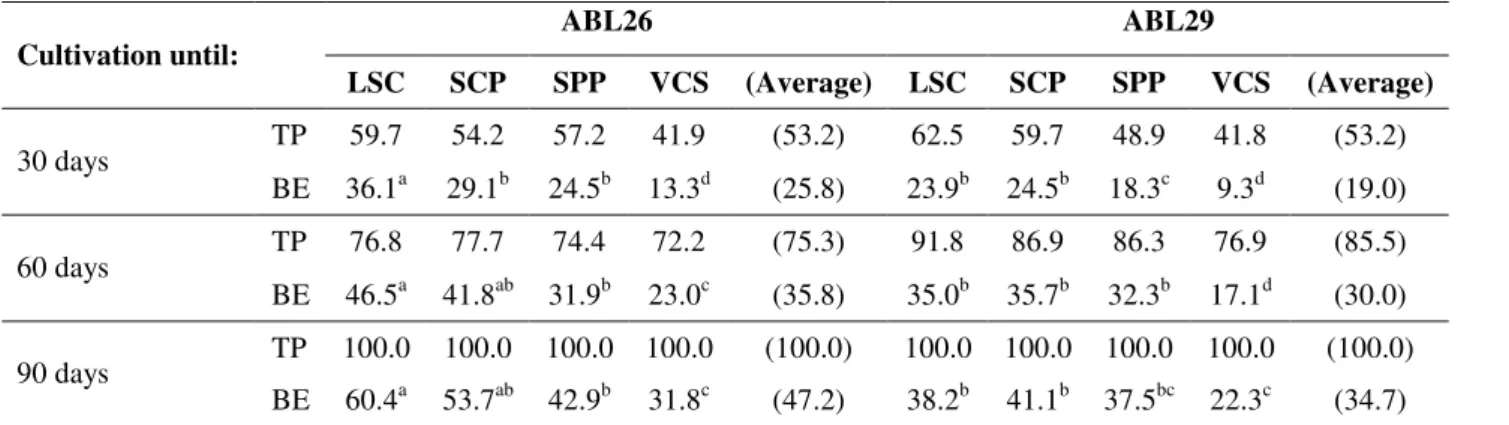
The control treatment of VCS presented the lowest BE
when compared to other casing layers for both strains, while
LSC and SCP had the highest BE throughout 90 cultivation
days (Table 1). Moreover, around 57% of total production
occurred in the first month for LSC, SCP and SPP, but VCS
produced only 42% of its total production at that time. So,
although VCS is the most used casing layer in Brazil, its BE
was the lowest among casing layers tested in this experiment
(Table 1). Physical and chemical characteristics as casing layer
depth, chemical and microbial composition, moisture content,
and porosity, play important roles in the yield and quality of
mushrooms (19, 29). Colauto et al. (5) reported the physical and chemical characteristics for the materials used as casing
layer in this study. LSC, SPP and SCP presented bigger particle
size than VCS (5). Thus, LSC, SPP and SCP have less
compaction tendency than VCS, facilitating mycelial growth
(21) due to the higher air availability. The low compaction
tendency of casing layers is very important to avoid the
formation of anaerobic systems (8), contaminant growth (32)
and stroma formation (13), mainly after water addition. Also
LSC, SPP and SCP have a better balance between total
porosity and micro porosity than VCS (5) corroborating the
low compaction tendency of the casing layer with more empty
spaces for gas exchanges and oxygen reserve (31). These
characteristics could explain the better values of BE for LSC,
SPP and SCP found in this work after 90 cultivation days,
whereas VCS presented the worst result. They could explain as
well the reduction of production along cultivation with 53.2%
in 30 days, 22.1% in 60 days and 24.7% in 90 days of
cultivation for ABL26 strain (Table 1). A yield reduction was
observed as well after 30 days of cultivation for ABL29 strain
(Table 1). It is important to know about basidiocarp production
percentage along cultivation to decide the economical moment
to stop cropping and the moment to invest in improvements for
mushroom production.
When analyzing the BE for each strain, it was lower for
ABL29 but the total mushroom production was anticipated
happened for the ABL26 strain, which reached 76.8% under
the same condition (Table 1). It seems that ABL29 has a short
production period, around 60 cultivation days, whereas ABL26
could last until 90 days. For ABL26, mainly with LSC, SCP
and SPP, two clear production flushes occurred until 30 days of
production but for VCS only one flush occurred (Fig. 1). Zied
et al. (34) studied different casing layers to produce A. blazei
and reported three distinct production flushes until 90
cultivation days. The first flush started at 37 cultivation days;
however, casing layers did not affect BE and production flush.
In this study, after 30 cultivation days, the production flushes
were less distinct, although a final flush occurred between 70
and 80 days of cultivation. For ABL29, the flushes were not so
clear with small increases on mushroom mass production along
the time (Fig. 2). This distinct behavioral characteristic can be
explained by the higher genetic distance between the strains.
Colauto et al. (4) used 20 primers to study polymorphism of
five (including ABL26 and ABL29) A. blazei strains. ABL26 and ABL29 showed higher genetic variability by RAPD. It was
possible to verify during the cultivation that basidiocarps had
distinct morphological differences (photos not showed). It is
possible that these genetic variability and morphological and
behavioral characteristics of these strains, isolated from
growers in Brazil, are the result of genetic recombination
and/or mutations processes, considering that many growers
used an open-air cultivation system for this mushroom in
Brazil.
The LSC, SPP and SCP casing layers anticipated
basidiocarp production and produced more distinct flushes for
both strains while VCS produced less distinct and delayed
flushes along the cultivation time (Fig. 1 and 2), explaining the
good porosity of LSC, SPP and SCP casing layers. Thus,
during 90 days, the BE and production flushes were affected by
the strains as well as by the casing layers.
Table 1. Percentage of total basidiocarp mass production (TP) and biological efficiency (BE) of Agaricus blazei ABL26 and ABL29 strains in function of casing layers of lime schist (LSC), São Paulo peat (SPP), Santa Catarina peat (SCP) and mixture
(7:3) of subsoil and charcoal (VCS), during 90 cultivation days
ABL26 ABL29
Cultivation until:
LSC SCP SPP VCS (Average) LSC SCP SPP VCS (Average)
TP 59.7 54.2 57.2 41.9 (53.2) 62.5 59.7 48.9 41.8 (53.2)
30 days
BE 36.1a 29.1b 24.5b 13.3d (25.8) 23.9b 24.5b 18.3c 9.3d (19.0)
TP 76.8 77.7 74.4 72.2 (75.3) 91.8 86.9 86.3 76.9 (85.5)
60 days
BE 46.5a 41.8ab 31.9b 23.0c (35.8) 35.0b 35.7b 32.3b 17.1d (30.0)
TP 100.0 100.0 100.0 100.0 (100.0) 100.0 100.0 100.0 100.0 (100.0)
90 days
BE 60.4a 53.7ab 42.9b 31.8c (47.2) 38.2b 41.1b 37.5bc 22.3c (34.7)
Colauto, N.B. et al. Production flush of A. blazei
0 200 400 600 800 1000 1200 1400 1600 1800
0 10 20 30 40 50 60 70 80 90 100
A
C
C
U
M
U
L
A
T
E
D
M
U
S
H
R
O
O
M
M
A
S
S
(
g
)
TIME (day) LSC SCP SPP VCS
Figure 1. Production flush and accumulated mass of fresh mushrooms of Agaricus blazei ABL26 strain on the casing layers of lime schist
(LSC), São Paulo peat (SPP), Santa Catarina peat (SCP) and mixture (7:3) of subsoil and charcoal (VCS), during 90 cultivation days. Arrows
indicate the time in which water was added to casing layers.
0 200 400 600 800 1000 1200 1400 1600 1800
0 10 20 30 40 50 60 70 80 90 100
A
C
C
U
M
U
L
A
T
E
D
M
U
S
H
R
O
O
M
M
A
S
S
(
g
)
TIME (day)
LSC SCP SPP VCS
Figure 2. Production flush and accumulated mass of fresh mushrooms of Agaricus blazei ABL29 strain on the casing layers of lime schist
(LSC), São Paulo peat (SPP), Santa Catarina peat (SCP) and mixture (7:3) of subsoil and charcoal (VCS), during 90 cultivation days. Arrows
Water was added every time the casing layers had visual
signs of lack of water that initially occurred in the period of 16
days, and then it has not showed any regular periods during the
cultivation (Fig. 1 and 2). At the end of the cultivation, water
addition was frequent due to the low retention capability of
casing layers mainly after 76 days. Two to five days after water
addition to casing layers, mushroom production was stimulated
(Fig. 1 and 2), although this was more evident in ABL26 than
ABL29, mainly in the first flushes; it was important to adjust
water management for each strain. Also A. blazei was induced to produce mushrooms two to five days after water addition,
mostly until second flush. It shows that the fungi respond to
fructification induction when water is available, similarly to
what happens in nature after rain. The best regular responses of
production flush to water addition happened when LSC or SCP
was used as casing layer, and no regular response was observed
with VCS, indicating that the adjustment depends on the casing
layer type and the strain (Fig. 1 and 2). At the end of the
cultivation time (90 days), the total mass of the substrate was
reduced in 65% with no differences (p 0.01) among casing layer types. That indicates that the casing layers had similar
capacity to avoid substratum water loss. Moreover, comparing
the differences of BE among casing layers, it is possible to
infer that the casing layer with higher BE, such as LSC for
ABL26 and LCS and SCP for ABL29 (Table 1), provided more
water to the basidiocarp, suggesting that the water in the casing
layer was responsible for the improvement of the mushroom
production. Colauto et al. (5) also reported that LSC, SPP and SCP have higher capacity to keep water linked into
physical-chemical structure than VSC. This is an important
characteristic because it may avoid sudden humidity variations
in the casing layer, improving the micro environment stability
and fungus adaptation. A casing layer may provide up to 37%
of water to mushrooms, and reduce the water demand from the
substrate which can not be easily replaced (12, 19). The higher
capacity to keep water of LSC, SPP and SCP could explain the
results in this study, where different values for BE were
obtained among tested casing layers, but the final total mass of
the substrate (data not showed) was equal (p 0.01), corroborating that the casing layer, not the substratum, is the
main water supplier for the basidiocarp production. Besides,
after 90 cultivation days, the production flushes were probably
reduced because of the substratum nutrient decrease and the
loss of the physical-chemical structure of LSC, SPP and SCP,
which reduced both the water capacity maintenance and gas
exchange.
0 10 20 30 40 50
30 60 90 30 60 90
F
R
E
S
H
M
A
S
S
P
E
R
M
U
S
H
R
O
O
M
(
g)
TIME (day)
30ABL26 60 90 30ABL29 60 90
a
b b
c
c
c
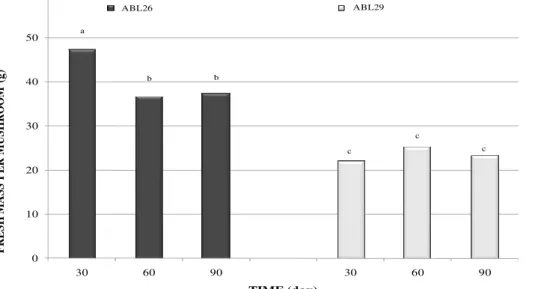
Figure 3. Average fresh mass
per mushroom of Agaricus blazei ABL26 and ABL29 strains at 30, 60 and 90 days of
cultivation. Different letters
indicate significant differences
according to Tukey’s test
Colauto, N.B. et al. Production flush of A. blazei
ABL26 produced bigger mushrooms (average of 37.4 g)
and ABL29 smaller ones (average of 23.2 g) for all casing
layers. This indicates that the basidiocarp mass is a genetic
characteristic with low influence from the casing layer
environment. However, when the average fresh mass per
mushroom is analyzed along the cultivation time, there are two
distinct results (Fig. 3). First, the average fresh mass per
mushroom was reduced for ABL26 (p 0.01) after 30 cultivation days, without further reduction; second, ABL29
kept the same mass per mushroom along cultivation time (Fig.
3). Thus, the strain, not the casing layer type, is responsible for
the average mushroom mass along cultivation time.
In conclusion, the BE and production flushes during 90
days were affected by the strains as well as by the casing
layers. The ABL26 and LSC produced the best BE of 60.4%.
Although VCS is the most used casing layer in Brazil, it is
inferior to other casing layers, for all strains, throughout
cultivation time. The strain, not the casing layer, is responsible
for eventual variations of the average mushroom mass. In
average, circa 50% of the mushroom production occurs around the first month, 30% in the second month, and 20% in third
month. The casing layer water management depends on the
casing layer type and the strain. Production flush responds
better to water reposition, mainly with ABL26, and better
porosity to LSC and SCP casing layers.
ACKNOWLEDGEMENTS
The authors thank the financial support and the
post-doctorate fellowship from the ‘Fundação de Amparo à Pesquisa
do Estado de São Paulo’ (FAPESP) Brazil.
REFERENCES
1. Braga, G.C.; Eira, A.F.; Celso, P.G.; Colauto, N.B. (1998). Manual for the Cultivation of Agaricus blazei Murr. "Cogumelo-do-sol". FEPAF, Botucatu.
2. Bustamante, M.A.; Paredes, C.; Moral, R.; Agulló, E.; Pérez-Murcia, M.D.; Abad, M. (2008). Composts from distillery wastes as peat substitutes for transplant production. Resour. Conserv. Recycl. 52 (5), 792-799.
3. Colauto, N.B.; Aizono, P.M.; Carvalho, L.R.M.; Paccola-Meirelles, L.D.; Linde, G.A. (2008). Temperature and pH conditions for mycelial growth of Agaricus brasiliensis on axenic cultivation. Semina: Cienc. Agrar. 29 (2), 307-312.
4. Colauto, N.B.; Dias, E.S.; Gimenes, M.A.; Eira, A.F. (2002). Genetic characterization of isolates of the basidiomycete Agaricus blazei by RAPD. Braz. J. Microbiol. 33 (2), 131-133.
5. Colauto, N.B.; Silveira, A.R.; Eira, A.F.; Linde, G.A. (2010). Alternative to peat for Agaricus brasiliensis yield. Bioresour. Technol. 101 (2), 712-716.
6. Cook, D.; Kirk, W. (1995). Pocket Guide Rocks & Minerals. Larousse, London.
7. Edwards, R.L.; Flegg, P.B. (1953). Experiments with artificial mixtures for casing mushroom beds. Mushroom Sci. 2, 143-149.
8. Eger, G. (1962). The ‘‘Halbschalentest”, a simple method for testing casing materials. Mushroom Growers Assoc. Bull. 148, 159-168. 9. Eira, A.F.; Nascimento, J.S.; Colauto, N.B.; Celso, P.G. (2005).
Agaricus blazei (Agaricus brasiliensis) medicinal mushroom cultivation technology. Agropecu. Catarin. 18 (3), 45-49.
10. Ellis, J.B., Everhart, B.M. (1893). New species of fungi from various localities. Proc. Acad. Nat. Sci. Philadelphia 45, 440. http://www.biodiversitylibrary.org/item/17606#456.
11. Escouto, L.F.S.; Colauto, N.B.; Linde, G.A.; Aizono, P.M.; Carvalho, L.R.M.; Eira, A.F. (2005). Acceptability of the sensory characteristics of the Brazilian mushroom Agaricus brasiliensis. Braz. J. Food Technol. 8 (4), 321-325.
12. Estrada, A.E.R.; Jimenez-Gasco, M.M.; Royse, D.J. (2009). Improvement of yield of Pleurotus eryngii var. eryngii by substrate supplementation and use of a casing overlay. Bioresour. Technol. 100 (21), 5270-5276.
13. Flegg, P. (1997). Stroma and overlay. Mushroom J. 570, 11-12. 14. Flegg, P.B.; Wood, D.A. (1985). Growing and fruiting. In: Flegg, P.B.;
Spencer, D.M.; Wood, D.A. (eds). The Biology and Technology of the Cultivated Mushroom. John Wiley & Sons, Chichester, p.141-177. 15. Fries, E.M. (1830). Eclogae fungorum, praecipue ex herbarus
germanorum de scriptorum. Linnaea 5, 497-553.
16. Heinemann, P. (1993). Agarici Austroamericani VIII. Agariceae from the intertropical region of South America. Bull. Jard. Bot. Nat. Belg. 62 (1-4), 355-384.
18. Jumes, F.M.D.; Lugarini, D.; Pereira, A.L.B.; Oliveira, A.; Christoff, A.O.; Linde, G.A.; Valle, J.S.; Colauto, N.B; Acco, A. (2010). Effects of Agaricus brasiliensis mushroom in Walker-256 tumor-bearing rats. Can. J. Physiol. Pharmacol. 88 (1), 21-27.
19. Kalberer, P.P. (1985). Influence of the depth of the casing layer and the water extraction from casing soil and substrate by the sporophores, on the yield and on the dry matter content of the fruit bodies of the first three flushes of the cultivated mushroom, Agaricus bisporus. Sci. Hortic. 27 (1-2), 33-43.
20. Kerrigan, R.W. (2005). Agaricus subrufescens, a cultivated edible and medicinal mushroom, and its synonyms. Mycologia 97 (1), 12-24. 21. Kurtzman Jr., R.H. (1995). Agaricus bisporus (Lge.) Imb. casing layer,
II:* porosity, the most important character. Int. J. Mushroom Sci. 1 (1), 11-17.
22. Liu, Y.; Fukuwatari, Y.; Okumura, K.; Takeda, K.; Ishibashi, K.I.; Furukawa, M.; Ohno, N.; Mori, K.; Gao, M.; Motoi, M. (2008). Immunomodulating activity of Agaricus brasiliensis KA21 in mice and in human volunteers. Evid. Based Complement. Alternat. Med. 5 (2), 205-219.
23. MacCanna, C. (1984). Comercial Mushroom Yield. Foras Taluntais, Dublin.
24. Malavolta, E. (1987). Manual for Soil Acidity Correction and Adubation of the Main Cultivations. Agronômica Ceres, São Paulo. 25. Mello, F.A.F.; Brasil Sobrinho, M.O.C.B.; Arzolla, S.; Silveira, R.I.;
Cobra Netto, A.C.; Kiehl, J.C. (1988). Soil Fertility. ESALQ, Piracicaba.
26. Mizuno, T.; Hagiwara, T.; Nakamura, T.; Ito, H.; Shimura, K.; Sumiya, T.; Asakura, A. (1990). Antitumor activity and some properties of water-soluble polysaccharides from “Himematsutake,” the fruiting body
of Agaricus blazei Murill. Agric. Biol. Chem. 54 (11), 2889-2896. 27. Mourão, F.; Linde, G.A.; Messa, V.; Cunha Júnior, P.L.; Silva, A.V.;
Eira, A.F.; Colauto, N.B. (2009). Antineoplasic activity of Agaricus brasiliensis basidiocarps on different maturation phases. Braz. J. Microbiol. 40 (4), 901-905.
28. Noble, R.; Dobrovin-Pennington, A. (2005). Partial substitution of peat in mushroom casing with fine particle coal tailings. Sci. Hortic. 104 (3), 351-367.
29. Pardo, A.; De Juan, J.A.; Pardo, J.E. (2002). Bacterial activity in different types of casing during mushroom cultivation (Agaricus bisporus (Lange) Imbach). Acta Alimentaria 31 (4), 327-342.
30. Pettijohn, F.J. (1957). Sedimentary Rocks. Harper & Brothers, New York.
31. Rainey, P.B.; Cole, A.L.J. (1987). Space-for-air, the key to a productive casing. Mushroom J. 178, 310-311.
32. Stamets, P. (1993). Casing: a topsoil promoting mushroom formation. In: Stamets, P. (ed). Growing Gourmet and Medicinal Mushrooms. Ten Speed, Berkeley, p.209-210.
33. Vedie, R. (1995). Perforated plastic film coverage of the casing soil and its influence on yield and microflora. In: Elliot, T.J. (ed). Science and Cultivation of Edible Fungi. A. A. Balkema, Rotterdam, p.347-352. 34. Wasser, S.P.; Didukh, M.Y.; Amazonas, M.A.L.A.; Nevo, E.; Stamets,
P.; Eira, A.F. (2002). Is a widely cultivated culinary-medicinal royal sun Agaricus (the himematsutake mushroom) indeed Agaricus blazei Murrill? Int. J. Med. Mushrooms 4 (4), 267-290.
35. Zied, D.C.; Minhoni, M.T.A.; Kopytowski-Filho, J.; Arruda, D.P.; Andrade, M.C.N. (2009). Production of Agaricus blazei ss. Heinemenn (A. brasiliensis) in function of different casing layers and composts. Interciencia 34 (6), 437-442.