Nauplius
T
HEJ
OURNAL OFT
HEB
RAZILIANC
RUSTACEANS
OCIETYe
-
ISSN 2358-2936
www.scielo.br/nau
www.crustacea.org.br
1
O
RIGINALA
RTICLENauplius,
25
:
e2017011
Nauplius
OCIETY
Nauplius
OCIETY
This article is part of the special series
offered by the Brazilian Crustacean Society
in honor to Nilton José Hebling in recognition
of his dedication and contributions to the
development of carcinology in Brazil.
CORRESPONDING AUTHOR
Sandro Santos
SUBMITTED 10 March 2016
ACCEPTED 1 October 2016
PUBLISHED 27 Abril 2017
Guest Editors
Maria Lúcia Negreiros-Fransozo and Adilson Fransozo
DOI 10.1590/2358-2936e2017011
Diversity and conservation status of
Aegla
spp. (Anomura, Aeglidae): an update
Sandro Santos
1, Georgina Bond-Buckup
2, Alberto Senra
Gonçalves
3, Marlise L. Bartholomei-Santos
1, Ludwig Buckup
2and Carlos G. Jara
41
Departamento de Ecologia e Evolução, Universidade Federal de Santa Maria.
97105-900 Santa Maria, Rio Grande do Sul, Brazil.
2
Retired from Departamento de Zoologia, Instituto Biociências, Universidade Federal
do Rio Grande do Sul, Av. Bento Gonçalves, 9500. 90501-970 Porto Alegre, Rio
Grande do Sul, Brazil.
3
Departamento Multidisciplinar, Unidade Descentralizada de Educação Superior da
Universidade Federal de Santa Maria, Rua Francisco Guerino, 407. 97195-000 Silveira
Martins, Rio Grande do Sul, Brazil.
4
Instituto de Zoología, Universidad Austral de Chile, Campus Isla Teja, Casilla 567,
Valdivia, Chile.
ZOOBANK
htt
p://zoobank.org/urn:lsid:zoobank.org:pub:A7252DAD-A10F-4110-94F0-890E2707F5EF
A
BSTRACTTh e speciose genus
Aegla Leach, 1820 is the only valid extant genus of the
anomuran family Aeglidae, bearing 83 known species. Th is diversity may be
even greater since there is some evidence for cryptic speciation. Th e genus
is endemic to southern South America, occurring in freshwater habitats. We
assessed the conservation status of 82 species of Aegla and found almost
70% of them under some level of threat, which represents a concerning
proportion. Major threats to the group include freshwater pollution with
urban, agricultural and industrial effluents, habitat modification and
fragmentation, riparian forest removal, among others. Conservation measures
are required to mitigate the major threats to freshwater ecosystems along
rivers where the group occurs.
K
EY WORDS2
Nauplius,
25
:
2017011I
NTRODUCTIONTaxonomically, the family Aeglidae was formerly
included within the anomuran superfamily
Galatheoidea, but morphological and molecular
evidence (Martin and Abele, 1986; Tudge and
Scheltinga, 2002; Pérez-Losada et al., 2002a; Ahyong
and O’Meally, 2004) questioned this position. A
reappraisal by McLaughlin et al. (2007) elevated
Aeglidae to superfamily rank (Aegloidea).
Aegla Leach, 1820 is the only extant genus of the
family Aeglidae and can be found in rivers, streams,
and lakes of southern South America, occurring
from the Rio Grande basin, on the border of São
Paulo and Minas Gerais states, Brazil (Bueno et al.,
2007), to Duque de York Island, South River basin,
Chile (Oyanedel et al., 2011). Th is genus includes 83
described species (Bond-Buckup et al., 2008; 2010a;
2010b; Santos et al., 2012; 2013; 2015; Moraes et al.,
2016) and probably new species will be uncovered in
the next years (
Fig. 1)
.
Th e use of molecular techniques together with
traditional systematics has helped to confi rm several
new species, as the number of morphological characters
for taxonomic use is limited by the conservative
morphotype of the group (Bond-Buckup and Buckup,
1994; Pérez-Losada et al., 2004; Santos et al., 2009;
2010; 2012; 2013). Moreover, the existence of cryptic
species cannot be ruled out since molecular markers
and geometric morphometrics have already pointed
to this possibility (Bartholomei-Santos et al., 2011;
Marchiori et al., 2014; 2015). Th is level of diversity is
greater than that observed for crayfi shes of the family
Parastacidae (Almerão et al., 2015) and brachyuran
crabs of the genus Trichodactylus Latreille, 1828 (Yeo
et al., 2006), other crustacean groups inhabiting
southern South American continental waters.
Bond-Buckup et al. (2008) estimated that 36.5% of the 63
species described at that time were under threat of
extinction. Pérez-Losada et al. (2009) assessed the
conservation status of 66 aeglid species and found
that 32% of them were threatened, that is, species
falling within the International Union for Nature
Conservation (IUCN) categories Vulnerable (VU),
Endangered (EN), and Critically Endangered (CR).
Many factors contribute to threat the group along its
distribution in southern South America, such as decline
in habitat quality, water contamination by extensive
use of pesticides in agriculture or by urban sewage,
silvicultural practices, construction of hydroelectric
plants, among others (Pérez-Losada et al., 2002b;
Bond-Buckup et al., 2008; Baumart and Santos, 2010;
Santos et al., 2012). Th e presence of some species in
restrict areas, as in headwaters, several of them with a
few records of occurrence, highlights even more the
level of threat to the group’s conservation (Magris et
al., 2010).
In this study, we present data on the diversity of
species of the genus Aegla, as well as updated information
on the distribution of these species in diff erent South
American hydrographic basins. Moreover, based on
data from several scientifi c collections and from years
of work and experience of the authors, we evaluated the
conservation status of the aeglid species and discussed
the main threats to the genus diversity.
M
ATERIAL ANDM
ETHODSSantos
et al.
3
Diversity and conservation of Aeglidae
Nauplius,
25
:
2017011(AOO; sub-criterion B2), using data from literature
(Bond-Buckup and Buckup, 1994; Jara and Palacios,
1999; Jara et al., 2003; Galves et al., 2007; Santos et al.,
2009; 2010; 2012; 2013; 2014; 2015; Bond-Buckup
et al., 2010a; 2010b; César and Damborenea, 2010;
Oyanedel et al., 2011; Rocha and Bueno, 2011; Boos
et al., 2012; Satterlee et al., 2012; Giri and Collins,
2014; Moraes et al., 2016) and from sampling records
in scientific collections (Universidade Federal do Rio
Grande do Sul, Universidade Federal de Santa Maria,
Pontifícia Universidade Católica do Rio Grande do
Sul, Fundação Zoobotânica do Rio Grande do Sul,
Universidade Regional do Alto Uruguai e das Missões
– Campus Erechim, Universidad Austral de Chile).
We determined the AOO for species with less than
four records, using an area measure unit (each pixel
corresponds to an area of 1 km
2). In this case, AOO
ranged from 1 to 3 km
2. For species with four or more
records, we calculated the EOO. We assessed data
for land-use classification for the whole occurrence
area of Aeglidae from the Harmonized World Soil
Database (
http://webarchive.iiasa.ac.at/Research/
LUC/External-World-soil-database/HTML/
), from
the World Land Use – Land cover from Food and
Agriculture Organization of the United Nations
(FAO) (
http://www.fao.org/geonetwork/srv/en/
metadata.show?id=12749&currTab=simple
), as well
as from SOS Mata Atlântica and Instituto Nacional
de Pesquisas Espaciais, 2011 (http://mapas.sosma.
org.br).
R
ESULTSThe list of species, with author(s) and year of
description, as well as their distributions, are presented
in
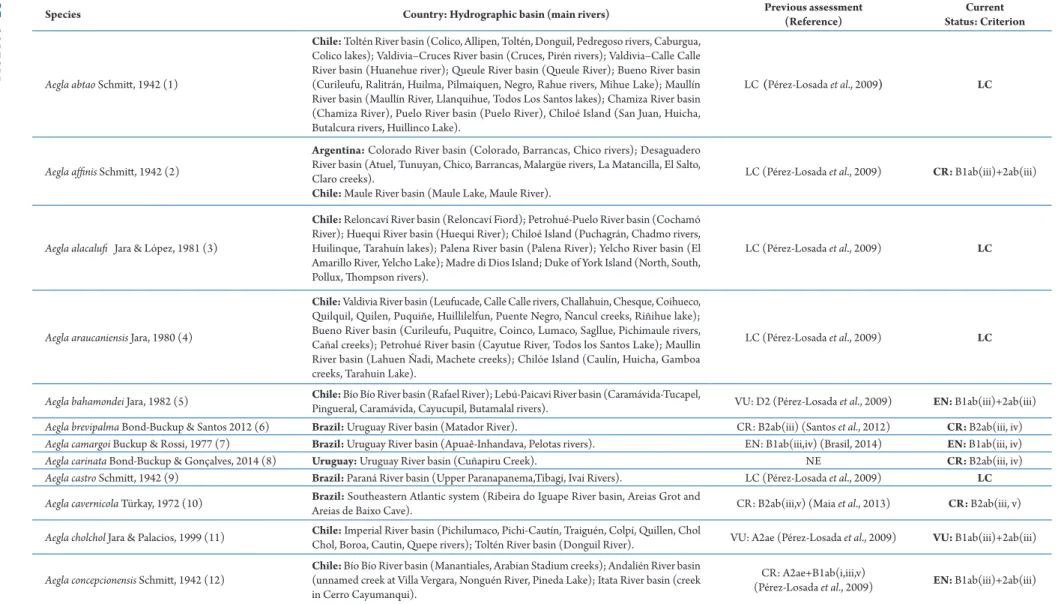
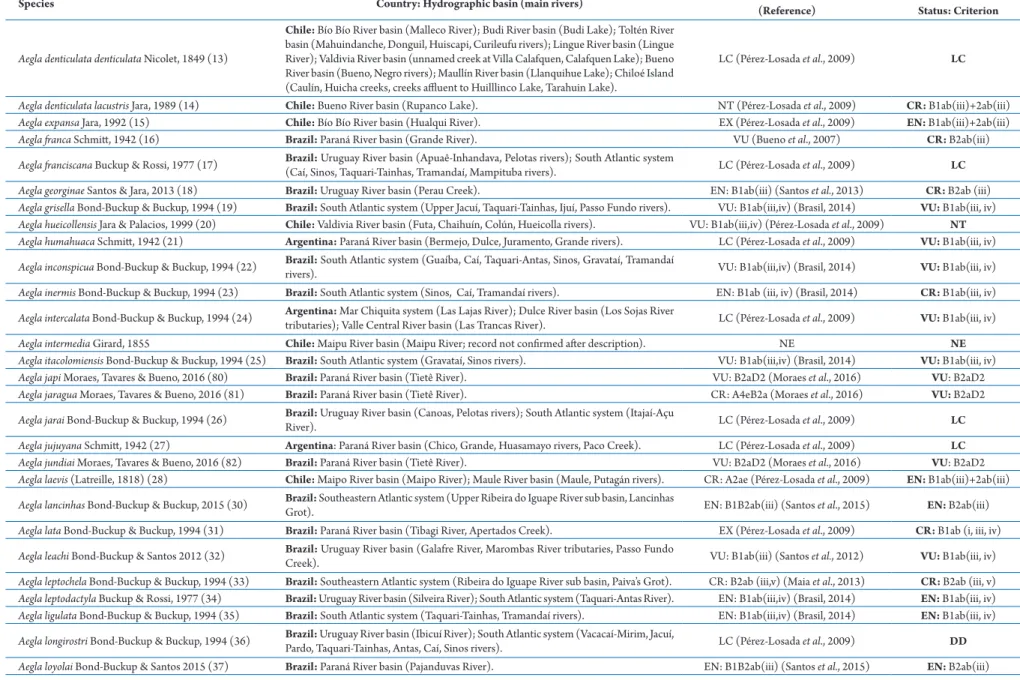
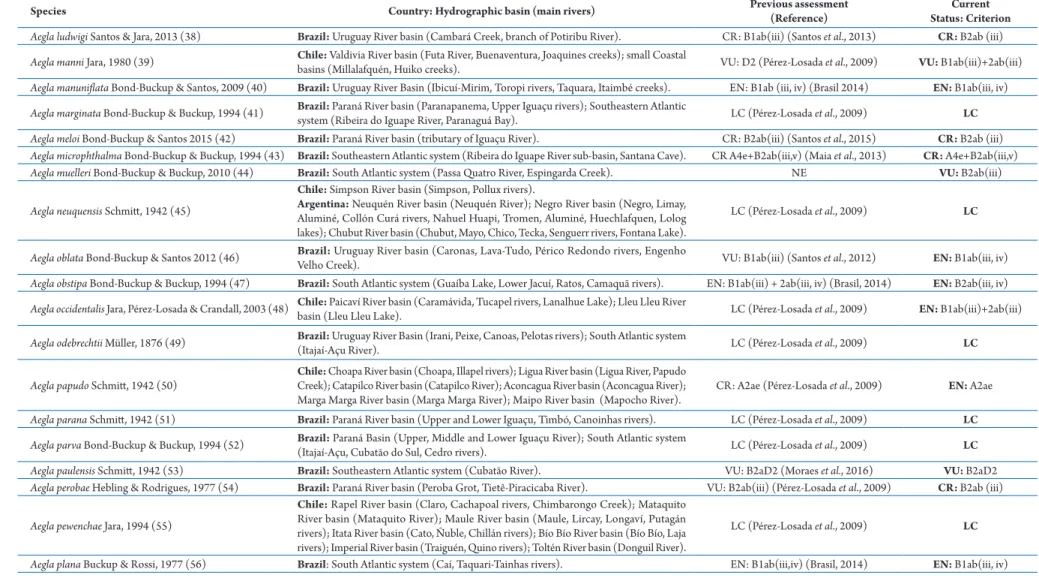
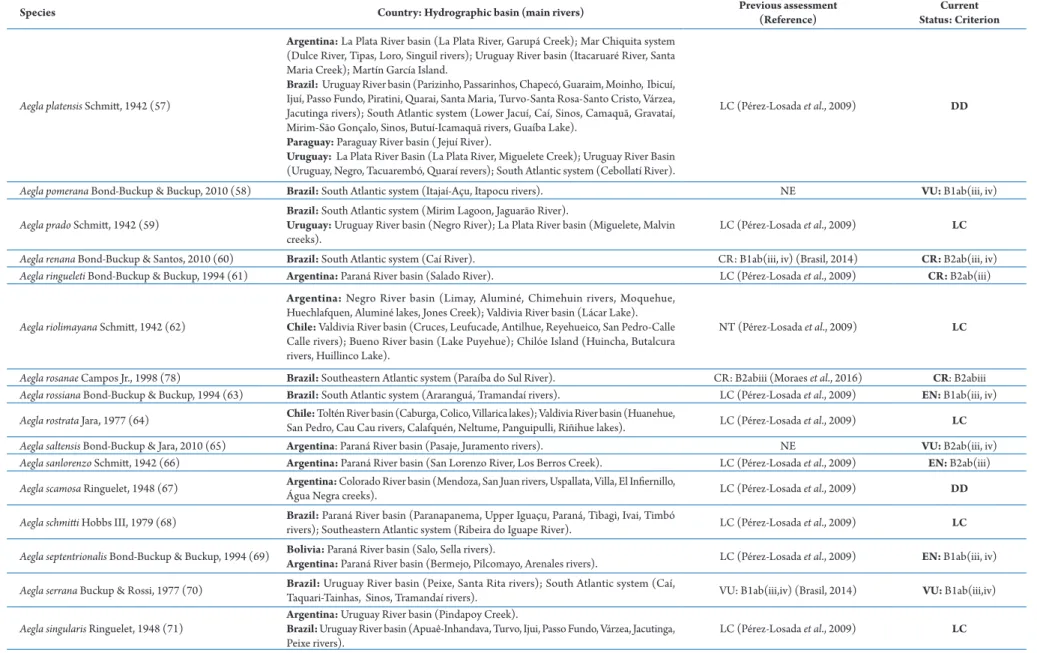
Tab. 1
. Records indicate the presence of aeglids in
rivers, lakes and streams in catchments in Argentina
(14 species), Bolivia (1 species), Brazil (52 species),
Chile (22 species, considering Aegla intermedia Girard,
1855), Paraguay (1 species) and Uruguay (4 species),
some species occurring in more than one country
(
Figs. 2, 3
).
Based on our assessment, 17 species were classified
as critically endangered (CR), 21 as endangered (EN),
19 as vulnerable (VU), one as near threatened (NT), 21
as least concern (LC), three had deficient data (DD),
and one was not evaluated (NE). Current and previous
conservation status and the criteria used to assign each
species to an IUCN category are also shown in
Tab. 1
.
D
ISCUSSIONThere are currently 83 known species of the
genus Aegla, although the existence of A. intermedia
is questioned. This species was described based upon
specimens collected by the “U. S. N. Astronomical
Expedition”, in tributaries of Maipu River, near
to Santiago, Chile. Despite the effort of various
researchers, the species has never been found again
in nature and its type-series has disappeared
(Bond-Buckup and (Bond-Buckup, 1994). Hence, the conservation
status of this species was not evaluated.
Using updated data from the species distribution,
we found 57 species of Aegla under threat or almost
70% of the 82 species evaluated. This proportion
represents a significant increase in relation to previous
assessments for the genus Aegla, which estimated nearly
half of the present value (Bond-Buckup et al., 2008;
Pérez-Losada et al., 2009). Considering the most recent
conservation status assessment for each species, from
the 32 species previously assessed as LC, only 20 kept
the same status; nine species changed the category
to some level of threat and three have deficient data.
Twenty-nine species kept the same threat category, but
seven previously threatened species raised the threat
level. Only one species changed from a threat category
to NT status (
Tab. 1
).
Eighteen new species were described in the last
decade (see
Tab. 1
). It is noteworthy that all the recently
described species are under some level of threat (Santos
et al., 2009; 2010; 2012; 2013; 2014; 2015;
Bond-Buckup et al., 2010a; 2010b; Moraes et al., 2016).
Two species previously considered extinct in the wild,
Aegla expansa Jara, 1992 (Pérez-Losada et al., 2002a)
and Aegla lata Bond-Buckup & Buckup, 1994
(Pérez-Losada et al., 2009), have been found again (Galves
et al., 2007; Ministerio del Medio Ambiente, Chile,
2013) and are currently categorized as endangered
and critically endangered, respectively.
The high rate of endemism presented by many aeglid
species, in association with habitat loss/fragmentation
or even climatic events, has led many populations to
decline (Maia et al., 2013; Bueno et al., 2014). Forty
years ago, many species were found in several streams
and rivers within a basin, but currently, most of them
are restricted to low order creeks (Bond-Buckup and
Buckup, 1994).
to
s
et
al
.
4
Div
ersit
y a
n
d c
o
ns
er
va
tio
n of A
eg
lid
ae
25
:
2017011
Table 1
.
Known species of the genus Aegla Leach, 1820, distribution, previous and current conservation status assessments according to IUCN (2012) Red List categories (CR – critically
endangered; EN – endangered; VU – vulnerable; NT – near threatened; LC – least concern; DD – deficient data; EX - extinct and NE – not evaluated). The numbers in parentheses, after
the name and author of the species, indicate their location in the maps of figures 2 and 3.
Species Country: Hydrographic basin (main rivers) Previous assessment
(Reference)
Current Status: Criterion
Aegla abtao Schmitt, 1942 (1)
Chile: Toltén River basin (Colico, Allipen, Toltén, Donguil, Pedregoso rivers, Caburgua, Colico lakes); Valdivia–Cruces River basin (Cruces, Pirén rivers); Valdivia–Calle Calle River basin (Huanehue river); Queule River basin (Queule River); Bueno River basin (Curileufu, Ralitrán, Huilma, Pilmaiquen, Negro, Rahue rivers, Mihue Lake); Maullín River basin (Maullín River, Llanquihue, Todos Los Santos lakes); Chamiza River basin (Chamiza River), Puelo River basin (Puelo River), Chiloé Island (San Juan, Huicha, Butalcura rivers, Huillinco Lake).
LC (Pérez-Losada et al., 2009) LC
Aegla affinis Schmitt, 1942 (2)
Argentina: Colorado River basin (Colorado, Barrancas, Chico rivers); Desaguadero River basin (Atuel, Tunuyan, Chico, Barrancas, Malargüe rivers, La Matancilla, El Salto, Claro creeks).
Chile: Maule River basin (Maule Lake, Maule River).
LC (Pérez-Losada et al., 2009) CR: B1ab(iii)+2ab(iii)
Aegla alacalufi Jara & López, 1981 (3)
Chile: Reloncaví River basin (Reloncaví Fiord); Petrohué-Puelo River basin (Cochamó River); Huequi River basin (Huequi River); Chiloé Island (Puchagrán, Chadmo rivers, Huilinque, Tarahuín lakes); Palena River basin (Palena River); Yelcho River basin (El Amarillo River, Yelcho Lake); Madre di Dios Island; Duke of York Island (North, South, Pollux, Thompson rivers).
LC (Pérez-Losada et al., 2009) LC
Aegla araucaniensis Jara, 1980 (4)
Chile: Valdivia River basin (Leufucade, Calle Calle rivers, Challahuin, Chesque, Coihueco, Quilquil, Quilen, Puquiñe, Huillilelfun, Puente Negro, Ñancul creeks, Riñihue lake); Bueno River basin (Curileufu, Puquitre, Coinco, Lumaco, Sagllue, Pichimaule rivers, Cañal creeks); Petrohué River basin (Cayutue River, Todos los Santos Lake); Maullin River basin (Lahuen Ñadi, Machete creeks); Chilóe Island (Caulín, Huicha, Gamboa creeks, Tarahuin Lake).
LC (Pérez-Losada et al., 2009) LC
Aegla bahamondei Jara, 1982 (5) Chile:Pingueral, Caramávida, Cayucupil, Butamalal rivers). Bío Bío River basin (Rafael River); Lebú-Paicavi River basin (Caramávida-Tucapel, VU: D2 (Pérez-Losada et al., 2009) EN: B1ab(iii)+2ab(iii)
Aegla brevipalma Bond-Buckup & Santos 2012 (6) Brazil: Uruguay River basin (Matador River). CR: B2ab(iii) (Santos et al., 2012) CR: B2ab(iii, iv)
Aegla camargoi Buckup & Rossi, 1977 (7) Brazil: Uruguay River basin (Apuaê-Inhandava, Pelotas rivers). EN: B1ab(iii,iv) (Brasil, 2014) EN: B1ab(iii, iv)
Aegla carinata Bond-Buckup & Gonçalves, 2014 (8) Uruguay: Uruguay River basin (Cuñapiru Creek). NE CR: B2ab(iii, iv)
Aegla castro Schmitt, 1942 (9) Brazil: Paraná River basin (Upper Paranapanema,Tibagi, Ivai Rivers). LC (Pérez-Losada et al., 2009) LC
Aegla cavernicola Türkay, 1972 (10) Brazil: Areias de Baixo Cave).Southeastern Atlantic system (Ribeira do Iguape River basin, Areias Grot and CR: B2ab(iii,v) (Maia et al., 2013) CR: B2ab(iii, v)
Aegla cholchol Jara & Palacios, 1999 (11) Chile: Imperial River basin (Pichilumaco, Pichi-Cautín, Traiguén, Colpí, Quillen, Chol
Chol, Boroa, Cautin, Quepe rivers); Toltén River basin (Donguil River). VU: A2ae (Pérez-Losada et al., 2009) VU: B1ab(iii)+2ab(iii)
Aegla concepcionensis Schmitt, 1942 (12)
Chile: Bío Bío River basin (Manantiales, Arabian Stadium creeks); Andalién River basin (unnamed creek at Villa Vergara, Nonguén River, Pineda Lake); Itata River basin (creek in Cerro Cayumanqui).
CR: A2ae+B1ab(i,iii,v)
(Pérez-Losada et al., 2009) EN: B1ab(iii)+2ab(iii)
San
to
s
et
al
.
5
Div
ersit
y a
n
d c
o
ns
er
va
tio
n of A
eg
lid
ae
Nauplius,
25
:
2017011
Cont.
Table 1
.
Cont.
Species Country: Hydrographic basin (main rivers) Previous assessment
(Reference)
Current Status: Criterion
Aegla denticulata denticulata Nicolet, 1849 (13)
Chile: Bío Bío River basin (Malleco River); Budi River basin (Budi Lake); Toltén River basin (Mahuindanche, Donguil, Huiscapi, Curileufu rivers); Lingue River basin (Lingue River); Valdivia River basin (unnamed creek at Villa Calafquen, Calafquen Lake); Bueno River basin (Bueno, Negro rivers); Maullín River basin (Llanquihue Lake); Chiloé Island (Caulín, Huicha creeks, creeks affluent to Huilllinco Lake, Tarahuin Lake).
LC (Pérez-Losada et al., 2009) LC
Aegla denticulata lacustris Jara, 1989 (14) Chile: Bueno River basin (Rupanco Lake). NT (Pérez-Losada et al., 2009) CR: B1ab(iii)+2ab(iii)
Aegla expansa Jara, 1992 (15) Chile: Bío Bío River basin (Hualqui River). EX (Pérez-Losada et al., 2009) EN: B1ab(iii)+2ab(iii)
Aegla franca Schmitt, 1942 (16) Brazil: Paraná River basin (Grande River). VU (Bueno et al., 2007) CR: B2ab(iii)
Aegla franciscana Buckup & Rossi, 1977 (17) Brazil:(Caí, Sinos, Taquari-Tainhas, Tramandaí, Mampituba rivers). Uruguay River basin (Apuaê-Inhandava, Pelotas rivers); South Atlantic system LC (Pérez-Losada et al., 2009) LC
Aegla georginae Santos & Jara, 2013 (18) Brazil: Uruguay River basin (Perau Creek). EN: B1ab(iii) (Santos et al., 2013) CR: B2ab (iii)
Aegla grisella Bond-Buckup & Buckup, 1994 (19) Brazil: South Atlantic system (Upper Jacuí, Taquari-Tainhas, Ijuí, Passo Fundo rivers). VU: B1ab(iii,iv) (Brasil, 2014) VU: B1ab(iii, iv)
Aegla hueicollensis Jara & Palacios, 1999 (20) Chile: Valdivia River basin (Futa, Chaihuín, Colún, Hueicolla rivers). VU: B1ab(iii,iv) (Pérez-Losada et al., 2009) NT
Aegla humahuaca Schmitt, 1942 (21) Argentina: Paraná River basin (Bermejo, Dulce, Juramento, Grande rivers). LC (Pérez-Losada et al., 2009) VU: B1ab(iii, iv)
Aegla inconspicua Bond-Buckup & Buckup, 1994 (22) Brazil:rivers). South Atlantic system (Guaíba, Caí, Taquari-Antas, Sinos, Gravataí, Tramandaí VU: B1ab(iii,iv) (Brasil, 2014) VU: B1ab(iii, iv)
Aegla inermis Bond-Buckup & Buckup, 1994 (23) Brazil: South Atlantic system (Sinos, Caí, Tramandaí rivers). EN: B1ab (iii, iv) (Brasil, 2014) CR: B1ab(iii, iv)
Aegla intercalata Bond-Buckup & Buckup, 1994 (24) Argentina:tributaries); Valle Central River basin (Las Trancas River). Mar Chiquita system (Las Lajas River); Dulce River basin (Los Sojas River LC (Pérez-Losada et al., 2009) VU: B1ab(iii, iv)
Aegla intermedia Girard, 1855 Chile: Maipu River basin (Maipu River; record not confirmed after description). NE NE
Aegla itacolomiensis Bond-Buckup & Buckup, 1994 (25) Brazil: South Atlantic system (Gravataí, Sinos rivers). VU: B1ab(iii,iv) (Brasil, 2014) VU: B1ab(iii, iv)
Aegla japi Moraes, Tavares & Bueno, 2016 (80) Brazil: Paraná River basin (Tietê River). VU: B2aD2 (Moraes et al., 2016) VU: B2aD2
Aegla jaragua Moraes, Tavares & Bueno, 2016 (81) Brazil: Paraná River basin (Tietê River). CR: A4eB2a (Moraes et al., 2016) VU: B2aD2
Aegla jarai Bond-Buckup & Buckup, 1994 (26) Brazil:River). Uruguay River basin (Canoas, Pelotas rivers); South Atlantic system (Itajaí-Açu LC (Pérez-Losada et al., 2009) LC
Aegla jujuyana Schmitt, 1942 (27) Argentina: Paraná River basin (Chico, Grande, Huasamayo rivers, Paco Creek). LC (Pérez-Losada et al., 2009) LC
Aegla jundiai Moraes, Tavares & Bueno, 2016 (82) Brazil: Paraná River basin (Tietê River). VU: B2aD2 (Moraes et al., 2016) VU: B2aD2
Aegla laevis (Latreille, 1818) (28) Chile: Maipo River basin (Maipo River); Maule River basin (Maule, Putagán rivers). CR: A2ae (Pérez-Losada et al., 2009) EN: B1ab(iii)+2ab(iii)
Aegla lancinhas Bond-Buckup & Buckup, 2015 (30) Brazil:Grot). Southeastern Atlantic system (Upper Ribeira do Iguape River sub basin, Lancinhas EN: B1B2ab(iii) (Santos et al., 2015) EN: B2ab(iii)
Aegla lata Bond-Buckup & Buckup, 1994 (31) Brazil: Paraná River basin (Tibagi River, Apertados Creek). EX (Pérez-Losada et al., 2009) CR: B1ab (i, iii, iv)
Aegla leachi Bond-Buckup & Santos 2012 (32) Brazil:Creek). Uruguay River basin (Galafre River, Marombas River tributaries, Passo Fundo VU: B1ab(iii) (Santos et al., 2012) VU: B1ab(iii, iv)
Aegla leptochela Bond-Buckup & Buckup, 1994 (33) Brazil: Southeastern Atlantic system (Ribeira do Iguape River sub basin, Paiva’s Grot). CR: B2ab (iii,v) (Maia et al., 2013) CR: B2ab (iii, v)
Aegla leptodactyla Buckup & Rossi, 1977 (34) Brazil: Uruguay River basin (Silveira River); South Atlantic system (Taquari-Antas River). EN: B1ab(iii,iv) (Brasil, 2014) EN: B1ab(iii, iv)
Aegla ligulata Bond-Buckup & Buckup, 1994 (35) Brazil: South Atlantic system (Taquari-Tainhas, Tramandaí rivers). EN: B1ab(iii,iv) (Brasil, 2014) EN: B1ab(iii, iv)
Aegla longirostri Bond-Buckup & Buckup, 1994 (36) Brazil:Pardo, Taquari-Tainhas, Antas, Caí, Sinos rivers). Uruguay River basin (Ibicuí River); South Atlantic system (Vacacaí-Mirim, Jacuí, LC (Pérez-Losada et al., 2009) DD
to
s
et
al
.
6
Div
ersit
y a
n
d c
o
ns
er
va
tio
n of A
eg
lid
ae
25
:
2017011 Species Country: Hydrographic basin (main rivers)
Previous assessment (Reference)
Current Status: Criterion
Aegla ludwigi Santos & Jara, 2013 (38) Brazil: Uruguay River basin (Cambará Creek, branch of Potiribu River). CR: B1ab(iii) (Santos et al., 2013) CR: B2ab (iii)
Aegla manni Jara, 1980 (39) Chile:basins (Millalafquén, Huiko creeks). Valdivia River basin (Futa River, Buenaventura, Joaquines creeks); small Coastal VU: D2 (Pérez-Losada et al., 2009) VU: B1ab(iii)+2ab(iii)
Aegla manuniflata Bond-Buckup & Santos, 2009 (40) Brazil: Uruguay River Basin (Ibicuí-Mirim, Toropi rivers, Taquara, Itaimbé creeks). EN: B1ab (iii, iv) (Brasil 2014) EN: B1ab(iii, iv)
Aegla marginata Bond-Buckup & Buckup, 1994 (41) Brazil:system (Ribeira do Iguape River, Paranaguá Bay). Paraná River basin (Paranapanema, Upper Iguaçu rivers); Southeastern Atlantic LC (Pérez-Losada et al., 2009) LC
Aegla meloi Bond-Buckup & Santos 2015 (42) Brazil: Paraná River basin (tributary of Iguaçu River). CR: B2ab(iii) (Santos et al., 2015) CR: B2ab (iii)
Aegla microphthalma Bond-Buckup & Buckup, 1994 (43) Brazil: Southeastern Atlantic system (Ribeira do Iguape River sub-basin, Santana Cave). CR A4e+B2ab(iii,v) (Maia et al., 2013) CR: A4e+B2ab(iii,v)
Aegla muelleri Bond-Buckup & Buckup, 2010 (44) Brazil: South Atlantic system (Passa Quatro River, Espingarda Creek). NE VU: B2ab(iii)
Aegla neuquensis Schmitt, 1942 (45)
Chile: Simpson River basin (Simpson, Pollux rivers).
Argentina: Neuquén River basin (Neuquén River); Negro River basin (Negro, Limay, Aluminé, Collón Curá rivers, Nahuel Huapi, Tromen, Aluminé, Huechlafquen, Lolog lakes); Chubut River basin (Chubut, Mayo, Chico, Tecka, Senguerr rivers, Fontana Lake).
LC (Pérez-Losada et al., 2009) LC
Aegla oblata Bond-Buckup & Santos 2012 (46) Brazil:Velho Creek). Uruguay River basin (Caronas, Lava-Tudo, Périco Redondo rivers, Engenho VU: B1ab(iii) (Santos et al., 2012) EN: B1ab(iii, iv)
Aegla obstipa Bond-Buckup & Buckup, 1994 (47) Brazil: South Atlantic system (Guaíba Lake, Lower Jacuí, Ratos, Camaquã rivers). EN: B1ab(iii) + 2ab(iii, iv) (Brasil, 2014) EN: B2ab(iii, iv)
Aegla occidentalis Jara, Pérez-Losada & Crandall, 2003 (48) Chile:basin (Lleu Lleu Lake). Paicaví River basin (Caramávida, Tucapel rivers, Lanalhue Lake); Lleu Lleu River LC (Pérez-Losada et al., 2009) EN: B1ab(iii)+2ab(iii)
Aegla odebrechtii Müller, 1876 (49) Brazil:(Itajaí-Açu River). Uruguay River Basin (Irani, Peixe, Canoas, Pelotas rivers); South Atlantic system LC (Pérez-Losada et al., 2009) LC
Aegla papudo Schmitt, 1942 (50)
Chile: Choapa River basin (Choapa, Illapel rivers); Ligua River basin (Ligua River, Papudo Creek); Catapilco River basin (Catapilco River); Aconcagua River basin (Aconcagua River); Marga Marga River basin (Marga Marga River); Maipo River basin (Mapocho River).
CR: A2ae (Pérez-Losada et al., 2009) EN: A2ae
Aegla parana Schmitt, 1942 (51) Brazil: Paraná River basin (Upper and Lower Iguaçu, Timbó, Canoinhas rivers). LC (Pérez-Losada et al., 2009) LC
Aegla parva Bond-Buckup & Buckup, 1994 (52) Brazil:(Itajaí-Açu, Cubatão do Sul, Cedro rivers). Paraná Basin (Upper, Middle and Lower Iguaçu River); South Atlantic system LC (Pérez-Losada et al., 2009) LC
Aegla paulensis Schmitt, 1942 (53) Brazil: Southeastern Atlantic system (Cubatão River). VU: B2aD2 (Moraes et al., 2016) VU: B2aD2
Aegla perobae Hebling & Rodrigues, 1977 (54) Brazil: Paraná River basin (Peroba Grot, Tietê-Piracicaba River). VU: B2ab(iii) (Pérez-Losada et al., 2009) CR: B2ab (iii)
Aegla pewenchae Jara, 1994 (55)
Chile: Rapel River basin (Claro, Cachapoal rivers, Chimbarongo Creek); Mataquito River basin (Mataquito River); Maule River basin (Maule, Lircay, Longaví, Putagán rivers); Itata River basin (Cato, Ñuble, Chillán rivers); Bío Bío River basin (Bío Bío, Laja rivers); Imperial River basin (Traiguén, Quino rivers); Toltén River basin (Donguil River).
LC (Pérez-Losada et al., 2009) LC
Aegla plana Buckup & Rossi, 1977 (56) Brazil: South Atlantic system (Caí, Taquari-Tainhas rivers). EN: B1ab(iii,iv) (Brasil, 2014) EN: B1ab(iii, iv)
San
to
s
et
al
.
7
Div
ersit
y a
n
d c
o
ns
er
va
tio
n of A
eg
lid
ae
Nauplius,
25
:
2017011
Cont.
Table 1
.
Cont.
Species Country: Hydrographic basin (main rivers) Previous assessment
(Reference)
Current Status: Criterion
Aegla platensis Schmitt, 1942 (57)
Argentina: La Plata River basin (La Plata River, Garupá Creek); Mar Chiquita system (Dulce River, Tipas, Loro, Singuil rivers); Uruguay River basin (Itacaruaré River, Santa Maria Creek); Martín García Island.
Brazil: Uruguay River basin (Parizinho, Passarinhos, Chapecó, Guaraim, Moinho, Ibicuí, Ijuí, Passo Fundo, Piratini, Quarai, Santa Maria, Turvo-Santa Rosa-Santo Cristo, Várzea, Jacutinga rivers); South Atlantic system (Lower Jacuí, Caí, Sinos, Camaquã, Gravataí, Mirim-São Gonçalo, Sinos, Butuí-Icamaquã rivers, Guaíba Lake).
Paraguay: Paraguay River basin ( Jejuí River).
Uruguay: La Plata River Basin (La Plata River, Miguelete Creek); Uruguay River Basin (Uruguay, Negro, Tacuarembó, Quaraí revers); South Atlantic system (Cebollatí River).
LC (Pérez-Losada et al., 2009) DD
Aegla pomerana Bond-Buckup & Buckup, 2010 (58) Brazil: South Atlantic system (Itajaí-Açu, Itapocu rivers). NE VU: B1ab(iii, iv)
Aegla prado Schmitt, 1942 (59)
Brazil: South Atlantic system (Mirim Lagoon, Jaguarão River).
Uruguay: Uruguay River basin (Negro River); La Plata River basin (Miguelete, Malvin creeks).
LC (Pérez-Losada et al., 2009) LC
Aegla renana Bond-Buckup & Santos, 2010 (60) Brazil: South Atlantic system (Caí River). CR: B1ab(iii, iv) (Brasil, 2014) CR: B2ab(iii, iv)
Aegla ringueleti Bond-Buckup & Buckup, 1994 (61) Argentina: Paraná River basin (Salado River). LC (Pérez-Losada et al., 2009) CR: B2ab(iii)
Aegla riolimayana Schmitt, 1942 (62)
Argentina: Negro River basin (Limay, Aluminé, Chimehuin rivers, Moquehue, Huechlafquen, Aluminé lakes, Jones Creek); Valdivia River basin (Lácar Lake). Chile: Valdivia River basin (Cruces, Leufucade, Antilhue, Reyehueico, San Pedro-Calle Calle rivers); Bueno River basin (Lake Puyehue); Chilóe Island (Huincha, Butalcura rivers, Huillinco Lake).
NT (Pérez-Losada et al., 2009) LC
Aegla rosanae Campos Jr., 1998 (78) Brazil: Southeastern Atlantic system(Paraíba do Sul River). CR: B2abiii (Moraes et al., 2016) CR: B2abiii
Aegla rossiana Bond-Buckup & Buckup, 1994 (63) Brazil: South Atlantic system (Araranguá, Tramandaí rivers). LC (Pérez-Losada et al., 2009) EN: B1ab(iii, iv)
Aegla rostrata Jara, 1977 (64) Chile:San Pedro, Cau Cau rivers, Calafquén, Neltume, Panguipulli, Riñihue lakes). Toltén River basin (Caburga, Colico, Villarica lakes); Valdivia River basin (Huanehue, LC (Pérez-Losada et al., 2009) LC
Aegla saltensis Bond-Buckup & Jara, 2010 (65) Argentina: Paraná River basin (Pasaje, Juramento rivers). NE VU: B2ab(iii, iv)
Aegla sanlorenzo Schmitt, 1942 (66) Argentina: Paraná River basin (San Lorenzo River, Los Berros Creek). LC (Pérez-Losada et al., 2009) EN: B2ab(iii)
Aegla scamosa Ringuelet, 1948 (67) Argentina:Água Negra creeks). Colorado River basin (Mendoza, San Juan rivers, Uspallata, Villa, El Infiernillo, LC (Pérez-Losada et al., 2009) DD
Aegla schmitti Hobbs III, 1979 (68) Brazil:rivers); Southeastern Atlantic system (Ribeira do Iguape River). Paraná River basin (Paranapanema, Upper Iguaçu, Paraná, Tibagi, Ivai, Timbó LC (Pérez-Losada et al., 2009) LC
Aegla septentrionalis Bond-Buckup & Buckup, 1994 (69) Bolivia: Paraná River basin (Salo, Sella rivers).
Argentina: Paraná River basin (Bermejo, Pilcomayo, Arenales rivers). LC (Pérez-Losada et al., 2009) EN: B1ab(iii, iv)
Aegla serrana Buckup & Rossi, 1977 (70) Brazil:Taquari-Tainhas, Sinos, Tramandaí rivers). Uruguay River basin (Peixe, Santa Rita rivers); South Atlantic system (Caí, VU: B1ab(iii,iv) (Brasil, 2014) VU: B1ab(iii,iv)
Aegla singularis Ringuelet, 1948 (71)
Argentina: Uruguay River basin (Pindapoy Creek).
Brazil: Uruguay River basin (Apuaê-Inhandava, Turvo, Ijui, Passo Fundo, Várzea, Jacutinga, Peixe rivers).
to
s
et
al
.
8
Div
ersit
y a
n
d c
o
ns
er
va
tio
n of A
eg
lid
ae
25
:
2017011
Species Country: Hydrographic basin (main rivers) Previous assessment
(Reference)
Current Status: Criterion
Aegla spectabilis Jara, 1986 (72) Chile:basin (Donguil River). Imperial River basin (Chol Chol, Perquenco, Quepe, Cautín rivers); Toltén River (Pérez-Losada CR: A2ae+B1ab(i,iii,v)
et al., 2009) VU: B1ab(iii)+2ab(iii)
Aegla spinipalma Bond-Buckup & Buckup, 1994 (73) Brazil:rivers); Uruguay River basin (Ijuí River). South Atlantic system ( Jacuí, Taquari-Tainhas, Sinos, Upper and Lower Jacuí VU: B1ab(iii, iv) (Brasil, 2014) VU: B1ab(iii, iv)
Aegla spinosa Bond-Buckup & Buckup, 1994 (74) Brazil: Uruguay River basin (Apuaê-Inhandava, Jacutinga, Canoas, Pelotas rivers). LC (Pérez-Losada et al., 2009) LC
Aegla strinatii Türkay, 1972 (75) Brazil: Southeastern Atlantic system (Ribeira do Iguape River, Diabo Cave, Tapagem Grot). LC (Pérez-Losada et al., 2009) EN: B2ab(iii)
Aegla talcahuano Schmitt, 1942 (29) Chile:River); Maule River basin (Maule, Lircay, Putagán, Liguay, Perquilauquén rivers). Cachapoal River basin (Antivero River); Tinguiririca River basin (Chimbarongo VU: A2ae (Pérez-Losada et al., 2009) EN: B1ab(iii)+2ab(iii)
Aegla uruguayana Schmitt, 1942 (76)
Argentina: Paraná River basin (Areco, Dulce, Tercero, Paraná, Baradero rivers); Uruguay River basin (Yeruá, Molino creeks); Martín García Island; La Plata River basin (Cepeda, Manantiales creeks).
Brazil: Uruguay River basin (Ibicuí, Quaraí, Santa Maria rivers); South Atlantic system (Guaíba, Lower Jacuí, Negro, Mirim, São Gonçalo, Icamaquã rivers).
Uruguay: Uruguay River basin (Uruguay River); La Plata River basin (Rosario River, Las Vacas, San Carlos creeks); South Atlantic system (Cebollatí River).
LC (Pérez-Losada et al., 2009) LC
Aegla vanini Moraes, Tavares & Bueno, 2016 (79) Brazil: Southeastern Atlantic system(Claro River). VU: B2aD2 (Moraes et al., 2016) VU: B2aD2
Aegla violacea Bond-Buckup & Buckup, 1994 (77) Brazil: South Atlantic system (Lower Jacuí, Lake Guaíba tributaries). EN: B1ab(iii, iv) + 2ab (iii, iv) (Brasil, 2014) EN: B1ab(iii,iv)