401 401 401 401 401 Mem Inst Oswaldo Cruz, Rio de Janeiro, Vol. 92(3): 401-408, May/Jun. 1997
Genetic Variability and Microdistribution of
Triatoma
infestans
Genotypes and
Trypanosoma cruzi
Clones in
Arequipa Region (Peru)
Simone F Brenière/
+, Jenny Lopez*, Fernando Vargas,
Christian Barnabé
UMR CNRS/ORSTOM no 9926: “Génétique Moléculaire des Parasites et des Vecteurs”, ORSTOM, BP 5045, 34032 Montpellier Cedex 01, France *Universidad National de San Agustin, Casilla 1365, Arequipa, Peru
The genetic variability of Triatoma infestans and Trypanosoma cruzi populations was studied by isoenzyme analysis in two distinct areas of Arequipa province (Peru); one, Santa Rita de Siguas, being an endemic area for Chagas’ disease, the second, Arequipa, recently infected. Analysis of T. infestans
genetic variability indicates, (i) temporal stability of genotypes found in Santa Rita de Siguas, (ii) high genetic differences between Arequipa and Santa Rita de Siguas populations suggesting minor contact between them, (iii) multiple origin of the T. infestans population in Arequipa, and (iv) poor dispersal capacity of T. infestans: the panmictic unit could be reduce to a house. Parasite isoenzyme analysis was performed in 29 Peruvian stocks of T. cruzi, mainly isolated from bugs taken in a single locality, Santa Rita de Siguas. The results show, (i) a high genetic polymorphism, (ii) nine different multilocus geno-types were detected and clustered in two different clades, (iii) most of the parasite isolates pertained to one of the clade and were genetically similar to those analyzed 12 years before. This sample allowed the study of the mating system of T. cruzi in strict sympatic conditions and gave more strength to the hypoth-esis of the clonal structure of T. cruzi populations.
Key words: population genetics - Triatoma infestans - Trypanosoma cruzi - Chagas’ disease - clones
The extent of genetic variation and population structure in Triatoma infestans, the principal vec-tors of Chagas’ disease in South America, were studied in Bolivian, Peruvian and Brazilian popu-lations by isoenzyme analysis (Dujardin & Tibayrenc 1985 a,b, Dujardin et al. 1987). The re-sults show: (i) a relatively low rate of variability when compared with most other insects (3 vari-able loci among 19); (ii) an apparent absence of speciation between geographically separate popu-lations and between domestic and sylvatic ones; (iii) free gene flow within T. infestans from a given locality and sometimes between neighboring lo-calities. In Peru, genetic of T. infestans populations is poorly documented.
Trypanosoma cruzi, the causative agent of Chagas’ disease, is present in nature as populations of “natural clones “ as demonstrated by
popula-tion genetic studies; these natural clones appear to be evolving over time and dispersing over geo-graphic locations without genetic exchange be-tween organisms, thus maintaining genetically similar populations (Tibayrenc & Ayala 1988). Sta-tistical tests exploring the reproductive system of population (segregation within a locus and recom-bination among loci) were developed in order to standardize the genetic analysis (Tibayrencet al. 1990). Lack of evidence for segregation and re-combination, indicate that genetic exchanges are limited and therefore that the population could present a clonal structure. The goals of this work were firstly, to study the epidemiological implica-tions of the genetic variability of the T. infestans
populations, second to analyze the genetic variabil-ity and mating system of T. cruzi populations in sympatric conditions, finally, to compare the present results with those obtained 12 years before (Brenière et al. 1985) and analyze the micro distri-bution of T. infestans genotypes and T. cruzi clones in a single locality.
MATERIALS AND METHODS
Origins of T. infestans insects and T. cruzi stocks - Table I summarizes the numbers and ori-gin of vectors and stocks of parasites. All of the insects were identified as T. infestans according to
Work supported by ORSTOM (Institut Français de Re-cherche Scientifique pour le Développement en Coopération).
+Corresponding author. Present address: ORSTOM
Mission Bolivia, Casilla 9214, La Paz, Bolivia. Fax : +591-2-39.1854
402 402 402 402
402 Population Genetics of T. infestans and T. cruzi in Peru • SF Brenière et al.
Lent and Wygodzinsky (1979). Eighty-three bugs were captured from 8 different houses in Santa Rita de Siguas locality, 85 km from Arequipa town (populations A to E). Population A grouped the insects from 4 different houses because of the low number of specimens. The other populations are from single houses and the maximum distance be-tween houses is 1.6 km. Populations F and G are from the neighborhood of Arequipa town, while population H is from laboratory colonies which originated from Arequipa. Twenty-three T. cruzi
stocks were isolated from T. infestans taken in Santa Rita de Siguas, two other stocks were isolated from two different chagasic patients of Arequipa town by xenodiagnosis, and two more stocks originated from T. infestans taken in Moquegua department, Matalaque.
Isoenzyme analysis - For parasites and vectors, we used electrophoretic separation of isoenzymes on cellulose acetate plates (Helena, Beaumont, TX). The vector isoenzyme study was performed from thoraxic extracts of each individual (adult or nymphs) according to Dujardin et al. (1985a) pro-cedures with slight modifications. A total of 10 enzyme systems were tested on a sample of 32 in-dividuals: alfa - glycerophosphate dehydrogenase (α GPD, EC 1.1.1.8), glutamate oxaloacetic tran-saminase (GOT, EC 2.6.1.1), glucosephosphate isomerase, (GPI, EC 5.3.1.9), leucine aminopepti-dase (LAP, EC 3.4.11.1), malate dehydrogenase (MDH, EC 1.1.1.37), malic enzyme (ME, EC 1.1.1.40), peptidases (substrates: L-leucyl-leucine-leucine and L-leucyl-L-alanine) (PEP1 and 2, EC 3.4.11.11 and 3.4.11.13), 6-phosphogluconate de-hydrogenase (6PGD, EC 1.1.1.44), and phospho-glucomutase (PGM, EC 2.7.5.1). The three enzyme systems previously described as variable in T. infestans (Dujardin et al. 1985a) were resolved from each individual (PGM, 6PGD and α GDH).
Parasites were isolated according to Tibayrenc et al.(1982) and cultured in LIT liquid medium. Parasites were harvested by centrifugation and lets stored at -70ºC. Before electrophoresis, pel-lets were mixed with an equal volume of enzyme stabilizer (Godfrey & Kilgour 1976) and left on ice for 20 min. They were then centrifuged at 11,000 g at 4ºC for 10 min. Supernatants were aliquoted and stored at -70ºC or used immediately. Two reference stocks named So34 cl4 and Mn, pertaining to natural clones 20 and 39 (see Tibayrenc & Ayala 1988) were selected as controls. Electrophoresis was performed according to Ben Abderrazak et al. (1993) with slight modifications. Twelve different enzyme systems were surveyed: glutamate dehydrogenase NAD (GD1, EC 1.4.1.2), glutamate dehydrogenase NADP+ (GD2, EC 1.4.1.4) glutamate oxaloacetic transaminase (GOT,
EC 2.6.1.1), glucose 6-phospate dehydrogenase (G6PD, EC 1.1.1.49), glucosephosphate isomerase (GPI, EC 5.3.1.9), isocitrate dehydrogenase (IDH, EC 1.1.1.42), malate dehydrogenase (MDH, EC 1.1.1.37), malic enzyme (ME, EC 1.1.1.40) pepti-dases (substrates: leucyl-leucine-leucine and L-leucyl-L-alanine) (PEP1 and 2, EC 3.4.11.11 and EC 3.4.11.13), 6-phosphogluconate dehydrogenase (6PGD, EC 1.1.1.44) and phosphoglucomutase (PGM, EC 2.7.5.1).
Genetic variability - In vectors - To determine whether genetic exchange has been occurring in the studied populations, we used the (F) fixation index (Nei 1987) according to the formula: F = (4n11n22-n122) / (2n11+n12) (2n22+n12) with n11 and n22 the number of homozygotes, and n12 the number of heterozygotes. The deviation of F from 0 was tested by X2 = nF2 with one degree of free-dom, and n = n11 + n12 + n22 (Nei 1987). We ap-plied the test in the entire population and in sub-populations.
Analysis of spatial subdivision, was conducted by Nei’s F statistics analysis (Nei 1987). The sig-nificance of the Fst (gene frequencies differences among populations) and Fis (fixation indices of in-dividuals relative of subpopulations) values were calculated according to Bilton (1992). This test is not applicable when only two sub populations are compared and the Workman and Niswander (1970) statistic was applied to test the homogeneity in al-lelic frequencies (Pgm and 6Pgdh loci) between two populations.
In parasites - Population structure was explored by two set of statistical tests. The tests estimate deviations from random mating (segregation of alleles at given loci) and linkage disequilibrium (re-combination of genotypes among loci). Departure from Hardy-Weinberg equilibrium (segregation within a locus) was tested by X2 test for expected values of > 2. The recombination tests have been detailed elsewhere (Tibayrenc et al. 1990, 1991), together with the possible biases brought by geo-graphical distance and natural selection. Test d1 relies upon a combinatory analysis, and gives the probability of sampling the most frequent geno-type as many or more times than actually observed in a population. Test d2 measure the probability of observing as many or more individuals of any geno-type as actually observed of the most common genotype. Test e gives the probability of observing as few or fewer different genotypes as found in the sample. Test f estimates the probability of observ-ing a linkage disequilibrium as high as actually found.
403 403 403 403 403 Mem Inst Oswaldo Cruz, Rio de Janeiro, Vol. 92(3), May/Jun. 1997
D j = 1 - (C / 2 N - C)
where, C = number of bands common to both geno-types to be compared; N = total number of observed bands in the two compared genotypes. The UPGMA method (unweighted pair-group method with arithmetic averages, Sneath & Sokal 1963) was used to cluster the zymodemes together ac-cording to their Jaccard’s distances. Dendrogram was computed by using the software kindly com-municated by Serres and Roux (1986).
The polymorphism rate P, was determined by p/n with p = number of variable loci and n = num-ber of studied loci.
We measure the clonal diversity in different populations by Whittam index (1989) :
d = n (1- Σ Xi2) / (n-1)
with, Xi = frequency of each zymodeme and n = number of individuals.
RESULTS
Genetic variability of vectors - Enzymatic poly-morphism: among 10 enzyme systems tested, 2 (ME and PEP1) made it possible to infer the activ-ity of two different enzyme loci, consequently, the 10 enzyme systems corresponded to 12 putative loci. In the entire sample, only two loci appeared polymorphic, Pgm and 6Pgdh exhibiting patterns reported before (Dujardin et al. 1985 a,b). The pro-portion of polymorphic loci was 0.16. Eigh
popu-lations were analyzed, 5 from a single locality (Santa Rita de Siguas), 2 from Arequipa town, and 1 from laboratory. Genotypes of the different popu-lations are presented in Table I. The 6PGD enzyme system was variable only in bugs from Arequipa town, in natural populations and laboratory rear-ing.
Genetic structure of populations: departure from Hardy-Weinberg equilibrium was tested by the fixa-tion index (F) of Nei and the results are presented in Table II. Genotype frequencies (Pgm and 6Pgdh
loci) of triatomines in the entire population, in Santa Rita de Siguas and in Arequipa ones were not sig-nificantly different from those expected for random mating population. Results of F-statistic (Table II) are suggestive of inbreeding and spatial partition among the seven natural populations from Arequipa and Santa Rita de Siguas (significant Fst). We also detected spatial partition among Santa Rita de Siguas populations which are from different houses (populations A, B, C, D, and E). When the popula-tion B, composed of bugs taken in house no. 3, is discarded from the analysis of Santa Rita de Siguas populations, spatial structuring disappeared. We ob-served differences in genotypic frequency between both natural populations from Arequipa (popula-tions F and G) for only Pgm locus(Workman and Niswander test, p < 0.01).
Genetic variability of parasites - Among the 12 enzyme systems tested, 1 (ME) made it
pos-TABLE I
Origin of vectors and parasites from Arequipa province (Peru) and vector genotype
Triatoma infestans Trypanosoma cruzi
Population Locality Capture Genotypes Number
code place Number Infected PGM 6PGD of
(house code) (%) 1/1 1/2 2/2 1/1 1/2 2/2 stocks
A Santa Rita 4 houses (no. 1, 2, 4, 5) 10 60.0 1 4 5 10 0 0 4
B 1 house (no. 3) 41 95.1 0 3 38 41 0 0 15
C de 1 house (no. 6) 7 14.3 0 3 4 7 0 0 1
D 1 house (no. 7) 16 43.7 2 8 6 16 0 0 3
E Siguas 1 house (no. 9) 9 11.1 0 5 4 9 0 0 0
Total 83 65.0 3 23 57 83 0 0 23
F Simon Bolivar 11 - 3 5 3 8 3 0 0
G Arequipa Mariano Melgar 5 - 0 0 5 1 3 0 0
H Laboratory rearing 14 - 11 3 0 2 5 6 2
xeno-diagnosis
Total 30 14 8 8 11 11 6
Entire 113 17 31 65 94 11 6 27a
population
404 404 404 404
404 Population Genetics of T. infestans and T. cruzi in Peru • SF Brenière et al.
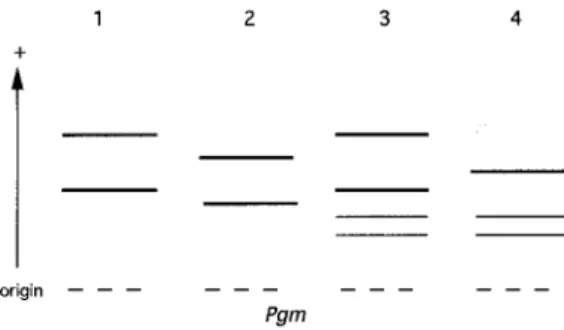
sible to infer the activity of two different enzyme loci. The locus which zone of activity had the fast-est elecrophoretic migration was coded : “ 1”, while the other one was coded “2”. The 12 enzyme sys-tems hence made it therefore possible to evidence the activity of 13 different genetic loci. Among them, 12 loci proved to be variable (polymorphism rate = 0.92). Genetic variability was interpreted when possible in terms of alleles, according to the hypothesis that T. cruzi is a diploid organism (Lanar et al. 1981, Tibayrenc et al. 1981). Nevertheless, at Pgm locus the patterns were too complex to be interpreted in terms of alleles. In this case, each distinct and reproducible pattern was considered as a distinct genotype, which precise allelic com-position remained unknown (Fig. 1).
Nine distinct multilocus genotypes, or zymodemes, were detected of the 27 Peruvian T. cruzi stocks examined (Table III, Fig. 2). Two stocks evidenced at some loci a superposition of
TABLE II
Genetic variability of Triatoma infestans natural population
Compared Fixation index F-Statistic
populations PGM 6PGD
Origin Code Number PGM 6PGD Fis Fit Fst Fis Fit Fst
Santa Rita A, B, C, D, E, 7 1.41 0.05 -0.04 0.14 0.17b -0.4b -0.004 0.28b de Siguas F, G
and Arequipa
Santa Rita A, B, C, D, E, 5 0.12 - -0.1 0.004 0.1a - -
-de Siguas
A, C, D, E, 4 0.54 - -0.1 -.04 0.05 - -
-Workman and Niswander test X2
Arequipa F, G 2 1.51 0.93 7.62a 2.08
a: p < 0.01; b: p < 0.001
Fig. 1: non-allelic genotypes recorded at the Pgm locus. Slot 1: 1-4 phenotype, slot 2: 2-5 phenotype, slot 3: 1-4-6-7 phe-notype, slot 4: 3-6-7 phenotype. The bold band are intense bands.
4
0
5
4
0
5
4
0
5
4
0
5
4
0
5
M
e
m
I
n
st
O
sw
a
ld
o
C
ru
z
,
R
io
d
e
Ja
n
e
ir
o
,
V
o
l.
9
2
(3
),
M
ay
/Ju
n
.
1
9
9
7
TABLE III
Multilocus genotypes of 27 Trypanosoma cruzi Peruvian stocks and two reference stock
Stocka G6pd Gpi Gd nad Gd nad + Idh Mdh Mel Me2 Pepl Pep2 Pgm 6Pgd Got Zymodemes
1.47, 1.50, 2.53 2/2 3/3 3/3 2/2 1/1 1/1 2/2 1/1 2/2 1/1 1-4 2/4 2/2
3.06, 3.34, 2
3.80, 5.75, 7.65, 7.69, MMX8b
3.10, 6.3, 3.40 2/2 3/3 3/3 1/1 1/1 1/1 2/2 1/1 2/2 1/1 1-4 2/4 2/2 6
3.20, 3.21, 3.26 2/2 3/3 3/3 1/1 1/1 1/1 2/2 1/1 2/2 2/2 1-4 4/4 2/2 5
MM4
3.35 2/2 3/3 3/3 2/2 1/1 1/1 2/2 1/1 2/2 2/2 1-4 2/4 2/2 4
3.31, 3.38c 2/2 3/3 3/3 2/2 1/1 1/1 2/2 1/1 1/1 1/1 1-4 2/4 2/2 7
7.56 1/1 3/3 3/3 2/2 1/1 1/1 2/2 1/1 2/2 1/1 1-4 2/4 2/2 3
So34 cl4, 2/2 3/3 3/3 2/2 1/1 1/1 2/2 1/1 2/2 1/1 1-4 4/4 2/2 1
AQX3, AQX6
3.30, mixture 2/2 3/3 3/3 1/1 1/1+2/2 1/1 2/2 1/1 2/2+3/3 1/1 1-4 2/4 1/1+2/2 6+(9 or 10)
3.32, mixture 2/2 3/3 1/1+3/3 1/1 1/1 1/1 2/2 1/1 2/2+3/3 1/1 1-4-6-7 2/4 1/1+2/2 6+(9 or 10)
3.37 2/2 2/2 1/1 1/1 2/2 1/1 1/1 2/2 3/3 2/2 3-6-7 4/4 1/1 9
3.17 2/2 2/2 1/1 2/2 2/2 1/1 1/1 2/2 3/3 2/2 3-6-7 4/4 1/1 10
Mn 1/1 1/2 2/2 2/2 2/2 1/1 2/2 2/2 3/3 2/2 2-5 1/3 1/1 8
406 406 406 406
406 Population Genetics of T. infestans and T. cruzi in Peru • SF Brenière et al.
patterns compatible with mixture of zymodemes as previously reported by Tibayrenc et al. (1986) and were excluded from genetic analysis when nec-essary.
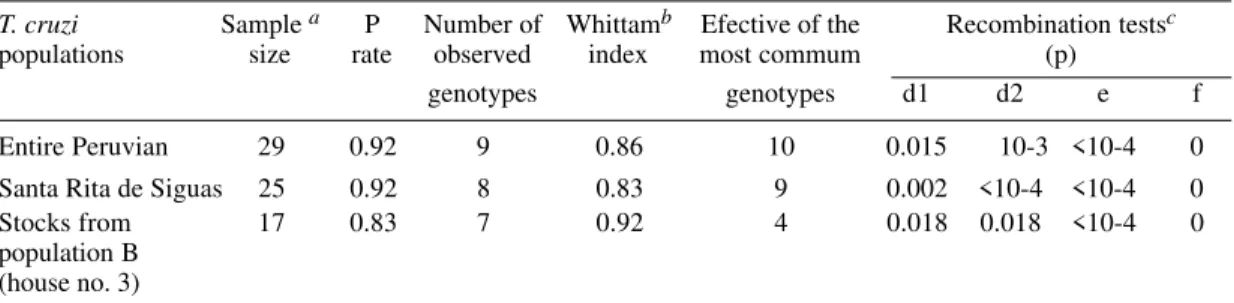
The polymorphism rates (Table IV) in the en-tire Peruvian sample and in Santa Rita de Siguas were very high and similar. Surprising, we observed a very important polymorphism in the sample lim-ited to the single house no. 3. The clonal diversity measured by the index of Whittam, is important and maintained in the population originated from a single house; the probability to sample two dif-ferent zymodemes in the population of house no. 3 is 0.92 (Table IV).
Population genetic analysis of parasites - Se-vere general deficit of heterozygotes is apparent in the entire sample and in the set of stocks from Santa de Rita de Siguas. Departures from Hardy-Weinberg expectations (segregation tests) were highly significant (p < 0.001) for glutamate dehy-drogenase NADP+ locus. The H-W test was not applicable for other loci. Linkage disequilibrium statistics (recombination tests; see Tibayrenc et al. 1990) were highly significant in the entire sample and in the set of T. cruzi stocks from Santa Rita de Siguas (Table IV). In the population composed of the T. cruzi stocks isolated from bugs taken in the house no. 3, we also observed significant tests of recombination (Table IV). In this population, un-der the null hypothesis of lack of departure from panmictic expectations, the probablility of record-ing the most abundant genotype with a size as high or higher than actually observed (4 stocks) was < 0.05 (test d1); the probability of observing any genotype with a size as high or higher than the dominant genotype’s one was < 0.05 (test d2); the probablility of observing as few or fewer different genotypes than actually observed (7 zymodemes) was < 10- 4 (test e); the probability of observing as high a linkage disequilibrium as actually observed
was close to 0 (test f).
Clustering - The UPGMA dendogram com-puted from Jaccard’s distance matrix (Fig. 2) shown two clades (A and B) each composed of Peruvian isolates. Most of the Peruvian stocks were clus-tered together with SO34 cl4 reference stock (clone 20) and pertained to the clade A. Only two stocks, namely 3.37 and 3.17 were genetically very differ-ent, more related to MN reference stock (clone 39) and clustered in clade B; they were only sampled in the house no. 3.
Spatial distribution of clones - Genotype 2 is the most frequently sampled in Santa Rita de Siguas. We studied its distribution among capture sites (houses) by X2. This genotype was signifi-cantly more abondant in the house no. 3 than in others of Santa Rita de Siguas (X2 = 7.71, ddl = 1, p < 0.01).
DISCUSSION
Genetic variability of vectors - This study real-ized in the province of Arequipa, Peru, allowed us to find two variable loci in T. infestans triatomines:
Pgm and 6Pgdh, whereas three different polymor-phic loci were previously described in T. infestans
species (Dujardin & Tibayrenc 1985 a,b, Dujardin et al. 1987). T. infestans triatomines from Arequipa and Santa Rita de Siguas showed high genetic dif-ferences: while both Pgm and 6Pgdh loci were vari-able in Arequipa only Pgm locus was variable in Santa Rita de Siguas. This last result is consistent with a previous study realized 12 years before in the same area of Santa Rita de Siguas (Dujardin 1990). The presence of T. infestans triatomines in Arequipa, described for the first time in this study, is recently and confirmed by the local authorities of the Ministry of Health and the scientists of the University of Arequipa. The origin of T. infestans
in Arequipa could derived in part from Santa Rita de Siguas, but the identification of allele 2 of 6Pgd
TABLE IV
Population genetic analysis of Trypanosoma cruzi stocks
T. cruzi Sample a P Number of Whittamb Efective of the Recombination testsc
populations size rate observed index most commum (p)
genotypes genotypes d1 d2 e f
Entire Peruvian 29 0.92 9 0.86 10 0.015 10-3 <10-4 0
Santa Rita de Siguas 25 0.92 8 0.83 9 0.002 <10-4 <10-4 0
Stocks from 17 0.83 7 0.92 4 0.018 0.018 <10-4 0
population B (house no. 3)
407 407 407 407 407 Mem Inst Oswaldo Cruz, Rio de Janeiro, Vol. 92(3), May/Jun. 1997
locus, found only in Arequipa triatomines, indi-cate a second origin; this allele 2 is also described in Bolivian populations (Dujardin 1990) and in southern Peruvian populations (unpublished data).
Genetic varability of parasites and clonality -Among the Peruvian T. cruzi stocks under study we observed 9 different zymodemes clearly grouped in two principal clades A and B (Fig. 2). The 25 stocks pertaining to clade A were geneti-cally related to those caracterized 12 years before (Brenière et al. 1985, 1991) by similar isoenzyme analysis using the same reference stocks as con-trol, clone 20 and clone 39 (Tibayrenc & Ayala 1988). Two other stocks pertaining to genotypes 9 and 10 were never described before in this region and were clustered in clade B.
Criteria of clonality have been extensively de-scribed by Tibayrenc et al. (1990). The present re-sults agree with the hypothesis of clonality of T. cruzi population.
Two stocks isolated from T. infestans in Moquegua departement present the same genotype (2 and 5) than several stocks isolated in Santa Rita de Siguas. The fact that these areas are geographi-cally distant confirms the ubiquitous character of
T. cruzi zymodemes, one of the criteria of clonality (Tibayrenc et al. 1990).
The genetic segregation and recombination tests were mostly significant in the entire population and in the population of Santa Rita de Siguas. Signifi-cant segregation and recombination tests are also criteria for clonal structure of populations (Tibayrenc et al. 1990). Even though, reliability of H-W test, depends on the diploid hypothesis of T. cruzi and is limited by small sample size, recom-binant tests, independent of diploid hypothesis, give more unquestionable interpretation of the re-sults.
Geographic partition of population (absence of sympatric conditions) is a potential source of sig-nificant tests even in sexual species. That can ex-plain the significativity of the tests when popula-tions of Santa Rita de Siguas and Arequipa are tested together and when the populations of the different houses in Santa Rita de Siguas are ana-lyzed. However, the T. cruzi population isolated from a single house (no. 3) is sympatric and the recombination test are still significant.
The stocks isolated from house no. 3 are clus-tered in two separate clades (A and B, Fig. 2) and the recombinant tests performed on clade A (data not shown) were not significant. Therefore, the presence of two cryptic species cannot be excluded. The absence of significativity of the recombina-tion tests could be related to the presence of two cryptic species either to bias due to the application of the tests to sub phylogenic division where
ge-netic diversity is low.
Micro distribution of T. infestans genotypes and T. cruzi clones - The micro distribution of T. infestans genotypes and T. cruzi clones within in-dividual houses of Santa Rita de Siguas indicate that house no. 3 differs from others for: (a) a higher density of insects in this house; (b) a greater in-fection rate of the triatomines; (c) a different T. cruzi
clone distribution; and (d) differences in allelic fre-quencies of T. infestans.
Therefore, the dispersal capacity of T. infestans
is very reduced and the panmictic unit appears to be smallest than the whole locality as previously proposed by Dujardin et al. (1985). The polymor-phism rate evidenced by isoenzyme in T. infestans
taxon is very low and limits the genetic interpreta-tion of genetic flux between populainterpreta-tions. New markers (eg. RAPD and microsatellite DNA) has to be developed to reach more resolutive approach. The absence of homogeneity in T. cruzi clone dis-tribution between house no. 3 and the others con-firm the separation of the insect populations.
ACKNOWLEDGEMENT
To Dr Jean-Pierre Dujardin (ORSTOM) for com-munication of the F statistic test and revising the manu-script. To Michel Tibayrenc (ORSTOM) for critical re-view of the manuscript which was helpful.
REFERENCES
Ben Abderrazak S, Guerrini F, Mathieu-Daudé F, Truc P, Neubauer K, Lewicka K, Barnabé C, Tibayrenc M 1993. Isoenzyme electrophoresis for pasasite char-acterization, 21, p. 361-382. In Methods in Molecu-lar Biology, John E. Hyde Copyright, Human Press Inc, Totowa,NJ.
Bilton DT 1992. Genetic population structure of the post-glacial relict diving beetle Hydroporus glabriusculus Aubé (Coleoptera : Dystiscidae). Heredity69: 503-511.
Brenière SF, Braquemond P, Solari A, Agnèse JF, Tibayrenc M 1991. An isoenzyme study of Trypa-nosoma cruzi natural clones isolated from the two sides of the West Andes Highland. Trans R Soc Trop Med Hyg 85: 62-66.
Brenière SF, LLanos B, Tibayrenc M, Desjeux P 1985. Isoenzymic studies and epidemiological data of Try-panosoma cruzi from Arequipa (Peru), Pacific side. Ann Soc Belge Méd Trop65:63-66.
Dujardin JP 1990. Etude de quelques populations naturelles deTriatoma infestans. PHD in Sciences, Université de Paris VI, France, 194 pp.
408 408 408 408
408 Population Genetics of T. infestans and T. cruzi in Peru • SF Brenière et al.
Belge Méd Trop65:165-169.
Dujardin JP, Tibayrenc M, Venegas L, Maldonado L, Desjeux P, Ayala FJ 1987. Isoenzyme evidence of lack of speciation between wild and domestic Tri-atoma infestans (Heteroptera: Reduviidae) in Bo-livia. J Med Entomol 24: 40-45.
Godfrey DG, Kilgour V 1976. Enzyme electrophoresis in characterizing the causative agent of Gambian try-panosomiasis. Trans R Soc Trop Med Hyg 71: 217-225.
Jaccard P 1908. Nouvelles recherches sur la distribution florale. Bull Soc Vaudoise de Sc Nat 44: 223-270. Lanar DE, Levy LS, Manning JE 1981. Complexity and
content of the DNA and RNA in Trypanosoma cruzi. Mol Biochem Parasitol3: 327-341.
Lent H, Wygodzinsky P 1979. Revision of the Triatominae (Hemiptera, Reduviidae) and their sig-nificance as vectors of Chagas’ disease. Bull Am Mus Nat Hist NY163:125-520.
Nei M 1987. Molecular evolutionary genetics. Columbian University Press, 512 pp.
Serres E, Roux M 1986. Pratique de la classification automatique: L’exemple des Leishmania, p. 27-40. In JA Rioux, Leishmania. Taxomomie et phylogénèse. IMEEE, Montpellier, France. Sneath PHA, Sokal RR 1973. Numerical taxonomy. The
principles and practice of numerical classification. In D Kennedy, RB Park (eds), Freeman and Com-pany, San Francisco, 359 pp.
Tibayrenc M, Ayala FJ 1988. Isoenzyme variability in Trypanosoma cruzi, the agent of Chagas disease: genetical, taxonomical and epidemiological
signifi-cance. Evolution 42: 277-292.
Tibayrenc M, Cariou ML, Solignac M 1981. Interprétation génétique de zymogrammes de flagellés des genres Trypanosoma et Leishmania. Comptes Rendus de l’Académie des Sciences, Paris 292: 623-625.
Tibayrenc M, Echalar L, Desjeux P 1982. Une méthode simple pour obtenir directement des isolats de Try-panosoma cruzi à partir du tube digestif du triatome vecteur. Cahiers ORSTOM, Série Entomol Méd Parasitol20: 187-188.
Tibayrenc M, Kjellberg F, Ayala FJ 1990. A clonal theory of parasitic protozoa: the population structure of Entamoeba, Gardia, Leishmania, Naegleria, Plas-modium, Trichomonas and Trypanosoma, and its medical and taxonomical consequences. Proc Nat Acad Sci USA87: 2414-2418.
Tibayrenc M, Hoffmann A, Poch O, Echalar L, Le Pont F, Lemesre JL, Desjeux P, Ayala FJ 1986. Additional data on Trypanosoma cruzi isozymic strains encoun-tered in Bolivian domestic transmission cycles. Trans R Soc Trop Med Hyg 80: 442-447.
Tibayrenc M, Kjellberg F, Arnaud J, Oury B, Brenière SF, Dardé ML, Ayala FJ 1991. Are eukaryotic mi-croorganisms clonal or sexual? A population genet-ics vantage. Proc Nat Acad Sci USA88: 5129-5133. Whittam TS 1989. Clonal dynamics of Escherichia coli in its natural habitat. Antonie van Leeuwenhock 55: 23-32.