Continuity effects on rotifers and microcrustaceans caused
by the construction of a downstream reservoir in a cascade
series (Iguaçu River, Brazil)
M. Serafim-Júnior
a*, F. A. Lansac-Tôha
b, R. M. Lopes
cand G. Perbiche-Neves
daCurso de Engenharia de Pesca, Laboratório de Aquicultura, Universidade Federal do Recôncavo da Bahia - UFRB,
Campus Universitário de Cruz das Almas, CEP 44380-000, Cruz das Almas, BA, Brazil
bNúcleo de Estudos em Limnologia, Ictiologia e Aquicultura – NUPÉLIA, Laboratório de Zooplâncton,
Universidade Estadual de Maringá - UEM, Avenida Colombo, 5790, CEP 87020-900, Maringá, PR, Brazil
cLaboratório de Sistemas Planctônicos, Departamento de Oceanografia Biológica, Instituto Oceanográfico,
Universidade de São Paulo - USP, Praça do Oceanográfico, 191, Cidade Universitária, CEP 05508-120, São Paulo, SP, Brazil
dCentro de Ciências da Natureza, Universidade Federal de São Carlos - UFSCar, Campus Lagoa do Sino,
Rodovia Lauri Simões de Barros, Km 12 - SP 189, Bairro Aracaçú, CP 094, CEP 18290-000, Buri, SP, Brazil
*e-mail: [email protected]
Received: January 17, 2014 – Accepted: January 15, 2015 – Distributed: May 31, 2016 (With 4 figures)
Abstract
This study evaluated changes in the community of rotifers and microcrustaceans associated with the construction of a large and dendritic reservoir in Iguaçu River (Brazil), as the last reservoir of a sequence of five cascading systems. Differences were clear between pre-filling and post-filling phases for organisms and some of environmental variables. In the pre-filling phase, the community was more homogeneous along the downstream river gradient, and spatial compartmentalization in the new reservoir was common during the post-filling phase. From 140 identified taxa, 10 species occurred exclusively in the pre-filling phase and 32 in the post-filling phase. After completion of the fifth reservoir filling-up, opportunistic, pioneer and fast-developing species quickly dominated, and downstream of the fourth reservoir the pre-filling decreasing gradient of richness, diversity and evenness disappeared. Richness of rotifers and cladocerans, cladocerans diversity, and evenness of rotifers, cladocerans and copepods were generally higher in the post-filling phase. A non-metric multidimensional analysis based on a presence/absence matrix depicted a homogeneous and dense group of species associated to the pre-filling phase and a second, dispersed group related to the post-filling phase. Spearman correlations pointed out significant positive effects of transparency on rotifer species richness in the post-filling phase, and negative effects on the microcrustacean richness in the pre-filling phase. Dam construction caused disruption of the downstream lotic gradient along the series of dams, leading to the development of distinct species in lentic spatial compartments.
Keywords: Rotifera, Cladocera, Copepoda, Iguaçu River.
Efeitos contínuos sobre rotíferos e microcrustáceos causados pela construção
de um reservatório a jusante de uma série em cascata, Rio Iguaçú, Brasil
Resumo
Esse estudo analisou os efeitos da construção de um reservatório largo e dendrítico no Brasil sobre a comunidade de rotíferos e microcrustáceos, sendo o último reservatório de uma cascata de cinco. Houve claras diferenças entre as fases pré e pós-enchimento para os organismos e para algumas variáveis ambientais. Na fase pré-enchimento, a comunidade foi mais homogênea no gradiente longitudinal no rio a jusante, e na fase pós-enchimento houve compartimentalização espacial no novo reservatório. Dos 140 táxons identificados, dez espécies ocorreram exclusivamente na fase pré-enchimento e 32 na fase pós-enchimento. Após o enchimento, espécies oportunistas, pioneiras e de rápido desenvolvimento foram dominantes, e desapareceu o gradiente de decréscimo a jusante do quarto reservatório para a riqueza, diversidade e equitabilidade durante a fase pré-enchimento. A riqueza de rotíferos e cladóceros, a diversidade de cladóceros, e a equitabilidade de rotíferos, cladóceros e copépodes foram elevadas na fase pós-enchimento. A análise de escalonamento multidimensional não-métrico sobre a matriz de presença e ausência mostrou um grupo homogêneo e denso de espécies e meses de amostragem na fase pré-enchimento, e outro grupo disperso na fase pós-enchimento. Correlações de Spearman apontaram efeitos significativos da transparência sobre a riqueza de rotíferos na fase pós-enchimento, e efeitos negativos sobre a riqueza de microcrustáceos na outra fase. Os efeitos da construção do reservatório causaram rompimento no gradiente lótico contínuo a jusante do quarto reservatório observado na fase pré-enchimento, permitindo o desenvolvimento de espécies em compartimentos espaciais lênticos.
1. Introduction
The damming of rivers leads to significant changes in
the abiotic environment and in the biological communities
both upstream and downstream (Marzolf, 1990; Straskraba and Tundisi, 1999; Garrido and Bozelli, 2000; Ribeiro Filho et al., 2011). Changes in abiotic conditions are
induced by reduction of water velocity, increase of water transparency, and the possibility of formation of thermal and chemical stratification. For plankton communities,
changes occur in several ecological attributes such as
species richness, diversity and abundance of phytoplankton and zooplankton, when lotic species are replaced by lentic species after stabilisation of the system (Pedrozo et al., 2012). The interactions occurring between the river basin
and the impounded water lead to the establishment of spatial gradients (longitudinal and lateral gradients) of
biotic and abiotic variables in the reservoir main channel (Perbiche-Neves and Nogueira, 2010; Perbiche-Neves et al., 2011). The formation of many side-arms generally
associated with tributary rivers is common in dendritic reservoirs, which can also contribute to the formation of
lateral gradients (Ward, 1989; Van Den Brink et al., 1994;
Bonecker et al., 2001).
In reservoirs, zooplankton communities exhibit
structural changes along longitudinal and lateral gradients,
because of the interaction with environmental factors such as water flow, physical and chemical stratification,
and tributary entrances (Nogueira, 2001; Sampaio et al., 2002; Sartori et al., 2009). Higher densities are expected
to occur in transition zones, both between the main river and the reservoir and between tributaries and the reservoir (backwater areas) (Marzolf, 1990; Van Den Brink et al., 1994). In cascade series of reservoirs, the upstream
reservoirs - especially those of the storage type with a high retention time - affect the zooplankton downstream
(Sampaio et al., 2002; Nogueira et al., 2008; Perbiche-Neves and Nogueira, 2010, 2013), exporting fauna by drifting process (Mitsuka and Henry, 2002; Perbiche-Neves et al., 2012). The organisms tend to disperse downstream, but
construction of a new dam can stop this process due to the development of lentic conditions. Although there are many reservoir cascades in the world, the effects of a new impoundment at the end of a series of reservoirs have
rarely been studied.
After the filling of a new reservoir, aquatic communities tend to follow a continuous process of changes and
succession (Garrido and Bozelli, 2000; Pedrozo et al., 2012). In the initial years after impoundment, irregular
reproduction cycles for many species of zooplankton
occur (Perbiche-Neves et al., 2007; Serafim-Júnior et al., 2010). Colonisation processes range from r- to k-strategist
species, initially with the dominance of small species (including rotifers, protozoans, small cladocerans and cyclopoid copepods), which tend to be replaced by
large species, such as large cladocerans and calanoid copepods (Matsumura-Tundisi et al., 1991; Santos, 1995;
Bonecker et al., 2001; Pedrozo et al., 2012). However, in
the Neotropical region, comparative studies on zooplankton
community in the pre- and post-impoundment phases remain scarce (Lansac-Tôha et al., 1999; Bonecker et al., 2001; Velho et al., 2001; Pedrozo et al., 2012), and additional investigations are needed to understand the succession
mechanisms along the different filling stages.
In this study, we examined the composition, richness, alpha diversity and evenness of rotifers and microcrustaceans
in relation to environmental variables, comparing a year
before and a year after the construction of a large and dendritic reservoir in the Iguaçu River, south of Brazil. We tested two hypotheses: 1) that the decreasing gradient downstream from the last reservoir will disappear after damming of the new reservoir, due to the establishment of lentic conditions favourable to some rotifers and microcrustaceans, such as increase in water transparency and chlorophyll; 2) that richness, diversity and evenness will increase in the post-filling phase, for the same reasons.
2. Material and Methods
The study was carried out in the low stretch of the Iguaçu River, in the Paraná State, south of Brazil. The climate in this region is Cfa sub-tropical (Koppen), usually with two distinct seasons: cool-dry (winter) and warm-wet (summer). The mean annual rainfall ranges from 1,500 to 1,700 mm.
The studied reservoir (Figure 1), named Salto Caxias
Reservoir (25°32’35”S; 53°29’43”W), is the last in a series of five large reservoirs in this river, all used for hydropower generation. The series of reservoirs along Iguaçu River is:
Foz do Areia, Segredo, Salto Santiago, Salto Osório and
Salto Caxias. A sixth new reservoir (Capanema) is being built in Iguaçu River few kilometres downstream Salto Caxias dam. The Salto Caxias Reservoir construction was completed in September of 1998 and is located in the final stretch of the Iguaçu River. The lake has a surface area of 141 km2 with an annual dam discharge of 3.6 × 10⁶ m3.
The mean water retention time of the lake is 38 days, the
mean depth is 40 m and the maximum is 60 m close to the dam.
For this study, a total of nine sampling sites were selected
along the Iguaçu River stretch and its tributaries (Figure 1).
The organisms were sampled monthly, from March of 1997 to February of 1998 (pre-impoundment phase) and from April of 1999 to March of 2000 (post-impoundment phase), totalling 216 samples. Samples were collected by filtering 300 L of water of sub-surface through 64-µm plankton net, with the aid of a motorised pump Stihl P835 and flow of 40 L/h. Organisms were immediately preserved in 4% buffered formalin. For microscopic analysis, sample aliquots of 1mL were obtained using Hensen-Stempel pipettes. Bdelloidea rotifers and Harpacticoida copepods, as well as nauplii and copepodites of Cyclopoida and Calanoida, were not identified to lower taxonomic level. Rotifers and copepod nauplii were analysed in Sedgwick-Rafter
chambers and adult cladocerans and adult and copepodites
of copepods in gridded acrylic chambers, under an optical
Species of rotifers, copepods and cladocerans were classified as their habits in planktonic or non-planktonic,
according to Koste (1978), Segers (1995), Lima et al.
(1998), and Serafim-Júnior et al. (2003).
The frequency of occurrence of each taxon was calculated by considering the numbers of samples in which the species were found in relation to the total number of samples. Species richness was determined according to the number of species recorded in each sample. Individual
abundance and the Shannon-Wiener diversity index
(H’=Σpi.log2.pi), where pi is the proportion of taxoni in
the sample, and evenness (E=H’/H’max) (Pielou, 1984)
were also determined.
Data of richness, diversity and evenness were examined by a factorial analysis of variance (ANOVA), using as factors the filling phases (pre- and post-filling), sampling
sites, and the interaction between both. ANOVA detected the effects of phases on sampling sites, using the significant differences in the interaction to represent the changes in ecological attributes. The assumptions of normality and homoscedasticity were previously checked with Shapiro-Wilk test and Levene test, respectively. The analysis was run in
Statistica 6.0 (STATSOFT INC, 2002).
The VEGAN and MASS packages in the software R
Cran Project (R CORE DEVELOPMENT TEAM, 2012)
were used for non-metric multidimensional analysis (NMDS, using isoMDS) to separate species and sampling months between pre- and post-filling phases, based on a presence/absence matrix. First, all data of sampling sites and months were analysed, but due to the excessive number of lines we opted to estimate a mean among sampling sites for each sampling date, for the final analyses. Bray-Curtis
distance was used. The convergent solutions were found
by several trials. For scaling, centring, PC rotation and
half change scaling were used.
Eleven environmental variables were measured in
each sampling site, including: temperature, electrical
conductivity, dissolved oxygen and pH (Horiba U10 probe), transparency (Secchi disk), chlorophyll (Talling and Driver, 1963), alkalinity total phosphorus (Strickland and Parsons, 1960), total nitrogen (Mackreth et al., 1978), total solids
(TS) and total suspended solids (TSS). In the pre-filling phase limnological variables were measured in the water surface, and in the post-filling phase water samples were taken with a Van Dorn bottle in several depths, selected
according to transparency, values. Sonde measurements
were made on board immediately after sampling, and sample jars were frozen subsequently for later chemical analysis. Mean values of each limnological variable were calculated for the entire water column for statistical analysis. One-way ANOVA was performed to test for significant differences in limnological variables between pre- and post-filling phases. Spearman correlations were estimated between environmental variables and rotifer and species richness in pre- and post-filling phases, in order to distinguish environmental influences on rotifers and microcrustaceans richness. Statistical analyses were performed on Statistica 6.0 (STATSOFT INC, 2002).
3. Results
A total of 140 taxa were identified in both phases, 10 of which were only recorded in the pre-impoundment
phase, and 32 only in the post-impoundment phase. Most
species are shown in Table 1 (except very rare species
which were not used in all statistical analysis). We found 99 species of rotifers distributed in 20 families. Eight species of rotifers were only found in the pre-impoundment
phase and 21 in the post-impoundment phase. The most
common rotifers in the pre-impoundment phase were Keratella cochlearis (61%), Polyarthra vulgaris (61%), K. americana (51%), Conochilus coenobasis (44%) and
Ploesoma truncatum (43%). In the post-impoundment
phase, Polyarthra vulgaris (89%), K. cochlearis (84%),
C. coenobasis (83%), C. unicornis (82%), Collotheca sp.
(81%), K. americana (80%) and Hexarthra intermedia brasiliensis (74%) were common.
Among the microcrustaceans, 26 species of cladocerans and 15 species of copepods were identified, the latter comprised by seven species of Cyclopidae and eight species of Diaptomidae.
Moina reticulata was only observed in the Iguaçu River (site 3) during the pre-impoundment phase. In contrast, seven species of Cladocera were exclusive to the
post-impoundment phase. The most common cladocerans
in the pre-impoundment phase were Ceriodaphnia cornuta (32%), Daphnia gessneri (27%) and Bosmina hagmanni (25%). In the post-impoundment phase, Moina minuta (80%) was the most common, followed by B. hagmanni
(78%), C. cornuta (66%) and Bosminopsis deitersi (63%). Thermocyclops decipiens (41%) and Argyrodiaptomus furcatus (27%) were dominant in the pre-impoundment
phase. In the post-impoundment phase, the dominant species
were T. decipiens (58%), followed by Microcyclops anceps
(36%), Notodiaptomus henseni (25%), N. anisitsi (22%) and N. deitersi (22%). Five species of copepods were only
found in the post-impoundment phase. Significant differences for important ecological attributes were detected between the pre- and post-filling phases, for rotifers, cladocerans
and copepods (Table 2). The interaction between phases
and sites was significant for richness and evenness of rotifers, for evenness of copepods, and for all attributes of cladocerans (Table 1). Among the sampling sites, only
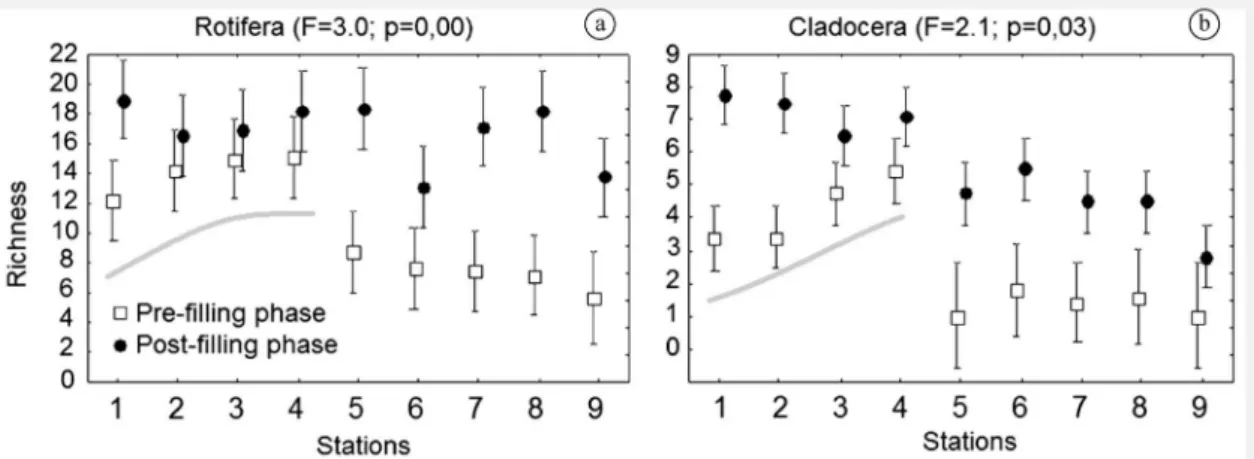
the evenness of rotifers was not different. Rotifer richness was usually high in the post-filling phase (Figure 2a) when
differences among sampling sites were minor; the opposite was observed in the pre-filling phase, when low rotifer richness occurred at the tributaries. Rotifer evenness was higher in the pre-filling phase and in tributaries; during the post-filling phase evenness increased in the main
channel (Figure 3b).
Figure 2. Mean values and standard error for richness of rotifers (a) and cladocerans (b), which showed significant
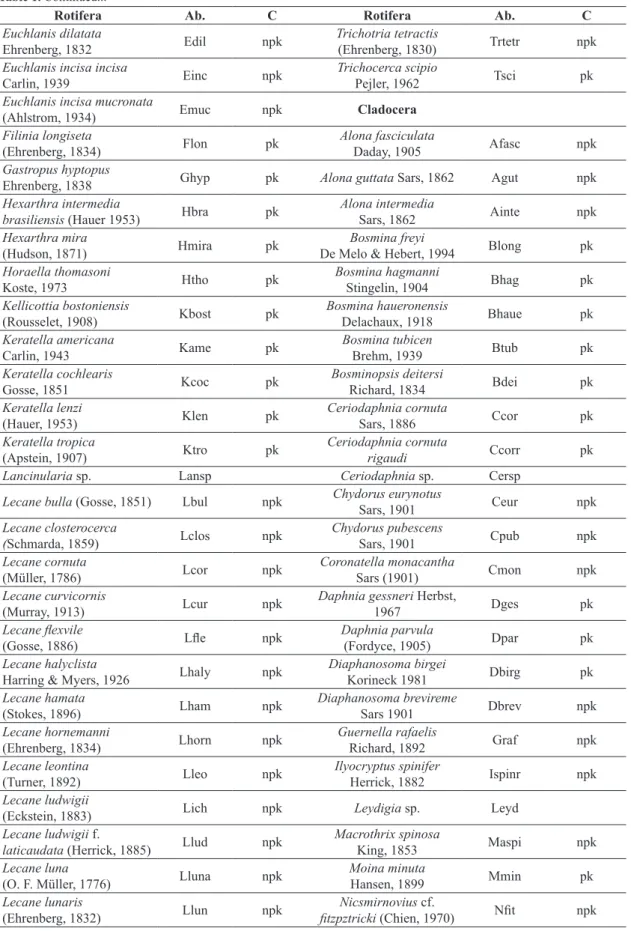
Table 1. List of almost all species found in our study, with abbreviations used in NMDS and habitat classification (C) in
planktonic (pk) or non-planktonic (npk). Species not identified in species level were not classified.
Rotifera Ab. C Rotifera Ab. C
Anuraeopsis naviculata
Rousselet, 1910 Anav pk
Platyas quadricornis
(Ehrenberg, 1832) Pqua pk Ascomorpha ecaudis
(Perty, 1859) Aeca npk brevispinaPlatyias quadricornis (Daday, 1905) Pbrev pk Ascomorpha ovalis
(Bergendal, 1892) Aova npk (O. F. Müller, 1786)Platyonus patulus Plpat npk Ascomorpha saltans
Bartsch, 1870 Asal pk
Platyonus patulus var.
macracanthus
(Daday, 1905) Plmac npk Asplanchna sieboldi
(Leydig, 1854) Asieb pk Ploesoma truncatum(Levander, 1894) Ptrun pk Brachionus angularis
Gosse, 1851 Bang pk
Polyarthra dolichoptera
(Idelson, 1925) Pdoli pk Brachionus budapestinensis
Daday, 1885 Bbud pk
Polyarthra remata
(Skorikov, 1896) Prem npk Brachionus calyciflorus
Pallas, 1766 Bcal pk
Polyarthra vulgaris
(Carlin, 1943) Pvul pk
Brachionus caudatus
insuetus Ahlstrom, 1940 Bins npk
Pompholyx complanata
Gosse, 1851 Pcom npk
Brachionus caudatus
personatus Ahlstrm, 1940 Bpers pk Ptygura sp. Ptysp
Brachionus falcatus
falcatus Zacharias, 1898 Bfal pk
Scaridium longicaudatum
(O. F. Müller, 1786) Scari npk Brachionus quadridentatus
(Hermanns, 1783) Bqua pk Synchaeta sp.1 Sysp1
Brachionus mirus reductus
(Koste, 1972) Bred pk Synchaeta sp.2 Sysp2
Cephalodella gibba
(Ehrenberg, 1838) Cgib npk Testudinella ahlstromi(Hauer, 1956) Tahls npk Cephalodella stenrossi
Wulfert, 1937 Cste npk Testudinella patina patina (Hermann, 1783) Tpat npk Collotheca sp. Cosp Trichocerca (D) similis
grandis (Hauer, 1965) Tsim pk
Collotheca sp. Csp
Trichocerca capucina Wierzejski & Zacharias,
1893
Tcap pk
Conochilus coenobasis
Skorikov, 1914 Cocoe npk
Trichocerca cylindrica chattoni De Beauchamp, 1907
Tchat pk
Conochilus unicornis
Rousselet, 1892 Couni npk
Trichocerca fusiformis
Levander, 1894 Tfusi pk
Corulella obtusa
(Gosse, 1886) Cobt npk Trichocerca haueroensis(Gillard, 1967) Tmucr pk Dicranophorus epicharis
Harring & Myers, 1928 Depic npk Trichocerca insignis(Lauterborn, 1898) Tins pk Dicranophorus caudatus
brasiliensis Koste, 1972 Dcbra pk
Trichocerca parvula
Carlin, 1939 Tparv npk
Dipleuchlanis propatula
(Gosse, 1886) Dipro npk (Lauterborn, 1898)Trichocercapusilla Tpus pk
Encentrum sp. Encsp Trichocerca sp. Trisp
Epiphanes clavatula
Table 1. Continued...
Rotifera Ab. C Rotifera Ab. C
Euchlanis dilatata
Ehrenberg, 1832 Edil npk
Trichotria tetractis
(Ehrenberg, 1830) Trtetr npk Euchlanis incisa incisa
Carlin, 1939 Einc npk
Trichocerca scipio
Pejler, 1962 Tsci pk
Euchlanis incisa mucronata
(Ahlstrom, 1934) Emuc npk Cladocera
Filinia longiseta
(Ehrenberg, 1834) Flon pk Alona fasciculataDaday, 1905 Afasc npk
Gastropus hyptopus
Ehrenberg, 1838 Ghyp pk Alona guttata Sars, 1862 Agut npk
Hexarthra intermedia
brasiliensis (Hauer 1953) Hbra pk Alona intermediaSars, 1862 Ainte npk
Hexarthra mira
(Hudson, 1871) Hmira pk De Melo & Hebert, 1994Bosmina freyi Blong pk Horaella thomasoni
Koste, 1973 Htho pk
Bosmina hagmanni
Stingelin, 1904 Bhag pk
Kellicottia bostoniensis
(Rousselet, 1908) Kbost pk Bosmina haueronensisDelachaux, 1918 Bhaue pk
Keratella americana
Carlin, 1943 Kame pk
Bosmina tubicen
Brehm, 1939 Btub pk
Keratella cochlearis
Gosse, 1851 Kcoc pk
Bosminopsis deitersi
Richard, 1834 Bdei pk
Keratella lenzi
(Hauer, 1953) Klen pk Ceriodaphnia cornutaSars, 1886 Ccor pk
Keratella tropica
(Apstein, 1907) Ktro pk Ceriodaphnia cornuta rigaudi Ccorr pk
Lancinularia sp. Lansp Ceriodaphnia sp. Cersp
Lecane bulla (Gosse, 1851) Lbul npk Chydorus eurynotus
Sars, 1901 Ceur npk
Lecane closterocerca
(Schmarda, 1859) Lclos npk
Chydorus pubescens
Sars, 1901 Cpub npk
Lecane cornuta
(Müller, 1786) Lcor npk Coronatella monacanthaSars (1901) Cmon npk Lecane curvicornis
(Murray, 1913) Lcur npk Daphnia gessneri1967 Herbst, Dges pk
Lecane flexvile
(Gosse, 1886) Lfle npk Daphnia parvula(Fordyce, 1905) Dpar pk Lecane halyclista
Harring & Myers, 1926 Lhaly npk Diaphanosoma birgeiKorineck 1981 Dbirg pk Lecane hamata
(Stokes, 1896) Lham npk Diaphanosoma breviremeSars 1901 Dbrev npk
Lecane hornemanni
(Ehrenberg, 1834) Lhorn npk Guernella rafaelisRichard, 1892 Graf npk
Lecane leontina
(Turner, 1892) Lleo npk Ilyocryptus spiniferHerrick, 1882 Ispinr npk Lecane ludwigii
(Eckstein, 1883) Lich npk Leydigia sp. Leyd
Lecane ludwigii f.
laticaudata (Herrick, 1885) Llud npk Macrothrix spinosaKing, 1853 Maspi npk
Lecane luna
(O. F. Müller, 1776) Lluna npk Moina minutaHansen, 1899 Mmin pk Lecane lunaris
Cladoceran richness (Figure 2a) and diversity (Figure 3a)
was high in the post-filling phase, with higher values in the main channel. In the pre-filling phase, a decreasing downstream trend of the richness and diversity was verified from site 4 towards site 1, and lower values also occurred in the tributaries. Rotifer evenness (Figure 3c) in the main
channel of the Iguaçu River was similar in the pre- and post-filling phases. However, in the tributaries evenness was higher in the post-filling phase, with a minor variation
among sites.
For copepods, only evenness had a significant difference between phases, being higher in the post-filling phase. There was a decrease gradient of evenness downstream
Salto Osório Reservoir, corresponding to the upstream
zone in the pre-filling phase (Figure 3d).
The NMDS clearly separated species groups of rotifers and microcrustaceans between pre- and post-filling phases
(Figure 4). In both taxa, the pre-filling phase station
grouping was less spread than in the post-filling phase indicating a more homogeneous condition in the former. For rotifers (Figure 4a), two convergent solutions were
found after 14 tries and the stress was 6.56, showing a pre-filling group with many species of low abundance, in contrast to a post-filling group with few highly abundant species, typical of lentic conditions.
No convergent solutions were found for the microcrustacean data, and the best solution occurred after
Table 1. Continued...
Rotifera Ab. C Rotifera Ab. C
Lecane monostyla
(Daday, 1897) Lmon npk Phryxura dadayiBirge, 1910 Pdad npk
Lecane papuana
(Murray, 1913) Lpap npk Copepoda
Lecane quadridentata
(Ehrenberg, 1832) Lqua npk Argyrodiaptomus furcatus(Sars, 1901) Afurc pk Lecane scutata
(Harring & Myers, 1926) Lscut npk Notodiaptomus anisitsi(Daday, 1905) Nanis pk Lecane signifera
(Jennings, 1896) Lsig npk Notodiaptomus conifer(Sars, 1901) Nconi pk
Lecane sp. Lecsp Notodiaptomus deitersi
(Poppe, 1981) Ndei pk
Lecane stenroosi
(Meissner, 1908) Lsten npk Notodiaptomus henseni(Dahl, 1891) Nhen pk Lecane stichea Harring,
1913 Lstic npk
Notodiaptomus iheringi
(Wright, 1935) Niher pk Lepadella acuminata
(Ehrenberg, 1834) Leacu npk
Notodiaptomus spinuliferus Dussart &
Matsumura-Tundisi, 1985
Nspi pk
Lepadella benjamini
Harring, 1916 Lben npk Notodiaptomus transitans(Kiefer, 1929) Ntran pk Lepadella ovalis
(O. F. Müller, 1786) Lova npk Notodiaptomus sp. Nsp Lepadella patela
(O. F. Müller, 1786) Lpat npk
Mesocyclops longisetus curvatus
(Thiébaud, 1914) Mlon npk Lophocaris salpina
(Ehrenberg, 1834) Lsal npk Mesocyclops meridianus(Kiefer, 1926) Mmer pk Macrochaetus sericus
(Thorpe, 1893) Mser npk Metacyclops sp. Metsp
Manfredium eudactylota
(Gallagher, 1957) Meud npk Microcyclops sp. Micsp Mytilina ventralis
(Ehrenberg, 1832) Mven npk Paracyclops chiltoni(Thomson, 1882) Pchil npk Notholca sp. Notsp Thermocyclops decipiens
(Kiefer, 1929) Tdec pk
Notomata copeus
Ehrenberg, 1834 Ncop npk
Thermocyclops minutus
(Lowndes, 1934) Tmin pk
Figure 3. Mean values and standard error for Shannon-Wiener diversity of cladocerans (a), and evenness of rotifers
(b), cladocerans (c) and copepods (d), which showed significant interactions in the bifactorial ANOVA.
Table 2. Results of the factorial ANOVA (F and p) for richness (S), diversity (H’) and evenness (E) of rotifers and microcrustaceans.
Groups
DF Rotifers Cladocerans Copepods
Attributes/Effects F p F P F
Richness (S)
Phase 1 98.2 0.00 129.7 0.00 20.5
Sites 8 6.3 0.00 16.3 0.00 3.8
Phase* Sites 8 3.0 0.00 2.1 0.03 0.2
Diversity
Phase 1 25.1 0.00 76.1 0.00 37.4
Sites 8 4.2 0.00 18.4 0.00 6.4
Phase* Sites 8 1.1 0.30 2.5 0.01 0.7
Evenness
Phase 1 6.4 0.01 31.8 0.00 51.4
Sites 8 0.5 0.83 11.0 0.00 8.6
Phase* Sites 8 3.7 0.00 5.4 0.00 2.6
* Bold values are significant (p < 0.05). DF = degrees of freedom.
20 tries, with a stress of 7.03 (Figure 4b). The results of
richness and abundance analyses were similar for rotifers
and microcrustaceans. Typical lotic and littoral cladocerans
and copepods were present in the pre-filling phase and were absent in the post-filling phase, when organisms adapted to lentic environments were dominant.
For the environmental variables (Table 3), ANOVA
showed significant differences (p < 0.05) between the
pre- and post-filling phases for water transparency, chlorophyll, alkalinity, and total solids, with high values in the post-filling phase, except for total solids. There were few significant Spearman correlations among rotifer and microcrustacean richness with environmental variables in the pre- and post-filling phases (Table 2). Rotifer richness
Figure 4. NMDS analyses for the zooplanktonic community between pre- and post-filling phases. (a) Rotifera.
(b) Microcrustaceans (Cladocera and Copepoda). For codes see Table 1.
Table 3. Mean values ± standard deviation of environmental variables, with ANOVA results (in bold are significant
differences at p < 0.05 level; NS = not significant); and results of Spearman correlation among Rotifera and microcrustacean
species richness and environmental variables.
Variables Mean±SD Rotifera (S) Microcrustaceans (S)
Pre Post Pre Post Pre Post
Transparency (cm) 87.5 ± 57.78 229.58 ± 79.41 –0.45 0.66 –0.56 0.08
Water temperature (°C) NS 21.29 ± 2.74 22.62 ± 1.66 0.20 –0.08 0.15 –0.60
Chlorophyll (µg.L–1) 1.99 ± 0.08 2.84 ± 0.26 0.30 –0.07 0.13 0.15
Conductivity (µS.cm–1) NS 35 ± 1.35 38.17 ± 1.90 –0.69 –0.28 –0.47 –0.40
Alkalinity (mg.L CaCO3) 7.67 ± 2.05 18.06 ± 2.23 –0.37 –0.22 –0.37 0.41 Dissolved oxygen (mg.L–1) NS 7.73 ± 0.09 7.04 ± 0.08 –0.07 –0.67 0.10 0.37
pH NS 7.01 ± 0.60 7.16 ± 1.42 –0.17 –0.43 –0.14 –0.13
TS (mg.L–1) 58.42 ± 0.29 40.08 ± 0.57 0.05 –0.21 0.33 –0.04
TSS (mg.L–1) NS 12.23 ± 23.63 10.46 ± 9.63 0.34 0.31 0.57 0.05
Total phosphorus (mg.L–1) NS 0.04 ± 1.08 0.03 ± 2.39 0.33 –0.31 0.58 –0.44
Total nitrogen (mg.L–1) NS 0.65 ± 0.45 0.66 ± 0.56 0.02 0.02 0.15 –0.53
in the pre-filling phase. Rotifer richness was negatively correlated with conductivity in the pre-filling phase. Rotifers and microcrustaceans were negatively correlated with dissolved oxygen and water temperature, respectively, in the post-filling phase. Microcrustaceans were positively correlated with total suspended solids and total phosphorus in the pre-filling phase.
4. Discussion
Detailed rotifers and microcrustaceans species inventories for the Iguaçu River can be found in several studies
(Lopes et al., 1997; Ghidini et al., 2009; Serafim-Júnior et al., 2010; Perbiche-Neves et al., 2007, 2012). Among the
140 identified planktonic and non-planktonic species, the littoral Lecanidae (rotifer) and Chydoridae (cladoceran) species contributed significantly to the total richness in the pre-filling phase. In contrast, planktonic forms dominated in the post-filling phase. Similar results were also found in
the Corumbá Reservoir in Goiás State (Lansac-Tôha et al., 1999; Bonecker et al., 2001). The number of species
identified in our study (140 species) is higher than that identified by Lopes et al. (1997) in Segredo Reservoir
(90 species), and by Perbiche-Neves et al. (2012) in Salto
Caxias Reservoir (92 species). This may be attributed to the longer period of study and higher sampling effort in nine sampling sites. The effect of filling on the organisms caused an increase of species richness (131 taxa) compared to the pre-impoundment phase (106 taxa), as previously observed in other reservoirs in Brazil for zooplankton (Pedrozo et al., 2012) and for phytoplankton (Bicudo et al., 2006).
Most rotifer species that occurred exclusively in the pre-impoundment phase are littoral and frequently associated with river potamoplankton (Paggi and Jose de Paggi, 1990). The species that occurred exclusively in the
post-impoundment phase were mainly planktonic, and were favoured by recently established lentic conditions. Most of the littoral species were found in the backwater sampling sites, with the exception of Platyias quadricornis, which was found in the main channel of the reservoir, probably
originating upstream.
The Chydoridae presented the highest number of species among the cladoceran. However, the most frequent
cladocerans belonged to the Daphniidae and Bosminidae
families, which are commonly found in tropical water bodies
(Dumont, 1994). Bosmina hagmanni, Ceriodaphnia cornuta,
C. cornuta rigaudi, Daphnia gessneri and Moina minuta
were the most frequent species in the pre-and post-filling phases. These species are frequent in the Neotropical region
(Dodson and Silva-Briano, 1996; Pinto-Coelho, 1998; Nogueira, 2001; Sendacz et al., 2006; Perbiche-Neves and Nogueira, 2010). Moina reticulata, which only occurred
in the pre-filling phase, is endemic to the Neotropical
region (Paggi, 1993). After inundation of the reservoir, the
emergence of littoral species exclusive to this phase may be explained by upstream export, which was more frequent at the backwater sites. In addition, Bosmina huaroensis was found only in the post-filling phase.
Copepods were clearly favoured by inundation as
several species only occurred in the post-impoundment phase, as observed in other studies (Lansac-Tôha et al., 1999). Regarding the most frequent species of Cyclopidae
(Cyclopoida), Thermocyclops decipiens is widely
distributed in the Neotropical region (Landa et al., 2007;
Santos-Wisniewski and Rocha, 2007) and often co-exists with T. minutus (Reid, 1989). However, co-existence was
not often observed during this study, nor in the Segredo
Reservoir (Lopes et al., 1997), located upstream in the same river. Mesocyclops longisetus and M. meridianus
occurred only in the post-filling phase, favoured by the lentic new conditions.
The changes found by other studies (e.g., Garrido and Bozelli, 2000; Pedrozo et al., 2012) were supported by the
ANOVA results, which showed significant changes for most ecological attributes of rotifers and microcrustaceans and also for some environmental/limnological variables, considering the interaction between sites and phases. For the tributaries, there was no change in the spatial variation trend, which is different from that observed for the sites located at the main channel of the Iguaçu River,
as previously discussed. The NMDS grouped sampling
sites, rotifers and microcrustacean species in the pre-filling phase, while the post-filling phase formed a disperse group in the plot graph of this analysis. Non-planktonic species dominated in pre-filling phase, in contrast with reservoir phase, when distinct spatial compartments appeared and
caused an aggregated group in the NMDS analyses.
Studies on the spatial distribution of zooplankton from impounded rivers show a reduction in both density and species richness below dam (Unni and Naik, 1997; Mitsuka
and Henry, 2002), consistent with the serial discontinuity
concept proposed by Ward and Stanford (1983).
The Salto Caxias Reservoir is the fifth largest dam
along the Iguaçu River, and the continuous succession
of reservoirs has affected the composition of the rotifers
and microcrustaceans community in the pre- and
post-filling phases of this new reservoir. First, the decreasing gradient of ecological attributes before filling is a result of the drift of organisms from the upstream reservoir (Salto Osorio Reservoir). Second, the rotifers and microcrustaceans species exported downstream from Salto Osorio Reservoir colonised the new reservoir, as shown by
NMDS (Perbiche-Neves et al., 2012). Probably the same
trend will occur in the sixth new reservoir. Similar results of fast colonisation were found by Garrido and Bozelli
(2000) during the filling of another large reservoir in Brazil.
The higher species richness in the Iguaçu River compared
to tributaries in both phases is probably due to the drift of species downstream from upstream reservoirs and the large size of the river, as occurs in most rivers connected to permanent or temporary bodies of water, from where
individuals are exported (Pourriot et al., 1997; Lopes et al., 1997; Viroux, 2002; Perbiche-Neves and Nogueira, 2010; Perbiche-Neves et al., 2012).
effects must have occurred also for microcrustaceans, due to the higher richness after filling the reservoir, consistent with the negative correlation found in the pre-filling phase. Turbidity, total suspended solids (TSS) or transparency can directly affect the organisms, especially microcrustaceans,
in rivers and reservoirs (Panarelli et al., 2001; Casanova
and Henry, 2004; Perbiche-Neves and Nogueira, 2013), and
can be positive if phytoplankton were related to suspended solids or another potential food for these organisms, as found in our data relative to the positive correlation between
TSS and microcrustacean richness. Total phosphorus can
enhance phytoplankton primary productivity, thus affecting food resources for microcrustaceans. Conductivity seems to affect negatively copepods (Matsumura-Tundisi and Tundisi, 2003), but our results also showed negative
effects on rotifers.
The two postulated hypotheses were accepted. We conclude that the formation of a reservoir tends to favour opportunistic coloniser species able to tolerate the new environmental conditions (e.g., increased transparency and chlorophyll content), or those species that easily adapt to the new environmental conditions.
The colonisation process in the Salto Caxias Reservoir
has occurred distinctly between the Iguaçu River and tributaries, as shown by the different values presented by the ANOVA, the NMDS results and by comparing with literature about downstream reservoir effects. The rupture in lotic continuity was evident also by the results of the NMDS, separating clearly the homogeneous pre-filling phase and post-filling disperses phases.
Acknowledgements
We thank Dr. Paulina Barbosa, Dr. Christina Castelo Branco, Dr. Luis Felipe Machado Velho, Dr. Claudia Costa Bonecker and Dr. Barbara Robertson for their valuable suggestions, as well as anonymous referees for suggestions. Funding and logistics were provided by COPEL and CAPES.
References
BICUDO, D.C., FERRAGUT, C., CROSSETTI, L.O. and BICUDO, C.E.M., 2006. Efeitos do represamento sobre a estrutura
da comunidade fitoplanctônica do reservatório de Rosana, baixo
rio Paranapanema, Estado de São Paulo. In: M.G. NOGUEIRA,
R. HENRY and A. JORCIN. Ecologia de Reservatórios: impactos potenciais, ações de manejo e sistemas em cascatas. São Carlos: Rima, pp. 349-377.
BONECKER, C.C., LANSAC-TÔHA, F.A., VELHO, L.F.M. and ROSSA, D.C., 2001. The temporal distribution pattern of copepods
in Corumbá Reservoir, State of Goias, Brazil. Hydrobiologia, vol. 453, pp. 375-384. http://dx.doi.org/10.1023/A:1013142101266.
CASANOVA, S.M. and HENRY, R., 2004. Longitidunal distribution
of Copepoda populations in the transition zone of Paranapanema River and Jurumirim Reservoir (São Paulo, Brazil) and interchange with two lateral lakes. Brazilian Journal of Biology = Revista Brasileira de Biologia, vol. 64, no. 1, pp. 11-26. http://dx.doi. org/10.1590/S1519-69842004000100003. PMid:15195360.
DODSON, S.I. and SILVA-BRIANO, M., 1996. Crustacean
zooplankton species richness and associations in Reservoirs and pounds of Aguascalientes State, Mexico. Hydrobiologia, vol. 325, no. 2, pp. 163-172. http://dx.doi.org/10.1007/BF00028277.
DUMONT, H.J., 1994. On the diversity of the Cladocera in the tropics. Hydrobiologia, vol. 272, no. 1-3, pp. 27-38. http://dx.doi. org/10.1007/BF00006510.
GARRIDO, A.V. and BOZELLI, R.L., 2000. The study of
zooplankton during the filling of the Serra da Mesa Reservoir, Tocantins River (GO, Brazil). Verhandlungen der Internationalen Vereinigung für Theoretische und Angewandte Limnologie, vol. 27, pp. 2875-2878.
GHIDINI, A.R., SERAFIM-JÚNIOR, M., PERBICHE-NEVES, G. and BRITO, L., 2009. Distribuição de Cladocera (Crustacea) em um
reservatório eutrófico na bacia do alto rio Iguaçu, Paraná, Brasil.
Pan-American Journal of Aquatic Sciences, vol. 4, pp. 294-305.
KOSTE, W., 1978. Rotatoria die Rodertiere itteleuropas begtündet von Max Voigt - Monogononta. 2. Auflage neubearbeitet von Walter Koste. Berlin: Gebrüder Borntraeger, vol. 1-2.
LANDA, G.G., BARBOSA, F.A.R., RIETZLER, A.C. and BARBOSA, P.M., 2007. Thermocyclops decipiens (Kiefer, 1929)
(Copepoda, Cyclopoida) as Indicator of Water Quality in the State of Minas Gerais, Brazil. Brazilian Archives of Biology and Technology, vol. 50, no. 4, pp. 695-705. http://dx.doi.org/10.1590/ S1516-89132007000400015.
LANSAC-TÔHA, F.A., VELHO, L.F.M. and BONECKER, C.C., 1999. Estrutura da comunidade zooplanctônica antes e
após a formação do reservatório de Corumbá-GO. In: R. HENRY.
Ecologia de reservatórios: estrutura, função e aspectos sociais. Botucatu: Universidade Estadual Paulista/Fundibio, pp. 347-374.
LIMA, A.F. and LANSAC-TÔHA, F.A., VELHO, L.F.M. and BINI, L.M., 1998. Environmental influence on planktonic
cladocerans and copepods in the floodplain of the Upper River
Paraná, Brazil. Studies on Neotropical Fauna and Environment, vol. 33, no. 1, pp. 188-196.
LOPES, R.M., LANSAC-TÔHA, F.A., VALE, R. and SERAFIM-JÚNIOR, M., 1997. Comunidade zooplanctônica do reservatório de
Segredo. In: A.A. AGOSTINHO and L.C. GOMES. Reservatório de segredo: bases ecológicas para o manejo. Maringá: Eduem, pp. 39-60.
MACKRETH, F.J.H.; HERON, J. and TALLING, J. F., 1978. Water
analysis: some revised methods for limnologist. Kendall: Titus
Wilson e Sons LTD. 120 p. Freshwater Biological Association/ Scientific Publication, no. 36.
MARZOLF, R.G., 1990. Reservoirs as environments for
zooplankton. In: K.M. THORNTON, L.B. KIMMEL and F.E. PAYNE. Reservoir limnology: ecological perspectives. New York: John Wiley and Sons, pp. 195-208.
MATSUMURA-TUNDISI, T. and TUNDISI, J.G., 2003.
Calanoida (Copepoda) species composition changes in the reservoirs of São Paulo State (Brazil) in the last twenty years.
Hydrobiologia, vol. 504, no. 1-3, pp. 215-222. http://dx.doi.
org/10.1023/B:HYDR.0000008521.43711.35.
MATSUMURA-TUNDISI, T., TUNDISI, J.G., SAGGIO, A., OLIVEIRA-NETO, A.L. and ESPINDOLA, E.G., 1991. Limnology
of Samuel Reservoir (Brazil, Rondonia) in the filling phase.
MITSUKA, P.M. and HENRY, R., 2002. The fate of copepod
populations in the Paranapanema River (São Paulo, Brazil), downstream from the Jurumirim Dam. Brazilian Archives of Biology and Technology, vol. 45, no. 4, pp. 479-490. http://dx.doi. org/10.1590/S1516-89132002000600012.
NOGUEIRA, M.G., 2001. Zooplankton composition dominance
and abundance as indicators of environmental compartmentalization in Jurumirim Reservoir (Paranapanema River), São Paulo,
Brazil. Hydrobiologia, vol. 455, no. 1/3, pp. 1-18. http://dx.doi. org/10.1023/A:1011946708757.
NOGUEIRA, M.G., REIS-OLIVEIRA, P.C. and BRITTO, Y.T.,
2008. Zooplankton assemblages (Copepoda and Cladocera) in a cascade of reservoirs of a large tropical river (SE Brazil).
Limnetica, vol. 27, no. 1, pp. 151-170.
PAGGI, J.C. and JOSÉ DE PAGGI, S., 1990. Zooplâncton de
ambientes lóticos e lênticos do rio Paraná Médio. Acta Limnologica Brasiliensia, vol. 3, pp. 685-719.
PAGGI, J.C., 1993. Preliminary analisys of geographic distribution
of sudamerican cladocerans. In: A. BOLTOVSKOY and H.L.
LOPEZ. Conference on Limnology, November 1991, La Plata,
Argentina. La Plata: Instituto de Limnología Dr RA Ringuelet,
pp. 108-113.
PANARELLI, E.A., NOGUEIRA, M.G. and HENRY, R., 2001.
Short-term variability of copepod abundance in Jurumirim
Reservoir, São Paulo, Brazil. Brazilian Journal of Biology = Revista Brasileira de Biologia, vol. 61, no. 4, pp. 577-598. http:// dx.doi.org/10.1590/S1519-69842001000400007. PMid:12071314.
PEDROZO, C.S., SCHNECK, F., SCHWARZBOLD, A. and FARIAS, R.N., 2012. Respostas da comunidade zooplanctônica
à formação do reservatório de Dona Francisca, Rio Grande do
Sul, Brasil. Iheringia Série Zoologia, vol. 102, no. 2, pp. 142-149. http://dx.doi.org/10.1590/S0073-47212012000200005.
PERBICHE-NEVES, G. and NOGUEIRA, M.G., 2010.
Multidimensional effects on cladoceran (Crustacea, Anomopoda) assemblages in two cascade reservoirs (SE - Brazil). Lakes and Reservoirs: Research and Management, vol. 15, no. 2, pp. 151-164. http://dx.doi.org/10.1111/j.1440-1770.2010.00429.x.
PERBICHE-NEVES, G., FERREIRA, R.A.R. and NOGUEIRA,
M.G., 2011. Phytoplankton structure in two contrasting cascade reservoirs (Paranapanema River, Southeast Brazil). Biologia Section Botany, vol. 66, no. 6, pp. 967-976.
PERBICHE-NEVES, G., SERAFIM-JÚNIOR, M., GHIDINI, A.R. and BRITO, L., 2007. Spatial and temporal distribution of
Copepoda (Cyclopoida and Calanoida) of an eutrophic reservoir in the basin of upper Iguaçu River, Paraná, Brazil. Acta Limnologica Brasiliensia, vol. 19, pp. 393-406.
PERBICHE-NEVES, G., SERAFIM-JÚNIOR, M., PORTINHO, J.L., SHIMABUKURO, E.M., GHIDINI, A.R. and BRITO, L.,
2012. Effects of atypical rainfall on lotic zooplankton: comparing downstream of a reservoir and tributaries with free stretches.
Tropical Ecology, vol. 53, pp. 149-169.
PERBICHE-NEVES, N. and NOGUEIRA, M.G., 2013. Reservoir
design and operation: effects on aquatic biota - a case study of planktonic copepods. Hydrobiologia, vol. 707, no. 1, pp. 187-198. http://dx.doi.org/10.1007/s10750-012-1425-1.
PIELOU, E.C., 1984. The interpretation of ecological data. New
York: John Wiley. 263 p.
PINTO-COELHO, R.M., 1998. Effects of eutrophication on seasonal patterns of mesozooplankton in a tropical Reservoir:
a 4-year study in Pampulha Lake, Brazil. Freshwater Biology, vol. 40, no. 1, pp. 159-173. http://dx.doi.org/10.1046/j.1365-2427.1998.00327.x.
POURRIOT, R., ROUGIER, C. and MIQUELIS, A., 1997. Origin
and development of river zooplankton: example of the Marne.
Hydrobiologia, vol. 345, no. 2/3, pp. 143-148. http://dx.doi. org/10.1023/A:1002935807795.
R CORE DEVELOPMENT TEAM, 2012 [viewed 10 December
2012]. A language and environment for statistical computing
[online]. Vienna: R Foundation for Statistical Computing. Available from: http://www.R-project.org
REID, J.W., 1989. The distribution of species of the genus Thermocyclops (Copepoda, Cyclopoida) in the western hemisphere, with description of T. parvus, new species. Hydrobiologia, vol. 175, no. 2, pp. 149-179. http://dx.doi.org/10.1007/BF00765125.
RIBEIRO FILHO, R.A., PETRERE JUNIOR, M., BENASSI, S.F. and PEREIRA, J.M.A., 2011. Itaipu reservoir limnology:
eutrophication degree and the horizontal distribution of its
limnological variables. Brazilian Journal of Biology = Revista Brasileira de Biologia, vol. 71, no. 4, pp. 889-902. http://dx.doi. org/10.1590/S1519-69842011000500010.
SAMPAIO, E.V., ROCHA, O., MATSUMURA-TUNDISI, T. and TUNDISI, J.G., 2002. Composition and abundance of zooplankton
in the limnetic zone of seven reservoirs of the Paranapanema
River, Brazil. Brazilian Journal of Biology = Revista Brasileira de Biologia, vol. 62, no. 3, pp. 525-545. http://dx.doi.org/10.1590/ S1519-69842002000300018. PMid:12530191.
SANTOS, G.M., 1995. Impactos da hidrelétrica samuel sobre as
comunidades de peixes do Rio Jamari (Rondônia, Brasil). Acta Amazonica, vol. 25, pp. 247-280. http://dx.doi.org/10.1590/1809-43921995253280.
SANTOS-WISNIEWSKI, M.J. and ROCHA, O., 2007. Spatial
distribution and secondary production of Copepoda in a tropical
reservoir: Barra Bonita, SP, Brazil. Brazilian Journal of Biology = Revista Brasileira de Biologia, vol. 67, no. 2, pp. 223-233. http:// dx.doi.org/10.1590/S1519-69842007000200007. PMid:17876432.
SARTORI, L.P., NOGUEIRA, M.G., HENRY, R. and MORETTO,
E.M., 2009. Zooplankton fluctuations in Jurumirim Reservoir (São Paulo, Brazil): a three-year study. Brazilian Journal of Biology = Revista Brasileira de Biologia, vol. 69, no. 1, pp. 1-18. http:// dx.doi.org/10.1590/S1519-69842009000100002. PMid:19347141.
SEGERS, H., 1995. Rotifera: the Lecanidae (Monogononta). The
Hague: SPB Academics, 226 p. Guides to the identification of the microinvertebrates of the continental waters of the world, vol. 2.
SENDACZ, S., CALEFFI, S. and SANTOS-SOARES, J., 2006.
Zooplankton biomass of reservoirs in different trophic conditions in the State of São Paulo, Brazil. Brazilian Journal of Biology = Revista Brasileira de Biologia, vol. 66, no. 1B, pp. 337-350. http:// dx.doi.org/10.1590/S1519-69842006000200016. PMid:16710526.
SERAFIM JUNIOR, J.R.M., LANSAC-TÔHA, F.A., PAGGI, J.C., VELHO, L.F.M. and ROBERTSON, B., 2003. Cladocera
fauna composition in a river-lagoon system of the Upper Paraná River floodplain, with a new record for Brazil. Brazilian Journal of Biology = Revista Brasileira de Biologia, vol. 63, no. 2, pp. 349-356. http://dx.doi.org/10.1590/S1519-69842003000200020. PMid:14509857.
SERAFIM-JUNIOR, M., PERBICHE-NEVES, G., BRITO, L.,
espaço-temporal de Rotíferos em um reservatório eutrofizado no sul do Brasil. Iheringia série. Zoologia, vol. 100, no. 3, pp. 233-241. STATSOFT INC, 2002. Statistica: data analysis software system: version 6.0. Tulsa: STATSOFT INC.
STRASKRABA, M. and TUNDISI, J.G., 1999. Reservoir
ecosystem functioning: theory and application. In: J.G. TUNDISI
and M. STRASKRABA. Theoretical Reservoir ecology and its applications. São Carlos: International Institute of Ecology, pp.
565-583.
STRICKLAND, J.D. and PARSONS, T.R., 1960. A manual or
sea water analisys. Bulletin Fisheries Research Board of Canada, vol. 125, pp. 1-185.
TALLING, J.F. and DRIVER, D., 1963. Some problems in the
estimation of chlorophyll a in phytoplankton. In: Proceendings on conference of primary productivity measurements in marine and freshwater, 21 August-06 September 1961, Manoa, Hawaii. Hawaii: USAEE, pp. 142-146.
UNNI, K.S. and NAIK, L., 1997. Distribution and ecology of the
zooplankton in the headwaters of the tropical River Narmada.
International Journal of Ecology and Environmental Sciences, vol. 23, pp. 1-16.
VAN DEN BRINK, F.W.B., VAN KATWIJK, M.M. and VAN DER VELDE, G., 1994. Impact of hidrology and phyto and
zooplankton community composition in floodplain lakes along the Lower Rhine and Meuse. Journal of Plankton Research, vol. 16, no. 4, pp. 351-373. http://dx.doi.org/10.1093/plankt/16.4.351.
VELHO, L.F.M., LANSAC-TÔHA, F.A., BONECKER, C.C., BINI, L.M. and ROSSA, D.C., 2001. The longitudinal
distribution of copepods in Corumbá Reservoir, State of Goiás,
Brazil. Hydrobiologia, vol. 453, pp. 385-391. http://dx.doi. org/10.1023/A:1013194118104.
VIROUX, L., 2002. Seasonal and longitudinal aspects of
microcrustacean (Cladocera, Copepoda) dynamics in a lowland
River. Journal of Plankton Research, vol. 26, pp. 281-292.
WARD, J.V. and STANFORD, J.A., 1983. The serial discontinuity
concept of lotic ecosystems. In: T.D. FONTAINE and S.M.
BARTELL. Dynamics of lotic ecosystems. Michigan: The Ann Arbor Science Publishers, pp. 29-42.