DOI: 10.1590/1518-8345.0959.2690 www.eerp.usp.br/rlae
Silva HC, Pessoa RL, Menezes RMP. Trauma in elderly people: access to the health system through pre-hospital care1 Rev. Latino-Am. Enfermagem. 2016;24:e2690. [Access ___ __ ____]; Available in: ____________________. DOI: http://dx.doi.org/ 10.1590/1518-8345.0959.2690
Trauma in elderly people: access to the health system through
pre-hospital care
1Hilderjane Carla da Silva
2Renata de Lima Pessoa
3Rejane Maria Paiva de Menezes
4Objective: to identify the prevalence of trauma in elderly people and how they accessed the health system through pre-hospital care. Method: documentary and retrospective study at a mobile emergency care service, using a sample of 400 elderly trauma victims selected through systematic random sampling. A form validated by experts was used to collect the data. Descriptive statistical analysis was applied. The chi-square test was used to analyze the association between the variables. Results: Trauma was predominant among women (52.25%) and in the age range between 60 and 69 years (38.25%), average age 74.19 years (standard
deviation±10.25). Among the mechanisms, falls (56.75%) and trafic accidents (31.25%) stood out, showing a signiicant relation with the pre-hospital care services (p<0.001). Circulation,
airway opening, cervical control and immobilization actions were the most frequent and Basic Life Support Services (87.8%) were the most used, with trauma referral hospitals as the main destination (56.7%). Conclusion: trauma prevailed among women, victims of falls, who received pre-hospital care through basic life support services and actions and were transported to the trauma referral hospital. It is important to reorganize pre-hospital care, avoiding overcrowded hospitals and delivering better care to elderly trauma victims.
Descriptors: Nursing; Pre-Hospital Care; Wounds and Injuries; Elderly.
1 Paper extracted from master’s thesis “Trauma in elderly patients by the mobile pre-hospital service”, presented to Universidade Federal do Rio Grande do Norte, Natal, RN, Brazil.
2 MSc, RN, Pronto Socorro Clóvis Sarinho, Hospital Monsenhor Walfredo Gurgel, Natal, RN, Brazil. 3 MSc, RN, Serviço de Atendimento Móvel de Urgência, Natal, RN, Brazil.
Rev. Latino-Am. Enfermagem 2016;24:e2690
Introduction
In recent decades, Brazil, like other countries in Latin America, observed technological innovations in the health sector. Nevertheless, the country continues struggling for universal coverage, as the epidemiological changes deriving from the aging of the population generated new demands for care delivery to non-transmissible diseases, among which the chronic-degenerative diseases, tumors and traumas stand out(1). Although trauma rates among young people are
high, this kind of events rank ifth in terms of global
mortality in the elderly population, which is affected as a result of exposure to risk factors like the reduction of the physiological reserves and functional capacity, related to the frailty syndrome, comorbidities, alcohol consumption, multiple medication, inappropriate
structure of spaces, trafic dynamics and inclusion in the
job market(2-3).
The peculiarities of elderly people, such as the degree of frailty, chances of infections and bleeding, hemodynamic instability, greater feeling of pain and presence of comorbidities commonly require
speciic and even intensive care. These circumstances
generate new demands in health care, contribute to the increase of care service spending, hospitalizations, institutionalizations, morbidity and mortality, resulting in a social and economic burden(4-8).
In view of the increase in trauma events among elderly people and the importance of immediate care
to deine a good prognosis, considering that trauma
is time-dependent, Mobile Pre-Hospital Care (MPHC) is relevant, as this care form is delivered by a medical and nursing team that provides initial care while still at the event site, through mobile services like Basic Life-Support (BLS), Advanced Life-Support (ALS) and Motorcycle Ambulances(3,9-10).
MPHC works in accordance with the Brazilian Emergency Care Services and the premises of the
Uniied Health System (SUS), including the principles
of universality, equity and integrality and the guidelines of decentralization, prioritization and regionalization, as it operates through a Regulation Central that permits organizing the services to prevent overcrowded hospitals and emergency care services(11).
The dificulty to obtain hospital beds, however, is a
generalized problem in the health system and is further exacerbated with regard to elderly patients, due to the
more speciic care required(12). The lack of an organized
health network makes the care services ineficient
to respond to the demand in view of the progressive population aging, hampering the elderly population’s access to high-quality services and leading to a loss of
resource eficiency, consequently increasing costs in the
health area(13).
Hence, the growth of the elderly population, in combination with the demand trauma events pose, represents new challenges for the emergency services, especially in the pre-hospital care context, as a result of elderly people’s particularities, which make them more vulnerable to trauma events and their consequences, with the necessary access to a universal and high-quality health system that has been structured to respond to this reality(14).
As an emergent health problem, the understanding of trauma in the elderly population enables the multiprofessional team, which nursing is part of, to plan
and implement strategies for more speciic geriatric care
and, hence, to contribute to the reduction of the chances of temporary or permanent sequelae, as well as to the prevention of these events, with a view to balancing the health system as a whole.
In emergency health services, nursing plays a fundamental role to achieve universal access to these services by applying its knowledge and fundamentals in
the use of critical and relexive reasoning on this care,
considering its presence at the different complexity levels of health care(15). MPHC is part of the care modalities not only in terms of care, but also in management.
To analyze the problem, in this study, the following question was raised: what is the prevalence of trauma in elderly people and how do they access the health system through MPHC?
The objective was to identify the prevalence of trauma in elderly people and how this population gets access to the health system through MPHC. It is relevant because studies on the magnitude, dynamics and understanding of trauma in elderly people are increasingly necessary in the health area, as they permit broadening the knowledge on this problem, with strong economic and social impacts. It should also be highlighted that the expansion of knowledge permits the enhancement of strategies to improve health service care.
Method
Descriptive and cross-sectional study with a retrospective documentary design, based on secondary data sources in the Mobile Emergency Care Service of the city of Natal, Rio Grande do Norte (SAMU/Natal-RN), Brazil.
trauma victims, corresponding to 8.46% of all trauma events the service attended in the same period.
The data were surveyed between July and September 2013. The sample size was estimated as follows: n0=Z2P2/ E2
0, with n indicating the sample size, Z the 95% conidence
interval (Z=1.96), P the probability of inding the study
phenomenon (P=0.5) and E the tolerated sampling error (E=0.05). Thus, a minimum sample size of 384 trauma victims was obtained, which was rounded off to 400 to minimize the risks of sampling error.
The sample was selected through systematic
random sampling, whose irst element was drawn and
the remainder followed the interval K=N/n, in which N corresponded to the population (N=2080) and n to the sample (n=400), revealing the constant K=5.2, rounded
off to 5. Hence, for every ive trauma events in elderly people, the ifth was selected for the study sample.
The following eligibility criteria were adopted: age 60 years or older, trauma victims, attended between January 2011 and December 2012. Records that were
illegible were excluded, which made it dificult to reach
the study objective. The variables considered in this research excerpt were: sex and age of the victims, trauma mechanism, care service, team actions and destination of the victim.
To collect the data, a form was used the researchers had elaborated, which was validated by expert judges, for the sake of retrospective analysis of the care records, which the nursing team from the service had completed during the selected period.
The collected data were registered in Microsoft Excel 2010 and imported to Statistical Package for Social Science (SPSS), version 20.0. To verify the association among the variables, Pearson’s chi-square test was
applied (X²) with a 95% conidence interval and a 5% signiicance level 5% (p<0.005).
The study was developed with the preliminary consent of the coordination of SAMU/Natal-RN and a favorable opinion from the Research Ethics Committee at Universidade Federal do Rio Grande do Norte (CEP/ UFRN), under Protocol 309.505/2013.
Results
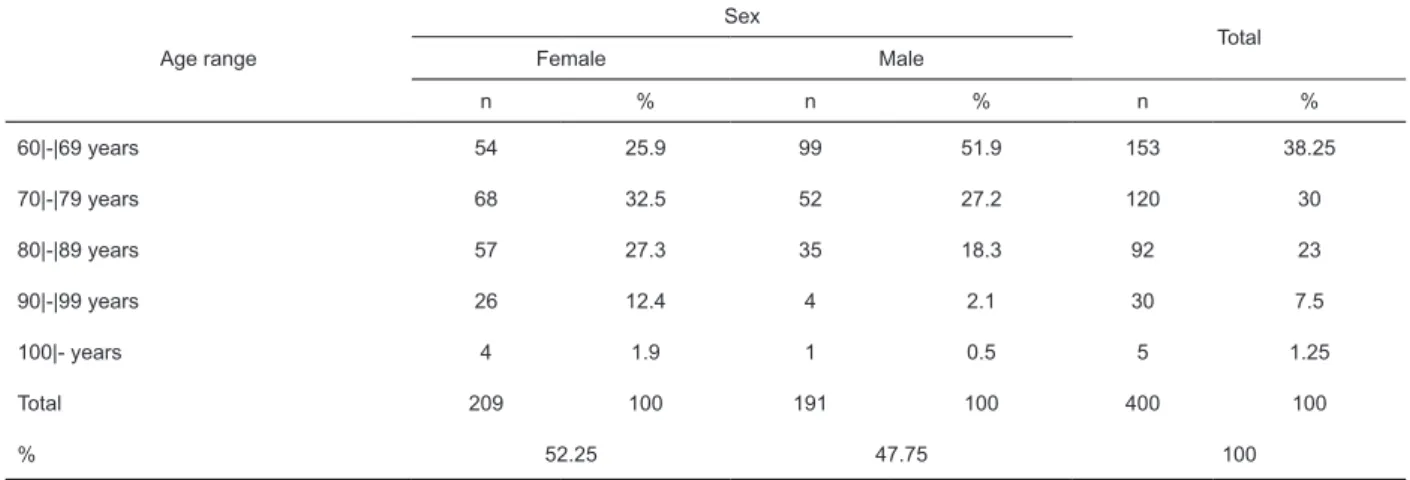
Trauma cases mainly affected women between 60 and 69 years of age, as shown in Table 1. The mean age was 74.19 years, with a standard deviation (sd) of 10.25 (sd±10.25).
Table 1 – Distribution of trauma events in elderly according to sex and age range. Natal, RN, Brazil, 2013
Age range
Sex
Total
Female Male
n % n % n %
60|-|69 years 54 25.9 99 51.9 153 38.25
70|-|79 years 68 32.5 52 27.2 120 30
80|-|89 years 57 27.3 35 18.3 92 23
90|-|99 years 26 12.4 4 2.1 30 7.5
100|- years 4 1.9 1 0.5 5 1.25
Total 209 100 191 100 400 100
% 52.25 47.75 100
The results displayed in Table 2 evidence that the BLS are the most used services for care delivery to elderly trauma victims, corresponding to more than 85% and present in care delivery to the different trauma mechanisms, despite being more represented in cases of falls, the prevalent mechanism in elderly people.
ALS were the most used services in trafic accidents,
Rev. Latino-Am. Enfermagem 2016;24:e2690
Table 2 – Distribution of trauma events in elderly victims according to trauma mechanism and care service. Natal, RN, Brazil, 2013
Trauma mechanism
Care service
Total
BLS* ALS† BLS+
ALS
BLS+ Motor‡
ALS+BLS+ Motor
Falls
212 2 8 5 0 227
93.4% 0.9% 3.5% 2.2% 0% 100%
Trafic accidents 104 5 13 1 2 125
83.2% 4.0% 10.4% 0.8% 1.6% 100%
Violence
6 2 4 1 0 13
46.2% 15.4% 30.8% 7.7% 0% 100%
Burns
5 0 0 0 0 5
100% 0% 0% 0% 0% 100%
Others§
24 2 4 0 0 30
80% 6.7% 13.3% 0% 0% 100%
Total
351 11 29 7 2 400
87.8% 2.8% 7.2% 1.8% 0.5% 100%
p value|| <0.001
*BLS=Basic Life Support; †ALS=Advanced Life Support; ‡Motor=Motor Ambulance; §Others=poisoning, airway obstruction by strange body and collision
with ixed objects; ║p value=obtained through chi-square test
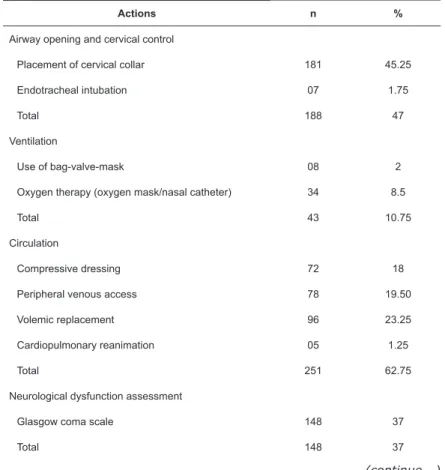
As regards the actions performed by or in cooperation with the nursing team in MPHC, circulatory actions were prevalent, mainly volemic replacement, as
well as limb immobilization using the rigid board and airway opening with cervical control. These data are summarized in Table 3, as follows.
Table 3 – Distribution of actions by or in cooperation with nursing team in MPHC. Natal, RN, Brazil, 2013
Actions n %
Airway opening and cervical control
Placement of cervical collar 181 45.25
Endotracheal intubation 07 1.75
Total 188 47
Ventilation
Use of bag-valve-mask 08 2
Oxygen therapy (oxygen mask/nasal catheter) 34 8.5
Total 43 10.75
Circulation
Compressive dressing 72 18
Peripheral venous access 78 19.50
Volemic replacement 96 23.25
Cardiopulmonary reanimation 05 1.25
Total 251 62.75
Neurological dysfunction assessment
Glasgow coma scale 148 37
Total 148 37
Actions n %
Immobilization
Limb immobilization 50 12.25
Use of rigid board 138 34.50
Total 188 47
Destination
Referral trauma hospital 227 56.7
Public hospitals 77 19.2
Private hospitals 61 15.3
Kept in same place 35 8.8
Total 400 100.0
Table 3 - (continuation)
As for the victim’s destination, after the mobile pre-hospital care, a clear concentration of transports to the public hospitals was evidenced, to the detriment of the private network, as shown in Table 3. The referral hospital received more than half of the elderly trauma victims attended by SAMU/Natal-RN.
Table 3 also reveals that almost 10% of the trauma victims were kept at the place of the event. This fact was due to different causes, among which deaths, refusal of care or transportation by the victim and/or relatives stood out, as well as removal not indicated by the physician attending the event. In these cases, the MPHC team provides orientations on the necessary conducts to minimize possible sequelae.
Discussion
The results achieved in this study in terms of the prevalence of trauma, sex, age and mechanism partially converge with the reports in the literature. In a similar study at an emergency service, it was evidenced that the elderly victims’ mean age was 72.6 years, with sd±9.3 years, close to the present indings(10).
The elderly’s proile differs from the young population, as they are more affected by falls, trafic
accidents (mainly collisions), burns and violence,
as identiied in this study and also appointed in the
literature(4,9-10).
The prevalence of the mechanism differs according to sex and age, as women over 69 years of age are the main victims of falls, due to the higher degree of frailty associated with osteoporosis, as a result of the post-menopause period, while men are more exposed to
trafic accidents and in the age group between 60 and
69 years, due to the exposure to risk factors like greater circulation in the urban perimeter, leisure activities and the job market(4-5,16-17).
In view of the magnitude and the impact the trauma can provoke in the morbidity and mortality rates among the elderly, MPHC, represented by the SAMU in Brazil is relevant because it not only provides early care, but also permits the organization of the hospital services the victims are destined to through the Regulation Central, according to the premises of the Brazilian Emergency Care Policy and the care decentralization concept,
according to the complexity levels the Uniied Health
System puts forward(11).
In the Regulation Central, the regulatory physician guides the citizen who summons the service and assesses the need to send the care resource and which is the most appropriate service in view of the severity of the situation(11). In this study, it was evidenced that the BLS service delivered most of the care, pointing towards less severe injuries, linked to the prevalent trauma mechanisms which were falls, as well as the fact that, in many cases, ALS is summoned after the BLS team assessed the victim. These data converge with other similar results, in which BLS represents more than 80% of the pre-hospital care provided(4,10,18).
The motor ambulances, as rapid intervention vehicles, are used to overcome obstacles related to
intense trafic in the urban area and to get access to
borderline areas(11). Thus, they guarantee support for the transportation services and are commonly associated with BLS and/or ALS, justifying their lower
care numbers, as identiied in this study. In addition,
it should be highlighted that these vehicles do not circulate at night, due to the lesser visibility, exposure to
violence, reduction of trafic jams and the lesser number
of events.
Besides the transportation, MPHC delivers the irst
Rev. Latino-Am. Enfermagem 2016;24:e2690
opening and cervical control, as well as immobilization were the actions most performed by or in cooperation with the nursing team in MPHC. These results are in line with the study in which it was appointed that airway opening, ventilation and circulatory control were performed in more than 92% of the events(19).
The pre-hospital actions are fundamental to reduce the risks of death within the so-called golden hour, but as important as these actions is to transport the victim
to a hospital for deinitive treatment, considering the
type of care needed, the location of the event, presence of geographical barriers, distance to the hospital and healthcare network infrastructure(18).
In this study, the main concentration of victims to
one speciic hospital was observed, to the detriment of
others, as well as the prevalence of public services as
the inal destination, as recommended by the regulatory
policies of MPHC(11) and the Regulation Central. This service aims to reduce the overcrowding of hospitals, but care through the referral hospital is based on the “zero vacancy” principle, as it has to be delivered independently of the existence of vacant beds, since emergencies demands fast and appropriate reactions(11,20) and, in terms of universal health coverage, guarantees equity and the right to health(21).
Authors refer that the main concentration of mobile care services to referral hospitals is in line with the hospital-centered care model and ignores the medical regulation protocols(18). Others appoint the need for better organization and enhancement of MPHC in terms of regulation forms, in order to avoid the burden of the
health services that provide deinitive care(22).
Although the zero vacancy policy is important, the overcrowding of hospitals should be taken into account,
due to the dificulty to get beds immediately, especially for an elderly patient, who commonly requires speciic
and intensive care due to age and comorbidities, which can exacerbate the sequelae of the trauma event. In addition, after being hospitalized, the elderly’s length of stay is longer, as well as the complications, increasing the costs of care.
As the nursing team participates in all care spheres
in MPHC, it needs to deliver speciic elderly care actions,
contributing to the reduction of sequelae, as emergency
care is one of the main factors deining the trauma
victim’s prognosis. Nevertheless, the importance of planning strategies to prevent trauma events should be highlighted.
This study is limited by the quality of the records, which made it impossible to assess the severity rates of the victims and the response time the MPHC used, as well as by the incipient nature of earlier studies at the same service with a view to comparing the results
for better discussion. The method employed made it impossible to identify the causes of trauma in the elderly and their outcomes after the patients’ hospital care.
These study indings can contribute to fundamental
information for the reorganization of mobile pre-hospital care to elderly trauma victims, besides promoting
relection on the theme which today is a health
problem around the world, as it causes strong impacts and interferes directly in the challenges to achieve appropriate universal health coverage.
Conclusion
This study revealed the prevalence of traumas in elderly victims, mostly women between 60 and 69 years
of age. This prevalence was mainly caused by falls, trafic
accidents and violence, leading to the predominance of BLS in emergency care delivery by the mobile pre-hospital care service.
Concerning the actions taken by or with the cooperation of the nursing team in MPHC, circulatory control, airway opening with cervical control and immobilization stood out. As for the access to the health system through MPHC, most victims were taken to the referral hospital in trauma emergency care, demonstrating that care is mainly concentrated in the SUS network and that the zero vacancy principle prevails.
Inpatient care needs to be redistributed through the Regulation Central, with a view to impeding the overcrowding of large and medium-sized hospital,
causing congestion of the ambulance low and consequent dificulties to obtain hospital beds due to the
high occupancy rates and the long hospitalization time of the victims.
Acknowledgements
To the undergraduate students Emily Kathiene Silva de Mesquita and Talita Adriano for their contributions in the data collection phase.
References
1. Frenk J. Leading the way towards universal health coverage: a call to action. Lancet. [Internet]. 2015 Mar-Apr [Acesso 3 ago 2015];385(9975):1352-8. Disponível em: http://www.sciencedirect.com/science/ article/pii/S0140673614614677 doi:10.1016/S0140-6736(14)61467-7.OS .
2. Lima RS, Campos MLP. Proile of the elderly trauma
USP. [Internet]. 2011 [Acesso 23 jan 2014];45(3):659-64. Disponível em: http://www.scielo.br/pdf/reeusp/ v45n3/en_v45n3a16.pdf
3. National Association of Emergency Medical Technicians. Comitê do PHTLS. Comitê de Trauma do National Association of Emergency Medical Technicians. Atendimento pré-hospitalar ao traumatizado: básico e avançado. 7ª ed. Rio de Janeiro: Elsevier; 2011.
4. Grden CRB, Sousa JAV, Lenardt MH, Pesck RM, Seima MD, Borges PKO. Characterization of elderly accident victims due to external causes. Cogitare Enferm. [Internet]. 2014 [Acesso 1 ago 2015];19(3):506-13. Disponível em: http://ojs.c3sl.ufpr.br/ojs/index. php/cogitare/article/view/37972/23225 http://dx.doi. org/10.5380/ce.v19i3.37972 Inglês, Português
5. Carpenter CR, Platts-Mills T. Evolving prehospital, emergency department and “inpatient” management models for geriatric emergencies. Clin Geriatr Med. [Internet]. 2013 [Acesso 1 ago 2015];29(1):1-20. Disponível em: http://www.ncbi.nlm.nih.gov/pmc/ articles/PMC3875836/ Inglês
6. Degani GC, Pereira Jr GA, Rodrigues RAP, Luchesi BM, Marques S. Idosos vítimas de trauma: doenças preexistentes, medicamentos em uso no domicílio e índices de trauma. Rev Bras Enferm. 2014;67(5):759-65.
7. Bonne S, Schuerer DJ. Trauma in the older adult: epidemiology and evolving geriatric trauma principles. Clin Geriatr Med. 2013;29(1):137-50.
8. Broska Jr CA, De Folchini AB, Ruediger RR. Estudo comparativo entre o trauma em idosos e não idosos atendidos em um Hospital Universitário de Curitiba. Rev Col Bras Cir. [Internet]. 2013 [Acesso 20 fev 2014];40(4):281-6. Disponível em: http://www. scielo.br/scielo.php?script=sci_arttext&pid=S0100-69912013000400005&lng=en. http://dx.doi. org/10.1590/S0100-69912013000400005.
9. Meschial WC, Soares DFPP, Oliveira NLB, Nespollo AM, Silva WA, Santil FLP. Elderly victims of falls seen by prehospital care: gender differences. Rev Bras Epidemiol. [Internet]. 2014 [Acesso 5 ago 2015];17(1):3-16. Disponível em: http://www.scielo. br/scielo.php?script=sci_arttext&pid=S1415-790X2014 000100003&lng=en&nrm=iso&tlng=en
10. Rodrigues J, Mantovani MF, Ciosak SI. Elderly
and trauma: proile and triggering factors. Rev
Enferm UFPE on line. [Internet]. 2015 [Acesso 3 ago 2015];9(3):7071-7. Disponível em: http://www.revista. ufpe.br/revistaenfermagem/index.php/revista/article/ view/7305/pdf_7382
11. Machado CV, Salvador FGS, O’Dwyer G. Serviço de Atendimento Móvel de Urgência: análise da política brasileira. Rev Saúde Pública. 2011;45(3):519-28.
12. Caldas CP, Veras RP, Motta LB, Guerra ACLC, Carlos MJ, Trocado CVM. Atendimento de emergência e suas interfaces: o cuidado de curta duração a idosos. J Bras Econ Saúde. [Internet]. 2015 [Acesso 3 ago 2015];7(1):62-9. Disponível em: http://files.bvs.br/upload/S/2175-2095/2015/ v7n1/a4757.pdf
13. Organização Pan-Americana da Saúde. Estratégia para o Acesso universal à saúde e a cobertura universal de saúde [Internet]. 2014 [Acesso 20 fev 2015]. Disponível em: www.paho.org/hq/index. php?option=com_docman&task.
14. Santos AMR, Rodrigues RAP, Diniz MA. Trauma
in the elderly caused by trafic accident: integrative
review. Rev Esc Enferm USP. [Internet]. 2015 [Acesso 5 ago 2015];49(1):162-72. Disponível em: http://www.scielo.br/pdf/reeusp/v49n1/0080-6234-reeusp-49-01-0162.pdf http://dx.doi.org/10.1590/ S0080-623420150000100021
15. Cassiani SHB. Strategy for universal access to health and universal health coverage and the contribution of the International Nursing Networks. Rev. Latino-Am. Enfermagem. [Internet]. 2014 [Acesso 28 fev 2015];22(6):891-92. Disponível em: http://www.scielo.br/scielo.php?pid=S0104-11692014000600891&script=sci_arttext http:// dx.doi.org/10.1590/0104-1169.0000.2502
16. Maeshiro FL, Lopes MCBT, Okuno MFP, Camapanharo CRV, Batista REA. Capacidade funcional e a gravidade do trauma em idosos. Acta Paul Enferm. 2013;36(4):389-94.
17. Oliveira KA, Rodrigues CC, Ribeiro RCHM, Martins CS, Abelan US, Fernandes AB. Causas de traumas em pacientes idosos atendidos em unidade de emergência. Rev Enferm UFPE on line. 2013;7(4):1113-9.
18. Gonsaga RAT, Brugugnolli ID. Características dos atendimentos realizados pelo Serviço de Atendimento Móvel de Urgência no município de Catanduva, Estado de São Paulo, Brasil, 2006 a 2012. Epidemiol Serv Saúde. 2013;22(2):317-24.
19. Simões RL, Duarte Neto C, Maciel GSB, Furtado TP, Paulo DNS. Atendimento pré-hospitalar a múltiplas vítimas com trauma simulado. Rev Col Bras Cir. [Internet]. 2012 [Acesso 10 ago 2015];39(3):230-7. Disponível em: http://www.scielo.br/pdf/rcbc/v39n3/ a13v39n3.pdf
Rev. Latino-Am. Enfermagem 2016;24:e2690
Received: Apr. 30th 2015
Accepted: Oct. 9th 2015
Copyright © 2016 Revista Latino-Americana de Enfermagem This is an Open Access article distributed under the terms of the Creative Commons (CC BY).
This license lets others distribute, remix, tweak, and build upon your work, even commercially, as long as they credit you for the original creation. This is the most accommodating of licenses offered. Recommended for maximum dissemination and use of licensed materials.
Corresponding Author: Hilderjane Carla da Silva
Universidade Federal do Rio Grande do Norte Departamento de Enfermagem
Av. Senador Salgado Filho, 3000 Bairro: Lagoa Nova
CEP: 59078-970, Natal, RN, Brasil E-mail: [email protected]
21. World Health Organization. Positioning Health in the Post-2015 Development Agenda. WHO discussion paper [Internet]. 2012 [Acesso 12 nov 2014]. Disponível em: http://www.who.int/topics/millennium_development_ goals/post2015/WHOdiscussionpaper_October2012.pdf 22. Araújo MT, Alves M, Gazzinelli MFC, Rocha TB.
Representações sociais de proissionais de unidades de