Revista Gaúcha
de Enfermagem
DOI: http://dx.doi.org/10.1590/1983-1447.2014.04.47820
Self-care among patients enrolled in a
self-monitoring blood glucose program
a RN. PhD in Sciences, University of São Paulo at
Ribeirão Preto, College of Nursing, Graduate Nursing Program. Ribeirão Preto, SP, Brazil.
b Psychologist. PhD in Psychology. Associate
Profes-sor, University of São Paulo at Ribeirão Preto, Faculty of Philosophy, Science and Letters, Department of Psy-chology. Ribeirão Preto, SP, Brazil
c RN. PhD candidate in Sciences, University of São
Paulo at Ribeirão Preto, College of Nursing, Graduate Nursing Program. Ribeirão Preto, SP, Brazil
d RN. PhD in Nursing. Associate Professor, University
of São Paulo at Ribeirão Preto, College of Nursing, De-partment of General and Specialized Nursing. Ribeirão Preto, SP, Brazil.
Vivian Saraiva Verasa
Manoel Antônio dos Santosb
Flavia Fernanda Luchetti Rodriguesc Clarissa Cordeiro Alves Arreliasc
Tatiane Aparecida Martins Pedersolic
Maria Lúcia Zanettid
Autocuidado de pacientes inseridos em um programa
de automonitorização da glicemia capilar no domicílio
Autocuidado de pacientes incluidos en un programa
de automonitorización de la glucosa sanguínea en domicilio
ABSTRACT
This cross-sectional study checks specifi c self-care activities of patients with diabetes mellitus enrolled in a self-monitoring blood glucose program from August to December 2012 in two Primary Health Care units in the interior of São Paulo, Brazil. The sample was composed of 74 female and male individuals, aged 18 years old or older. The Summary of Diabetes Self-Care Activities Questionnaire was used. It contains six dimensions: general diet, specifi c diet, physical activity, blood glucose monitoring, foot care, medication usage, plus three items about smoking. Eight out of the 15 self-care activities were within desirable levels, namely: healthy diet, not eating sweets, blood glucose testing and as frequently as recommended, drying between toes after washing feet, and taking medica-tions (three items). The results enabled the identifi cation of gaps in specifi c self-care activities among patients with diabetes mellitus. Descriptors: Self-care. Diabetes Mellitus. Blood glucose self-monitoring. Nursing.
RESUMO
Estudo transversal com o objetivo de verifi car as atividades de autocuidado específi cas de pacientes com diabetes mellitus inseridos em programa de automonitorização da glicemia capilar, de agosto a dezembro de 2012, em duas unidades básicas de saúde do interior paulista. A amostra foi composta por 74 sujeitos de ambos os sexos, com idade igual ou superior a 18 anos. Utilizou-se Ques-tionário de Atividades de Autocuidado com Diabetes, contendo seis dimensões: alimentação geral, alimentação específi ca, atividade física, monitorização da glicemia, cuidados com pés, uso de medicamento, acrescidos de três itens sobre tabagismo. Das 15 atividades de autocuidado, oito estavam dentro do padrão desejável, destacando-se: alimentação saudável, não ingerir doces, avaliar o açúcar no sangue e o número de vezes, secar os espaços interdigitais depois de lavar os pés e tomar medicamentos (três itens). Os resultados obtidos possibilitaram identifi car as lacunas das atividades de autocuidado específi cas de pacientes com diabetes mellitus. Descritores: Autocuidado. Diabetes Mellitus. Automonitorização da glicemia. Enfermagem.
RESUMEN
INTRODUCTION
Diabetes Mellitus (DM) is a complex chronic condition due to the multiple elements involved in its treatment such as: regularly maintaining a healthy diet; exercising as a habit incorporated in the patient’s routine; self-monitoring of blood glucose; and taking medication that is not always easy to administer due to pharmacokinetic and pharmaco-dynamics factors. In this sense, self-care has been explored in the literature as an important construct in the consol-idation of lifestyle modifi cations, which are necessary to achieving good metabolic control(1-4).
In regard to self-monitoring of blood glucose (SMBG), in 2007, the Ministry of Health established a list of medica-tions and supplies provided by the Brazilian Health System (SUS) to patients with DM to self-monitor blood glucose. To be included in this public policy, patients must be enrolled in the programa de AMGC no domicílio [SMBG at home pro-gram]. This program is intended to assess monitoring of blood glucose as performed by patients with DM at home according to adherence to their treatment recommenda-tions. This assessment’s purpose is to support therapeutic adjustments in order to achieve improved glycemic con-trol, preventing acute and/or chronic complications(5).
Nonetheless, to eff ectively achieve results that accrue from SMBG, patients with DM should incorporate self-care activities into the set of demands required to maintain metabolic control. Self-care refers to activities people per-form with responsibility and effi cacy to benefi t their lives, health and well-being(6). One’s age, experiences and life-style, education, culture, gender, attitudes, and systems of beliefs and values directly aff ect one’s ability to self-care(7-8). There are various studies in the literature that identify factors related to self-care behaviors of patients with DM using generic instruments(9-10). There is, however, a lack of studies using specifi c instruments(2,4). Among the specifi c instruments used to assess self-care activities among peo-ple with DM, the Summary of Diabetes Self-Care Activities Questionnaire (SDSCA) stands out.
Brazilian studies assessing self-care activities using spe-cifi c instrument are incipient(2-4) because the translation, cross-cultural adaptation and validation of SDSCA became available in 2010(11). Additionally, there are no studies in the Brazilian context assessing self-care activities among pa-tients with DM enrolled in SMBG at home programs.
Acknowledging that patients with diabetes have par-ticularities due to treatment complexity, the use of a spe-cifi c instrument such as SDSCA can contribute to a more accurate diagnosis of self-care activities. In this sense, the planning of interventions will be based on reliable data
concerning how well patients adhere to the recommenda-tions of healthcare providers. This information is valuable for planning eff ective healthcare actions to manage DM.
Recognizing the importance of identifying self-care activities among patients enrolled in the SMBG at home program, this study’s aim was to identify the specifi c self-care activities performed by patients with DM, enrolled in this program.
METHOD
Cross-sectional study conducted in two Primary Health Care (PHC) units in the East District of Ribeirão Preto Health Department, from August to December 2012. These health units were selected because they are located in the city’s East District and are linked to the university and also be-cause of the participation of professors and undergraduate and graduate students in research and extension activities. The convenience sample was composed of 74 individ-uals with type 2 DM who agreed to participate in an ed-ucational group on diabetes concerning self-monitoring of blood glucose. The groups were composed of 12 to 13 patients who met weekly for 60 minutes over the course of 12 weeks. The teaching strategy used was group discus-sion. The topics discussed included how the body and dia-betes work; healthy diet and physical exercise; medication scheme and blood glucose testing; and how to achieve goals to manage the disease.
The SMBG program was implemented in 2005 as a con-tinuous project in accordance with city policy; however, it did not include an educational group. The patients en-rolled in the SMBG receive a glucometer, lancing device, and reagent strips in number suffi cient for them to test blood glucose at home according to the recommended number of times per month.
The study included both female and male patients with DM, aged 18 years old or older, originating from Ribeirão Preto or surrounding cities, monitored through the SMBG at home program in the two selected health units, and who presented no understanding defi cits that would im-pede completing the instrument.
Two instruments were used to collect data: a form addressing sociodemographic data and the Summary of Diabetes Self-Care Activities (SDSCA). The form included the following sociodemographic data: sex, age (complete years), schooling, family income, occupation, along with the clinical variables: time since diagnosis, treatment to control DM and comorbidities.
orig-inally developed in English and its name in Portuguese is Questionário de Atividades de Autocuidado com o Diabetes (QAD). The SDSCA was adapted to Portuguese in Portu-gal(12), in which version, the Cronbach’s alpha ranged from 0.36 to 0.68. This instrument was also adapted and val-idated for the Brazilian context(11), presenting good inter-nal consistency; inter-item correlation, measured through Cronbach’s alpha, was 0.86.
The instrument was specifi cally conceived to deter-mine six dimensions of self-care behavior among people with diabetes: general diet (two items), specifi c diet (three items), physical activity (two items), glucose blood testing (two items), foot care (three items), and medication (three items according to the medication scheme), in addition to three items concerning smoking.
This questionnaire addresses self-care activities per-formed by the patient in the last seven days. The assess-ment is standardized in days per week with scores indicat-ing the performance in self-care activities on a scale from 0 to 7, corresponding to behaviors performed in the last seven days, in which 0 (zero) corresponds to the least desir-able behavior and 7 refers to the most desirdesir-able behavior (except in the specifi c diet dimension, in which values are inverted). The items in the specifi c diet dimension address the consumption of foods rich in fat and glucose. As in the original instrument, scores in this dimension are inverted (if 7 = 0; 6 = 1; 5 = 2; 4 = 3; 3 = 4; 2 = 5; 1 = 6; and 0 = 7 and vice-versa)(12). Smoking habits are considered separately because they are coded diff erently, with an emphasis on the average number of cigarettes smoked per day(12).
The patients were recruited via telephone and invited to attend the PHC unit in which they were enrolled on scheduled days and times. The patients were informed in regard to the study’s nature and objectives and showed their consent by signing free and informed consent forms. Data were collected in August 2012 in a private room in which the participants individually self-applied the instru-ments, which took 20 minutes on average.
Descriptive statistics was used to analyze data and to characterize the distribution of the responses of patients with DM. Because it is seven-point Likert scale, we need to consider the amplitude of distribution of responses. In this study, we considered desirable self-care behaviors the means of which were above 4. The choice of this param-eter is justifi ed because it corresponds to the most desir-able self-care activities. This cut-off point was also adopted for items with inverted values and is related to the num-ber of days in a week on which the self-care activity was performed. In the analysis, we computed the mean and standard deviation for each item of the SMB’s six
dimen-sions. The project was approved by the Institutional Review Board at the University of São Paulo at Ribeirão Preto, Col-lege of Nursing (Protocol No. 418).
RESULTS
In regard to the demographic variables, most of the patients were female, aged between 50 and 69 years old. In regard to education, most had not completed middle school. Clinical variables showed that 46.6% of the patients have had the disease for 10 years. In terms of comorbidities, most had more than one comorbidity, mainly hyperten-sion and dyslipidemia. Concerning medication, most used insulin in the treatment. In regard to the number of med-ical appointments per year, most patients attended from one to four consultations per year with a physician.
Table 1 shows the self-care activities performed by the participants assessed through SMBG. Note that mean scores above 4 indicate desirable self-care behaviors, ex-cept for items with reverse values. When analyzing data in Table 1, one should bear in mind that it is a 7-point Likert scale and, considering this amplitude of answers, values from 0 to 4 indicate undesirable self-care activities, and from 5 to 7 indicate desirable activities, except for the items with inverted values.
Most of the patients in the SMBG program presented a desirable behavior in the General Diet dimension and com-plied with the recommendations of healthcare providers to “follow a healthy diet”. When, however, this dimension was analyzed in the item “follow their diet plan”, most pre-sented an undesirable self-care behavior in this item.
The items in the Specifi c Diet dimension “Eating fi ve or more portions of fruits and/or vegetables” and “Eating red meat and/or whole milk derivatives”, the scores of which are inverted, revealed most patients presented desirable self-care behavior.
The items “Exercise for at least 30 minutes” and “Perform specifi c exercises”, both in the Physical Activities dimen-sion, showed undesirable self-care behaviors among the participants.
In regard to the dimension Blood Glucose Testing, the mean scores of the items “blood glucose monitoring” and “blood glucose monitoring as frequently as recommend-ed” showed most patients presented desirable self-care behavior.
When the Medication dimension was considered, most patients presented desirable behaviors in regard to all the items assessed (“Taking medication as recommended”; “Taking insulin shots as recommended”; and “Taking the indicated number of anti-diabetes pills”).
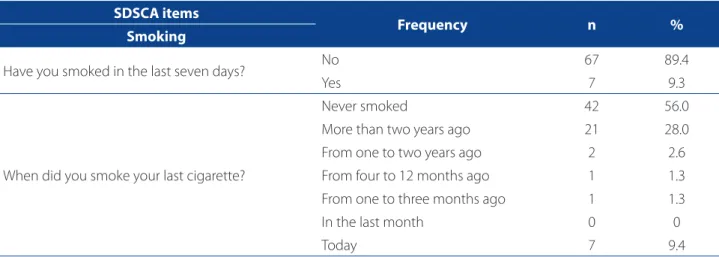
Table 2 presents the results obtained in the items relat-ed to smoking habits. Most of the patients had not smokrelat-ed in the last seven days, with an expressive number of former smokers and people who never smoked before.
DISCUSSION
The analysis of self-care activities performed by pa-tients enrolled in a self-monitoring blood glucose program and using, for the fi rst time in the Brazilian context, a
spe-cifi c instrument, showed that eff ort is required to monitor individuals with diabetes. The results revealed that patients recognize the importance of diet, exercise, monitoring blood glucose and foot care, but require continuous eff ort to achieve the goals established for the management of the disease from the perspective of diabetes education.
The analysis of the General Diet dimension showed that patients with DM presented desirable self-care behav-iors in regard to complying with a healthy diet. One study shows that diffi culties for and barriers to the modifi cation of eating habits are known and include: negative per-ception concerning diet plans; barriers in regard to social events; and lack of knowledge and understanding of the importance of having a healthy diet as a pillar of the treat-ment of diabetes, such as: regular hours and smaller meals,
SDSCA items
Frequency (days per week)
Mean±SD 0 to 4 days 5 to 7 days
n % N %
General diet
1. Follow a healthy diet (D) 33 44.0 41 54.7 4.41± 0
2. Follow dietary recommendations (D) 45 60.0 29 38.7 3.00± 3.08
Specifi c diet**
3. Eating fi ve or more portions of fruits an/or vegetables (ND) 36 48.0 38 50.7 4.24± 2.69 4. Eating red meat and/or whole milk derivatives (ND) 30 40.0 44 58.7 5.10± 2.23
5. Eating sweets (ND) 67 89.3 7 9.4 1.45± 1.95
Exercise
6. Exercise for at least 30 minutes (D) 55 73.3 19 25.4 2.05± 2.53
7. Perform a specifi c exercise (D) 66 88.0 8 10.7 0.89± 2.03
Blood glucose testing
8. Assessing blood glucose (D) 34 45.3 40 53.4 4.71± 2.49
9. Assessing blood glucose as frequently as recommended (D) 41 54.7 33 44.0 4.06± 2.74
Foot care
10. Checking feet (D) 43 57.3 31 41.4 3.29± 3.18
11. Inspecting inside shoes before putting them on (D) 39 52.0 35 46.7 3.59± 3.26
12. Drying between toes after washing feet (D) 22 29.3 52 69.4 4.97± 3.11
Medication
13.Taking medication as recommended (D) 4 5.3 70 93.4 6.58± 1.35
14. Taking insulin shots (D) 10 13.3 64 85.4 6.14± 2.05
15. Taking the indicated number of anti-diabetic pills* (D) 13 17.3 56 74.7 5.63± 2.59
Table 1. Self-care activities of patients enrolled in a self-monitoring blood glucose at home program assessed through SDSCA, Ribeirão Preto-SP, Brazil 2012.
Source: Study’s data
and the relationship of eating with the use of medication and exercise, among other aspects(13).
Diffi culties were observed regarding compliance with the diet plan, which may be explained, in part, by a lack of nutritionists in the multidisciplinary teams in the two studied PHC units. A lack of this type of professional im-pedes patients with diabetes from discussing, sharing and developing a diet plan that meets their needs concerning preferences and costs. One study conducted with DM pa-tients who experienced complications in their lower limbs reports means higher than those presented in this study(2). We need to consider that eating habits are already es-tablished in adult individuals and are maintained by a set of beliefs and values already incorporated over the course of life(7-8). Therefore, assessing self-care activities is always a dif-fi cult and complex task. Often, changes in a diet plan may be desirable from the point of view of healthcare providers but not feasible from the perspective of patients.
The Specifi c Diet dimension showed that patients with DM present undesirable behavior related to the excessive consumption of foods such as red meat and whole milk. We expected a predominance of patients with desirable self-care behavior, since recommendations regarding diet are basic and have a direct eff ect on blood sugar. These results are also reported by one study conducted in India with DM2 patients, which confi rms that self-care activities concerning diet fall short of what is ideal in regard to the restriction of simple carbohydrates, which are immediate-ly absorbed.
The Physical Activity dimension showed that patients do not recognize this therapeutic resource as an activity
incorporated into their self-care actions. Hence, the results show that patients with DM do not incorporate exercise into their self-care activities, which is in agreement with the results of studies conducted both in China and India(1,3). This situation may refl ect a lack of recommendation on the part of health providers for this mainstay of DM treatment. Other factors that may explain this undesirable behavior include a risk of hypoglycemia during exercise and ortho-pedic problems that hinder the practice of exercise, among other factors(10). One study conducted in India verifi ed that self-care activities concerning exercise are below the ideal level(3). One study conducted in China reports that 56% of the investigated sample performed some exercise, either as a leisure activity or not, and only 4% were considered very active(1). One Brazilian study conducted with DM2 pa-tients with low education and income, who had DM for a long time, presented low adherence to self-care actions such as exercise and diet(4).
One systematic review identifi ed that most people with DM self-manage the disease, but there is variation in how well they adhere to the main self-care activities. The levels of exercise do not change over time. Evidence sug-gests that the pattern of response to exercise changes in response to many factors, such as vacation times, holidays, and weekends, suggesting the need for further studies to clarify this issue(14).
Most patients with DM presented desirable behavior in regard to the items “testing for blood glucose” and “testing for blood glucose as frequently as recommended”, which shows that patients enrolled in the SMBG program are veri-fying their blood glucose at home, as prescribed.
SDSCA items
Frequency n %
Smoking
Have you smoked in the last seven days? No 67 89.4
Yes 7 9.3
When did you smoke your last cigarette?
Never smoked 42 56.0
More than two years ago 21 28.0
From one to two years ago 2 2.6
From four to 12 months ago 1 1.3
From one to three months ago 1 1.3
In the last month 0 0
Today 7 9.4
Table 2. Smoking habits in the studied sample, according to items in the Summary of Diabetes Self-Care Activities Ques-tionnaire (SDSCA). Ribeirão Preto-SP, Brazil 2012.
One study conducted in India reports that self-care activities related to SMBG were considered appropriate(3). One Chinese study showed that only 13% of the 163 par-ticipants presented desirable behavior regarding SMBG and only 3% tested it four or more times during the week(1). Another study investigating the experiences of patients with glucose testing shows that this dimension of self-care benefi ts and favors decision-making that results in manag-ing the disease(15).
Diffi culties of patients with DM to make decisions con-cerning SMBG due to insuffi cient education to read and properly interpret data should be taken into account. In this sense, educating patients to self-monitor their glucose is a challenge for healthcare providers, who should seek in-novative strategies(16). At the same time, nurses need to be qualifi ed to motivate patients to recognize the monitoring of blood glucose as an important tool in self-care(17).
If nurses are not trained to work in the SMBG program, the resources provided to patients to monitor blood sugar at home (glucometer, lancet, test strips, etc.) might be un-derutilized or misused. This suggests that simply providing supplies does not ensure they will be properly employed(3). Most of the patients did not present desirable behavior in regard to foot care. One study, though, in which patients received educational instruction in a large hospital in a city of São Paulo, Brazil reports scores close to desirable levels in the three dimensions concerning foot care, indicating the importance of education to modify health behavior(2).
The best result was found in the Medication dimension, in the taking medication as a recommended item(10). The behavior “taking insulin shots as recommended” shows pa-tients have diffi culty taking the recommended dosage at the recommended times. In regard to the number of oral anti-diabetes pills, a minority was unable to take the rec-ommended number of pills some days in the week. One Chinese study shows that most participants presented very desirable self-care behavior concerning adherence to medication(1).
In regard to smoking habits, this study shows that there is an incorporation of self-care regarding smoking, consid-ering that smoking is a risk factor for the development of diabetic neuropathy. This study’s results are consistent with those reported by another study that investigated smok-ing ussmok-ing SDSCA among DM patients with complications in their lower limbs(2).
We expected that the self-care behaviors concerning specifi c diet, physical activity and self-monitoring of blood glucose would reach highly desirable levels, considering the participants were enrolled in an SMBG program in a PHC unit in a city of the state of São Paulo. Nonetheless,
the results obtained concerning self-care behavior in SD-SCA’s six dimensions were below desirable levels, showing the need to develop eff ective educational strategies to strengthen self-care practices among diabetes patients participating in SMBG programs.
Identifying self-care activities using an instrument specifi c for the population with diabetes enabled verify-ing that there is a weakness in the educational process, since the participants were already enrolled in the SMBG at home program. The few studies using SDSCA to assess self-care activities among patients with diabetes limited the comparison of data, hindering the establishment of similarities and diff erences. We expect that future studies will allow a better understanding of self-care activities of patients with DM.
Finally, the modifi cation of self-care actions among pa-tients with diabetes includes cooperation within the health staff , supply of resources, the development of alternatives that include family members and other people from the patient’s social network and social organizations.
CONCLUSION
The analysis of specifi c self-care activities of DM patients enrolled in an educational group for SMBG at home revealed that eight of the 15 assessed self-care activities were with-in desirable levels, namely: healthy diet, not eatwith-ing sweets, testing blood glucose as frequently as recommended, dry-ing between toes after washdry-ing feet, and takdry-ing medications (three items). These results can support the reorganization of the SMBG program in the city because non-adherence of patients to self-care activities may compromise the ef-fectiveness of the program and hinder the achievement of metabolic control. Assessing specifi c self-care activities pro-vides valuable elements for nursing professionals as agents who primarily coordinate educational groups in diabetes, encouraging the reformulation of educational practices concerning SMBG. Healthcare practices should strengthen desirable self-care practices. The educational process is diffi -cult, continuous and permanent, requiring the use of inno-vative strategies to achieve the goals related to controlling DM, since the modifi cation of habits and behavior demands changing feelings, emotions, rooted beliefs.
REFERENCES
1. Zhou Y, Liao L, Sun M, He G. Self-care practices of Chinese individuals with dia-betes. Exp Ther Med. 2013;5(4):1137-42.
3. Gopichandran SV, Lyndon MK, Angel PB, Manayalil BP, Blessi KR, Alex RG et al. Diabetes self-care activities: a community-based survey in urban southern In-dia. Natl Med J InIn-dia. 2012;25(1):14-7.
4. Villas Boas LCG, Foss MC, Freitas MCF. Relação entre apoio social, adesão aos tra-tamentos e controle metabólico de pessoas com diabetes mellitus. Rev Latino--Am Enfermagem. 2012;20(1):52-8.
5. Secretaria Municipal da Saúde de Ribeirão Preto (BR). Protocolo de atendimento em hipertensão e diabetes [Internet]. Ribeirão Preto; 2011 [citado 2014 mar 17]. Disponível em: http://www.ribeiraopreto.sp.gov.br/ssaude/programas/ cronico/prot-hipertensao.pdf
6. Organización Panamericana de Salud. Fortalecimiento del autocuidado como estratégia de la atención primaria en salud: la contribuición de las instituiciones de salud en America Latina. Santiago; 2006.
7. Rodrigues FFL, Zanetti ML, Santos MA, Martins TA, Sousa VD, Teixeira CRS. Co-nhecimento e atitudes: componentes para a educação em diabetes. Rev Latino--am Enfermagem. 2009;17(4):436-73.
8. Oliveira NF, Souza MCBM, Zanetti ML, Santos MA. Diabetes mellitus: desafi os relacionados ao autocuidado abordados em grupo de apoio psicológico. Rev Bras Enferm. 2011;64(2):301-7.
9. Baquedano IR, Santos MA, Martins TA, Zanetti ML. Self-care of patients with diabetes mellitus cared for at an emergency service in Mexico. Rev Latino-Am Enfermagem. 2010;18(6):1195-202.
10. Faria HTG, Rodrigues FFL, Zanetti ML, Araújo MFM, Damasceno MMC. Fatores associados à adesão ao tratamento de pacientes com diabetes mellitus. Acta Paul Enferm. 2013;26(3):231-7.
11. Michels MJ, Coral MHC, Sakae TM, Damas TB, Furlanetto LM. Questionário de atividades de autocuidado com diabetes: tradução, adaptação e avaliação das propriedades psicométricas. Arq Bras Endocrinol Metabol. 2010;54(7):644-51. 12. Bastos F, Severo M, Lopes C. Propriedades psicométricas da escala de
autocuida-do com a diabetes traduzida e adaptada. Acta Med Port. 2007;20(1):11-20. 13. Booth AO, Lowis C, Dean M, Hunter SJ, McKinley MC. Diet and physical
ac-tivity in the self-management of type 2 diabetes: barriers and facilitators identifi ed by patients and health professionals. Prim Health Care Res Dev. 2013;14(3):293-306.
14. Coyle ME, Francis K, Chapman Y. Self-management activities in diabetes care: a systematic review. Aust Health Rev. 2013;37(4):513-22.
15. Dlugasch LB, Ugarriza DN. Self-monitoring of blood glucose experiences of adults with type 2 diabetes. J Am Assoc Nurse Pract. 2013;18:1-7. 16. Evans JM, Mackison D, Swanson V, Donnan PT, Emslie-Smith A, Lawton J.
Self--monitoring of blood glucose in type 2 diabetes: patients’ perceptions of ‘high’ readings. Diabetes Res Clin Pract. 2013;102(1):e5-7.
17. Schöld AK, Ylikivelä R, Lindström K, Östgren CJ, Grodzinsky E. The options of the management of self-monitoring of blood glucose in primary health care centres by the diabetes nurses and patients. Prim Care Diabetes. 2013;7(2):143-9.
Author’s address:
Maria Lucia Zanetti
Av. Bandeirantes, 3900, Monte Alegre 14040-902, Ribeirão Preto, SP E-mail: [email protected]