R E V B R A S R E U M A T O L . 2 0 1 4 ;5 4 ( 2 ): 1 4 8 – 1 5 1
www.reumatologia.com.br
REVISTA BRASILEIRA DE
REUMATOLOGIA
Case report
Chronic lymphomonocytic meningoencephalitis,
oligoarthritis and erythema nodosum: report of
Baggio-Yoshinari syndrome of long and relapsing evolution
☆Nilton Salles Rosa Neto
a,*, Giancarla Gauditano
b, Natalino Hajime Yoshinari
aa Faculdade de Medicina , Universidade de São Paulo (FMUSP), São Paulo, SP, Brazil
b Service of Rheumatology, Hospital das Clínicas, Faculdade de Medicina, Universidade de São Paulo (HC-FMUSP), São Paulo, SP, Brazil
a r t i c l e i n f o
Article history:
Received 30 October 2011 Accepted 14 May 2013
Keywords: Borrelia burgdorferi Borrelia infections Brazil
Spirochaetales
Tick-borne diseases
a b s t r a c t
The Brazilian human borreliosis, also known as Baggio-Yoshinari Syndrome (BYS), is a tick-borne disease but whose ticks do not pertain to the Ixodes ricinus complex. It is caused by Borrelia burgdorferi sensu lato microorganisms and resembles clinical and laboratory features of Lyme disease (LD). BYS is also distinguished from LD by its prolonged clinical evolution, with relapsing episodes and autoimmune dysfunction. We describe the case of a young female who, over one year, progressively presented with oligoarthritis, cognitive impairment, menigoencephalitis and erythema nodosum. Diagnosis was established by
means of the clinical history and a positive serology to Borrelia burgdorferisensu strictu. The
patient received Ceftriaxone 2 g IV/day during 30 days, followed by 2 months of
doxicy-cline 100 mg bid. Symptoms remitted and the Borrelia serology tests returned to normality.
BYS is a new disease described only in Brazil, which has a raising frequency and deserves the attention from the country´s medical board because of clinical, epidemiological and laboratory differences from LD. Despite the fact that it is a hard-to-diagnose zoonosis, it is important to pursuit an early diagnosis because the symptoms respond well to antibiotics or it might be resistant to treatment and may evolve to a chronic phase with both articular and neurological sequelae.
© 2014 Elsevier Editora Ltda. All rights reserved.
☆
Study conducted at Service of Rheumatology, Hospital das Clínicas, Medicine School, Universidade de São Paulo (HC-FMUSP), São Paulo, SP, Brazil. * Corresponding author.
E-mail: [email protected] (N.S. Rosa-Neto).
149
R E V B R A S R E U M A T O L . 2 0 1 4 ;5 4 ( 2 ): 1 4 8 – 1 5 1Meningoencefalite linfomonocitária crônica, oligoartrite e eritema nodoso: relato de síndrome de Baggio-Yoshinari de longa e recorrente evolução
Palavras-chave: Borrelia burgdorferi
Infecções por Borrelia
Brasil
Spirochaetales
Doenças transmitidas por carrapatos
r e s u m o
A borreliose humana brasileira, também conhecida como Síndrome de Baggio-Yoshinari (SBY), é uma enfermidade infecciosa própria do território brasileiro, transmitida por
car-rapatos não pertencentes ao complexo Ixodes ricinus, causada por espiroqueta do gênero
Borrelia e que apresenta semelhanças clínicas e laboratoriais com a Doença de Lyme (DL). A SBY distingue-se da DL por apresentar evolução clínica prolongada, com episódios de recorrência e importante disfunção autoimune. Descreveremos o caso de uma paciente jovem, que desenvolveu progressivamente durante cerca de um ano oligoartrite de gran-des articulações, seguida de distúrbio do cognitivo, meningoencefalite e eritema nodoso. O diagnóstico foi irmado devido à concomitância de queixas articulares e neurológicas com
sorologia positiva para Borrelia burgdorferi sensu stricto. A paciente foi medicada com
ceftria-xone 2 g/EV/dia por 30 dias, seguido de dois meses de doxiciclina 100 mg duas vezes ao dia. Houve remissão dos sintomas e normalização dos exames sorológicos para a borreliose. A SBY é uma zoonose emergente descrita apenas no Brasil, cuja frequência tem crescido bas-tante, e que, em razão das importantes diferenças nos aspectos epidemiológicos, clínicos e laboratoriais em relação à DL, merece especial atenção da classe médica do país. Trata-se de zoonose camulada e de difícil diagnóstico, mas este deve ser perseguido com tenacida-de, pois a enfermidade responde aos antibióticos no estágio inicial, podendo evoluir com sequelas neurológicas e articulares nos casos reconhecidos tardiamente ou recorrentes.
© 2014 Elsevier Editora Ltda. Todos os direitos reservados.
Introduction
Brazilian human borreliosis or Baggio-Yoshinari Syndrome (BYS) is an endemic anthropozoonosis proper to Brazil, caused by spirochetes of the genus Borrelia, transmitted by ticks of the genus Amblyomma and Rhipicephalus, which have clinical simi-larities with Lyme disease (LD).1-8 BYS can be distinguished
from LD, since the transmission vectors for this latter disease belong to the Ixodes ricinus species. Furthermore, from a clini-cal standpoint, this Brazilian disease evolves with symptom-atic and immunological disorder recurrence.1,5-7
Researchers at the Medical Research Laboratory, Medicine School, Universidade de São Paulo (LIM -17) suggest that the biodiversity conditions particular to the Brazilian territory, such as the presence of exotic vectors and favorable ecologi-cal conditions, have allowed for bacteria of the Borrelia burg-dorferi complex sensu lato, to adapt to the country1,6,7,9 and
de-velop a zoonosis with typical clinical and laboratory aspects. The dissemination of clinical and laboratory knowledge about BYS has been a great challenge, because even with a different clinical and laboratory picture of LD, there is huge resistance from national and international scholars to admit the existence of this Brazilian zoonosis. Concepts such as pro-longed latent infection caused by spirochetes in the form of cysts, clinical recurrence, different serologic diagnosis from standards adopted by the Centers for Disease Control and Pre-vention (CDC), and the therapeutic strategies for use of anti-biotics during extended periods of time are not acceptable for certain countries of the northern hemisphere.
However, to deny its existence as an emerging clinical en-tity would be gross negligence, especially when there is
evi-dence that the disease may progress to develop severe joint and neurological sequelae, if not treated properly.6,10 In this
paper, we describe an illness of prolonged evolution and re-current symptoms, in that the diagnosis of BYS was estab-lished after the onset of meningoencephalitis with positive serology for B. burgdorferi, according to LIM-17 adopted stan-dards.
Case report
150
R E V B R A S R E U M A T O L . 2 0 1 4 ;5 4 ( 2 ): 1 4 8 – 1 5 1In December 2006 the patient was admitted for evaluation of cerebellar ataxia and neuritis of the 2nd cranial nerve. On admission, she was in good general condition, pale, normo-tensive and afebrile, without lymphadenomegaly. Upon in-spection, the patient had hyperchromic macules, with palpa-ble nodules in the anterior region of both legs, with no other mucocutaneous lesions. Cardiopulmonary and abdominal workup revealed no changes.
Arthritis showed up on her knees and left ankle, with pres-ervation of small joints, without joint limitation or deformities. The patient was lucid and oriented in time and space, alert and cooperative, amnesic to recent events, but with remote memory preserved. A nontoxic march with grade V driving force in all members was observed, with a mild dysmetria of the left arm. Sensitivity and relexes were preserved and there was no sign of meningeal irritation.
Laboratory tests revealed normocytic and normochromic anemia, erythrocyte sedimentation rate = 85 mm/1st hour and C-reactive protein = 99 mg/L. The tuberculin test was negative, as well as antinuclear and rheumatoid factors. A CSF analysis revealed pleocytosis at the expense of lympho-monocytic cells. Search for infectious and parasitic agents (toxoplasmosis, tuberculosis, hepatitis B and C, herpes sim-plex, cytomegalovirus, cysticercosis, HIV, HTLV, mumps, cryp-tococcosis, trypanosomiasis, malaria) were negative in serum and CSF. The magnetic resonance imaging revealed enlarge-ment of the basal cisterns, with a hyperintense signal on T2 and FLAIR at cerebral white matter, in the precentral gyrus at the left and in orbital gyrus at the right, without anomalous impregnation after the contrast.
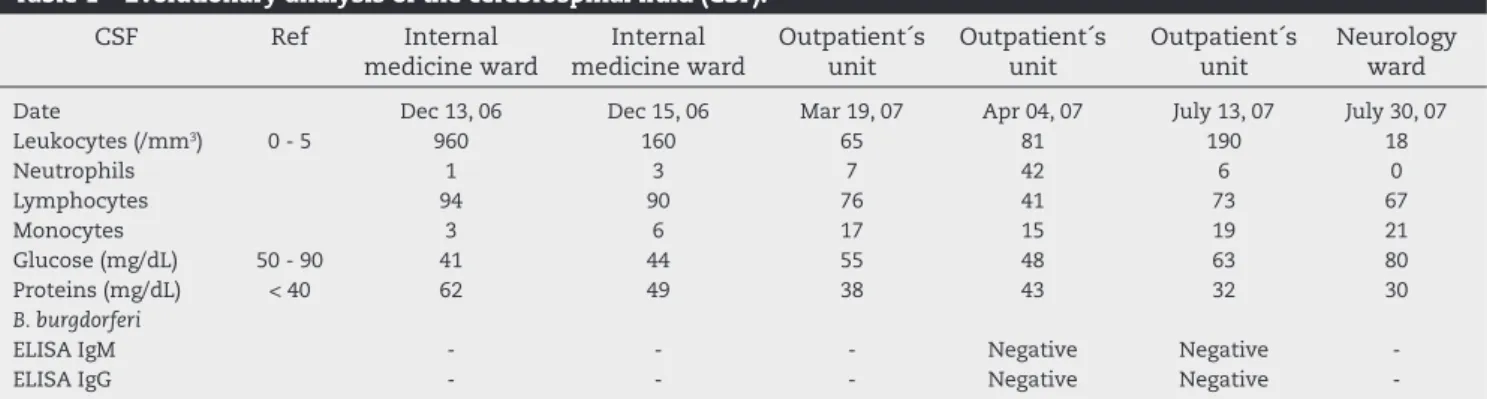
Spontaneous neurological improvement was noted; after-wards, the patient was referred for outpatient follow-up. The CSF samples conirmed the diagnosis as chronic lymphocytic meningoencephalitis (Table 1).
In April 2007 the patient had intermittent episodes of dip-lopia and skin lesions, whose biopsy showed chronic septal panniculitis consistent with erythema nodosum. Serology for B. burgdorferi was requested, including ELISA IgM/IgG 1/800 re-agent negative and a Western blot that revealed presence of one IgM band and 3 IgG bands.
Given the clinical laboratory and epidemiological charac-teristics, the diagnosis of BYS was established. Ceftriaxone 2 g/day for 30 days was introduced, followed by doxycycline 200 mg/day for two months. There was improvement in the
cog-nitive dysfunction at the end of the irst cycle of antibiotics, with disappearance of erythema nodosum and arthritis reso-lution. Due to the persistence of cerebellar dysfunction, the patient was readmitted for investigation in July 2007.
The neurological examination revealed decreased speed of movement to the left, dysdiadocokinesia, intention tremor and nystagmus evoked to the left. The neuropsychological as-sessment showed impairment in information processing as well as nominative and visual-spatial dificulties. Then, we decided to prescribe ive days of pulse therapy with methyl-prednisolone 1 g, followed by ive days of prednisone 60 mg/ day. Doxycycline was maintained for 60 days, in association with 250 mg of chloroquine diphosphate. The serology for B. burgdorferi became negative during the evolution, according to data from Table 2.
Currently, the patient is asymptomatic, without changes in the brain resonance, but with some memory impairment.
Discussion
In this paper, the case of a patient with late diagnosed BYS and with severe neurological injury associated with joint and cutaneous manifestations is presented. A positive serology for B. burgdorferi (sensu stricto) helped conirm the diagnosis. Posi-tive epidemiological history, presence of cogniPosi-tive impairment and neuropsychiatric symptoms, along with a good response to treatment with disappearance of antibodies anti-spirochetes, were equally relevant to the diagnosis.
In Brazil, this zoonosis may have a long latency period be-tween initial infection and the onset of symptoms, as well as with relapsing episodes during its evolution. Generally, the joint condition of BYS emerges in large joints, especially the knees, and can evolve to simulate rheumatoid arthritis, as it was in this case.5,6,8 In this country, whenever there is presence of
oli-goarthritis of large joints, an investigation of BYS is mandatory, and one should search both the epidemiological and clinical histories.
LIM-17 adopts as diagnostic criteria for BYS the presence of major (positive epidemiology, MS or systemic symptoms, and positive serology) and minor (a history of systemic episodes compatible with BYS, symptoms of chronic fatigue or cognitive dysfunction, autoimmune disorders and visualization of spiro-chetes in peripheral blood) parameters.11 The patient visited risk
Table 1 – Evolutionary analysis of the cerebrospinal luid (CSF).
CSF Ref Internal
medicine ward
Internal medicine ward
Outpatient´s unit
Outpatient´s unit
Outpatient´s unit
Neurology ward
Date Dec 13, 06 Dec 15, 06 Mar 19, 07 Apr 04, 07 July 13, 07 July 30, 07
Leukocytes (/mm3) 0 - 5 960 160 65 81 190 18
Neutrophils 1 3 7 42 6 0
Lymphocytes 94 90 76 41 73 67
Monocytes 3 6 17 15 19 21
Glucose (mg/dL) 50 - 90 41 44 55 48 63 80
Proteins (mg/dL) < 40 62 49 38 43 32 30
B. burgdorferi
ELISA IgM - - - Negative Negative
-ELISA IgG - - - Negative Negative
151
R E V B R A S R E U M A T O L . 2 0 1 4 ;5 4 ( 2 ): 1 4 8 – 1 5 1areas, socialized with domestic animals and had episodes of tick bites. The BYS vectors often infest animals living close to man.1,6
The fact that the patient denied recent tick bites is not surpris-ing, as the contagion may have occurred months or years before the current symptoms.
The concomitant occurrence of meningoencephalitis and the involvement of the second cranial nerve, associated with the joint manifestation, is a relevant aspect. Shinjo et al.,10 studied
30 patients with BYS neuroborreliosis, and found that 73.6% had recurrence episodes, 56.7% had concomitant neurologic com-plaints with arthritis, and meningoencephalitis was identiied in 33.3% of cases.
The encephalomyelitis of human borreliosis may be con-fused with multiple sclerosis (EM).12,13 In this report, the
exuber-ance of the inlammatory symptoms, the multiplicity of system-ic complaints, a positive serology for B. burgdorferi and the good response to antibiotics excluded this diagnostic option. Other causes of infectious and autoimmune encephalomyelitis were also excluded.
There is no mention about MS in our patient's history, but it should be noted that this initial injury, which arises at the point of inoculation of spirochetes, occurs in less than 50% of cases in Brazil.6,8 Interestingly, other atypical cutaneous presentations
have been reported, such as panniculitis, lymphocytoma and scleroderma-like plate.6,8,11,14 There is no record of erythema
no-dosum associated with BYS, but there are reports of erythema nodosum in patients with LD.15
This paper conirms the existence of recurring outbreaks in BYS patients. This inding is highly relevant, since the current symptoms are not always associated with epidemiological and clinical data of the past. However, due to the severity of illness, a good response of the condition to the treatment with antibiotics in its early stages, and the possibility of preventing progression to chronicity, physicians of different specialties should be vigi-lant for suspected cases of Brazilian human borreliosis.
Conlicts of interest
The authors declare no conlicts of interest.
R E F E R E N C E S
1. Mantovani E. Identiicação do agente etiológico da Doença de Lyme-símile brasileira (Síndrome de Baggio-Yoshinari):
Tese de Doutorado apresentada à Faculdade de Medicina da Universidade de São Paulo; 2010: 117 pp. Disponível em http://www.teses.usp.br/teses/disponiveis/5/5164/tde-04112010-145154/pt-br.php
2. Azulay RD, Azulay-Abulaia L, Sodré CT, Azulay DR, Azulay MM. Lyme disease in Rio de Janeiro, Brazil. Int J Dermatol. 1991;30:569-71.
3. Yoshinari NH, Barros PJ, Cruz FCM, Oyafuso LK, Mendonça M, Baggio D. Clínica e sorologia da doença de Lyme no Brasil. Rev Bras Reumatol. 1992;32.
4. Melo IS, Gadelha AR, Ferreira LC. Estudo histopatológico de casos de eritema crônico migratório diagnosticados em Manaus. An Bras Dermatol. 2003;78:9.
5. Yoshinari NH, de Barros PJ, Bonoldi VL, Ishikawa M, Battesti
DM, Pirana S et al. [Outline of Lyme borreliosis in Brazil].
Rev Hosp Clin Fac Med Sao Paulo. 1997;52:111-7. 6. Yoshinari NH, Mantovani E, Bonoldi VL, Marangoni RG,
Gauditano G. [Brazilian lyme-like disease or Baggio-Yoshinari syndrome: exotic and emerging Brazilian tick-borne zoonosis]. Rev Assoc Med Bras. 2010;56:363-9. 7. Gouveia EA, Alves MF, Mantovani E, Oyafuso LK, Bonoldi
VL, Yoshinari NH. Proile of patients with Baggio-Yoshinari Syndrome admitted at “Instituto de Infectologia Emilio Ribas”. Rev Inst Med Trop Sao Paulo. 2010;52:297-303. 8. Costa IP, Bonoldi VLN, Yoshinari NH. Peril clínico e
laboratorial da Doença de Lyme símile no Estado de Mato Grosso do Sul: análise de 16 pacientes. Rev Bras Reumatol. 2001;41:8.
9. Derdáková M, Lencáková D. Association of genetic variability within the Borrelia burgdorferi sensu lato with the ecology, epidemiology of Lyme borreliosis in Europe. Ann Agric Environ Med. 2005;12:165-72.
10. Shinjo SK, Gauditano G, Marchiori PE, Bonoldi VLN, Costa IP,
Mantovani E et al. Manifestação neurológica na síndrome
de Baggio-Yoshinari (síndrome brasileira semelhante à doença de Lyme). Rev Bras Reumatol. 2009;49:13.
11. Mantovani E, Costa IP, Gauditano G, Bonoldi VL, Higuchi ML, Yoshinari NH. Description of Lyme disease-like syndrome in Brazil. Is it a new tick borne disease or Lyme disease variation? Braz J Med Biol Res. 2007;40:443-56.
12. Kristoferitsch W. Neurological manifestations of Lyme borreliosis: clinical deinition and differential diagnosis. Scand J Infect Dis Suppl. 1991;77:64-73.
13. Schumutzhardt E. Multiple Sclerosis and Lyme borreliosis. Wien Klin Wochenschr. 2002;114:5.
14. Yoshinari N, Spolidorio M, Bonoldi VL, Sotto M. Lyme disease like syndrome associated lymphocytoma: irst case report in Brazil. Clinics (Sao Paulo). 2007;62:525-6.
15. Simakova AL, Popov AF, Dadalova OB. Ixodes tick-borne borreliosis with erythema nodosum. Med Parazitol (Mosk). 2005;4:2.
Table 2 – Evolutive analysis of serology for Borrelia burgdorferi.
B. burgdorferi Serology Ref Outpatient´s unit Outpatient´s unit Neurology ward Outpatient´s unit Outpatient´s unit
Data Apr 11, 07 Aug 11, 07 Aug 23, 07 Sept 26, 07 Nov 14, 07
ELISA IgM 1/100 Neg 1/100 Neg Neg Neg
ELISA IgG 1/400 1/800 Neg Neg Neg Neg
WB IgM a 1 b 2 b 2 b Neg Neg
WB IgG a 3 b 3 b Neg Neg Neg
Neg, negative; Ref, reference value.
a WB is considered positive with presence of at least 4 IgG bands, or at least 2 IgM bands; or at least 2 IgG bands and 1 IgM band simultaneously.