Algorithms for monitoring warfarin use: Results from Delphi Method
EUNICE KAZUE KANO1, JESSICA BASSANI BORGES1, ERIKA BURIM SCOMPARINI1, ANA PAULA CURI2, ELIANE RIBEIRO1*
1Department of Pharmacy, Faculty of Pharmaceutical Sciences, Universidade de São Paulo (USP), São Paulo, SP, Brazil 2School of Arts, Sciences and Humanities, USP, São Paulo, SP, Brazil
S
UMMARYStudy conducted by University Hospital, Universidade de São Paulo (USP), São Paulo, SP, Brazil
Article received: 1/17/2017
Accepted for publication: 2/26/2017
*Correspondence:
Address: Av. Prof. Lineu Prestes, 2.565 São Paulo, SP – Brazil Postal code: 05508-000
http://dx.doi.org/10.1590/1806-9282.63.10.842
Funding: This study was supported by São Paulo Research Foundation (Fapesp).
Warfarin stands as the most prescribed oral anticoagulant. New oral anticoagulants have been approved recently; however, their use is limited and the reversibility techniques of the anticoagulation effect are little known. Thus, our study’s purpose was to develop algorithms for therapeutic monitoring of patients taking warfarin based on the opinion of physicians who prescribe this medicine in their clinical practice. The development of the algorithm was performed in two stages, namely: (i) literature review and (ii) algorithm evaluation by physicians using a Delphi Method. Based on the articles analyzed, two algorithms were developed: “Recommendations for the use of warfarin in anticoagulation therapy” and “Recommendations for the use of warfarin in anticoagulation therapy: dose adjustment and bleeding control.” Later, these algorithms were analyzed by 19 medical doctors that responded to the invitation and agreed to participate in the study. Of these, 16 responded to the irst round, 11 to the second and eight to the third round. A 70% consensus or higher was reached for most issues and at least 50% for six questions. We were able to develop algorithms to monitor the use of warfarin by physicians using a Delphi Method. The proposed method is inexpensive and involves the participation of specialists, and it has proved adequate for the intended purpose. Further studies are needed to validate these algorithms, enabling them to be used in clinical practice.
Keywords: Delphi technique, warfarin, decision-making, medication ther-apy management.
I
NTRODUCTIONWarfarin was commercially introduced in the market in 1954.1 Since then, it stands as the most prescribed oral
anticoagulant, widely used for prophylaxis and treatment of venous thromboembolism and complications associ-ated with atrial ibrillation and heart valve replacement.2,3
New oral anticoagulants, such as direct thrombin in-hibitors (DTIs), have been recently approved. However, their use is restricted and reversibility techniques are little known, unlike warfarin, which can be readily reversed by using vitamin K, fresh plasma or recombinant factor VII.4-6 Thus,
despite DTIs show predictable pharmacokinetics, which eliminates the need for serum monitoring, they must be monitored as the causative factors for this risk.4,6
Other problems related with DTIs include the need for dose adjustments in renal failure patients, the contraindica-tion of use by liver disease patients and drug interaccontraindica-tions.4-7
Although some DTIs have shown good risk-beneit ratio,5,8-10 more information regarding safety, especially
in long-term treatment, is still needed,4-7 as well as
con-irmation of the indings obtained so far for DTIs in new clinical trials.11
Nevertheless, warfarin, which is inexpensive and eas-ily accessible, shows eficacy above 90% in preventing further thrombotic episodes, if correctly used, and con-stitutes an important therapeutic alternative, especially for low-income populations.12
able, produced in a structured basis, with common sense and honesty. In the absence of evidence or in situations of conlicting evidence, consensus of experienced experts must be achieved. Therefore, relevant information, ap-propriate for every situation, are obtained in a system-atic basis and become the inal link between good qual-ity science and good medical practice.15-17
The Delphi Method is a widespread technique, used since the early 1960s for the systematic search of expert consensus on a speciic issue.18,19 According to this
meth-od, a group of experts is consulted on a particular subject, usually related to low-grade scientiic evidence that re-quires a consensus.20
In the health sector, the Delphi Method is being in-creasingly used due to its ease of application, low cost, the fact that it allows equal participation of all individu-als involved, in addition to yielding qualiied collective opinion on the subject. Despite these advantages, its use is not free from bias, especially if the choice of panelists is not done carefully. It is also important to emphasize that the results obtained using the Delphi Method rep-resent a speciic time and the opinion of some profession-als, and it is not an absolute truth.21
Thus, while warfarin, despite its limitations, still re-mains as the drug of choice in anticoagulation therapy, being distributed free of charge by the Brazilian public health system, developing new strategies, such as the development and validation of algorithms/protocols for the drug’s use, is fundamental to increase therapy safety and effectiveness.
The objective of our study was to develop algorithms for therapeutic monitoring of patients taking warfarin based on the opinion of medical experts.
M
ETHODThe development of the algorithm was performed in two stages: (i) a literature review for developing the algorithm; and (ii) the algorithm’s evaluation by medical experts.
In the irst stage, a search was performed in the fol-lowing electronic databases for the years 2008 to present: “PubMed” and “Medline” (International Medical Litera-ture), Lilacs (Latin American and Caribbean Literature on Health Sciences), and Embase (International Biomed-ical Literature). The UptoDate (Wolters Kluwer Health) evidence-based clinical decisions database was also used. The combination of the following terms was applied: warfarin, algorithm, therapeutic, dose adjustment, DRR, INR, drug monitoring, dose and response.
review articles on the subject were included. In addition to this strategy, some articles were selected from refer-ences of articles found in the databases searched. From the analysis of the articles, we elaborated the irst algo-rithm and questions to be responded by medical experts in anticoagulation according to the Delphi Method.
The questions were sent to a group of experts, anon-ymously and systematically. Three rounds of question-naires containing questions that did not reach consensus in the previous stage were applied.
Anonymity, the lack of personal contact among re-spondents, the statistical representation of the distribu-tion of results, and the feedback to the group for reas-sessment of responses in subsequent rounds were the main features used from said method.20
Our project was approved by the Research Ethics Committee of the University Hospital of University of São Paulo, number 764/07 and SISNEP 0048.0.198.018-07; all respondents signed an Informed Consent (IC) form. Nineteen (19) medical doctors experts in warfarin anticoagulation, from different specialties and different institutions, all linked to teaching hospitals in São Paulo, were invited to participate in the research. The medical experts were selected after curriculum review, contacts in university hospitals and search on university websites.
The inclusion criteria were:
• being a general practitioner, cardiologist, hemato-logist and/or vascular surgeon;
• working in universities and/or hospitals in the city of São Paulo that conduct scientiic research;
• being experienced in the clinical use of warfarin.
The irst contact with medical experts was performed over the phone, and then an invitation letter containing the study objectives and responsibilities of the respondents was electronically sent. In cases where the physician agreed to participate in the study, a date was scheduled so that the researcher could provide more details on the project and collect a signed IC form.
Elaboration and application of questionnaires
For the irst questionnaire (Q1), 25 questions were elabo-rated about conlicting theoretical data to be answered in a maximum of 30 minutes. Q1 was developed in elec-tronic and printed forms, with open ields for answers only, and was divided into four parts:
b. Personal data such as age, gender, specialty, and type of ser-vice in which he/she worked at the time were requested. c. Questions about conlicting data, and about the
eva-luation algorithm itself.
d. Generic questions, in order to evaluate the usefulness of the algorithm in medical practice.
From the analysis of Q1 responses, a second questionnaire (Q2) was elaborated and sent to those same experts, this time divided into two parts: a) letter to the expert; b) multiple-choice questions which did not reach consensus in Q1, with a graph showing the percentage results ob-tained in Q1, so that respondents could know the answer trend for each question. Then, the third questionnaire (Q3) was elaborated, containing questions that did not reach consensus in Q2, divided into two parts, with an explanatory letter and multiple-choice questions. After reviewing the responses in Q3, a letter expressing our gratitude and containing feedback from the study results was elaborated and sent to each respondent.
Quantitative analysis of the responses obtained in Q1, Q2 and Q3 was performed by using basic descriptive statistics, including means, medians, and standard de-viation. For qualitative data, the responses were expressed in percentage (response distribution frequencies). Con-sensus was achieved whenever a minimum of 70% of re-spondents chose the same alternative.
R
ESULTSDevelopment of algorithm for therapeutic drug monitoring in pa-tients taking warfarin
Based on the analyzed articles, two algorithms were de-veloped: “Recommendations for the use of warfarin in anticoagulation therapy” (Figure 1A) and “Recommenda-tions for the use of warfarin in anticoagulation therapy: dose adjustment and bleeding control” (Figure 1B).
Algorithm evaluation by medical experts by Delphi Method
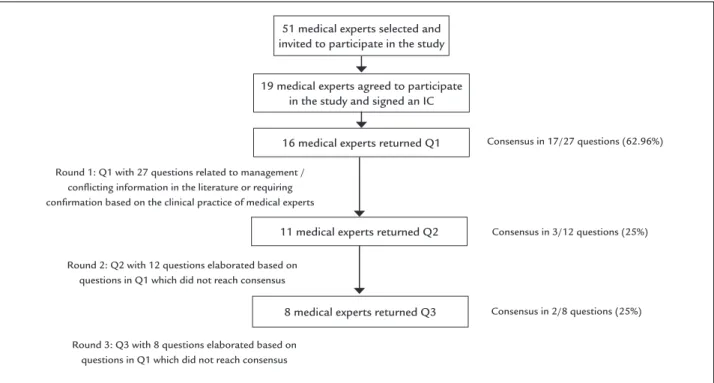
Figure 2 shows the lowchart of the Delphi Method used for applying the questionnaires to medical experts.
Medical experts participating in the study
Most medical experts (63%) were male, aged 41.5±10.13 (mean±SD) years, with a length of education of 14.46 years after medical internship. Nineteen percent (19%) worked in public institutions, 6.25% in private institutions, and 75% in both.
These experts represented the following medical areas: 68% cardiology, 16% hematology, 11% general practice and 5% vascular surgery.
Algorithms evaluation
In the irst round, out of 19 questions sent, 16 were an-swered and sent back to us, representing a loss of 15.79%. Regarding miscellaneous data, all the doctors report-ed that the algorithms are useful tools for warfarin dose adjustment in clinical practice. Sixty-three percent (63%) considered it important to apply the algorithm in public and private hospitals, and medical ofices.
Based on the results observed in this irst round, it became clear that the optimum dosage of warfarin is controversial. The doubts raised and the lack of stan-dardization are so great that 100% of the doctors who answered the questionnaire considered the use of the algorithm as an important decision tree for the prescrip-tion of warfarin dose.
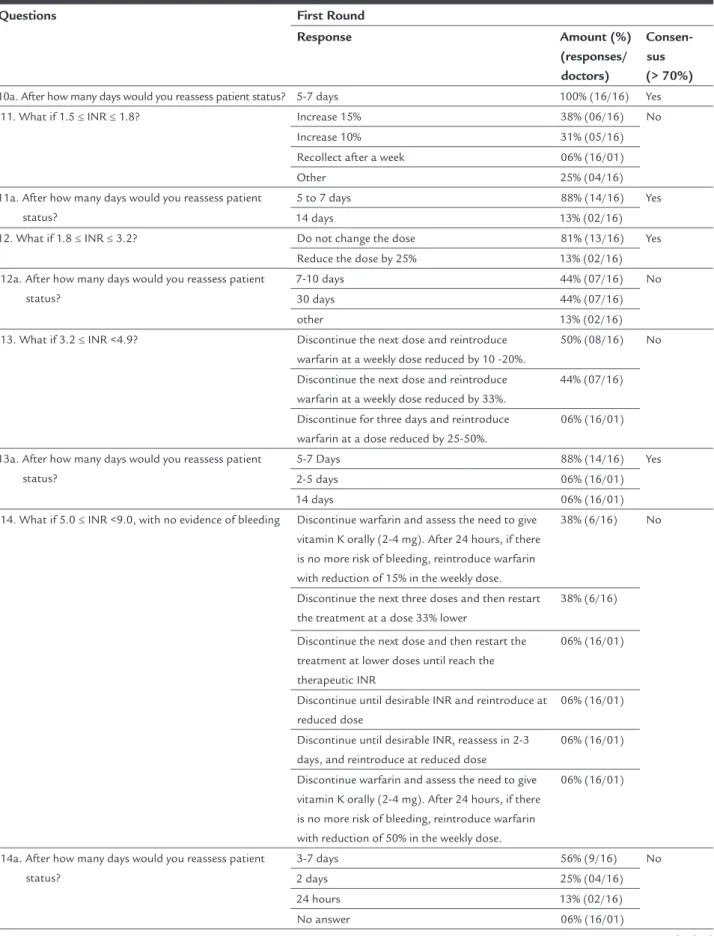
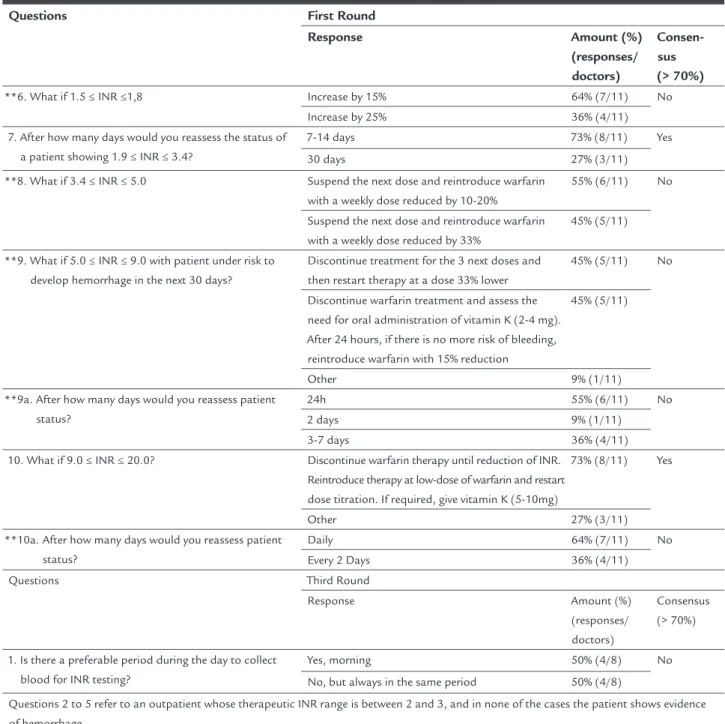
The conlicting questions in Q1 were classiied ac-cording to the percentage found: with consensus and without consensus. Those questions without consensus in the irst round were repeated in the second round (Q2), and those for which no consensus was obtained in the second round were repeated once again in the third round (Q3). Table 1 shows the questions contained in all ques-tionnaires as well as their responses.
In Table 1, it is noted that, for 18 conlicting questions in the irst round, subdivided into 27 questions, consen-sus was reached with 70% or higher agreement for 17 (62.96%=17/27).
Q2 comprised ten multiple-choice questions sent to 16 experts who participated in the irst round. Of these, 11 responded to the questions. Therefore, there was a loss
of 31.25% compared to the previous round, and 42.10% of the total.
In three (3/12=25%) out of 12 questions, consensus was reached with ≥ 70% agreement; Q3 was sent to the 11 respondents from the previous round, including eight questions that achieved no consensus in the second round, as well as frequency graphs for the responses in the previ-ous questionnaire.
Eight experts responded to this round (72.72%=8/11). Based on the previous round, there was a loss of 27.27% of respondents. For all the rounds, the registered loss was 57.89% (8/19).
Consensus of ≥ 70% was reached for two questions, and at least 50% for the other six.
Questions First Round
Response Amount (%)
(responses/ doctors)
Consensus (> 70%)
1. What is the initial dose of warfarin for an adult outpatient who has never taken warfarin and whose desirable INR range for therapy is between 2 and 3?
5 mg/day 94% (15/16) Yes
2.5 mg/day 06% (16/01)
2. And for those patients in poor nutritional status, the elderly, patients with liver disease or those at high risk of bleeding?
2.5 mg/day 75% (12/16) Yes
2.0 mg/day 13% (02/16)
5 mg/day 06% (16/01)
I would not use 06% (16/01)
3. Is there any difference in the initial dose of warfarin between inpatients and outpatients?
No 75% (12/16) Yes
Yes 25% (04/16)
*4. After how many days from taking the initial dose should the irst INR testing be done to assess the patient?
5 days 50% (08/16) No
3 days 25% (04/16)
7 days 25% (04/16)
*5. What should be the frequency of INR monitoring until the desired range is reached?
weekly 63% (10/16) No
every 2-3 days 31% (05/16)
Daily 06% (16/01)
*6. Is there a preferable period in a day to collect blood for INR testing?
Yes, morning. 56% (09/16) No
No 44% (07/16)
7. What should be the frequency for monitoring of INR after reaching the therapeutic range?
monthly 81% (13/16) Yes
every 6 weeks 13% (02/16)
weekly 06% (16/01)
8. When should dose adjustment be done? If INR is out of the therapeutic range, after 4-6 days from the beginning of therapy.
75% (12/16) Yes
If INR is out of the therapeutic range, in two consecutive measurements;
44% (07/16)
If after 3 days using warfarin, the patient has not yet reached the expected INR range
06% (16/01)
**9. Which INR ranges would determine an action for changing the dose?
INR ≤ 1.5/1.5 < INR ≤ 1.8/ 1.9 ≤ INR < 3.2/ 3.2 ≤ INR < 5.0/INR ≥ 5.0
25% (04/16) Yes
1.0 ≤ INR <2.0/ 3.0 < INR < 6.0/ 6.0 ≤ INR < 10.0/ 10.0 ≤ INR ≤ 18.0/ INR > 18.0
69% (11/16)
INR ≤ 1.5/1.51 ≤ INR ≤1.99/ 2.0 ≤ INR ≤ 3.0/ 3.01 ≤ INR < 3.99/ 4.0 ≤ INR ≤ 4.99/5.0 ≤ INR ≤ 8.99/ INR ≥ 9.0
13% (02/16)
other 25% (04/16)
No answer 13% (02/16)
Questions 10 to 16 refer to an outpatient whose therapeutic INR range is between 2 and 3, and in none of the cases the patient has shown evidence of hemorrhage.
*10. If a patient shows an INR lower than or equal to 1.5; what would the dose adjustment be?
Increase 20% 38% (06/16) No
Increase 33% 31% (05/16)
Double the dose 06% (16/01)
other 25% (04/16)
TABLE 1 Questions contained in Q1, Q2 and Q3 and responses obtained from medical experts after their application in irst, second and third rounds. The responses were classiied according to their percentage of agreement.
Questions First Round
Response Amount (%)
(responses/ doctors)
Consen-sus (> 70%) 10a. After how many days would you reassess patient status? 5-7 days 100% (16/16) Yes
*11. What if 1.5 ≤ INR ≤ 1.8? Increase 15% 38% (06/16) No
Increase 10% 31% (05/16)
Recollect after a week 06% (16/01)
Other 25% (04/16)
11a. After how many days would you reassess patient status?
5 to 7 days 88% (14/16) Yes
14 days 13% (02/16)
12. What if 1.8 ≤ INR ≤ 3.2? Do not change the dose 81% (13/16) Yes Reduce the dose by 25% 13% (02/16)
*12a. After how many days would you reassess patient status?
7-10 days 44% (07/16) No
30 days 44% (07/16)
other 13% (02/16)
*13. What if 3.2 ≤ INR <4.9? Discontinue the next dose and reintroduce warfarin at a weekly dose reduced by 10 -20%.
50% (08/16) No
Discontinue the next dose and reintroduce warfarin at a weekly dose reduced by 33%.
44% (07/16)
Discontinue for three days and reintroduce warfarin at a dose reduced by 25-50%.
06% (16/01)
13a. After how many days would you reassess patient status?
5-7 Days 88% (14/16) Yes
2-5 days 06% (16/01)
14 days 06% (16/01)
*14. What if 5.0 ≤ INR <9.0, with no evidence of bleeding Discontinue warfarin and assess the need to give vitamin K orally (2-4 mg). After 24 hours, if there is no more risk of bleeding, reintroduce warfarin with reduction of 15% in the weekly dose.
38% (6/16) No
Discontinue the next three doses and then restart the treatment at a dose 33% lower
38% (6/16)
Discontinue the next dose and then restart the treatment at lower doses until reach the therapeutic INR
06% (16/01)
Discontinue until desirable INR and reintroduce at reduced dose
06% (16/01)
Discontinue until desirable INR, reassess in 2-3 days, and reintroduce at reduced dose
06% (16/01)
Discontinue warfarin and assess the need to give vitamin K orally (2-4 mg). After 24 hours, if there is no more risk of bleeding, reintroduce warfarin with reduction of 50% in the weekly dose.
06% (16/01)
*14a. After how many days would you reassess patient status?
3-7 days 56% (9/16) No
2 days 25% (04/16)
24 hours 13% (02/16)
No answer 06% (16/01)
Questions First Round
Response Amount (%)
(responses/ doctors)
Consen-sus (> 70%) 15. And if INR > 10.0, with no evidence of bleeding? Discontinue warfarin until INR reduction and give
5 to 10 mg of vitamin K orally.
75% (12/16) Yes
Other 31% (05/16)
*15a. After how long would you reassess patient status? 24 hours 69% (11/16) No
Every 2 Days 31% (05/16)
16. In case there is evidence of minor bleeding, what is the dose of vitamin K?
Discontinue warfarin, give vitamin K 10mg and, if necessary, supplement with fresh plasma or prothrombin concentrate.
94% (15/16) Yes
Discontinue warfarin, give vitamin K, and restart later 06% (16/01) 16a. After how many days would you reassess patient
status?
12 hours 75% (12/16) Yes
24 hours 25% (04/16)
The question below refers to the case of a patient showing evidences of major bleeding:
17. Sugiro: How would you manage warfarin therapy? Discontinue warfarin, give prothrombin complex and vitamin K 10mg 75% (12/16)
Yes
other 25% (04/16)
17a. After how long should the patient be reassessed? 12 hours 81% (13/16) Yes
1 day 19% (3/16)
The question below refers to the case of a patient experiencing life-threatening bleeding:
18. Sugiro: How would you manage warfarin therapy?
Discontinue warfarin, give prothrombin complex and vitamin K 10mg
75% (12/16) Yes
Other 25% (04/16)
18a. After how many days would you reassess patient status?
12 hours 81% (13/16) Yes
1 day 19% (3/16)
Questions Second Round
Response Amount (%)
(responses/ doctors)
Consensus (> 70%)
**1. How many days after taking the initial dose should the irst INR testing be done to assess the patient?
3 days 27% (3/11) No
5 days 55% (6/11)
1 week 18% (2/11)
**2. What should be the frequency of INR monitoring until the desired range is reached?
Every 2-3 days 36% (4/11) No
Weekly 64% (7/11)
**3. Is there a preferable period within the day to collect blood for INR testing?
Yes, morning 36% (4/11) No
No 64% (7/11)
4. When should dose adjustment be done (tick all possible alternatives)?
If the INR is out of therapeutic range after 4-6 days from the beginning of the therapy.
100% (11/11) Yes
The following questions refer to an outpatient whose therapeutic INR range is between 2 and 3, and in none of the cases the patient shows evidence of hemorrhage.
**5. If a patient shows INR lower than 1.5, which would be the dose adjustment?
Increase by 20% 27% (3/11) No
Double the daily dose 9% (1/11)
Increase by 33% 55% (6/11)
Other 9% (1/11)
TABLE 1 Questions contained in Q1, Q2 and Q3 and responses obtained from medical experts after their application in irst, second and third rounds. The responses were classiied according to their percentage of agreement.
Questions First Round
Response Amount (%)
(responses/ doctors)
Consen-sus (> 70%)
**6. What if 1.5 ≤ INR ≤1,8 Increase by 15% 64% (7/11) No
Increase by 25% 36% (4/11)
7. After how many days would you reassess the status of a patient showing 1.9 ≤ INR ≤ 3.4?
7-14 days 73% (8/11) Yes
30 days 27% (3/11)
**8. What if 3.4 ≤ INR ≤ 5.0 Suspend the next dose and reintroduce warfarin with a weekly dose reduced by 10-20%
55% (6/11) No
Suspend the next dose and reintroduce warfarin with a weekly dose reduced by 33%
45% (5/11)
**9. What if 5.0 ≤ INR ≤ 9.0 with patient under risk to develop hemorrhage in the next 30 days?
Discontinue treatment for the 3 next doses and then restart therapy at a dose 33% lower
45% (5/11) No
Discontinue warfarin treatment and assess the need for oral administration of vitamin K (2-4 mg). After 24 hours, if there is no more risk of bleeding, reintroduce warfarin with 15% reduction
45% (5/11)
Other 9% (1/11)
**9a. After how many days would you reassess patient status?
24h 55% (6/11) No
2 days 9% (1/11)
3-7 days 36% (4/11)
10. What if 9.0 ≤ INR ≤ 20.0? Discontinue warfarin therapy until reduction of INR. Reintroduce therapy at low-dose of warfarin and restart dose titration. If required, give vitamin K (5-10mg)
73% (8/11) Yes
Other 27% (3/11)
**10a. After how many days would you reassess patient status?
Daily 64% (7/11) No
Every 2 Days 36% (4/11)
Questions Third Round
Response Amount (%)
(responses/ doctors)
Consensus (> 70%)
1. Is there a preferable period during the day to collect blood for INR testing?
Yes, morning 50% (4/8) No
No, but always in the same period 50% (4/8)
Questions 2 to 5 refer to an outpatient whose therapeutic INR range is between 2 and 3, and in none of the cases the patient shows evidence of hemorrhage.
2. If a patient shows INR lower than 1.5, which would be the dose adjustment?
Increase by 20% 38% (3/8) No
Increase by 33% 62% (5/8)
3. What if 1.5 ≤ INR ≤1.8 Increase by 15% 38% (3/8) No
Increase by 25% 50% (4/8)
Other 12% (1/8)
4. What if 3.2 ≤ INR ≤ 4.9 Suspend the next dose and reintroduce warfarin with a weekly dose reduced by 10-20%
62% (5/8) No
Suspend the next dose and reintroduce warfarin with a weekly dose reduced by 33%
25% (2/8)
Other 12% (1/8)
Questions First Round
Response Amount (%)
(responses/ doctors)
Consen-sus (> 70%) 5. What if 5.0 ≤ INR ≤ 9.0 with no evidences of bleeding? Discontinue the next 3 doses and then restart the
therapy at a dose 33% lower
50% (4/8) No
Discontinue warfarin treatment and assess the need for oral administration of vitamin K (1-2 mg). After 24 hours, if there is no more risk of bleeding, reintroduce warfarin with 15% reduction
38% (3/8)
Other 12% (1/8)
6. In case there is evidence of bleeding, classiied as minor, what should the management be?
Suspend the next dose, give vitamin K according to INR (1-2 mg for INR> 4.5; p 1-2,5mg/5.0 <INR <9.0; 2,5-5,0mg for INR> = 9.0), monitor, and
repeat if necessary, the dose of vitamin K, and restart warfarin therapy
50% (4/8) No
Discontinue and give vitamin K 1-2 mg, monitor, and repeat if necessary vitamin K, and restart therapy
38% (3/8)
Other 12% (1/8)
7. In case there is evidence of bleeding, classiied as minor, what should the management be?
Discontinue, give 5-10mg of vitamin K by slow intravenous infusion plus 25-50U/kg of prothrombin complex concentrate or 15ml/kg of fresh plasma, and reassess
100% (8/8) Yes
8. In case there is evidence of a life-threatening bleeding, what should the management be?
Discontinue, give 10mg of vitamin K by slow intravenous infusion and 25-50U/kg of prothrombin complex concentrate OR 150 to 300 ml of fresh plasma, and reassess
75% (6/8) Yes
Discontinue, give 10mg of vitamin K by slow intravenous infusion, 25-50U/kg of prothrombin complex concentrate and 15ml/kg of fresh plasma, and reassess
25% (2/8)
K AN O E K ET AL . R EV A SS O C M ED B R AS 2 0 1 7 ; 6 3 (1 0 ):8 4 2 -8 5 5
Assess patient characteristics.
Obtain baseline values for aPTT, TP, INR and complete blood count. *Average duration of treatment: 3 months
Emergency (patient ≤ 50 years) Non-emergency
*Before starting the treatment, the physician must always advise the patient about the risks of using warfarin and the importance of correctly using the drug, a continuous diet rich in potassium, and the use of drugs only on medical prescription.
**In all visits, the patient must be asked about which drugs he is taking, and the presence of hemorrhagic foci or thrombi must be checked out.
INR desirable ** ** ** * * * RNI desirable
NEVER used warfarin ALREADY used warfarin
Warfarin crosses the placenta
These ranges must be kept for 2 consecutive weeks
These ranges must be kept for 2 consecutive weeks Warfarin is excreted
in breast milk at low concentrations
Contraindicated treatment
Treatment does not affect infants. It is the
same as in adults
5.0 mg/day (2-4 days) NOTE: Single dose, given
always at the same time
Monitor INR (always in the morning) daily until reach therapeutic range.
After estabilization of INR, monitor once a month
If INR increases rapidly in the irst days, the dose must be reduced. INR must increase by 0.2-0.3 units a day. Therapeutic INR will be reached after 4-5 days
Same dose used when therapeutic effect has been reached. NOTE: Single dose, given always
at the same time Pregnant in 1st quarter
Risk of fetal hemorrhage and/or
teratogenic effects
Adults
Discontinue heparin after 4-5 days e INR ≥ 2.0
Patients showing:
Prosthetic heart valve Recent myocardial
infarction Antiphospholipid
syndrome
↓
2.5 ≤ INR ≤ 3.5 (optimal 3.0)
Patients showing:
Prosthetic heart valve Recent myocardial infarction
Antiphospholipid syndrome
↓
2.5 ≤ INR ≤ 3.5 (optimal 3.0) Prophylaxis and treatment of venous
and arterial thromboembolism Treatment of pulmonary embolism
Prevention of systemic embolism Atrial ibrillation Heart valve disease
↓
2 ≤ INR ≤ 3 (optimal 2.5) Active or severe
hemorrhatic dithesis No compliance
Uncontrolled hypertension Severe liver disease Recent surgery involving
central nervous system, spine and eyes
Prophylaxis and treatment of venous and anterial
thromboembolism Treatment of pulmonary
embolism Prevention of systemic
embolism Atrial ibrillation Heart valve disease
↓
2 ≤ INR ≤ 3 (optimal 2.5)
Infants Elderly patients ( ≥ 65 years) Hepatopathy Poor nutritional status At high risk of hemorrhage
Sensitive to warfarin
Start of therapy: 2-2.5 mg/day NOTE: Single dose, given always at
the same time
Start of therapy
Patient must mandatorily be hospitalized
Monitor INR (always in the morning):
Every 2-3 days in the irst 2 weeks. Once a week in the next 4 weeks After estabilization of INR, monitor
every 4-6 weeks Monitor INR daily in the morning until
therapeutic level is reached
Patient has not to be hospitalized
7.5-10.0 mg/day NOTE: Single dose, given
always at the same time. +
Heparin for 4-5 days
AR
FA
R
IN
U
SE
: R
ES
U
LT
S
FR
O
M
D
EL
PH
I
M
ET
H
O
D
; 6
3
(1
0
):8
4
2
-8
5
5
8
5 FIGURE 1 (A) Algorithm “Recommendation for the use of warfarin in anticoagulation therapy.” (B) Algorithm “Recommendations for the use of warfarin in anticoagulation therapy: dose
RNI ≤ 1.5
Minor
Reassess weelky until stabilizatoin
of INR
Discuss reintroduction
of warfarin at lower doses
Discuss reintroduction
of warfarin at lower doses Reassess after
5-7, 7-10 or 5-10 days?
Reassess after 5-7, 7-10 or
5-10 days?
Reassess after 7-14 or 7-10
days? Reassess after 5-7, 7-10 or 5-10 days?
Reassess 2-5, 5-7days or weekly until the INR reach
the therapeutic range
Discontinue warfarin Give vitamin K 5-10 mg by slow intravenous infusion + Prothrombin
Complex Concentrate 25-50 U/Kg (if required) or Fresh Frozen
Plasma 15ml/Kg Reassess after administration
and daily Increase the weekly
dose by 15%, 33% or 30-40%?
Do not give the next 1 to 2 doses Restart the therapy with low doses
until reach the therapeutic INR If INR > 4.5 give 1-2 mg of vitamin K
If 5.0 < INR < 9.0 give 1-2.5 mg of vitamin K and If INR ≥ 9.0 give
2.5-5.0 mg of vitamin K Monitor INR every 12 to 24 hs
Repeat vitamin K, if necessary
Doubts are underlined NOTE: The discontinuation of chronic treatment with oral anticoagulants must be gradually performed with the administration of low doses of
vitamin K1 (by slow intravenous infusion)
NO YES
Increase the weekly dose by 10%, 15%
or 20%? 1.5 < RNI ≤ 1.8
Do not change the dose 1.8 < RNI < 3.2
Discontinue warfarin Reassess after 24 hs If there is risk of bleeding
give 1-2 mg of vitamin K orally (low dose) Reintroduce warfarin at weekly dose reduced by 15%
(or 10-20%)
Discontinue warfarin until reach the therapeutic INR
Give 3-5 mg or 5-10 mg of vitamin K orally Reassess in 12-24 hs
Monitor frequently Repeat vit. K if necessary When INR reach the therapeutic range,
reintroduce low dose of warfarin and restart titration of dose
RNI ≥ 9.0 5.0 ≤ IRNI < 8.9
Discontinue the next dose. Reduce the doses until the
INR reaching the therapeutic range (reduce the weekly dose by 10-20%
or 10%?) 3.2 ≤ IRNI < 4.9
Major Life-threatening
Discontinue warfarin
Give vitamin K (10mg by slow intravenous infusioun) + Prothrombin Complex Concentrate 25-50 U/Kg (if available) or
Fresh Frozen Plasma 150 - 300ml If required (intense hemorrhage), perform
blood transfusion.
Monitor INR after 12h and repeat, if required In case of hemodiamic instability, assess
FIGURE 2 Flowchart of Delphi Method for the application of questionnaires to medical doctors specialized in anticoagulation with warfarin. 51 medical experts selected and
invited to participate in the study
19 medical experts agreed to participate in the study and signed an IC
16 medical experts returned Q1
11 medical experts returned Q2
8 medical experts returned Q3
Round 1: Q1 with 27 questions related to management / conlicting information in the literature or requiring conirmation based on the clinical practice of medical experts
Round 3: Q3 with 8 questions elaborated based on questions in Q1 which did not reach consensus
Consensus in 17/27 questions (62.96%)
Round 2: Q2 with 12 questions elaborated based on questions in Q1 which did not reach consensus
Consensus in 3/12 questions (25%)
Consensus in 2/8 questions (25%)
D
ISCUSSIONEven with the introduction of new oral anticoagulants,10
warfarin still stands as the oral anticoagulant of choice for thromboembolic events due to several factors: (i) deep knowledge of various clinical indications; (ii) accumula-tion of safety data; (iii) availability of antidote; (iv) pos-sibility of monitoring with a simple blood sample; (v) low cost of treatment; (vi) free distribution by the Brazilian public health system; (vii) availability of pharmacoge-netic studies for optimization of drug therapy.
Pharmacotherapy with warfarin requires careful and continuous monitoring of the patient to minimize the risk of bleeding and thrombosis, since the dose required for proper anticoagulation is highly variable. One measure to minimize the risks and enhance patient safety is the application of clinical and pharmacogenetic algorithms to establish the optimal dose.
The use of algorithms based on pharmacogenetics for individualization of dose regimen for warfarin is de-scribed by several authors,22-25 since genotype is the main
determinant of the required warfarin dose and the risk of bleeding, especially in the early months of therapy.26
Clinical studies have shown that the use of genotype to determine warfarin dose generates variability of results, especially because of the complexity of interrelations between genetic and non-genetic factors.3,23 Meta-analyses
have shown that the dose-adjustment strategy guided by
genotype does not improve anticoagulation control at the beginning of therapy compared to adjustments based on clinical data.24,27 Thus, studies conducted by Johnson
and Cavallari3 indicated that the algorithms based on
pharmacogenetics to warfarin are “population-speciic” and generally achieve better responses in European pop-ulations, and cannot be extrapolated for mixed samples. The Brazilian population is highly heterogeneous and this scenario is challenging for pharmacogenetic studies.23
Additionally, the amount of information related to pharmacogenomics of warfarin, especially from well-conducted studies, still remains poor and inconsistent.2,28
In times of cost reductions and patient-centered care, clinical practice must always aim at reducing adverse events and improving patient quality of life, as well as optimize the use of inancial resources. Cost-effectiveness analyses of dose adjustment guided by genotype for war-farin are inconclusive. In this context, it seems unlikely that a dose adjustment guided by genotype for patients who will start treatment with warfarin will become the standard in the near future.27 For Stergiopoulos and
Brown,27 it is more feasible to allocate inancial resources
AR
FA
R
IN
U
SE
: R
ES
U
LT
S
FR
O
M
D
EL
PH
I
M
ET
H
O
D
; 6
3
(1
0
):8
4
2
-8
5
5
8
5
Are there bleeding evidences?
NO
YES
RNI ≤ 1.5
Minor Major Life-threatening
Discuss reintroduction
of warfarin at lower doses
Discuss reintroduction
of warfarin at lower doses Reassess
after 5-7 days
Reassess after 5-7 days
Reassess after 5-7 days
Reassess 3-7 days
Discontinue warfarin Give vitamin K 5-10 mg by slow intravenous infusion +
Prothrombin Complex Concentrate 25-50 U/Kg (if
required) or Fresh Frozen Plasma 15ml/Kg Reassess after administration
and daily Increase
weekly dose by 25% Increase weekly
dose by 33%
Discontinue the next dose. Reintroduce warfarin at weekly dose reduced by
10-20%
Discontinue the next three doses of warfarin. Reassess after 24h Reintroduce warfarin at weekly dose reduced by 33%
Discontinue warfarin until reduction of INR to desired therapeutic range Give vitamin K orally 5-10mg (1 ampoule)
Reassess after 24 hours Monitor frequently Repeat vitamin K, if required When INR reaches the therapeutic range,
reintroduce warfarin at reduced doses and restart dose titration
Do not give the next 1 to 2 doses Give vitamin K according to patient INR:
If INR > 4.5 give 1 to 2 mg of vitamin K If 5.0 < INR < 9.0 give 1 to 2.5 mg
of vitamin K, and
If INR ≥ 9.0 give 2.5 to 5 mg of vitamin K Monitor INR every 12 to 24 hours
Repeat vitamin K , if required Restart therapy with warfarin
Discontinue warfarin
Give vitamin K (10mg by slow intravenous infusioun) + Prothrombin Complex Concentrate 25-50 U/Kg (if available) or
Fresh Frozen Plasma 150-300 mL If required (intense hemorrhage), perform
blood transfusion.
Monitor INR after 12h and repeat, if required In case of hemodiamic instability, assess
hemodinamic parameters every 1 hour RNI ≥ 9.0 1.5 < RNI ≤ 1.8 3.2 ≤ IRNI< 4.9 5.0 ≤ IRNI < 8.9
Changes are in bold type Consensus of more than 70% are underlined
Consensus of more than 50% are in italics NOTE: The discontinuation of chronic treatment with oral anticoagulants must be gradually performed with the administration of low doses of vitamin K1 (by slow intravenous infusion)
Reassess weelky until stabilizatoin
of INR Do not change
the dose
the INR of prothrombin time. A literature search indi-cated that there are disagreements regarding the initial dose, the time and frequency of INR monitoring, and dose adjustment in case of some adverse event. These issues were evaluated in our study by means of Delphi Method.
In our study, experts were judiciously selected from different specialties and linked to private and/or public hospitals to ensure group diversity. According to Keeney et al.,29 the selection of experts (or panelists) is one of the
critical points of this method, since the result of the study will critically depend on the opinion of the respondents. They must be really involved with the subject of the
pan-el and represent the opinion of a population.
Regarding panel size, the literature does not determine the ideal number of panelists, since the result does not depend on the statistical power of the sample size. Nev-ertheless, it suggests the inclusion of 10-18 experts.30
Furthermore, the size and composition of the panel de-pends on the nature of the research.31 Our study started
with 19 panelists, which is a number higher than the recommended considering potential dropouts.
The loss of follow-up by panelists along the rounds may restrict the application of the Delphi Method. Con-sidering this, some care has been taken in our study, such as providing speedy feedback of the results of each round, and encouraging non-respondents to respond through systematic follow-up contacts. The peak loss in our study was recorded in the second round, 31.25%, and according to Keeney et al.29 the optimal maximum
loss of respondents at follow-up must be 30% in each round of the questionnaire.
Regarding the number of questions that composed the questionnaire, the irst round, which included the largest number of questions, contained 27 items, which is an adequate number to ensure the compliance of re-spondents. According to Wright and Giovinazzo,20
ques-tions should be mainly composed of alternatives, so that the total time to answer them does not exceed 30 minutes. The number of rounds in the studies published in the literature varies from 1 to more than 5 and most of them include 2-3 rounds.32 In our study, a 3-round design
was adopted.
The responses obtained from the questionnaires must be evaluated based on the agreement or consensus among the consulted experts, but the deinition of whatever con-stitutes consensus is controversial. Some authors suggest as consensus 51% of agreement among respondents re-garding a certain answer, but others suggest 70%, or 50%. 33-35 In our study, most of the questions reached a consensus ≥ 70%, and all of them had a consensus ≥ 50%.
In the irst round, there was no consensus in 37% of the questions, which shows a high degree of disagreement among the consulted experts. Most of the questions that did yield consensus were related to dose adjustment based on the results of patients’ INR without evidence of hemorrhage and time for reassessment. On the other hand, consensus was reached in all questions related to clinical management whenever the patient has hemorrhage, demonstrating agree-ment to procedures among health professionals when the patient experiences a serious adverse event.
By resubmitting the questions, consensus was reached in only 25%, related to procedure and period for dose adjustment. This low agreement rate in the responses was expected since those were questions that depended great-ly on the clinical experience of each medical expert.
In the third round, including eight questions, con-sensus was reached in two questions. Unfortunately, ques-tions related to procedure and period for dose adjustments did not reach consensus. However, if a 50% agreement rate was considered in the third round, a consensus would be reached for all questions.
Therefore, out of 27 initial questions, only six questions failed to reach ≥ 70% consensus, which proves the applica-bility of this method for developing algorithms for moni-toring the use of warfarin, in which the main questions about the pharmacotherapy of this drug could be solved.
S
TUDY LIMITATIONSOur study was conducted based on the subjective reason-ing of the experts. Thus, besides the frequent disagreement in responses between the consulted health professionals, other experts who were not included in our study may not agree with the results obtained.
C
ONCLUSIONWe were able to develop algorithms for monitoring the use of warfarin by medical experts using the Delphi Method. Since this method is inexpensive and involves the participation of experts, it has proved adequate for the intended purpose.
Further studies are needed to validate the algorithms developed in our research, enabling them to be used in clinical practice.
A
CKNOWLEDGMENTSWe gratefully acknowledge all participants for taking their time to complete this survey.
C
ONFLICT OF INTERESTAlgoritmos para monitorar o uso de varfarina: resultados do método Delphi
A varfarina é o anticoagulante oral mais prescrito. Novos anticoagulantes orais foram recentemente aprovados; porém, o uso é restrito e as técnicas de reversibilidade do efeito anticoagulante ainda são pouco conhecidas. Assim, este estudo propõe o desenvolvimento de um algoritmo para o monitoramento terapêutico de pacientes em uso de varfa-rina, com base na opinião de médicos que utilizam esse fármaco na prática clínica. O desenvolvimento do algoritmo foi realizado em dois estágios: (i) revisão da literatura e (ii) avaliação do algoritmo por médicos, segundo o método Delphi. Com base na análise dos artigos, dois algoritmos foram desenvolvidos: “Recomendações para o uso de varfa-rina na terapia anticoagulante” e “Recomendações para o uso de varfarina na terapia anticoagulante: ajuste de dose e controle de sangramento”. Posteriormente, os algoritmos foram analisados por 19 médicos que responderam ao con-vite e aceitaram participar da pesquisa. Desses, 16 respon-deram a primeira rodada, 11, a segunda e oito, a terceira. Houve um consenso de 70% ou mais na maioria das questões e 50% para seis questões. Assim, foi possível desenvolver algoritmos para o monitoramento do uso de varfarina por médicos, utilizando o método Delphi. O método proposto é de baixo custo e envolve a participação de médicos espe-cialistas, revelando-se adequado para o im pretendido. Mais estudos são necessários para validar esses algoritmos, per-mitindo que eles sejam usados na prática clínica.
Palavras-chave: técnica Delfos, varfarina, tomada de decisões, conduta do tratamento medicamentoso.
R
EFERENCES1. Mueller RL, Scheidt S. History of drugs for thrombotic disease. Discovery, development, and directions for the future. Circulation. 1994; 89(1):432-49. 2. Liao Z, Feng S, Ling P, Zhang G. Meta-analysis of randomized controlled trials reveals an improved clinical outcome of using genotype plus clinical algorithm for warfarin dosing. J Thromb Thrombolysis. 2014; 39(2):228-34. 3. Johnson JA, Cavallari LH. Warfarin pharmacogenetics. Trends Cardiovasc
Med. 2015; 25(1):33-41.
4. Ma TK, Yan BP, Lam YY. Dabigatran etexilate versus warfarin as the oral anticoagulant of choice? A review of clinical data. Pharmacol Ther. 2011; 129(2):185-94.
5. Tran A, Cheng-Lai A. Dabigatran etexilate: the irst oral anticoagulant available in the United States since warfarin. Cardiol Rev. 2011; 19(3):154-61. 6. Fellows SE, Rosini JM, Curtis JA, Volz EG. Hemorrhagic gastritis with dabigatrana
in a patient with renal insuficiency. J Emerg Med. 2013; 44(2):e221-5. 7. Meeting Report. Oral anticoagulants: will safety be the distinguishing factor?
Reactions Weekly. 2012; 1403:3-4.
8. Cheng JW, Vu H. Dabigatran etexilate: an oral direct thrombin inhibitor for the management of thromboembolic disorders. Clin Ther. 2012; 34(4):766-87. 9. Eikelboom JW, Wallentin L, Connolly SJ, Ezekowitz M, Healey JS, Oldgren
J, et al. Risk of bleeding with 2 doses of dabigatran compared with warfarin
10. Sun D, Lazo-Langner A. New oral anticoagulants. CMAJ. 2013; 185(4):E212. 11. Lip GY, Ponikowski P, Andreotti F, Anker SD, Filippatos G, Homma S, et al; ESC Task Force. Thrombo-embolism and antithrombotic therapy for heart failure in sinus rhythm. A joint consensus document from the ESC Heart Failure Association and the ESC Working Group on Thrombosis. Eur J Heart Fail. 2012; 14(7):681-95.
12. Garcia D, Libby E, Crowther MA. The new oral anticoagulants. Blood. 2010; 115(1):15-20.
13. Baker RI, Coughlin PB, Gallus AS, Harper PL, Salem HH, Wood EM; Warfarin Reversal Consensus Group. Warfarin reversal: consensus guidelines, on behalf of the Australasian Society of Thrombosis and Haemostasis. Med J Aust. 2004; 181(9):492-7.
14. Vats V, Nutescu EA, Theobald JC, Wojtynek JE, Schumock GT. Survey of hospitals for guidelines, policies and protocols for anticoagulants. Am J Health Syst Pharm. 2007; 64(11):1203-8.
15. Atallah AN, Castro AA. Medicina baseada em evidências: o elo entre a boa ciência e a boa prática clínica. Diagn Tratamento. 1998; 3(2):50-8. 16. Weingarten S. Translating practice guidelines into patient care: guidelines
at the bedside. Chest. 2000; 118(2 Suppl):4S-7S.
17. Smith WR. Evidence for the effectiveness of techniques to change physician behavior. Chest. 2000; 118(2 Suppl):8S-17S.
18. Piola SF, Vianna SM, Vivas-Consuelo D. Estudo Delphi: atores sociais e tendências do sistema de saúde brasileiro. Cad Saúde Pública. 2002; 18(Suppl):181-90.
19. Steurer J. The Delphi method: an eficient procedure to generate knowledge. Skeletal Radiol. 2011; 40(8):959-61.
20. Wright JTC, Giovinazzo RA. Delphi: uma ferramenta de apoio ao planejamento prospectivo. Cad Pesq Administração. 2000; 1(12):54-65. 21. Kennedy HP. Enhancing Delphi research: methods and results. J Adv Nurs.
2004; 45(5):504-11.
22. Tan GM, Wu E, Lam YY, Yan BP. Role of warfarin pharmacogenetic testing in clinical practice. Pharmacogenomics. 2010; 11(3):439-48.
23. Suarez-Kurtz G, Paula DP, Struchiner CJ. Pharmacogenomic implications of population admixture: Brazil as a model case. Pharmacogenomics. 2014; 15(2):209-19.
24. Kimmel SE, French B, Kasner SE, Johnson JA, Anderson JL, Gage BF, et al.; COAG Investigators. A pharmacogenetic versus a clinical algorithm for warfarin dosing. N Engl J Med. 2013; 369(24):2283-93.
25. Ekladious SM, Issac MS, El-Atty Sharaf SA, Abou-Youssef HS. Validation of a proposed warfarin dosing algorithm based on the genetic make-up of Egyptian patients. Mol Diagn Ther. 2013; 17(6):381-90.
26. Limdi NA, McGwin G, Goldstein JA, Beasley TM, Arnett DK, Adler BK, et al. Inluence of CYP2C9 and VKORC1 1173C/T genotype on the risk of hemorrhagic complications in African-American and European-American patients on warfarin. Clin Pharmacol Ther. 2008; 83(2):312-21. 27. Stergiopoulos K, Brown DL. Genotype-guided vs clinical dosing of warfarin
and its analogues: meta-analysis of randomized clinical trials. JAMA Inter Med. 2014; 174(8):1330-8.
28. Scott SA, Lubitz SA. Warfarin pharmacogenetic trials: is there a future for pharmacogenetic-guided dosing? Pharmacogenomics. 2014; 15(6):719-22. 29. Keeney S, Hasson F, McKenna HP. A critical review of the Delphi technique as a research methodology for nursing. Int J Nurs Stud. 2001; 38(2):195-200. 30. Okoli C, Pawlowski SD. The Delphi method as a research tool: an example, design considerations and applications. Inform & Manag. 2004; 42(1):15-29. 31. Álvarez I, Calvo JA, Mora A. Involving academics in the accounting standard setting process: an application of the Delphi methodology to the assessment of IASB proposals. J Manag Governance. 2012; 18(3):765-91.
32. Diamond IR, Grant RC, Feldman BM, Pencharz PB, Ling SC, Moore AM, et al. Deining consensus: a systematic review recommends methodologic cri-teria for reporting of Delphi studies. J Clin Epidemiol. 2014; 67(4):401-9. 33. Loughlin K, Moore L. Using Delphi to achieve congruent objectives and
activities in a pediatrics department. J Med Educ. 1979; 54(2):101-6. 34. Hasson F, Keeney S, McKenna H. Research guidelines for the Delphi survey
technique. J Adv Nurs. 2000; 32(4):1008-15.