he reality of patients requiring prolonged
mechanical ventilation: a multicenter study
Sérgio Henrique Loss1, Roselaine Pinheiro de
Oliveira2,3,6, Juçara Gasparetto Maccari2,4, Augusto
Savi2, Marcio Manozzo Boniatti1, Márcio Pereira
Hetzel3, Daniele Munaretto Dallegrave3, Patrícia
de Campos Balzano1, Eubrando Silvestre Oliveira1,
Jorge Amilton Höher3,5, André Peretti Torelly4,
Cassiano Teixeira2,3,5
1. Department of Critical Care, Hospital Mãe de Deus - Porto Alegre (RS), Brazil.
2. Department of Critical Care, Hospital Moinhos de Vento - Porto Alegre (RS), Brazil.
3. Department of Critical Care, Central Intensive Care Unit, Hospital Irmandade Santa Casa de Porto Alegre - Porto Alegre (RS), Brazil. 4. Department of Critical Care, Santa Rita Intensive Care Unit, Hospital Irmandade Santa Casa de Porto Alegre - Porto Alegre (RS), Brazil. 5. Universidade Federal de Ciências da Saúde de Porto Alegre - Porto Alegre (RS), Brazil. 6. Universidade de Santa Cruz do Sul - Santa Cruz do Sul (RS), Brazil.
Objective: he number of patients who require prolonged mechanical ventilation increased during the last decade, which generated a large population of chronically ill patients. his study established the incidence of prolonged mechanical ventilation in four intensive care units and reported diferent characteristics, hospital outcomes, and the impact of costs and services of prolonged mechanical ventilation patients (mechanical ventilation dependency ≥ 21 days) compared with non-prolonged mechanical ventilation patients (mechanical ventilation dependency < 21 days).
Methods: his study was a multicenter cohort study of all patients who were admitted to four intensive care units. he main outcome measures were length of stay in the intensive care unit, hospital, complications during intensive care unit stay, and intensive care unit and hospital mortality.
Results: here were 5,287 admissions to the intensive care units during study period. Some of these patients (41.5%) needed ventilatory support (n = 2,197), and 218 of the patients met criteria for prolonged Conflicts of interest: None.
Submitted on October 20, 2014 Accepted on January 20, 2015
Corresponding author: Cassiano Teixeira
Unidade de Terapia Intensiva do Hospital Moinhos de Vento
Rua Ramiro Barcelos, 910
Zip code: 91340-001 - Porto Alegre (RS), Brazil E-mail: [email protected]
Responsible editor: Carmen Valente Barbas
A realidade dos pacientes que necessitam de ventilação mecânica
prolongada: um estudo multicêntrico
ABSTRACT
Keywords: Respiration, artiicial/ methods; Prognosis; Mortality
mechanical ventilation (9.9%). Some complications developed during intensive care unit stay, such as muscle weakness, pressure ulcers, bacterial nosocomial sepsis, candidemia, pulmonary embolism, and hyperactive delirium, were associated with a signiicantly higher risk of prolonged mechanical ventilation. Prolonged mechanical ventilation patients had a signiicant increase in intensive care unit mortality (absolute diference = 14.2%, p < 0.001) and hospital mortality (absolute diference = 19.1%, p < 0.001). he prolonged mechanical ventilation group spent more days in the hospital after intensive care unit discharge (26.9 ± 29.3 versus 10.3 ± 20.4 days, p < 0.001) with higher costs.
INTRODUCTION
Advances in intensive care have enabled more patients to survive an acute critical illness. However, these advances also created a large and growing population of patients with prolonged dependence on mechanical ventilation (MV) and other intensive care therapies.(1-3) Most patients require short periods of
respiratory support, but a minority require prolonged MV (PMV), which is deined as a period of ≥ 6 hours/day on MV for 21 days.(4) he requirement for
a period of MV usually mandates admission to an intensive care unit (ICU), and PMV is included in the term ‘‘chronically critically ill’’ described in a 1985 study by Girard and Rain.(1) his study focused on patients
who survived an initial episode of critical illness but remained dependent on intensive care. hese patients neither died during the acute period of ICU treatment nor recovered.(5)
he hallmark of chronic critical illness (CCI) is respiratory failure that requires prolonged dependence on MV, and the number of patients who require ventilatory support is predicted to increase, particularly in the elderly or patients with comorbidities (e.g., chronic obstructive pulmonary disease [COPD], cancer and sepsis). hese factors will likely increase the incidence of PMV.(6) CCI is
a devastating condition for patients, their families, and the entire health care system.(3,6-8) Trends in the
numbers of patients requiring PMV are of interest to health service planners because these patients consume a disproportionate amount of health care resources and impose high illness costs.(9-11)
he limited available data on patient outcomes indicate considerable variations between the populations studied.(12) Single-center studies(6,13-17) indicate that
approximately 3 to 11% of patients receiving MV meet the criteria for ventilatory dependency for more than 21 days. Nevertheless, multicenter studies using this stricter deinition of PMV have not been performed previously.(18) herefore, this cohort study established
the incidence of PMV in four ICUs and reported diferent characteristics, hospital outcomes, and the impact of costs and services of PMV patients (MV dependency ≥ 21 days) compared to non-PMV patients (MV dependency < 21 days).
METHODS
We performed a retrospective cohort study using an ICU database prospectively and routinely collected by the ICU staf of four institutions. he Research Ethics Committees of four institutions waived the need for formal ethical review. Patient conidentiality was ensured because the dataset was fully anonymized.
Each hospital has a “closed” adult general mixed medical/surgical ICU with specialist intensive care staf. he number of ICU beds included in this study was 93 (ICU-1 [Hospital Moinhos de Vento - 31 beds], ICU-2 [Central-ICU of Hospital Santa Casa - 18 beds], ICU-3 [Hospital Santa Rita - 10 beds], and ICU-4 [Hospital Mãe de Deus - 34 beds]), and data were collected for 26 months (between June 2008 and July 2010). VM strategies in the 4 participating hospitals followed the recommendations of the current ventilatory support guidelines.
All data were entered prospectively by clinical staf and include demographics (gender, age, body mass index [BMI]); cause of ICU admission; admission source; disease severity scores (Acute Physiology and Chronic Health Evaluation [APACHE] II scoring at 24 hours, Sepsis-related Organ Failure Assessment [SOFA], herapeutic Intervention Scoring System [TISS], and Glasgow Coma Score [GCS] at admission and discharge). Documented preexisting chronic diseases and severity of underlying medical conditions were recorded and classiied using the Charlson Index, number of comorbidities, and McCabe score (as nonfatal - score 1, ultimately fatal - score 2, or fatal - score 3], the; presence of infection and sepsis. Organ support data during ICU stay (e.g., renal replacement therapy [RRT], vasoactive therapy, and need for parenteral nutrition) and the need for unscheduled surgery or tracheotomy were entered on a daily basis during an admission episode. Complications during ICU hospitalization, ICU length of stay (LOS), hospital LOS, days on MV, survival status at ICU and hospital discharge were also recorded.
continuous hemoiltration or intermittent hemodialysis in more stable patients.
We calculated an average daily cost per capita in a patient sample (non-PMV = 425 and PMV = 28 at ICU-4, where cost data were disclosed and collected in all patients) to evaluate resource utilization. he obtained value was multiplied by ICU LOS (ICU cost) and hospital LOS (hospital cost).
Statistical analysis
Patient characteristics are presented as number and percentage, mean and standard deviation (SD). Characteristics are described for PMV and non-PMV groups and compared using the following tests: t-test for normally distributed data, Mann-Whitney U test for non-normally distributed data, and chi-squared test for categorical variables. Trends were analyzed using chi-squared test for categorical variables. he association between PMV status and diagnostic category was assessed using odds ratio (OR). A multivariate analysis was performed to determine the risk factors for evolution to chronic critical illness using backward stepwise multiple logistic regression. Factors with a value of p ≤ 0.01 (as determined by univariate analysis) were selected for the model. Conidence intervals (CI) for incidence rates were derived using the Poisson distribution. A signiicance level of 1% was used for analyses, and 95% CI are presented (unless stated). All analyses were performed using Statistical Package for the Social Science (SPSS) v18.
RESULTS
here were 5,287 admissions to the four ICUs during study period (ICU-1 = 3,345, ICU-2 = 603, ICU-3 = 886, and ICU-4 = 453). Readmissions were excluded from the analysis. Some of these patients (41.5%) needed ventilatory support (n = 2,197), and 218 (9.9%) met the criteria for PMV (ICU-1 = 112 (9.1%), ICU-2 = 40 (6.7%), ICU-3 = 38 (10.2%), and ICU-4 = 28 (13.7%)). Tables 1 and 2 show patient baseline characteristics.
Comparison of PMV and non-PMV groups: at ICU admission
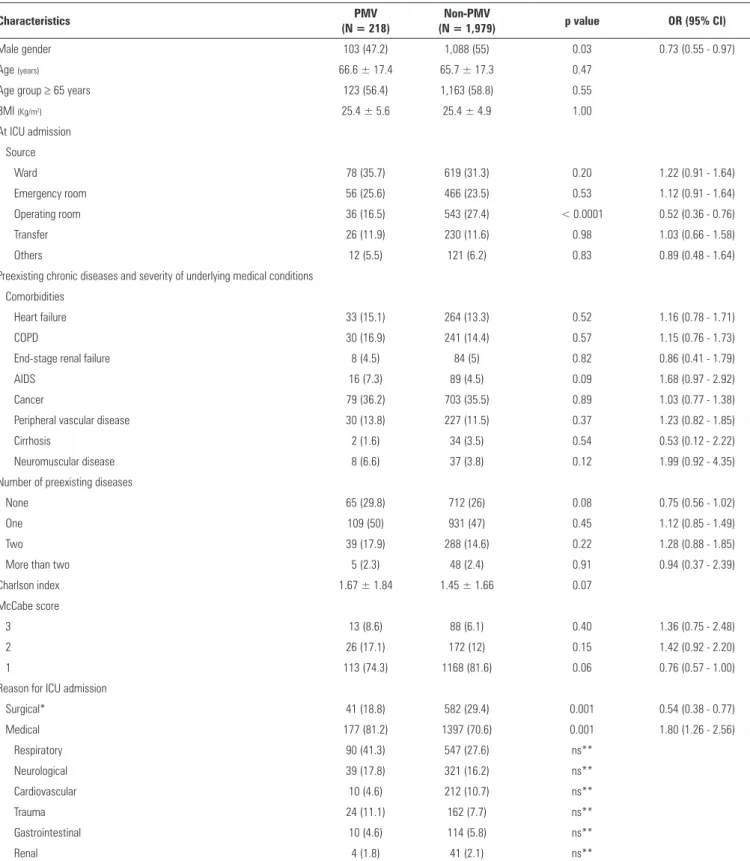
PMV patients were more likely to have ICU admissions for respiratory (41.3% versus 27.6%,
p < 0.001) and infection (61.4% versus 50.7%, p < 0.001) causes (Table 1) and more prolonged hospital LOS before ICU admission (13.7 ± 44.3 days versus 9.3 ± 21.6 days, p = 0.01) (Figure 1). No diferences were found in age, BMI, preexisting chronic diseases and severity of underlying medical conditions.
Comparison of PMV and non-PMV groups: during ICU stay and at ICU discharge
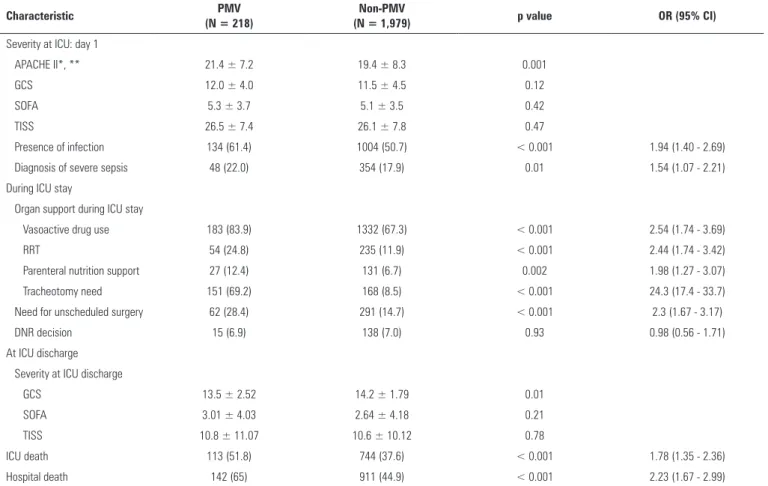
PMV patients had higher APACHE II scores with 24 hours of ICU admission. PMV patients were more likely to receive organ support (vasoactive therapy [83.9% versus 67.3%, p < 0.001], RRT [24.8% versus 11.9%, p < 0.001] and parenteral nutrition [12.4% versus 6.7%, p < 0.001]). hese patients underwent more unscheduled surgery (28.4 versus 14.7%, p < 0.001) and tracheotomy (69.2% versus 8.5%, p < 0.001) (Table 2).
Several complications developed during ICU stay, such as pressure ulcers (OR 9.18, 95% CI 6.64 - 12.7), muscle weakness (OR 6.99, 95% CI 4.94-9.82), infection (bacterial sepsis (OR 5.18, 95% CI 3.75 - 7.15), candidemia (OR 3.82, 95% CI 1.31 - 11.09) and pulmonary embolism (OR 3.71, 95% CI 1.43 - 9.63), and these complications were associated with a signiicantly higher risk of PMV (Table 3).
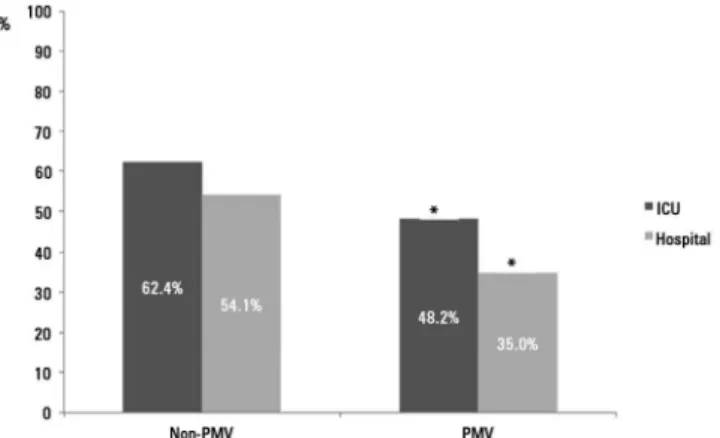
PMV patients spent more days in the ICU (42.7 ± 25.9 versus 11.2 ± 15.3, p < 0.001) and hospital after ICU discharge (26.9 ± 29.3 versus 10.3 ± 20.4, p < 0.001) than non-PMV patients (Figure 1). Prolonged MV patients had a signiicant increase in ICU mortality (absolute diference = 14.2%, 95% CI 1.78 (1.35 - 2.36), p < 0.001) and hospital mortality (absolute diference = 19.1%, 95% CI 2.23 (1.67 - 2.99), p < 0.001) (Table 2 and Figure 2).
Patterns of discharge from the ICU were worse in the PMV group, based on GCS evaluation (13.5 ±2.52 versus 14.2 ± 1.79, p = 0.01).
Table 1 - Characteristics of the study subjects at admission in the intensive care unit
Characteristics PMV
(N = 218)
Non-PMV
(N = 1,979) p value OR (95% CI)
Male gender 103 (47.2) 1,088 (55) 0.03 0.73 (0.55 - 0.97)
Age (years) 66.6 ± 17.4 65.7 ± 17.3 0.47
Age group ≥ 65 years 123 (56.4) 1,163 (58.8) 0.55
BMI (Kg/m2) 25.4 ± 5.6 25.4 ± 4.9 1.00
At ICU admission
Source
Ward 78 (35.7) 619 (31.3) 0.20 1.22 (0.91 - 1.64)
Emergency room 56 (25.6) 466 (23.5) 0.53 1.12 (0.91 - 1.64)
Operating room 36 (16.5) 543 (27.4) < 0.0001 0.52 (0.36 - 0.76)
Transfer 26 (11.9) 230 (11.6) 0.98 1.03 (0.66 - 1.58)
Others 12 (5.5) 121 (6.2) 0.83 0.89 (0.48 - 1.64)
Preexisting chronic diseases and severity of underlying medical conditions
Comorbidities
Heart failure 33 (15.1) 264 (13.3) 0.52 1.16 (0.78 - 1.71)
COPD 30 (16.9) 241 (14.4) 0.57 1.15 (0.76 - 1.73)
End-stage renal failure 8 (4.5) 84 (5) 0.82 0.86 (0.41 - 1.79)
AIDS 16 (7.3) 89 (4.5) 0.09 1.68 (0.97 - 2.92)
Cancer 79 (36.2) 703 (35.5) 0.89 1.03 (0.77 - 1.38)
Peripheral vascular disease 30 (13.8) 227 (11.5) 0.37 1.23 (0.82 - 1.85)
Cirrhosis 2 (1.6) 34 (3.5) 0.54 0.53 (0.12 - 2.22)
Neuromuscular disease 8 (6.6) 37 (3.8) 0.12 1.99 (0.92 - 4.35)
Number of preexisting diseases
None 65 (29.8) 712 (26) 0.08 0.75 (0.56 - 1.02)
One 109 (50) 931 (47) 0.45 1.12 (0.85 - 1.49)
Two 39 (17.9) 288 (14.6) 0.22 1.28 (0.88 - 1.85)
More than two 5 (2.3) 48 (2.4) 0.91 0.94 (0.37 - 2.39)
Charlson index 1.67 ± 1.84 1.45 ± 1.66 0.07
McCabe score
3 13 (8.6) 88 (6.1) 0.40 1.36 (0.75 - 2.48)
2 26 (17.1) 172 (12) 0.15 1.42 (0.92 - 2.20)
1 113 (74.3) 1168 (81.6) 0.06 0.76 (0.57 - 1.00)
Reason for ICU admission
Surgical* 41 (18.8) 582 (29.4) 0.001 0.54 (0.38 - 0.77)
Medical 177 (81.2) 1397 (70.6) 0.001 1.80 (1.26 - 2.56)
Respiratory 90 (41.3) 547 (27.6) ns**
Neurological 39 (17.8) 321 (16.2) ns**
Cardiovascular 10 (4.6) 212 (10.7) ns**
Trauma 24 (11.1) 162 (7.7) ns**
Gastrointestinal 10 (4.6) 114 (5.8) ns**
Renal 4 (1.8) 41 (2.1) ns**
Table 2 - Characteristics and main outcomes of the study patients during admission to the intensive care unit
Characteristic PMV
(N = 218)
Non-PMV
(N = 1,979) p value OR (95% CI)
Severity at ICU: day 1
APACHE II*, ** 21.4 ± 7.2 19.4 ± 8.3 0.001
GCS 12.0 ± 4.0 11.5 ± 4.5 0.12
SOFA 5.3 ± 3.7 5.1 ± 3.5 0.42
TISS 26.5 ± 7.4 26.1 ± 7.8 0.47
Presence of infection 134 (61.4) 1004 (50.7) < 0.001 1.94 (1.40 - 2.69)
Diagnosis of severe sepsis 48 (22.0) 354 (17.9) 0.01 1.54 (1.07 - 2.21)
During ICU stay
Organ support during ICU stay
Vasoactive drug use 183 (83.9) 1332 (67.3) < 0.001 2.54 (1.74 - 3.69)
RRT 54 (24.8) 235 (11.9) < 0.001 2.44 (1.74 - 3.42)
Parenteral nutrition support 27 (12.4) 131 (6.7) 0.002 1.98 (1.27 - 3.07)
Tracheotomy need 151 (69.2) 168 (8.5) < 0.001 24.3 (17.4 - 33.7)
Need for unscheduled surgery 62 (28.4) 291 (14.7) < 0.001 2.3 (1.67 - 3.17)
DNR decision 15 (6.9) 138 (7.0) 0.93 0.98 (0.56 - 1.71)
At ICU discharge
Severity at ICU discharge
GCS 13.5 ± 2.52 14.2 ± 1.79 0.01
SOFA 3.01 ± 4.03 2.64 ± 4.18 0.21
TISS 10.8 ± 11.07 10.6 ± 10.12 0.78
ICU death 113 (51.8) 744 (37.6) < 0.001 1.78 (1.35 - 2.36)
Hospital death 142 (65) 911 (44.9) < 0.001 2.23 (1.67 - 2.99)
PMV - prolonged mechanical ventilation; OR - odds ratio; 95% CI - 95% confidence interval; APACHE - Acute Physiology and Chronic Health Evaluation; GCS - Glasgow Coma Score; SOFA - Sepsis-related Organ Failure Assessment; TISS - Therapeutic Intervention Scoring System; ICU - intensive care unit; RRT - renal replacement therapy; DNR - do not resuscitate. Results are expressed as number (percentage) or mean ± standard deviation. Data obtained by univariate analysis; * only in patients without sedation; ** score applied and calculated in neurological and no neurological patients.
Table 3 - Complications during intensive care unit stay
Complications PMV
(N = 218)
Non-PMV
(N = 1979) p value OR (95% CI)
Myocardial infarction 5 (2.6) 41 (2.3) 0.97 1.1 (0.43 - 2.83)
Cerebrovascular disease 3 (2) 37 (2.6) 0.73 0.73 (0.22 - 2.39)
Pulmonary embolism 6 (5.4) 17 (1.5) 0.004 3.71 (1.43 - 9.63)
Muscle weakness 71 (37.6) 144 (7.9) < 0.001 6.99 (4.97 - 9.82)
ARDS 37 (17.1) 124 (6.3) < 0.001 3.07 (2.06 - 4.57)
Bacterial nosocomial sepsis 129 (68.3) 533 (29.3) < 0.001 5.18 (3.75 - 7.15)
Candidemia 5 (5.4) 12 (1.5) 0.008 3.82 (1.31 - 11.09)
Upper gastrointestinal bleeding 19 (10.1) 59 (3.2) < 0.001 3.33 (1.94 - 5.71)
Hyperactive delirium 27 (22.3) 147 (15) 0.03 1.62 (1.02 - 2.57)
Pressure ulcer 86 (39.4) 131 (6.6) < 0.001 9.18 (6.64 - 12.7)
DISCUSSION
his analysis of a large, multicenter and retrospective cohort of MV patients found that patients who required PMV (MV support ≥ 21 days) had higher risk for complications during ICU stays, higher death rates during ICU and hospital LOS, and higher illness costs.
Between 3 to 10% of patients who require MV for acute conditions develop chronic critical illness.(3,13-16)
Generalization of outcomes from published reports is complicated by variations in the study populations that are described as CCI, deinitions of outcomes of interest, and post-acute care practices that afect hospital use. A threshold period of MV, ranging from 2 to 30 days, was used to deine the majority of cohorts in longitudinal studies.(8,18,19) Martin et al.(7) evaluated
patients who required ≥ 10 days of MV. Combes et al.(20)
studied the outcome and health-related quality of life of patients who required ≥ 14 days of MV. Carson et al.(21)
and Cox et al.(22) evaluated the long-term prognosis of
patients who required ≥ 21 days of MV. A consensus conference established a formal deinition for PMV to limit the heterogeneity of these cohorts and improve the comparability of outcomes across diferent studies. PMV is deined as at least 21 consecutive days on a ventilator for more than 6 hours/day.(4) Our data demonstrated a
9.92% incidence of CCI using this criterion, and this incidence varied according to patient characteristics in each ICU study (ICU-1 = 8.8%; ICU-2 = 12%; ICU-3 = 9%; ICU-4 = 15%). However, other authors identiied chronically critically ill patients by elective placement of a tracheotomy to facilitate prolonged ventilation and weaning eforts.(14,22-25) Referral for tracheotomy relects
a clinician’s judgment that the patient will neither wean nor die in the immediate future, which provides a point of demarcation between acute and chronic critical illness that is clinically meaningful and practical.(26,27) Cox
et al.(22) revealed that these two suggested deinitions
for PMV, Diagnosis-Related Groups (DRGs) 541/542 (Medicare’s deinition: tracheotomy and MV ≥ 96 hours) and MV ≥ 21 days, select cohorts with similar baseline clinical characteristics and trends in survival, disposition and resource utilization. However, PMV deined by ventilation for ≥ 21 days can more speciically identify patients who are outliers in resource consumption among ventilated patients, which is why we analyzed patients based on this deinition.(3,4)
Figure 1 - Mean of length of stay in the intensive care unit, in the hospital before intensive care unit, and in the hospital post-intensive care unit stay of non-prolonged
mechanical ventilation and prolonged mechanical ventilation patients. d - days;
PMV - prolonged mechanical ventilation; ICU - intensive care unit. * p < 0.001 compared to non-PMV.
Figure 2 - Intensive care unit and hospitalization of non-prolonged mechanical
ventilation and prolonged mechanical ventilation patients. PMV - prolonged mechanical
ventilation; ICU - intensive care unit.* p < 0.001 compared to non-prolonged mechanical ventilation.
Physicians and scoring systems are inaccurate for the predicting of morbidity and mortality at the time of ICU admission.(28) However, it is important to identify patients
with a high risk of becoming chronic early enough to manage these patients. Preexisting chronic diseases and the severity of underlying medical conditions were not associated with CCI, age, BMI and the source of admitted patients in our study. Notably, the operating room as the source of admission seemed protective in our study. However, longer hospital stay before ICU admission and non-surgical admission (OR 1.8 (1.26 - 2.56), p < 0.001) were associated with the evolution to CCI. he admission of patients for nonsurgical reasons was identiied previously as a factor that is associated with the evolution to chronic critical illness.(3,23) Severity scores are
considered predictors of prolonged MV.(3,17,23,29) Our data
at admission are not consistent with this assumption. However, multi-organ involvement is also related with mortality. Recently, Carson et al.(21) developed the
ProVent score (need for a vasopressor and hemodialysis, presence of thrombocytopenia, and age ≥ 50 years), which showed good discriminatory power to predict mortality in PMV patients.
Regardless of PMV deinition, the main characteristics of this population are repeated episodes of shock and infection during ICU stays.(6) his
condition is associated with persistent inlammation, immunosuppression and catabolism syndrome or persistent inlammation and catabolism syndrome (PICS).(30) herefore, CCI cannot be viewed as a simple
extension of an acute critical illness, but rather as a complex syndrome that is characterized by metabolic, neuroendocrine, neuropsychiatric and immunological changes.(3,31) hese changes include profound
weakness attributed to myopathy, neuropathy, and alterations in body composition (loss of lean body mass, increased adiposity, and anasarca),(32) increased
vulnerability to infection, often with multi-resistant microbial organisms,(33,34) brain dysfunction (coma or
delirium),(35) neuroendocrine changes (loss of pulsatile
secretion of anterior pituitary hormones, which contributes to low target organ hormone levels and impaired anabolism)(36-38) and skin breakdown (pressure
ulcers).(39,40) Some of these conditions were evaluated
and conirmed in our study (Tables 2 and 3).
Some previous authors found higher mortality in
is likely related to the heterogeneity and intrinsic characteristics of the study populations. However, most studies show that CCI and PMV patients have worse disease courses and higher mortality. he ICU and hospital mortality in PMV patients was 14.2% and 19.1%, respectively, in our study, which was absolutely higher than non-PMV patients.
Critical ill survivors have an ongoing morbidity, and actual evidence suggests that quality of life after intensive care admission is generally poor compared to population data.(42-47) hese morbidities include
a high incidence of psychological problems,(47-50)
cognitive dysfunction,(51) impairments in pulmonary
function,(47,52,53) and development of neuromuscular
complications of critical illness,(54) which may be
long-lasting despite slow improvement over time. hese problems are more prevalent in chronic critical patients, and the need for PMV may also afect the patient’s prognosis for the ability to perform activities of daily living.(20) Some authors report that 5% to 20% of ICU
patients receive MV, and 25% of these patients require MV for more than seven days.(55) Nearly all patients
with CCI leave the hospital with profound impairments in physical function, cognitive status, or both. herefore, most of these patients require institutional care.(56,57) Hospital readmission rates during the year
after hospital discharge exceed 40% in these subjects. Patients who are discharged to extended care facilities and cannot be suiciently rehabilitated to return home within 6 months usually remain institutionalized until death.(3,56,57) Multiple studies demonstrated
that fewer than 12% of CCI patients were alive and independent one year after their acute illness.(58) he
prolonged need for ventilatory support reduces life quality and life expectancy in the long term.(20,58,59)
Functional limitations are common even in patients who recover suiciently to permit discharge from an inpatient facility, but these patients typically require paid care giving as outpatients, or family members must leave their jobs to provide ongoing care. Indeed, some patients may beneit from these eforts, but other patients may not.(24) In this scenario, the identiication
of the predictors of a poor prognosis might help doctors choose more aggressive treatments or treatments that prioritize comfort.(3,4,41)
MV, but these patients consume 20 to 40% of ICU bed-days and other critical care resources.(16,27) PMV
patients represented 10% of all ICU admissions and 71% of the total cost of all ICU admissions during our study period. Our results indicate that the PMV patients imposed a cost of more than three times non-PMV patients. he overall cost to the health care system for the management of CCI already exceeds an estimated $20 billion annually, and this number is expected to climb with increases in the incidence of this syndrome and overall expenditures for critical care. hese expenditures nearly doubled between 1985 and 2000 and represented 13% of all hospital costs in the United States.(2,60)
his study has a few limitations. his study was an observational study without long-term outcomes, such as evaluations of quality of life and cognitive impairment. his was a retrospective study, and it was not possible to describe and compare the diferent mechanical ventilation strategies (including ventilatory
mode and low/pressure adjustments) in patients who developed acute respiratory distress syndrome. All PMV patients were a group with more than 21 days on MV, whereas non-PMV patients were a heterogeneous group with variation in the total number of MV days until 20 MV days. However, the study provides an important contribution to CCI with a large patient sample that was obtained from various centers and the utilization of a uniform deinition.
CONCLUSION
Patients in our study with prolonged mechanical ventilation constituted a distinct group of patients, who were sicker on admission and exhibited higher mortality, longer hospital stays and higher costs. Patients in respiratory failure at admission who experience a period of pre-intensive care unit hospitalization longer than 12 days, are non-surgical and have sepsis exhibit a higher risk to become dependent on prolonged mechanical ventilation support.
Objetivo: Na última década ocorreu um aumento no número de pacientes que necessitam manutenção de ventilação mecânica prolongada, resultando no surgimento de uma grande população de pacientes crônicos criticamente enfermos. Este estudo estabeleceu a incidência de ventilação mecânica prolongada em quatro unidades de terapia intensiva e relatou as diferentes características, desfechos hospitalares e impacto nos custos e serviços de pacientes com ventilação mecânica prolongada (dependência de ventilação mecânica por 21 dias ou mais) em comparação a pacientes sem ventilação mecânica prolongada (dependência de ventilação mecânica inferior a 21 dias).
Métodos: Este foi um estudo multicêntrico de coorte que envolveu todos os pacientes admitidos em quatro unidades de terapia intensiva. As principais avaliações de desfechos incluíram o tempo de permanência na unidade de terapia intensiva e no hospital, a incidência de complicações durante a permanência na unidade de terapia intensiva, e a mortalidade na unidade de terapia intensiva e no hospital.
Resultados: Durante o período do estudo, ocorreram 5.287 admissões às unidades de terapia intensiva. Alguns desses pacientes (41,5%) necessitaram de suporte ventilatório (n = 2.197), e 218 dos pacientes (9,9%) cumpriram os critérios
de ventilação mecânica prolongada. Algumas complicações se desenvolveram durante a permanência na unidade de terapia intensiva como fraqueza muscular, úlceras de pressão, sepse nosocomial bacteriana, candidemia, embolia pulmonar,
e delirium hiperativo; estas se associaram com um risco
signiicantemente maior de ventilação mecânica prolongada. Os pacientes de ventilação mecânica prolongada tiveram um aumento signiicante da mortalidade na unidade de terapia intensiva (diferença absoluta = 14,2%; p < 0,001) e da mortalidade hospitalar (diferença absoluta = 19,1%; p < 0,001). O grupo com ventilação mecânica prolongada permaneceu mais dias no hospital após receber alta da unidade de terapia intensiva (26,9 ± 29,3 versus 10,3 ± 20,4 dias; p < 0,001) e acarretou custos mais elevados.
Conclusões: A classiicação de pacientes crônicos criticamente enfermos segundo a deinição de ventilação mecânica prolongada adotada em nosso estudo (dependência de ventilação mecânica por período igual ou superior a 21 dias) identiicou pacientes com risco elevado de complicações durante a permanência na unidade de terapia intensiva, permanência mais longa na unidade de terapia intensiva e no hospital, taxas de mortalidade maiores e custos mais elevados.
RESUMO
REFERENCES
1. Girard K, Raffin TA. The chronically critically ill: to save or let die? Respir Care. 1985;30(5):339-47.
2. Halpern NA, Pastores SM, Greenstein RJ. Critical care medicine in the United States 1985-2000: an analysis of bed numbers, use, and costs. Crit Care Med. 2004;32(6):1254-9.
3. Nelson JE, Cox CE, Hope AA, Carson SS. Chronic critical illness. Am J Respir Crit Care Med. 2010;182(4):446-54.
4. MacIntyre NR, Epstein SK, Carson S, Scheinhorm D, Christopher K, Muldoon S; National Association for Medical Direction of Respiratory Care. Management of patients requiring prolonged mechanical ventilation: report of a NAMDRC consensus conference. Chest. 2005;128(6):3937-54. 5. Zilberberg MD, de Wit M, Pirone JR, Shorr AF. Growth in adult prolonged
acute mechanical ventilation: implications for healthcare delivery. Crit Care Med. 2008;36(5):1451-5.
6. Estenssoro E, Reina R, Canales HS, Saenz MG, Gonzalez FE, Aprea MM, et al. The distinct clinical profile of chronically critically ill patients: a cohort study. Crit Care. 2006;10(3):R89.
7. Martin CM, Hill AD, Burns K, Chen LM. Characteristics and outcomes for critically ill patients with prolonged intensive care unit stays. Crit Care Med. 2005;33(9):1922-7; quiz 1936.
8. Daly BJ, Douglas SL, Kelley CG, O’Toole E, Montenegro H. Trial of a disease management program to reduce hospital readmissions of the chronically critically ill. Chest. 2005;128(2):507-17.
9. Robson V, Poynter J, Lawler PG, Baudouin SV. The need for a regional weaning centre, a one-year survey of intensive care weaning delay in the Northern Region of England. Anaesthesia. 2003;58(2):161-5.
10. Zilberberg MD, Luippold RS, Sulsky S, Shorr AF. Prolonged acute mechanical ventilation, hospital resource utilization, and mortality in the United States. Crit Care Med. 2008;36(3):724-30.
11. Kahn JM, Benson NM, Appleby D, Carson SS, Iwashyna TJ. Long-term acute care hospital utilization after critical illness. JAMA. 2010;303(22):2253-9. 12. Mauri T, Pivi S, Bigatello LM. Prolonged mechanical ventilation after critical
illness. Minerva Anestesiol. 2008;74(6):297-301.
13. Gracey DR, Viggiano RW, Naessens JM, Hubmayr RD, Silverstein MD, Koenig GE. Outcomes of patients admitted to a chronic ventilator-dependent unit in an acute-care hospital. Mayo Clin Proc. 1992;67(2):131-6.
14. Engoren M, Arslanian-Engoren C, Fenn-Buderer N. Hospital and long-term outcome after tracheostomy for respiratory failure. Chest. 2004;125(1):220-7. 15. Seneff MG, Zimmerman JE, Knaus WA, Wagner DP, Draper EA. Predicting
the duration of mechanical ventilation. The importance of disease and patient characteristics. Chest. 1996;110(2):469-79.
16. Wagner DP. Economics of prolonged mechanical ventilation. Am Rev Respir Dis. 1989;140(2 Pt 2):S14-8.
17. Loss SH, Marchese CB, Boniatti MM, Wawrzeniak IC, Oliveira RP, Nunes LN, et al. Prediction of chronic critical illness in a general intensive care unit. Rev Assoc Med Bras. 2013;59(3):241-7.
18. Chelluri L, Im KA, Belle SH, Schulz R, Rotondi AJ, Donahoe MP, et al. Long-term mortality and quality of life after prolonged mechanical ventilation. Crit Care Med. 2004;32(1):61-9.
19. Gracey DR, Naessens JM, Krishan I, Marsh HM. Hospital and posthospital survival in patients mechanically ventilated for more than 29 days. Chest. 1992;101(1):211-4.
20. Combes A, Costa MA, Trouillet JL, Baudot J, Mokhtari M, Gibert C, et al. Morbidity, mortality, and quality-of-life outcomes of patients requiring >or=14 days of mechanical ventilation. Crit Care Med. 2003;31(5):1373-81. 21. Carson SS, Garret J, Hanson LC, Lanier J, Govert J, Brake MC, et al. A
prognostic model for one-year mortality in patients requiring prolonged mechanical ventilation. Crit Care Med. 2008;36(7):2061-9.
22. Cox CE, Carson SS, Lindquist JH, Olsen MK, Govert JA, Chelluri L; Quality of Life After Mechanical Ventilation in the Aged (QOL-MV) Investigators.
23. Boniatti MM, Friedman G, Castilho RK, Vieira SR, Fialkow L. Characteristics of chronically critically ill patients: comparing two definitions. Clinics (Sao Paulo). 2011;66(4):701-4.
24. Carson SS, Bach PB, Brzozowski L, Leff A. Outcomes after long-term acute care. An analysis of 133 mechanically ventilated patients. Am J Respir Crit Care Med. 1999;159(5 Pt 1):1568-73.
25. Engoren M, Arslanian-Engoren C. Hospital and long-term outcome of trauma patients with tracheostomy for respiratory failure. Am Surg. 2005;71(2):123-7.
26. Kahn JM, Carson SS, Angus DC, Linde-Zwirble WT, Iwashyna TJ. Development and validation of an algorithm for identifying prolonged mechanical ventilation in administrative data. Health Serv Outcomes Res Method. 2009;9:117-32.
27. Cox CE, Carson SS, Holmes GM, Howard A, Carey TS. Increase in tracheostomy for prolonged mechanical ventilation in North Carolina, 1993-2002. Crit Care Med. 2004;32(11):2219-26.
28. Sinuff T, Adhikari NK, Cook DJ, Schünemann HJ, Griffith LE, Rocker G, et al. Mortality predictions in the intensive care unit: comparing physicians with scoring systems. Crit Care Med. 2006;34(3):878-85.
29. Honarmand A, Safavi M, Moradi D. The use of infection probability score and sequential organ failure assessment scoring systems in predicting mechanical ventilation requirement and duration. Ulus Travma Acil Cerrahi Derg. 2009;15(5):440-7.
30. Gentile LF, Cuenca AG, Efron PA, Ang D, Bihorac A, McKinley BA, et al. Persistent inflammation and immunosuppression: a common syndrome and new horizon for surgical intensive care. J Trauma Acute Care Surg. 2012;72(6):1491-501.
31. Nierman DM. A structure of care for the chronically critically ill. Crit Care Clin. 2002;18(3):477-91, v.
32. Hollander JM, Mechanick JI. Nutrition support and the chronic critical illness syndrome. Nutr Clin Pract. 2006;21(6):587-604.
33. Kalb TH, Lorin S. Infection in the chronically critically ill: unique risk profile in a newly defined population. Crit Care Clin. 2002;18(3):529-52. 34. Scheinhorn DJ, Hassenpflug MS, Votto JJ, Chao DC, Epstein SK, Doig
GS, Knight EB, Petrak RA; Ventilation Outcomes Study Group. Post-ICU mechanical ventilation at 23 long-term care hospitals: a multicenter outcomes study. Chest. 2007;131(1):85-93.
35. Nelson JE, Tandon N, Mercado AF, Camhi SL, Ely EW, Morrison RS. Brain Dysfunction: another burden for the chronically critically ill. Arch Intern Med. 2006;166(18):1993-9.
36. Van den Berghe G, de Zegher F, Veldhuis JD, Wouters P, Awouters M, Verbruggen W, et al. The somatotropic axis in critical illness: effect of continuous growth hormone (GH)-releasing hormone and GH-releasing peptide-2 infusion. J Clin Endocrinol Metab. 1997;82(2):590-9.
37. Van den Berghe G, de Zegher F, Veldhuis JD, Wouters P, Gouwy S, Stockman W, et al. Thyrotrophin and prolactin release in prolonged critical illness: dynamics of spontaneous secretion and effects of growth hormone-secretagogues. Clin Endocrinol (Oxf). 1997;47(5):599-612. 38. Van den Berghe G. Growth hormone secretagogues in critical illness. Horm
Res. 1999;51 Suppl 3:21-8. Review.
39. Carasa M, Polycarpe M. Caring for the chronically critically ill patient: establishing a wound- healing program in a respiratory care unit. Am J Surg. 2004;188(1A Suppl):18-21.
40. Brem H, Nierman DM, Nelson JE. Pressure ulcers in the chronically critically ill patient. Crit Care Clin. 2002;18(3):683-94.
41. Heyland DK, Konopad E, Noseworthy TW, Johnston R, Gafni A. Is it ‘worthwhile’ to continue treating patients with a prolonged stay (>14 days) in the ICU? An economic evaluation. Chest. 1998;114(1):192-8. 42. Desai SV, Law TJ, Needham DM. Long-term complications of critical care.
Crit Care Med. 2011;39(2):371-9.
44. Cuthbertson BH, Hull A, Strachan M, Scott J. Post-traumatic stress disorder after critical illness requiring general intensive care. Intensive Care Med. 2004;30(3):450-5.
45. Cuthbertson BH, Roughton S, Jenkinson D, Maclennan G, Vale L. Quality of life in the five years after intensive care: a cohort study. Crit Care. 2010;14(1):R6.
46. Oeyen SG, Vandijck DM, Benoit DD, Annemans L, Decruyenaere JM. Quality of life after intensive care: a systematic review of the literature. Crit Care Med. 2010;38(12):2386-400.
47. Dowdy DW, Eid MP, Sedrakyan A, Mendez-Tellez PA, Pronovost PJ, Herridge MS, et al. Quality of life in adult survivors of critical illness: a systematic review of the literature. Intensive Care Med. 2005;31(5):611-20.
48. Azoulay E, Pochard F, Kentish-Barnes N, Chevret S, Aboab J, Adrie C, Annane D, Bleichner G, Bollaert PE, Darmon M, Fassier T, Galliot R, Garrouste-Orgeas M, Goulenok C, Goldgran-Toledano D, Hayon J, Jourdain M, Kaidomar M, Laplace C, Larché J, Liotier J, Papazian L, Poisson C, Reignier J, Saidi F, Schlemmer B; FAMIREA Study Group. Risk of post-traumatic stress symptoms in family members of intensive care unit patients. Am J Respir Crit Care Med. 2005;171(9):987-94.
49. Flaatten H. Mental and physical disorders after ICU discharge. Curr Opin Crit Care. 2010;16(5):510-5.
50. de Miranda S, Pochard F, Chaize M, Megarbane B, Cuvelier A, Bele N, et al. Postintensive care unit psychological burden in patients with chronic obstructive pulmonary disease and informal caregivers: A multicenter study. Crit Care Med. 2011;39(1):112-8.
51. Hopkins RO, Jackson JC. Long-term neurocognitive function after critical illness. Chest. 2006;130(3):869-78. Review.
52. Quinnell TG, Pilsworth S, Shneerson JM, Smith IE. Prolonged invasive ventilation following acute ventilatory failure in COPD: weaning results, survival, and the role of noninvasive ventilation. Chest. 2006;129(1):133-9. 53. Herridge MS, Cheung AM, Tansey CM, Matte-Martyn A, Diaz-Granados
N, Al-Saidi F, Cooper AB, Guest CB, Mazer CD, Mehta S, Stewart TE, Barr A, Cook D, Slutsky AS; Canadian Critical Care Trials Group. One-year outcomes in survivors of the acute respiratory distress syndrome. N Engl J Med. 2003;348(8):683-93.
54. Hough CL. Neuromuscular sequelae in survivors of acute lung injury. Clin Chest Med. 2006;27(4):691-703; abstract x.
55. Esteban A, Anzueto A, Frutos F, Alía I, Brochard L, Stewart TE, Benito S, Epstein SK, Apezteguía C, Nightingale P, Arroliga AC, Tobin MJ; MechanicalVentilation International Study Group. Characteristics and outcomes in adult patients receiving mechanical ventilation: a 28-day international study. JAMA. 2002;287(3):345-55.
56. Rimachi R, Vincent JL, Brimioulle S. Survival and quality of life after prolonged intensive care unit stay. Anaesth Intensive Care. 2007;35(1):62-7. 57. Euteneuer S, Windisch W, Suchi S, Köhler D, Jones PW, Schönhofer B.
Health-related quality of life in patients with chronic respiratory failure after long-term mechanical ventilation. Respir Med. 2006;100(3):477-86. 58. Lipsett PA, Swoboda SM, Dickerson J, Ylitalo M, Gordon T, Breslow M,
et al. Survival and functional outcome after prolonged intensive care unit stay. Ann Surg. 2000;231(2):262-8.
59. Tonnelier A, Tonnelier JM, Nowak E, Gut-Gobert C, Prat G, Renault A, et al. Clinical relevance of classification according to weaning difficulty. Respir Care. 2011;56(5):583-90.