Prevalence of burnout syndrome in intensivist
doctors in ive Brazilian capitals
INTRODUCTION
Daily work in intensive care settings requires the intensivist to develop skills that allow him/her to manage demands inherent to two poles of performance (the technical/scientiic and the relational). he former, which is more objective, imposes continuous scientiic updating to obtain advanced knowledge in this area, whereas the latter, which is more subjective, demands the development of sensitivity, which should allow the individuals to recognize the needs of the human beings who are the subject/object of their work. Tironi et al.(1) conducted a study with intensivists that demonstrated a high prevalence of burnout syndrome among these professionals and demonstrated that in Márcia Oliveira Staffa Tironi1, José Mário
Meira Teles2, Dalton de Souza Barros3, Débora Feijó Villas Bôas Vieira4, Colbert Martins da Silva Filho5, Davi Felix Martins Júnior5, Marcos Almeida Matos1, Carlito Lopes Nascimento Sobrinho5
1. Escola Bahiana de Medicina e Saúde Pública - Salvador (BA), Brazil.
2. Instituto de Gestão em Saúde, Hospital de Urgências de Goiânia - Goiânia (GO), Brazil. 3. Hospital das Clínicas, Faculdade de Medicina, Universidade São Paulo - São Paulo (SP), Brazil. 4. Universidade Federal do Rio Grande do Sul - Porto Alegre (RS), Brazil.
5. Universidade Estadual de Feira de Santana - Feira de Santana (BA), Brazil.
Objective: To estimate the prevalence of burnout in intensivist doctors working in adult, pediatric and neonatal intensive care units in ive Brazilian capitals.
Methods: Descriptive epidemiological study with a random sample stratiied by conglomerate with 180 intensivist doctors from ive capitals representing the Brazilian geographic regions: Porto Alegre (RS), Sao Paulo (SP), Salvador (BA), Goiania (GO) and Belem (PA). A self-administered questionnaire examining sociodemographic data and the level of burnout was evaluated through the Maslach Burnout Inventory.
Results: A total of 180 doctors were evaluated, of which 54.4% were female. he average age was 39 ± 8.1 years, 63.4% had specialization as the highest degree, 55.7% had up to 10 years of work experience in an intensive care unit, and 46.1% had the title intensive
Conflicts of interest: None.
Submitted on March 24, 2016 Accepted on May 28, 2016
Corresponding author: Márcia Oliveira Staffa Tironi
Escola Bahiana de Medicina e Saúde Pública Avenida Dom João VI, 275 - Brotas Zip code: 40.290-000 - Salvador (BA), Brazil E-mail: [email protected]
Responsible editor: Jorge Ibrain de Figueira Salluh
Prevalência de síndrome de burnout em médicos intensivistas de
cinco capitais brasileiras
ABSTRACT
Keywords: Burnout, professional/ epidemiology; Working conditions; Physicians/psychology; Occupational diseases/epidemiology; Prevalence; Intensive care units; Intensive care units, pediatric; Intensive care, neonatal care specialist. Most (50.3%) had weekly workloads between 49 and 72 hours, and the most frequent employee type was salaried. High levels of emotional exhaustion, depersonalization and ineicacy were found (50.6%, 26.1% and 15.0%, respectively). he prevalence of burnout was 61.7% when considering a high level in at least one dimension and 5% with a high level in three dimensions simultaneously.
Conclusion: A high prevalence of burnout syndrome among intensivist doctors was observed. Strategies for the promotion and protection of health in these workers must be discussed and implemented in hospitals.
addition to improving the quality of care provided, the balance between the two poles can be a factor associated with health protection in these workers.
Burnout is a psychological syndrome involving professional exhaustion that arises from chronic emotional overload in work that involves interpersonal relationships with great responsibility. Burnout presents three interdependent dimensions: emotional exhaustion, depersonalization and ineicacy.(2-6) Exhaustion represents the individual component, with feelings that an individual is required to perform beyond his/her resources. Depersonalization refers to the interpersonal component and, at high levels, can give an initial impression of defensiveness and protection with a risk of chronic detachment. Ineicacy is the self-assessment component and is typically accompanied by feelings of incompetence and low productivity.(3,7)
Burnout is related to the provision of services. Vulnerability to its development increases when this interaction involves a signiicant load of responsibility, protection and care for another, which occurs in intensivist work.(2,7) It is also important to recognize that burnout must be understood as a process with a close relationship with the context in which this service is provided, which
helps to shape this phenomenon. Many authors(3-5)
highlight that workers sufer more due to issues linked to the context of work than individual characteristics.
Considering the importance of intensivists for the care of gravely sick people and the possibility that the repercussions of burnout can lead to an inability to work, which can compromise patient care, the early identiication of this syndrome can assist with interventions (individual and/or organizational) for the prevention of these situations.(7,8) Some Brazilian(1,9) and international(10-14) studies have made eforts to better understand the issue. However, the majority of these studies did not address the full complexity of the work in the intensive care unit (ICU). Issues with the sample size, considering a single hospital/city, or even studying only a single ICU type (adult, neonatal or pediatric) resulted in these studies leaving a gap in the knowledge on this topic. Without the pretense of fully covering the topic but with the purpose of contributing signiicantly, our study aims to estimate the prevalence of burnout in intensivist doctors who work in adult, pediatric and neonatal intensive care units in ive capitals representative of the Brazilian geographic regions with a substantial sample of these professionals.
METHODS
A descriptive epidemiological study was performed with doctors working in ICUs who agreed to participate in the study. he sample was random and stratiied by conglomerate through a lottery of 60 ICUs registered with the Associação de Medicina Intensiva Brasileira (AMIB) in ive capitals representative of the Brazilian geographic regions (six in Belem (PA) in the northern region, six in Goiania (GO) in the central-west region, 10 in Porto Alegre (RS) in the southern region, 12 in Salvador (BA) in the northeastern region, and 26 in Sao Paulo (SP) in the southeastern region). Ten doctors were randomly selected from every ICU that agreed to collaborate with the study, for a total of 600 workers. he study was
approved by the Ethics Committee at the Universidade
Estadual de Feira de Santana (CEP-UEFS) by Protocol CAAE-21500313.4.0000.0053. he data collection was performed from December 2013 to August 2014. All those who participated in the survey signed informed consent statements.
For data collection, we used a self-administered questionnaire that was anonymous and composed of nine blocks of questions as follows: general identiication; general information about the work; psychosocial characteristics of the work; burnout syndrome; quality of life; ability to work; aspects related to health; life habits; and occupational stress factors in the ICU. he questionnaire and informed consent statements were forwarded to workers through the coordinators of the ICU accompanied by a letter of presentation and an explanation of the study. he questionnaires were returned directly to the AMIB in sealed envelopes through correspondence with postage paid to ensure secrecy and conidentiality.
he collected data were organized from criteria established by the instruments used, and the results are presented in tables. he Maslach Burnout Inventory (MBI) was used to identify burnout. he MBI comprises 22 statements concerning feelings and attitudes that compose its dimensions through three 7-point scales (zero to 6) that independently describe each of the dimensions. Emotional exhaustion is evaluated by nine items, depersonalization by ive and ineicacy by eight. he cutof points referenced by the author of the scale were used.(15)
indicate a high level, 7 to 12 indicate a moderate level, and less than 6 indicate a low level. he ineiciency scores trend in the opposite direction, with scores of zero to 31 indicating a high level, 32 to 38 a moderate level and ≥ 39 a low level.(15)
Because there is no consensus in the literature for the interpretation of the MBI scale, the results are described according to the signalized criteria of Tucanduva et al.(16) by the presence of three dimensions at a high level or at least one dimension at a high level.
With respect to stress factors in the ICU, 14 factors were presented. he questionnaire requested that the doctor assess the intensity with which the factor stressed him or her on a scale of zero to 3. he answers zero and 1 were grouped as factors that caused no or very little stress, whereas responses between 2 and 3 indicated factors that caused moderate or great stress.
Two databases were constructed using the EpiData program to avoid possible data entry errors. After this step, the data were exported to the Statistical Package for Social Science (SPSS) program. Descriptive analysis of the data was performed based on the calculation of absolute and relative frequencies of categorical variables and means and standard deviations of numeric variables.
RESULTS
One hundred and eighty intensivists participated in the study (24 from Belem, 18 from Goiania, 28 from Porto Alegre, 65 from Salvador and 45 from Sao Paulo). Of these, 127 (70.6%) worked in an adult ICU, 22 (12.2%) in a pediatric ICU and 31 (17.2%) in a neonatal ICU. his amount represented only 30% of the initially eligible doctors. he losses were caused by the diiculty of accessing the doctors, non-acceptance by the administration at many hospitals, whose ICU were randomly selected to collaborate with the study, direct refusal by the doctors, or inaccuracy in the list of doctors who worked in the ICU. herefore, the planned random sample became a convenience sample.
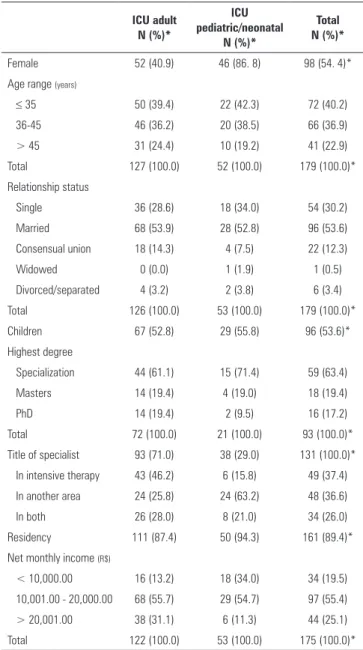
Among the intensivists studied, 54.4% were female. his percentage increased when considering the intensivists working in pediatrics or neonatology (86.8%) and decreased for intensivists working with adults (40.9%). he majority (40.2%) were at least 35 years of age, with an average age of 39 ± 8.1 years. Regarding marital situation, 53.6% were married, 30.2% were single, and 53.6% had children. Regarding the highest degree, the majority (63.4%) had specialization, followed by a
Table 1 - Personal characteristics
ICU adult N (%)*
ICU pediatric/neonatal
N (%)*
Total N (%)*
Female 52 (40.9) 46 (86. 8) 98 (54. 4)*
Age range (years)
≤ 35 50 (39.4) 22 (42.3) 72 (40.2)
36-45 46 (36.2) 20 (38.5) 66 (36.9)
> 45 31 (24.4) 10 (19.2) 41 (22.9)
Total 127 (100.0) 52 (100.0) 179 (100.0)*
Relationship status
Single 36 (28.6) 18 (34.0) 54 (30.2)
Married 68 (53.9) 28 (52.8) 96 (53.6)
Consensual union 18 (14.3) 4 (7.5) 22 (12.3)
Widowed 0 (0.0) 1 (1.9) 1 (0.5)
Divorced/separated 4 (3.2) 2 (3.8) 6 (3.4)
Total 126 (100.0) 53 (100.0) 179 (100.0)*
Children 67 (52.8) 29 (55.8) 96 (53.6)*
Highest degree
Specialization 44 (61.1) 15 (71.4) 59 (63.4)
Masters 14 (19.4) 4 (19.0) 18 (19.4)
PhD 14 (19.4) 2 (9.5) 16 (17.2)
Total 72 (100.0) 21 (100.0) 93 (100.0)*
Title of specialist 93 (71.0) 38 (29.0) 131 (100.0)*
In intensive therapy 43 (46.2) 6 (15.8) 49 (37.4)
In another area 24 (25.8) 24 (63.2) 48 (36.6)
In both 26 (28.0) 8 (21.0) 34 (26.0)
Residency 111 (87.4) 50 (94.3) 161 (89.4)*
Net monthly income (R$)
< 10,000.00 16 (13.2) 18 (34.0) 34 (19.5)
10,001.00 - 20,000.00 68 (55.7) 29 (54.7) 97 (55.4)
> 20,001.00 38 (31.1) 6 (11.3) 44 (25.1)
Total 122 (100.0) 53 (100.0) 175 (100.0)*
ICU - intensive care unit. * Valid responses.
Masters (19.4%) and a PhD (17.2%). he title of intensive care specialist was held by 46.1% of the intensivists, and 89.4% were residents (Table 1). his percentage increased when considering the doctors who attended adult patients (54.3%) and decreased when considering pediatricians and neonatologists (32.0%). Regarding net monthly income, most (55.4%) had incomes in the range of R$ 10,001.00 to R$ 20,000.00, but it should be stressed that 31.1% of the doctors who attended adults received more than R$ 20,001.00.
Table 2 - Functional characteristics
ICU adult N (%)*
ICU pediatric/neonatal
N (%)*
Total N (%)*
Time working in ICU (years)
0 - 5 27 (21.6) 18 (35.3) 45 (25.6)
6 - 10 40 (32.0) 13 (25.5) 53 (30.1)
11 - 15 21 (16.8) 7 (13.7) 28 (15.9)
> 16 37 (29.6) 13 (25.5) 50 (28.4)
Total 125 (100.0) 51 (100.0) 176 (100.0)*
Hourly workload in ICU
< 24 44 (36.7) 24 (47.1) 68 (39.8)
25 - 40 24 (20.0) 11 (21.6) 35 (20.4)
41 - 60 38 (31.7) 8 (15.7) 46 (26.9)
> 61 14 (11.7) 8 (15.7) 22 (12.9)
Total 120 (100.0) 51 (100.0) 171 (100.0)*
Load weekly total hourly work
≤ 48 30 (24.2) 21 (39.6) 51 (28.8)
49 - 72 64 (51.6) 25 (47.2) 89 (50.3)
≥ 73 30 (24.2) 7 (13.2) 37 (20.9)
Total 124 (100.0) 53 (100.0) 177 (100.0)*
Institutional employment
Partner 8 (4.4) 4 (5.3) 12 (4.7)
Legal person 39 (21.4) 14 (18.6) 53 (20.6)
Salaried private 62 (34.1) 32 (42.7) 94 (36.6)
Contract temporary private 5 (2.8) 2 (2.7) 7 (2.7)
Cooperative 2 (1.1) 0 (0.0) 2 (0.8)
Salaried public 49 (26.9) 17 (22.7) 66 (25.7)
Contract temporary public 4 (2.2) 4 (5.3) 8 (3.1)
Service provider 13 (7.1) 2 (2.7) 15 (5.8)
Total 182 (100.0) 75 (100.0) 257 (100.0)*
ICU - intensive care unit. * Valid responses.
Regarding the hourly workload in the ICU, most (39.8%) worked less than or up to 24 hours a week, although many reported working in the range of 25 to 40 hours (20.4%) and 41 to 60 hours (26.9%).
Most doctors (50.3%) had a total weekly workload in the range of 49 to 72 hours, but 24.2% of those who attended adult patients worked more than 73 hours a week. he most frequent type of employment was salaried private sector employee (36.6%), followed by salaried public sector employee (25.7%) and legal person (20.6%) (Table 2).
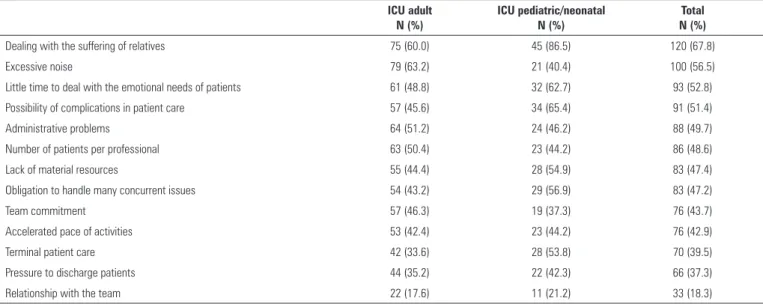
he factors that most stressed professionals are presented as simple frequencies in table 3, organized from most stressful to least stressful. Some of the most frequent factors were related to the direct relationship with users of the services of doctors, with special emphasis on dealing
with the sufering of relatives (67.8%), little time to deal with the emotional needs of patients (52.8%), the possibility of complications in patient care (51.4%), and the amount of patients per professional (48.6%). Others reported stressors concerning the structure and the functioning of the ICU, such as excessive noise (56.5%), administrative problems (49.7%), a lack of material resources (47.4%), and an obligation to deal with issues simultaneously (47.2%). Next were the factors that called attention to the work in interdependence with other professionals, such as the commitment of the team (43.7%). One of the factors not considered stressful by the doctors studied was dealing with sufering and death.
Regarding burnout, there was a prevalence of high scores in at least one of the three dimensions of the MBI for 56.6% for the doctors who attended children/newborns and 63.8% of the doctors who worked in adult ICUs. Of the three dimensions, high scores were observed in 7.1% of the doctors who worked in the adult ICUs and who were not identiied as pediatricians/neonatologists. When we analyzed each of the three dimensions separately, high scores were present in 50.6% for emotional exhaustion, 26.1% for depersonalization and 15.0% for ineicacy (Table 4). Of the doctors who presented a high score in only one dimension, 27.8% (50) had a high level only in emotional exhaustion, 5.0% (9) only in depersonalization, and 3.9% (7) only in ineicacy.
DISCUSSION
he results of this study present an intensivist medical proile that is mostly young, female, married, with children, with up to 10 years of work experience in the ICU, a high weekly workload, and a monthly income of up to R$ 20,000.00. he most common employment type was salaried (private/public). Most doctors had a medical residency and specialization as the highest degree. Less than half of the doctors held the title of intensive care specialist. his proile changes a little when considering doctors who worked in the adult ICUs, who were male and mostly held the title of intensive care specialist.
Table 3 - Occupational stress factors in the intensive therapy unit
ICU adult N (%)
ICU pediatric/neonatal N (%)
Total N (%)
Dealing with the suffering of relatives 75 (60.0) 45 (86.5) 120 (67.8)
Excessive noise 79 (63.2) 21 (40.4) 100 (56.5)
Little time to deal with the emotional needs of patients 61 (48.8) 32 (62.7) 93 (52.8)
Possibility of complications in patient care 57 (45.6) 34 (65.4) 91 (51.4)
Administrative problems 64 (51.2) 24 (46.2) 88 (49.7)
Number of patients per professional 63 (50.4) 23 (44.2) 86 (48.6)
Lack of material resources 55 (44.4) 28 (54.9) 83 (47.4)
Obligation to handle many concurrent issues 54 (43.2) 29 (56.9) 83 (47.2)
Team commitment 57 (46.3) 19 (37.3) 76 (43.7)
Accelerated pace of activities 53 (42.4) 23 (44.2) 76 (42.9)
Terminal patient care 42 (33.6) 28 (53.8) 70 (39.5)
Pressure to discharge patients 44 (35.2) 22 (42.3) 66 (37.3)
Relationship with the team 22 (17.6) 11 (21.2) 33 (18.3)
ICU - intensive care unit.
Table 4 - Occurrence of burnout syndrome in the three dimensions
ICU adult N (%)
ICU pediatric/neonatal N (%)
Total N (%)
Emotional exhaustion
Low 27 (21.3) 8 (15.1) 35 (19.4)
Moderate 34 (26.8) 20 (37.7) 54 (30.0)
High 66 (51.9) 25 (47.2) 91 (50.6)
Depersonalization
Low 64 (50.4) 36 (67.9) 100 (55.6)
Moderate 24 (18.9) 9 (17.0) 33 (18.3)
High 39 (30.7) 8 (15.1) 47 (26.1)
Inefficacy
Low 70 (55.1) 34 (64.2) 104 (57.8)
Moderate 33 (26.0) 16 (30.1) 49 (27.2)
High 24 (18.9) 3 (5.7) 27 (15.0)
High level in burnout dimensions
In any dimension 46 (36.2) 23 (43.4) 69 (38.3)
In one dimension 42 (33.1) 24 (45.3) 66 (36.7)
Emotional exhaustion 30 (23.7) 20 (37.7) 50 (27.8)
Depersonalization 6 (4.7) 3 (5.7) 9 (5.0)
Inefficacy 6 (4.7) 1 (1.9) 7 (3.9)
In two dimensions 30 (23.6) 6 (11.3) 36 (20.0)
Emotional exhaustion + depersonalization 21 (16.5) 4 (7.5) 25 (13.9)
Emotional exhaustion + inefficacy 6 (4.7) 1 (1.9) 7 (3.9)
Depersonalization + inefficacy 3 (2.4) 1 (1.9) 4 (2.2)
In three dimensions 9 (7.1) 0 (0.0) 9 (5.0)
Total 127 (100.0) 53 (100.0) 180 (100.0)
considered a reaction to the demands of the work; in this case, this exhaustion can be translated as both physical and emotional overload. Depersonalization was the second most afected dimension, followed by ineicacy. When we analyzed the occurrence of high levels in two dimensions simultaneously, the combination between emotional exhaustion and depersonalization was emphasized, which in this case had a prevalence of 13.9%.
hree of the four stressors referred to by more than half of the intensivist doctors were related to the relationship with users of these professional services (dealing with sufering of the family, little time to deal with the emotional needs of patients, and the possibility of complications in patient care).
he proile of the professionals analyzed in the present sample was similar to some previous studies. When considering all doctors, this study was similar to more recent studies,(9,12,17-19) that found a predominance of women (between 55 and 76%). However, our results difered from Embriaco et al.(10) and Tironi et al.,(1) who found that only 28% of the doctors were women. hese data are explained by separating the doctors by ICU type because the latter two studies did not include pediatric and neonatal ICU, which had a greater percentage of women. Even so, there was an increase in the number of women in the adult ICU, which could indicate an ongoing change in the proile due to the inclusion of women in several medical specialties.(20)
Regarding age, marital status and children, the data from this study are similar to other studies(1,9,10,12,17-19) that observed an average age between 34 and 44 years, a percentage of married doctors between 52% and 73% and a percentage of intensivists with children between 46%
and 77%. he low rate of sensu stricto courses suggests
that these professionals prepare much more for practical applications than for teaching and research. Regarding the title of specialist, our results resemble those of Barbosa et al.,(9) who found a percentage of 46.3%, and difer from Tironi et al.,(1) who found a lower percentage (27.0%).
he burnout values found in this study agree with the values reported in the literature(1,9) (between 63.4% and 70.14%) and are higher than the values reported in some
studies(18,19) (41.0% and 50.0%). Among the dimensions,
emotional exhaustion had the greatest contribution in our results. With respect to the simultaneous occurrence of the emotional exhaustion and depersonalization dimensions, it was not possible to determine which dimension reached
a high score irst; however, chronic emotional exhaustion caused by interpersonal demands and workload can generate detachment and indiference of the professional for the individuals and families assisted.(21)
he high prevalence of burnout, especially when associated with the emotional exhaustion and depersonalization dimensions, might suggest both work overload under varying types of pressure and an imbalance between technical and interpersonal preparation. We believe that there may be a gap in the psycho-emotional training of intensivists, such that the technical preparation, even when of high quality, may not be suicient for the intensivists to deal with the day-to-day emotional demands of the ICU. his hypothesis is supported by the inding that three of the four factors considered most stressful concerned the relationship with patients and families.(7,22)
Finally, we stress some limitations of our study, such as the high number of losses and refusals (70%), which might have generated selection bias, and the descriptive model that prevented the analysis of cause and efect. However, the sample of 180 respondents is adequate to detect a burnout rate of approximately 60% (based on our results), with a sampling error of 7% and 95% reliability. he results also properly represented doctors who worked in units of ive regions of Brazil in ICUs that cared for patients of diferent ages by analyzing the prevalence of burnout on three dimensions separately and in combination.
Our indings efectively contribute to a greater understanding of this phenomenon and assist with organizational policies for the promotion and protection of health in this professional category. his scenario appears unfavorable to doctors who work in the ICU and can afect the quality of care provided to health service users. he results also suggest the lack of psycho-emotional preparation among these professionals, which can indicate the need to rethink medical training in intensive care.
CONCLUSION
Objetivo: Estimar a prevalência de burnout em médicos intensivistas que trabalham em unidades de terapia intensiva adulto, pediátrica e neonatal, de cinco capitais brasileiras.
Métodos: Estudo epidemiológico descritivo, com amostra aleatória e estratiicada por conglomerado, de 180 médicos intensivistas de cinco capitais, representando as regiões geográicas brasileiras: Porto Alegre (RS), São Paulo (SP), Salvador (BA), Goiânia (GO) e Belém (PA). Um questionário autoaplicável avaliou dados sociodemográicos e o nível de burnout foi avaliado por meio do Maslach Burnout Inventory.
Resultados: Foram avaliados 180 médicos, sendo 54,4% do sexo feminino. A média de idade foi 39 ± 8,1 anos, 63,4% com a especialização como a maior titulação, 55,7% com até 10 anos de trabalho em unidade de terapia intensiva e 46,1% possuíam título de especialista em terapia intensiva. A maioria (50,3%)
tinha carga horária semanal de trabalho entre 49 e 72 horas, e o tipo de vínculo mais frequente foi empregado assalariado. Níveis elevados de exaustão emocional, despersonalização e ineicácia foram encontrados em 50,6%, 26,1% e 15,0%, respectivamente. A prevalência de burnout foi de 61,7%, quando considerado nível alto em pelo menos uma dimensão e de 5% com nível alto nas três dimensões simultaneamente.
Conclusão: Observou-se elevada prevalência da síndrome de burnout entre os médicos intensivistas. Estratégias para promoção e proteção à saúde desses trabalhadores devem ser discutidas e implementadas nos hospitais.
RESUMO
Descritores: Esgotamento proissional/epidemiologia; Condições de trabalho; Médicos/psicologia; Doenças ocupacionais/epidemiologia; Prevalência; Unidades de terapia intensiva; Unidades de terapia intensiva pediátrica; Terapia intensiva neonatal
REFERENCES
1. Tironi MO, Nascimento Sobrinho CL, Barros DS, Reis EJ, Marques Filho ES, Almeida A, et al. Trabalho e síndrome da estafa profissional (Síndrome de Burnout) em médicos intensivistas de Salvador. Rev Assoc Med Bras. 2009;55(6):656-62.
2. Maslach C, Schaufeli WB, Leiter MP. Job burnout. Annu Rev Psychol. 2001;52:397-422.
3. Maslach C. Entendendo o burnout. In: Rossi AM, Perrewé PL, Sauter SL, organizadores. Stress e qualidade de vida no trabalho: perspectivas atuais da saúde ocupacional. São Paulo: Atlas; 2005.p.41-55.
4. Ferreira MC, Assamar EML. Fontes ambientais de estresse ocupacional e burnout: tendências tradicionais e recentes de investigação. In: Tamayo A, organizador. Estresse e cultura organizacional. São Paulo: Casa do Psicólogo; 2008. p.21-73.
5. Tamayo MR. Burnout: aspectos gerais e relação com o estresse no trabalho. In: Tamayo A, organizador. Estresse e cultura organizacional. São Paulo: Casa do Psicólogo; 2008. p.75-105.
6. Trigo TR. Síndrome de Burnout ou esgotamento profissional: como identificar e avaliar. In: Glina DM, Rocha LE, organizadoras. Saúde mental no trabalho: da teoria à prática. São Paulo: Roca; 2010. p.160-75. 7. Maslach C, Leiter MP. Early predictors of job burnout and engagement. J
Appl Psychol. 2008;93(3):498-512.
8. Kompier MA, Kristensen TS. As intervenções em estresse organizacional: considerações teóricas, metodológicas e práticas. Cad Psicol Soc Trab. 2003;6:37-58.
9. Barbosa FT, Leão BA, Tavares GM, Santos JG. Síndrome de burnout e carga horária semanal de trabalho em médicos plantonistas: estudo transversal. São Paulo Med J. 2012;130(5):282-8.
10. Embriaco N, Papazian L, Kentish-Barnes N, Pochard F, Azoulay E. Burnout syndrome among critical care healthcare workers. Curr Opin Crit Care. 2007;13(5):482-8.
11. Raggio B, Malacarne P. Burnout in intensive care unit. Minerva Anestesiol. 2007;73(4):195-200.
12. Merlani P, Verdon M, Businger A, Domenighetti G, Pargger H, Ricou B; STRESI+ Group. Burnout in ICU caregivers: a multicenter study of factors associated to centers. Am J Respir Crit Care Med. 2011;184(10):1140-6. 13. Teixeira C, Ribeiro O, Fonseca AM, Carvalho AS. Ethical decision making in
intensive care units: a burnout risk factor? Results from a multicentre study conducted with physicians and nurses. J Med Ethics. 2014;40(2):97-103. 14. Piers RD, Azoulay E, Ricou B, DeKeyser Ganz F, Max A, Michalsen
A, Azevedo Maia P, Owczuk R, Rubulotta F, Meert AP, Reyners AK, Decruyenaere J, Benoit DD; Appropricus Study Group of the Ethics Section of the European Society of Intensive Care Medicine. Inappropriate care in European ICUs: confronting views from nurses and junior and senior physicians. Chest. 2014;146(2):267-75.
15. Maslach C. A multidimensional theory of burnout. In: Cooper C, editor. Theories of organizational stress. Manchester: Oxford University Press; 1998.
16. Tucanduva LT, Garcia AP, Prudente FV, Centofanti G, Souza CM, Monteiro TA, et al. A síndrome da estafa profissional em médicos cancerologistas brasileiros. Rev Assoc Med Bras. 2006;52(2):108-12.
17. Fogaça MC, Carvalho WB, Cítero VA, Nogueira-Martins LA. Preliminary study about occupational stress of physicians and nurses in pediatric and neonatal intensive care units: the balance between effort and reward. Rev Lat Am Enfermagem. 2010;18(1):67-72.
ACKNOWLEDGEMENTS
We are thankful for the support received from the
Associação de Medicina Intensiva Brasileira (AMIB),
inancing from the Fundação de Amparo à Pesquisa do
Estado da Bahia (FAPESB) - nº APP0032/2011 and the medical students and scientiic initiation fellows from the
18. Galván ME, Vassallo JC, Rodríguez SP, Otero P, Montonati MM, Cardigni G, Buamscha DG, Rufach D, Santos S, Moreno RP, Sarli M; Members of Clinical and Epidemiological Research Group in Pediatric Intensive Care Units - Sociedad Argentina de Pediatría. Professional burnout in pediatric intensive care units in Argentina. Arch Argent Pediatr. 2012;110(6):466-73.
19. Garcia TT, Garcia PC, Molon ME, Piva JP, Tasker RC, Branco RG, et al. Prevalence of burnout in pediatric intensivists: an observational comparison with general pediatricians. Pediatr Crit Care Med. 2014;15(8):e347-53.
20. Nascimento Sobrinho CL, Carvalho FM, Bonfim TA, Cirino CA, Ferreira IS. Condições de trabalho e saúde dos médicos em Salvador, Brasil. Rev Assoc Med Bras. 2006;52(2):97-102.
21. Benevides-Pereira AM. Burnout: o processo de adoecer pelo trabalho. In: Benevides-Pereira AM, organizadora. Burnout: quando o trabalho ameaça o bem-estar do trabalhador. 3a. ed. São Paulo: Casa do Psicólogo; 2010. p. 21-91.