Is the anesthesiologist actually prepared for loss of airway or
respiratory function? A cross-sectional study conducted in a
tertiary hospital
HELGA VASCONCELOS1, CAMILA CAVALCANTE BOMFIM2, MARIA JULIA GONÇALVESDE MELLO3, PAULO SÉRGIO GOMES NOGUEIRA BORGES4,
TANIA CURSINODE MENEZES COUCEIRO5, FLÁVIA AUGUSTADE ORANGE6
1resident physician in anesthesiology at the integral Medicine institute Prof. Fernando Figueira (iMiP); Medical Degree from the Federal University of Pernambuco (UFPe), recife, Pe, Brazil 2Undergraduate medical student at the Faculdade Pernambucana de Saúde (FPS). Fellow of the Scientiic initiation Program (Pic) at FPS, recife, Pe, Brazil
3PhD awarded by the Federal University of Pernambuco; Professor of the Postgraduate Program at the integral Medicine institute Prof. Fernando Figueira (iMiP), Professor at the Faculdade Pernambucana de Saúde (FPS),
recife, Pe, Brazil
4coordinator of the Department of Pediatric Surgery, integral Medicine institute Prof. Fernando Figueira (iMiP); Doctoral student at iMiP, recife, Pe, Brazil
5Postgraduate student in neuropsychiatry and Behavioral Science at the Federal University of Pernambuco; advanced specialist degree in anesthesiology. Specialist certiicate in Pain Management awarded by the
Brazilian Medical association and the Brazilian Society of anesthesiology, recife, Pe, Brazil
6PhD awarded by the School of Medicine, University of campinas (UnicaMP). Professor of the Postgraduate Program at the integral Medicine institute Prof. Fernando Figueira (iMiP); anesthesiologist at iMiP and at the
teaching Hospital of the Federal University of Pernambuco; Professor at the Faculdade Pernambucana de Saúde (FPS), recife, Pe, Brazil
S
UMMARYStudy conducted at the integral Medicine
institute Prof. Fernando Figueira (iMiP), recife, Pe, Brazil
Article submitted: 04/19/13
Accepted for publication: 07/22/13
Correspondence:
rua Simão Mendes, 200/2302 - Jaqueira
ZiP code: 50070-110 recife, Pe - Brazil
Phone: +55 81 2122-5732 (iMiP), +55 81 8852-3842 (cell)
+55 81 3266-8177 (home) Fax: +55 81 423-7772
http://dx.doi.org/10.1590/1806-9282.60.01.010
Conflict of interest: none
Objective: To identify compliance with the procedures for securing the airway of patients submitted to anesthesia, defined as highly recommended in the World Health Organization Surgical Safety Checklist.
Methods: A prospective, cross-sectional, observational study was conducted with 87 patients aged 18 to 60 years, classified as ASA grade 1 or 2 according to the American Society of Anesthesiologists’ Physical Status Classification. The study variables consisted of: whether the Mallampati test had been performed, whether equipment was readily available for orotracheal intubation, whether the correct placement of the endotracheal tube was verified, whether patient venti-lation was monitored and whether fasting was confirmed. Prevalence ratios and their respective 95% confidence intervals were calculated as measures of relative risk. Statistical significance was defined at 5%.
Results: It was found that in 87.4% of patients, the airway was not evaluated using the Mallampati classification and in 51.7% of cases, preoperative fasting was not confirmed. In 29.9% of cases, the ready availability of equipment for orotracheal intubation was not verified. In all of the cases in which the availabi-lity of this equipment was not checked, the patient was submitted to regional anesthesia, with a statistically significant difference compared to the cases in which the patient was submitted to general anesthesia.
Conclusion: Measures considered essential for the safety of the patient during surgery are still being ignored.
Key words: Anesthesia, conduction anesthesia, patient safety, airway management.
I
NTRODUCTIONNo progress has had such a significant impact on the care of surgical patients as the advances made in the safe prac-tice of anesthesiology1,2. The Ministry of Health, in
part-nership with the Pan American Health Organization, put together a safe surgery checklist following the stages re-commended by the World Health Organization (WHO) 3,4.
Of the steps that fall under the responsibility of the anes-thesiologist, objective 3: “The team will recognize and
ef-fectively prepare for life-threatening loss of airway or res-piratory function” is specifically noteworthy5-7.
causes complete paralysis, preventing patients from brea-thing on their own. In this situation, the anesthetized pa-tient is extremely vulnerable to hypoxia and completely dependent on the anesthesiologist to maintain the air-way and ventilation.7
The Guidelines for Safe Surgery list the following pro-cedures as being highly recommended to secure the patient’s airway: all patients should undergo an objecti-ve evaluation of their airway before induction of anesthe-sia, even when orotracheal intubation is not anticipated; the anesthesiologist should have a planned strategy for managing the airways and be prepared to execute it, and alternatives should be available for potential difficulties; after intubation, the anesthesiologist should always con-firm endotracheal placement by listening for breath sounds as well as gastric ventilation; the anesthesiologist should confirm adequate ventilation after intubation by use of pulse oximetry and capnography; patients undergoing elective surgery should be fasting prior to anesthesia.3
The principal objective of the present study was to identify whether the highly recommended procedures for managing the airways of patients submitted to anesthe-sia, based on the WHO anesthesia safety guidelines, are being followed.
M
ETHODSA prospective, observational, cross-sectional study was conducted with 87 patients submitted to anesthesia in the adult surgical ward of the Integral Medicine Institu-te Prof. Fernando Figueira (IMIP), in Recife, state of Per-nambuco in northeastern Brazil, between May 2011 and April 2012. Patients included in the study agreed to par-ticipate and signed an informed consent form. The study was previously approved by the institution’s internal re-view board under reference # 2299.
Patients aged 18 to 60 years and classified according to the American Society of Anesthesiologists (ASA) phy-sical status classification as ASA I or II were eligible for the study, while outpatients were excluded.
In addition to the demographic variables (sex and age), data were also collected with respect to the extent of the surgery performed, whether the patient had been evaluated according to the Mallampati classification, whe-ther equipment was readily available for orotracheal in-tubation, whether the correct placement of the endotra-cheal tube was verified, whether patient ventilation was monitored and whether fasting was confirmed. Further-more, data were collected on the occurrence of intraope-rative complications such as hypoxia, esophageal intuba-tion and any difficulty with orotracheal intubaintuba-tion.
Sample size was calculated using the Statcalc modu-le of the Epi-Info program (Centers for Disease Control and Prevention, Atlanta, GA, USA), version 3.5.3, based on data in the literature5,8 reporting an incidence of
anes-thetic complications of 3-16%. Considering a power of 80% and an alpha error of 5%, sample size was calculated at 85 patients.
The type of anesthesia was classified as general or re-gional and the extent of surgery as: major, in the case of surgeries in which the probability of fluid and blood loss is high (emergency surgeries, wound in the precordial re-gion, vascular surgeries such as abdominal aortic aneurysm repair); moderate, when the probability of fluid or blood loss is moderate (carotid endarterectomy, head and neck surgery, hip prosthesis and transurethral resection of the prostate); and, finally, minor surgeries, when the proba-bility of fluid and blood loss is slight (otorhinolaryngo-logic surgery, plastic surgery, endoscopy, ophthalmolo-gic surgery and fracture repair).9
The Mallampati test10 is a classification system used
to correlate the oropharyngeal space with the degree of difficulty in performing direct laryngoscopy and tracheal intubation. Patients are classified as: class 1, when the soft palate, fauces, uvula, anterior and posterior pillars are visible; class 2, when the soft palate, fauces and uvu-la are visible; cuvu-lass 3, when the soft pauvu-late and base of the uvula are visible; and class 4, when the soft palate is not visible at all. Whether or not the Mallampati classifica-tion was applied was considered a dichotomous variable. The ready availability of the material required for oro-tracheal intubation was considered to have been verified if the anesthesiologist confirmed that all the material re-quired for a possible intubation was present and had been tested, including the laryngoscope blade, endotracheal tubes, tracheal tube introducer, tracheal tube, mask and ventilation system. In the absence of one of these com-ponents, it was interpreted that the material required for intubation was unavailable.
Correct placement of the endotracheal tube is con-firmed by auscultation of bilateral vesicular breath sounds over the chest, and the absence of epigastric sounds. If auscultation was not performed, it was con-sidered that the correct placement of the orotracheal tube had not been confirmed. The position of the tube should be monitored and capnography and pulse oxi-metry should be used to check whether ventilation/ oxygenation is adequate. Capnography determines
ex-piratory CO2 concentration and serves as a valuable
monitor of ventilation and pulmonary perfusion.11 On
satu-ration in arterial blood in a non-invasive manner, and also indicates tissue perfusion and measures heart rate.11 Whether or not capnography and pulse oximetry
were used during anesthesia was also taken into ac-count.
Intraoperative complications consisted of difficulties with intubation, hypoxia and esophageal intubation. Hypoxia was defined as reduced tissue oxygen levels, iden-tified by a pulse oximeter indicating peripheral oxygen saturation <90%.12 Esophageal intubation was defined as
failed tracheal intubation, identified by the absence of ve-sicular breath sounds and the presence of gastric sounds during ventilation, or, more precisely, by an absent cap-nographic waveform. Difficult intubation was defined as when an experienced anesthesiologist, with the required material and using the correct techniques, encountered difficulty in performing direct laryngoscopy or tracheal intubation.11
Preoperative fasting was evaluated by questioning the patient with respect to his/her food intake prior to the procedure. The recommended fasting period for adults is two hours for clear liquids, 6 hours for light food and 8 hours for fatty or fried foods.13
The patients were recruited at the surgical ward of the Integral Medicine Institute Prof. Fernando Figueira
(IMIP) and all of those who met the admission criteria were invited to participate in the study. The patients were interviewed by the principal investigator using a standard form with pre-coded answers. As the study concerns the observation of anesthetic practices, the anesthesiologists involved in performing the procedures on the patients participating in the study were asked to sign an informed consent form; however, they were not given any informa-tion on what practices were to be observed in order to avoid any change in conduct. In addition, at the end of the study and after the results had been made available, the anesthesiologists were asked to sign a form authori-zing publication of the findings.
After double data entry and the correction of any in-consistencies, data analysis was performed using the Epi--Info program (Centers for Disease Control and Preven-tion, Atlanta, GA, USA), version 3.5.3. Frequency tables were constructed for all the variables. In addition, 2 x 2 contingency tables were constructed for the variables: whether or not the Mallampati test was performed, ther or not preoperative fasting was confirmed and whe-ther or not the necessary material was available for oro-tracheal intubation, according to whether general or regional anesthesia was used. The chi-square test was used to verify the association between the variables
stu-died, and Yates’ correction or Fisher’s exact test was used when one of the values was <5. A significance level of 5% was adopted.
R
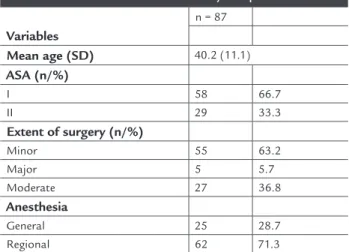
ESULTSA total of 88 patients were selected for the study; ho-wever, one patient was excluded because he presented signs of respiratory depression immediately before anesthesia induction; therefore, 87 patients were ad-mitted to the study. The mean age of the patients in the study sample was 40 ± 11 years and the majority (66.7%) were classified as ASA I. Approximately 63.2% of the surgical procedures were minor surgeries and 71.3% of the anesthetic procedures consisted of regio-nal blocks (Table 1). With respect to the type of sur-gery, 34.9% consisted of general surgical procedures, while 32.6% were cases of vascular surgery, 19.1% were orthopedic procedures and 2.3% were urological pro-cedures.
TABLE 1 Characteristics of the study sample
Variables
n = 87
Mean age (SD) 40.2 (11.1)
ASA (n/%)
I 58 66.7
II 29 33.3
Extent of surgery (n/%)
Minor 55 63.2
Major 5 5.7
Moderate 27 36.8
Anesthesia
General 25 28.7
Regional 62 71.3
ASA=American Society of Anesthesiologists e SD=standard deviation
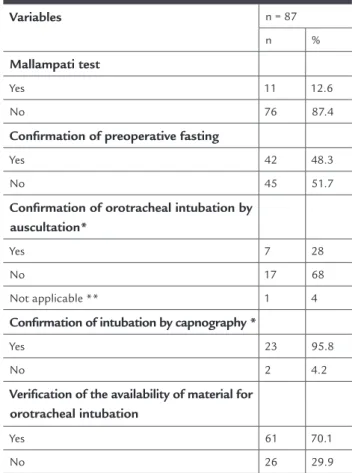
As shown in Table 2, in the majority of the patients (87.4%) the Mallampati test was not performed and in ap-proximately half the cases (51.7%) the anesthesiologist failed to confirm preoperative fasting. It was also found that in 29.9% of the procedures, the availability of mate-rial for orotracheal intubation was not verified.
TABLE 3 Whether or not the Mallampati test was performed and preoperative fasting was confirmed in accordance with whether general or regional anesthesia was scheduled
Variables n = 87
P-value General Regional PR
(95%CI)
Mallampati test (n/%)
Yes 6(54.5) 5 (45.5) 0.4 (0.23-0.89) 0.09*
No 19(25.0) 57(75.0)
Confirmation of preoperative fasting (n/%)
Yes 10 (23.8) 32(76.2) 1.4 (0.70-2.7) 0.45*
No 15(33.3) 30(66.7)
Verification of the availability of material for endotracheal intubation (n/%)
Yes 25 (41) 36(59) NC 0.00**
No 0 26 (100)
* Yates chi-square test **Fisher’s exact test NC = not calculated
D
ISCUSSIONThe present study showed that in the majority of the pa-tients (87.4%) the Mallampati classification was not used to evaluate the airway and in approximately half the ca-ses (51.7%) the anesthesiologist failed to check whether the patient had complied with the requirement for preo-perative fasting. Furthermore, in 29.9% of the anesthetic procedures, the anesthesiologists failed to check whether the material required for orotracheal intubation was avai-lable. Failure to perform the Mallampati test, confirm fas-ting or check the availability of the material for intuba-tion occurred predominantly when regional anesthesia was scheduled; however, in comparison to cases of gene-ral anesthesia, a statistically significant difference was only found with respect to verification of the availability of the material required for orotracheal intubation. In addition, it should be noted that of the patients submit-ted to general anesthesia, orotracheal intubation was not confirmed by auscultation in the majority (68%) of cases, being confirmed by capnography in 95.8% of cases. Only
TABLE 2 Percentage of cases in which the recommended safe surgery procedures were performed
Variables n = 87
n %
Mallampati test
Yes 11 12.6
No 76 87.4
Confirmation of preoperative fasting
Yes 42 48.3
No 45 51.7
Confirmation of orotracheal intubation by auscultation*
Yes 7 28
No 17 68
Not applicable ** 1 4
Confirmation of intubation by capnography *
Yes 23 95.8
No 2 4.2
Verification of the availability of material for orotracheal intubation
Yes 61 70.1
No 26 29.9
* Only for the patients submitted to general anesthesia. ** Use of laryngeal mask
The patients submitted to regional anesthesia were found to be less likely to have had their airway classified by the Mallampati test; however, this finding was not statisti-cally significant. Likewise, fasting was less likely to have been checked in the case of patients submitted to regio-nal anesthesia; nevertheless, this difference was not sta-tistically significant. It was also found that when gene-ral anesthesia was scheduled, the availability of material for orotracheal intubation was checked, while in all ca-ses in which verification was not made, the patient was to be submitted to regional anesthesia. This difference was statistically significant (Table 3).
two patients (2.3%) suffered some form of complication during anesthesia.
Motivated by the evidence of the substantial health damage inflicted by adverse events, most of which are pre-ventable, the World Health Organization (WHO) has been encouraging the adoption of measures to improve health safety based on monitoring systems.1,14,15 The first
chal-lenge to be tackled was that of healthcare-associated in-fection, while the second deals with safety during surgery. In Brazil, the Ministry of Health, together with the Pan American Health Organization and the regional office for
the Americas of the World Health Organization, launched
a manual containing ten basic, essential objectives for any surgery, the third of which is particularly noteworthy: “The team will recognize and effectively prepare for life--threatening loss of airway or respiratory function”.3
In this manual, some measures are considered highly recommended in order to secure the airway. The first mea-sure emphasizes the need for all patients to undergo an objective evaluation of their airway prior to anesthesia in-duction, even when intubation is not anticipated, so that potential difficulties in airway management can be identi-fied. Notwithstanding, the present study found that this evaluation is not routinely performed, principally when intubation is less likely, as in the case of regional blocks.
In 1985, Mallampati et al. conducted a study to eva-luate signs predictive of difficult tracheal intubation.16
In 1987, Samson and Young proposed four different Mal-lampati classes, which have been used up to the present date as one of the principal tests for airway evaluation. According to this test, it is possible to predict whether
orotracheal intubation will be difficult in any given pa-tient. This allows the anesthesiologist to prepare airway support equipment, thus avoiding a situation in which unexpected difficulties with orotracheal intubation re-sult in an unfavorable outcome, threatening the patient’s life.17 Furthermore, most of the evidence suggests that
the Mallampati test should be performed in all patients to be submitted to surgery and/or anesthesia, even tho-se in whom orotracheal intubation is not expected, such as patients scheduled for a regional block, since the need for orotracheal intubation is always a possibility.17
In addition, another action considered indispensa-ble is the need for the anesthesiologist to plan a strategy for securing the airway even when loss of airway is not ex-pected. This consists of ensuring that all the equipment for orotracheal intubation is accessible and has been tes-ted, as well as establishing a back-up plan for a difficult airway if necessary.5,18 These actions were not observed in
this study. On the contrary, in 29.9% of cases, the
availa-bility of this equipment was not checked. More precisely, in all the cases in which this action was ignored the pa-tient was to be submitted to regional anesthesia.
Regarding confirmation of preoperative fasting by the anesthesiologist, the safe surgery checklist recommends that this procedure should always be carried out in the case of elective surgeries; therefore, compliance should be strict. Nevertheless, we found that in approximately half the ca-ses, the anesthesiologist failed to confirm fasting, possibly because he/she assumed that the patients would comply with the preoperative instructions provided by the surgeon. Also regarding the actions recommended in the Mi-nistry of Health’s manual, a step often forgotten by the anesthesiologist and one that merits particular attention refers to the recommendation that, following intubation, it is always necessary to confirm the correct placement of the tube by listening to the breath sounds through a ste-thoscope and to confirm adequate ventilation by capno-graphy. However, what was found in the present study was that in around 68% of the patients, intubation was not confirmed by auscultation, in the majority of cases (98.5%) being confirmed by capnography. Nevertheless, it is important to clarify that although the latter method is the most reliable means of evaluating orotracheal in-tubation, only auscultation is able to guarantee that se-lective intubation has not occurred and to monitor lung complications such as pneumothorax.19
It is important to emphasize that, although the eviden-ce suggests that not performing actions considered essen-tial may result in an increase in the occurrence of unfavo-rable events, this was not found in the present study. On the contrary, the rate of complications was 2.3%, a value well below figures published in the literature where rates range from 3% to 16%.4,8 This may be explained by the fact
that in this study the surgeries were mostly minor and per-formed under regional anesthesia, whereas these details are not provided with any precision in the literature. It is pos-sible that the rate of complications may be higher when major surgery is associated with a failure to comply with procedures aimed at improving the safety of anesthesia.
Most of the communities worldwide that are concer-ned with patient safety believe that something has to be done to improve the safety and quality of risk manage-ment within the realm of healthcare. The existing pro-cesses are fragmented and information on what is wrong is sparse. An information system and the management of incidents based on a universal safety classification would probably contribute towards ensuring that mea-sures were taken.22
Finally, in 2005, the World Health Organization’s World Alliance for Patient Safety initiated a project to de-velop an International Classification for Patient Safety (ICPS) and to elaborate a classification system that would transform the data on patient safety collected from dif-ferent systems into a common format to facilitate poo-ling, analysis and, principally, to provide knowledge on important and unified actions.14,23
It should also be emphasized that cross-sectional stu-dies need to be analyzed with caution. In this type of study design, exposure and effect are measured at the same point in time, which makes it difficult to identify the time of exposure, i.e. whether this precedes the appearance of the disease or whether the presence of the disease alters the degree of exposure to a certain factor. Another disad-vantage of this type of study design is the inability to ex-clude systematic bias observation, which consists of dif-ferent evaluation for subgroups of patients. Likewise, those who are being observed can modify their behavior. However, in this study specifically, we believe that this bias was minimized through two conducts: the observer was not part of the surgical team and the members of this team were not initially informed of the real objectives of the research.
C
ONCLUSIONActions considered essential for patient safety during sur-gery are still ignored; therefore, measures aimed at acqui-ring information and standardizing conduct may contri-bute towards improving surgical outcome.
Authors’ contributions
HV participated in the data collection and in writing this manuscript. CCB participated in the data collection, in reviewing the literature and in writing this manuscript. JM conceived the idea for the protocol and reviewed this final version of the manuscript. PSGNB and TCMC col-laborated in writing the manuscript. FAO, together with JM, conceived the original idea for the protocol, supervi-sed the study, wrote the manuscript and reviewed this fi-nal version.
Ethics
Details of the ethics committee approval: approval of this study (entry number: 2299) was provided by the Ethics Committee on Human Research of the Integral Medici-ne Institute Professor Fernando Figueira (IMIP).
R
ESUMOO anestesiologista está efetivamente preparado para per-da per-da via aérea ou per-da função respiratória? Um estudo de corte transversal em hospital terciário
Objetivo: Identificar a realização de procedimentos alta-mente recomendados para assegurar a via aérea de pa-cientes submetidos a anestesia, previstos no manual de segurança anestésica da Organização Mundial da Saúde.
Métodos: Realizou-se um estudo prospectivo do tipo
transversal observacional, envolvendo 87 pacientes com idade entre 18 e 60 anos, ASA 1 e 2 de acordo com a clas-sificação do Estado Físico pela Sociedade Americana de Anestesiologia. Variáveis estudadas: realização do teste de Mallampati, disponibilidade de material para intubação orotraqueal, confirmação do posicionamento do tubo en-dotraqueal, monitoração da ventilação do paciente e con-firmação do jejum. Calculou-se a Razão de Prevalência (RP) e o seu Intervalo de Confiança a 95% (IC 95%) como medida do risco relativo. Adotou-se o nível de significân-cia de 5%.
Resultados: Em 87,4% dos pacientes a via aérea não foi avaliada pelo teste de Mallampati e 51,7% não tiveram seus jejuns pré-operatórios confirmados, e em 29,1% das anestesias não se verificou a disponibilidade de material para intubação orotraqueal. Todos os casos em que não ocorreu esta verificação o paciente foi submetido à anes-tesia regional, com diferença significativa entre os gru-pos (p = 0.00). 95,8% dos pacientes tiveram a intubação orotraqueal confirmada pela capnografia e 68% tiveram esta confirmação realizada pela ausculta.
Conclusão: Medidas consideradas essenciais para a se-gurança do paciente durante a cirurgia ainda são negli-genciadas.
Unitermos: Anestesia, segurança, manuseio de vias aé-reas.
R
EFERENCES1. World Health Organization. Guidelines for WHO guidelines. Geneva: Global Programme on Evidence for Health Policy; 2003.
Pan-Americana da Saúde; Ministério da Saúde; Agência Nacional de Vigilância Sanitária; 2009.
4. Ferraz EM. A cirurgia segura. Uma exigência do Século XXI. Rev Col Bras Cir. 2009;36(4):281-2.
5. Brennan TA, Leape LL, Laird NM, Hebert L, Localio AR, Lawthers AG, et al. Incidence of adverse events and negligence in hospitalized patients. Results of the Harvard Medical Practice Study. N Engl J Med. 1991;324(6):370-6. 6. Schlack WS, Boermeester MA. Patient safety during anaesthesia:
incorporation of the WHO safe surgery guidelines into clinical practice. Curr Opin Anaesthesiol. 2010;23(6):754-8.
7. Norton EK, Rangel SJ. Implementing a pediatric surgical safety checklist in the OR and beyond. AORN J. 2010;92(1):61-71.
8. Windsor JA, Petrov MS. Patient safety in medicine: are surgeons ready for checklists? ANZ J Surg. 2010;80(1-2):3-5.
9. Eagle KA, Froehlich JB. Reducing cardiovascular risk in patients undergoing noncardiac surgery. N Engl J Med. 1996;335(23):1761-3.
10. Stackhouse RA, Infosino A. Airway management. In: Miller RD, editor. Basics of anesthesia. 6th ed. Philadelphia: Elsevier; 2005. p. 223. 11. Morgan GE. Anestesiologia clínica. 4ª ed. Rio de Janeiro: Revinter, 2010. 12. Cangiani LM, Posso IP, Potério GMB, Nogueira CS. Tratado de anestesiologia:
manuseio da via aérea difícil. 6ª ed. Rio de Janeiro: Atheneu, 2006. 13. Gottlieb EA, Andropoulos DB. Pediatrics. In: Miller RD, editor. Basics of
anesthesia. 6th ed. Philadelphia: Elsevier; 2005. p. 1062.
14. Runciman WB. Lessons from the Australian Patient Safety Foundation: setting up a national patient safety surveillance system - is this the right model? Qual Saf Health Care. 2002;11(3):246-51.
15. Nilsson L, Lindberget O, Gupta A, Vegfors M. Implementing a pre-operative checklist to increase patient safety: a 1-year follow-up of personnel attitudes. Acta Anaesthesiol Scand. 2010;54(2):176-82.
16. Mallampati SR, Gatt SP, Gugino LD, Desai SP, Waraksa B, Freiberger D, et al. A clinical sign to predict difficult tracheal intubation: a prospective study. Can Anaesth Soc J. 1985;32(4):429-34.
17. Adamus M, Fritscherova S, Hrabalek L, Gabrhelik T, Zapletalova J, Janout V. Mallampati test as a predictor of laryngoscopic view. Biomed Pap Med Fac Univ Palacky Olomouc Czech Repub. 2010;154(4):339-43.
18. American Society of Anesthesiologists Task Force on Management of the Difficult Airway. Practice Guidelines for Management of the Difficult Airway: an updated report by the American Society of Anesthesiologists Task Force on Management of the Difficult Airway. Anesthesiology. 2003;98(5):1269-77.
19. Leigh-Smith S, Harris T. Tension pneumothorax - time for a re-think? Emerg Med J. 2005;22(1):8-16.
20. Hurtado JJ, Jiménez X, Peñalonzo MA, Villatoro C, de Izquierdo S, Cifuentes M. Acceptance of the WHO Surgical Safety Checklist among surgical personnel in hospitals in Guatemala city. BMC Health Serv Res. 2012;12:169. 21. Cassinello F, Ariño JJ, Bartolomé Ruibal A, de la Pinta JC, de la Quintana FB, Espinosa ME, Ariño JJ, Bartolomé Ruibal A, de la Pinta JC, de la Quintana FB, Espinosa ME, et al. [Spanish Society of Anaesthesia (SEDAR) guidelines for pre-anaesthesia checking procedures]. Rev Esp Anestesiol Reanim. 2012;59(4):210-6.
22. Runciman WB, Williamson JA, Deakin A, Benveniste KA, Bannon K, Hibbert PD. An integrated framework for safety, quality and risk management: an information and incident management system based on a universal patient safety classification. Qual Saf Health Care. 2006;15(Suppl 1):i82-90. 23. World Alliance For Patient Safety Drafting Group, Sherman H, Castro G,