AR
TICLE
Gender inequalities in external cause mortality in Brazil, 2010
Abstract Objective: To estimate mortality rate by external causes in Brazil. Methods: Mortali-ty national 2010’s data corrected by underreport and adjusted by direct method were evaluated by sex according to age, region of residence, race/ skin color, education and conjugal situation. Re-sults: The standardized mortality coefficient of external causes is higher among men (178 per thousand inhabitants) than among women (24 per thousand inhabitants), being higher among young men (20 to 29 years old) in all regions and decreasing with aging. The mortality rate reaches almost nine times higher among men comparably to women, being higher in North and Northeast regions. The death incidence by external causes is higher among men (36.4%) than among women (10.9%), meaning 170% more risk for men. The risk is also higher among the youngest: 6.00 for men and 7.36 for women. The main kind of de-ath by external causes among men is aggressions, followed by transport accidents, the opposite of women. Conclusions: Besides sex, age is the more important predictive factor of precocious death by external causes, pointing the need of many and various sectors in order to construct new identities of non violence.
Key words Men’s health, Mortality, External
causes, Gender, Brazil Erly Catarina de Moura 1
Romeu Gomes 1
Marcia Thereza Couto Falcão 2 Eduardo Schwarz 3
Alice Cristina Medeiros das Neves 4 Wallace Santos 4
1 Instituto Fernandes Figueira, Fiocruz. Av. Rui Barbosa 716, Flamengo. 22250-020 Rio de Janeiro RJ Brasil. [email protected] 2 Departamento de Medicina Preventiva, Universidade de São Paulo.
3 Departamento de Ações Programáticas e Estratégicas, Secretaria de Atenção à Saúde, Ministério da Saúde.
M
our
Introduction
Inequality and gender are interrelated issues. During the last century, the feminist movement began to use the expression gender to denounce the inadequacy of existing explanations for in-equalities between women and men1. In this sense, explanations arising from differences be-tween the sexes may be released from a biological determinism and expand the discussion, locating it in the context of the social organization of the relationship between the sexes. Starting from the last decades of the 20th century, the field of health has progressively incorporated the perspective of gender, aiming to understand the relations estab-lished between men and women in society and their repercussions on state of health, sickness and death, as well as access to and use of health services2. In this way, gender, used as an analyti-cal category, may support the development of ex-planatory hypotheses for differences in mortality and morbidity profiles, including external causes, by sex.
Within Brazil, external causes (accidents and violence) have been the group which most re-veals the inequality between men and women in the adult population aged 20 to 593. While there has been a fall in these rates over the last decade, the reduction is still small (7%) and gives the country a differentiated international mortality pattern, as has been illustrated by Abouzhar et al.4, challenging various sectors to reflect on and resolve the complexity of this phenomenon.
For over more than a decade, the literature5-7 has drawn particular attention to more aggres-sive and risky behavior among men, which may explain the higher frequency of external cause deaths compared to women. On the other hand, if Bourdieu’s8 considerations on symbolic vio-lence are considered, women may be the target of male domination, without them being recog-nized as victims of violence9. It is also true that the understanding of differential gender models is fundamental for drawing up strategies aimed at reducing this inequality and the rate of exter-nal cause deaths in general.
In this sense, this article estimates the ratios of external cause mortality rates, in particular due to violence and suicide, within Brazilian states and evaluates the risk of death by socio-demographic characteristics, from the relational perspective of gender.
Methods
The data were obtained from the Mortality Infor-mation System (SIM) of the Secretariat of Health Vigilance of the Ministry of Health, for a total of 241,276 male deaths and 112,386 female deaths during the year 2010. Due to the territorial extent of Brazil, the investigation of causes of deaths and active search, there is a delay in concluding the national database, varying from 2 to 3 years, con-sidered internationally as one of the most rapid.
In 2010, the estimated coverage of deaths oc-curring in Brazil was 94.2%, in such a way that gross data were corrected using factors from the study on active death searches10 by state, sex and age group11.
The basic cause of death was cited in ac-cordance with the chapters of the International Classification of Diseases - ICD-1012, with chap-ter XX – exchap-ternal causes being the focus of the study.
The direct method was used for standardiz-ing mortality rates by age, takstandardiz-ing the average of the male and female population of 2010 by age decade group (20 to 59 years of age) as a stan-dard. The crude coefficients were calculated (by age group and total), standardized by age ac-cording to place of residence (state, regions and country). In addition, the ratio between mortali-ty coefficients between men and women was also calculated.
aúd e C ole tiv a, 20(3):779-788, 2015 Results
Table 1 shows that the standardized exter-nal cause mortality coefficient is much greater among men (183 per 100,000 inhabitants) than among women (23 per 100,000 inhabitants). The coefficients are higher among younger men (20 to 29 years old) in every region and diminish with age. Among women, this pattern only oc-curs in the Center-West region. In the other re-gions, the coefficients diminish between the first
age group (20 to 29 years old) and the second (30 to 39 years old), rising again in the third (40 to 49 years old) or fourth (50 to 59 years old), to reach values very close to those of younger wom-en, with the exception of the South region, which basically stabilizes the fall from the age of 30 on-wards.
The difference between the sexes is clearly identified in the external cause mortality ratio, which reaches 7.5 times more among men than among women. We may also add to this the
re-Location North RO AC AM RR PA AP TO Northeast MA PI CE RN PB PE AL SE BA Southeast MG ES RJ SP South PR SC RS Center-West MS MT GO DF Brazil
Table 1. Adjusted mortality coefficient (per 100,000 inhabitants) and mortality risk ratio due to external causes, according to place of residence and sex. Brazil, 2010.
20-29 294 272 158 262 243 333 294 269 308 285 217 301 228 307 306 458 283 334 172 193 305 228 130 197 258 148 168 246 220 274 273 178 230 30-39 218 230 187 184 235 239 211 183 223 204 177 238 188 221 216 303 248 225 137 151 223 153 117 160 193 140 139 184 169 220 194 135 173 50-59 172 207 139 147 154 170 208 203 156 138 142 189 140 147 155 176 176 145 117 123 185 118 107 119 134 113 109 155 149 199 152 109 132 40-49 194 237 120 158 203 202 179 213 174 158 140 189 167 158 179 239 199 163 120 129 199 126 106 136 150 127 129 160 168 202 151 120 144 229 241 154 197 216 249 230 221 227 208 175 238 188 221 226 316 235 232 140 155 237 165 117 159 194 135 141 193 182 229 202 141 178
* Adjusted coefficient for men/adjusted coefficient for women.
M
our
gional difference, for which the ratio reaches 9.1 in the North and 8.9 in the Northeast versus 6.5 in the South, 6.6 in the Center-West and 6.8 in the Southeast. Pará and Amapá stand out in the North region and Alagoas in the Northeast re-gion, while the lowest ratio (4.9) was observed in Roraima.
The standardization of mortality rates by age (crude rate for each state applied to the same population age structure) allows places of resi-dence to be compared. The Southeast region no-tably presents the lowest rates for both sexes. The highest external cause mortality rates for men are observed, in decreasing order, in the North (63% higher than the Southeast), Northeast (62%), Center-West (38%) and South (13%) regions. Among women, there is an inversion, with the Center-West region (44% higher than the South-east) presenting the highest coefficient, followed by the North and Northeast (26%) and South (19%). Notable among states is Roraima, with the highest standardized rates for both men and women.
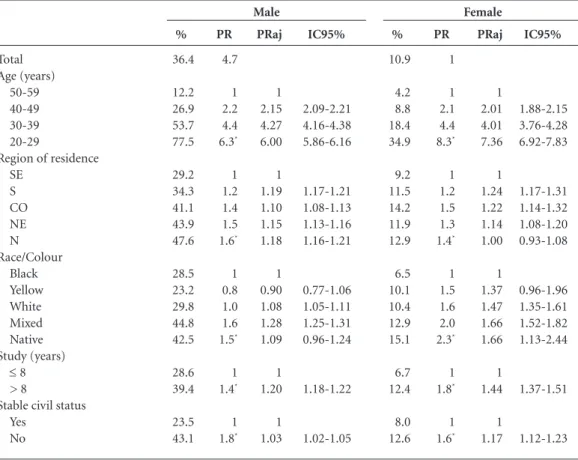
Table 2 shows that the incidence of external cause deaths is much higher among men than among women (36.4% versus 10.9%), represent-ing a risk of early death due to external causes for men almost five times higher than among women. The association with sociodemographic vari-ables shows similar behavior between the sexes, i.e. the risk is greater among younger people (6.3 among men and 8.3 among women), is lowest among residents of the Southeast region (for men it is higher among residents of the North re-gion and for women in the Center-West rere-gion), it is higher among those of mixed and indigenous race/color, individuals, with a higher education level and unstable marital status.
However, after an adjustment for all of the variables, it was found that age maintains an in-verse gradient (higher among women, 7.36 versus
6.00), but that there is a reduction in differenc-es by region of rdifferenc-esidence (slightly higher in the South and North region for men and lower in the Southeast and North region for women), which is higher for mixed race men and straight and
in-Total Age (years) 50-59 40-49 30-39 20-29
Region of residence SE S CO NE N Race/Colour Black Yellow White Mixed Native Study (years)
≤ 8
> 8
Stable civil status Yes
No
Table 2. Incidence (%), Incidence coefficient, gross (RI) and adjusted (RIaj) with a 95% confidence
interval (IC95%), of deaths due to external causes pursuant to sociodemographic and sex variables. Brazil, 2010.
* p < 0.05.
aúd
e C
ole
tiv
a,
20(3):779-788,
2015
digenous women (with it notable that in general, there is an overlap of confidence intervals), there is a reduction of risk by increasing educational level (men with a higher educational level have a risk 20% higher and women a risk 44% higher than the respective categories with a lower educa-tional level) and for unstable marital status (men 3% and women 17%).
Adding sex to the adjusted regression model, the risk among men falls to 2.7. This means that maintaining all of the other variables equal, the risk of early death among men due to external causes is 170% higher than for women.
The principal types of external cause deaths (Figure 1) among men are those due to violence, followed by land-based transport accidents (in-cluding all types), which is the opposite to wom-en. The proportional distribution by type of death relating to external causes shows that more deaths among women are due to suicide than among men.
Violence accounts for almost 80 deaths per 100,000 men (Figure 2), a rate 12 times higher than among women. Coefficients fall gradually with increasing age in every region of Brazil for both sexes. Rates higher than 115 per 100,000 men were observed in the North and Northeast regions and lower than 60 in the Southeast and South of the country. Among women the rate varied from 5.0 in the Southeast to 8.5 in the North. The high coefficients for younger men in the North and Northeast were notable, with these as high as 18 times those for younger women in the same regions.
With regard to rates for suicides (Figure 3), within Brazil 10.7 men and 3.4 women died
per 100,000 inhabitants. In total, among men, coefficients fell gradually with increasing age, but increased among women. The highest rates were observed in the Center-West (16.4 among men and 4.3 among women) and the lowest in the North for men (10.7) and in the North and Southeast for women (3.1). The greatest differ-ences occurred in the Southeast (20 to 29 years old) and Northeast regions (30 to 39 years old) with men registering coefficients almost 8 times higher than women.
Discussion
This study showed that the difference between the sexes is clearly identified in the mortality ra-tio, which estimated that for each woman, almost 8 men die from external causes in Brazil. This dif-ference may be understood better on the basis of the inequalities between men and women, from a perspective of cultural models of gender. Accord-ing to Souza14, men expose themselves more to situations of accidents and violence on account of their conduct specific to contemporary soci-ety, which reaffirmed masculinity, symbolizing greater power and requiring greater virility and aggressiveness, paradoxically making them more vulnerable to events with a risk of early death due to avoidable escalations.
We should highlight that during the last pe-riod between censuses, women registered an in-crease in crude rates of external cause deaths, as well as for neoplasms15.
In addition to the differences between the sexes, we may also observe a regional difference,
Figure 1. Distribution (%) of deaths by type of external cause and by sex, Brazil, 2010. violence land-based
transport accidentsother suicides falls other 0,0
5,0 10,0 15,0 20,0 25,0 30,0 35,0 40,0 45,0 50,0
%
M
our
with the North and Center-West regions the most affected for men, in decreasing order; the least affected was the Southeast for both sexes. This pattern has been maintained over the last two de-cades, as identified in the study on mortality due to violence and accidents among young people aged 15 to 29 within Brazil16, which highlighted
that for the period 1990-2005, the Center-West took first place for external cause mortality, with the North region registering a gradual increase in this rate. Conversely, the Southeast region was the only one which registered a decline, princi-pally influenced by the state of São Paulo, which continues to maintain its position.
Figure 2. Coefficient (per 100,000 inhabitants) for violent death by age range, region of residence for men and women. Brazil, 2010.
0 20 40 60 80 100 120 140 160 180 200
T
axa (p
o
r 100 mil habitant
es)
No
rt
h
N
o
rtheast
S
ou
theast Sou
th
C
ent
er
-W
est
T
otal
No
rt
h
N
o
rtheast
S
ou
theast Sou
th
C
ent
er
-W
est
T
otal
Men Women
20-29 30-39 40-49 50-59 Total
Figure 3. Coefficient (per 100,000 inhabitants) of death through suicide by age range, region of residence for men and women. Brazil, 2010.
0 5 10 15 20 25 30
T
axa (p
o
r 100 mil habitant
es)
No
rt
h
N
o
rtheast
S
ou
theast Sou
th
C
ent
er
-W
est
T
otal
No
rt
h
N
o
rtheast
S
ou
theast Sou
th
C
ent
er
-W
est
T
otal
Men Women
aúd
e C
ole
tiv
a,
20(3):779-788,
2015
The Poisson regression, adjusted for all of the studied variables (sex, age, region of residence, race/color, educational level and marital status), shows that men have a risk of early death due to external causes 2.7 times higher than that of women.
According to Victora et al. 17, these types of deaths are among the health problems with un-acceptably high levels and since the 1980s, have appeared among the principal causes of mortal-ity, being aggravated by gender inequality and challenging various sectors to resolve this phe-nomenon18.
In general, the data show that the principal risk factor for both sexes is age. Considering that national and international studies highlight that external cause mortality greatly affects young males living in large urban centers in areas with a juxtaposition of social disadvantages, it is im-portant to consider indicators such as commu-nity and criminal violence, the presence of drug trafficking and other illegal activities as import-ant factors for understanding the differentials be-tween the sexes, by different age group19,20.
When the data for women are analyzed, we observe that those with a higher educational lev-el and unstable marital status run a greater risk than men in the same categories, as well as white and mixed race women.
This study highlights the fact that mixed race race/color men have a higher probability of death due to external causes (28%) than black, yellow and indigenous as well as white (8%) men. A study carried out in Salvador (State of Bahia) of external cause deaths which occurred between 1998 and 2003 showed that the mixed race pop-ulation loses more potential years of life (13.0 times more for men and 6.2 for women) due to external causes than the white population21, as well as black men (3.0 times more) These data are partially corroborated by the data presented by Soares Filho22, in a study on deaths due to homi-cide occurring between 2000 and 2009, showing a greater (and growing) risk of death of the black population (black and mixed race) than the white one, regardless of educational level. We highlight that the cited studies exclude the indigenous and yellow populations due to the low occurrence of the evaluated event in these categories.
With regard to the region of residence, the risk of early death due to external causes is equal in the South (19% higher) and in the North (18% higher) and slightly lower in the Northeast (13%) and Center-West (10%), in relation to the Southeast region.
Andrade et al. 23, who evaluated deaths due to homicide among men aged 15 to 29 in the state of Paraná between 2002 and 2004, identified an association with social inequality (as expressed by the Gini index) and not with poverty, noting that unequal access to goods and services deter-mines the state of violence. This is corroborated by Peres et al.24, who maintain the hypothesis that demographic changes, economic acceleration, investments and social policies and changes in public security policies acted jointly to reduce the mortality rate due to homicide in the munic-ipality of São Paulo between 1996 and 2008. An ecological study of death due to homicide among men aged 20 to 39, during the period from 1999 to 2010, indicates an increase in risks in munic-ipalities with higher population levels, fertility, income and urbanization inequality and lower literacy levels25.
Specifically in relation to suicide, we observe that despite the fact that the percentage of deaths due to suicide among women is higher, rates are lower than among men, who in turn show a higher proportion of deaths due to violence. When Lovisi et al.26 discuss higher suicide rates among men than among women, they present International studies which reflect gender issues linked to the propensity the suicide, highlighting that women have a greater propensity to suicide but that men are often more successful in their attempts, suggesting that they use more lethal methods, since the male intention to die is stron-ger. Also according to the cited authors, the lower mortality rate due to suicide among women may be associated with: the low frequency of alcohol-ism, stronger religious beliefs, social support and seeking help in the face of mental disorders and suicidal thoughts.
Souza14 had already drawn attention to the growth in external cause deaths among young middle and upper class people, in so far as the use of weapons (deaths due to violence) and cars (deaths due to accidents) are symbols and repre-sentations of force: power of submission/control of life and power of movement /speed/freedom, which became evident in this study, in which a higher educational level acts as a risk factor (the probability of external cause death is 22% higher, compared to the group with a lower educational level), as well as unstable marital status (risk 3% higher).
M
our
73 deaths per 100,000 inhabitants27. The same data further reveal that the proportion of deaths due to these causes is almost double among men (18.8% in men and 10.3% in women) and that the mortality rate is approximately three times higher for this sex (105.6 in men and 39.8 in women). In comparing the values for the years 2000 and 2011, we observe that external cause mortality has fallen, although the difference be-tween the sexes has increased26.
Within Brazil, external cause deaths are around 21.6% of total deaths, among individu-als aged 15 to 69 of both sexes, albeit being three times more frequent among men (28.6% among men and 8.3% among women), affecting 159 men and 23 women for every 100,000 inhabi-tants, according to 2010 data28. These values are close to those of African countries, albeit with greater inequality: approximately 160 deaths among men and 59 among women for every 100,000 inhabitants27.
However, violent situations which do not re-sult in death principally affect women, with men as the principal aggressors29.
Within this context, the National Policy of Full Attention to Men’s Health (PNAISH) in-troduced in 2009 by the Ministry of Health18,30 with the objective of promoting health actions, which expanded the comprehension of the male reality and quality access to men aged between 20 and 59 in their various contexts, to the full-time health assistance services of the SUS [Single Health System] Network, has focused some of its principal strategies on the younger population, whose risk of death is six times higher than that of men aged 50 to 59, noting the strength of as-sociation between cause of death and age (4.27 between the ages of 30 and 39 and 2.15 between the ages of 40 and 49).
These strategies are above all focused on the planning and execution of educational ac-tions within the health territories intended for the reconfiguration of structures and practices of Basic Healthcare, principally in the Family Health Strategy (ESF), with a special focus on awareness raising and capacity building among workers within health teams, with regard to the prevention of violence and accidents, as well as actions for identifying, receiving and forwarding
these situations, involving men in the articula-tion within a network on the basis of the design of lines of care with other levels of media atten-tion and high complexity, gradually contributing to the reduction of morbimortality due to these affronts and in order to change paradigms in the sphere of care and enhancement of life as being the exclusive preserve of women, so that it is also available to, cultivated and practiced by men in all age groups.
This study was realized with secondary data, obtained from the Mortality Information System, which did not permit an analysis of causality, but simply of association. It nevertheless reinforces the findings of the literature and highlights im-portant differences between the sexes.
In any event, the discussion of the predomi-nance of male external deaths relative to female ones needs to be expanded with an interdisciplin-ary analysis, which contemplates an analysis in greater depth of the singular nature of hegemon-ic models of masculinity, whhegemon-ich are still present, active and reinforced within the collective social imagination. On the basis of the understanding of these models, public policies will have better contributions for understanding this phenome-non in which men both die and kill because, in affirming their virile condition as an inalienable choice of what it means to be a man, they find themselves living under exacerbated tension and restrictions, characterized by both physical and symbolic violence8.
aúd
e C
ole
tiv
a,
20(3):779-788,
2015
References
Scott J. Gênero: uma categoria útil de análise histórica. Educação e Realidade 1990; 16(2):5-22.
Barata RB. Como e por que as desigualdades sociais fa-zem mal à saúde. Rio de Janeiro: Ed. Fiocruz; 2009. Moura EC. Perfil da situação de saúde do homem no Brasil. Rio de Janeiro: Editora Fiocruz; 2012.
Abouzhar C, Mikkelsen L, Rampatige R, Lopez A. Mor-tality statistics: a tool to enhance understanding and im-prove quality. Queensland: University of Queensland; 2010.
Gomes R. A dimensão simbólica da violência de gê-nero: uma discussão introdutória. Athenea Digit 2008; 14(2):237-243.
Greig A. Political connections: men, gender and violen-ce. In: United Nations Publications. Partners in Change: Working with Men to End Gender-based Violence. Santo Domingo: Instraw; 2002. p. 10-32.
Minayo MCS. Seis características das mortes violentas no Brasil. Rev Brasileira de Estudos de População 2009; 26(1):135-140.
Bourdieu P. A Dominação Masculina. Rio de Janeiro: Bertrand Brasil; 1999.
Gomes R. Sexualidade masculina, gênero e saúde. Rio de Janeiro: Editora Fiocruz. 2008.
Szwarcwald CL, Morais Neto OL, Frias PF, Souza Ju-nior PRB, Cortez-Escalante JJ, Lima RB, Viola RC. Bus-ca ativa de óbitos e nascimentos no Nordeste e na Ama-zônia Legal: estimação das coberturas do SIM e Sinasc nos municípios brasileiros. In: Brasil. Ministério da Saúde (MS). Saúde Brasil 2010: uma análise da situação de saúde e de evidências selecionadas de impacto de ações de vigilância em saúde. Brasília: MS; 2011. p. 99-116. Morais Filho OL, Moura EC, Cortez-Escalante JJ. Como morrem os brasileiros: tendências e desigualda-des nas regiões, unidadesigualda-des federadas e nas categorias de raça-cor nos anos de 2000 a 2010. In: Brasil. Ministério da Saúde (MS). Saúde Brasil 2011: uma análise da situ-ação de saúde e a vigilância da saúde da mulher. Brasília: MS; 2012. p.105-163.
World Health Organization. Injuries and violence: the facts. Geneva: WHO; 2010.
Farias N, Souza JMP, Laurenti R, Alencar SM. Mortali-dade cardiovascular por sexo e faixa etária em São Pau-lo, Brasil: 1996 a 1998 e 2003 a 2005. Arq Bras Cardiol 2009; 93(5):498-505.
Souza ER. Masculinidade e violência no Brasil: contri-buições para a reflexão no campo da saúde. Cien Saude Colet 2005; 10(1):59-70.
Garcia LP, Freitas LRS. Mortalidade feminina no Brasil: evolução no período de 2000 a 2010. In: Brasil. Minis-tério da Saúde (MS). Saúde Brasil 2011: uma análise da situação de saúde e a vigilância da saúde da mulher. Bra-sília: MS; 2012. p.303-328.
Souza ER, Minayo MCS. Mortalidade de jovens de 15 a 29 anos por violências e acidentes no Brasil: situação atual, tendências e perspectivas. In: Rede Interagencial de informações para a saúde. Demografia e saúde: con-tribuição para análise de situação e tendências. Brasília: OPAS; 2009. p. 113-142.
1. 2. 3. 4.
5.
6.
7.
8. 9. 10.
11.
12. 13.
14.
15.
16. Collaborations
M
our
Victora CG, Barreto ML, Leal MC, Monteiro CA, Sch-midt MI, Pain J, Bastos FI, Almeida C, Bahia L, Travas-sos C, Reichenheim M, Barros FC & the Lancet Brazil Series Working Group. Condições de saúde e inovações nas políticas de saúde no Brasil: o caminho a percorrer. Lancet 2011; 6(Supl. Saúde no Brasil):90-102. Brasil. Ministério da Saúde (MS). Política Nacional de Atenção Integral à Saúde do Homem: princípios e dire-trizes. Brasília: MS; 2009.
McCall PL, Parker KF, MacDonald JM. The dynamic relationship between homicide rates and social, eco-nomic, and political factors from 1970 to 2000. Social science research 2008; 37(3):721-735.
Zaluar A. Integração perversa: pobreza e tráfico de dro-gas. Rio de Janeiro: Editora FGV; 2004.
Araújo EM, Costa MCN, Hogan VK, Mota ELA, Araújo TM, Oliveira NF. Diferenciais de raça/cor da pele em anos potenciais de vida perdidos por causas externas. Rev Saude Publica 2009; 43(3):405-441.
Soares Filho AM. Vitimização por homicídios segun-do características de raça no Brasil. Rev Saude Publica 2011; 45(4):745-755.
Andrade SM, Soares DA, Souza RKT, Matsuo T, Souza HD. Homicídios de homens de quinze a 29 anos e fato-res relacionados no estado do Paraná, de 2002 a 2004. Cien Saude Colet 2011; 16(Supl.1):1281-1288. Peres MFT, Almeida JF, Vicentin D, Cerda M, Cardia N, Adorno S. Queda dos homicídios no município de São Paulo: uma análise exploratória de possíveis condicio-nantes. Rev bras epidemiol 2011; 14(4):709-721. Duarte EC, Garcia LP, Freitas LRS, Mansano NH, Mon-teiro RA, Ramalho WM. Associação ecológica entre características dos municípios e o risco de homicídios em homens adultos de 20-39 anos de idade no Brasil, 1999-2010. Cien Saude Colet 2012; 17(9):2259-2268.
Lovisi GM, Santos AS, Legay L, Abelha L, Valencia E. Análise epidemiológica do suicídio no Brasil entre 1980 e 2006. Rev Bras Psiquiatr 2009; 31(Supl. 2):S86-S93. World Health Organization (WHO). Disease and in-jury regional estimates: cause specific mortality: regional estimates for 2000-2011. Geneva: WHO; 2013. Brasil. Mortalidade geral e por causas - por local de re-sidência – Brasil. Rio de Janeiro: MS; 2013. [acessado 2013 out 1]. Disponível em: http://tabnet.datasus.gov. br/cgi/tabcgi.exe?sih/cnv/nruf.def Acesso em: outubro de 2013.
Gomes DL, Malta DC, Silva MMA, Paiva EA, Moraes Neto AV, Nunes ML, Silva RE, Medeiros AC, Viegas APB, Lima CM. Violência contra mulheres adultas no Brasil: análise das notificações do Sistema de Vigilância de Violências em 2010. In: Brasil. Ministério da Saú-de (MS). SaúSaú-de Brasil 2011: uma análise da situação Saú-de saúde e a vigilância da saúde da mulher. Brasília: MS; 2012. p. 327-344
Schwarz E, Gomes R, Couto MT, Moura EC, Carvalho SA, Silva SFC. Política de saúde do homem. Rev Saúde Pública 2012; 46(Supl. 1):108-116.
Article submitted 03/06/2014 Approved 14/08/2014
Final version submitted 16/08/2014 17.
18.
19.
20. 21.
22.
23.
24.
25.
26.
27.
28.
29.
reads up:
3 Departamento de Ações Programáticas e Estratégicas, Secretaria de Atenção à Saúde, Ministério da Saúde.
p. 782, which reads:
Table 2. Incidence (%), Incidence coefficient, gross (RI) and adjusted (RIaj) with a 95% confidence
interval (IC95%), of deaths due to external causes pursuant to sociodemographic and sex variables. Brazil, 2010.
reads up:
Table 2. Proportion (%), proportion rate, crude (PR) and adjusted (PRaj) with a 95% confidence