Dementia & Neuropsychologia 2007;1(4):402-406
Evaluation of clinical comorbidities in cognitively
impaired patients with depressive symptoms
Rossana Maria Russo Funari
1, Letícia Lessa Mansur
1,2, Paulo Rogério Rosmaninho Varandas
1,
Maria Isabel D´Avila Freitas
3, Wilson Jacob Filho
1,4Abstract – In demented patients, depressive symptoms as well as cognition and clinical comorbidities can interact and induce a complex condition of severity and handicap. Objective: The objective of this study was to evaluate the influence of depressive symptoms in cognitively impaired patients on associated clinical comorbidities in geri-atric patients. Methods: One-hundred-thirty-eight (138) patients were divided into two groups: the first contained cognitively impaired patients with depressive symptoms while the second comprised cognitively impaired patients without depressive symptoms. To quantify comorbidities, the Modified CIRS Scale was used. Results: Out of the 138 patients, 52 were cognitively impaired with depressive symptoms and 86 were cognitively impaired without depressive symptoms, both having mean CDR of 1.74 (moderate dementia). The patients with depressive symp-toms used more drugs (4.98 per patient vs. 3.45 per patient without depressive sympsymp-toms; p=0.001), presented more comorbidities (3.24 per patient vs. 2.46 per patient without depressive symptoms; p=0.009). However, these comorbidities were neither more severe nor more complex in the patients with depressive symptoms, with mean Comorbidity Severity Index of 1.45 in patients with and 1.37 in patients without depressive symptoms (p= 0.078) and mean Comorbidity Complexity Index of 2.41 in patients with depressive symptoms and 2.01 in those without depressive symptoms (p=0.103). Conclusion: Cognitively impaired patients with depressive symptoms had a greater absolute number of comorbidities and took more drugs although these comorbid diseases were less severe and complex than in non-depressive cognitively impaired patients.
Key words: dementia, depressive symptoms, comorbidities, depression.
Avaliação de comorbidades clínicas em pacientes depressivos com distúrbio cognitivo.
Resumo – Em pacientes com demência, sintomas depressivos, cognição e comorbidades podem interagir resul-tando em uma condição de agravamento do quadro e desvantagem. Objetivo: O objetivo do estudo foi avaliar a influência de sintomas depressivos sobre as comorbidades em pacientes geriátricos com declínio cognitivo. Me-todos: 138 pacientes foram divididos em dois grupos: o primeiro composto de pacientes com distúrbio cognitivo associado a sintomas depressivos e o segundo de pacientes com distúrbio cognitivo sem sintomas depressivos. Para quantificar as comorbidades a Escala CIRS modificada foi utilizada. Resultados: 52 pacientes apresentavam distúrbio cognitivo com sintomas depressivos e 86 apresentavam distúrbios cognitivos sem sintomas depressivos, ambos com média de 1.74 no CDR (demência moderada). Os pacientes com sintomas depressivos usaram maior número de fármacos (4.98 / paciente com sintomas depressivos versus 3.45 / pacientes sem sintomas depressivos; p=0.001), apresentaram maior número de comorbidades (3.24 / paciente com sintomas depressivos versus 2.46 / pacientes sem sintomas depressivos; p=0.009) mas essas comorbidades não foram mais graves nem mais com-plexas nos pacientes depressivos: média do Índice de Gravidade das Comorbidades=1.45 no grupo com sintomas depressivos e 1.37 no grupo sem sintomas depressivos (p=0.078) e média de do Índice de Complexidade da Comorbidade com sintomas depressivos = 2.41 no grupo com sintomas depressivos e 2.01 no grupo sem sinto-mas depressivos (p=0.103). Conclusão: Os pacientes com distúrbio cognitivo associado a sintomas depressivos apresentaram maior número absolute de comorbidades e ingeriam maior número de fármacos mas as doenças eram menos graves e complexas do que as do grupo de não depressivos.
Palavras-chave: demência, sintomas depressivos, comorbidades, depression.
1Serviço de Geriatria do Hospital das Clínicas da Faculdade de Medicina da Universidade de São Paulo. 2Departamento de Fisioterapia, Fonoaudiologia
e Terapia Ocupacional. Faculdade de Medicina da USP. 3Pós-Graduação Departamento Neurologia - FMUSP. 4Departamento de Clínica Médica da
Facul-dade de Medicina da UniversiFacul-dade de São Paulo.
Rossana Maria Russo Funari – Praça Nami Jafet 55 / apto. 4183 - 042050-005 São Paulo SP - Brazil. E-mail: [email protected]
of individuals with dementia.
1,2Approximately 30 to 40%
of patients with Alzheimer’s disease present significant
depressive symptoms
3and the prevalence of depression in
vascular dementia can be even greater.
4,5Patients with
de-pression usually present more complaints and can present
greater functional compromise than those not depressed,
6although diagnosis of depression in patients with dementia
remains a challenge.
7Numerous studies have demonstrated
how comorbidities, frequently called psychosocial, such as
agitation, aggression, pain and depression can reduce the
quality of life in the patient as well as caregiver.
8,9To our
knowledge, there have been no studies analyzing possible
influences of depression on clinical comorbidities in
am-bulatory patients with dementia.
The objective of this study was to verify the impact of
de-pression in patients with cognitive disturbances considering
1) the number, severity and complexity of comorbidities;
2) number of medications used. The study included a
des-criptive analysis of the two groups, regarding the most
pre-valent comorbidities and the type and degree of dementia.
Methods
138 patients with cognitive disturbances were
se-lected at the Cognitive Geriatric Outpatient Unit - HC/
groups: those having dementia with depressive symptoms
(DEM+DEP) and those having dementia without
depres-sive symptoms (DEM). A multidisciplinary team evaluated
all patients. The criteria used to diagnose dementia were
from the National Institute of Neurological and
Commu-nicative Disorders and Stroke and Alzheimer’s Disease
and Related Disorders Association (NINCDS-ADRDA).
This classifies probable or possible Alzheimer’s disease
10while the criteria of the National Institute of
Neurologi-cal Disorders and Stroke and Association Internationale
pour la Recherche et l’Enseignement en Neurosciences
(NINDS/AIREN) classifies vascular dementia as probable
or possible,
11and the Diagnostic and Statistic Manual for
Mental Diseases, 4th edition (DSM-IV) assesses dementia
and depressive symptoms.
12The Mini-Mental State
Exami-nation (MMSE),
13the Clinical Dementia Rating (CDR),
14the Geriatric Depression Scale (GDS 30)
15and the modified
Cumulative Illness Rating Scale (CIRS)
16were also applied
to evaluate the degree and complexity of comorbidities.
These patients were submitted to clinical and
labora-tory exams, diagnosing current and previous diseases, and
were questioned about the number of medications
cur-rently being taken.
Pearson’s chi-square test or Fisher exact test were used
Table 1. Characteristics of the two groups studied regarding age, gender, schooling and severity of dementia.
Age (years) mean (SD)
Gender Male/Female
Schooling (years) mean (SD)
CDR mean (SD)
MMSE mean (SD)
DEM+DEP 77.3 (6.95) 8/44 4.66 (5,01) 1.74 (0.87) 15.89 (7,42) DEM 77.2 (6.69) 37/49 4.69 (3.97) 1.73 (0.88) 15.97 (8.64)
DEM: dementia; DEM+DEP: dementia with depressive symptoms; CDR: clinical dementia rating scale; MMSE: mini-mental state exami-nation; SD: standard deviation.
20
6
5
18
3
52
52
10
12
7
5
86
0
20
40
60
80
100
DEM+DEP
20
6
5
18
3
52
DEM
52
10
12
7
5
86
AD
MD
VD
MCI
OD
TOTAL
to compare categorical variables. Student’s t test or
Mann-Whitney test were used for quantitative variables and either
Pearson or Speaman coefficients were used for correlations
between variables according to the presence or absence of
normal distribution of the data.
17The value of statistical
significance accepted was 0.05.
Results
Of the 138 patients, 52 belonged to the DEM+DEP
group and 86 the DEM group. The characteristics of each
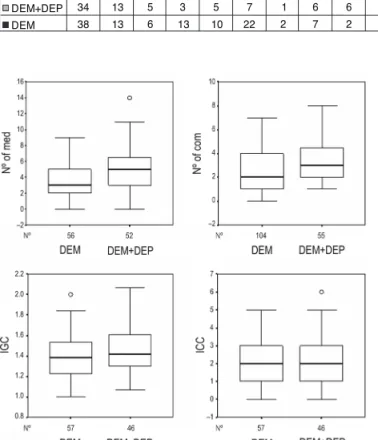
Figure 3. Box plots of the Number of medications, Number of co-morbidities, comorbidity severity index, comorbidity complexity in-dex for depressive symptoms. IGC: comorbidity severity inin-dex; ICC: comorbidity complexity index; DEM: dementia without depressive symptoms; DEM+DEP: dementia with depressive symptoms.
Table 2. Averages summary of the number of medications, num-ber of comorbidities, comorbidity severity index, comorbidity complexity index for Dementia without depressive symptoms, and Dementia with depressive symptoms.
Averages summary NM NC CSI CCI
DEM
N Mean Median Minimum Maximum Standard deviation
86 3.45 3.00 0.00 9.00 2.23
104 2.46 2.00 0.00 7.00 1.75
87 1.37 1.38 1.00 2.00 0.22
87 2.01 2.01 0.00 5.00 1.30
DEM+DEP
N Mean Median Minimum Maximum Standard deviation
52 4.98 5.00 0.00 14.00
3.05 55 3.24 3.00 1.00 8.00 1.79
46 1.45 1.42 1.07 2.07 0.25
46 2.41 2.00 0.00 6.00 1.42
NM: number of medications; NC: number of comorbidities; CSI: comor-bidity severity index; CCI: comorcomor-bidity complexity index; DEM: demen-tia without depressive symptoms; DEM+DEP: demendemen-tia with depressive symptoms.
Figure 2. Most prevalent comorbidities in pa-tients with dementia and depressive symptoms, and dementia without depressive symptoms. SAH, systemic arterial hypertension; DM, diabetes mellitus; HEM/VAS, hematopoietic and vascular diseasea; THYREO, diseases of thyroid; DYSLIP, dyslipidemias; LUNG, lung diseases; CARDIO, cardiopathies; SENDIST, sensorial disturbances; GIT, diseases of gas-trointestinal tract; NEO, neoplasias; RENAL, renal diseases; GU, genito-urinary diseases. 0
10 20 30 40 50
DEM+DEP 34 13 5 3 5 7 1 6 6 5 1 1 1
DEM 38 13 6 13 10 22 2 7 2 2 4 3 2
SAH DM HEM/
VAS NEUROL
THYREO
DIST DYSLIP LUNG CARDIO
SENS
DIST GIT NEO RENAL GU
Table 3. Inferential comparative results of average values for num-ber of medications, numnum-ber of comorbidities, comorbidity sever-ity index, comorbidsever-ity complexsever-ity index, for dementia without depressive symptoms, and dementia with depressive symptoms.
Variables Conclusion
Number of medications DEM<DEM+DEP (p=0.001) Number of comorbidities DEM<DEM+DEP (p=0.009) Comorbidity severity index DEM=DEM+DEP (p=0.078) Comorbidity complexity index DEM=DEM+DEP (p=0.103)
mentia, are listed in Table 1. The proportion of male
in-dividuals was higher in the DEM group. The two groups
presented average MMSE and CDR of 15.9 and 1.7
respec-tively (moderate dementia).
The diagnoses for types of dementia along with the
most prevalent comorbidities are listed in Figures 1 and 2.
The most prevalent comorbidities were arterial
hyper-tension, mellitus diabetes and dyslipidemia in both groups,
with neurological disorders and dyslipidemia being more
prevalent in the group without depressive symptoms, and
sensorial disturbances more present in the group with
de-pressive symptoms.
The patients with dementia and depressive symptoms
took more medication: 4.98 per patient versus 3.45
medi-cation per patient without depressive symptoms (p=0.001)
and presented a greater absolute number of comorbidities
3.24 versus 2.46 per patient (p=0.009), however these
co-morbidities were neither more severe nor more complex,
according to the CIRS scales: average CSI (comorbidity
severity index) with depressive symptoms was 1.45 and
without depressive symptoms 1.37 (p=0.078) and
avera-ge CCI (comorbidity complexity index) with depressive
symptoms was 2.41 and without depressive symptoms 2.01
per patient (p=0.103) (Tables 2 and 3 and Figure 3).
Discussion
The findings of this study showed that when comparing
two groups with very similar clinical characteristics, the
group of patients with dementia associated to depressive
symptoms presented a greater number of comorbidities and
took a greater number of medications than non-depressive
patients with dementia, although these comorbidities were
neither more severe nor more complex. The majority of
these illnesses did not interfere with basic activities, did
not need treatment, and according to the morbidity scale
used had excellent prognosis. Schubert et al., compared the
profile of patients in a primary evaluation and concluded
that multiple morbidities are common in the aged with or
without dementia having a mean chronic disease frequency
of 2.4 per patient and an average of 5.1 for medications.
18Kaup et al., compared dementia patients with depressive
symptoms and depressive patients without dementia, and
found a significantly positive association with greater
num-ber of comorbidities without dementia and with depressive
symptoms, as well as greater physical dependency,
inde-pendent of cognitive state.
19Thus, thorough diagnosis is
necessary in dementia patients with depressive symptoms
for correct treatment,
20although it is also important to
va-lue complaints and quantify morbidities to avoid excessive
use of medication, as was seen in this study.
hypertension and diabetes, while in a multi-centric study
with ambulatory patients (REAL FR) cardiovascular
dise-ases (including systemic arterial hypertension) were most
frequent in patients with Alzheimer’s dementia, followed
by sensorial alterations and neurological disturbances.
21In the present study, the patients with depressive
symp-toms associated to dementia presented a greater prevalence
of sensorial disturbances in relation to patients with
de-mentia and no depressive symptoms. Perhaps these
senso-rial deficits (in this case visual and auditory) may
contri-bute to the decrease in quality of life in these patients and
consequently may have constituted an additional factor for
the emergence of depressive symptoms in our sample.
In the literature, numerous studies have related
depres-sive symptoms with cognitive disturbances and dementia,
although it is not yet clear if the depressive symptoms
con-tributed to the worsening of cognitive results.
22Other
stu-dies have commented that patients with depressive
symp-toms and dementia need more inpatient healthcare services
and nursing homes, as the depressive symptoms associated
with dementia can affect the course of the illness, elevating
the degree of functional alteration and leading to the
po-tential risk of being institutionalized or hospitalized.
23It would be interesting for a further study to verify
whether these patients with depressive symptoms are being
correctly treated with adequate doses of medications, as it
is known that patients who are poorly diagnosed and
trea-ted with sub-doses have a poorer clinical evolution
24while
these two groups of depressed patients without dementia
could be compared and analyzed to ascertain the impact
of clinical morbidities on the daily lives of these patients.
Thus, this study concluded that individuals with dementia
associated to depressive symptoms presented a greater
ab-solute number of comorbidities, although these tended to
be less severe and less complex than in the group without
depressive symptoms. It is of the utmost importance to
ob-serve details on cognitive disturbances in association with
depressive symptoms, thereby avoiding poly-pharmacy,
found to be the most prevalent phenomenon in the group
of patients with depressive symptoms and dementia.
Acknowledgements
– This research was supported by and
performed at the Geriatric Service of Hospital das Clínicas
da Faculdade de Medicina da Universidade de São Paulo.
.
References
2. Reifler BV, Larson E, Hanley R. Coexistence of cognitive im-pairment and depression in geriatric outpatients. Am J Psy-chiatry 1982;139:623-626.
3. Lyketsos CG, Olin J. Depression in Alzheimer’s disease: over-view and treatment. Biol Psychiatry 2002;52:243-252. 4. Simpson S, Allen H, Tomenson B, et al. Neurological
cor-relates of depressive symptoms in Alzheimer’s disease and vascular dementia. J Affect Disord 1998;53:129-136. 5. Groves WC, Brandt J, Steinberg M et al. Vascular dementia
and Alzheimer’s disease: is there a difference? a comparison of symptoms by disease duration. J Neuropsychiatry Clin Neurosci 2000;12:305-315.
6. Mehta KM. Cognitive impairment, depressive symptoms, and functional decline in older people. J Am Geriatr Soc 2002;50:1045-1050.
7. Starkstein SE, Mizrahi R, Garau L. Specificity of symptoms of depression in Alzheimer disease. Am J Geriatric Psychiatry 2005;13:802-807.
8. Snow AL, Dani R, Souchek J, Sullivan G, Ashton CM, Kunik ME. Comorbid psychosocial symptoms and quality of life in pa-tients with dementia. Am J Geriatr Psychiatry 2005;13:393-401. 9. Kunik ME, Cully JA, Snow AL, Souchek J, Sullivan G, Ashton
CM. Treatable comorbid conditions and use of VA health care services among patients with dementia. Psychiatr Serv 2005;56:70-75.
10. McKhann G, Drachman D, Folstein M, et al: Clinical Diagno-sis of Alzheimer’s Disease: Report of the NINCDS-ADRDA-work group under the auspices of department of health and human services task force on Alzheimer’s disease. Neurology 1984;34:939-44.
11. Roman GC, Tatemichi TK, Erkinjuntti T, et al: Vascular de-mentia: Diagnostic criteria for research studies: report of the NINDS-AIREN International Workshop. Neurology 1993;43:250-260.
12. American Psychiatric Association (DSM-IV). Diagnostic and Statistical Manual of Mental Disorders, 4th; Washington, DC: American Psychiatric Association;1994.
13. Folstein MF, Folstein SE, Mc Hugh PR. Mini-mental state. A practical method for grading the cognitive state of patients for clinician. J Psychiat Res 1975;12:189-198.
14. Morris JC. Clinical dementia rating: a reliable and valid diag-nostic and staging measure for dementia of the Alzheimer type. Int Psychogeriatr 1997; 9(Suppl 1):173-176;discussion 177-8. 15. Burke WJ, Houston MJ, Boust SJ, Roccaforte WH. Use of the
Geriatric Depression Scale in dementia of the Alzheimer type. J Am Geriatric Soc 1989;37: 856-860.
16. Pamelle PA, Thuras PD, Katz IR, Lawton MP. Validation of the cumulative illness rating scale in a geriatric residential population. J Am Geriatric Soc 1995;43:130-137.
17. Bussab WO, Morettin PA. Estatística básica. 5o ed. São Paulo:
Saraiva, 2006.
18. Schubert CC, Boustani M, Callahan CM, et al. Comordidity profile of dementia patients in primary care: are they sicker? J Am Geriatric Soc 2006;54:104-109.
19. Kaup BA, Loreck D, Gruber-Baldini AL, et al. Depression and its relationship to function and medical status, by dementia status, in nursing home admissions. Am J Geriatr Psychiatry. 2007;15:438-42.
20. Kales HC, Chen P, Blow FC, Welsh DE, Mellow AM. Rates of clinical depression diagnosis, functional impairment, and nursing home placement in coexisting dementia and depres-sion. Am J Geriatr Psychiatry 2005;13:441-449.
21. Artaz MA, Boddaert J, Hériche-Taillandier E, Dieudonné B, Verny M; le groupe REAL.FR. Medical comorbidity in Alzheimer’s disease: baseline characteristics of the REAL.FR Cohort. Rev Med Interne. 27:91-97.
22. Ganguli M, Du Y, Dodge HH, Ratcliff GG, Chang CC. Depres-sive symptoms and cognitive decline in late life: a prospective epidemiological study. Arch Gen Psychiatry. 2006;63:153-160. 23. Kales HC, Blow FC, Copeland LA, et al: Healthcare utilization
by older patients with coexisting dementia and depression. Am J Psychiatry 1999;156:550–556.