Original Article
Artigo Original
Nasalance values for syllables produced by
Brazilian Portuguese speakers
Valores de nasalância para sílabas produzidas
por falantes do Português Brasileiro
Viviane Cristina de Castro Marino1
Vanessa Moraes Cardoso1
Renata Giorgetto Ramos1
Jeniffer de Cássia Rillo Dutka2,3
Keywords
Acoustics Speech Acoustics
Speech
Adult Children
Adolescent
Descritores
Acústica
Acústica da Fala Fala
Adulto
Criança Adolescente
Correspondence address: Viviane Cristina de Castro Marino Departamento de Fonoaudiologia
Faculdade de Filosoia e Ciências
Universidade Estadual Paulista – UNESP
Rua Júlio de Mesquita Filho, 737, Bairro Mirante, Marília (SP), Brazil, CEP: 17525-000.
E-mail: [email protected]
Received: June 10, 2015
Study carried out at School of Philosophy and Sciences, Universidade Estadual Paulista – UNESP - Marília (SP), Brazil.
1 Universidade Estadual Paulista – UNESP - Marília (SP), Brazil. 2 Universidade de São Paulo – USP - Bauru (SP), Brazil.
3 Hospital de Reabilitação de Anomalias Craniofaciais - Bauru (SP), Brazil.
Financial support: São Paulo Research Foundation (Fundação de Amparo à Pesquisa do Estado de São Paulo) – FAPESP.
Conlict of interests: nothing to declare. ABSTRACT
Purpose: This study aimed to determine nasalance values for syllables produced by Brazilian Portuguese speakers of different ages and gender. Methods: Nasalance scores were collected for 14 syllables (10 orals and 4 nasals) using Nasometer II 6400. The participants were 245 Brazilian Portuguese speakers (121 males and 124 females), both genders, divided into four age groups: 57 children, 61 adolescents, 65 young adults and 62 adults. Results: Nasalance scores for nasal syllables were higher than for oral syllables. For both, oral and nasal syllables, nasalance scores were higher for vowel /i/ than for /a/. Across all syllables, the females’ nasalance scores were higher than males, with most of this difference attributed to the oldest age group where females mean nasalance was three points higher than males. Conclusion: Values obtained demonstrated nasalance scores variation according to gender, particularly for the adult group and for the syllables tested.
RESUMO
Objetivo: o objetivo do estudo foi estabelecer valores de nasalância para sílabas produzidas por falantes do
Português Brasileiro com diferentes idades e sexo. Métodos: Participaram deste estudo 245 falantes do Português
Brasileiro (121 do sexo masculino e 124 do sexo feminino), de ambos os sexos, divididos em quatro grupos de
idade: 57 crianças, 61 adolescentes, 65 adultos jovens e 62 adultos. Valores de nasalância foram obtidos para um conjunto de 14 sílabas (dez orais e quatro nasais), utilizando o Nasômetro II 6400. Resultados: Valores de nasalância mais altos foram encontrados para sílabas nasais quando comparadas às orais e para as sílabas constituídas pela vogal /i/ quando comparadas com a vogal /a/. Valores de nasalância mais altos foram obtidos para mulheres quando comparados aos dos homens e, particularmente, para os adultos. Conclusão: Valores de
INTRODUCTION
The speech oronasal balance may be affected in clinical populations in risk for velopharyngeal dysfunction (cleft lip and palate, neuromotor disorders, hearing impairment) and/or in the population with reduced permeability of the upper airways (nasal obstruction and/or nasopharyngeal). The speech pathologist has an essential role in the identiication of the oronasal balance changes in different clinical populations, seeking a precise diagnosis and appropriate treatment.
The auditory-perceptual evaluation of the oronasal balance is considered essential for the identiication of changes in speech nasality(1). Some authors argue that the clinical evaluation can be corroborated with instrumental evaluation including nasometry(2), while others(3-5) emphasize the importance of using direct (videoluoroscopy/nasoendoscopy) and indirect (nasometry/ aerodynamic measures) assessment of the velopharyngeal function combined with perceptual assessment of populations with velopharyngeal dysfunction or changes in nasal permeability.
The nasometry, in particular, is an acoustic evaluation technique that provides a physical correlate of speech nasality. Previous studies have shown acceptable levels of agreement between nasalance measures provided by the nasometer and hypernasality perceptual ratings(6,7), resulting in the acceptance of the nasometer for clinical and research use(3,8). Nasalance measurements were obtained in various studies that aimed to document the oronasal balance presented by population with cleft lip and palate(7), neuromotor diseases(9) and hearing loss(10,11).
Standardized speech stimuli were proposed by the American literature to obtain the nasalance values and included an oral text (Zoo Passage), an oronasal text (The Rainbow Passage) and nasal sentences, as summarized in prior literature(3). Perceptually, high nasalance values obtained for oral text usually correlate with hypernasality. On the other hand, low nasalance values for nasal text correlate with hyponasality(3).
In general, normative values of nasalance were established for US’ speakers by using the three standard stimuli and, clinically, these stimuli are used with both, adults and children. Alternative stimuli with shorter and with simpler grammar(12) (oral text Turtle and nasal text Mouse) and even stimuli including six syllables(13) were suggested for use with children.. The Simpliied Nasometric Assessment Procedure (SNAP Test) was particularly proposed for use with children(14) and consists of three subtests. One of these subtests consists of a set of syllables that contain an oral pressure consonant (plosive, fricative, affricate), or a nasal consonant followed by a vowel. The use of syllables’ repetition in the subtest was suggested to favor identiication of resonance changes(14) by the evaluator since nasalance values for speech stimuli with consonant recurrence (as occurs during repetition of syllables) can be more easily compared and thus facilitate the interpretation of the indings.
Literature(8) reports 10 percentage points higher in nasalance values for the vowel /i/ as compared with the vowel /a/, since the low vowels, in contrast to high, have relatively lower tongue position, which reduces the oral impedance of the sound. Furthermore, the size of the oral cavity during production of the lower vowels could result in a more pronounced oral resonance.
Studies have shown that speech stimuli predominantly constituted by the vowel /i/ resulted in higher nasalance values than those obtained for low vowels since the higher vowels have higher nasal intensity than the low vowels(15-17).
Normative nasalance values during repetition of syllables were obtained for speakers of American English(18) and Marathi(19), Turkish(20), Egyptian(21) and Ugandan English dialect(22), as well as for adults speakers of Greek(23). One of these studies, in particular, determined the nasalance values for Egyptian language speakers, and checked the effect of gender and age in these values(21). Jointly, the indings reported in these studies indicated higher nasalance values for the nasal syllables than oral syllables, and higher nasalance values for syllables including the vowel /i/ as compared to the syllables including the vowel /a/. Differences in nasalance values between syllables (vowel /a/ versus vowel /i/) varied between 10 and 20 points for speakers of Egyptian(21). Furthermore, for the Egyptian population, nasalance values for syllables varied according to the age, with higher values for adults speakers. There was an effect of gender for the oral syllables including the vowel /a/, with higher values for female speakers of Egyptian language(21).
In Brazilian Portuguese, more speciically, we have not yet established nasalance values during the production of syllables. Previous studies have established the irst normative nasalance values for Brazilian Portuguese speakers, with different age groups, using oral texts(24) or single word (“papai”)(25). Both speech stimuli proposed in the Brazilian Portuguese language did not aim to control the effect of the vowels in nasalance values. As reported in the literature(8), the control of vowels in speech stimuli can provide important information on the functioning of the velopharyngeal mechanism. Some researchers(17) emphasize that nasometry should be used to corroborate nasality clinical ratings and therefore, it is prudent to take into account the natural oronasal intensity characteristics of vowels (especially the vowel /i/), particularly when interpreting the indings obtained by the nasometer.
Considering that normative nasalance values for Brazilian Portuguese speakers were determined only during production of texts and isolated words, this study aimed to establish nasalance values for syllables produced by speakers of Brazilian Portuguese. The study also aimed to characterize nasalance for these speech stimuli regarding the possible effects of age and sex.
METHODS
The study was approved by the Ethics Committee on Human Research of the institution of origin, under number 0657/2013. The data analyzed in this study are part of a broader research analyzed and approved by the Ethics Committee of the Universidade Estadual Paulista “Júlio de Mesquita Filho” in Marília, São Paulo, Brazil.
Participants
Children, adolescents, young adults and adults, speakers of Brazilian Portuguese from the Midwest region of the State of São Paulo, were recruited from local schools, universities and the community. A speech pathologist conducted interviews to conirm the absence of syndromes or other conditions that could affect the performance of the participants during the recording task, and also to check if they had previously received speech therapy and reported normal hearing. Interviews were conducted with parents and/or teachers of the participating children and teenagers, while adults were interviewed directly. The study included only participants who had luency, voice, and normal speech production and who had no resonance changes as judged by the speech pathologist at the moment of data collection. Participants were excluded if they presented with nasal congestion (due to a cold, for example) or nasal obstruction (as found by Glatzel mirror test) at the time of the nasometric evaluation, and also were excluded when they were unable to repeat the syllables of interest. After meeting the inclusion and exclusion criteria, 245 participants were included in this study. Participants were divided into four groups according to age. The younger groups, G1 and G2, were divided according to the World Health Organization classiication for children (5-9 years) and adolescents (10-19 years)(26). The third group G3 consisted of young adults aged 20-24 years, according to the literature(27). The fourth group G4 includes adults aged 25-35 years. The proportion of participants per group was as follows: 23% for G1 with 57 children (27M, 30F) with a mean age of 7y8m (SD=1y1m), 24% for G2, 61 adolescents (30M, 31F) with mean age of 15y (SD=2y6m), 27% for G3 with 65 young adults (34M, 31F) with a mean age of 22y2m (SD=1y4m) and 26% for G4, 62 adults (30M, 32F) with mean age of 29y8m (SD=3y2m).
Speech stimuli
The speech stimuli of interest included a set of 14 syllables adapted fromMacKay-Kummer SNAP Test-R(18). In this set of syllables, 5 consisted of oral consonants followed by vowel /a/ (pa, ta, ka sa, ∫a), 5 consisted of oral consonants followed by
the vowel /i/ (pi, ti, ki si, ∫i), 2 consisted of nasal consonants followed by the vowel /a/ (ma, na) and 2 consisted of nasal consonants followed by the vowel /i/ (mi, ni).
Procedures
Nasalance was obtained using the Nasometer II 6400 (KayPentax, NJ, EUA). All nasalance measures and recordings took place in a quiet room acoustically prepared for speech recording. The Nasometer was calibrated daily before the data collection, according to the manufacturer’s instructions. Participants were itted with the Nasometer’s headgear with the sound separator plate positioned between the nose and upper lip, also according to the manufacturer instructions. The examiner checked the separator plate regularly to ensure proper positioning throughout the evaluation. Each participant was asked to repeat the syllables using habitual pitch and loudness for two seconds until there was, at least, 6 syllables and a maximum of 10 syllables, on the computer screen, as demonstrated by the nasogram displayed in this screen. The mean nasalance value for each participant was calculated using the nasometer’s software. When the participant made a mistake during the repetition of the stimulus, he/she was asked to repeat the selected stimulus and the revised version was saved and used for the data analysis. The order of syllables presentation was the same for all participants.
Data analysis
Data were analyzed using SPSS version 8.0. The nasalance values were analyzed using General Linear Models (GLM) and Tukey Multiple Comparison (post hoc) for paired comparison of the levels. The signiicance level for paired comparisons was p=0.05.
RESULTS
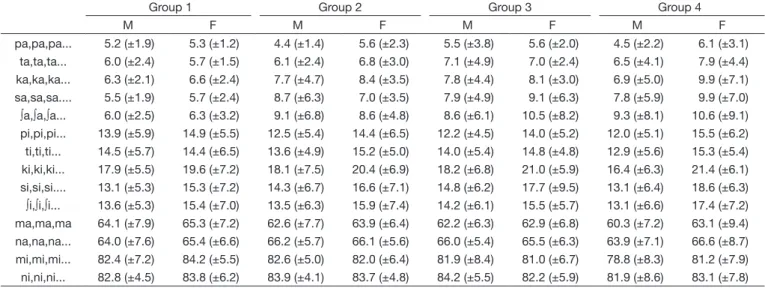
Mean nasalance (and standard deviation) for each of the 14 syllables produced by the 245 participants, according to the age group and gender are shown in Table 1.
Table 1. Average values (±standard deviation) of nasalance for the syllables produced by the 245 participants, according to the age group (Group 1: 5-9 years old; Group 2: 10-19 years old; Group 3: 10-19 years old; Group 4: 25-35 years old) and gender (M: male; F: female)
Group 1 Group 2 Group 3 Group 4
M F M F M F M F
pa,pa,pa... 5.2 (±1.9) 5.3 (±1.2) 4.4 (±1.4) 5.6 (±2.3) 5.5 (±3.8) 5.6 (±2.0) 4.5 (±2.2) 6.1 (±3.1)
ta,ta,ta... 6.0 (±2.4) 5.7 (±1.5) 6.1 (±2.4) 6.8 (±3.0) 7.1 (±4.9) 7.0 (±2.4) 6.5 (±4.1) 7.9 (±4.4)
ka,ka,ka... 6.3 (±2.1) 6.6 (±2.4) 7.7 (±4.7) 8.4 (±3.5) 7.8 (±4.4) 8.1 (±3.0) 6.9 (±5.0) 9.9 (±7.1)
sa,sa,sa.... 5.5 (±1.9) 5.7 (±2.4) 8.7 (±6.3) 7.0 (±3.5) 7.9 (±4.9) 9.1 (±6.3) 7.8 (±5.9) 9.9 (±7.0)
∫a,∫a,∫a... 6.0 (±2.5) 6.3 (±3.2) 9.1 (±6.8) 8.6 (±4.8) 8.6 (±6.1) 10.5 (±8.2) 9.3 (±8.1) 10.6 (±9.1)
pi,pi,pi... 13.9 (±5.9) 14.9 (±5.5) 12.5 (±5.4) 14.4 (±6.5) 12.2 (±4.5) 14.0 (±5.2) 12.0 (±5.1) 15.5 (±6.2)
ti,ti,ti... 14.5 (±5.7) 14.4 (±6.5) 13.6 (±4.9) 15.2 (±5.0) 14.0 (±5.4) 14.8 (±4.8) 12.9 (±5.6) 15.3 (±5.4)
ki,ki,ki... 17.9 (±5.5) 19.6 (±7.2) 18.1 (±7.5) 20.4 (±6.9) 18.2 (±6.8) 21.0 (±5.9) 16.4 (±6.3) 21.4 (±6.1)
si,si,si.... 13.1 (±5.3) 15.3 (±7.2) 14.3 (±6.7) 16.6 (±7.1) 14.8 (±6.2) 17.7 (±9.5) 13.1 (±6.4) 18.6 (±6.3)
∫i,∫i,∫i... 13.6 (±5.3) 15.4 (±7.0) 13.5 (±6.3) 15.9 (±7.4) 14.2 (±6.1) 15.5 (±5.7) 13.1 (±6.6) 17.4 (±7.2)
ma,ma,ma 64.1 (±7.9) 65.3 (±7.2) 62.6 (±7.7) 63.9 (±6.4) 62.2 (±6.3) 62.9 (±6.8) 60.3 (±7.2) 63.1 (±9.4)
na,na,na... 64.0 (±7.6) 65.4 (±6.6) 66.2 (±5.7) 66.1 (±5.6) 66.0 (±5.4) 65.5 (±6.3) 63.9 (±7.1) 66.6 (±8.7)
mi,mi,mi... 82.4 (±7.2) 84.2 (±5.5) 82.6 (±5.0) 82.0 (±6.4) 81.9 (±8.4) 81.0 (±6.7) 78.8 (±8.3) 81.2 (±7.9)
The GLM model was used to measure the effects of age (4 groups), gender (2 groups), and syllables (14 groups). There was a main effect for syllables (F(13;3317=6110, p<0.001) and gender (F(1;3317=42.29, p<0.001), and interaction for age*gender (F(3;3317=6.16, p<0.001). There was no main effect for age (F(3;3317=1.59, p=0.189), there was no effect for age*syllables (F(39;3317=1.40, p=0.051) and for gender*syllables (F(13;3317=1.72, p=0.051), as well as there was no effect for age*gender and syllables (F(39;3317=0.29, p=1.000).
Signiicant effects were analyzed by Turkey’s test (post hoc), with signiicance established at 0.05. For the syllable variable, the mean nasalance values for syllable followed by the vowel /i/ were statistically higher (p<0.001) than those obtained for the corresponding consonant followed by the vowel /a/ (Table 2).
For the variable gender, the overall mean nasalance value for females, considering all ages and all oral and nasal syllables was signiicantly higher (29.73; SD=27.17) than the males (28.48; SD=29.43) (p-value<0.001).
For the age*gender interaction, considering all syllables (oral and nasal), the mean nasalance value was signiicantly higher (p<0.001) for older women (30.52; SD=28.79) than for men in the same age group (27.74; SD=28.92).
DISCUSSION
The main goal of this study was to establish nasalance values for syllables produced by Brazilian Portuguese speakers, adopting the hypothesis that oral syllables would present nasalance values lower than the nasal syllables. We also expected that syllables with the vowel /i/ would present with higher nasalance values than the syllables with the vowel /a/, both for oral and nasal stimuli. The main effect analysis for syllable type and post hoc comparisons conirm these hypotheses. The current data also corroborates indings from previous studies that showed higher nasalance values for nasal syllables than oral syllables for speakers of American English(18), Turkish(20), as well as adult speakers of Greek(23) and for children, adolescents and adult speakers of the Egyptian language(21). These indings were expected since higher nasalance values are associated to the nasal consonants included in the nasal syllables. Obtaining nasalance values for nasal syllables is seen as relevant to the assessment of hyponasality resulting from upper airways obstruction.
The results of this study also conirmed previous indings that indicated higher nasalance values for syllables including the vowel /i/ than for the corresponding syllables followed by the
vowel /a/(18,20,21). Closer inspection of the current results revealed that difference between nasalance values for the vowels /a/ and /i/ ranged between 8 and 20 points. These indings agree with those obtained previously by other researchers(18,21,28). According to the literature(18), these indings were also expected since lower vowels, in contrast to higher, have relatively lower tongue position, which decreases oral sound impedance. Furthermore, the size of the oral cavity during production of the lower vowels could result in a more pronounced oral resonance.
It was adopted as a secondary hypothesis of this study, that age and gender have no signiicant effects on nasalance values obtained during syllable repetitions. This hypothesis, however, was only partially conirmed. When considering all the syllables (oral and nasal), nasalance values for women (mean=29.73, SD=29.17) were signiicantly higher than nasalance values for men (mean=28.48, SD=29.43). This difference can be explained by the higher nasalance values (mean=30.52, SD=28.79) for the adult females than those found for the adult males with similar age (mean=27.74, SD=28.92). A previous study also found a trend toward higher values for females when compared to males during production of oral syllables including the vowel /a/(21). The literature(8) reports that speech nasalance can be affected by the speaker’s gender. However, prior study involving speakers of Brazilian Portuguese(24) reported that the difference between genders for the population studied, when present, was only 2 percentage points and therefore there was no clinical signiicance.
In this study, there was no signiicant difference in nasalance values between the age groups evaluated, disagreeing with the study of Greek speakers(21) showing differences between age groups (children, adolescents and adults) with consistent increase in nasalance values for adults. In a previous study involving Brazilian Portuguese speakers(24), the authors reported lower nasalance values for children compared with adolescents and adults, during production of an oral text. Although the increase in adults nasalance values can be explained by larger sizes of oral and nasal cavities with increasing age(29), this fact has not been observed by other authors(6). Moreover, the literature indicates that although statistically signiicant, differences in nasalance values reported between children and adults are usually within three perceptual points, and may not be clinically signiicant(3).
The literature points out the relevance of information derived from speech stimulus involving syllables repetition to infer the status of velopharyngeal function, more speciically when the studied population presents with subtle changes of
Table 2. Average values (±standard deviation) of nasalance for the 14 syllables produced by the 245 participants
Vowel /a/ Average (±SD) Vowel /i/ Average (±SD) P-value
pa,pa,pa... 5.33 (±2.49) pi,pi,pi... 13.71(±5.66) <0.001*
ta,ta,ta 6.71 (±3.43) ti,ti,ti... 14.44(±5.46) <0.001*
ka,ka,ka.. 7.80 (±4.49) ki,ki,ki 19.19(±6.74) <0.001*
sa,sa,as... 7.80 (±5.32) si,si,si... 15.56(±7.15) <0.001*
∫a,∫a,∫a... 8.70 (±6.72) ∫i,∫i,∫i... 14.92(±6.63) <0.001*
ma,ma,ma... 63.06 (±7.48) mi,mi,mi... 81.79(±7.14) <0.001*
na,na,na... 65.55 (±6.72) ni,ni,ni... 83.24(±6.13) <0.001*
speech nasality(8). The information obtained in the present study, therefore, can contribute with the clinical assessment of resonance disorders, as it provides an acoustic correlate of speech nasality for a group of speciic sounds, particularly, when takes into account the effects of the vowels.
The current data will be helpful during evaluation of different clinical populations of Brazilian Portuguese speakers (with cleft lip and palate, neuromotor disorders or hearing impairment). It is clinically accepted that interpretation of nasalance values obtained for clinical populations require comparisons with normative values established for each particular language. Therefore, it is essential to consider the language effect in nasalance values of syllables. It is important to avoid comparing nasalance values between different languages such as featured in a previous study(21) comparing the scores for the Egyptian language with those reported for North American English(18). Future studies involving nasalance values obtained during syllable repetition for different clinical populations are still needed. It is expected that the use of syllables in studies involving clinical populations may provide information, which contribute to assessments of speech oronasal balance.
CONCLUSION
Nasalance values of syllables produced by Brazilian Portuguese speakers showed variation in the investigated stimuli, with higher values for nasal syllables when compared to oral syllables, and also higher values for stimuli including the vowel /i/ as compared to the vowel /a/. There was also variation in nasalance values of syllables for the variable gender, particularly for adults, since women from this age group had higher nasalance values than men of similar ages.
REFERENCES
1. Kuehn D, Moller K. Speech and language issues in the cleft palate population: the state of the art. Cleft Palate Craniofac J. 2000;37(4):348-83. http://
dx.doi.org/10.1597/1545-1569(2000)037<0348:SALIIT>2.3.CO;2. 2. Brunnegård K, Lohmander A, van Doorn J. Comparison between perceptual
assessments of nasality and nasalance scores. Int J Lang Commun Disord. 2012;47(5):556-66. http://dx.doi.org/10.1111/j.1460-6984.2012.00165.x. PMid:22938066.
3. Mayo CM, Mayo R. Normative nasalance values across languages. ECHO. 2011;6(1):22-32.
4. Kummer AW. Perceptual assessment of resonance and velopharyngeal function. Semin Speech Lang. 2011;32(2):159-67. http://dx.doi. org/10.1055/s-0031-1277718. PMid:21948642.
5. Kummer AW. Speech evaluation for patients with cleft palate. Clin Plast Surg. 2014;41(2):241-51. http://dx.doi.org/10.1016/j.cps.2013.12.004. PMid:24607192.
6. Whitehill TL. Nasalance measures in cantonese-speaking women. Cleft Palate Craniofac J. 2001;38(2):119-25.
http://dx.doi.org/10.1597/1545-1569(2001)038<0119:NMICSW>2.0.CO;2. PMid:11294539.
7. Sweeney T, Sell D. Relationship between perceptual ratings of nasality and nasometry in children/adolescents with cleft palate and/or velopharyngeal dysfunction. Int J Lang Commun Disord. 2008;43(3):265-82. http://dx.doi. org/10.1080/13682820701438177. PMid:17852526.
8. Kummer A. Cleft palate and craniofacial anomalies: effects on speech and resonance. Clifton Park: Delmar Cengage Learning; 2008. p. 311-329.
9. Green JR, Yunusova Y, Kuruvilla MS, Wang J, Pattee GL, Synhorst L, et al. Bulbar and speech motor assessment in ALS: Challenges and future directions. Amyotroph Lateral Scler Frontotemporal Degener. 2013;14(7-8):494-500.
http://dx.doi.org/10.3109/21678421.2013.817585. PMid:23898888. 10. Hassan SM, Malki KH, Mesallam TA, Farahat M, Bukhari M, Murry T.
The effect of cochlear implantation on nasalance of speech in postlingually hearing-impaired adults. J Voice. 2012;26(5):669.e17-22. http://dx.doi. org/10.1016/j.jvoice.2011.07.014. PMid:22082866.
11. Kim EY, Yoon MS, Kim HH, Nam CM, Park ES, Hong SH. Characteristics of nasal resonance and perceptual rating in prelingual hearing impaired
adults. Clin Exp Otorhinolaryngol. 2012;5(1):1-9. http://dx.doi.org/10.3342/
ceo.2012.5.1.1. PMid:22468195.
12. Watterson T, Hinton J, McFarlane S. Novel stimuli for obtaining nasalance measures from young children. Cleft Palate Craniofac J. 1996;33(1):67-73. http://dx.doi.org/10.1597/1545-1569(1996)033<0067:NSFONM>2.3 .CO;2. PMid:8849861.
13. Watterson T, Lewis KE, Foley-Homan N. Effect of stimulus length on nasalance scores. Cleft Palate Craniofac J. 1999;36(3):243-7. http://
dx.doi.org/10.1597/1545-1569(1999)036<0243:EOSLON>2.3.CO;2. PMid:10342612.
14. Mackay IR, Kummer AW. Simplified nasometric assessment procedures. Lincoln Park: Kay Elemetrics; 1994.
15. Lewis KE, Watterson T, Quint T. The effect of vowels on nasalance scores. Cleft Palate Craniofac J. 2000;37(6):584-9.
http://dx.doi.org/10.1597/1545-1569(2000)037<0584:TEOVON>2.0.CO;2. PMid:11108528.
16. Gildersleeve-Neumann CE, Dalston RM. Nasalance scores in noncleft individuals: why not zero? Cleft Palate Craniofac J. 2001;38(2):106-11.
http://dx.doi.org/10.1597/1545-1569(2001)038<0106:NSINIW>2.0.CO;2. PMid:11294537.
17. Lewis KE, Watterson T. Comparison of nasalance scores obtained from the nasometer and the nasal view. Cleft Palate Craniofac J. 2003;40(1):40-5.
http://dx.doi.org/10.1597/1545-1569(2003)040<0040:CONSOF>2.0.CO;2. PMid:12498604.
18. Kummer AW. The MacKay-Kummer SNAP Test-R: simplified nasometric assessment procedures. KayPENTAX; 2005 [citado em 2015 Jun 10]. Disponível em: https://www.google.com.br/?gws_rd=ssl#q=The+MacKay-Kummer+SNAP+Test-R:+Simplified+nasometric+assessment+procedures
19. Nandurkar A. Nasalance measures in Marathi consonant-vowel consonant syllables with pressure consonants produced by children with and without cleft lip and palate. Cleft Palate Craniofac J. 2002;39(1):59-65. http://
dx.doi.org/10.1597/1545-1569(2002)039<0059:NMIMCV>2.0.CO;2. PMid:11772171.
20. Sarac ET, Kayikci ME, Ozkan S. Nasality evaluation of Turkish phonemes in vowel-consonant combinations. Int J Pediatr Otorhinolaryngol. 2011;75(7):894-8. http://dx.doi.org/10.1016/j.ijporl.2011.03.031. PMid:21612830. 21. Abou-Elsaad T, Quriba A, Baz H, Elkassaby R. Standardization of
nasometry for normal Egyptian arabic speakers. Folia Phoniatr Logop. 2012;64(6):271-7. http://dx.doi.org/10.1159/000343999. PMid:23328484. 22. Luyten A, D’haeseleer E, Hodges A, Galiwango G, Budolfsen T, Vermeersch H, et al. Normative nasalance data in Ugandan english-speaking children. Folia Phoniatr Logop. 2012;64(3):131-6. http://dx.doi.org/10.1159/000338235. PMid:22627117.
23. Okalidou A, Karathanasi A, Grigoraki E. Nasalance norms in Greek adults. Clin Linguist Phon. 2011;25(8):671-88. http://dx.doi.org/10.3109/026992 06.2010.549993. PMid:21668367.
24. Trindade IEK, Genaro KF, Dalston RM. Nasalance scores of normal Brazilian Portuguese speakers. Braz J Dysmorphol Speech Hear Disord. 1997;1:23-34.
25. Di Ninno CQMS, Vieira JM, Teles-Magalhães LC, Padovani CR, Pegoraro-Krook MI. Determinação dos valores de nasalância para falantes normais
do Português Brasileiro. Pro Fono. 2001;13(1):71-7.
26. WHO: World Health Organization. Young people’s health: a challenge for society. Report of a WHO study group on young people and health for all. Geneva: WHO; 1986. (Technical Report Series; 731).
28. Hirschberg J, Bok S, Juhasz M, Trenovszki Z, Votisky P, Hirschberg A.
Adaptation of nasometry to Hungarian language and experiences with its
clinical application. Int J Pediatr Otorhinolaryngol. 2006;70(5):785-98.
http://dx.doi.org/10.1016/j.ijporl.2005.09.017. PMid:16246433. 29. Rochet AP, Rochet BL, Sovis EA, Mielke DL. Characteristics of nasalance
in speakers of western Canadian English and French. J Speech Lang Pathol Audiol. 1998;22(2):94-103.
Author contributions