Assessment of the effect of different surface
treatments on the bond strength of brackets
bonded to acrylic resin
Deise Lima Cunha Masioli*, Marco Antonio de Oliveira Almeida**, Marco Antonio Masioli***, José Roberto Moraes de Almeida****
Objective: To evaluate the influence of the surface treatment of acrylic resins on the shear
bond strength of brackets bonded with composite resin. Methods: Were fabricated 140
discs with autopolymerizing acrylic resin (Duralay®) and divided them into 14 groups (n
= 10). In each group, the specimens received a different type of surface treatment. Group 1- untreated surface (control), Group 2- silane, Group 3- aluminum oxide blasting (AOB), Group 4- AOB + silane, Group 5- diamond bur, Group 6- diamond bur + silane, Group 7- hydrofluoric acid, Group 8- hydrofluoric acid + silane, Group 9- phosphoric acid, Group 10- phosphoric acid + silane, Group 11-methylmethacrylate monomer (MMA), Group 12-
MMA + silane, Group 13- plastic conditioner (Reliance®); Group 14- plastic conditioner
(Reliance®) + silane. After surface treatment the specimens were analyzed using a surface
roughness tester. Subsequently, standard edgewise central incisor brackets (Morelli®) were
bonded using Transbond XT® light-cure adhesive system, according to the manufacturer’s
instructions. Results: The silane-based wetting agent had no statistically significant effect
on bond strength values. Treatments with AOB and bur generated the highest topographical changes on the surface of acrylic resin as well as the highest roughness values. A nonlinear correlation was found between bond strength and surface roughness. Monomer + AOB
treatment yielded the highest bond strength values. Conclusions: Silane failed to increase
the bond strength between brackets and acrylic resin. We encourage further studies on this subject since the bond strength achieved in our study was extremely low.
Abstract
Keywords: Orthodontics. Acrylic resin. Composite resin. Brackets.
* MSc in Orthodontics and Dentofacial Orthopedics, State University of Rio de Janeiro (UERJ). Professor of Orthodontics, São Francisco de Assis School (ESFA). ** Head Professor of Orthodontics, State University of Rio de Janeiro (UERJ).
*** Professor of Dentistry, Federal University of Espírito Santo (UFES).
IntROduCtIOn
Given the increasing number of adults that seek orthodontic treatment some procedures used in the office have had to be modified to fit this new patient profile. This age shift means that orthodontics is no longer just sought as an end in itself but also as a means towards achieving other goals. In other words, orth-odontic treatment is now multidisciplinary and, as such, the treatment plan, previously developed by the orthodontist alone, must be carried out in conjunction with periodon-tists, endodonperiodon-tists, surgeons, GPs and implant
dentists.2,11 As a result, orthodontic treatment
may serve as a pre-prosthetic activity as it is confronted not only with natural teeth but also extensive composite resin restorations, implants, metal crowns, ceramics and
provi-sional restorations.6,7 In short, given the fact
that archwires and brackets are still needed to achieve orthodontic movements, a wide range of surfaces exists where brackets need to be bonded. Moreover, effective bracket bonding still plays a key role in the success of orth-odontic treatment.
Bonding techniques comprising etching, primer and adhesive have been widely accepted and documented for bonding brackets to the
surface of natural teeth.1,3,9,12 They afford more
than the necessary bond strength to enable
orth-odontic treatment.10 Many studies have been
conducted in attempts to accomplish a similar performance when bonding orthodontic attach-ments to amalgam, porcelain, composite resin
and metal surfaces.2,13,14 In fact, until recently, it
was considered inconceivable that any clinically acceptable bond strength could be achieved in areas other than the enamel, particularly in the lower posterior region. However, advances in orthodontic materials and the development of new techniques have shown that the bonding of orthodontic attachments to surfaces other than
enamel is also possible.8,13-17
However, the literature is still rather sparse when it comes to the bonding of orthodontic attachments to acrylic resin provisional restora-tions. This dearth of scientific studies leads prac-titioners to resort to empirical protocols, which ultimately cause brackets to debond frequently, thereby hindering the orthodontic treatment.
This study was designed to perform an in vitro analysis to measure and compare the roughness of acrylic resin surfaces after ap-plying different surface treatments. It also aimed to characterize these surfaces by scan-ning electron microscopy (SEM) and assess the bond strength of metal brackets bonded to pre-treated acrylic resin surfaces using composite resin. Furthermore, we assessed the effects of applying a silane-based wetting agent to the acrylic resin in terms of bond strength between bracket and acrylic resin.
MAteRIAl And MethOds
Table 1 lists the materials used in this study and their composition. All materials were used as received without adding any further formula-tion and/or treatment.
One hundred and forty acrylic resin
(Du-ralay®) specimens were fabricated for bonding
40 central incisor standard Edgewise brackets
(Morelli®, slot 0.022x0.028-in). The specimens
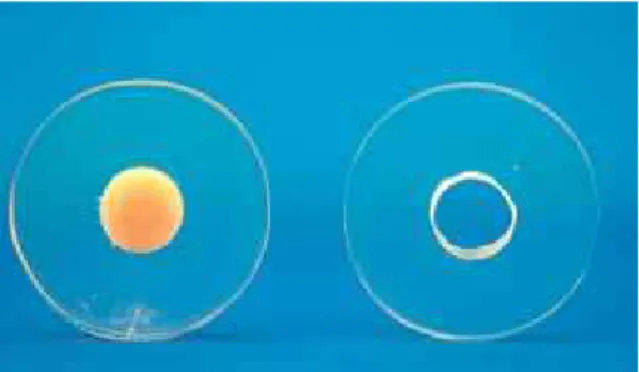
were fabricated using as matrix an acrylic disc with 25 mm diameter and 5 mm in height with a central hole of 8 mm diameter and 5 mm in height, where the heat-polymerized acrylic
resin (Duralay®) was inserted (Fig 1). In
FIGURE 1 - Acrylic matrix with 25 mm diameter and 5 mm in height, containing a central 8 mm hole used as a basis for preparing the specimens.
TABLE 1 - Materials used for surface treatment and bonding of brackets.
TABLE 2 - Experimental conditions for bonding of brackets.
Material (Manufacturer) Composition
Phosphoric acid 37% (Dentsply® Indústria
e Com. Ltda.) L156380
Phosphoric acid
(in aqueous solution, 37 wt% in gel form), silicon dioxide and pigments
Porcelain Conditioner®
(Dentsply® Indústria e Com.
Ltda.) L244578
Hydrofluoric acid (aqueous solution 9.6% in gel form)
Transbond XT Primer
(3M- Unitek, Monrovia) 712-035
Triethyleneglycol-dimethac-rylate
Bis-GMA
Transbond XT Paste
(3M- Unitek, Monrovia) 712-035 Silica Bis-GMA Silane N-dimethyl benzocaine hexa-fluoride-phosphate
Duralay® Powder and Liquid (Reliance, Dental Mfg. Co. Worth) 60482
Powder - copolymer of methyl methacrylate color 81 Liquid - methyl methacrylate
Aluminum oxide blasting (BIO-ART® Ind. de Eq. Odont.
Ltda.)
Aluminum oxide 50 µm / 220 mcsh
Plastic Appliance Conditioner®
(Reliance, Ortho Prod. Inc) 0473
Composition was not informed
Ceramic Primer®
(3M- ESPE, St. Paul) 551441000
Metacriloxipropil-trimetoxisi-lano (MPTS)
1 wt%
Ethanol-water solution with acetic acid - pH = 4 - 99 wt%
Diamond bur # 3145
(KG- Sorensen) 1076/1103 Diamond and Stainless Steel
Groups 1 2 3 4 5 6 7 8 9 10 11 12 13 14
Primer x x x x x x x x x x x x x x
Silane x x x x x x x
Aluminum oxide blasting x x
Diamond bur x x
Hydrofluoric acid x x
Phosphoric acid x x
Monomer x x
Plastic appl. conditioner x x
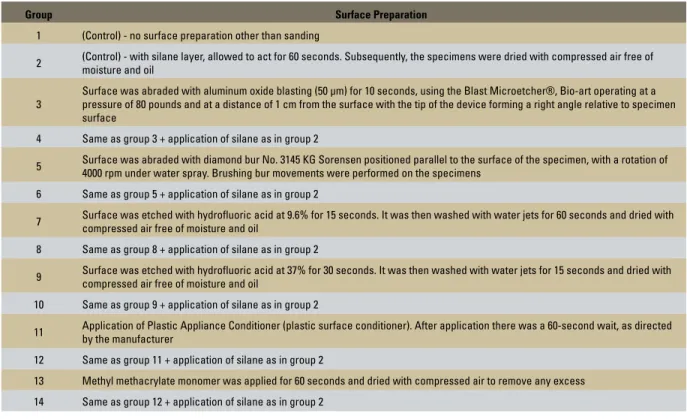
The surfaces were then treated in prepara-tion for bonding the brackets. Fourteen different surface conditioning methods were used, which are summarized in Table 2. These conditioning methods are detailed in Table 3, by group. Ten samples were tested using 14 experimental con-ditions. The brackets were bonded to the acrylic resin using Transbond XT primer and adhesive (composite resin).
Before bonding the brackets, three specimens from each group were analyzed with a roughness tester to determine the effect of the various treat-ments on the surface topography of the samples. This procedure was adopted because the rough-ness of the substrate is a parameter that
Measurements were made in an automated Sur-face Roughness Tester, Mitutoyo (Illinois, USA).
In view of the fact that roughness can be characterized by several different parameters, in this investigation we used the arithmetic mean of roughness profiles, called Ra, which gives the arithmetic average of all profile de-partures from a given baseline (valley depth and peak height). Five roughness profiles of surface texture were measured in each sample in order to evaluate the uniformity of surface treatment of substrates, both in terms of clean-ing and the treatment itself.
Topographic analysis of the treated surfaces was also performed using scanning electron microscopy (SEM). Analyses were performed on surfaces coat-ed with a conductive metal layer using an electron acceleration voltage of 10-15 kV, 80 µA current, and secondary and/or backscattered electrons.
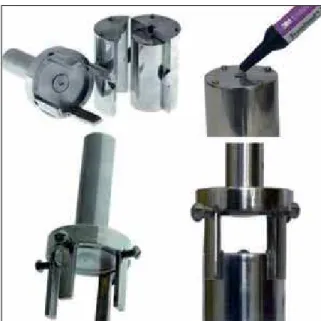
After completing surface treatment, we bonded the brackets using Transbond XT ad-hesive system, according to the manufactur-er’s instructions. The specimens were then attached to a device especially fabricated for
bracket bonding.18 This metal device was used
to help standardize the distance and parallel-ism between bracket and specimen while pro-viding bond strength and homogeneous po-lymerization (Fig 2).
Small amounts of Transbond XT adhesive were placed on the bracket bases with the aid of a No. 5 explorer and then pressed against the specimens. The device ensured that each speci-men axis remained in an orthogonal position rela-tive to the bracket (Fig 2). The entire assembly was light-activated for 60 seconds through a slit
in the device, using an Optilux 400® unit with a
light intensity of 500±20 mw/cm2. Five minutes
Group Surface Preparation
1 (Control) - no surface preparation other than sanding
2 (Control) - with silane layer, allowed to act for 60 seconds. Subsequently, the specimens were dried with compressed air free of moisture and oil
3
Surface was abraded with aluminum oxide blasting (50 µm) for 10 seconds, using the Blast Microetcher®, Bio-art operating at a pressure of 80 pounds and at a distance of 1 cm from the surface with the tip of the device forming a right angle relative to specimen surface
4 Same as group 3 + application of silane as in group 2
5 Surface was abraded with diamond bur No. 3145 KG Sorensen positioned parallel to the surface of the specimen, with a rotation of 4000 rpm under water spray. Brushing bur movements were performed on the specimens
6 Same as group 5 + application of silane as in group 2
7 Surface was etched with hydrofluoric acid at 9.6% for 15 seconds. It was then washed with water jets for 60 seconds and dried with compressed air free of moisture and oil
8 Same as group 8 + application of silane as in group 2
9 Surface was etched with hydrofluoric acid at 37% for 30 seconds. It was then washed with water jets for 15 seconds and dried with compressed air free of moisture and oil
10 Same as group 9 + application of silane as in group 2
11 Application of Plastic Appliance Conditioner (plastic surface conditioner). After application there was a 60-second wait, as directed by the manufacturer
12 Same as group 11 + application of silane as in group 2
13 Methyl methacrylate monomer was applied for 60 seconds and dried with compressed air to remove any excess
1 2 3 4 5 6 7 8 0 10 11 12 55
74
81 84
after bonding, the specimens were stored in zip lock bags and kept at room temperature. Twenty-four hours prior to shear bond strength testing, the specimens were stored in water at 37±2°C in conformity with ISO/TS 11405, of 2003.
Shear bond strength tests were performed on a Universal Testing Machine set to apply the load onto the specimen at a speed of 0.5 mm/min.
Results
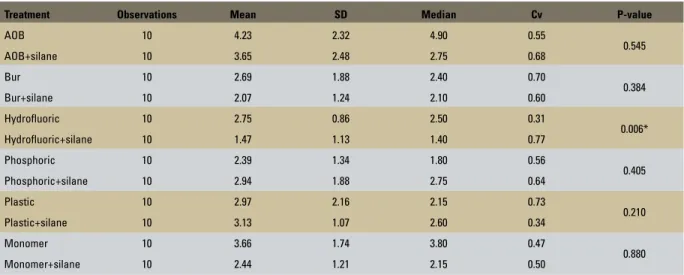
In examining Table 4, we noted that it was only in the Phosphoric Acid + Silane and Plas-tic + Silane treatment groups that the com-bination with silane yielded increased bond strength. In all other groups, the addition of silane caused a decrease in both the mean and the median (Table 5).
For statistical evaluation, two-by-two sam-ple comparisons were carried out in order to check whether or not the silane had any bear-ing on the bond strength of each surface treat-ment. The comparison was performed by the Mann-Whitney test (Table 5, p value). The choice of this test was due to the fact that the samples did not display a normal pattern.
Overall, silane application did not stabilize bond strength measurements, causing instead increases and decreases in measurement
vari-ability, as shown in Table 4. FIGURE 2 - Bonding device used to ensure standardization. Illustration of
how the brackets were bonded to the acrylic resin discs.
FIGURE 3 - Box plot chart showing variation in bond strength within and between groups.
Groups TreatmentSurface Mean DeviationStandard Cv
G1 Control 0.35 0.02 0.057
G3 AOB 0.85 0.23 0.270
G5 Bur 7.77 1.48 0.190
G7 Hydrofluoric 0.38 0.04 0.105
G9 Phosphoric 0.47 0.06 0.127
G11 Monomer 0.55 0.14 0.254
G13 Plastic 0.45 0.03 0.066
TABLE 4 - Roughness evaluation (µm). dIsCussIOn
The effect of various treatments on the surface roughness of acrylic resin is shown in Table 4. It is noted that the groups undergoing mechanical bur treatment yielded much higher roughness values than all other groups, includ-ing those whose surface was treated with alu-minum oxide blasting (AOB).
S h e a r b o n d s tr e n g th 0.00 2.00 4.00 6.00 8.00 10.00 AOB
1 = 7 =
AOB + silane
2 = 8 =
Bur
3 = 9 =
Bur + silane
4 = 10 =
Hydrofluoric
5 = 11 =
Hydrofluoric + silane
6 = 12 =
It is noteworthy that although the rough-ness of bur-treated surfaces was far superior to the others, their uniformity was adequate since their coefficient of variation was less than 30%, similar to that achieved with other treatments. It was also noted that treatment using phos-phoric and hydrofluoric acid etching was unable to significantly alter acrylic resin topography as the surface roughness of these groups was similar to the control group. Treatments using conditioner and monomer also produced little change in acrylic resin roughness in comparison with the control group.
Experimental shear bond strength test re-sults are shown in Figure 3. We were unable to determine the shear bond strength of the con-trol groups (groups 1 and 2) because the brack-ets came off as we were handling the samples. This means that these control samples with no surface treatment had very limited bond strength. As shown in Table 4, standard devia-tion was high for all groups although the bond-ing procedure was performed as reproducibly as possible. A similar behavior has been observed
by other authors.19
Table 5 shows the minimum and maximum values for each group, the first and third quartile
Treatment Observations Mean SD Median Cv P-value
AOB 10 4.23 2.32 4.90 0.55
0.545
AOB+silane 10 3.65 2.48 2.75 0.68
Bur 10 2.69 1.88 2.40 0.70
0.384
Bur+silane 10 2.07 1.24 2.10 0.60
Hydrofluoric 10 2.75 0.86 2.50 0.31
0.006*
Hydrofluoric+silane 10 1.47 1.13 1.40 0.77
Phosphoric 10 2.39 1.34 1.80 0.56
0.405
Phosphoric+silane 10 2.94 1.88 2.75 0.64
Plastic 10 2.97 2.16 2.15 0.73
0.210
Plastic+silane 10 3.13 1.07 2.60 0.34
Monomer 10 3.66 1.74 3.80 0.47
0.880
Monomer+silane 10 2.44 1.21 2.15 0.50
TABLE 5 - Shear bond test experimental results and descriptive statistics of the influence of silane on bond strength (MPa).
and the median (represented by the solid line), as well as possible outliers. This chart shows shear bond strength variability within and be-tween groups and reveals that the data do not follow a normal distribution and must therefore be analyzed by a nonparametric test.
By examining the data shown in Table 5 and in Figure 4 the influence of silane on the bond strength of the different surface treatments can be assessed. It becomes obvious that only the treatments using phosphoric acid and plastic conditioner yielded an increase in bond strength when the surface treatment was associated with silane. In the other groups, including the AOB treatment group, the use of silane caused a re-duction both in mean and median bond strength. A statistical evaluation of these results was made by comparing the samples subjected to the same surface treatment, with and without the applica-tion of silane (e.g., groups 3 and 4).
A1
B1
A2
B2
A3
B3
FIGURE 4 - Variation in bond strength / roughness. The hydrofluoric acid group (p = 0.006) was
the only group that showed significant variation. However, the silane caused a decrease in bond strength, and not an increase, as is the case when
bonding to porcelain.14,15,16
Figure 4 shows the correlation between roughness and shear bond strength. The data indicate that initially a small increase in rough-ness results in a large increase in bond strength. However, as soon as a ‘critical’ roughness value is reached the bond strength remains stable.
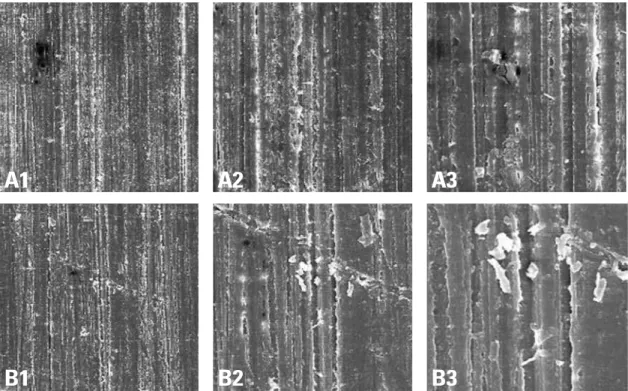
Figure 5 shows the microstructure of the various surfaces investigated in this study. Fig-ure 5A (A1, A2 and A3) represents the control group, i.e., the surfaces have been sanded and are now ready to receive surface treatment. A number of grooves can be seen which result from the initial sanding process. They are ho-mogeneously distributed in a mostly unidirec-tional arrangement. Acrylic resin debris is also visible. Figure 5B (B1, B2 and B3) shows the
untreated areas where silane has been applied. As can be observed, the silane does not alter the acrylic resin topography since the surface features that can be viewed here are basically the same as in Figure 5A.
FIGURE 5 - Control groups surface topography: A) Group 1 (control), B) Control + Silane (Image magnification for each group: 1 = 200 times, 2 = 500 times and 3 = 1000 times).
B
o
n
d
in
g
s
tr
e
n
g
th
(
kN
)
Roughness (µm)
0 2 4 6 8 10
0 1 3 5
A1
C1
D1
A2
C2
D2
A3
C3
D3
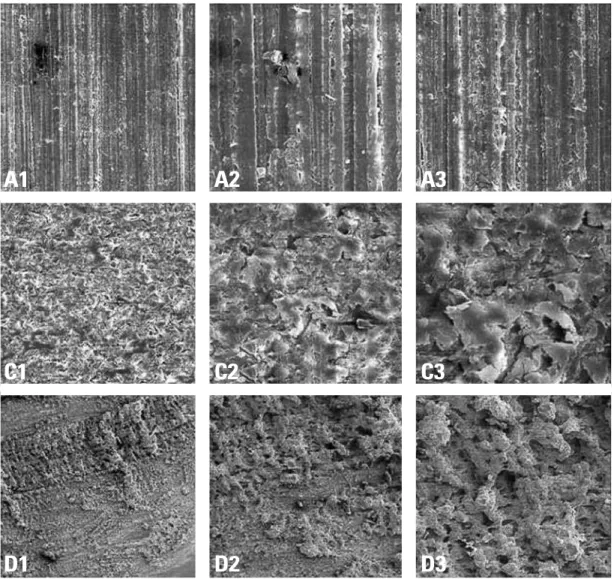
When comparing the control group (Fig 6A) with the AOB group (Fig 6C) and bur-treated group (Fig 6D) we can see that these treatments were able to completely alter the topography of acrylic resin. In the AOB group, the surfaces were evenly blasted (C1), gen-erating a uniform topography with a nearly equiaxed relief composed of valleys and peaks. The bur-treated surface (D) exhibits rounded lumps and a pronounced relief variation, which was confirmed by measurements taken with the roughness tester (7.77 Ra). As shown in
Figure 4, increases in roughness also increase shear bond strength. This finding is in agree-ment with results achieved using the
mechani-cal inter-locking bonding mechanism.20
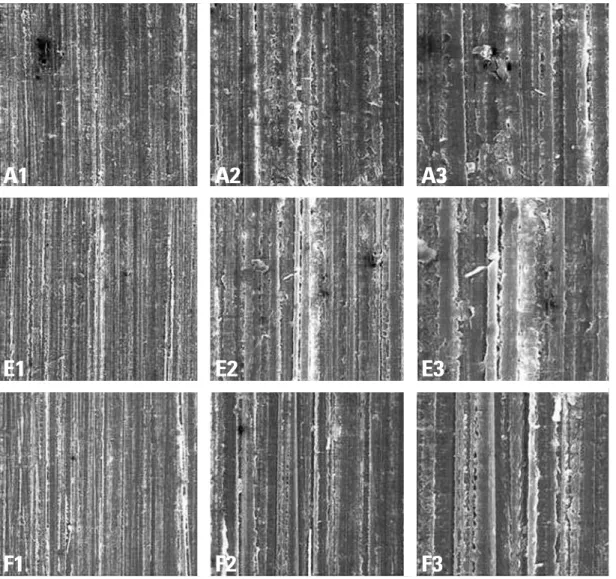
Acid etching (hydrofluoric and phosphoric) resulted only in an apparent removal of impuri-ties generated by the original sanding process, as can be shown in Figure 7. This seems to be the great advantage of using acid on the acrylic resin as the presence of debris on the surface has been known to affect bond strength.
Figure 8 shows the effect of monomer and
A1
E1
F1
A2
E2
F2
A3
E3
F3
FIGURE 7 - Acrylic resin surface topography. A = Group 1 (Control), E = Group 7 (Hydrofluoric acid), F = Group 9 (Phosphoric acid). plastic conditioner treatments on the
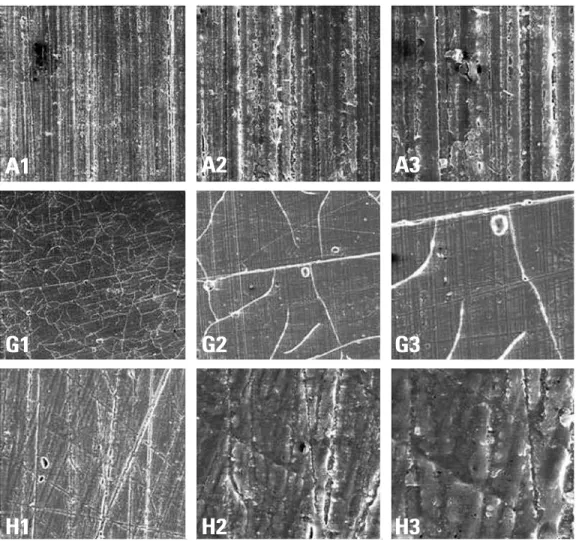
topog-raphy of acrylic resin. A comparison between the control group (A) and the monomer coated group (G) shows a total change in the topog-raphy of acrylic resin with the formation of randomly distributed micro-cracks. This modi-fication in the substrate increased the bond strength of the composite resin (3.66 MPa) and led to an increase in surface roughness com-pared with the control group (from 0.35 Ra to 0.55 Ra). Although not within the scope of this investigation, studies should be conducted
A1
G1
H1
A2
G2
H2
A3
G3
H3
FIGURE 8 - Acrylic resin surface topography. A = Group 1 (Control), G = Group 11 (Monomer), H = Group 13 (Plastic Surface Conditioner).
COnClusIOns
Based on the experimental findings achieved through this study we have concluded that:
I) Silane application does not contribute to enhance bond strength values, leading only to non-significant variations. Thus, the use of si-lane after treating the acrylic surface, within the parameters of this study, does not improve the bond strength of orthodontic brackets.
II) No linear correlation was found between bond strength and surface roughness of acryl-ic resin. A critacryl-ical roughness value was found
which must be reached if maximum bond strength is to be achieved. Within the experi-mental parameters used in this research, such critical roughness value is approximately 2 µm.
III) Treatments involving aluminum oxide blasting (AOB) and burs produced the greatest changes in acrylic resin surface topography and produced greater roughness, which contributes to increase the bond strength between resin and bracket.
1. Capelli Júnior J. Planejamento ortodôntico pré-protético. In: Vanzillotta OS, Salgado LPS, editores. Odontologia integrada: atualização multidisciplinar para o clínico e o especialista. Rio de Janeiro: Pedro Primeiro; 1999. p. 548-75.
2. Ong MM, Wang HL. Periodontic and orthodontic treatment in adults. Am J Orthod Dentofacial Orthop. 2002 Oct;122(4):420-8.
3. Fonseca DM, Camara CAP. Tratamento integrado sinérgico: o verdadeiro conceito da odontologia integrada. In: Vanzillotta OS, Salgado LPS, editores. Odontologia integrada: atualização multidisciplinar para o clínico e o especialista. Rio de Janeiro: Pedro Primeiro; 1999. p. 124-37.
4. Fonseca DM, Camara CAP. Tratamento interdisciplinar – ajuste estético de casos ortodônticos atípicos. Rev Dental Press Ortod Ortop Facial. 2000 set-out;5(5):68-74.
5. Newman GV. Current states of bonding attachment. J Clin Orthod. 1973 Jul;7(7):425-34.
6. Alexandre P, Young J, Sandrik JL, Bowman D. Bond strength of three orthodontic adhesives. Am J Orthod. 1981 Jun;79(6):653-60.
7. Dominguez Rodriguez GC, Carvalho PAL, Horliana RF, Bonim
RA, Vigorito JW. Avaliação “in vitro” da resistência a tração de braquetes metálicos colados com o novo sistema adesivo “self etching primer”. Ortodontia. 2002 abr-jun;35(2):28-34. 8. Buyukyilmaz T, Usumez S, Karaman AI. Effect of self-etching
primers on bond strength – are they reliable? Angle Orthod. 2003 Feb;73(1):64-70.
9. Reynolds IR. A review of direct orthodontics bonding. Br J Orthod. 1975 Jul;2(3):171-8.
10. Newman SM, Dressler KB, Grenadier MR. Direct bonding of orthodontic brackets to esthetic restorative materials using a silane. Am J Orthod. 1984 Dec;86(6):503-6.
11. Andreasen GF, Stieg MA. Bonding and debonding brackets to porcelain and gold. Am J Orthod Dentofacial Orthop. 1988 Apr;93(4):341-5.
12. Pannes DD, Bailey DK, Thompson JY, Pietz DM. Orthodontic bonding to porcelain: a comparison of bonding systems. J Prosthet Dent. 2003 Jan;89(1):66-9.
13. Wood DP, Jordan RE, Way DC, Galil KA.Bonding to porcelain and gold. Am J Orthod. 1986 Mar;89(3):194-205.
RefeRenCes
14. Zachrisson BU, Buyukyilmaz T. Recent advances in bonding to gold, amalgam and porcelain. J Clin Orthod. 1993 Dec; 27(12): 661-75.
15. Zachrisson YO, Zachrisson BU, Büyükyilmaz T. Surface preparation for orthodontic bonding to porcelain. Am J Orthod Dentofacial Orthop. 1996 Apr;109(4):420-30.
16. Zachrisson BU. Orthodontic bonding to artiicial tooth surfaces: clinical versus laboratory indings. Am J Orthod Dentofacial
Orthop. 2000 May;117(5):592-4.
17. Berry NG, D’Almeida JRM. The inluence of circular centered
defects on the performance of carbon–epoxy single lap joints. Polym Testing. 2002;21(4):373-9.
18. Masioli DLC. Inluência do tratamento de superfície de resinas
acrílicas na resistência ao cisalhamento de braquetes colados com resina composta [dissertação]. Rio de Janeiro (RJ): Universidade do Estado do Rio de Janeiro; 2005. 19. Coutinho ET. Caracterização microestrutural da dentina
humana e aspectos de adesão [dissertação]. Rio de Janeiro (RJ): Pontifícia Universidade Católica do Rio de Janeiro; 2001.
20. Allen KW. Some relections on contemporary views of theories
of adhesion. Int J Adhesion Adhesives. 1993 Apr;13(2):67-72.
Contact address
Deise Lima Cunha Masioli
Av. Nossa Senhora dos Navegantes 635/802 CEP: 29.050-335 – Enseada do Suá - Vitória/ES E-mail: [email protected] Submitted: April de 2088
Revised and accepted: December de 2009
of cleaning debris generated by the process of pre-paring the original acrylic resin.
V) Treatment with monomer caused a se-ries of micro-cracks on the acrylic resin surface. These micro-cracks actually increased surface