Evaluation of the determinants of facial profile
aesthetics
Sílvia Augusta Braga Reis*, Jorge Abrão**,
Cristiane Aparecida de Assis Claro***, Leopoldino Capelozza Filho****
Objective: To evaluate the influence of age, gender, sagittal occlusal relationship, facial pattern and 8 facial profile measures on profile aesthetics. Methods: Contingency tables, chi-square test and Cramer’s coefficient were used to evaluate the possible association be-tween the scores assigned by 32 examiners (14 orthodontists, 12 laypeople and 6 artists) to the aesthetics of the profile of 100 Brazilian Caucasian adults, all patients with lip seal competence, and age, gender, sagittal occlusal relationship, facial pattern and the variables of the numerical analysis of the facial profile. Results: No association was found between age, gender and sagittal occlusal relationship and the aesthetics of facial profile. An association was observed between profile scores and facial pattern, facial convexity angle and lower face angle. Conclusions: Among the factors evaluated in this study, facial profile convexity and anterior chin projection were the key determinants of facial profile aesthetics.
Abstract
Keywords: Facial proile. Aesthetics. Orthodontic diagnosis.
* Doctoral candidate in Orthodontics, University of São Paulo (USP), São Paulo. MSc in Orthodontics, Methodist University of São Paulo. ** Full Professor, School of Dentistry, University of São Paulo.
*** PhD, Department of Orthodontics and Pediatric Dentistry, Dental School, University of São Paulo, São Paulo, SP, Brazil. Professor, Department of Orthodontics, Dental School, University of Taubaté, Taubaté, SP, Brazil.
**** PhD and Professor, School of Dentistry, University of São Paulo at Bauru. Member of the Orthodontics Department (HRAC), USP, Bauru.
intROduCtiOn
Since the early twentieth century Case6 tried to establish the features responsible for a beauti-ful or perfect face:
» Prominent chin with mild mentolabial furrow.
» Lower lip slightly posterior to the upper lip. » Upper lip in balance with the cheek, malar
prominence and nose. » Lip seal competence.
However, this concept of beauty is
undergo-ing constant change.2,17,18 Aesthetics can be de-fined as appreciation of beauty, or a combination of qualities that afford intense pleasure to the senses and the intellectual and moral faculties.10 This appreciation of beauty is influenced by in-dividual factors, such as sex, race and education, and by social factors, such as the environment and, nowadays increasingly advertising (media). It therefore varies across different populations and historical periods.2,10,14,15,16
the facial features that account for a pleasant or unpleasant aesthetic appearance. Pleasant aesthet-ics is related to harmony and balance between the parts that make up the facial profile.4,15 Arguably, in the female profile, the shape of the chin and, in men, the mouth and lips are instrumental in as-sessing aesthetics.19
Increases in profile convexity have been as-sociated with unpleasant aesthetic appearance.7 Apparently, the major components in evaluating facial esthetics would be, first and foremost, the mouth, followed by the eyes, facial structure, hair and nose, in the order given.29
The aim of this study was to assess the possible influence of age, gender, occlusal sagittal relation-ship,1 facial pattern5 and 8 facial profile measures on the aesthetic classification of facial profiles.
MAtERiAL And MEtHOdS Sample
The study sample consisted of 100 Brazilian Caucasian adults with competent lip seal, com-prising 50 men and 50 women with a mean age of 23 years and 7 months, and ages ranging between 18 and 36 years.13,20 The mean ages in the female and male groups were 23 years and 4 months and 23 years and 9 months, respectively. The criteria used for inclusion in the sample were adequate facial muscle balance, reflected in lip seal com-petence, no prior orthodontic treatment or fa-cial surgery, and willingness to participate in this study. All individuals who agreed to participate in this study signed a consent form that stated the research objectives and the exams they would un-dergo. In the consent form, participants also au-thorized the disclosure of their facial photographs for teaching and research.
Standardized profile photographs were taken, and plaster models of the upper and lower dental arches were fabricated for each individual.13,20
Aesthetic Subjective Facial Analysis23
The sample was subjected to aesthetic
subjec-tive facial analysis through assessment performed by 32 individuals divided into 3 groups from dif-ferent professional areas: Fourteen orthodontists (7 men and 7 women), 12 laypeople not linked to the dental area nor to any artistic activity (6 men and 6 women) and six female artists (one teach-er and five postgraduate art students enrolled at the School of Fine Arts), all residing in the cities of São Paulo, São Bernardo do Campo or Santo André. Mean examiner age was 37 years and 6 months with a standard deviation of 9 years, rang-ing from 21 to 56 years.
Examiners were asked to provide their opin-ion by rating each photograph within 30 sec-onds. Scores should be given according to the following options:
a) Aesthetically pleasing: Scores 7, 8 and 9. b) Aesthetically acceptable: Scores 4, 5 and 6. c) Aesthetically unpleasant: Scores 1, 2 and 3. With the purpose of assessing intra-examiner agreement in a subjective evaluation of the pro-file, 10 facial profile photographs were randomly selected and examiners asked to repeat the aes-thetic classification with at least one week interval between the two ratings.
Student’s t-test for paired samples was em-ployed to determine evaluation error. There was no significant difference between the first and sec-ond scores assigned by the examiners at a signifi-cance level of 5% (p>0.05) (Table 1).
Table 1 presents the means, minimum and maximum values, and standard deviations for the first and second assessments.
The mean value for the 32 scores assigned by each individual in the sample was calculated for the present study.
Morphological Subjective Facial Analysis22,23,24
can be classified as Patterns I, II, III, Long Face or Short Face based on a direct evaluation of the face.
Pattern I consists of a normal face. Patterns II and III are characterized, respectively, by a posi-tive and negaposi-tive sagittal step between maxilla and mandible. The long face and short face pat-terns feature a vertical discrepancy.
The sample selection method excluded indi-viduals with incompetent lip seal, which resulted in the exclusion of the long and short patterns in this study.
Numerical analysis of the facial proile22,24 Profile photographs were traced and measured by two examiners.
After demarcation of the soft tissue landmarks a numerical analysis of the facial profile was per-formed using the following measures:
1) Nasolabial Angle.
2) Mentolabial Sulcus Angle. 3) Interlabial Angle.15 4) Facial Convexity Angle. 5) Total Facial Convexity Angle. 6) Lower Face Angle.
7) Ratio between the mid anterior facial height and lower anterior facial height (MAFH/LAFH).
8) Lower Face Ratio.
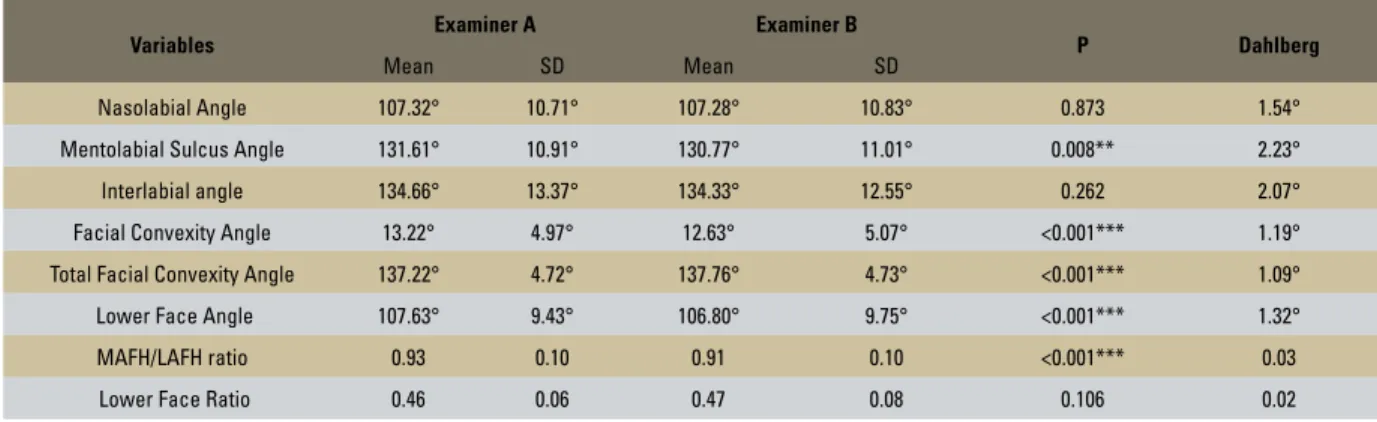
In assessing the method, Student’s t-test was used to evaluate systematic error (bias) and Dahl-berg’s to evaluate random error (Table 2).
A statistical difference was observed between measurements taken of the following angles: men-tolabial sulcus, facial convexity, total facial convex-ity, lower face, and in the ratio between the mid- and lower face heights (Table 2). One should con-sider, however, that not only were the means found by the two raters for these variables very similar, but the random errors identified by Dahlberg’s test justify using these measures in this study.
The values obtained for each of the variables for all individuals in the sample were used in this study. TABLE 1 - Evaluation of intra-examiner error in Subjective Facial Profile
Analysis.
TABLE 2 - Assessment of inter-observer error concerning variables of Numerical Analysis of Facial Profile. Note: p-value refers to Student’s t-test for paired samples.
Captions: F - First evaluation; S - Second evaluation; n.s. - non-significant.
Descriptive measures
p Measure Minimum Maximum Mean SD
First 1.0 9.0 4.9 1.6
Profile 0.357n.s.
Second 2.0 9.0 4.9 1.5 F = S
Variables Examiner A Examiner B P Dahlberg
Mean SD Mean SD
Nasolabial Angle 107.32° 10.71° 107.28° 10.83° 0.873 1.54°
Mentolabial Sulcus Angle 131.61° 10.91° 130.77° 11.01° 0.008** 2.23°
Interlabial angle 134.66° 13.37° 134.33° 12.55° 0.262 2.07°
Facial Convexity Angle 13.22° 4.97° 12.63° 5.07° <0.001*** 1.19°
Total Facial Convexity Angle 137.22° 4.72° 137.76° 4.73° <0.001*** 1.09°
Lower Face Angle 107.63° 9.43° 106.80° 9.75° <0.001*** 1.32°
MAFH/LAFH ratio 0.93 0.10 0.91 0.10 <0.001*** 0.03
Lower Face Ratio 0.46 0.06 0.47 0.08 0.106 0.02
Sagittal occlusal relationship21
The plaster casts of all sample individuals were assessed in occlusion with the primary objective of sorting them according to the classification pro-posed by Angle:1
» Normal occlusion. » Class I malocclusion.
» Class II, Division 1 malocclusion. » Class II, Division 2 malocclusion. » Class III malocclusion.
Only those models were classified as belonging to the Normal Occlusion group which showed up to 3 mm of crowding, not located in any single region of the dental arches.
Statistical method
Contingency tables were constructed to perform the chi-square test and determine the influence of age, gender, sagittal occlusal rela-tionship, facial pattern and the 8 variables of numerical analysis of the facial profile on the scores assigned to each subject in the evaluation of facial aesthetics.
To build the contingency tables, the mean of the subjective facial analysis for Pattern I indi-viduals was calculated and served as a normality benchmark to study individuals with discrepan-cy.24 This mean was 4.8.
Distribution of the sample individuals was then carried out for each of the features which had been assigned a facial aesthetic score above and below 4.8.
By means of the chi-square test, the frequen-cy observed for each individual was noted in all groups where these features were being rated for gender, facial pattern and sagittal occlusal rela-tionship with those whose scores for facial aes-thetics were above and below 4.8 with the ex-pected frequency.
For age and the 8 measures of numerical analy-sis of the facial profile, three groups were obtained for each variable, given the mean and standard deviation of the Pattern I sample.24 The groups
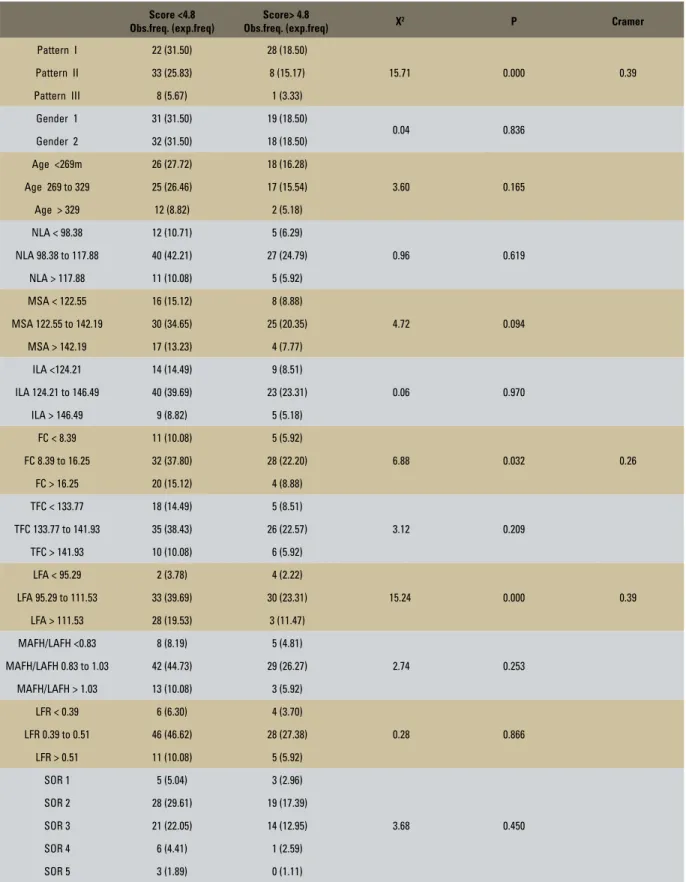
were divided into scores that fell below, above or within a standard deviation derived from a given mean. The same assessment described above was performed for each variable, i.e., the frequency observed for subjects in each group whose facial aesthetic scores fell above and below 4.8 were compared with the expected frequency (Table 3).
In cases where the Chi-square test identified dependency relationship between the aesthetics of the profile and the factors studied, Cramer’s test was applied to identify the strength of the as-sociation. Cramer’s coefficient ranges from 0 to 1. The closer a coefficient is to 1, the stronger the association (Table 3).
The choice of this statistical method was based on the assumption that the measures of facial pro-file could negatively influence propro-file aesthetics when such measures diverged more or less from the standard deviation of Pattern I. This would not be applicable to other statistical methods that evaluate association between variables.
RESuLtS
The results of this study showed an associa-tion between the score assigned to each individ-ual for esthetic facial profile and facial pattern classification, facial convexity angle and lower face angle (Table 3).
No association was found between age, gender or sagittal occlusal relationship and the aesthetic evaluation of facial profile.
diSCuSSiOn
Score <4.8 Obs.freq. (exp.freq)
Score> 4.8
Obs.freq. (exp.freq) X
2 P Cramer
Pattern I 22 (31.50) 28 (18.50)
15.71 0.000 0.39
Pattern II 33 (25.83) 8 (15.17)
Pattern III 8 (5.67) 1 (3.33)
Gender 1 31 (31.50) 19 (18.50)
0.04 0.836
Gender 2 32 (31.50) 18 (18.50)
Age <269m 26 (27.72) 18 (16.28)
3.60 0.165
Age 269 to 329 25 (26.46) 17 (15.54)
Age > 329 12 (8.82) 2 (5.18)
NLA < 98.38 12 (10.71) 5 (6.29)
0.96 0.619
NLA 98.38 to 117.88 40 (42.21) 27 (24.79)
NLA > 117.88 11 (10.08) 5 (5.92)
MSA < 122.55 16 (15.12) 8 (8.88)
4.72 0.094
MSA 122.55 to 142.19 30 (34.65) 25 (20.35)
MSA > 142.19 17 (13.23) 4 (7.77)
ILA <124.21 14 (14.49) 9 (8.51)
0.06 0.970
ILA 124.21 to 146.49 40 (39.69) 23 (23.31)
ILA > 146.49 9 (8.82) 5 (5.18)
FC < 8.39 11 (10.08) 5 (5.92)
6.88 0.032 0.26
FC 8.39 to 16.25 32 (37.80) 28 (22.20)
FC > 16.25 20 (15.12) 4 (8.88)
TFC < 133.77 18 (14.49) 5 (8.51)
3.12 0.209
TFC 133.77 to 141.93 35 (38.43) 26 (22.57)
TFC > 141.93 10 (10.08) 6 (5.92)
LFA < 95.29 2 (3.78) 4 (2.22)
15.24 0.000 0.39
LFA 95.29 to 111.53 33 (39.69) 30 (23.31)
LFA > 111.53 28 (19.53) 3 (11.47)
MAFH/LAFH <0.83 8 (8.19) 5 (4.81)
2.74 0.253
MAFH/LAFH 0.83 to 1.03 42 (44.73) 29 (26.27)
MAFH/LAFH > 1.03 13 (10.08) 3 (5.92)
LFR < 0.39 6 (6.30) 4 (3.70)
0.28 0.866
LFR 0.39 to 0.51 46 (46.62) 28 (27.38)
LFR > 0.51 11 (10.08) 5 (5.92)
SOR 1 5 (5.04) 3 (2.96)
3.68 0.450
SOR 2 28 (29.61) 19 (17.39)
SOR 3 21 (22.05) 14 (12.95)
SOR 4 6 (4.41) 1 (2.59)
SOR 5 3 (1.89) 0 (1.11)
related to facial aesthetics, in making plans that are consistent with the expectation of patients, and result in treatments whose aesthetic benefits can be perceived by all.
Whereas 80% of patients seek orthodontic treatment for aesthetic purposes, regardless of their functional condition,10 evaluation of facial aesthetics should be a routine in orthodontic prac-tice, not only in the diagnostic phase but during and after orthodontic treatment.
During diagnosis, professionals should try to identify unpleasant facial features that can be changed through orthodontic treatment. Pleasant features, however, should be preserved and where possible, enhanced by treatment. It is important to note, however, that this evaluation is performed in light of the ethnical and individual character-istics of each patient while endeavoring to apply the same aesthetic parameters embraced by the patient and his/her society.
This study found no association between gen-der and subjective analysis of facial profile. How-ever, in assessing the distribution of individuals in the groups rated as aesthetically pleasing (scores 7, 8 or 9), acceptable (scores 4, 5 or 6) and unpleas-ant (scores 1, 2 or 3) it became clear that all those rated as aesthetically pleasing were women, while 6 of the 8 classified as aesthetically unpleasant (75%) were men. This finding may be explained by a higher frequency of male individuals in Pat-terns II (63.4%) and III (66.7%).22 These patients presented with sagittal skeletal discrepancies that negatively impacted on the assessment of facial profile aesthetics. Sixty-four percent of the indi-viduals in the Pattern I group, which comprised patients with a balanced face, were women. This finding reinforces the association between facial pattern and aesthetics, but not between gender and aesthetic evaluation of the profile.
No association was found between gender and facial aesthetics in the literature. Meta-analysis of published studies on facial beauty found that the determinants of attractiveness would be the same
for women and men in all cultures.25 These fac-tors are related to symmetry, characteristics that emphasize sexual dimorphism and faces with fea-tures similar to the average population, construed as signs of health and quality that guide both gen-ders in choosing a spouse.25
Older individuals in this sample did not re-ceive lower scores for facial profile aesthetics than younger patients.
As previously reported, mean sample age was 23 years and 7 months, ranging between 18 and 36 years. The sample was divided into three age groups (Table 3) for statistical analysis.
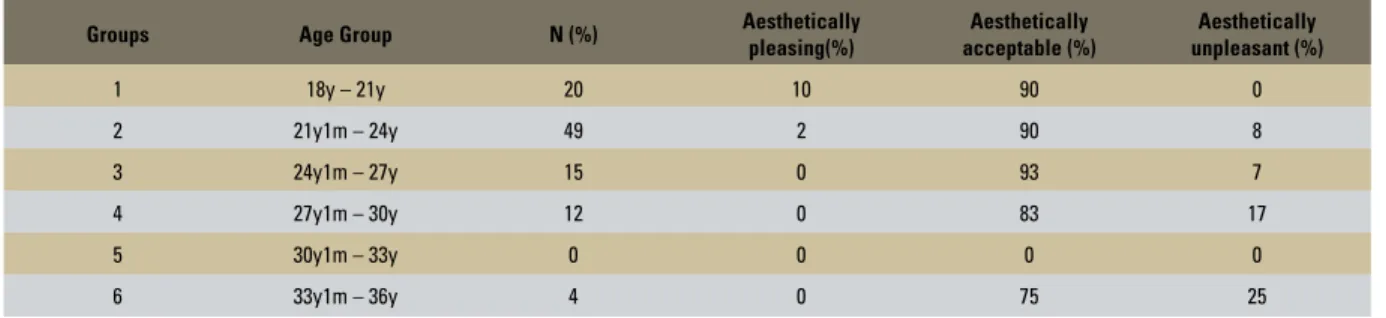
However, in order to better visualize the dis-tribution of individuals between maximum and minimum ages, the sample was divided into six age groups (Group 1 - 18 to 21 years, Group 2 - 21 years and 1 month to 24 years, Group 3 - 24 years and 1 month to 27 years, Group 4 - 27 years and 1 month to 30 years, Group 5 - 30 years and 1 month to 33 years and Group 6 - 33 years and 1 month to 36 years). It was found that 20% of the sample belonged to Group 1, 49% to Group 2, 15% to Group 3, 12% to Group 4, 0% to Group 5 and 4% to Group 6. The small dis-persion of individuals found in all groups, with greater concentration in the younger age groups may explain the lack of association between age and facial aesthetics. Further studies with more homogeneous distribution of the sample across different age groups should be conducted to sub-stantiate the findings of this study.
A clear tendency was noted, however, of those individuals rated as aesthetically pleasing to be concentrated in the younger groups while the percentage of unattractive individuals increased in the older sample groups (Table 4), in agreement with longitudinal studies, which showed that at-tractiveness tends to decrease with age from 11 to 31 years. However, people tend to keep their rela-tive level of attracrela-tiveness over their life time.28
investigated since the beginning of the last cen-tury, when Angle1 noted that the effect of maloc-clusion on the facial lines produced distinct de-formities, which allowed orthodontists to classify malocclusion based on facial assessment alone. Angle also found that the quality of facial balance would be commensurate with normal occlusion.
Further studies have contradicted these ob-servations by concluding that aesthetically pleas-ing features could be present in individuals with normal occlusion or malocclusion, suggesting that individuals belonging to the same occlusal class could exhibit considerably different faces.6,7 Fur-ther investigation found that the Class I malocclu-sion is associated with a more pleasant face, and Class III with the worst facial aesthetics, suggest-ing that the sagittal position of the mandible influ-ences raters’ opinions on profile aesthetics.9
In this study no association was observed be-tween the sagittal occlusal relationship and the score assigned to facial profile aesthetics. One should take into account the fact that this result may have been influenced by the sample selec-tion method, which excluded all individuals with dental or skeletal discrepancies that might com-promise lip seal competence. It can therefore be argued that the Class II and Class III subjects found in the sample had dental and skeletal dis-crepancies of small magnitude. The latter were
naturally well balanced and not always notice-able on the face as they did not compromise fa-cial profile aesthetics.
Also noteworthy is the fact that the selected sample was comprised of individuals whose so-cioeconomic status allowed them to undergo orthodontic treatment in case their malocclusion made them feel somehow aesthetically or func-tionally uncomfortable. It can be inferred there-fore that the need for such treatment went un-noticed until adulthood due to dental and skeletal compensations that masked the malocclusion and ensured lip seal competence.21
One must consider, however, that facial pat-tern had a bearing on the score assigned to the profile (Table 3), indicating the presence of indi-viduals in the sample who had sagittal skeletal er-rors that marred their profile aesthetics. It can be concluded that the lack of association between beauty and sagittal occlusal relationship found in this study reinforces the findings of Bittner and Pancherz,3 i.e., that occlusal discrepancies are only partially reflected in the face. Many Class II or III malocclusions have a dental origin only and are not associated with any skeletal discrep-ancy, while other Class I patients exhibit skeletal errors that are adequately offset by occlusion. Diagnosis must begin in the face so as to avert errors likely to occur when priority is given to TABLE 4 - Distribution of aesthetically pleasing, acceptable and unpleasant individuals in age groups.
Groups Age Group N (%) Aesthetically
pleasing(%)
Aesthetically acceptable (%)
Aesthetically unpleasant (%)
1 18y – 21y 20 10 90 0
2 21y1m – 24y 49 2 90 8
3 24y1m – 27y 15 0 93 7
4 27y1m – 30y 12 0 83 17
5 30y1m – 33y 0 0 0 0
the dental relationship. Normal occlusion alone is not indicative of profile attractiveness. Patients with Class II and Class III malocclusions, on the other hand, may display a balanced face with dental malocclusions only.30
Among the profile variables assessed in this study, the only association was found to exist be-tween the scores for facial profile aesthetics and facial convexity and lower face angles.
Facial convexity angle is extremely sensitive to sagittal skeletal discrepancies. Patterns II and III individuals showed this angle to be, respectively, increased and decreased in relation to the same angle in Pattern Iindividuals.22,24
In this study, most individuals whose facial convexity angles were above 16.25º or below 8.39° (1 SD above and below the sample mean for Pattern I) were given scores lower than 4.8 for facial profile aesthetics (mean of scores assigned to Pattern I individuals). It can be deduced that profiles whose convexity is increased or decreased in relation to balanced profiles (Pattern I) are con-sidered less aesthetically pleasing.
One hundred percent of individuals rated as aesthetically pleasing showed the value of this angle within a standard deviation equivalent to Pattern I patients (12.32±3.93°), while 62.5% of those classified as aesthetically unpleasant had this angle either above (37.5%) or below (25%) the standard deviation of balanced patients.
Thus, a direct relationship exists between pro-file convexity and unpleasant aesthetic appear-ance.26 The preferred facial profile for women is slightly convex, whereas in men, preference is given to a straight profile.8
Lower face angle enables assessment of chin protrusion relative to the midface. Evaluation of this angle is essential in planning the correction of sagittal skeletal discrepancies.22,24 This study dis-closed that any increase in this angle above the standard deviation of the mean found for Pattern I individuals was associated with a reduction in the score assigned to profile aesthetics. This increase
in the angle is related to a smaller anterior projec-tion of the chin, typical of Class II patients or of sub-mandibular tissue excess.22,24 Among the in-dividuals in the sample classified as unattractive 62.5% had this angle above the standard devia-tion of the mean value. All these individuals were male. It can be inferred therefore that men with lower anterior projection of the chin are particu-larly less attractive, very often requiring surgical intervention associated with orthodontic correc-tion to improve their profile.
No association was found between profile aes-thetics and the angles that measure upper and lower lip protrusion (nasolabial, mentolabial sul-cus and interlabial angles). It should be noted that this finding is not surprising since all individuals in the sample had lip seal competence and therefore no major imbalances in lip positioning.
Subjective Morphological Facial Analysis clas-sifies patients’ faces as Patterns I, II and III, Long Face and Short Face.5 Pattern I individuals are characterized by normal vertical and sagittal facial proportions. Any malocclusion in these patients will necessarily have a dental origin. Patterns II and III patients present with sagittal discrepan-cies, with positive and negative steps between the maxilla and mandible, respectively. The Long and Short Face patterns are characterized by excess and deficiency in vertical face growth, with sev-eral studies published in the literature referring to them as Long Face and Short Face Syndromes. Malocclusions present in patients with skeletal discrepancies (Patterns II, III, Long Face and Short Face) usually result from these imbalances.
The method for selecting subjects for this sample excluded patients with Long Face, Short Face as well as Patterns I, II or III with no lip seal competence.
This study therefore revealed that 50% of patients were Pattern I, 41% Pattern II and 9% Pattern III.22, 24
After distributing the individuals in a Con-tingency Table and applying the chi-square test, an association was found between the score assigned to facial aesthetics and facial pattern (p<0.001). Cramer’s coefficient found a 0.396 association (Table 3).
In evaluating the distribution of Patterns I, II and III individuals, who were assigned facial aesthetics scores below and above 4.8, it was observed that among Pattern I patients, 56% re-ceived scores above 4.8. For those classified as Class II this percentage was reduced from 19.5% to 11.1% among Pattern III patients.
The most simplistic explanation for this find-ing corroborates several authors who found that, from a strictly aesthetical viewpoint, balanced profiles are the most widely preferred, followed by Pattern II profiles, whereas Pattern III profiles were considered the least aesthetic. The literature also suggests that Pattern III individuals are more likely to accept orthognathic surgery than Patterns II patients due to the impact of this discrepancy on facial aesthetics.11,27
A published study22 showed, however, that Pattern III individuals in this sample exhibited more striking discrepancies in their profile than those with Pattern II, when compared with Pat-tern I individuals. This may be one of the rea-sons why Pattern III individuals received lower scores than Pattern II.
1. Angle EH. Classiication of malocclusion. Dent Cosmos. 1899 Apr;41(2):248-65.
2. Auger TA, Turley PK.The female soft tissue proile as presented in fashion magazines during the 1900s: a photographic analysis. Int J Adult Orthodon Orthognath Surg. 1999;14(1):7-18.
3. Bittner C, Pancherz H. Facial morphology and malocclusions. Am J Orthod Dentofacial Orthop. 1990 Apr;97(4):308-15. 4. Brons R. Facial harmony: standards for orthognathic surgery
and orthodontics. London: Quintessence; 1998. 5. Capelozza Filho L. Diagnóstico em Ortodontia. Maringá:
Dental Press; 2004.
6. Case CS. A practical treatise on the technics and principles of dental orthopedia and prosthetic correction of cleft palate. Chicago: Case; 1921.
7. Cox NH, Van Der Linden FPGM. Facial harmony. Am J Orthod Dentofacial Orthop. 1971 Aug;60(2):175-83. 8. Czarnecki ST, Nanda RS, Currier GF. Perceptions of a
balanced facial proile. Am J Orthod Dentofacial Orthop. 1993 Aug;104(2):180-7.
9. Dongieux J, Sassouni V. The contribution of mandibular positioned variation to facial esthetics. Angle Orthod. 1980 Oct;50(4):334-9.
REFEREnCES
10. Giddon DB. Aplicações ortodônticas de estudos psicológicos e perceptuais da estética facial. In: Sadowsky PL, Peck S, King G. Laskin DM, editores. Atualidades em Ortodontia. São Paulo: Editorial Premier; 1997.p.79-88. 11. Johnston C, Hunt O, Burden D, Stevenson M, Hepper
P. The inluence of mandibular proeminence on facial attractiveness. Eur J Orthod. 2005;27:129-33.
12. Legan HL, Burstone CJ. Soft tissue cephalometric analysis for orthognathic surgery. J Oral Surg. 1980 Oct;38(10):744-51. 13. Martins LF. Análise fotométrica em norma frontal
de adultos, brasileiros, leucodermas, não tratados ortodonticamente, classificados pela estética facial [dissertação]. São Bernardo do Campo (SP): Universidade Metodista de São Paulo; 2001.
14. Mantzikos T. Esthetic soft tissue profile preferences among the Japanese population. Am J Orthod Dentofacial Orthop. 1998 Jul;114(1):1-7.
15. Morris W. An orthodontic view of dentofacial esthetics. Compend Contin Educ Dent. 1994;15(3):378-90. 16. Moss JP, Linney AD, Lowey MN. Uso das técnicas
tridimensionais na estética facial. In: Sadowsky PL, Peck S, King G, Laskin DM, editores. Atualidades em ortodontia. São Paulo: Editorial Premier; 1997. p. 89-97.
to Pattern I. Moreover, 85.4% of Pattern II indi-viduals were rated as aesthetically acceptable, and 14.6% as aesthetically unpleasant, all of whom were men. Regarding Pattern III, 88.9% were considered aesthetically acceptable and 11.1% unsightly, all of whom were women. All Pattern II women and all Pattern III men were considered aesthetically acceptable, show-ing that a reduction in the facial convexity of women, and an increase in men’s are aestheti-cally acceptable.
COnCLuSiOnS
An association was observed between scores for facial profile aesthetics and facial convexity angle, lower face angle and facial pattern. Increases in facial convexity in men and decreases in women resulted in a aesthetically unpleasant appearance, which might require surgical procedures combined with orthodontics to enhance aesthetics.
Contact address
Sílvia Augusta Braga Reis Av. Tiradentes, 477, apto 34 CEP: 12.030-180 - Taubaté / SP, Brazil E-mail: [email protected]
23. Reis SAB, Abrão J, Capelozza Filho L, Claro CAA. Análise facial subjetiva. Rev Dental Press Ortod Ortop Facial. 2006 set-out;11(5):159-72.
24. Reis SAB, Abrão J, Capelozza Filho L, Claro CAA. Análise facial numérica do peril de brasileiros Padrão I. Rev Dental Press Ortod Ortop Facial. 2006 nov-dez;11(6):24-34. 25. Rhodes G. The evolutionary psychology of facial beauty.
Annu Rev Psychol. 2006;57:199-226.
26. Riedel RA. Esthetics and its relation to orthodontic therapy. Angle Orthod. 1950 Jul;20(3):168-78.
27. Soh J, Chew MT, Wong HB. Professional assessment of facial proile attractiveness. Am J Orthod Dentofacial Orthop. 2005;128(2):201-5.
28. Tartarunaite E, Playle R, Hood K, Shaw W, Richmond S. Facial attractiveness: a longitudinal study. Am J Orthod Dentofacial Orthop. 2005;127:676-82.
29. Terry RL, Davis JS. Components of facial attractiveness. Percept Mot Skills. 1976 Jun;42:918.
30. Trevisan F, Gil CTLA. Análise fotogramétrica e subjetiva do peril facial de indivíduos com oclusão normal. Rev Dental Press Ortod Ortop Facial. 2006 jul-ago;11(4):24-35. 17. Nguyen DD, Turley PK. Changes in the caucasian male
facial proile as depicted in fashion magazines during the twentieth century. Am J Orthod Dentofacial Orthop. 1998 Aug;114(2):208-17.
18. Peck S, Peck L. Aspectos selecionados da arte e da ciência da estética facial. In: Sadowsky PL, Peck S, King G, Laskin DM, editores. Atualidades em Ortodontia. São Paulo: Editorial Premier; 1997. p. 99-116.
19. Perrin FAC. Physical attractiveness and repulsiveness. J Exp Psychol. 1921;4:203-17.
20. Reis SAB. Análise facial numérica e subjetiva do peril e análise da relação oclusal sagital em brasileiros, adultos, leucodermas, não tratados ortodonticamente [dissertação]. São Bernardo do Campo (SP): Universidade Metodista de São Paulo; 2001.
21. Reis SAB, Capelozza Filho L, Mandetta S. Prevalência de oclusão normal e má oclusão em brasileiros, adultos, leucodermas, caracterizados pela normalidade do peril facial. Rev Dental Press Ortod Ortop Facial. 2002 set-out; 7(5):17-25.
22. Reis SAB, Abrão J, Capelozza Filho L, Claro CAA. Estudo comparativo do peril facial dos Padrões I, II e III portadores de selamento labial passivo. Rev Dental Press Ortod Ortop Facial. 2006 jul-ago;11(4):36-45.
Submitted: July 2007