Real e Benemérita Sociedade Portuguesa de Beneficência de São Paulo Mailing address: José Armando Mangione - Hospital Beneficência Portuguesa Rua Maestro Cardim, 769 - 1o SS, S/71, bl. 1 - 01323-001 - São Paulo, SP, Brazil E-mail: [email protected]
English version by Stela Maris C. e Gandour
Objective - To assess coronary stent placement in patients with multivessel coronary disease and involvement of the proximal portion of the anterior descending coronary artery.
Methods - We retrospectively analyzed the in-hospital and late evolution of 189 patients with multivessel coronary disease, who underwent percutaneous coronary stent pla-cement. These patients were divided into 2 groups as follows: group I (GI) - 59 patients with involvement of the proximal seg-ment of the anterior descending coronary artery; and group II (GII) - 130 patients without involvement of the proximal seg-ment of the anterior descending coronary artery.
Results - No significant difference was observed in the success rate of the procedure (91.5% versus 97.6%, p=0.86), nor in the occurrence of major adverse cardiac events (5.1% versus 1.5%, p=0.38), nor in the occurrence of major vascular complications (1.7% versus 0%, p=0.69) in the in-hospital phase. In the late follow-up, the incidence of major adverse cardiac events (15.4% versus 13.7%, p=0.73) and the need for new revascularization (13.5% versus 10.3%, p=0.71) were similar for both groups.
Conclusion - The in-hospital and late evolution of pa-tients with multivessel coronary disease with and without involvement of the proximal segment of the anterior des-cending coronary artery treated with coronary stent pla-cement did not differ. This suggests that this revasculariza-tion method is an effective procedure and a valuable op-tion for treating these types of patients.
Key words: multivessel coronary disease, stent, anterior descending coronary artery
Arq Bras Cardiol, volume 79 (nº 1), 30-4, 2002
Sandro Salgueiro, Augusto Daige da Silva, Ricardo José Tofano, Vinicius Carvalho da Costa,
Karina Pizarro, Adnan Ali Salman, José Armando Mangione
São Paulo, SP - Brazil
Percutaneous Stent Implantation for Treating Multivessel
Coronary Disease in Patients with and without Involvement
of the Proximal Segment of the Anterior Descending
Coronary Artery
Patients with multivessel coronary disease who have lesion in the proximal segment of the anterior descending coronary artery have a shorter event-free survival when treated with balloon catheter coronary angioplasty as com-pared with those who do not have lesion in that arterial seg-ment 1,2. This fact limited the use of that technique, and the surgical procedure became the preferential option for trea-ting that type of patient 3.
Stents, however, are currently used in more than 70% of the percutaneous coronary procedures and have been shown to provide a great number of benefits, such as the possibility of treating more complex lesions, the control of the complications of coronary dilation, a better clinical evo-lution, and a significant reduction in restenosis 4,5. In addi-tion, a substudy of the Stent Restenosis Study 6, which randomized patients with single-vessel coronary disease for balloon catheter coronary angioplasty or stent placement, showed that the most benefited subgroup in regard to reste-nosis comprised patients with lesion in the anterior descen-ding coronary artery treated with stents.
However, it has not yet been clarified whether in pa-tients with multivessel coronary disease, stent placement may provide similar results in the groups with and without obstruction of the proximal segment of the anterior descen-ding coronary artery. Therefore, in our study, we compared the in-hospital results and the clinical evolution of the pa-tients who had undergone stent implantation.
Methods
We carried out a retrospective observational study of the patients who had undergone percutaneous coronary intervention in 2 or more epicardial vessels from July 1997 to December 2000 at the Hospital Beneficência Portuguesa of São Paulo.
fin-dings of stable or unstable angina or documented myocar-dial ischemia, or both. Patients with findings of acute myo-cardial infarction lasting less than 24 hours were excluded, as were those with contraindication for platelet antiaggre-gating therapy.
Exertional angina was classified according to the criteria of the Canadian Society of Cardiology 7, and unsta-ble angina was classified according to the Braunwald classification 8.
Acute myocardial infarction was defined as an increa-se in the CKMB isoenzyme greater than 3 times the normal value, or the appearance of new Q waves, or both, in 2 or more contiguous electrocardiographic leads 9.
The vascular complications were classified as follows: a) major – bleeding (puncture sites, and gastrointestinal or genitourinary systems) with a reduction in hemoglobin le-vels > 5 g/L, or when surgical repair of the artery used for an access route was required, or both; b) minor – bleeding with a reduction in hemoglobin levels > 3 g/L and < 5 g/L.
Patients were divided into 2 groups as follows: group 1 - patients with 1 of the lesions treated with stent place-ment located in the proximal segplace-ment of the anterior des-cending coronary artery; and group II – patients without involvement of the proximal segment of that artery.
Clinical follow-up was performed with medical visits or telephone calls.
Clinically significant coronary lesion was established as stenosis >70%, which was assessed through quantitati-ve digital angiography. We selected patients with this de-gree of obstruction in at least 2 of the major epicardial ves-sels or in their branches with diameters > 2.5 mm.
We defined as the proximal portion of the anterior des-cending coronary artery its initial segment as far as the emergence of the first septal branch.
The complexity of the lesions was classified as A, B1, B2, and C types according to the criterion of the American Heart Association and American College of Cardiology 10, which was modified by Ellis et al 11.The success of the pro-cedure was defined as a residual lesion < 20% and a normal arterial flow (TIMI III) 12 in the absence of major cardiac complications (death, acute myocardial infarction, and need for emergency surgical revascularization).
Implantation technique and adjunct pharmacotherapy - Patients were prescribed 200 mg/day of aspirin for an unde-termined time and 250 mg of ticlopidine twice a day for 30 days, both orally, which should be started, if possible, 3 days prior to the intervention. At the beginning of the procedure 10,000U of intravenous heparin were administered.
The preferred access route was the femoral via, accor-ding to our service’s practice. After passing a 0.014” extra-support guidewire, predilation of the lesions with the bal-loon catheter was performed. The stents were implanted in an attempt to achieve a 1.1-1.2 ratio between the diameter of the balloon and that of the artery. The mean final inflation pressure was 12 atmospheres.
Heparin administration after the procedure was indi-cated only for the patients whose images suggested intra-coronary thrombus and for those who had received 3 or more stents.
Once the procedure was finished, the arterial introdu-cers were removed when the activated clotting time was be-low 150 seconds.
The use of GP IIb/IIIa inhibitors was up to the surgeon in charge.
The primary objective of the study was to assess the incidence of major adverse cardiac events, such as death of any cause, nonfatal acute myocardial infarction, and the need for new revascularization during the clinical follow-up. The secondary objectives were to determine the success ra-te of the procedure, the in-hospital evolution, and the recur-rence of angina during clinical follow-up.
The continuous variables were expressed as mean and standard deviation and were compared using the Student t
test. The categorical variables were expressed as percenta-ges and the groups were compared using the chi-square and the Fisher tests. A p value < 0.05 was considered statistically significant.
Results
Of the 1,235 patients who underwent stent placement in our service from July 1997 to December 2000, we selected 189 patients with a mean age of 62.47±11.8 years, who met the inclusion criteria of the study. Of these 189 selected patients, 59 (31.2%) comprised group I (GI) and 130 (68.8%) comprised group II (GII).
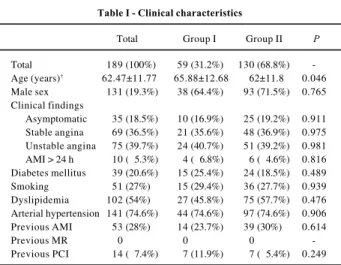
Patients did not differ in regard to clinical and angiogra-phic characteristics, except for age, which was higher in GI, 65.9±12.7 versus 62±11.8 years (p=0.046), as shown in table I. Unstable angina was the most frequent form of clinical pre-sentation, and 11.9% of GI patients and 5.4% of GII patients (p=0.25) had undergone previous percutaneous intervention. In regard to angiographic data, patients with 2-vessel coronary artery disease and good ventricular function pre-dominated. The complexity of the lesions was similar in both groups. The average number of stents placed was higher in
Table I - Clinical characteristics
Total Group I Group II P
Total 189 (100%) 59 (31.2%) 130 (68.8%) -Age (years)† 62.47±11.77 65.88±12.68 62±11.8 0.046 Male sex 131 (19.3%) 38 (64.4%) 93 (71.5%) 0.765 Clinical findings
Asymptomatic 35 (18.5%) 10 (16.9%) 25 (19.2%) 0.911 Stable angina 69 (36.5%) 21 (35.6%) 48 (36.9%) 0.975 Unstable angina 75 (39.7%) 24 (40.7%) 51 (39.2%) 0.981 AMI > 24 h 10 (05.3%) 4 (06.8%) 6 (04.6%) 0.816 Diabetes mellitus 39 (20.6%) 15 (25.4%) 24 (18.5%) 0.489 Smoking 51 (27%) 15 (29.4%) 36 (27.7%) 0.939 Dyslipidemia 102 (54%) 27 (45.8%) 75 (57.7%) 0.476 Arterial hypertension 141 (74.6%) 44 (74.6%) 97 (74.6%) 0.906 Previous AMI 53 (28%) 14 (23.7%) 39 (30%) 0.614
Previous MR 0 0 0
-Previous PCI 14 (07.4%) 7 (11.9%) 7 (05.4%) 0.249
GII [1.79 versus 1.5, (p=0.001)]. GP IIb/IIIa inhibitors were used in 15.3% of the cases (tab. II).
The success rates of the procedure were 91.5% and 97.6% (p=0.86) for GI and GII, respectively, and the incidences of major adverse cardiac complications were 5.1% and 1.5% (p=0.38) for GI and GII, respectively. One 82-year-old patient in GI (1.7%) died from renal failure and diabetes mellitus, due to aggravation of renal function, despite the previous protec-tive measures. No patient required emergency myocardial revascularization in any of the groups.
The incidence of major vascular complications was low, 1.7%, corresponding to only 1 GI patient. The results of the in-hospital phase are shown in table III.
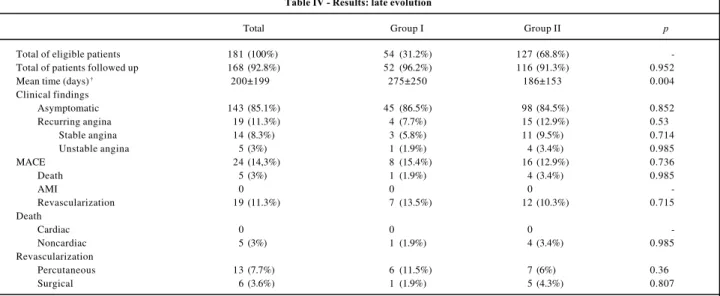
Of the eligible patients, 52 (94.5%) GI patients and 116 (90%) GII patients (p=0.92) were followed up for a mean pe-riod of 275±250 days and 186±153 days for groups GI and GII, respectively (p=0.004).
In regard to the incidence of death, no significant dif-ference was observed between the groups: 1.9% (GI) and 3.4% (GII) (p=0.98). No nonfatal acute myocardial infarction occurred. The need for new myocardial revascularization was also similar in both groups, 13.5% (GI) and 10.3% (GII) (p=0.71).
The rate of major adverse cardiac events, which was the primary objective of this study, was 15.4% and 13.7% for groups GI and GII, respectively (p=0.73).
Finally, 7.7% of GI patients and 12.9% of GII patients (p=0.53) had recurrence of angina pectoris. The results of the clinical follow-up are shown in table IV.
Discussion
The anterior descending coronary artery accounts for 40% to 50% of the irrigation of the left ventricular myocar-dium. Therefore, a severe obstructive lesion involving its proximal portion is an important predictor of morbidity and mortality 13,14.In these cases, invasive treatment is usually indicated, particularly when a large myocardial area is under a higher risk 15-17.
Coronary angioplasty and surgical myocardial revas-cularization have been indicated for the treatment of
multi-vessel coronary disease with or without involvement of the anterior descending coronary artery 18.A substudy of the Coronary Angioplasty versus Bypass Revascularization Investigation (CABRI) randomized 1,054 patients with coro-nary disease in 2 or more epicardial corocoro-nary vessels for sur-gical treatment or balloon catheter coronary angioplasty. That study, however, showed that, compared with other segments, the proximal 1/3 of the anterior descending coro-nary artery had the highest risk of developing restenosis after percutaneous intervention. This suggested that the presence of a proximal lesion in that artery should influence the choice of the revascularization strategy, when the surgi-cal approach would be the most indicated. However, that study did not routinely use coronary stents, which would have decreased the restenosis rate and the need for new re-vascularization 4,5,19.
Versaci et al 20 carried out a randomized study of patients with single-vessel disease with proximal lesion of the anterior des cending coronary artery treated with balloon catheter coronary angioplasty or stent placement. Those authors re-ported a greater event-free survival in the latter group, 70% versus 87% (p=0.04), and a lower rate of restenosis, 40% versus 19% (p=0.02), after a 1-year evolution.
The great advantage of the use of stents in the proxi-mal 1/3 of the anterior descending coronary artery is based on the fact that balloon catheter coronary angioplasty at that site has late luminal loss twice as high as that found in other arterial segments 5,21,22.
Based on these data, we tried to assess whether the involvement of the proximal segment of the anterior descen-ding coronary artery would continue to influence the evolu-tion of patients with multivessel coronary disease treated with coronary stent implantation.
In-hospital evolution was similar in both groups, and a high success rate was observed for the procedure, 91.5% for GI and 97.6% for GII (p=0.86). It is worth noting that only 1 patient (1.7%) in GI had Q-wave acute myocardial
infarc-Table II - Angiographic characteristics
Total Group I Group II p
Number of patients 189 (100%) 59 (31.2%) 130 (68.8%) -Lesions treated 411 (100%) 136 (33.1%) 275 (66.9%)
-Stents implanted 292 (100%) 94 (32.2%) 198 (67.8%) -Lesions/patient† 2.83±0.37 2.2±0.42 2.15±0.35 0.3940 Stents/patient† 1.6±0.55 1.5±0.55 1.79±0.54 0.0001 Ejection fraction† 72.7±14.9 75.2±14.4 71.7±15.1 0.1360 2-vessel 157 (83.1) 46 (78%) 111 (85.4%) 0.7880
3-vessel 32 (16.9%) 13 (22%) 19 (14.6%) 0.3970
Types of lesions
B2 105 (25.5%) 23 (16.9%) 82 (29.8%) 0.1160 C 89 (21.7%) 25 (18.4%) 64 (23.3%) 0.6970
Use of GP
IIb/IIIa inhibitor 29 (15.3%) 11 (18.6%) 18 (13.8%) 0.6120
† mean ± standard deviation.
Table III - Results: in-hospital phase
Total Group I Group II p
Success 181(95.7%) 54(91.5%) 127 (97.6%) 0.860
Success 8 (4.3%) 5 (8.5%) 3 (2.4%) 0.143 MACE 5 (2.6%) 3 (5.1%) 2 (1.5%) 0.381 Death 1 (0.5%) 1 (1.7%) 0 0.691 QAMI 1 (0.5%) 1 (1.7%) 0 0.695 NQAMI 3 (1.6%) 1 (1.7%) 2 (1.5%) 0.583
Emergency MR 0 0 0
Surgical 0 0 0
Percutaneous 0 0 0
-Vascular
complications 5 (2.6%) 3 (5.1%) 2 (1.5%) 0.381 Minor 4 (2.1%) 2 (3.4%) 2 (1.5%) 0.789 Major 1 (0.5%) 1 (1.7%) 0 0.691 ARF 4 (2.1%) 1 (1.7%) 3 (2.3%) 0.779 Stroke 2 (1.1%) 1 (1.7%) 1 (0.8%) 0.844
tion, but no emergency surgery was required. In reality, as stents control severe coronary dissection, which is the most common cause of acute occlusion after balloon catheter co-ronary angioplasty, they significantly reduce the need for emergency surgery.
These early results are in accordance with those of other authors who used stent implantation to treat multives-sel coronary disease, except for the incidence of non-Q-wave acute myocardial infarction, which was lower in our study (1.7% in GI and 1.5% in GII) as compared with the inci-dence in the series of other authors, which ranged from 6% to 18% 23-26. A probable explanation for this fact is that those authors included patients with lesions located in saphe-nous vein bypasses and used rotational and directional a-therectomy as an adjunct device; these strategies relate to a higher rate of early complications 27-32.
Major and minor vascular complications also did not differ in either group.
Clinical follow-up data showed that 86.5% of GI patients and 84.5% of GII patients were asymptomatic (p=0.85). Mathew et al 25 in their series of patients with multivessel coronary disease treated with stents also reported excellent control of symptoms because 79% of their patients had no severe angina (CCS III and IV) by the end of 1 year.
The occurrence of major adverse cardiac events, which was the primary objective of our study, was 15.4% in GI and 13.7% in GII (p=0.73), showing a similar and favora-ble evolution in both groups.
No acute myocardial infarction was observed in this period, a fact that was also reported by Kornowski et al 23 in their series.
It is worth emphasizing that the need for new myocar-dial revascularization was 13.5% in GI and 10.3% in GII (p=0.71) in our study. This need was lower than that obser-ved in the randomized studies using conventional balloon catheter coronary angioplasty or surgery for treating multi-vessel coronary disease, where that need ranged from 30% to 48% in the percutaneous group 33.
Table IV - Results: late evolution
Total Group I Group II p
Total of eligible patients 181 (100%) 54 (31.2%) 127 (68.8%)
-Total of patients followed up 168 (92.8%) 52 (96.2%) 116 (91.3%) 0.952
Mean time (days) † 200±199 275±250 186±153 0.004
Clinical findings
Asymptomatic 143 (85.1%) 45 (86.5%) 98 (84.5%) 0.852
Recurring angina 19 (11.3%) 4 (7.7%) 15 (12.9%) 0.530
Stable angina 14 (8.3%) 3 (5.8%) 11 (9.5%) 0.714
Unstable angina 5 (3%) 1 (1.9%) 4 (3.4%) 0.985
MACE 24 (14,3%) 8 (15.4%) 16 (12.9%) 0.736
Death 5 (3%) 1 (1.9%) 4 (3.4%) 0.985
AMI 0 0 0
-Revascularization 19 (11.3%) 7 (13.5%) 12 (10.3%) 0.715
Death
Cardiac 0 0 0
-Noncardiac 5 (3%) 1 (1.9%) 4 (3.4%) 0.985
Revascularization
Percutaneous 13 (7.7%) 6 (11.5%) 7 (6%) 0.360
Surgical 6 (3.6%) 1 (1.9%) 5 (4.3%) 0.807
† mean ± standard deviation.
The analysis of our data suggests that percutaneous treatment using coronary stents in a patient with multives-sel coronary artery disease may be safely performed and provides good clinical follow-up results. The involvement of the proximal portion of the anterior descending coronary artery treated with stent implantation did not prove to be a factor of worse prognosis in the clinical evolution, despite the fact that GI had the highest mean age (p=0.046), the lon-gest follow-up (p=0.004), and the lowest mean number of stents implanted (p=0.001).
Finally, the late results of the ARTS and SoS trials 34,35 are important and have been anxiously awaited. Those trials randomized patients with multivessel coronary disease for surgery or percutaneous treatment with stents, and the ana-lysis of the subgroups will probably provide further infor-mation about the importance of the proximal lesion of the an-terior descending coronary artery in patients with multives-sel coronary disease.
In conclusion, ours was a retrospective study that in-cluded a heterogeneous population with a relatively small number of patients. Among the basic clinical characteris-tics, we observed a difference in age, a longer follow-up, and a lower mean number of stents implanted in group I, facts that would not favor the patients who had lesion in the ante-rior descending coronary artery. A large variety of stent de-signs was used. Most patients treated had 2-vessel corona-ry disease and good ejection fraction, and the results here found may not occur in a population in which 3-vessel coro-nary artery disease and significant ventricular dysfunction predominate.
Acknowledgment
References
1. Vandormael MG, Deligonul U, Kem MJ, Harper M, Presant S, Gibson P, et al. Mul-tilesion coronary angioplasty: clinical and angiographic follow-up. J Am Coll Cardiol 1987; 10: 246-52.
2. Ellis SG, Cowley MJ, DiSciascio G, et al. Multivessel Angioplasty Prognosis Study Group. Determinants of 2-year outcome after coronary angioplasty in pa-tients with multivessel disease on the basis of comprehensive preprocedural eva-luation: implications for patient selection. Circulation 1991; 83: 1905-14. 3. Kurbaan AS, Richards AF, Bowker TJ. Differential restenosis rate of individual
coronary artery sites after multivessel angioplasty: implications for revasculari-zation strategy. Am Heart J 1998; 135: 703-8.
4. Serruys PW, de Jaegere P, Kiemeneij F, et al. A comparison of balloon-expandable-stent implantation with balloon angioplasty in patients with coronary artery di-sease. N Engl J Med 1994; 331: 489-95.
5. Fischman DL, Leon MB, Baim DS, et al. A randomized comparison of coronary-stent-placement and balloon angioplasty in the treatment of coronary artery di-sease. N Engl J Med 1994; 331: 496-501.
6. Heuser RR, Wong SC, Ghuang YC, et al. The LAD subgroup in the Stent Resteno-sis Study (STRESS): the most pronounced antirestenoResteno-sis effect of stenting. Eur Heart J 1995; 16(suppl.): 291.
7. Campeau L. Grading of angina pectoris. Circulation 1976; 54: 522-3. 8. Braunwald E. Unstable angina: a classification. Circulation 1989; 80: 410-4. 9. Alpert J, Thygesen K, et al. Myocardial Infarction Redefined - A Consensus
Do-cument of The Joint European Society of Cardiology/American College of diology Committee for the Redefinition of Myocardial Infarction. J Am Coll Car-diol 2000; 36: 959-69.
10. Ryan TJ, Faxon DP, Gunnar RM, et al. Guidelines for percutaneous transluminal coronary angioplasty: a report of the American College of Cardiology/American Heart Association Task Force on Assessment of Diagnostic and Therapeutic Car-diovascular Procedures (Subcommittee on Percutaneous Transluminal Corona-ry Angioplasty). J Am Coll Cardiol 1988; 12: 529-45.
11. Ellis SG, Vandormael MG, Cowley MJ, et al. Coronary morphologic and clinical determinants of procedural outcomes with angioplasty for multivessel coronary disease: inplications for patients selection. Circulation 1990; 82: 1193-202. 12. The TIMI Study Group. Thrombolysis in myocardial infarction (TIMI) trial:
pha-se I findings. N Engl J Med 1985; 312: 932-6.
13. Mahmarian JT, Pratt Cm, Boyce Tm, Verani MS. The variable extent of jeopardized myocardium in patients with single vessel coronary artery disease: quantifica-tion by thallium-201 single photon emission computed tomography. J Am Coll Cardiol 1991; 17: 355-62.
14. Kalbfleisch H, Hort W. Quantitative study on the size of coronary supplying areas postmortem. Am Heart J 1977; 94: 183-8.
15. Klein LW, Weintraub WS, Agarwal JB, et al. Prognostic significance of severe narrowing of the proximal portion of left anterior descending coronary artery. Am J Cardiol 1986; 58: 42-6.
16. Rahimtoola SH. Left main equivalence is still an unproved hypothesis but proxi-mal left anterior descending coronary artery disease is a high risk lesion. Am J Car-diol 1984; 53: 1719-21.
17. Califf RM, Tornacechi Y, Lee KL, et al. Outcome in one-vessel coronary artery di-sease. Circulation 1993; 67: 283-90.
18. White HD. Angioplasty versus bypass surgery. Lancet 1995; 346: 1174-5. 19. Salvage MP, Fischman DL, Schatz RA, et al. Long-term angiographic and clinical
outcome after implantation of a balloon-expandable stent in the native coronary circulation. J Am Coll Cardiol 1994; 128: 1207-12.
20. Versaci F, Gaspardone A, TomaiFF, Crea F, Chiariello L, Gioffré P. A comparison of coronary-artery stenting with angioplasty for isolated stenosis of the proximal left anterior descending coronary artery. N Engl J Med 1997; 336: 817-22. 21. Phillips OS, Segovia J, Alfonso F, et al. Advantage of stents in the most proximal
left anterior descending coronary artery. Am Heart J 1998; 135: 719-25. 22. Foley DP, Melkert R, Serruys PW. Influence of coronary vessel size on
renarro-wing process and late angiographic outcome after successful balloon angioplas-ty. Circulation 1994; 17: 758-69.
23. Kornowski R, Mehran R, Sartler LF, et al. Procedural results and late clinical outcomes following multivessel coronary stenting. J Am Coll Cardiol 1999; 33: 420-6.
24. Laham RJ, Ho KK, Baim DS, Kuntz RE, Cohen DJ, Carrozza JP Jr. Multivessel Pal-maz-Schatz stenting: early results and one-year outcome J Am Coll Cardiol 1997; 30: 180-5.
25. Mathew V, Garratt KN, Holmes DR Jr. Clinical outcome after multivessel corona-ry stent implantation. Am Heart J 1999; 138: 1105-10.
26. Antolin RAH, Alfonso F, Goicolea J, et al. Results (>6 months) of stenting of >1 major coronary artery in multivessel coronary artery disease. Am J Cardiol 1999; 84: 147-51.
27. Topol EJ, Leya F, Pinkerton CA, et al. A comparison of directional atherectomy with angioplasty in patients with coronary artery disease. N Engl J Med 1993; 329: 221-7.
28. Bass TA, Whitlow PL, et al. Acute complications related to coronary rotational atherectomy strategy: A report from the STRATAS trial. J Am Coll Cardiol 1996; 29(suppl. A): 68-A.
29. Reisman M, Harms V, et al. Comparison of early and recent results with rotational atherectomy. J Am Coll Cardiol 1997; 29: 353-7.
30. Topol E, Leya F, Pinkerton C, et al. A comparison of directional atherectomy with coronary angioplasty in patients with coronary artery disease. N Engl J Med 1993; 329: 221-7.
31. Adelman A, Cohen E, Kimball B, et al. A comparison of directional atherectomy with balloon angioplasty for lesions of the left anterior descending coronary ar-tery. N Engl J Med 1993; 329: 228-33.
32. Tan K, Henderson R, Sulke N, Cooke R. Percutaneous transluminal coronary an-gioplasty in patients with prior coronary artery bypass grafting: tem years of ex-perience. Cath Cardiovasc Diagn 1994; 31: 11-7.
33. Pocock SJ, Henderson RA, Richards AF, et al. Meta-analysis of randomized trials comparing angioplasty with bypass surgery. Lancet 1995; 346: 1184-9. 34. Serruys PW, Unger F, van Hout BA, et al. The ARTS Study (Arterial
Revasculari-zation Therapies Study). Semin Interv Cardiol 1999; 4: 209-19.