Department of Atherosclerosis, Department of Clinical Cardiology, and FUNCOR - Brazilian Society of Cardiology
Mailing address: Raul D. Santos - InCor - Av. Dr. Enéas C. Aguiar , 44 - 1o andar
- 05403-000 - São Paulo, SP – Brazil - E-mail- [email protected]
Objective - To report about a group of physicians’
understanding of the recommendations of the II Brazilian Guidelines Conference on Dyslipidemias, and about the state of the art of primary and secondary prevention of atherosclerosis.
Methods - Through the use of a questionnaire on
dys-lipidemia, atherosclerosis prevention, and recommendati-ons for lipid targets established by the II Brazilian Guide-lines Conference on Dyslipidemias, 746 physicians, 98% cardiologists, were evaluated.
Results - Eighty-seven percent of the respondents stated
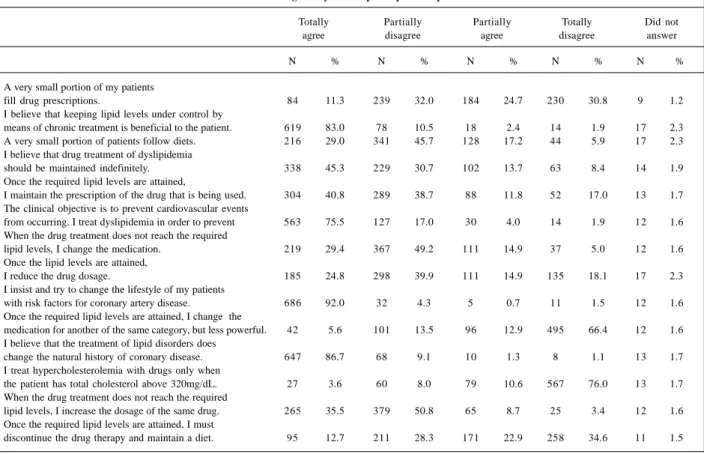
that the treatment of dyslipidemia changes the natural history of coronary disease. Although most of the participants followed the total cholesterol recommendations (<200mg/dL for atherosclerosis prevention), only 55.8% would adopt the target of LDL-C <100 mg/dL for secondary prevention. Between 30.5 and 36.7% answered, in different questions, that the recommended level for HDL-C should be <35mg/dL. Only 32.7% would treat their patients indefinitely with lipid-lowering drugs. If the drug treatment did not reach the proposed target, only 35.5% would increase the dosage, and 29.4% would change the medication. Participants did not know the targets proposed for diabetics.
Conclusion - Although the participating physicians
valued the role played by lipids in the prevention of athe-rosclerosis, serious deficiencies exist in their knowledge of the recommendations given during the II Brazilian Guide-lines Conference on Dyslipidemias.
Kew words: Hypercaulesterolomia atherosclerosis, risk factors
Arq Bras Cardiol, volume 75 (nº 6), 296-302, 2000
Raul D. Santos, Andrei C. Spósito, José Ernesto dos Santos, Francisco H. Fonseca, Emílio H. Moriguchi, Tania L. R. Martinez, Dikran Armaganijam, Sérgio Timerman, Ari Timerman,
José C. N icolau, José A. F. Ramires
São Paulo, SP - Brazil
PANDORA - Survey of Brazilian Cardiologists about
Cholesterol Reduction
In Brazil, according to death certificate data from the SUS (Unified Health System) (Internet site: http//www.sau-de.gov.br), acute myocardial infarction was responsible for 76.5 % (N = 73,636) of deaths second to ischemic heart disease. That represents roughly 15% of all cause mortality for all ages.
The role played by dyslipidemia in the genesis of coro-nary atherosclerosis is well established. More specifically, high levels of total cholesterol and LDL-cholesterol (LDL-C), reduction in HDL-cholesterol (HDL-C) and increase in triglyceride levels predispose to coronary disease 1.
Today, the role of hypolipemic therapy in the prevention of coronary artery disease morbidity and mortality is no longer discussed 2. In 1996, when the results of the secondary prevention study 4S 3 and the primary prevention study WOS-COPS 4 became known, the findings of the II Brazilian Gui-delines Conference on Dyslipidemias were published 5. Goals for the primary and secondary prevention of coronary artery disease were established. The goals for secondary prevention were reinforced by the findings of the CARE trial 6.
Although the recommendations about the control of risk factors for coronary artery disease are a constant among international medical societies 7,8, studies show low adhe-rence to those recommendations from patients and from physicians 9,10. The most classic example is the data from the EUROASPIRE 11 study, showing low rates of control of arte-rial hypertension, a still high proportion of smokers and obesity, besides showing the low use of statins by coronary artery disease patients 6 months after hospitalization. We believe that lack of adherence to those guidelines, which in their majority were validated by clinical evidence, harms patients.
and the state of the art of primary and secondary prevention measures for coronary atherosclerosis.
Methods
This was a descriptive cohort study conducted during the LIV Congress of the Brazilian Society of Cardiology in the city of Recife in September 1999. Seven hundred and forty-six physicians, 20% of the congress’ attendees, 98% cardiologists, were evaluated. Forty percent of the partici-pants were from the north/northeast regions, 37% were from the southwest regions, 13% were from the south, and 10% were from the west central region.
Both the questionnaire and the clinical cases were prepared by members of the Departments of Atheroscle-rosis and Clinical Cardiology of the Brazilian Society of Car-diology, aided by professionals experienced in market rese-arch. The questions addressed mainly the importance given by physicians to dyslipidemia and whether they know the recommendations of the II Brazilian Guidelines Conference on Dyslipidemias. In summary those recommendations were: total cholesterol and LDL-C, respectively, <200mg/dL and <100mg/dL in secondary prevention and <240mg/dL and <130mg/dL in high-risk primary prevention (2 or more risk factors besides elevated cholesterol). In low- risk prima-ry prevention (less than 2 risk factors besides elevated cholesterol) the recommendations were LDL-C <160mg/dL but >130mg/dL. In all cases triglyceride levels <200mg/dL and HDL-C >35mg/dL were recommended. A special re-commendation was made for diabetics, because they show a very high risk of coronary events. Similar values were suggested for secondary prevention patients, but in this case triglycerides should be <150mg/dL.
Assessment procedure – 1) Specific questions - Each participant in the Congress was given, together with the material related to the Congress, a questionnaire to be filled individually containing 11 questions. The questions were to be answered anywhere, without hurrying, and upon com-pletion placed in urns distributed around the convention center during the Congress.
See Appendix 1 for the full text of these questions. 1) Estimate the proportion of coronary artery disease patients seen by physicians in their offices.
2) Evaluate the proportion of patients diagnosed as having dyslipidemia.
3) Estimate the percentage of the lipid disturbances found in the patients’ (4 options).
4) Behavior physicians recommended before a patient was diagnosed with dyslipidemia: diet only; drug therapy only; a diet-and-drug therapy, and no treatment at all.
5) Experience in managing hyperlipidemias.
6) Evaluate the knowledge of the recommendations proposed by the II Brazilian Guidelines Conference on Dys-lipidemias in 6 clinical situations
7) Answers to statements regarding dyslipidemia treat-ment in which participants would agree or not.
8) The importance attributed by the physician to treat-ment interruption, using a predefined scale.
9) The time necessary for a new evaluation of plasma lipids after the treatment was started.
10) Average duration of the drug treatment for dyslipi-demia.
11) Which drugs physicians believed to be able to change the natural history of coronary disease in coronary artery disease patients, with or without previous infarct.
2) Clinical cases - Four clinical cases were proposed to assess the knowledge of each physician regarding the recommendations of the II Brazilian Guidelines Conference on Dyslipidemias, as well as the current literature, in the fol-lowing clinical situations: a patient with coronary artery disease, but with no hypercholesterolemia; a patient with se-condary dyslipidemia; a patient with diabetes mellitus and hypertriglyceridemia; a patient in primary prevention at hi-gh risk for coronary artery disease. Physicians were asked to answer the questions by female monitors distributed through the Congress. Cases were presented on data sheets to be evaluated by the physicians on a separate sheet. The assessment of the results of the clinical cases will be the ob-ject of separate papers to be published, which will discuss the results in depth.
Results
Discussion
The study population had knowledge of the role and treatment of dyslipidemia in the prevention of atheroscle-rosis. The great majority of participants said they believed that the treatment of dyslipidemia prevents atherosclerosis, and statins were said by participants to be the main drugs that change the natural history of atherosclerosis, well abo-ve the anti-platelet drugs and beta-blockers. Howeabo-ver, we have found distortions in the knowledge of the recommen-dations of the II Brazilian Guidelines Conference on Dyslipi-demias and on the use of hypolipemic drugs.
The combination of pharmacological treatment and diet was the favorite option for the control of dyslipidemia. However, although they recognized the value of statins, al-most 40% of participants would treat their patients with a diet only. In our opinion, this approach is valid in cases of low-risk primary prevention, but not in cases of secondary prevention. The base of any hypolipemic treatment is diet. However, evidence exists that the reduction of LDL-C with Phase I and Phase II diets in individuals who are out of me-tabolic units is about 6% 12. In cases of secondary preventi-on, a diet would hardly reduce LDL-C to 25-30%, nor would the target of LDL-C <100mg/dL be reached. Values attained would depend on the dose or type of statin used 2,13.
Total cholesterol levels <200mg/dL were recommended by most of the participants for the hypothetical patients in question 6, even for the 38-year-old female without any other risk factor besides high cholesterol. In general, when total cholesterol is <200mg/dL, LDL-C is about 100mg/dL, except in the case of patients with low HDL-C levels. The to-tal cholesterol value may be a substitute for LDL-C, as long as the HDL-C is also measured. Data from Framingham 1
in-dicate that the total cholesterol/HDL-C ratio is a predictor of risk of coronary artery disease. Also, in the 4S study 3 the treatment target was to reduce total cholesterol to levels <200mg/dL. Our study’s finding would be stimulating if the values found for LDL-C followed the values of total choles-terol. In patients with coronary artery disease and in those with diabetes mellitus, an undesirably high number of phy-sicians considered levels of LDL-C <100mg/dL as appro-priate. In the other cases of primary prevention, it seems that many physicians accepted the recommendations of the con-sensus conference. However, another common mistake among participants was that almost one third of the res-ponders considered levels of HDL-C <35mg/dL as desirable, when for all situations those levels should be >35mg/dL 5. The great majority of responders followed the guidelines conference recommendations regarding triglyceride levels.
Although a large number of participants agreed on the use of hypolipemic drugs to prevent CAD, between 35% and 60% of the participants said they would not maintain such drugs after reaching the levels recommended for pre-vention. In question 10, a great number of the participants chose not to answer about the duration of the treatment, and only about one third of all participants said they would keep the pharmacological therapy indefinitely. This fact is worrisome because the participants did not take into ac-count the evidence that the difference in the clinical benefit from using statins will differ from that of using placebo only after 1 to 2 years of continuous treatment 2. The average treatment duration in the large statin studies was 5.4 years. After statins are discontinued, lipids will probably return to their pretreatment values and, until proven otherwise, the pharmacological treatment must be continued indefinitely. Another fact that worries us is that only 35% of the
Table I - Adequate blood levels of total cholesterol (TC), LDL-cholesterol (LDL-C), HDL-cholesterol (HDL-C) and triglycerides (TG) in mg/dL for the hypothetical patients in question 6 in accord to the 746 participants
Man, Woman Mam, Woman, Woman, Man, 45 years,
40 years, 40 years, 50 years, 40 years 38 years, smoker father hypertensive non smoker, smoker, type II diabetes smoker (52yr old) brother
diabetic normotensive CAD dyslipidemia (48 yr old),
normoglycemic mixed both infarcted
N % N % N % N % N % N %
TC <200 676 90.6 531 71,2 686 92.0 644 86.3 636 85.3 608 81.5
201 a 239 18 2.4 84 11,3 9 1.2 28 3.7 25 3.4 82 11.0
>240 21 2.8 98 13.1 19 2.5 31 4.2 46 6.2 23 3.1
N. A. 31 4.2 33 4.4 32 4.3 43 5.8 39 5.2 33 4.4
LDL-C <100 195 26.1 35 4.7 416 55.8 184 24.7 118 15.8 287 38.5
101 a 130 416 55.8 360 48.3 229 30.7 410 55.0 465 62.3 354 47.5
131 a 159 50 6.7 96 12.9 33 4.4 45 6.0 53 7.1 23 3.1
>160 45 6.0 212 28.4 23 3.1 54 7.2 64 8.6 36 4.8
N. A. 40 5.4 43 5.8 45 6.0 53 7.1 46 6.2 46 6.2
HDL-C <35 266 35.7 254 34.0 230 30.8 228 30.6 227 30.4 239 2.0
36 - 51 289 38.7 313 42.0 305 40.9 310 41.6 318 42.6 294 39.4
> 52 153 20.5 143 19.2 176 23.6 164 22.0 166 22.2 179 24.0
NR 38 5.1 36 4.8 35 4.7 43 5.8 36 4.8 34 4.6
TG <200 630 84.4 627 84.0 621 83.2 601 80.6 616 82.6 614 82.3
>201 25 3.4 31 4.2 16 2.1 25 3.3 32 4.3 17 2.3
NR 91 12.2 88 11.8 110 4.7 120 16.1 98 13.1 115 15.4
participants said they would increase the doses, and 18% said they would change the drug in order to reach the levels recommended by the consensus conference. This finding suggests a lack of knowledge of the pharmacology of sta-tins and the prevention studies. In case the recommended value is not reached or, as an alternative, reductions betwe-en 25 and 35% in LDL-C occur, as happbetwe-ened in the clinical studies 2, the dose must be increased 3,14 or the drug may be changed to a more powerful one 15. Each time we double the dose of statins, an average 6% reduction occurs in LDL-C 16. None of the large studies on prevention used any dosage of statins that might be considered low. On the contrary, the 4S 3 study used 20-40 mg of simvastatin; the WOSCOPS 4, CARE 6 and LIPID 17 studies used 40mg of pravastatin, and the AFCAPS/TEXCAPS 14 study used 20-40mg of lovastatin. Those were the minimum required doses to achieve a
satis-Table II - Answers given by the 746 participants to question 7
Totally Partially Partially Totally Did not
agree disagree agree disagree answer
N % N % N % N % N %
A very small portion of my patients
fill drug prescriptions. 84 11.3 239 32.0 184 24.7 230 30.8 9 1.2
I believe that keeping lipid levels under control by
means of chronic treatment is beneficial to the patient. 619 83.0 78 10.5 18 2.4 14 1.9 17 2.3 A very small portion of patients follow diets. 216 29.0 341 45.7 128 17.2 44 5.9 17 2.3 I believe that drug treatment of dyslipidemia
should be maintained indefinitely. 338 45.3 229 30.7 102 13.7 63 8.4 14 1.9 Once the required lipid levels are attained,
I maintain the prescription of the drug that is being used. 304 40.8 289 38.7 88 11.8 52 17.0 13 1.7 The clinical objective is to prevent cardiovascular events
from occurring. I treat dyslipidemia in order to prevent 563 75.5 127 17.0 30 4.0 14 1.9 12 1.6 When the drug treatment does not reach the required
lipid levels, I change the medication. 219 29.4 367 49.2 111 14.9 37 5.0 12 1.6 Once the lipid levels are attained,
I reduce the drug dosage. 185 24.8 298 39.9 111 14.9 135 18.1 17 2.3
I insist and try to change the lifestyle of my patients
with risk factors for coronary artery disease. 686 92.0 32 4.3 5 0.7 11 1.5 12 1.6 Once the required lipid levels are attained, I change the
medication for another of the same category, but less powerful. 42 5.6 101 13.5 96 12.9 495 66.4 12 1.6 I believe that the treatment of lipid disorders does
change the natural history of coronary disease. 647 86.7 68 9.1 10 1.3 8 1.1 13 1.7 I treat hypercholesterolemia with drugs only when
the patient has total cholesterol above 320mg/dL. 27 3.6 60 8.0 79 10.6 567 76.0 13 1.7 When the drug treatment does not reach the required
lipid levels, I increase the dosage of the same drug. 265 35.5 379 50.8 65 8.7 25 3.4 12 1.6 Once the required lipid levels are attained, I must
discontinue the drug therapy and maintain a diet. 95 12.7 211 28.3 171 22.9 258 34.6 11 1.5
Table III - Average time of dyslipidemia treatment according to the 746 participants
Time of treatment N %
less than 1 month 2 0,3
from 1 to 3 months 40 5,3
from 3 to 6 months 66 9,0
from 6 to 9 months 17 2,3
from 9 months to 1 year 22 2,9
more than 1 year 53 7,2
whole life 245 33,0
did not answer 301 40,0
Total 746 100
factory reduction in total cholesterol and LDL-C. One sho-uld remember that in the studies performed in the ‘70s and ‘80s with fibrates 18,19 resins 20, and in the recent HERS 21 stu-dy with estrogens and progestogens, the small 10% de-crease of in total cholesterol was not enough to reduce co-ronary mortality or coco-ronary events, as was the case in the latter study . Statins are a safe group of drugs for which the incidence of serious side effects is very low, in the order of 0.08% to 1.5% for the increase of aminotransferases and CPK 22. Higher doses may be used safely 15.
The change of habits and the awareness of patients, as well as concurrent pathologies, were considered more im-portant than the cost and side effects of the drugs, for the discontinuation of the pharmacological treatment. For the participants, as well as in reports in the literature 23,24, life style changes are very important and may be the only provi-sion required in cases of primary prevention. But in cases of secondary prevention, we would like to emphasize that sta-tins add to other preventive measures and are not superse-ded by them 25. It is possible that chronic concomitant di-seases needing continuous treatment have a negative im-pact on the use of statins due to the high cost of the latter. Also, patients having to take a great number of medications would reduce adherence to the treatment.
conducted in other countries. Frolics et al. evaluating col-leagues in the United States showed that only 50% of the physicians evaluated would adopt NCEP goals for LDL-C 26. Data from the EUROASPIRE 11 study showed that about 44% of coronary artery disease patients that were evaluated had cholesterol levels above the recommended values. Re-cently, another large U.S. study that evaluated 140 cardiolo-gy and multispeciality clinics showed that only 25% of 58,890 patients with coronary disease had reached the target of LDL-C <100mg/dL proposed by the NCEP 27. One of the explanations for these findings is that physicians we-re not in the habit of following the we-recommendations given by the societies, or maybe they did not know those recom-mendations 10. Another explanation might be the excessive number of recommendations or consensus statements abo-ut various diseases, which make the job of the physician very hard to perform if he or she were to try to comply with all of them.
In conclusion, in the study population, both the re-commendations given during the II Brazilian Guidelines
Conference on Dyslipidemias and the information from the large studies on prevention are not being followed as they should be. Apparently, the participants had little understan-ding of the use of statins for prevention. These finunderstan-dings could be indicators of what is going on in our country as a whole. In order to correct the distortions found in our study, we propose that the findings of this study and the interna-tional studies that evaluated the knowledge of the control of dyslipidemias be divulged. Physicians must also be made aware of the continuing medical education courses organi-zed jointly by the Departments of Atherosclerosis, Clinical Cardiology, and FUNCOR. Also a plan is underway to upda-te the II Brazilian Guidelines Conference on Dyslipidemias with an emphasis on new information and the reinforcement of the recommendations for lipid values, treatment duration, and the assessment of the absolute risk of coronary disease as a threshold value in pharmacological treatment. The next step would be to give courses aimed at the population in ge-neral which, in our opinion, is mostly interested in preven-ting cardiovascular events.
1. Castelli WP. The new pathophysiology of coronary artery disease. Am J Cardiol 1998; 82: 60T-65T.
2. LaRosa JC, He J, Vupputuri S. Effect of statins on risk of coronary disease. A meta-analysis of randomized controlled trials. JAMA 1999; 282: 2340-6. 3. Scandinavian Simvastatin Survival Study Group: Randomized trial of
choleste-rol lowering in 4444 patients with coronary heart disease: The Scandinavian Simvastatin Survival Study (4S). Lancet 1994; 344: 1383-9.
4. Shepherd J, Cobbe SM, Ford I, et al for The West of Scotland Coronary Prevention Study Group. Prevention of coronary heart disease with pravastatin in men with hypercholesterolemia. N Eng J Med 1995; 333: 1301-07.
5. II Consenso Brasileiro sobre Dislipidemias. Detecção, avaliação e tratamento. Arq Bras Cardiol 1996; 67: 1-16.
6. Sacks FM, Pfeffer MA, Moye LA, et al. The effect of pravastatin on coronary events after myocardial infarction in patients with average cholesterol levels. Choleste-rol and Recurrent Events Trial investigators. N Engl J Med 1996; 335: 1001-09. 7. Summary of the second report of the National Cholesterol Education Program (NCEP) Expert Panel and detection, evaluation, and treatment of high blood cholesterol in adults (Adult Treatment Panel II). JAMA 1993; 269: 3015-23. 8. Pyoralla K, De Backer G, Graham I, Poole-Wilson P and Wood D on behalf of
the Task Force. Prevention of coronary heart disease in clinical practice. Recom-mendations of the Task force of the European society of Cardiology, European Atherosclerosis Society, and European Society of Hypertension. Eur Heart J 1994; 110: 121-61.
9. Roberts WC. The underused miracle drugs: The Statin drugs are to atherosclero-sis what penicilin was to infectious diseases. Am J Cardiol 1996; 78: 377-8. 10. Feely J. The therapeutic gap- compliance with medication and guidelines.
Athe-rosclerosis 1999; 147(suppl 1): S31-S7.
11. EUROASPIRE Study Group. EUROASPIRE a European Society of Cardiolo-gy survey of secondary prevention of coronary heart disease: Principal Results. Eur Heart J 1997; 18: 1569-82.
12. Smith GD, Shah E. Systematic review of dietary intervention trials to lower blood total cholesterol in free-living subjects. Br Med J 1998; 316: 1213-20. 13. Nawrocki JW, Weiss SR, Davidson MH et al. Reduction of LDL-cholesterol by
25-60% in patients with primary hypercholesterolemia by atorvastatin, a new H-MGCo-A reductase inhibitor. Arterioscler Thromb Vasc Biol 1995; 15: 678-82. 14. Downs JR, Clearfield M, Weiss DO, et al. Primary prevention of acute coronary events with lovastatin in men and women with average cholesterol levels. Re-sults of AFCAPS/TEXCAPS. JAMA 1998; 279: 1615-22
References
15. Jones P, Kafonek S, Laurora I, Hunninghake D. Comparative dose efficacy study of atorvastatin versus simvastatin, pravastatin, lovastatin, and fluvastatin in pa-tients with hypercholesterolemia. Am J Cardiol 1998; 81: 582-7.
16. Vaughn CJ, Gotto Jr AM, Basson CT. The evolving role of statins in the manage-ment of atheroscleroris. J Am Coll Cardiol 2000; 35: 1-10.
17. The Long-Term Intervention with Pravastatin in Ischaemic Disease (LIPID) Study Group. Prevention of Cardiovascular Events and Death with Pravastatin in Patients with Coronary Heart Disease and a Broad Range of Initial Cholesterol Levels. N Engl J Med 1998; 339: 1349-57.
18. Report from the Committee of Principal Investigators. A co-operative trial in the primary prevention of ischaemic heart disease using clofibrate. Br Heart J 1978; 40: 1069-18. 19. Frick MH, Elo O, Haapa K, et al. Helsinki heart study: primary prevention trial
with gemfibrozil in middle-aged men with dyslipidemia. N Eng J Med 1987; 317: 1237-45.
20. Lipid Research Clinics Program. The Lipid Research Clinics Coronary Primary Prevention Trial Results. 1. Reduction in incidence of coronary heart disease. JAMA 1984; 214: 351-64.
21. Hulley S, Grady D, Bush T, et al. Randomized trial of estrogen plus progestin for secondary prevention of coronary heart disease in postmenopausal women. He-art and estrogen/progestin replacement study (HERS) research group. JAMA 1998; 280: 605-13.
22. Shepherd J. Fibrates and statins in the treatment of hyperlipidaemia: an appraisal of their efficacy and safety. Eur Heart J 1995; 6: 5-13.
23. Martinez-Gonzalez MA, Bueno-Cavanillas A, Sanchez-Izquierdo F, Aguinaga Ontoso I, Jimenez-Moleon JJ, Delgado-Rodriguez M. Changes in coronary risk profiles in employees after three years of multifactorial intervention. Eur J Epide-miol 1998; 14: 653-62.
24. Grimm RH Jr. The multiple risk factor intervention trial in the U.S. A summary of results at four years in special intervention and usual care men. Prev Med. 1983; 12: 185-90.
25. Flanagan DE, Cox P, Paine D, Davies J, Armitage M. Secondary prevention of coro-nary heart disease in primary care: a healthy heart initiative. QJM 1999; 92: 245-50. 26. Froliks JP, Zyzanski SJ, Schwartz JM, Suhan PS. Physician noncompliance with the 1993 National Cholesterol Education Program (NCEP-ATP II) guidelines. Circulation 1998; 98: 851-5.
Appendix 1
Full questions proposed to physicians.
SBC questionnaire
SBC text
Profile Total - C LDL – C HDL Triglycerides
Man, 40 years; hypertensive and diabetic
Woman, 40 years, non smoker, normotensive and normoglycemic
Man, 50 years, smoker, with Coronary arterial disease
Woman, 40 years
Type II diabetes
Woman, 38 years, smoker,
mixed dyslipidemia
Man, 45 years, smoker
Infarcted father (52years)
1. Of the patients you see in your practice, how many have coronary artery disease?
( ) up to 10% of patients ( ) from 10% to 25% of patients ( ) from 25% to 50% of patients ( ) more than 75% of patients ( ) from 50% to 75% of patients
2. Of the patients you see in your practice, how many have diagnosed lipid change?
( ) up to 10% of patients ( ) from 50% to 75% of patients ( ) from 10% to 25% of patients ( ) more than 75% of patients ( ) from 25% to 50% of patients
3. Of your patients with diagnosed lipid change, what is the percentage with:
A- High total cholesterol and normal triglycerides _________
B- High LDL and normal triglycerides _________
C- High triglycerides and normal cholesterol _________
D- High LDL and triglycerides _________
Should add 100
4. Of your patients with diagnosed lipid change, what is the percentage for the following provisions:
A- Diet only _________
B- Drug therapy only _________
C- Diet and drug therapy combined _________
D- Do not treat _________
Should add 100
5. On the average, how long (how many months) does it take to reduce or normalize cholesterol by means of drug therapy?
1 2 3 4
A very small portion of my patients fills drug prescriptions.
I believe that maintaining lipidic levels under control by means of chronic treatment is beneficial to the patient.
A very small portion of patients follow diets.
I believe that drug treatment of dyslipidemia should be maintained indefinitely.
Once the required lipid levels are reached, I maintain the prescription of the drug that is being used.
The clinical objective is to prevent cardiovascular events from occurring. I treat dyslipidemia in order to prevent.
When the drug treatment does not reach the required lipid levels, I change medication.
Once the lipid levels are attained, I reduce the drug dosage.
I insist and try to change the lifestyle of my patients with risk factors for the Coronary Artery Disease.
Once the required lipid levels are attained, I change the medication to another of the same category, but less powerful.
I believe that the treatment of lipid disorders does change the natural history of the coronary disease.
I treat hypercholesterolemia with drugs only when the patient has total cholesterol above 320 mg/dL.
When the drug treatment does not reach the required lipid levels, I increase the dosage of the same drug..
Once the required lipid levels are reached, I must discontinue the drug therapy and maintain a diet.
1 2 3 4 5 6 7 8
Side effects
Cost of treatment
Type of drug
Amount of drug
Awareness of patient
Change in patient’s habits
Concomitant pathologies
7. Regarding the statements below, answer on a scale of 1 to 4, where:
1 - totally agree 2 - partially agree
3 - partially disagree 4 - totally disagree
8. For the items below, what is the degree of difficulty to reach the objectives in the treatment of lipid disorders? (1= no difficulty; 8=highly difficult)
9. After how many months of treatment (diet and/or drug), do you ask for a new lipid profile to reassess a patient?
( ) less than 3 months ( ) from 9 months to 1 year
( ) from 3 to 6 months ( ) more than 1 year
( ) from 6 to 9 months ( ) I don’t ask
10. What is the average period of drug treatment for dyslipidemias?
( ) less than 1 month ( ) from 9 months to 1 year
( ) from 1 to 3 months ( ) more than 1 year
( ) from 3 to 6 months ( ) whole life
( ) from 6 to 9 months