Assistance to Normal Delivery in Two Public
Maternities: Perception of the Health
Professionals
Assistência para parto normal em duas maternidades
públicas: percepção dos pro
fi
ssionais da saúde
Nayara Rodrigues Gomes de Oliveira
1Thaís Rocha Assis
2Waldemar Naves do Amaral
3Valdivina Eterna Falone
4Lívia Maria Oliveira Salviano
51Division of Infectious and Parasitics Diseases, Department of Health Sciences, Universidade Federal de Goiás, Jataí, Goiás, Brazil 2Department of Health Sciences, Universidade Federal de Goiás, Jataí,
Goiás, Brazil
3Division of Infectious and Parasitic Diseases, Department of Health Sciences Program, Universidade Federal de Goiás, Goiânia, Goiás, Brazil 4Department of Women’s Health, Clínica Fértile, Goiânia, Goiás, Brazil 5Department of Medicine, Universidade Federal de Goiás, Goiânia,
Goiás, Brazil
Rev Bras Ginec Obst 2017;39:202–208.
Address for correspondence Nayara Rodrigues Gomes de Oliveira, MSc, Departmento de Ciências da Saúde, Universidade Federal de Goiás, Av. Walquiria n. 81, Vila Santos Dumont, Casa 81, Aparecida de Goiânia; CEP: 74910439, Brazil (e-mail: [email protected]).
Keywords
►
labor
►
delivery care
►
perception
►
professional
Abstract
Purpose
To evaluate the perception of health professionals involved in the labor process
and the assistance to normal delivery, comparing two hospitals in the city of Goiânia, Brazil,
regarding the perception of these professionals when they are performing the routines and
practices recommended by the World Health Organization (WHO).
Methods
This is an analytical comparative study with a quantitative approach,
performed in two public hospitals in the city of Goiânia, in the state of Goiás, Brazil.
The study included 86 professionals working in assistance to immediate labor in two
hospitals. A questionnaire containing 40 questions was applied. The questionnaire
related to the Program for the Humanization of Prenatal and Childbirth Care (PHPN, in
the Portuguese acronym) of the Brazilian Ministry of Health, the presence of a
companion, and the procedures performed. For the data analysis, we used the
chi-square and Fisher
’
s exact tests.
Results
Most of the professionals claimed to know about the PHPN proposed by
Brazilian Ministry of Health in the two hospitals. With regard to good practices, most
professionals said that they are performed in maternity ward 2, while on maternity 1,
although many of them are present, there are still many unnecessary interventions.
Conclusion
When comparing the two maternity hospitals, maternity 2, which was
created as a routine humanization model, manages to better adhere to the WHO
recommendations. In maternity 1, there was a series of interventions considered by the
WHO as ineffective, or used in an inappropriate manner.
received
September 5, 2016 accepted
March 15, 2017 published online May 18, 2017
DOI https://doi.org/ 10.1055/s-0037-1603315. ISSN 0100-7203.
Copyright © 2017 by Thieme Revinter Publicações Ltda, Rio de Janeiro, Brazil Original Article
Introduction
In 1985, with the goal of improving the quality of obstetric care in several countries, the Pan American Health Organi-zation (PAHO) and the World Health OrganiOrgani-zation (WHO) met to discuss the cautious use of technologies in the attention of labor and birth.1In 1996, the WHO2published
a practical guide describing a series of practices and recom-mendations for childbirth care, from the results of interna-tional discussions and scientific evidence-based data, providing a framework to combat high maternal and neona-tal morneona-tality rates. Since then, several governments have issued and tried to implement these practices, contributing significantly to reducing avoidable deaths.1
In Brazil, with the movement of favoring the improvement of the assistance to delivery, the Brazilian Ministry of Health created the Program for the Humanization of Prenatal and Childbirth Care3 (PHPN, in the Portuguese acronym) on
January 6, 2000. This program aims to improve the assistance during the gestation, childbirth and puerperal periods, guaranteeing the women’s civil rights throughout this
process.
There is scientific evidence that several practices followed during the assistance to gestation and childbirth or pregnan-cy outcomes promote better obstetric results and are impor-tant for the reduction of negative perinatal outcomes. Appropriate obstetrical care with the use of convenient technology may significantly decrease the number of com-plications that occur during childbirth. However, the inap-propriate use of technology and unnecessary interventions can cause maternal and fetal harm.4
However, even with all the governmental initiatives to implement these practices, unnecessary interventions and high maternal mortality rates persist in the national and international scenario.1The WHO, in 2013, reported that
289,000 women worldwide died during pregnancy, child-birth and the puerperium, with a worldwide death rate of 210 mothers per 100,000 live births.1
Given this reality, the present study aims to evaluate the perception of the health professionals involved in the labor process regarding normal deliveries, and to compare two maternities hospitals in the city of Goiânia, Brazil, regarding the perception of these professionals on the routines and practices recommended by the WHO on delivery care.
Methods
This is an analytical, comparative study with a quantitative approach, performed in two public maternity hospitals in the city of Goiânia, in the state of Goiás, Brazil, and maternity 1, a maternity of low complexity, is one of the oldest in the city, and has a structure oriented to the “hospital-centered”
model of care, but is beginning to follow the process of humanization. Maternity 2, also of low complexity, which was opened more recently, was designed to be a model for humanized care.
The study was conducted with 86 health professionals who assisted in immediate labor and delivery in the two maternity hospitals. Of these, 43 professionals belonged to maternity 1, and 43 professionals were from maternity 2. The participants fulfilled the selection criteria and consented to their participation in the research after the responsible Palavras-chave
►
trabalho de parto
►
assistência ao parto
►
percepção
►
pro
fi
ssionais
Resumo
Objetivos
avaliar a percepção dos pro
fi
ssionais de saúde envolvidos no processo do
trabalho de parto quanto à assistência ao parto normal, e comparar duas maternidades
de Goiânia quanto à percepção desses pro
fi
ssionais na realização das rotinas e práticas
recomendadas pela Organização Mundial de Saúde (OMS).
Métodos
Trata-se de um estudo analítico, comparativo, com abordagem
quantita-tiva, realizado em duas maternidades públicas da cidade de Goiânia-GO. Participaram
do estudo 86 pro
fi
ssionais que atuavam na assistência ao trabalho de parto imediato
nas duas maternidades. Foi utilizado um questionário contendo 40 questões
relacio-nadas ao programa de humanização no pré-natal e nascimento (PHPN) do Ministério da
Saúde (MS), presença do acompanhante, e os procedimentos realizados. Para a análise
dos dados, utilizou-se os testes Qui-quadrado e Exato de Fisher.
Resultados
A maioria dos pro
fi
ssionais a
fi
rmou conhecer sobre o PHPN proposto pelo
MS nas duas maternidades. Com relação às boas práticas recomendadas, a maioria dos
pro
fi
ssionais a
fi
rmou que elas são aplicadas na maternidade 2, enquanto, na
matern-idade 1, apesar de muitas delas estarem presentes, ainda há muitas intervenções
desnecessárias.
researcher provided them with explanations about the na-ture of the study, and after they signed the free and informed consent form (FICF). We used convenience sampling to compose the study group, that is, the total number of professionals was achieved by the spontaneous presentation of volunteers during the period of data collection.
The study included professionals involved in the labor process in maternity wards 1 and 2 who had worked for more than one year in their respective institutions. Health pro-fessionals who worked in other sectors of the maternity ward and who had no direct contact with women in parturition were excluded from the study.
The health professionals were approached during their shifts at the maternity. Those who agreed to participate in the study answered a questionnaire about the delivery assistance adapted from the questionnaire used in the study by Boaretto.5 This questionnaire was scientifically
validated, and evaluated the perception of the hospitals’
board of directors regarding the PHPN in twenty public maternity hospitals in the city of Rio de Janeiro, Brazil. The adaptation made for this study was the inclusion of data such as time of graduation and amount of time working at the institution for each participant. Later, we performed a pilot test with 10 participants to observe the difficulties of
the application of the questionnaire, as well as their doubts.
The questionnaire used in this study contains 40 ques-tions divided into four blocks, namely: data from the registry,
humanization policy, presence of a companion and proce-dures performed.
A descriptive analysis of these data was performed. For the quantitative variables, the mean and standard deviation (SD) were calculated. Data analysis was performed using the Chi-square test and Fisher’s exact test. In addition, a
com-parison was made between the two maternity hospitals regarding the perception of the professionals about the humanization policy, and the performance of practices con-sidered useful and those concon-sidered ineffective by the WHO. The following variables were compared: knowledge about the PHPN, appreciation of prenatal care, presence of a companion, an obstetric nurse as a team member, analgesia, stimulus to walk, delivery in vertical position.
The study was performed in accordance with the Direc-tives and Norms Regulating Research Involving Human Beings (Resolution 466/12 of the Brazilian National Health Council), after having been approved by the Research Ethics Committee of our institution (protocol no. 861,536).
Results
Regarding the characterization of the sample, 43 professio-nals were interviewed in each maternity ward. ►Table 1
presents information about the health professionals. In maternity ward 1, other professionals were involved in childbirth besides doctors and nurses, but there was not any obstetric nurse present.
Table 1 Data about the professionals in each maternity. Goiânia-GO, 2015
Information Maternity 1 (n¼43)
Maternity 2 (n¼43)
p
N % N %
Time of graduation (years)
<5 11 25.6 12 27.9 0.128
5-10 5 11.6 13 30.2
10-20 19 44.2 14 32.6
20 8 18.6 4 9.3
Time working in the institution (years)
0-1 21 48.8 15 34.9 <0.001
2-3 3 7.0 14 32.6
3-6 5 11.6 12 27.9
6 14 32.6 2 4.7
Profession
Doctor 11 25.6 19 44.2 0.001#
Obstetric Nurse — 0.0 10 23.3
Nurse 9 20.9 6 14.0
Physiotherapist 2 4.7 — 0.0
Psychologist 3 7.0 — 0.0
Nurse Technician
18 41.9 8 18.6
Note:Chi-square test; #Fisher
►Table 2 shows that most of the professionals
inter-viewed said they knew about the program. Regarding the prenatal care appreciation, most professionals know it, agree with it, and perform it in both maternities (p¼0.241).
Regarding the knowledge about the importance of the presence of an obstetric nurse, in maternity 1, most profes-sionals know about it, agree with it but do not follow it, while in maternity 2, most professionals said they know about it, agree with it and follow it.
►Table 3provides information on the procedures
consid-ered useful by the WHO. There was a significant difference between the two maternities regarding non-pharmacologi-cal methods (p¼0.010) and vertical birth (p<0.001).
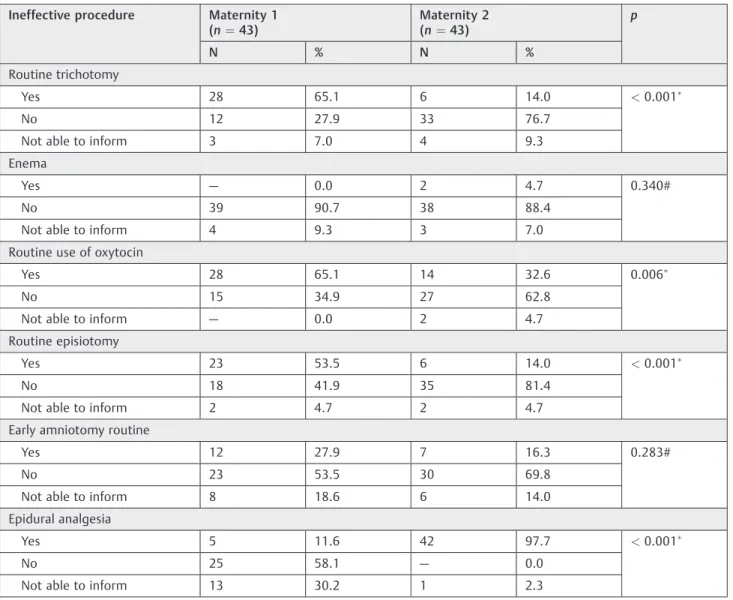
►Table 4presents the procedures considered ineffective
or that should be used with caution according to the WHO. There was a significant difference between the two materni-ties regarding trichotomy (p<0.001), analgesia (p<0.001),
routine use of oxytocin (p¼0.006) and episiotomy
(p<0.001).
Discussion
In the present study, the health professionals in maternity 1 mentioned the practices recommended by the WHO that form part of their routine: the use of the partograph and encouraging women to move and deliver in non-supine positions. On the other hand, the practices considered inef-fective or performed inappropriately were the routine use of oxytocin, episiotomy and trichotomy. In maternity 2, regard-ing the practices recommended by the WHO, most of the professionals reported using the partogram, encouraging women to move and deliver in non-supine positions, the presence of a companion, as well as having the obstetric
nurse as part of the team. Regarding the practices considered ineffective or inappropriate in this maternity hospital, only epidural analgesia was mentioned.
The Brazilian Ministry of Health recommends the pres-ence of an obstetric nurse as part of the team, since this contributes to the reduction of unnecessary interventions, besides reducing the rate of cesarean sections.3,6The
pres-ence of a physiotherapist, for example, in the attention to labor is not an established practice in maternities. However, this professional plays an important role in this process, since it is her job to assist the pregnant woman in childbirth, guiding the control of the pelvic floor musculature, and suggesting positions that relieve pain and facilitate labor.7
In the two maternities investigated, only the one that fol-lowed humanized assistance models has an obstetric nurse as part of their team and, consequently, less ineffective procedures were observed there. However, in maternity 1, other professionals compose the team that manages childbirth.
Many professionals believe that the presence of a com-panion would make things difficult for them because of the risk of interference in their jobs; they even think that their service is being inspected by the companion.8In the study
conducted by Bruggemann et al9, the health professionals ’
expectation about the presence of a companion in labor was initially negative, but was overcome after the experience.9In
maternity 1, it was observed that most of the professionals did not follow the recommendations due to the lack of physical structure, since the pre labor room is very small and designed to accommodate more than one patient at a time, which makes the presence of a companion uncomfort-able, because it makes the progress of the service difficult. In this room there is no accommodation for the companions, no
Table 2 Knowledge about the policies of humanization in each maternity. Goiânia-GO, 2015
Humanization policies Maternity 1 (n¼43)
Maternity 2 (n¼43)
p
N % N %
Knowledge of the PHPN
Yes 40 93.0 43 100.0 0.241
No 3 7.0 — 0.0
Appreciation of prenatal care
Know and disagree 1 2.3 1 2.3 0.005#
Know, agree, but do not perform 15 34.9 3 7.0
Know, agree, and perform 25 58.1 39 90.7
Do not know 2 4.7 — 0.0
Presence of a professional obstetric nurse
Know and disagree 2 4.7 10 23.3 <0.001#
Know, agree, but do not perform 31 72.1 — 0.0
Know, agree, and perform 7 16.3 33 76.7
Do not know 3 7.0 — 0.0
Abbreviation: PHPN, Brazilian Program for the Humanization of Prenatal and Childbirth Care. Note:Chi-square test; #Fisher
screen dividing the beds; therefore, it is uncomfortable for the parturient and for her companion, because they are forced to share this very intimate moment with strangers.
The partograph is a communication instrument that allows the observation of the evolution of labor through a graphic representation. It contains information about dila-tion, uterine dynamics and heart rate.10The WHO
recom-mends the use of the partograph in labor, with the aim of improving care, avoiding unnecessary interventions and reducing maternal and fetal morbidity-mortality.2In a study
performed in a maternity school in the state of Alagoas, Brazil, it was observed that the use of the partograph is scarce. In addition, when it is used, the necessary items are not completely filled.11 In a meta-analysis performed by
Lavender, Hart and Smyth,five clinical trials were evaluated, and two studies evaluated the use or not of the partograph involving 1,590 women. It was concluded that there was insufficient evidence to recommend the routine use of it, with no difference between the use of the partograph and the reduction of the cesarean rates.12However, according to the
Brazilian Ministry of Health, the use of this device improves the quality of delivery care, since it allows the identification of possible complications, so the health professionals can intervene effectively.3In the present study, it was observed
that the partogram is widely used in both maternities (88.4%).
As to the stimulus to movement and delivering in non-supine positions, most of the professionals of the two
maternities said that they carry out this type of practice. In a meta-analysis involving 21 studies with a total of 3,706 women, it was observed that the vertical position decreased labor time in about one hour. In addition, women in the non-supine position who walked required less analgesia and perceived more comfort throughout the process.13
Many doctors still use the lying position (lithotomy) because, according to them, it facilitates the examination to verify the dilation of the uterine cervix and the evolution of the birth through observation and palpation, allowing the active conduction of the delivery by the doctor, even though they are aware of the fact that this position does not favor the evolution of labor.14In the Brazilian study called
“Nascer no
Brasil”(“Being Born in Brazil”), which was conducted in the five regions of the country in 266 hospitals, it was observed that the lithotomy position was present in 90% of deliveries, and in the Midwestern Region, it was more frequent. How-ever, it was observed that freedom of movement in thefirst phase of labor reduces labor time, but it does not appear to be associated with increased interventions or negative effects related to the well-being of mothers and newborns.4
One of the practices considered ineffective or inappropri-ately used is analgesia.2In the present study, most of the
professionals in maternity 1 said they did not perform this type of procedure, whereas in maternity 2 the majority reported performing it. In the“Being Born in Brazil”study,
which involved 23,840 women, it was observed that women with higher education and who had delivered in private
Table 3 Routine implementation of procedures considered useful by the WHO in each maternity. Goiânia-GO, 2015
Useful procedures Maternity 1 (n¼43)
Maternity 2 (n¼43)
p
N % N %
Use of the partogram
Yes 38 88.4 38 88.4 0.435#
No 3 7.0 1 2.3
Not able to report 2 4.7 4 9.3
Stimulus to Movement/non-supine positions
Yes 40 97.6 42 100.0 0.309#
No 1 2.4 — 0.0
Non-pharmacological methods of combating pain
Yes 30 75.0 40 95.2 0.010#
No 10 25.0 2 4.8
Childbirth in the vertical position
Yes 3 8.6 25 64.1 <0.001#
No 32 91.4 14 35.9
Presence of a companion
Know and disagree 5 11.6 — 0.0 <0.001
Know, agree, but do not allow 32 74.4 4 9.3
Know, agree, and allow 3 7.0 39 90.7
Note:
hospitals and clinics had a higher proportion of use of analgesia. For socioeconomically disadvantaged women, a greater use of painful procedures and lower use of analgesia was observed.4In a study conducted with 40 patients divided
into 2 groups to compare the effect of epidural analgesia and combined analgesia, it was observed that the combined technique provides rapid pain relief, and both of them are safe and effective for labor. Moreover, the increase in the use of the forceps in the expulsion stage is not related.15
Many professionals believe that trichotomy is necessary due to hygiene issues and to avoid possible infections; besides, it facilitates the suture in cases of laceration or epsiotomy.14However, a meta-analysis performed by Porto
et al16 involving three clinical trials with 1,039 women
concluded that there is no evidence to recommend its routine use.14 In the present study, it was observed that
most professionals reported it being a routine in maternity 1 (65.1%); however, in maternity 2, the majority (76.7%) re-ported not performing this type of procedure.
The routine use of oxytocin was reported by most professionals in maternity 1, whereas in maternity 2, most of the professionals said they did not perform it. This type of procedure is used to induce or accelerate labor, but it may cause adverse effects, such as uterine hyperstim-ulation and, consequently, it presents a risk to the fetus.17
Nevertheless, the indiscriminate use of oxytocin, mainly in the beginning of the labor, leads to the fact that the pain does not follow the dilation, and, with this, the women get exhausted mainly when they perceive that the pain has increased and there is no evolution of this process, often resulting in them choosing a cesarean section.11 In the “Being Born in Brazil” survey, it was observed that the
infusion of oxytocin and amniotomy were techniques wide-ly used to accelerate labor, and were performed in 40% of women at normal risk.4In the present study, 65.1% of the
professionals reported that this type of procedure is routine in maternity 1, while in maternity 2, 62.8% said they did not perform it.
Table 4 Routine implementation of procedures considered ineffective or that should be used with caution according to the WHO in each maternity. Goiânia-GO, 2015
Ineffective procedure Maternity 1 (n¼43)
Maternity 2 (n¼43)
p
N % N %
Routine trichotomy
Yes 28 65.1 6 14.0 <0.001
No 12 27.9 33 76.7
Not able to inform 3 7.0 4 9.3
Enema
Yes — 0.0 2 4.7 0.340#
No 39 90.7 38 88.4
Not able to inform 4 9.3 3 7.0
Routine use of oxytocin
Yes 28 65.1 14 32.6 0.006
No 15 34.9 27 62.8
Not able to inform — 0.0 2 4.7
Routine episiotomy
Yes 23 53.5 6 14.0 <0.001
No 18 41.9 35 81.4
Not able to inform 2 4.7 2 4.7
Early amniotomy routine
Yes 12 27.9 7 16.3 0.283#
No 23 53.5 30 69.8
Not able to inform 8 18.6 6 14.0
Epidural analgesia
Yes 5 11.6 42 97.7 <0.001
No 25 58.1 — 0.0
Not able to inform 13 30.2 1 2.3
Note:Chi-square test; #Fisher
Amniotomy prior to full dilatation (early amniotomy) is often used to accelerate labor. In the present study, this practice did not prevail in the maternities studied. In a study performed at a delivery center in the district of Sapopemba, in the city of São Paulo, Brazil, involving 1,079 deliveries, it was observed that amniotomy was performed in 53.4% of the deliveries.18A systematic review involving 14 randomized
clinical trials evaluating 4,893 women to verify whether amniotomy decreases labor time concluded that there was no evidence of its impact in the duration of the delivery, but amniotomy was associated with an increased risk of pro-gression to cesarean section.19 In the present study, the
majority of professionals in both maternities reported it not being part of the routine (53.5% in maternity 1, and 69.8% in maternity 2).
The WHO2recommends that the rate of episiotomy stays
between 10% and 30% of all deliveries. In a study by Monte and Rodrigues,17it was observed that the interviewed
professio-nals have often perform episiotomy because they feel insecure and fear lacerations, even if the scientific evidence proves otherwise.2However, scienti
fic evidence demonstrates that
grade 1 and 2 lacerations present better results regarding pain, blood loss and dyspareunia than episiotomy.14
Finally, in the present study, when comparing the two maternities, the routines of maternity 2, which was created as a model of humanization, follow more the recommenda-tions of the WHO, such as the presence of a companion, of an obstetric nurse, the stimulation of movements and non-supine positions, and the use of the partograph. In maternity 1, a series of interventions considered by the WHO to be ineffective or inappropriately used, such as the routine use of oxytocin, episiotomy, trichotomy and the lack of permission of the presence of a companion were observed.
Therefore, in this study, many professionals admit they do not follow some recommendations made by the WHO due to lack of structure and adequate health professionals in the maternity wards.
References
1 Carvalho EMP, Göttems LBD, Pires MRGM. Adherence to best care
practices in normal birth: construction and validation of an instrument. Rev Esc Enferm USP 2015;49(06):890–898
2 Organização Mundial de Saúde. Assistência ao parto normal: um
guia prático. Genebra: Organização Mundial da Saúde; 1996
3 Brasil. Ministério da Saúde. Secretaria de Políticas de Saúde. Área
Técnica da Mulher. Programa de Humanização do Pré-natal e Nascimento. Brasília (DF): Ministério da Saúde; 2000
4 Leal MC, Pereira APE, Domingues RMSM, et al. Obstetric
inter-ventions during labor and childbirth in Brazilian low-risk women. Cad Saude Publica 2014;30(Suppl 1):S17–S32
5 Boaretto MC. Avaliação da política de humanização ao parto e
nascimento no município do Rio de Janeiro [dissertation]. Rio de Janeiro: Escola Nacional de Saúde Pública; 2003
6 Vogt SE, Silva KS, Dias MA. Comparison of childbirth care models
in public hospitals, Brazil. Rev Saude Publica 2014;48(02): 304–313
7 Canesin KF, Amaral WN. Atuaçãofisioterapêutica para diminuição do tempo do trabalho de parto: revisão de literatura. Femina 2010;38(08):429–433
8 Gonçalves AdeC, Rocha CM, Gouveia HG, Armellini CJ, Moretto VL,
Moraes BA. The companion in the obstetrics centre of a university hospital in southern Brazil. Rev Gaucha Enferm 2015;36(Spec No):159–167
9 Brüggemann OM, Osis MJD, Parpinelli MA. Support during
child-birth: perception of health care providers and companions cho-sen by women. Rev Saude Publica 2007;41(01):44–52
10 Rocha IMS, de Oliveira SM, Schneck CA, Riesco MLG, da Costa AS.
[The partogram as an instrument to analyze care during labor and delivery]. Rev Esc Enferm USP 2009;43(04):880–888
11 Barros LA, Veríssimo RCSS. Uso do partograma em maternidades
escola de Alagoas. Rev Rene 2011;12(03):555–560
12 Lavender T, Hart A, Smyth RMD. Effect of partogram use on
outcomes for women in spontaneous labour at term. Cochrane Database Syst Rev 2013;(07):CD005461
13 Lawrence A, Lewis L, Hofmeyr GJ, Styles C. Maternal positions and
mobility duringfirst stage labour. Cochrane Database Syst Rev 2013;(08):CD003934
14 Brasil. Ministério da Saúde. Humanização do parto e do
nasci-mento. Brasília (DF): Ministério da Saúde; 2014
15 Côrtes CA, Sanchez CA, Oliveira AS, Sanchez FM. Labor analgesia: a
comparative study between combined spinal-epidural anesthesia versus continuous epidural anesthesia. Rev Bras Anestesiol 2007; 57(01):39–51
16 Porto AMF, Amorim MMR, Souza ASR. Assistência ao primeiro
período do trabalho de parto baseado em evidências. Femina 2010;38(10):527–537
17 Monte AS, Rodrigues DP. Percepção de profissionais de saúde e mulheres sobre a assistência humanizada no ciclo gravídico-puerperal. Rev Baiana Enferm 2013;27(03):265–276
18 Barbosa da Silva FM, Rego da Paixão TC, de Oliveira SM, Leite JS,
Riesco MLG, Osava RH. [Care in a birth center according to the recommendations of the World Health Organization]. Rev Esc Enferm USP 2013;47(05):1031–1038
19 Smyth RMD, Markham C, Dowswell T. Amniotomy for shortening