Radiol Bras. 2016 Mai/Jun;49(3):176–181 176
Correlation between effective dose and radiological risk:
general concepts
*
Correlação entre dose efetiva e riscos radiológicos: conceitos gerais
Costa PR, Yoshimura EM, Nersissian DY, Melo CS. Correlation between effective dose and radiological risk: general concepts. Radiol Bras. 2016 Mai/ Jun;49(3):176–181.
Abstract
R e s u m o
The present review aims to offer an educational approach related to the limitations in the use of the effective dose mgnitude as a tool for the quantification of doses resulting from diagnostic applications of ionizing radiation. We present a critical analysis of the quantities accepted and currently used for dosimetric evaluation in diagnostic imaging procedures, based on studies published in the literature. It is highlighted the use of these quantities to evaluate the risk attributed to the procedure and to calculate the effective dose, as well as to determine its correct use and interpretation.
Keywords: Radiation dosage; Radiation effects; Diagnostic imaging/adverse effects; Relative biological effectiveness.
Este trabalho de revisão pretende oferecer uma abordagem educacional relacionada às limitações na utilização da grandeza dose efetiva como ferramenta para quantificação de doses decorrentes de aplicações em diagnóstico médico utilizando radiações ionizantes. Os auto-res apauto-resentam uma análise crítica sobre as grandezas aceitas e utilizadas atualmente para a avaliação dosimétrica em procedimentos de diagnóstico médico por imagem, tendo como base estudos publicados na literatura. Destacam-se as formas de utilização dessas grandezas para a avaliação do risco atribuído ao procedimento e para o cálculo da dose efetiva e sua correta utilização e interpretação.
Unitermos: Dosagem de radiação; Efeitos da radiação; Diagnóstico por imagem/efeitos adversos; Eficiência biológica relativa.
* Study conducted by the Radiation Dosimetry and Medical Physics Group of the Instituto de Física da Universidade de São Paulo (IFUSP), São Paulo, SP, Brazil.
1. PhD, Professor at the Instituto de Física da Universidade de São Paulo (IFUSP), São Paulo, SP, Brazil.
2. PhD, Full Professor at the Instituto de Física da Universidade de São Paulo (IFUSP), São Paulo, SP, Brazil.
3. PhD, Physicist at the Instituto de Física da Universidade de São Paulo (IFUSP), São Paulo, SP, Brazil.
4. Specialist in Physics of Diagnostic Radiology, Physicist at the Instituto de Física da Universidade de São Paulo (IFUSP), São Paulo, SP, Brazil.
Mailing address: Dr. Paulo Roberto Costa. Instituto de Física da Universidade de São Paulo – Física Nuclear. Rua do Matão, 1371, Cidade Universitária. São Paulo, SP, Brasil, 05508-090. E-mail: [email protected].
Received September 26, 2014. Accepted after revision May 12, 2015.
tive dose. The correct use and interpretation of the effective dose are also addressed.
EFFECTIVE DOSES AND RADIATION RISKS The method presented by the International Commission on Radiation Protection (ICRP) to calculate the effective dose is based on the use of multiplicative models of risk factors, applied to quantities that are more fundamental, such as the
absorbed dose(1). Behind the risk factors published by the
ICRP is the opportunity to use the knowledge associated with the long-term biological effects of ionizing radiation,
knowl-edge accumulated since the beginning of last century(2), to
draw a correlation between exposure to radiation in living beings and the biological effects associated with such
expo-sure. Using the concepts of stochastic effects, Drexler et al.(3)
made a detailed interpretation of this quantity, also known as the “effective dose equivalent”. The authors predicted its association with doses in small groups or even in individu-als. The authors made it clear that, in those cases, it is not possible to calculate the true risks or detriment using the factors presented, stating that the data available in the offi-cial radiological protection publications of the period are applicable to the average population of workers and that the detriment rates for other populations would, of course, be different. They also stated that the use of effective dose is justified in order to follow the principle of limitation of oc-cupationally exposed individuals, considering uniform whole-body exposures. Although the effective dose concept can be applied in situations of non-uniform irradiation, the results
Paulo Roberto Costa1, Elisabeth Mateus Yoshimura2, Denise Yanikian Nersissian3, Camila Souza Melo4
INTRODUCTION
Much of the motivation in establishing dosimetric meth-ods related to diagnostic imaging procedures is based on the interest in estimating health risks to a patient subjected to a given type of examination using ionizing radiation. This motivation has a strong correlation with the need to balance the risks and benefits of a new diagnostic modality or with the desire to ensure that the chosen modality is the one that will have the fewest potentially harmful effects on the health of the patient.
effec-derived from models for this kind of situation cannot be associated with the basic radiological protection quantities.
Drexler et al.(4) stated that applying the concepts of
ef-fective dose to the radiological protection of patients is mis-leading and meaningless when used in order to estimate in-dividual or collective patient risk. The authors discussed the use of this quantity to support the optimization procedures, to compare risks between methods and to set dose constraint levels, as well as to estimate risks to individuals and popula-tions undergoing diagnostic imaging procedures. Based on that argument, they demonstrated support for their previous interpretation, concluding that the use of effective dose is incorrect because of inappropriate simplification of the un-derlying biological mechanisms and the inadequacy of us-ing weightus-ing factors connected to the definition of the ef-fective dose for a given patient population.
A number of studies associating the quantity effective dose with diagnostic imaging procedures have been published in widely circulated journals. Such associations have been identified in studies related to imaging tests in which there is a possibility that high doses will be used, such as
interven-tional radiology(5) and computed tomography (CT) scans(6),
as well as other modalities(7).
CALCULATING AND INTERPRETING THE QUANTITY EFFECTIVE DOSE
According to national(8) and international(1) regulations,
the effective dose can be calculated by determining the sum of the weighted equivalent doses in different organs and tis-sues:
(1)
where HT and DT,R represent the equivalent dose in tissue
or organ T and the mean absorbed dose in tissue or organ T
from radiation R, respectively; wT is the tissue weighting
factor; and wR is the radiation weighting factor for
radia-tion R(9).
According to ICRP Publication 103(1), the fact that the
effective dose and the equivalent dose in an organ or tissue are not directly measurable quantities must be taken into account. Therefore, operational quantities have been defined. Those quantities are obtained through the use of
instru-ments(10) to determine the radiation protection quantities for
the assessment of occupational exposures.
The numerical simulator of the human body (computa-tional phantom) recommended by the ICRP for
determin-ing the conversion factors is based on Zankl et al.(11–13). On
the basis of the correlation between the voxels provided by these computer models and the organs of the human body, adjustments were made in order to render these models suit-able in relation to the masses of the organs in the reference
male and female, as defined in ICRP Publication 89(14).
These reference phantoms were adopted in order to deter-mine the conversion factors reproduced in ICRP Publica-tion 103, which correlate physical quantities—such as the
air kerma, the particle fluence induced by external radiation and the activity incorporated for internal exposure—with the radiological protection quantities such as the equivalent dose and the effective dose.
Paragraph B132 of ICRP Publication 103(1) details the
method of obtaining the effective dose, regardless of patient gender. This method was used in order to define unified conversion factors and can be used, simplistically, for radia-tion protecradia-tion purposes. The document shows that the ef-fective dose is calculated on the basis of the equivalent doses obtained for organs and tissues, through the use of the fol-lowing equation:
(2)
where HM and HF are the equivalent doses obtained for
or-gans and tissues of the reference male and the reference fe-male, respectively.
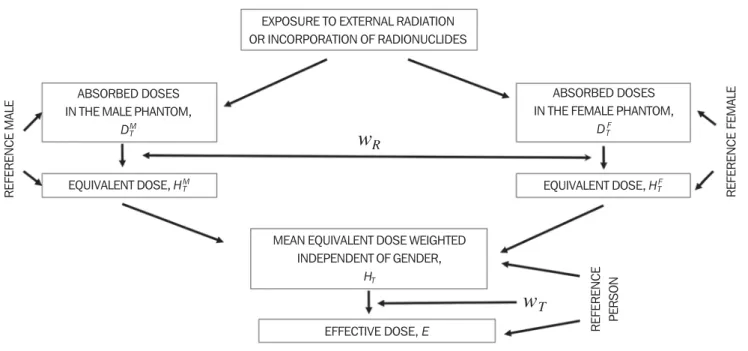
As a result of the independent gender mean represented by Eq. (2), the quantity effective dose, for radiation protec-tion purposes, provides values that take into account the exposure conditions of the reference person, rather than those of a specific individual. When using the quantity defined by the ICRP, the fact that the weighting factors are obtained from average values derived from a large number of indi-viduals of both genders should be taken into account. Fig-ure 1 shows the ICRP method adopted to determine the ef-fective dose regardless of gender, by means of weighted mean values for the reference person.
In 2000, before the publication of ICRP Publication
103(1), McCollough et al.(15) published an important
con-tribution to the interpretation of the quantity effective dose and the methods for its calculation. The authors described the various definitions of that quantity presented in different ICRP Publications issued since 1977. They also stated that the values corresponding to the application of the weighting factors and the association with the resulting overall detri-ment are relevant only to the population and the irradiation conditions from which those factors were derived. Thus,
according to the interpretation of Drexler et al.(3,4), they
re-affirm that the detriment resulting from the application of the concept of effective dose only makes sense for the popu-lation in general or for specific popupopu-lations of workers, not being suitable for use to patients, due to differences related to age and gender. Finally, the authors highlighted the in-consistency related to the use of weighting factors, because the normalization cannot be applied in cases of inhomoge-neous radiation.
However, one should not underestimate the importance of establishing methods for estimating risks related to
medi-cal exposure. According to McCollough et al.(15), the most
comprehensive approach to risk assessment is to increase the knowledge of the doses to all relevant organs and the risks for those organs, associated with and related to age and gen-der. The important point of this discussion is the correct
definition of the applicability limits of the weighting factors set by the ICRP for dose-risk correlation in medical proce-dures that use ionizing radiation. Therefore, the effective dose can be used in order to compare the relative detriments be-tween different radiologic procedures and to facilitate the comparison of detriments in the application of different ra-diation sources. However, in either case, it must be calcu-lated for patient populations of consistent age and gender.
Despite of the limitations described above, there are many recent studies correlating effective doses with
diagnos-tic imaging procedures(16–18). Not all of those publications
addressed the limitations, uncertainties, and adaptation of interpretation that should be associated with the quantifica-tion of effective dose or the fact that it cannot be associated
with the risk to individuals(19).
Verdun et al.(20) reviewed the concepts and quantities of
radiological protection. The authors explained that the quan-tity effective dose has a stochastic origin and correlates with health risks as follows: “This quantity takes the health risk (fatal and nonfatal cancers, taking into account the latency period as well as severe hereditary disorders) of a “standard” patient who is nonuniformly exposed to ionizing radiation and transposes it into a situation in which this patient would be uniformly exposed to a radiation field. This methodology is used for monitoring workers exposed to ionizing radiation.” The concept of the standard patient is presented in Chapter
7 of ICRP Publication 103(1), which states that the effective
dose can be useful in cases of medical exposure, in order to draw comparisons between different procedures, between countries or hospitals in terms of the use of similar techniques and procedures, and between different types of equipment used in the same type of examination. This is valid provided that the reference patient or populations are homogeneous
with respect to age and gender. The publication emphasizes that the interpretation of the effective dose in relation to medical exposure is problematic when organs and tissues are partially exposed and when the exposure is heterogeneous. In terms of the limitations related to the ICRP method
for the determination of effective doses, Verdun et al.(20) made
it clear that, due to the differences in risk factors related to physical characteristics, age, and gender, the effective dose should not be used in order to infer excess relative risk to a
particular individual(21). Finally, the authors discouraged the
use of these correlations for associated risks related to the use of radiation in diagnostic imaging procedures.
CONTROVERSIES REGARDING THE USE
OF EFFECTIVE DOSE IN DIAGNOSTIC IMAGING The popularization and systematic use of the effective dose as a metric for dosimetric evaluation in medical procedures
might have begun with the study conducted by Martin(22), in
2007. In that study, the author presented a thoughtful re-flection on the stochastic nature of the calculation of the det-riment, which gives the weighting factors used in the calcula-tion of effective dose, as well as on the uncertainties involved in its calculation. In particular, the author highlighted the excessive attention given to the effective dose calculations related to medical procedures and their associated risks, with-out due care in determining the explanations for those asso-ciations. The author also provided estimates that lead to un-certainty values of approximately 40% in calculating the ef-fective dose for a standard patient. It is noteworthy that the use of the effective dose concept to estimate the risk for an individual subjected to a diagnostic imaging procedure is not recommended by the ICRP. Martin concluded that the ef-fective dose is the only available quantity associated with the Figure 1. Method adopted by the ICRP to determine the gender-specific independent effective dose through the use of weighted average values for the reference person. (Based on ICRP Publication 103(1)).
EXPOSURE TO EXTERNAL RADIATION OR INCORPORATION OF RADIONUCLIDES
R
E
F
E
R
E
NC
E
M
A
LE
ABSORBED DOSES IN THE MALE PHANTOM,
DM T
ABSORBED DOSES IN THE FEMALE PHANTOM,
DF T
EQUIVALENT DOSE, HM
T EQUIVALENT DOSE, HTF RE
F
E
R
E
NC
E
F
E
M
A
LE
R
E
F
E
R
E
NC
E
P
E
R
S
O
N
w
Rw
TMEAN EQUIVALENT DOSE WEIGHTED INDEPENDENT OF GENDER,
HT
risk of a detriment to health. The author made it clear that the effective dose should not be related to an individual but rather to a non-gender-specific reference patient, for which the risks have been determined based on the average stan-dard population. The author argued that, to calculate the risk for an individual patient, the best indicator should be related to the estimation of doses in all radiosensitive organs and tissues, as well as to the combination of those values with the specific risks to those organs, by age and gender.
Unquestionably, the great complexity that underlies the understanding of the quantities adopted for radiation
pro-tection(23). Consequently, a great care should be taken when
using this terminology.
The appropriateness of using the effective dose as the quantity adopted to represent doses related to exposures in patients or patient populations is a source of concern
regard-ing its correct interpretation(20) and of various controversies
in the scientific community. Such disputes arise with the use of a measure originally introduced as a quantitative repre-sentation of the potential stochastic detriments, in particu-lar cancer and hereditary effects, resulting from exposure of
populations of workers and the general population(24), as a
representative measure of the dose received by patients un-dergoing radiological examinations.
Controversy regarding the effective dose led to a debate in the “point-counterpoint” section of the July 2010 issue of
the Medical Physics journal (25). In that article, Professor
Borrás argued against the use of the effective dose as a rep-resentative measure of doses during medical procedures, whereas Professor Huda argued in favor of such use. Profes-sor Huda was also the protagonist of another debate, this time with Dr. Cohen, presented in the 2011 issue of the
jour-nal Radiology(26).
In Annex A of its 2008 report(27), the United Nations
Scientific Committee on the Effects of Atomic Radiation pointed out the numerous difficulties in obtaining reliable estimates of absorbed doses and consequently the effective doses corresponding to clinical examinations, noting that this quantity should always be correlated with homogeneous populations. That report highlighted three major approaches to estimating doses in patients undergoing radiological pro-cedures: dose measurements directly in the patient; dose measurements in physical phantoms and Monte Carlo
cal-culations. In each case, the associated uncertainties(28) and
difficulties were highlighted, as was the weak association that these results can have with estimates of risk or detriment.
McCollough et al.(29) recently revisited the theme of the
effective dose. The authors began by addressing the scenario in which a patient, after undergoing an examination, asks the doctor: “What dose did I receive?”. The authors assert that what the patient really wants to know is how much risk is associated with the procedure performed. In addition, other medical professionals now have more access to information available in medical journals about the risk of stochastic
ef-fects resulting from procedures such as CT(30).
Taking into account the limitations and uncertainties associated with the use of the effective dose to support the determination of risks from radiological procedures,
McCollough et al.(29) pointed out its usefulness as a tool for
making comparisons between different types of radiation exposure and for converting the complex dose distribution in various tissues and organs into a single dosimetric param-eter. The authors stated that the effective dose could be ap-plied as a kind of “whole-body dose equivalent” value related to the risks arising from non-uniform irradiation in differ-ent diagnostic modalities. With this approach, it is possible to compare different dose values resulting from different imaging modalities with similar purposes, such as conven-tional coronary angiography, CT angiography and myocar-dial perfusion with nuclear medicine.
THE IMPORTANCE OF PROPER INTERPRETATION OF THE QUANTITY EFFECTIVE DOSE
The article “Health risks from exposure to low levels of
ionizing radiation: BEIR VII Phase 2”(31), published in 2006,
defined the effective dose as the sum of the doses absorbed by different organs from different types of radiation, multi-plied by weighting factors for the organs and for the types of radiation. This definition is similar to that outlined in ICRP
Publication 103(1). The unit of the quantity effective dose is
the sievert (Sv): 1 Sv = 1 J/kg. Excluding differences related to gender and age, equal effective doses correspond to ap-proximately the same overall risk. For uniform whole-body exposure, even for a specific type of radiation, the effective dose is equal to the absorbed dose of radiation multiplied by the radiation weighting factor.
ICRP Publication 103 states that the effective dose is calculated for a reference person and not for an individual.
In addition, ICRP Publication 116(30) clarifies that the
fac-tors used to weight the absorbed doses to specific tissues do not vary with age or gender, and that the use of the weighted sum for obtaining the effective dose is not applicable to a specific individual. Therefore, the effective dose serves to support regulatory devices and comparative assessments of professional practices.
It should be noted that effective dose was established as a quantity applicable to planned situations. ICRP
Publica-tion 105(33) states that the distribution of ages of workers
and the general population can be significantly different from that of a population subjected to a given type of medical procedure that employs ionizing radiation. Other aspects, such as the gender of the patients undergoing the procedure, can be related to these age distributions, which are used in deriving the value of the effective dose.
quantitative parameters that describe a procedure in terms of its potential risk to the health of patients, compared with the alternative practices or the application of a new technique in contrast with others currently in use, makes it a tempting option. For such correlations associated with the CT
tech-nique, Dixon(34 ) emphasized the need to train all of the
workers involved, which comprises adapting the instruction of medical students, technicians, technologists, and physi-cians of other specialties to include concepts regarding doses and their implications. The author also highlighted the ap-parent inconsistency of institutions that invest hundreds of thousands of dollars, euros, or Brazilian reals in the acquisi-tion of a new CT modality but are reluctant to invest in train-ing their staff, in the continutrain-ing education of their physi-cians, or in obtaining the support of medical physics profes-sionals for the proper monitoring of aspects related to the dose in CT and in other modalities.
CONCLUSIONS
The present review aims to provide readers with an edu-cational approach related to limitations in the use of the ef-fective dose quantity as a tool to access doses and health-related risks associated to diagnostic imaging procedures that employ ionizing radiation. This quantity can be used in or-der to compare the relative detriments of radiological pro-cedures and other radiation sources when calculated for populations of patients that are homogeneous in terms of age and gender. The use of effective dose can also be useful for the purpose of comparisons between different procedures and techniques, or between different hospitals or countries pro-vided that the reference patient or patient population are similar with respect to age and gender.
It should be borne in mind that the ICRP does not rec-ommend using effective dose to estimate the risk for an in-dividual subjected to a diagnostic imaging procedure. That is because the quantity was introduced as a means of repre-senting the potential stochastic detriments resulting from the exposure of populations of workers and the general popula-tion. Therefore, it is incorrect to use effective dose as an estimator of individual risks for patients undergoing radio-logic studies.
In summary, the effective dose can be useful for esti-mating the detriment relative to non-uniform and partial-body irradiation; for optimizing radiological procedures involv-ing multiple organs or tissues; for drawinvolv-ing comparisons between alternative procedures or background radiation lev-els; and for estimating the relative detriment attributed to multiple exposures or different modalities.
The effective dose serves to support regulatory documents and comparative assessments of professional practices, de-spite of the fact that its quantity is not able to represent the stochastic health risk resulting from exposures of a given worker or other individual.
For the medical community, the principle of justifying radiological procedures is more important than the
deter-mination of doses through the use of quantities that are not
applicable to the estimation of risks(35). It is understood that
this is a factor, which affects radiation protection more sig-nificantly than does the determination of the individual dose.
REFERENCES
1. International Commission on Radiation Protection. The 2007 Rec-ommendations of the International Commission on Radiological Protection. ICRP Publication 103. Ann ICRP. 2007;37(2-4):1– 332.
2. Jennings W. Evolution over the past century of quantities and units in radiation dosimetry. J Radiol Prot. 2007;27:5–16.
3. Drexler G, Williams G, Zankl M. The meaning and the principle of determination of the effective dose equivalent in radiation protec-tion. Radiat Prot Dosimetry. 1985;12:95–100.
4. Drexler G, Panzer W, Petoussi N, et al. Effective dose – how effec-tive for patients? Radiat Environ Biophys. 1993;32:209–19. 5. Struelens L, Bacher K, Vanhavere F, et al. DAP to effective dose
conversion in cardiology and vascular/interventional radiology. [cited 2014 May 13]. Available from: www.fanc.fgov.be/GED/00000000/ 2300/2369.pdf.
6. Huda W, Magill D, He W. CT effective dose per dose length prod-uct using ICRP 103 weighting factors. Med Phys. 2011;38:1261– 5.
7. Osei EK, Darko J. A survey of organ equivalent and effective doses from diagnostic radiology procedures. ISRN Radiol. 2012;2013: 204346.
8. Brasil. Ministério de Ciência e Tecnologia. Comissão Nacional de Energia Nuclear. CNEN-NN-3.01 – Diretrizes básicas de prote-ção radiológica. Resoluprote-ção Nº 027, de 17 de dezembro de 2004. D.O.U. 06/01/2005.
9. Okuno E, Yoshimura EM. Física das radiações. São Paulo, SP: Oficina de Textos; 2010.
10. McDonald JC. Calibration measurements and standards for radia-tion protecradia-tion dosimetry. Radiat Prot Dosimetry. 2004;109:317– 21.
11. Zankl M, Fill U, Petoussi-Henss N, et al. Organ dose conversion coefficients for external photon irradiation of male and female voxel models. Phys Med Biol. 2002;47:2367–85.
12. Zankl M, Petoussi-Henss N, Fill U, et al. The application of voxel phantoms to the internal dosimetry of radionuclides. Radiat Prot Dosimetry. 2003;105:539–48.
13. Zankl M, Becker J, Fill U, et al. GSF male and female adult voxel models representing ICRP reference man – the present status. Pa-per presented at: The Monte Carlo Method: Versatility Unbounded in a Dynamic Computing World. 2005 April 17–21; Chattanooga, TN, USA. American Nuclear Society; 2005.
14. International Commission on Radiation Protection. Basic anatomical and physiological data for use in radiological protection: reference values. A report of age- and gender-related differences in the ana-tomical and physiological characteristics of reference individuals. ICRP Publication 89. Ann ICRP. 2002;32(3-4):5–265. 15. McCollough CH, Schueler BA. Calculation of effective dose. Med
Phys. 2000;27:828–37.
16. Smith-Bindman R, Miglioretti DL. CTDIvol, DLP, and effective dose are excellent measures for use in CT quality improvement. Radiology. 2011;261:999.
17. Brink JA. Radiation dose reduction in renal colic protocol CT: are we doing enough to ensure adoption of best practices? Radiology. 2014;271:323–5.
18. Ward VL, Strauss KJ, Barnewolt CE, et al. Pediatric radiation ex-posure and effective dose reduction during voiding cystourethrog-raphy. Radiology. 2008;249:1002–9.
equiva-lent and effective dose: their basis and application. Radiat Prot Dosimetry. 2007;127:12–8.
20. Verdun FR, Bochud F, Gundinchet F, et al. Quality initiatives ra-diation risk: what you should know to tell your patient. Radio-graphics. 2008;28:1807–16.
21. Okuno E. Epidemiologia do câncer devido a radiações e a elabora-ção de recomendações. Rev Bras Fís Méd. 2009;3:43–55. 22. Martin CJ. Effective dose: how should it be applied to medical
ex-posures? Br J Radiol. 2007;80:639–47.
23. Nickoloff EL, Lu ZF, Dutta AK, et al. Radiation dose descriptors: BERT, COD, DAP, and other strange creatures. Radiographics. 2008;28:1439–50.
24. Böhm J, Thompson IM. Adaptation of the present concept of dosi-metric radiation protection quantities for external radiation to ra-diation protection practice. Radiat Prot Dosimetry. 2004;109: 311–5.
25. Borrás C, Huda W, Orton CG. Point/counterpoint. The use of effective dose for medical procedures is inappropriate. Med Phys. 2010;37:3497–500.
26. Garcia-Bennett A, Nees M, Fadeel B. In search of the Holy Grail: folate-targeted nanoparticles for cancer therapy. Biochem Phar-macol. 2011;81:976–84.
27. United Nations Scientific Committee on the Effects of Atomic Radiation. Sources and effects of ionizing radiation. Annex A: Medical radiation exposures. New York, NY: United Nations Publication; 2010.
28. Durand DJ, Dixon RL, Morin RL. Utilization strategies for cumu-lative dose estimates: a review and rational assessment. J Am Coll Radiol. 2012;9:480– 5.
29. McCollough CH, Christner JA, Kofler JM. How effective is effec-tive dose as a predictor of radiation risk? AJR Am J Roentgenol. 2010;194:890–6.
30. Pearce MS, Salotti JA, Little MP, et al. Radiation exposure from CT scans in childhood and subsequent risk of leukaemia and brain tumours: a retrospective cohort study. Lancet. 2012;380:499–505. 31. Committee to Assess Health Risks from Exposure to Low Levels of Ionizing Radiation . Health risks from exposure to low levels of ion-izing radiation: BEIR VII Phase 2. Washington, DC: The National Academies Press; 2006.
32. Petoussi-Henss N, Bolch WE, Eckerman KF, et al. ICRP Publica-tion 116. Conversion coefficients for radiological protecPublica-tion quan-tities for external radiation exposures. Ann ICRP. 2010;40(2-5):1– 125.
33. International Commission on Radiation Protection. ICRP Publi-cation 105. Radiological protection in medicine. Ann ICRP. 2007; 37(6):1–63.
34. Dixon AK. Benefits and costs, an eternal balance [Editorial]. Ann ICRP. 2007;37(1):1–3.