w w w . j c o l . o r g . b r
Journal
of
Coloproctology
Original
Article
Subjective
processes
surgical
treatment
in
patients
with
stages
of
the
disease
hemorrhoidal
Magno
Otávio
Salgado
de
Freitas
a,b,∗,
Jaciara
Aparecida
Dias
Santos
a,
Cristina
Andrade
Sampaio
c,daUniversidadeEstadualdeMontesClaros(UNIMONTES),MontesClaros,MG,Brazil
bUniversidadeEstadualdeMontesClaros(UNIMONTES),DepartamentodeClínicaCirúrgica,MontesClaros,MG,Brazil cUniversidadeFederaldeSãoPaulo(UNIFESP),SãoPaulo,SP,Brazil
dUniversidadeEstadualdeMontesClaros(UNIMONTES),DepartamentodeSaúdeMentaleColetiva,MontesClaros,MG,Brazil
a
r
t
i
c
l
e
i
n
f
o
Articlehistory:
Received22November2016 Accepted19March2017 Availableonline4May2017
Keywords: Hemorrhoids Hemorrhoidectomy Cartography Qualitativeresearch
a
b
s
t
r
a
c
t
Introduction:Hemorrhoidaldiseaseafflicts4.4%oftheworldpopulation,beingthemost com-monanaldisorder.Surgicaltreatmentisusedforabout5–10%ofcaseswhereconservative procedureshavenotworked.
Objective:Tounderstandthetrajectoryandperceptionofindividualssubmittedtosurgical treatmentofhemorrhoidaldisease.
Methods:Thisisadescriptivestudywithaqualitativeapproach,whichemphasized Car-tographyasthemainmethodintheanalysisoftheresults.Datawereproducedthrough individualinterviewsrecordedandtranscribedinfull,fromMarchtoJune2015,ina Poly-clinicandinapublichospitalinthemunicipalityofMontesClaros-MG.Twelveinterviews werecarriedout.
Results:Theresultsevidencedtheexistenceofprocessesofsubjectivizationthat,through affectations,causeindividualstodemonstrateatranscendentthought,exemplifiedbythe sensationofaself-knowledgeofthedisease,includingcorrelatingitwithpossible hered-itary,behavioralandalimentarycauses.Therewasanescalationinthevariouslevelsof health care, standardizedbythe publicsystem,sometimesrevealing a molarthought, preventing theoccurrenceofanevent,reducingpowerandfailingtoachievea planof immanencewiththecompleteresolutionoftheproblem.Thehardlines,evidencedbya delayinobtainingatreatmentthanksforfearandshame,favoredself-medication,witha worseningofsymptoms.
Conclusion: ItwasnotedthattherewereobstaclesinalllevelsoftheSUSthatmadeitdifficult toreachthesurgicaltreatment,butallpatientswereconsideredwithsurgeryandwiththe postoperativeperiod.
©2017SociedadeBrasileiradeColoproctologia.PublishedbyElsevierEditoraLtda.This isanopenaccessarticleundertheCCBY-NC-NDlicense(http://creativecommons.org/ licenses/by-nc-nd/4.0/).
∗ Correspondingauthor.
E-mail:[email protected](M.O.Freitas). http://dx.doi.org/10.1016/j.jcol.2017.03.002
Processos
de
subjetivac¸ão
no
desenrolar
do
tratamento
cirúrgico
de
indivíduos
com
doenc¸a
hemorroidária
Palavras-chave: Hemorroidas Hemorroidectomia Cartografia Pesquisaqualitativa
r
e
s
u
m
o
Introduc¸ão: Adoenc¸ahemorroidariaaflige4,4%dapopulac¸ãomundial,sendoodistúrbio analmaiscomum.Otratamentocirúrgicoéutilizadoparacercade5a10%doscasosem queosprocedimentosconservadoresnãosurtiramefeito.
Objetivo: Compreenderatrajetóriaepercepc¸ãodosindivíduossubmetidosaotratamento cirúrgicodadoenc¸ahemorroidária.
Métodos: Trata-sedeumestudodescritivodeabordagemqualitativa,queprivilegioua Car-tografiacomométodoprincipalnaanálisedosresultados.Aproduc¸ãodosdadosocorreu pormeiodeentrevistasindividuaisgravadasetranscritasnaíntegra,noperíododemarc¸o ajunhode2015,emumaPoliclínicaeemumhospitalpúblicodomunicípiodeMontes Claros-MG.Foramrealizadas12entrevistas.
Resultados: Evidenciaram a existênciade processos de subjetivac¸ão, quepor meio de afetamentos, fazem com que os indivíduos demonstrem um pensamento transcen-dente, exemplificado pela sensac¸ão de um autoconhecimento da doenc¸a, inclusive correlacionando-a com possíveis causas hereditárias, comportamentais e alimentares. Evidenciou-seumaescaladapelosvários níveisdeatenc¸ão àsaúde,normatizados pelo sistema público, deixando transparecerem algunsmomentos um pensamento molar, impedindoosurgimentodeumacontecimento,reduzindoapotênciaedeixandodeatingir umplanodeimanênciacomacompletaresoluc¸ãodoproblema.Aslinhasduras, evidenci-adaspelademoraemseconseguirumtratamento,pelomedoepelavergonha,favoreceram aautomedicac¸ãoeoagravamentodossintomas.
Conclusão: Notou-sequehouveentravesem todososníveisdoSUSquedificultaramo alcanceaotratamentocirúrgico,mastodosospacientesseconsideraramsatisfeitoscoma cirurgiaecomopós-operatório.
©2017SociedadeBrasileiradeColoproctologia.PublicadoporElsevierEditoraLtda.Este ´eumartigoOpenAccesssobumalicenc¸aCCBY-NC-ND(http://creativecommons.org/ licenses/by-nc-nd/4.0/).
Introduction
Thefourth-degree hemorrhoidal disease has, inthe surgi-cal treatment, a way ofobtaining its cure; this disease is thesubjectofmanyquantitativestudieswhoseauthorswere concernedwithstatisticalaspectsanddidnotfocusonthe individualwiththediseaseandonhis/herperceptions.Thus, thisstudyaimstounderstandthetrajectoryandperceptionof patientssubmittedtosurgicaltreatmentforthehemorrhoidal disease,seeking,withtheuseoftherhizomaticphilosophyof DeleuzeandGuattari,toinvestigatetheprocessesof subjec-tivizationthatoccurredwiththesepatients,mappingthelines ofsegmentaritythatpassthroughthem.1
Initially,wewillintroducetheconceptsthatexplainwhat hemorrhoidal disease is; inwhich consists its clinical and surgicaltreatment;andhowtheaccesstotreatmentoccurs throughtheSistemaÚnicodeSaúde/UnifiedHealthSystem (SUS), that is, its trajectory. Secondly, we willpresent the conceptsusedtocarryoutouranalysisoftheprocessesof sub-jectivization,extractedfrom thephilosophyofDeleuzeand Guattari,withclarificationonCartographyasamethod.
Hemorrhoidsarearteriovenousplexusesthatsurroundthe distalrectumandanalcanal.Theyarepresentinall individ-ualsfrombirthandbecomesymptomaticwhentheyincrease insize,becomeinflamed,thrombosed,orprolapsed.2Thus,
hemorrhoidaldisease(HD)canoccurinbothgenders,being morecommoninmales(2:1).Thisconditionafflicts4.4%of the worldpopulation. However,there isno precisedatain Brazilforthisproblem.Themainriskfactorsarehigh socio-economiclevel,heredity,pregnancy,obesity,smoking,adiet richinfats,alcohol,spicesand pepper,aswellaslowfluid intake.3
Consideringitsanatomicallocation,HDmaybeclassified as“internal”(anorectalsubmucosaaboveParksligament,and coveredbymucousepithelium),“external”(belowParks liga-ment,andcoveredbymodifiedanalcanalskin)and“mixed “(internalandexternalextensions).4
Internal hemorrhoidsare furtherclassifiedinto degrees: Firstdegree,whenbleedingoccursbutwithoutprolapse. Sec-onddegree,whenprolapse occursduringdefecationeffort, returningspontaneouslytotheanalcanal.Thirddegree,when occurs prolapse,withmanualreduction;andfinally,Fourth degree, when prolapse occurs, without reduction. Mixed (internal–external)hemorrhoidsappearaboveandbelowthe pectinealline.5
The diagnosis is established based on the symptoma-tology and on the results of a proctological examination. Themostindicativesymptomsare prolapseand bleeding.6
asmedicationsthatattenuateits multiplesymptoms, such asburning,pain, pruritus,etc. Thearsenal ofnon-surgical approachesincludessclerotherapy,cryotherapy,elastic liga-tion,andphotocoagulation.7
Surgicaltreatmentisneededinabout10%ofthepatients; thistherapyisindicatedforthosepatientswhosesymptoms havebeenshowntoberefractorytoconservativetreatment, and for patients with a bulky hemorrhoidal disease. The goalofhemorrhoidectomyistheexcisionoftheinternaland externalcomponentsofthehemorrhoidalplexusesand com-promised tissues. Different surgical techniques have been describedforthird-andfourth-degreeHD, andusually,the choiceofatechniquedependsonthesurgeon’s preference. Duringthelastcentury,openandclosedhemorrhoidectomies wereproposedbyMilligan-MorganandFerguson,respectively, andtheseproceduresbecamethemostpopularmethodsfor treatingthiscondition.8
Theperiodelapsedbetween the surgicalindicationand thesurgeryitselfvariesamongpatientscaredforinthe pri-vatenetworkandinhealthinsuranceservicesversuspatients caredforinthepublicnetwork.Thisintervalreachesupto4–6 monthsorevenlonger.9,10TheSistemaÚnicodeSaúde(SUS),
throughitsPrimaryCareNetwork,FamilyHealthStrategy,or BasicUnit,providespatients’accesstothegeneralpractitioner who,throughareferralsystem,redirectsthesickpersonto expertassessment,whichwillresultintheindicationofthe besttreatmentforeachcase.SUSoffersonlysurgical treat-mentbytheconventionaltechnique.
Weobservedthatlongperiodselapsedbetweentheonset ofsymptomsand discomfortsofthehemorrhoidaldisease, besidespatients’complaints,untilthedecisioninfavorofa treatmentthatwouldresultinimprovementofthese symp-toms and discomforts. Thus, in order to be aware of the processesthatledthesepatientstodelaytheirtreatment,a studywasneededwhosemethodologywascapableof ana-lyzing the processesofsubjectivization that pervadethese individuals,aswellastheirinterrelationsintheplaneofforces (hard, flexible,and escapelines). Thismethodology is Car-tography,whichseekstoaccompanythe pathwayswithout worryingaboutmakingdecalsorrepresentations,andwhich istotallygearedtowardanexperimentationanchoredinthe real.
Cartographyproposesamethodologicalreversion: trans-formingthemeta-hodosintohodos-meta,thatis,nolongera journeyinordertoreachpredeterminedgoals(meta-hodos), butawalkthattracesitsgoalsalongitscourse(hodos-meta). Thisisamethodthatisnottobeapplied,buttobe experi-enced.Thus,evenwithoutgivinguptherigorofinformation, themethodstaysclosertothemovementsoflife.Thismap succeedsinmapping themicropolitical movements and in accompanyingtheprocessesofactionsfromminoritiesthat occurduringtheirjourney,inanattempttogetatreatment forwhatisbotheringthem.
Inthissense,thisstudyaimedtounderstandthetrajectory andperceptionofpatientswhounderwenttheconventional Milligan-Morgansurgicaltechnique.Itshouldbeemphasized thatthepatient’sperceptionabouthemorrhoidectomyisstill asubjectnotmuchaddressedanddiscussedwithinthescope
oftheColoproctologyspecialty,whichspeaksinfavorofthe presentreflection.
Method
This is a descriptive study with a qualitative approach, whichemphasizedCartographyasthemainmethodfordata production.11
Based on the work of the French philosophers Gilles Deleuzeand FélixGuattari,1Cartography isconsideredone
oftheprinciplesoftherhizome,whichisdefinedasathing thatisrooted,acomplexsystem,withverydiversifiedforms, fromtheramifiedsurfaceineverysensetoItsconcretionsin bulbsandtubers,havingascharacteristicstheprinciplesof connectionandheterogeneity,multiplicity,a-significant rup-turewithitslinesofsegmentarity(hard,flexible,andescape lines),Cartographyanddecals.Cartographyconsistsof mon-itoring processes,aiming ataninterventionalinvestigation andusinganattentiverecognition.12
Cartographyisanimportantmethodtoevaluate subjec-tiveandcomplexconditions,whichaimstosupplyimportant contributions tothestudies ofsubjectivityandtothe clar-ification of the truths of individuals.11,12 As a qualitative
research,Cartographyseekstointerpretwhatindividualssay about thetreatmenttheyundergo,andhow theydealwith it.13
Thestudywascarriedout atapublichealthunitinthe municipalityofMontesClaros,MinasGerais,wherebasiccare andmedicalconsultationsareoffered,resultinginthe diag-nosisofhemorrhoidaldiseaseandalsointhepostoperative follow-upsinaUniversityHospitalwherethesurgerieswere performed.
Inordertoselecttheparticipants,thefollowinginclusion criteria shouldbemet:a diagnosisofFourth-grade hemor-rhoidal disease,residing incitiesintheNorthernregionof MinasGerais,ahemorrhoidectomycarriedoutfromJuly2014 toJanuary2015,andsigningofaFreeandInformedConsent Term(FICT),acceptingtoparticipateintheresearchthrough individual interviews. Patients who were treated forother anorectalconditionsatthesametimeashemorrhoidectomy wereexcludedfromthestudy.
All ethical precepts were followed, according to resolu-tion466/12/CNS,whichdealswithresearchinvolvinghuman beings.14ThestudyprojectwassubmittedtotheEthicsand
ResearchCommitteeoftheUniversidadeEstadualdeMontes Clarosandwasapprovedbyopinion911.381/2014.
DataproductionwasconductedbetweenMarchandJune 2015inthreephases.
Phase1
Phase2
Individualswhounderwenthemorrhoidectomyandwhomet theinclusioncriteriawereidentified.Theseindividualswere contactedbytelephoneandinvitedtoparticipateinthisstudy. Atthisstage,therecordsofhospitalizationandcaseprogress wereanalyzedtoidentifyanysurgicalcomplications.
Phase3
Detailedinterviewswithparticipantswerescheduled;these interviews were guided by the guiding question: What is your perception of the surgical treatment you underwent (hemorrhoidectomy)?Theinterviewswererecordedwiththe permissionoftheinterviewees andwere carriedout atthe Centro de Atendimento de Especialidades Tancredo Neves (CAETAN)andatthePoliclínicadoAltoSãoJoão.
Twelveindividuals,sevenmenandfivewomen,aged25–58 years,wereinterviewed.Theinterviews were conductedin discrete and silent environments, ensuring the privacy of the interviewees and allowing the dialogs to be recorded and later transcribed in full for their analysis and inter-pretation,throughthetheoreticalreferentialofCartography. The speeches were transcribed and organized in the pro-gram Atlas.ti, version 6.0, allowing the codification of the themespresented,whichresultedinthreecategories: trajec-tory,patients’ perceptionsabout the hemorrhoidaldisease, andtheirperceptionsrelatedtothesurgicaltreatment.Inthe program,itwaspossibletogathertheinformationobtainedat timesoftheconstructionoftheresearchfield,in memoran-dumsthatenabledthedescriptionofthisphasewithgreater detail.Fromthenon,itwaspossibletoelaboratethe Cartog-raphy.
Results
and
discussion
Inordertointerprettheresults,conceptsderivedfrom Car-tographywereused.11Theinterestinthesubjectstudiedin
thisarticlearosefrommorethantwentyyearsofworkingin thisarea,togetherwithsomequestionsthatneededanswers. Duringthetreatmentofpatientswithhemorrhoidaldisease, emergedinusthe desiretobecomeawareofthe patient’s perceptionofthediseaseanditstreatment.Inthisway,we attemptedtoavoidthereproductionofanotherworkingmodel alreadyreadyforuseandinconsonancewiththeso-called “scientific”systematizationofknowledge,inordertovalue, withthisformofapproach,elementssuchasinventionand creativity.
WhenwedecidedinfavorofCartographytoinvestigatethis theme,somequestionsarose:Howtodoit?WillIbeanintegral partoftheprocess?Couldthismodelchangethepathstobe covered?Theanswerswouldonlycomewiththework.Thus, westartedtheproposedproject,makingappointmentsforthe interviewswiththepatients,inordertoinquirethemabout whattheycouldreportwithrespecttothetreatmenttowhich theyweresubmitted.Atfirst,thereweredifficulties,sinceit wasnecessarytode-territorializethedoctor’spositionandto re-territorializethecartographer’s;andatthatmoment,there werethequestionsandthewayofdoingthem.15
Twelve interviews, one ata time, were conducted; and in this process,re-territorialization was possible. The pro-cessesofsubjectivizationwerecrossedbythesegmentation linesand,inanattentiveandquietway,thepatientsreported their impressionsabout thedisease andits treatment.The speeches ofthese patients coursed similar but not identi-calpaths,revealingdetailsofeach individual.Doubtsarose astowhethercartographicclueswere adequatelyfollowed, certainlybecauseoftheinexperienceinthisfirstworkasa cartographer.16
In this study, the concepts used in the analysis of the perception and trajectoryof patients submitted to hemor-rhoidectomyarethefollowing:subjectivity–hereunderstood asmultiplicity,andcollective–thatis,inconnectionwiththe world,theformsofcomposingwithlife.17Theprocessof
sub-jectivizationpointstothreetypesoflinesthatmakeupour relations:thoseofhardsegmentarity,whichare characteris-ticofthemolarsets(strata),forinstance,socialandgender classes;thoseofmalleablesegmentarity(flexible) character-izedbymolecularrelationships(de-stratification),andescape lines,thatarecharacterizedbyarupturewithstrata(absolute de-stratification). Hard lines stipulate dualities, for exam-ple,rich-poor;boss-worker;married-single,etc.;themalleable linesshowgreaterfluidityandrhizomaticfunctioning,related tomultiplicityandconnectivity–pointsthat intercommuni-catebytracingnewlines;therearenoaxesorcenterswhere eventsdestroystratificationsandformnewflows.18
Themicropolitics19iscomparedtothetelescope,an
opti-calinstrumentthatisabletoseethemovements,notbeing allowedtobecodifiedbydualsystems;escapelinesarelines ofrupture –which produceabruptbut oftenimperceptible changes,notbeingover-coded.Thesearelinesthatare some-times invented. The three lines mix constantly. The term “immanence”isdescribedasamarginaloutpouringthat tra-versesnomadic,inventedpaths;itistheencounterbetween desireandthoughtand,inthisway,valuestheexperimental plane.Transcendenceisthewayofthinkingofthetraditional, hierarchical, stratified, representative philosophy.20 After a
judiciousandcarefulreading,weproceededwiththe anal-ysisofthe discourses,thusidentifyingthe threecategories thatemergedaftertheinterpretationofthesediscoursesby theresearcher.
Perceptionofindividualsabouthemorrhoidaldisease
Transcendentalthinking
Intheanalysisofthediscourses,onenoticeswhatDeleuze andGuattaricalled“transcendentthinking”inrelationtothe disease,whereonealreadyhasaknowledgeaboutthedisease, whentheparticipantsinformedthatitisaverycommon prob-lemamongpeople,whichoccursinachronicway,incrises, without majorrisksand,therefore,the treatmentdoesnot requireagreaterrigor.20
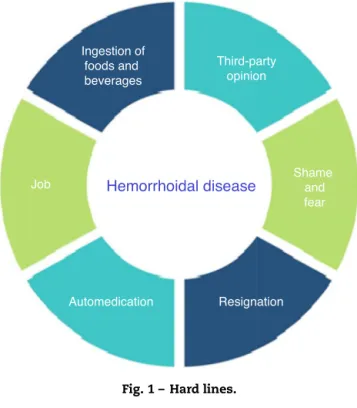
Hard(molar)lines
Ingestion of foods and beverages
Third-party opinion
Shame and fear
Resignation Automedication
Job
Hemorrhoidal disease
Fig.1–Hardlines.
empirical treatments, which makes it difficult to carry outaneventoraffectationthatcanchangetheflowofthese hardlinestoflexibleorescapelines.21,22
“Alongtimeago,whenIworkedintheCentral–therail network–Iusedtoliftbigloadsthere.Thus,withallmy timeworked,andthesun,dust,weight...Ibegantofeelthat Iwasexposingmyhemorrhoids,sometimeswithbleeding” (E7)
Self-medicationisalsodemonstratedasahardlineinthe speech:
“Peoplespokeofthisbabosathing;Iusedit,ontheadvice ofmyaunts;Homeremedies,Iusedalot;buttheydidnot solvetheproblem.“(E8)”Homemademedicinethatweuse fromtimetotime,theyusedtorelievewhatIfelt.”(E7)
Other flows interpreted as hard lines have also been observed;theseflowshinderedtheemergenceofcreativeand inventive thinking,thus making it impossible to breakthe cycleofsufferingfromthedisease;forexample,thefactof thisbeinganintimateplace,Ifeltshameandfear22(Fig.1).
“Regardingthehemorrhoidproblem,thisisarather com-plexplace,becauseitistoointimateaplace;thus,weended uppostponingthevisittothedoctor.Westartedtonotice alocalbleedingandthenwestartedtoseeabulgeinthe place,but,outofshame,andbecauseitisanintimateplace, weenduppushingtheproblem.”(E12)
Flexible(molecular)lines
Justasthefactors–gettingusedtoillness,third-party opin-ions,self-medication,shame,andfear–hereidentifiedashard linesforstratifyingandcodingpatients,thesesamefactors– inthefaceofdiseaseprogression–areunderstoodas affecta-tionandpotentiateaneventthatchangesthedirectionofthe flowofforces.Then,flexiblelinesemergewhichtranslateinto
1
2
3
4
5
6
7
Disease Progression
Affectation
A more effective treatment
Healthcare professional Cure
Regular activities
Fig.2–Flexiblelines.
adesiretoseekamoreeffectivetreatmentand,atthistime, theindividualmakesuphis/hermindbyseekingforahealth professional.Inthissense,hardlinesarenotnecessarilybad –aslongasthereisnofixationinitsflow23(Fig.2).
“TherecameamomentwhenIreallyneededtogotothe doctortotrytoeasemysituation.That’swhenIwentto thehealthclinic.”(E12)
Inanotherspeech,oneperceivestheonsetofan affecta-tion,potentiatingaflowofforcesandtransformingthehard lines into flexible ones, which aim at reachinga plane of immanence,makingit possibletoexperiencethepleasures oflife23(Fig.3).
“IfItookawalk[Ialwaysliketowalkintheafternoon], whenIpushedhard,Ifeltuncomfortable,bleeding,andin greatpain.Sothatwasthereasonthatledmetodothe treatment.”(E7)
Trajectoryandescapelines
Allpatientsparticipatinginthisstudyweretreatedbythe Sis-temaÚnicodeSaúde,apublicsystemthatguaranteeshealth aseveryone’srightandadutyoftheState,andwhose princi-plesareuniversalityandintegralityintheprovisionofhealth services.Intheanalysisofthespeeches,werealizedthatlong periodshadtopasssothattheindividualcouldbeeffectively treated. Thus, the patients had afragmented24 and
strati-fiedtherapy,withtheobservationofmolarandtranscendent traces,andhardlinesthatcrossalllevelsnormalizedbySUS. Asaresult,patientslostfocusonthetreatmentandcureof thedisease.20,21Thishegemonicmodel,basedonmolarityand
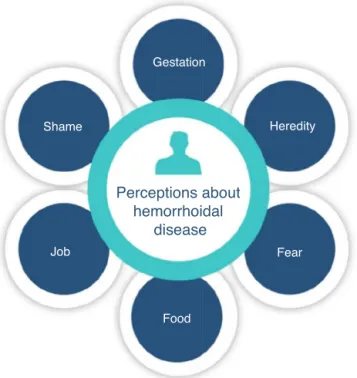
Gestation
Heredity
Fear
Food Job
Shame
Perceptions about
hemorrhoidal
disease
Fig.3–Perceptionofthepatientabouthemorrhoidal disease.
alimitingcauseforachievingaplanofimmanence,freeing patientsfromdiseaseanddecreasingitspotency.19,20
Thetrajectoryrunsthroughseverallevels, dependingon theinterviewees’speeches,beginningatthelevelofPrimary CarewiththemedicalconsultationinthePSF;referraltothe secondarylevelwiththeopinionofthespecialistandcarrying outlaboratoryexaminations;and,finally,atthetertiarylevel, whichisthehospitalwherethetreatmentwiththesurgeryis completed.NotwithstandingthisstructuringoftheSUS,this situationremindsusonceagainofthehardlinesandofthe transcendenceplane,sothatthereisadelayintreatmentof severalmonthsandevenyears.21,23
“Ittookmethreeyearstooperate,togettooperate.”(E4)”
“Ittookawhile,thattooksometimeindeed,evenafterthe doctoraskedforthesurgery,ittookabout4years.”(E6)
Insomepatients’speeches,wefound thepresenceofa micropolitics,wherethe speechesgivenwitheachother in thecorridorsandinthewaitingroomoftheconsultationoffice aimedattheexchangeofinformationaboutthediseasethat wereaffectingthem,consideringthateachpatientsoughtfora solution,thuspromotingruptures,thatis,escapelines,which allowedade-territorializationandthe emergenceofevents thatshortenedthepathstothedreamedsolutionofthe prob-lem,whichimprisonstheminthetranscendentplane.19,21
“LuckilyIknewthegirlfromtheBlock,andshesentme tolookforthegirlfromthereception,becauseIhadalready gonetherealotoftimesandhadnotgottenanything.”(E2)
“Sincethen,I’vebeenwaitingforsomeone’squittingatthe AltoSãoJoãopolyclinic.Then,hopefully,Icoulddoit.”(E5)
Trajectory
01
Aggravation of symptoms02
SUS03
ESF/PSF04
Conservative and ineffective treatment05
Specialist06
Tests & exams07
Hospital08
SurgeryFig.4–Trajectoryofpatientssubmittedto hemorrhoidectomy.
“Iwasluckybecauseitseemsthatsomepersonwas quit-tingtheprocedure;thus,theysentmeover,intheplaceof thatperson.”(E9)
Thesespeechesdemonstratesomeofthemolecularshifts usedtobreakthehierarchicalstrataconstitutedbythehealth system.Fig.4exemplifieshowtheindividuals’usualtrajectory isthroughthevariousnormativestrataofthepublichealth system.
Perceptionsrelatedtosurgicaltreatment
Thesurgicaltreatmentperformedinthe patientswas con-ventional, that is, an open hemorrhoidectomy with local anesthesiaandsedation.Thisprocedurewasperformedatthe UniversityHospital,butwithoutpatientsurgery characteris-tics.Aftersurgery,thepatientremainedunderobservationfor afewhoursandwasthendischarged,followedbyoutpatient follow-up.Fromthespeechestranscribed,thereisagreement thattheresultsweresatisfactory.
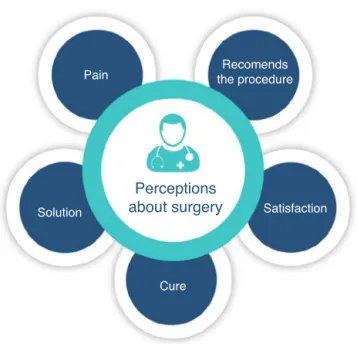
Pain the procedureRecomends
Satisfaction
Cure Solution
Perceptions
about surgery
Fig.5–Perceptionsofthepatientabouthemorrhoidectomy.
recommendthetreatment.Itwasalsoobservedthat,through micropoliticsatalllevelscoveredinthehealthsystem,this treatmentwillbeannounced,andanincreasingnumberof peoplewillhaveaccesstoit.19,20
“Ididthesurgery[...]it’scool,inasenseneitheraproblem. Therewasnothingelse.I’mfeelinggood!Thereisno prob-lematall!Ahhh,thistreatmentisthesalvationofwhohas, hadmyproblem.ToallwhohavethisproblemthatIhave, thatIhad,thisisthesolution,right?!Itistheonlyresource thatsomeonehas,isthissurgery.”(E8)
“Yes!TodayIdonotfeelanythinganymore!AndIevacuate normally!Inolongerhavethesymptomsofitchingandit doesnotbothermeanymore,untilmysexualrelationship; itchanged,improvedtoo...becausewhenwewere,when Ihadthesymptoms,itbotheredme,Iwasinsecurewith mypartner.I’mmarried,buttoday,thankGod,everything isfine.”(E10)
Itwasthenrealizedthattheprocessesofsubjectivization thatemergedwiththesurgicaltreatmentwerecrossedbyhard andescapelines,allowingahighdegreeofsatisfactiontobe obtainedwiththesolutionoftheproblem.Fig.5summarizes theseprocesses.
Conclusion
Thisstudycomprisedthetrajectoryandprocessesof subjec-tivizationofindividualssubmittedtosurgicaltreatmentfor hemorrhoidaldisease,anchoredinthecartographicapproach, accordingtotheepistemologicalandphilosophical hypothe-sesofGillesDeleuzeand Félix Guattari.Thismethodology allowedustofollowthepathstakenbypatientsintheSUS network,withthediscoveryoftheemergenceofhardlines thatcrossthistrajectory,beingtheselinesresponsible,atleast inpart,forthelongperiodsinwhichthepatientsremained
suffering from their uncomfortable symptoms, without obtainingthesurgicaltreatment.Obstaclesoccurredatall lev-elsofthenetwork:primary,secondaryandtertiaryones.Other hard lineshavealsobeen observedthatcontributed tothe patients’delayindecidinginfavorofsurgery,suchasshame andfear,andtheperceptionthathemorrhoidaldiseaseisa verycommonandbenigncondition,withalowriskforserious complications.
Through micropolitics, molecular relations, and escape lines,theintervieweeswereabletoobtainthetreatmentthey consideredascurativeand,despitethepostoperative discom-fort(mainlypain),theresultswereconsideredrewarding,thus potentiatingtheflowofforcesandtransformingthe transcen-denttrajectoryintoaplaneofimmanencewithahighdegree ofsatisfactioninfunctionoftheresultsobtained,therefore speakinginfavorofthesurgicaltreatment.Duetothe involve-ment ofcomplex issues,suchasperceived subjectivization processes, the surgical treatment of hemorrhoidal disease dependsonamoreflexibleandrhizomaticapproachonthe partofpublichealthsystemadministrators,soastotakeinto accountthemultiplewaysofaccesstothistreatmentbythe patients, withoutthestratificationsperceived inits various levels.
Conflicts
of
interest
Theauthorsdeclarenoconflictsofinterest.
r
e
f
e
r
e
n
c
e
s
1.DeleuzeG,GuattariF.Introduc¸ão:Rizoma.In:DeleuzeG, GuattariF,editors.Milplatôs:capitalismoeesquizofrenia.Rio deJaneiro:Editora;1995.p.10–36.
2.HalversonA.Hemorrhoids.ClinColonRectalSurg. 2007;20:77–85.
3.CostaLMP,SilvaTB.Doenc¸ahemorroidária:incidência, etiopapotogeniaeaspectosclínicos.In:CamposFGCM, RegadasFSP,PinhoM,editors.Tratadodecoloproctologia.São Paulo:Atheneu;2012.p.53,749.
4.MisraMC,ImlitemsU.Drugtreatmentofhaemorrhoids. Drugs.2005;65:81–91.
5.GreenbergR,KarinE,AvitalS,SkornickY,WerbinN.First100 caseswithDoppler-guidedhemorrhoidalarteryligation.Dis ColonRectum.2006;49:485–9.
6.BledayR,BreenE.Treatmentofhemorrhoids.Waltham(MA): UpToDate;2015.Availableat:
http://www.uptodate.com/contents/treatment-of-hemorrhoids. Access15Sep2015.
7.BreenE,BledayR.Analabscessesandfistulas.Waltham(MA): UpToDate;2009.
8.AmericanGastroenterologicalAssociation.American gastroenterologicalassociationmedicalpositionstatement: diagnosisandcareofpatientswithanalfissure.
Gastroenterology.2003;124:233–4.
9.CarvalhoTC,GianiniRJ.Equidadenotempodeesperapara determinadascirurgiaseletivassegundootipodehospital emSorocaba,SP.RevBrasEpidemiol.2008;11:473–83. 10.RibeiroML,CunhaMI.Trajetóriasdadocênciauniversitária
11.MartinesWRV,MachadoAL,ColveroLA.Acartografiacomo inovac¸ãometodológicanapesquisaemsaúde.Tempus– ActasdeSaucolet.2013;7:203–11.
12.RomagnoliRC.Acartografiaearelac¸ãopesquisaevida.Psicol Social.2009;21:166–73.
13.TuratoER.TratadodaMetodologiadaPesquisa Clínico-Qualitativa.Petrópolis:Vozes;2013.
14.Brasil.ConselhoNacionalDeSaúde.Resoluc¸ãono466,de12 dedezembrode2012.Brasília:Tratadepesquisaemseres
humanos;2012.
15.HaesbaertR,BruceG.Adesterritorializac¸ãonaobrade DeleuzeeGuattari.GEOgraphia.2002;4:7–22.
16.KastrupV,EscóssiaL.Pistasdométododacartografia: pesquisa-intervenc¸ãoeproduc¸ãodesubjetividade.Porto Alegre:Sulina;2012.p.52–75.
17.PeresRS,BorsoneloEC,PeresWS.Aesquizoanáliseea produc¸ãodasubjetividade:considerac¸õespráticaseteóricas. Psicolemestudo.2000;5:35–43.
18.FerreiraFT.Rizoma:ummétodoparaasredes.RJ:Liincem revista;2008.p.28–40.
19.MerhyEE.CadernosdeSaúdePública.RJ.2009;25:898–906. 20.FugantiLA.Saúde,desejoepensamento,SaúdeLoucura.São
Paulo:Hucitec;1990.p.19–82.
21.SchopkeR.Opensamentocomoultrapassamentodarazão
clássica.In:SchopkeR,editor.Porumafilosofiadadiferenc¸a: GillesDeleuze,opensadornômade.RiodeJaneiro/SãoPaulo: Contraponto/EDUSP;2004.p.19–42.
22.PaulonSM,RomagnoliRC.Pesquisaintervenc¸ãoecartografia: melindresemeandrosmetodológicos.EstudosPesquisas Psicolog.2010;10:85–102.
23.CassianoM,FurlanR.Oprocessodesubjetivac¸ãosegundoa esquizoanálise.PsicolSoc.2013;25:372–8.