O
h
r
c
i
r
g
a
in
e
a
s
l
R
e
Sedat Yahsi, Senol Tonyali, Cavit Ceylan, Serkan Dogan, Eymen Gazel Department of Urology, Turkiye Yuksek Ihtisas Training and Research Hospital, Ankara, Tunkey Body Mass Index and Stone Disease
Is There a Threshold of Body Mass Index for to Predict
Extracorporeal Shock Wave Lithotripsy Success?
Ekstrakorporeal Şok Dalga Litotripsi Başarını
Öngörmede Bir Vücut Kitle İndeksi Eşik Değeri var mı?
DOI: 10.4328/JCAM.4729 Received: 28.06.2016 Accepted: 29.08.2016 Printed: 01.03.2017 J Clin Anal Med 2017;8(2): 126-9
Corresponding Author: Senol Tonyali, Turkiye Yuksek Ihtisas Training and Research Hospital, Sihhiye 06230 Ankara, Turkey. Tel: +90 3123061829 E-Mail: [email protected]
Özet
Amaç: Vücut kitle indeksinin (VKİ) ekstrakorporeal şok dalga litotripsi (SWL) başarısı üzerine olan etkisini ortaya koymak. Gereç ve Yöntem: 1.5 cm’den kü
-çük böbrek taşı için SWL olan tüm hastalar retrospektif olarak tarandı. Has
-taların demografik bilgileri, boyları, kiloları ve taş karakteristikleri kaydedildi. Taşsız ve rezidü taşı olan hastalar VKİ, ortalama Hounsfield Unitesi (HU), taş boyutu ve sayısı ve şok dalga süresine göre karşılaştırıldı. Bulgular: Ortalama yaşı 48.17 ± 1.58 yıl ve ortalama taş boyutu 9.54 ± 1.61 mm olan 100 hasta çalışmaya dahil edildi. Genel SWL başarısı %69 iken 31 hastanın rezidü taşı vardı. Taşsızlık üst kaliks taşlarında %85, orta kaliks taşlarında %57.1, alt ka
-liks taşlarında %58.1 ve renal pelvis taşlarında %78.6 oranında sağlandı. VKİ ve ortalama taş boyutu taşsız ve rezidü taş gruplarında anlamlı olarak fark
-lıydı [sırasıyla 25.3 ± 3.5 kg/m2‘e karşın 30 ± 3.4 kg/m2, 8.7 ± 1.3 mm’e karşın
9.7 ± 1.6 mm (p< 0.001)]. Youden’s indekse göre başarılı bir SWL için VKİ eşik değeri 26.75 kg/m2 olarak bulundu. Tartışma: Bu ön çalışma SWL başarısını öngörmek için bir VKİ eşiği ortaya konmasına öncülük edebilir.
Anahtar Kelimeler
Böbrek Taşı; SWL; Vücut Kitle İndeksi
Abstract
Aim: We aimed to determine the impact of BMI (body mass index) on extra
-corporeal shock wave lithotripsy (SWL) success. Material and Method: We
retrospectively analyzed the medical records of all patients who underwent
SWL for single renal stone smaller than 1.5 cm. Patient demographics, height,
weight and stone characteristics were recorded. Stone free (SF) patients and patients with residual stone (RS) were compared according to BMI, mean
HU (Hounsield unit), stone size and number and duration of shock waves. Results: A total of 100 patients with an average age of 48.17 ± 1.58 years and an average stone size of 9.54 ± 1.61 mm were included the study. Overall SWL success was 69 % such 31 patients had RS. SF status achieved in 85%, 57.1%, 58.1% and 78.6% of patients with renal stones in upper, middle, lower
calyces and renal pelvis, respectively. Mean BMI and mean stone sizes were
found signiicantly diferent between SF and RS groups, 25.3 ± 3.5 kg/m2
versus 30 ± 3.4 kg/m2, 8.7 ± 1.3 mm versus 9.7 ± 1.6 mm, respectively (p<
0.001). The best cut-of value, which was found according to Youden’s index, for BMI for a successful SWL was 26.75 kg/m2. Discussion: These preliminary
results may lead further studies with large patient numbers to determine a
threshold of BMI for to predict SWL success.
Keywords
Nephrolithiasis; SWL; Body Mass Index
Introduction
With the development of technology extracorporeal shock wave lithotripsy (SWL) has emerged as the irst choice of treatment in renal calculi smaller than 2 cm over 3 decades [1,2]. SWL procedure has many advantages such as it is minimally inva-sive, has low complication rates and can be performed on an outpatient base [3]. Prediction of stone fragmentation is critical to avoid waste of time and money. Some well-described factors related to patient and stone are known to be associated with efective renal stone fragmentation. These factors are stone burden, localization, stone size and density, skin to stone dis-tance, skeletal and renal anomalies, calyx diverticula and BMI [3,4]. Obesity afects more than 1.5 billion people worldwide as was proven to be associated with hypertension, diabetes mel-litus, ischemic heart disease and urinary stone disease [5,6]. There is a limited study in the literature showing obesity as an independent predictor of SWL treatment success [5]. In this original study we aimed to determine the impact of BMI on SWL treatment success.
Material and Method
We retrospectively analyzed the medical records of all patients who admitted to urology clinic between 1 May 2014 and 1 No-vember 2015 with single renal stone smaller than 1.5 cm and underwent SWL. Patients with a history of SWL failure were excluded from the study. Patient demographics, height, weight, stone history, stone size, stone localization and Hounsield (HU) unit, SWL duration and number of shocks were recorded. All patients were evaluated with low-dose non-contrast enhanced computerized tomography (NCCT) before and with either NCCT or KUB (kidney-ureter-bladder) radiograph one month ater SWL. Mean Hounsield unit (HU) on NCCT was used to calculate stone density. Patients with stones ≤ 2 mm ater SWL were assumed SF. Patients were stratiied into two groups based on stone free (SF) status. SF patients and patients with residual stone (RS) were compared according to BMI, stone location, mean HU, stone size and number and duration of shock waves. SWL was performed with Stonelith V3 Lithotriptor (PCK, Tur-key) on an outpatient base. Initial energy was 10kV, gradually increased by 0.5 kV to a maximum level of 21kV.
Statistical Analysis
Statistical analysis was performed via an available licensed statistic programme. Chi-square test was used to determine the diference of age, stone site, stone localization and HU be-tween groups as well as Mann Withney U test for BMI, stone size and number and duration of shock waves. ROC curve analy-sis and Youden’s index was used to ind a cut-of. P < 0.05 was considered signiicant in statistical analysis.
Results
In total of 100 patients with an average age of 48.17 ± 1.58 years and an average stone size of 9.54 ± 1.61 mm were in-cluded the study. 65 patients were male and 35 were female. 51 renal stones were let-sided whereas 49 were right-sided. Number of patients within stones in upper calyces, middle ca-lyces, lower calyces and renal pelvis were 20, 21, 31 and 28, respectively.
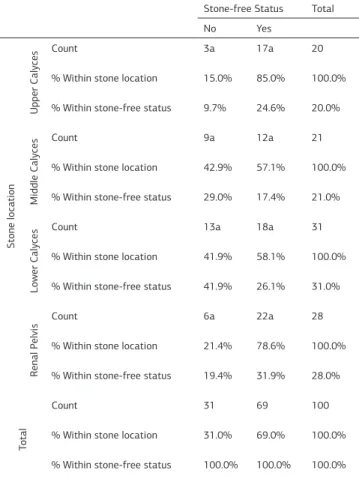
Overall SWL success was 69% such 31 patients had residual stones (RS). In comparison, no statistically signiicant difer-ence was found between SF and RS groups according to sex, stone side and stone localization (p= 0,94; p= 0,34; p= 0.082). Stone-free status achieved in 85%, 57.1%, 58.1% and 78.6% of patients with renal stones in upper, middle, lower calyces and renal pelvis, respectively. SWL success in patients with renal stones in the upper calyces and the renal pelvis was higher than patients with renal stones in middle or lower calyces, which was statistically not signiicant (p = 0.082) [Table 1].
Mean BMI and mean stone sizes were found signiicantly
dif-ferent between SF and RS groups, 25.3 ± 3.5 kg/m2 versus 30 ±
3.4 kg/m2, 8.7 ± 1.3 mm versus 9.7 ± 1.6 mm, respectively (p<
0.001).
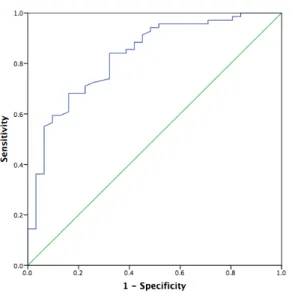
The best cut-of value, which was found according to Youden’s
index, for BMI was 26.75 kg/m2 with a sensitivity of 0.681 and
a speciicity of 0.839 [Area Under Curve (AUC)= 0.83 and p< 0.001]. (Figure 1).
And also no signiicant diference was noted between SF group and RS group related to HU (599.8 ± 80 versus 607.6 ± 77), shock number (2188 ± 334 versus 2232 ± 317) and procedure duration (31.3 ± 2.6 min versus 32 ± 2.2 min). (P > 0.05; p= 0,28; p= 0,16).
Discussion
Extracorporeal shock wave lithotripsy has been widely used since 1980’s. It is suggested as irst line-treatment in urinary tract stones in several guidelines [1,7]. Reported overall stone-free status rate is approximately 80-90%. It stands out as an alternative treatment choice because it is less invasive than percutaneous nephrolithotomy and ureterorenoscopy.
Treat-Table 1. Comparison Of Stone-free Status According to Stone Localization
Stone-free Status Total
No Yes
Stone location
Upper Caly
ces
Count 3a 17a 20
% Within stone location 15.0% 85.0% 100.0%
% Within stone-free status 9.7% 24.6% 20.0%
Middle Caly
ces
Count 9a 12a 21
% Within stone location 42.9% 57.1% 100.0%
% Within stone-free status 29.0% 17.4% 21.0%
Lo
w
er Caly
ces
Count 13a 18a 31
% Within stone location 41.9% 58.1% 100.0%
% Within stone-free status 41.9% 26.1% 31.0%
Renal P
elvis
Count 6a 22a 28
% Within stone location 21.4% 78.6% 100.0%
% Within stone-free status 19.4% 31.9% 28.0%
T
otal
Count 31 69 100
% Within stone location 31.0% 69.0% 100.0%
% Within stone-free status 100.0% 100.0% 100.0%
Journal of Clinical and Analytical Medicine | 127
ment failure, additional treatment requirement and relatively long time to SF status are main limitations [8]. Therefore, pre-diction of treatment success is mandatory to determine the best treatment choice and to inform patient well.
Factors afecting SWL outcomes are being discussed over the past 20 years. Previous studies reported more favorable results in young patients and patients with low BMI and less stone bur-den [3]. In addition, upper pole, renal pelvis and proximal ureter stones represent more favorable results compared to lower pole and distal ureter stones [3]. In another study, hydronephrotic kidney was found associated with better SWL treatment suc-cess compared to non-dilated renal collecting system [9]. Abdel-Khalek et al.[10] also reported that stone size, stone localization and presence of ureteral stent afect SWL treatment success. In concordance, Shiroyanagi [11] was found stone size and stone localization as independent factors afecting SWL results. Many attempts have been made to develop nomograms in this re-gard. Kanao et al.[1] suggested that stone size, localization and number are predictive on SWL success and can be used in pre-operative nomograms; whereas Pareek et al.[4] proposed BMI and HU as signiicant predictors of ESWL outcomes. HU is an-other frequently studied parameter in the assessment of stone density and fragility. In many studies, HU was found related with ESWL failure [12]. In other study, HU was found higher in RS group however statistical signiicant diference was not observed (p> 0.05). This might be due to some measurement biases deriving from the lack of a standardized measurement of HU on NCCT.
In the literature, stone burden is stated to have a signiicant efect on SWL success both in renal and ureteral stones [1,3]. Stone size was shown be a predictor of SWL success [8]. Abdel-Khalek et al.[13] found 89.7 % and 78 % of SF rates for stones <15 mm and >15mm, respectively. Similar to that, another study demonstrated 90 % success in stones <10mm and 70 % success in stones >10 mm [14]. In our study, a statistically signiicant diference was observed between SF and RS groups related to stone size, 8.7 ± 1.3 mm versus 9.7 ± 1.6 mm (p< 0.001). Ackerman et al.[15] suggested stone number to be more crucial than stone burden in ESWL and they attribute that to
the diiculty of focusing in multiple stones.
In a study focused on stone localization, SF rates was found higher in upper pole and renal pelvis stones compared to lower pole stones [8]. According to these studies, stone localization, size and number seem to be signiicant in prediction of SF rate. Extracorporeal shock wave lithotripsy is reported to be a safe method in renal stone treatment up to 2 cm but we preferred opaque and single stones smaller than 1.5 cm to lessen dis-advantages of stone burden and focusing problems. Patients were stratiied in to four groups based on stone localization as upper calyces, middle calyces, lower calyces and pelvis groups. SF rates were higher in patients with upper calyces and renal pelvis stones compared to middle calyces and lower calyces stones. However, no signiicant diference was found in SF rates between these groups (p= 0.082). This might be due to low pa-tient number and/or exclusion of stone between 1,5 and 2 cm. Signiicant results could be obtained in large series such our “p” value is very close to signiicance level.
Body mass index is widely used as a deinitive and easily ap-plied indicator of obesity. Generally accepted BMI ranges are normal weight from 18.5 to 25 kg, overweight from 25 to 30 kg and obese over 30 kg [4]. The association of BMI with lousy outcomes of several procedures was demonstrated in previous studies. However, efect of BMI on SWL results is not entirely clear. BMI and stone size were found related with SWL eicacy and also BMI was found a signiicant predictor of SF status (p< 0.01)[4]. In contrast, Takahara et al found an association be-tween BMI and stone fragility (p= 0.04) whereas no relation was found in regard to SF status [8]. The factors acting in relation between BMI and SWL failure has not been entirely determined yet. Possible factors include diiculty in stone focusing and di-minished shock waves during transition between the tissues [4]. Skin to stone distance is also reported to be an independent factor of SWL failure. Subcutaneous tissue is thought to absorb the shock wave energy and diminish the energy reaching the stone [3]. In our study, there was a signiicant diference be-tween SF and RS groups according to BMI (p< 0.001). And the cut-of value of BMI was found to be 26.75 kg/m2 with a high positive prediction (AUC= 0.83). The diference in SF rates may suggest BMI as an independent predictor of SWL success. With the aid of further studies it might be possible to determine a threshold of BMI for to predict SWL success. By this way, pa-tients could be informed about SWL success according to BMI before treatment and alternative treatment methods can be of-fered if necessary.
There are several factors efecting SWL success in urinary tract stones. In this study, we found BMI as a predictor of SWL suc-cess in opaque, single renal stones smaller than 1.5 cm with a cut-of value of 26.75 kg/m2. These preliminary results may lead further studies with large patient numbers to determine a threshold of BMI for to predict SWL success.
Compliance With Ethical Standards: Funding: None
Conlict of Interest: The authors declare that there is no conlict of interests regarding the publication of this manuscript. Ethical Approval: All procedures performed in studies involving human participants were in accordance with the 1964 Helsinki
Figure 1. ROC Curve analysis to determine a cut-of value for BMI. Area Under Curve (AUC) is 0.830 (p <0.001). Smaller BMI values indicate stronger evidence
for a stone-free status.
| Journal of Clinical and Analytical Medicine 128
declaration and its later amendments or comparable ethical standards.
Informed Consent: Not required for this type of (retrospective) study.
Competing interests
The authors declare that they have no competing interests.
References
1. Kanao K, Nakashima J, Nakagawa K, Asakura H, Miyajima A, Oya M et al.
Pre-operative nomograms for predicting stone-free rate ater extracorporeal shock wave lithotripsy. J Urol 2006;176(4 Pt 1):1453-7.
2. El-Nahas AR, El-Assmy AM, Mansour O, Sheir KZ. A prospective multivariate analysis of factors predicting stone disintegration by extracorporeal shock wave lithotripsy: the value of high-resolution noncontrast computed tomography. Eur
Urol 2007;51(6):1688-94.
3. Yang TK, Yang HJ, Lee LM, Liao CH. Body mass index and buttock circumference
are independent predictors of disintegration failure in extracorporeal shock wave
lithotripsy for ureteral calculi. J Formos Med Assoc 2013;112(7):421-5.
4. Pareek G, Armenakas NA, Panagopoulos G, Bruno JJ, Fracchia JA. Extracorporeal
shock wave lithotripsy success based on body mass index and Hounsield units. Urology 2005;65(1):33-6.
5. Şimşek A, Özgör F, Akbulut MF, Küçüktopçu O, Berberoğlu AY, Sarılar Ö et al. Does body mass index efect the success of percutaneous nephrolithotomy? Turk
J Urol 2014;40(2):104-9.
6. Calvert RC, Burgess NA. Urolithiasis and obesity: metabolic and technical
con-siderations. Curr Opin Urol 2005;15(2):113-7.
7. Semins MJ, Matlaga BR. Strategies to optimize shock wave lithotripsy outcome:
Patient selection and treatment parameters. World J Nephrol 2015;4(2):230-4.
8. Takahara K, Ibuki N, Inamoto T, Nomi H, Ubai T, Azuma H. Predictors of
suc-cess for stone fragmentation and stone-free rate ater extracorporeal shockwave lithotripsy in the treatment of upper urinary tract stones. Urol J 2012;9(3):549-52.
9. Turna B, Akbay K, Ekren F, Nazli O, Apaydin E, Semerci B et al. Comparative study of extracorporeal shock wave lithotripsy outcomes for proximal and distal ureteric stones .Int Urol Nephrol 2008;40(1):23-9.
10. Abdel-Khalek M, Sheir K, Elsobky E, Showkey S, Kenawy M. Prognostic fac-tors for extracorporeal shock-wave lithotripsy of ureteric stones--a multivariate
analysis study. Scand J Urol Nephrol 2003;37(5):413-8.
11. Shiroyanagi Y, Yagisawa T, Nanri M, Kobayashi C, Toma H. Factors associated with failure of extracorporeal shock-wave lithotripsy for ureteral stones using
Dornier lithotripter U/50. Int J Urol 2002 Jun;9(6):304-7.
12. Pareek G, Armenakas NA, Fracchia JA. Hounsield units on computerized to
-mography predict stone-free rates ater extracorporeal shock wave lithotripsy. J Urol 2003;169(5):1679-81.
13. Abdel-Khalek M, Sheir KZ, Mokhtar AA, Eraky I, Kenawy M, Bazeed M.
Predic-tion of success rate ater extracorporeal shock-wave lithotripsy of renal stones--a
multivariate analysis model. Scand J Urol Nephrol 2004;38(2):161-7.
14. Al-Ansari A, As-Sadiq K, Al-Said S, Younis N, Jaleel OA, Shokeir AA. Prognostic
factors of success of extracorporeal shock wave lithotripsy (ESWL) in the treat -ment of renal stones. Int Urol Nephrol 2006;38(1):63-7.
15. Ackermann DK, Fuhrimann R, Pluger D, Studer UE, Zingg EJ. Prognosis ater
extracorporeal shock wave lithotripsy of radiopaque renal calculi: a multivariate
analysis. Eur Urol 1994;25(2):105-9.
How to cite this article:
Yahsi S, Tonyali S, Ceylan C, Dogan S, Gazel E. Is There a Threshold of Body Mass
Index for to Predict Extracorporeal Shock Wave Lithotripsy Success? J Clin Anal
Med 2017;8(2): 126-9.
Journal of Clinical and Analytical Medicine | 129