PROBLEMY TRANSPORTU Volume 10 Issue 4
public transport; regional and suburban railway transport; revitalisation
Jaroslav MAŠEK*, Martin KENDRA, Juraj ČAMAJ
Department of Railway Transport, Faculty of Operation and Economics of Transport and Communication, University of Zilina
Univerzitna 1, 01026, Zilina, Slovakia Sanjin MILINKOVIĆ, Slavko VESKOVIĆ
Faculty of Traffic and Transport Engineering, University of Belgrade Vojvode Stepe 305, 11000 Belgrade, Serbia
*Corresponding author. E-mail: [email protected]
PROPOSAL AND APPLICATION OF METHODOLOGY
OF REVITALISATION OF REGIONAL RAILWAY TRACK IN SLOVAKIA
AND SERBIA. PART 2: STATE OF REGIONAL TRANSPORT IN SLOVAKIA
AND SERBIA
Summary. This paper discusses a proposal of methodology of revitalisation of regional railway tracks and regional railway traffic, liberalization and competition in railway transport, quality requirements in regional traffic, principles of the contract on transport services in the public interest and with the current state of regional passenger transport in Slovakia and Serbia. This is Part 2 which is dedicated to study the current situation of regional railway transport in Slovakia and Serbia, the investment plans, the potential changes on the railway transport market and the quality of transport service provided in these countries.
VORSCHLAG UND ANWENDUNG DER METHODE REVITALISIERUNG
REGIONALE BAHNSTRECKE IN DER SLOWAKEI UND SERBIEN. TEIL 2:
SITUATION DES REGIONALVERKEHRS IN DER SLOWAKEI UND SERBIEN
UND ANWENDUNGSMÖGLICHKEIT REVITALISIERUNG METHODE
Zusammenfassung. Arbeit beschäftigt sich mit Vorschlag der Methodik der Wiederbelebung der regionalen Eisenbahnlinien und regionalen Bahnverkehr, Liberalisierung und Wettbewerb im Eisenbahnverkehr, Qualitätsanforderungen im Regionalverkehr, Grundsätze des Vertrags auf Verkehrsleistungen im öffentlichen Interesse und mit dem Stand der regionalen Personenverkehr in der Slowakei und Serbien. Zweiter Teil der Arbeit beschäftigt sich die Situation der regionalen Eisenbahnverkehr und Änderung auf dem Eisenbahnverkehrsmarkt in der Slowakei und Serbien und mit der Möglichkeit der Anwendung der Methodik und Revitalisierung dieser Staaten.
1. INTRODUCTION
are very similar. Both countries were to the 90's of the 20th century part of the East European block with strictly centralized management of planning. The principles of competition and free market were not present at the time, which caused the significant decline in the quality of rail passenger transport.
Slovakia in the last 25 years became part of the EU and hence had to transpose legislation and standards for EU transport and railway to support the development and enhance the quality of railway passenger services through investment in transport infrastructure and rolling stock. The transformation in Serbia was more complicated, resulting in a lower volume of investments in railways and slower development of services in this area.
The paper discusses the possibilities of increasing the quality and attractiveness of railway transport through a revitalization of regional rail lines.
2. STATE IN REGIONAL RAILWAY TRANSPORT IN SERBIA
In Serbia, many regions have networks of railroads, especially in Vojvodina, East and Central Serbia. Regional and local railroads are in different statuses: most of the railroads are in function; some railroads are out of function and, unfortunately, there are a few liquidated railroads.
In South Banat Region, local community wanted to preserve railway transport. Local municipalities supported by AP Vojvodina Government showed interest in improving the regional railway transport. Their goal was to analyse the feasibility of investing in regional railway transport by reconstructing the tracks and investing in new DMUs. The Study on revitalisation of railways in South Banat was conducted in 2008 [10]. Results of this study showed that the current state of the South Banat region transport system was not good. Preliminary analysis revealed that there was a shortage of busses in regional traffic, high bus transport prices (up to 60% more than in railways) and lack of reliability (especially in winter). Also, there were high passenger flows in regional railway zones in peak hours. Rail passenger transport had a low quality because of the lack of trains, frequent failures and cancellations, small train frequency, lot of delays, old and uncomfortable DMUs etc. Timetable could not meet passenger demands and requests for regional transport [1]. A survey conducted in 2008 showed that there are various categories of passengers in regional transport: employees, pupils and students, users of medical services etc.
2.1. Analysis of the necessity for railways revitalisation in South Banat
The main objective of the revitalization of regional and local railways is to achieve a better, more reliable and economic transportation link especially with the economic, educational, administrative and cultural centres (Vrsać, Panćevo, Beograd). Also, the strategic plan of the region, is to connect to Corridor X, IV and V, and the Danube Corridor VII (Fig. 1).
Higher market share for railways in the passenger and freight transport can help in improving economy of the region, and to keep cohesion and improve the social status of residents. Also, it improves safety, achieves positive environmental effects and reduces the total external costs of transport.
Fig. 1. Map of the railway lines in South Banat Abb. 1. Karte der Bahnlinien in Süd-Banat
The forecast of railway flows is the basis for defining the concept of regional passenger railway transport and selecting the lines and volume for the regional trains. The central part of the methodology proposes the revitalization of railways and bringing them to a level that enables the organization of reliable and regional railway transport of high quality. This is based on the feasibility study, i.e. Cost-Benefit analysis in terms of the needs of the community. The feasibility of investment of the regional transport is by socio-economic assessment, including the plan of revenue, costs and investments in the period of 20 years. The criterion for dynamic assessment approach is the internal rate of returns (IRR). The goal is to determine whether the income as derived from the regional passenger traffic on the railway can develop a positive contribution for covering the total fixed costs and investments in DMU and railroad overhaul, after deduction of variable costs.
Only the income that would be achieved by selling tickets to passengers who use regional passenger trains and possible subsidies is taken into the assessment.
All costs are divided into two groups: 1) fixed costs that do not depend on the volume of traffic and 2) variable costs that depend on traffic volume. Fixed costs are: capital for maintenance of train units, insurance, maintenance of railways, salaries of personnel. Variable costs include: DMU maintenance and energy costs.
Fig. 2. Internal rate of returns for investment in regional passenger transport Abb. 2. Internal Rücklaufquote für Investitionen in die regionalen Personenverkehr
2.2. Trains and traffic organisation in South Banat Region
Passenger regional transport in South Banat Region was mostly carried on diesel motor units (DMU) series 812 (Fig. 3) and 712 (40-50 years old), and classic train sets with locomotive traction.
Fig. 3. Series 812 DMU Abb. 3. Series 812 DMU
In the past couple of years, the situation has not improved until March 2012, when Serbian Railway invested in new DMU.
After 36 years, Serbian Railways have bought a new diesel multiple unit (DMU) for a regional passenger transport. DMU is a series 711 (Fig. 4) unit made by Metrowagonmash, and it was introduced on the Beograd – Vrsac regional line. It is a modern design DMU (Table 1) equipped with contemporary facilities for passengers (and passengers with disabilities) including air conditioning, high comfort seats and video surveillance. Diesel multiple units of series 711 has a modular structure. Units have multi-functional easily adjustable space, designed to accommodate baby carriages, bicycles, wheelchairs and bulky luggage.
in other modes are the reason that there is an offer of low priced train tickets on Beograd – Vrsac line. Additionally, new DMU increased the quality of rail transport (on time traffic, comfort and higher speeds).
Table 1 Technical specifications of the DMU series 711
Name Description
Wheel arrangement Bo'2'-2'Bo '
Power (kW) 2 x 250 kW
Maximum construction speed, km / h 120
Seating Capacity (second class) 110 (+ 10 folding) Number of standing positions (4 per./m2) 126
Max number of passengers 246
Fig. 4. New DMU series 711 in South Banat region Abb. 4. Neue DMU-Baureihe 711 in Süd-Banat
Fig. 5. Number of passengers by trains on Beograd Dunav – Vrsać line Abb. 5. Anzahl der Fahrgäste von Zügen auf Beograd Dunav – Vrsac Linie
From the start of the new DMU, number of the passengers on the line is increasing rapidly. Also, the punctuality is much higher than on any other trains in the network. The number of passengers was increasing rapidly from the start of the service (Fig. 5).
Table 2 Average number of passengers in trains on Beograd Dunav – Vrsac line
Train No. 2600 2601 2602 2603 2604 2605 2606 2607
Average No. passengers 110 91 91 72 65 125 78 64
Seating capacity
utilization 92% 76% 76% 60% 54% 104% 65% 53%
In January - February 2013, there has been additional increase in the average number of passengers and the train capacity utilisation (Table 2).
In 2013, from the start of the current timetable the increase in the number of passengers is even higher [3]. According to the recent data, train 2605, now has the highest number of passengers (Fig. 6). Train 2605 departs from the Belgrade railway node (station Beograd Dunav) at 15.55 which is a suitable time for the citizens of Pancevo and others cities in the region. Trains 2600/2601 and 26060/2607 are suitable for workers and students. Also, there are some daily variations for the weekend where trains 2605/2607 have increased number of passengers on Friday, and trains 2604/2606 on Sunday. Increase in number of passengers brought significant growth of income. Total income from train tickets on Beograd Dunav – Vrsac line increased three times from March 2012 to February 2013 (Fig. 6).
Fig. 6. Monthly revenue for the Beograd Dunav – Vrsać line
Abb. 6. Monatliche Einnahmen für das Beograd Dunav - Vrsac Linie
The results of the new regional passenger transport concept initiated a need to evaluate the level of passenger satisfaction. The passenger’s opinion can be used as a valuable parameter in future decision-making regarding the regional rail transport. During the April 2013 the survey on passenger satisfaction on regional railways started. Survey is anonymous and is directed in two ways. Firstly, survey is by direct approach among the train passengers in the form of the questionnaire. Passengers receive the paper form in the station or in the train (from the staff). Secondly, similar form is available as an anonymous online survey on the link http://www.sf.bg.ac.rs/anketajuznibanat. The survey was created for the South Banat region and has the following sections:
• Personal data (gender, age, occupation, social status); • Relation of travel and frequency of travel by train;
• Comparing the rail with other modes of transport by price and time;
• Rating the rail travel for price, comfort, speed, cleanliness, frequency, on time travel, quality of timetable;
• Use of passenger intermodality and Park & Ride facilities; • Opinion for priory in new investments in railways in the region.
Passengers have recognised the good service on the Beograd Dunav – Vrsac line and shifted to rail. For the analysis of the passenger satisfaction and further improvement of rail service in region the survey is in progress on South Banat. The results of the survey will be used for decision-making in future planning of regional railways.
Results of the study produced in 2008 showed that it is feasible to invest in regional trains in South Banat. When the new DMU was introduced in traffic in March 2012, results on the number of passengers exceeded all expectations. The passenger transport income increased three times and the number of passengers is rising every month.
3. STATE IN REGIONAL RAILWAY TRANSPORT IN SLOVAKIA
European Union, the state is required to ensure a certain level of transport service area, these performances, which are for the carrier unprofitable, viewed as services of public interest. Transport service area is meant basic transport requirements of the population - especially travel to and from work, school, medical facilities, a shopping and culture. Development of the passengers transport performance (thousands of persons) in the years 1995-2012 in Slovakia you can see on Fig. 7. Moreover, according to the principles of state transport policy are fares in public transport services regulated (ordinary fare trains except higher category, students, retirees, other groups), so the price does not even the own carrier´s costs.
The financing of public transport is based on existing laws and conducted on the basis of contract on transport services in the public interest (contract). Parties to the contract is the state, respectively the Ministry of Transport, Construction and Regional Development of the Slovak Republic, regions and municipalities as the customers of services and individual carriers - companies, who are the suppliers of these services [9].
The most important laws governing the operation and financing of rail passenger transport: Railroads Act No 513/2009, regulating [4]:
• The types of railroad and rules for their construction and operation; • Type-approval of rolling stock and the authorization of their operation;
• The operation of for technical equipment and authorization to perform specified activities; • Operation of railway infrastructure, the allocation of capacity and determination of charges for
the use thereof;
• Professional competence, health capability and psychological ability to work on the railways; • Interoperability and safety of the railway system;
• Competences of state administration in the railways.
Transport on the railways Act No 514/2009, regulating [5]: • Conditions for providing services on railroads;
• The rights and obligations of carriers and passengers in public passenger transport;
• The rights and obligations of carriers and senders and recipients of consignment in freight transport;
• Certification of locomotion drivers;
• Competences of state administration in transport on the railways.
The purpose of the contract on transport services in the public interest is to ensure safe, effective and quality services for regulated fares, their adequate performance according to the needs of transport service area and take into account social and environmental factors, factors of regional development and the requirements of the armed forces.
The contract on transport services in the public interest is to provide a legal form of commitment of the customer (state) with the carriers for transport services, which as an entrepreneur in terms of its commercial interests, especially economic disadvantage, not provided at all, or did not provide the requested size or quality, or would not providing for regulated fares, but which are necessary from transport services point of view in the area coverage. Contracts for transport services in the public interest are not for providing services of local recreational, commercial and tourist character.
Customer of transport services may contract directly with a selected carrier. The payment obligation from the contract consists in the compensation of the proven loss of performance of the obligation of the customer services.
Fig. 7. Development of the passengers transport performance (thousands of persons) in the years 1995-2012 in Slovakia
Abb. 7. Entwicklung der Passagiere der Verkehrsleistung (tausend Personen) in den Jahren 1995 bis 2012 in der Slowakei
To the costs of the rail company, which provide transport services included are the costs of staff, the energy costs for the use of railway infrastructure maintenance costs, repair and operation costs of rolling stock and other equipment necessary for the provision of transport services, fixed costs and holding suitable return on capital [8]. The refund granted proven loss can be used only to fulfil the obligation of contracts of transport services in the public interest.
3.1. The present contracting arrangement of transport services in the public interest
Railway passenger transport services in Slovakia are provided by two carriers - Železničná spoločnosť Slovensko, a.s. (ZSSK) and RegioJet, a.s. (RJ), with the exception of foreign carriers in the local border transport, which is regulated by specific legal documents.
The financing of rail passenger transport is currently done through noninvestment subsidies on the basis on contracts of transport services in the public interest. These contracts were concluded by the Ministry of Transport, Construction and Regional Development of the Slovak Republic and both passenger carriers.
Regular rail passenger transport services are operated from 4.3.2012 by RegioJet only on the line between Bratislava - Dunajská Streda - Komárno on the basis of a contract (Ministry of Transport, 2010) concluded with the Ministry of Transport, Construction and Regional Development of the Slovak Republic. This contract was concluded in 27.12.2010 for 9 years [6]. Ordered traffic performance for the whole period of the timetable (TT) has a range of 1 246 451 of train kilometres (train km). For the duration of the timetable 2011/2012 range was set as equivalent traffic performance corresponding with the start of operations 4.3.2012 (947 743 train kilometres). Amount of ordered train kilometres specifies amendments to contracts for the duration of the annual TT depending on the structure of the timetable. The amount of payment for one train km, which is 4.52 € per train km is agreed for the whole period of the contract.
Supplement no. 1 to the contract, dated 19.3.2012 for the period of the timetable 2011/2012 set of ordered services to 947 269 train km. Total payment for a period of 4 3 2012 - 8 12th 2012, in accordance with Supplement no. 1 is maximum amount of 5 485 225 €. Payment was realized according to the schedule specified in the Annex no. 5. Supplement no. 2 dated 20.12.2012 for the duration of the timetable 2012/2013 agreed amount the ordered 1 196 422 train km and total payment for transport services for a period of 9.12.2012 – 14.12.2013 is set to a maximum of 7 115 021.13 €.
0 2 000 000 4 000 000
1995 2000 2005 2008 2009 2010 2011 2012
Development of the passenger transport performance
Total passenger transport performance (tous. pass) Railway transport
Road transport Urban transport
Payment shall be calculated using the formula:
CRI
x
KM
TRAIN
+
i
x
P
x
KM
TRAIN
=
Payment
,
(1)
where: TRAIN KM - amount of train km for timetable period [train km]; P - price for train km - 4,52 [€/train km] according to art. 6; para. 1 of contract, i - cumulative increase in the consumer price index provided by the Statistical Office of the Slovak Republic for the duration of timetable; CRI - costs for the use of railway infrastructure maintenance for the duration of timetable [€/train km].
Regular rail passenger transport services on all other lines of Slovak Railways (excluding the lines with cancelled passenger traffic) are provided by Železničná spoločnosť Slovensko on the basis of a contract (Ministry of Transport, 2010) agreed with the Ministry of Transport, Construction and Regional Development of the Slovak Republic dated 27.12.2010. The contract was concluded for a fixed term with effect from 1.1.2011 for a period of 10 years [7]. The contract may be extended for a further period of 5 years. The total duration must not exceed 15 years.
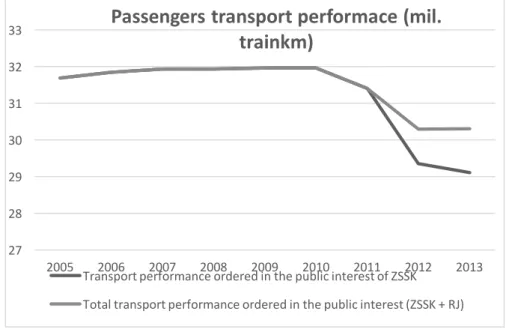
Fig. 8. Development of ordered passengers transport performance in years 2005-2013 in Slovakia Abb. 8. Entwicklung der bestellten Fahrgäste Verkehrsleistung in den Jahren 2005-2013 in der Slowakei
The customer - Ministry has the right to exclude individual trains from the range of the contract and take them directly to another carrier or put out to tender. Range of total traffic performance ordered by client under this contract may be reduced due to exclusion of trains crossing original competences in regional rail to regions or any other reason gradually over the effectiveness of this contract by up to 35%, on a year on year no more than 10% of the total ordered performance of train transport 2010/2011. Carrier obligations include a commitment to carry, operate and secure tariff commitment. The commitment to carry means obligation to transport passengers according predetermined ranges of traffic under the current train timetable. The operating commitment is the obligation of the carrier in relation to the rolling stock. The carrier operates rolling stock on the basis of licenses, uses them, maintains and restores them to perform public service. Tariff commitment is obligation of carrier to apply the fare, which shall not exceed a maximum price of transport in relation to the predetermined categories of customers, which is established by the valid decree the Office for Rail Regulation.
In the first contract year (2010/2011) was agreed and ordered a guaranteed range of total transport performance to 30.3 million train km.
Amount of reasonable profit may not exceed 7.5% of the total payment. Amount of reasonable profit is of at least 1% of economically justified costs. Basic level of reasonable profit for 2011 was agreed to 0%. The method of calculation and payment structure under contract is in Annex 1 and 2. Also with ZSSK customer governs the range of ordered train kilometres by supplements to the contract for a period
27 28 29 30 31 32 33
2005 2006 2007 2008 2009 2010 2011 2012 2013
Passengers transport performace (mil.
trainkm)
Transport performance ordered in the public interest of ZSSK
of annual timetable. According supplement no. 2, which was agreed 23.12.2011, is in year 2012 guaranteed and ordered a range of total traffic performance at 29.35 million train km. Basic level of reasonable profit for 2012 was agreed to 0%. From contract for transport services in the public interest were excluded traffic performance of IC trains.
Supplement no. 3 was agreed 20.12.2012 and in the year 2013 will be guaranteed and ordered range of total traffic performance featuring 29.104 million train km, of which productive traffic enforcement is 28.684 million train km (Fig. 8). Basic level of reasonable profit for 2012 will still be 0%.
3.2. The current state of regional passenger transport in Slovakia
During the first year of operation, on the line Bratislava - Dunajská Streda - Komárno, RegioJet (RJ) transported about 1.5 million passengers. RJ brought new quality of regional transport on regional lines, which attracted new customers. RJ is a proof that the combination of modern vehicles, tact timetable and new services on the train and at the stations is an example of how to make rail transport more attractive in the region. RJ daily dispatches about 50 trains, offers modern air-conditioned, low-floor vehicles Talent from Bombardier, tact schedule (during peak are intervals 30 min.), special faster connections (travel time BA - DS 38 min.) and new service on trains (free internet, newspapers) and additional services at the railway stations (P + R parking place). A detailed comparison between RJ and ZSSK is shown in Table 3 and Fig. 9.
Table 3 A detailed comparison between RJ and ZSSK
RJ ZSSK
12 months 2012-2013 2011-2012 Change
Number of passengers (thous.) 1 511.161 764.283 98%
Pass. transport performance (thous. pass.km) 54 516.027 21 850.851 150%
Average transport distance (km) 36.080 28.590 26%
Train transport performance (thous. tr.km) 1 204.473 719.057 68%
Number of trains 17 475 9 127 91%
Average number of passengers/tr.km 45.260 30.390 49%
Average number of passenger/train 86.480 83.740 3%
Trains occupancy 0.290 0.169 72%
Reimbursement of MDVRR SR total (thous. EUR) 7 014.796 4 875.206 44%
Reimbursement of MDVRR SR /1 tr.km 5.820 6.780 -14%
Reimbursement of MDVRR SR /1 pass.km 0.130 0.220 -42%
Reimbursement of MDVRR SR /1 pass. 4.640 6.380 -27%
Source: RegioJet.
The number of passengers transported in 2011 increased by 10-12% in comparison to others carrier employee’s travel benefits used to track section. The significant difference after the start of RJ could be mainly due to:
• Non-recognition of employee’s travel benefits of state railway companies;
• Reconstruction of the railroad, which allowed implementation tact timetable (before renovation were intervals more than 5 minutes, now within 1 minute);
• Reconstruction - improving the quality environment of all railway stations and stops; • 68% increase of transport performance ordered by the Ministry of Transport.
Fig. 9. Proportional comparison of traffic, transport and economic indicators of operational (%) RJ and ZSSK Abb. 9. Proportional-Vergleich von Verkehr, Transport und Wirtschaftsindikatoren der operativen (%) RJ und ZSSK
4. CONCLUSION
An important precondition for providing attractive passenger transport services does not only include a reconstruction of tracks and a use of new rolling stock; it also includes improved transport performance, which results in more attractive timetable. For the timetable to be attractive, it must be based on the demands of passengers, which can be only achieved by concentrated tact timetables. Additional services should be value-added, offering more enjoyable time for the passengers during transport, otherwise the passengers would perceive this time negatively as a lost time. Additional services without attractive timetable don´t bring the desired positive effect. Therefore transport service provider should change the order of transport services to be in the public interest; this will create a passengers attractive timetable.
Acknowlwdgements
This paper was created within the framework of projects:
Project VEGA 1/0188/13 Quality factors of integrated transport system in the effective provision of public transport services in the context of globalisation.
Project VEGA 1/0701/14 Impact of liberalization of the rail freight market on the social costs of transport.
Project KEGA 026ŽU-4/2015 Innovative approaches in system of teaching management in the study program Railway transport with a focus on application the dynamic quality models in the railway transport
APVV SK-SRB-0050-11 Serbian-Slovak science and technology co-operation within the research project - Reconstruction and revitalization of railway infrastructure in accordance with regional development.
0 0,5 1 1,5 2 2,5 3
Proportional comparison of operating the line BA-DS-KN
References
1. Pečený, L. & Gašparík, J. & Zitrický, V. The methodology for rating quality in the regional passenger rail transport. Reconstruction and revitalization of railway infrastructure in accordance with regional development. Belgrade: Publishing centre of Faculty of Transport and Traffic Engineering. 2014. P. 37-43. ISBN 978-86-7395-331-1.
2. Vesković, S. & Belošević, I. & Milinković, S. & Ivić, M. Methodology for revitalization of regional and local railroads. In: XV Scientific-Expert Conference of Railways - RAILCON'12. Nis, 2012, Serbia.
3. Fischer, U. & Mirković, S. & Milinković, S. & Schöbel, A. Possibilities for Integrated Timetables within the Serbian Railway Network. Facta universitatis-series: Mechanical Engineering. 2012. P. 145-56.
4. Railroads Act No 513/2009. National Council of the Slovak Republic. 2009.
5. Transport on the railroads Act No 514/2009. National Council of the Slovak Republic. 2009. 6. Contract on transport services in the public interest. Ministry of Transport, Slovak Republic. 2010. 7. Contract on transport services in the public interest for operation the passengers transport on railway line Bratislava – Dunajská Streda – Komárno. Ministry of Transport. Slovak Republic. 2010.
8. Ľupták, V. & Gašparík, J. & Pečený, L.Methodology for assessing the quality of rail connections on the network. In: TRANSCOM 2015: 11-th European conference of young researchers and scientists. Žilina. June 22-24, 2015. Žilina: University of Žilina. P. 81-86. ISBN 978-80-554-1043-2.
9. Dolinayová, A. & Nedeliaková, E. National railway policy in the Slovak Republic and regulation of the transport. TEN-T core network & European and national railway policies: proceedings of the 3rd SoNorA University Think Tank Conference (Potsdam), 11th of November 2009. Erfurt: Institut Verkehr und Raum der Fachhochschule Erfurt. 2009. P. 71-78.
10. Revitalization of railroads and railway passenger and freight traffic in County of South Banat.
Institute of Faculty of Transport and Traffic Engineering ITTE, Belgrade: University of Belgrade, Serbia. 2008