Abstract
This article explores one aspect of the processing perspective in L2 learning in an EST context: the processing of new content words, in English, of the type cognates and false friends, by Spanish speaking engineering students. The paper does not try to offer a comprehensive overview of language acquisition mechanisms, but rather it is intended to review more narrowly how our conceptual systems, governed by intricately linked networks of neural connections in the brain, make language development possible, creating, at the same time, some L2 processing problems. The case of cognates and false friends in specialised contexts is brought here to illustrate some of the processing problems that the L2 learner has to confront, and how mappings in the visual, phonological and semantic (conceptual) brain structures function in second language processing of new vocabulary.
Key words: Applied Cognitive linguistics, L2 new vocabulary processing, cognates, false friends, EST.
Resumen
Este artículo pretende reflexionar sobre un aspecto de la perspectiva del procesamiento de segundas lenguas (L2) en el contexto del ICT: el procesamiento de palabras nuevas, en inglés, conocidas como cognados y falsos amigos, por parte de estudiantes de ingeniería españoles. No se pretende ofrecer una visión completa de los mecanismos de adquisición del lenguaje, más bien se intenta mostrar cómo nuestro sistema conceptual, gobernado por una complicada red de conexiones neuronales en el cerebro, hace posible el desarrollo del lenguaje, aunque ello conlleve ciertas dificultades en el procesamiento de segundas lenguas. El caso de los cognados y los falsos amigos, en los lenguajes de especialidad, se trae para ilustrar algunos de los problemas de procesamiento que el estudiante de una lengua extranjera tiene que afrontar y el funcionamiento de las correspondencias entre las estructuras visuales, fonológicas y semánticas (conceptuales) del cerebro en el procesamiento de nuevo vocabulario.
Palabras clave: psicolingüística aplicada, lingüística cognitiva, procesamiento de nuevo vocabulario en L2, cognados, ICT.
language acquisition: the case of
cognates and false-friends in EST
Pilar Durán Escribano
Language as a cognitive construct
Language is central in our lives. In our global society, this is the case not only of our mother tongue, but also of other second languages required to communicate within the international society in specialised contexts. From this perspective, the paper tries to awaken a sound curiosity about cognition processes related to language acquisition and to provide concrete examples of processing mechanisms governing L2 learning, such as language transfer and generalisation principles applied to meaning deduction of L2 cognates.
Knowing a language involves more than knowing what form it takes: it involves knowing how it functions too. According to Widdowson (1996: 18), referring to adults, What is distinctive about it (linguistics) is that it uses the abstracting potential of language to categorise and explain language itself . Language may be considered from different though complementary points of view: the study of language itself and the human ability to acquire it and to use it in concrete situations. Both aspects should be born in mind by L2 teachers if they are to help learners in their process of acquiring new languages. Consequently, this paper has been motivated by the drive to uncover some of the mechanisms involved in one aspect of L2 acquisition: the processing of new vocabulary by L2 EST learners, as it has proved to be a difficult task, rather than by a wish to fulfil some immediate classroom need of a more general nature. In order to uncover such processing mechanisms, the underlying theoretical foundation of this study will include an abstract cognitive approach, as well as a more mentalist view based on a neurobiological foundation, letting other possible approaches aside.
accept that human language and human knowledge are of a higher nature than animals. In this sense, Gutt (2000: 24-26) remarks that linguistic communication is the strongest possible form of communication and that it is possible because we are capable of assigning semantic representations to verbal expressions, which imply the mental representation of words, sounds, images and concepts. Thus, through words we acquire new concepts, and through our need to express ideas and emotions we create words, endow them with new meanings, or use them metaphorically. Language and communication are two sides of the same coin. Sperber and Wilson (1994: 215) explain the relationship between language and communication as the relationship between the heart and the blood circulation: they cannot be considered separately.
Along the same line, Taylor (1995:IX) affirms that Language, being at once both the
creation of human cognition and an instrument in its service, is thus more likely than not to reflect, in its structure and functioning, more general cognitive abilities. Therefore, the essential nature of human language may be considered cognitive, a manifestation of the intricate development of the human brain that makes a child capable of developing a linguistic framework from which to build not only his first language structure, but other foreign languages as well. Human beings are born with a cognitive learning capability that is genetically transmitted. We know that such cognition mechanisms rest upon highly intricate neural connections in our brain, and that our mind is endowed with certain information-processing faculties, to which language is bound; these, in turn, enable us to communicate with one another. Language, therefore, may be considered an observable manifestation of hidden and highly abstract cognitive constructions.
Adult second language learning
However, the process of L2 learning in adults, as it is the case with engineering students, is different from a childs process of learning because adults have developed cues to comprehend a new language based on their mother tongue principles. From a cognitive perspective, the concept of interlanguage tries to explain the mental processes responsible for L2 acquisition: the internal system that a learner has constructed at a point in time, and the series of interconnected systems characteristic of the learners progress over time (Ellis, 1994: 350-352). Interlanguage theory is now considered the first major attempt to provide an explanation of L2 acquisition. It was based on the research that investigated learners errors and the general pattern of L2 development, and it tried to explain why most learners do not achieve full target language competence.
Selinker (1992), who coined the term interlanguage, mentions five cognitive processes related to L2 acquisition: language transfer, transfer of training, strategies of L2 language learning, L2 communication strategies, and generalisation of rules and principles. In relation to L1L2 language transfer mechanisms, Garrudo (1996: 18-19) points out that both positive and negative transfer should be born in mind, and that these do not always function according to the same rules; age, knowledge of the L1 and the L2, among other variables, influence learning transfer abilities. Considering generalisation principles, Selinker (1972: 37) affirms that some interlenguage elements are the result of clear overgeneralisation of target language rules and semantic features. Focusing on meaning deduction strategies, we have observed that generalisation principles may frequently turn into overgeneralisation, as we shall see in some of the learners interpretations of words known as cognates and false friends. It seems that students activate ad hoc hypotheses built in their minds, trying to understand a new language principle or a new word (Garrudo, 1996: 15). This construct has been subject to both linguistic and cognitive interpretations, but we will only be concerned with the cognitive approach here.
Brain-based linguistic acquisition: a brief outline
Mental associations and memory lanes
In order to form concepts, our mind tends to categorise stimuli. For example, by the time a child is four months old, he has categorised a great number of sounds and phonemes from his mother tongue, so that he is ready to begin acquiring an acoustic image of words (Serra et al., 2000: 51-52). When we use language we try to categorise the world around us by assigning a term to a concept. In the same way, when one hears a word, one tends to project ones own patterns of reality in order to have a mental image of it. Things are classified in linguistics in much the same way as everywhere else, that is, on the basis of similarity. As adults, people link features of the language with familiar features of their world, with what is established in their minds as a normal pattern of reality or schema. In other words, we tend to organise our knowledge using the conceptual categories and structures we already have, basing ourselves on similarity and depending on the world around us (Cuenca & Hilferty, 1999: 18-19). Context is a schematic construct that is represented in the mind. So the achievement of pragmatic meaning is a matter of matching up the linguistic elements of the code with the schematic elements of the context (Widdowson, 1996: 62-63). And this holds for all language learning, whether it is the mother tongue, or other second languages.
the formation of concepts (Johnson-Laird, 1986). The theory of neural instantiation, explained by Jackendoff (2002), holds that the data structures and the processes that store and assemble them are realised in the brain. Thus, according to the same author, linguistic structures are functional characterisations that require neural instantiation (Jackendoff, 2002: 58), although little is known yet about how neurones actually instantiate such language details.
On the other hand, the essence of cognition appears to rely on mechanisms of memory. Now we know that our memory is based on neural connections of the hippocampus area of the brain, though the localisation of various forms of memory is under research (Aleksander, 1996). Long-term memory refers to the information stored in the brain for long periods of time, including our store of knowledge that represents our semantic memory. Much of the neuroscience of language has been concerned with how memory can be dependent on context; that is, how an area of knowledge may be activated and become working memory at a given point in time. The way words stored in long-term memory are activated in the course of sentence perception and production is another area of concern still under study (Caramazza & Miozzo, 1997; Pulvermüller, 1999). Neuropsychologists consider that cognitive phenomena, such as attention and the use of language, could involve many functional modules of the cerebral cortex yet to be determined. Understanding both the localisation and the interaction between such functional areas in the brain is now a challenge for most neuroscientists. In a near future, linguists will surely profit from such findings. Along this line, recent studies on brain-based learning try to facilitate the way in which people learn and store information, by using activities that help activate the several memory lanes in which the brain stores information (Leiguarda, 2003).
Perceptive, phonological and semantic structures
(...) language as a whole can be thought of as a mapping between sounds and meanings; phonological structure is the specifically linguistic encoding of sounds, and conceptual structure is the encoding of meaning. Syntactic structure serves as a way-station between these two structures, making the mappings between them more articulate and precise. (Jackendoff, 2002: 126)
As we can see, the phonological and the conceptual components of a language are closely interrelated and this holds for the language as a whole as well as for the acquisition of conceptual words. Furthermore, when the conceptual word is printed, another perception mechanism is activated. We add a new aspect to brain functioning: the visual graphic representation of the word according to a concrete linguistic code. So, the capacity to associate sounds, graphic representations, images and words is a key human faculty, basic for the development of language and thought. With the assistance of learning strategies, in which sounds, graphic representations, and mental images of words are involved, as well as syntactic rules, adult learners build mental principles to help them acquire new vocabulary.
Van Patten (1996: 53) acknowledges the importance of perceptual salience in input processing. Talking about how input processing is concerned with the way adult learners make form-meaning connections when attending to input, the question is under what conditions can they attend to both form and meaning, and how attention to form and meaning develops over time. According to Van Pattens (1996) studies, learners attention is first directed towards meaning; therefore, they are initially driven to process content words before anything else. Looking for semantic information, they prefer to process lexical items to grammatical ones (Van Patten, 1996: 21), but learners should also be taught to process grammatical items so as to develop positive strategies that may increase their level of accuracy in their interpretation of new items.
Cognates and false friends processing in technical texts
Scientific language uses a great number of words of Greek and Latin origins that are very similar in form both in English and in Spanish. Moreover, as Roldán (1999: 33) points out many technical terms are also part of the more general repertoire of everyday vocabulary: Their meanings may have been expanded (by metonymy or metaphor) or may be highlighting a specific sense derived from a common semantic core (by polysemy). (...) A linguistic term exists because of culture-based and conventionalised background knowledge. The author offers the example of the term resistance and its meanings according to political, medical, mechanical and electrical domains. Another example of this would be the term deposit. Coming from a common semantic core, it may mean layer formed under the ground over a long period(yacimiento), in mining; or a sum of money given in advance as part of a total payment (depósito, adelanto), in economics. Their correct interpretation depends on context and background knowledge from different fields.
Considering form, many of these English words can either be taken as cognates or even become false friends to Spanish-speaking engineering students. A cognate is a word in one language, which is similar both in form and meaning to a word in another language due to the same etymology and use. A false friend, on the other hand, is a word that has the same or very similar form in two languages but with different meanings; they may have the same etymology, but their meaning has evolved differently in both languages. An example of a false friend from the field of mining would be the term petrol, which in English is used to mean gasolina,whereas the closest similar word in Spanish is petróleo (oil). Other examples are the terms deposit, meaning yacimiento not always depósitos and the names of the elements carbon carbono, not carbón (coal) and silicon silicio, not silicona(silicone) among many others. Their wrong interpretation might mean the lack of scientific preciseness required by academic communication.
the brain may become a misleading clue for the L2 learner lacking the required background knowledge, or the cognitive ability to discriminate stimuli. In these cases, the learning strategies related to meaning deduction of new words may turn into a foul for intermediate students who do not master other contextual clues.
Talking about L2 vocabulary learning, one of the most important strategies for meaning deduction is being able to identify polysemy and to distinguish homographs and homophones and their different meanings in one or more languages, in general and in special contexts. Homographs are words spelled the same way, which might be pronounced the same or differently, but have different meanings. Lead, the element whose symbol is Pb, and the verb to lead are homographs but not homophones. Bow meaning the front of a ship, bow meaning a weapon for shooting arrows, and bow meaning a loop made in a ribbon, are examples of both homographs and homophones. The graphic stimulus reaching the brain is one, but there are several meanings that might be attached to the word, according to concrete, special contexts that the learner should be taught to identify. The same could be said of homophonous words taken out of context (e.g. the verb to hear and here, adverb); in this case it may be a misleading sound stimulus, whose right interpretation can only depend on contextual clues. But in this paper we will concentrate only on the visual, graphic stimuli of linguistic signs.
On occasions, homographs may become false friends for L2 learners in one of their meanings, what Lerchundi and Moreno (1999: 311) name partial false friends. This is the case with the word paper meaning a flat material made from crushed wood, papelin Spanish; or meaning a piece of writing on a particular subject, written by an expert, artículoor trabajoin Spanish. Used as a plural noun papers, (los papeles in Spanish), may mean the same in both languages: official documents, especially ones that show who you are. Their identification and distinction depend on linguistic as well as on contextual knowledge.
the students diminish their translation errors. This awareness has helped them not to fall into the trap of misleading visual clues.
Through the cognitive mechanisms of association and transfer, the human brain is capable of identifying cognates in their adequate context, in a foreign language, even though the reader might not have met the word before. Linguistic input reaches the brain through the senses: sight or hearing. Through association mechanisms, mental representations are recalled and verbal labels are appended. When we come across a cognate in a second language, our brain automatically tends to match it with the meaning we already know from our mother tongue, but what might happen if the word is a false friend instead of a real cognate? After many years of teaching experience to mining engineering students, we have come across a long list of such words. In the next section, there is an example of a specific text related to the field of mining, with simple syntactic structures but full of false friends. Their interpretation based on the students background knowledge has been analysed.
A case study: the influence of background knowledge on the
processing and interpretation of new technical vocabulary
The purpose of this case study is not to compare learners performance in reading skills, but, rather, to analyse how background knowledge helps students to interpret and process new technical terms in context. Let us consider a passage written in English about the closing of a mine in Jamestown, California, in which we find both cognates and false friends for Spanish speaking readers. We shall see how mining engineering students from two different academic years interpreted them.
§ The text
Closure concerns at Sonora Minings Jamestown Mine
(Mining Engineering, 3 [1996]: 236-238)1
The Jamestown Mine is an open-pit gold mining operation locatedin the central portion
of California. Most early production from the Jamestown area occurred in underground
operationsfrom 1906 through 1916. Pit productionbegan at Jamestown in early 1987 and
continueduntil July 1994.
The mines close proximityto the town of Jamestown has made it a highly visible operation. Closing the open-pit mining operationhas required resolutionof numerousissues. Reclamationand closure involveenvironmental protectionissues, communityissues and people issues. The obviousand often most expensive of them is the physicalreclamationof mining disturbanceand the eliminationof long-term commitments and maintenance.
Concurrent reclamation. At Jamestown, the most beneficial aspectof the programhas been reclamation concurrentwith mining operations. Concurrent reclamationbegan the first year of operation. And, although requiredby the usepermit and reclamationplan, it has been expandedto encompass all operation areasas they are completed. (...)
Vegetation. With assistancefrom the mines wildlife and vegetation consultant, a master
planfor revegetation was established well after concurrent reclamationbegan. The goal is to establish vegetative cover on disturbed areasthat is similarto naturalsurrounding areas. This will encourage and support the reestablishment of wildlife in the area. Planting practices and plant concentrationsare based on achieving an ultimate cover similarto surrounding woodlands. (...)
The underlined words are considered cognates for all readers, whereas the words in bold type turned to be false friends for many students, as we shall see next.
§ Subjects
- Group A = 38, 1st year mining engineering students. Intermediate and low-intermediate English level. No mining specific subjects in their curriculum yet. - Group B = 43, 3rd year mining engineering students. Intermediate and upper-intermediate English level. Mining specific subjects in their 2nd and 3rd academic years.
§ Procedure
of the text in Spanish, so as to ensure reliable answers as far as their understanding of the passage was concerned. Writing it in English might have deviated the purpose of the test, as it was not intended to measure their correctness of grammar, spelling and punctuation in English, but to measure their comprehension of the meaning of the article. They were allowed eight minutes to do so. Both text and questionnaire handouts were returned to the teacher to mark the answers and count the results. The activity was carried out at the end of January, in class, following the regular schedule.
§ Variables considered for this analysis:
- Number of underlined unknown words, - Answers to the six following questions2, and
- Text summary.
Questions:
1 [Q. 1] He comprendido el texto/ I have understood the text
2 [Q. 2] Su temática me era conocida/ I was familiar with the topic
3 [Q. 6] Conocía el vocabulario general/ I knew most of the general vocabulary
4 [Q. 7] Conocía la terminología específica/ I knew the specific terminology
5 [Q. 8] He podido deducir, por el contexto, palabras desconocidas/ I was able to deduce the meaning of unknown words from the context
6 [Q. 10] Calificación del resumen/ Summary marks
The evaluation of each item in the questionnaire had four possibilities: 100%, 75%, 50%, and 25% agreement (appendix 1).
§ Results
- 38 valid questionnaires were completed in group A, and 43 in group B. - Group A students underlined a mean of 28 unknown words out of a total of
here were also underlined as unknown, but these did not seem to bother students or to hinder comprehension.
- The mean marked percentages corresponding to each item were calculated for both groups A and B. The results were plotted in a histogram (figure 1) comparing the average percentages allotted to each item by students from both groups.
Figure 1. Graphic representation of group results.
The results were as expected; however, group A students marked their understanding of the text (Q. 1) with an average score of 56.9, whereas, in reality, their text comprehension summary marks (Q. 6) reached 30 points only. On the other hand, group B students summary marks (Q. 6) quite agreed with their self-evaluation (Q. 1). In regard to the unknown words (Q. 3 and Q. 4), the most important difference between both groups lies in their knowledge of special terms (Q. 4), as the general vocabulary was not difficult for any of them (Q. 3). In the next section, we shall try to interpret such results in the light of the different image schema related to the students background knowledge.
§ Text comprehension summary marks
Group B students summaries were quite appropriate. The majority of them contained most of the main ideas in the text. The title Closure Concerns ... was understood by 88% of the class. A typical summary, translated into English, was:
In 1994, an underground gold mine was closed in Jamestown, California. It had been productive for more than
ninety years. Consequently, several issues related to the community and the environment had to be resolved. The
most important was the physical reclamation of mining disturbance; that is, the restoration of the land altered
by mine works. A master plan for revegetation was established, using plants similar to those in the surroundings.
This is considered quite adequate for a group of third year mining engineering students with an intermediate or upper intermediate English level, and knowledge of mining works. Obviously, not all summaries contained all the mentioned ideas, and there were many students who included other details about dates or names of plants, or that expanded certain ideas more than others. Both groups mentioned dates, a typical feature that engineering students often recall.
A sample summary, representative of false clues processing by group A students, may be as follows:
An underground gold mine was closed in Jamestown, California, in 1994. This caused several problems,
economic and social. Crowds of people (concurrent reclamation) protested, and there were riots
(disturbances) in several areas. After the claims and protests (reclamations) a plan for revegetation was established using plants from the surroundings.
Again, not all summaries contained all the mentioned ideas, nor were all group A students trapped by false friends, but the great majority misinterpreted the meaning of the terms disturbances and reclamation which are considered key words for the correct interpretation of the texts meaning.
Discussion of results
understood by 29 out of 38 group A students. Their summaries show that many of them were trapped by false friends: many translated concurrent as concurridas, reclamation as reclamaciónand disturbed areas as áreas o zonas de disturbios.
Considering that students were allowed just eight minutes to complete the questionnaire and write the summary, and that their previous knowledge of the topic was very limited, it is understandable that the subheadings concurrent reclamation and vegetation became the leading clues for the summary. Note that the word problems (problemas) appears in group A summaries, whereas in group B students use issues (asuntos).
According to Huckin and Olsen (1991: 397), the use of key words in a scientific text has three functions:
(1) they trigger vivid imagery in the readers mind, (2) are related in an obvious way to the topic of the passage, and (3) are related to the readers purpose in reading the passage. If you select key words that satisfy these criteria, and if you put them in prominent positions in the text, you will be doing much to activate the right kind of given information in the readers mind.
In the reading process, when we come across a new word in any language, this follows a process of re-coding as we try to identify or translate it into our own language first, and then, a process of de-coding when we give it a meaning (Goodman, 1997). If the new word we find, in a second language, is homographic to a known word in our first language, but with a different meaning, a false friend, a misleading visual stimulus reaches our brain resulting in its wrong interpretation. From Goodmans cognitive model point of view, false translations can be explained as an application of our re-coding and de-re-coding mental processes to a second language. By re-re-coding we understand the mental process of translating graphemes to phonemes, and by de-coding the process of allotting meaning to a given stimulus, whether graphic of phonic (Carrell et al., 1988: 23). As Van Patten (1996) argues, the natural priority during communication is towards meaning, so whenever we come across a new stimulus, our mind tries to uncover its meaning and assimilate it. But, sometimes, L2 learning principles are fouled by the trial-and-error mental activities carried out by L2 learners trying to clarify information so that it becomes meaningful for them.
across a new word in a passage, he tries to de-code it paying attention to contextual clues. If the key words in a given text are misinterpreted due to false clues, the readers will match up the linguistic elements of both codes (English and Spanish) with wrong contexts. If to this we add the fact that the reader may not be familiar with certain terms proper of a specialist academic community, a new difficulty for their correct interpretation of a text arises. From a mentalist position, Jackendoff (1986: 83) explains the situation this way:
For if an entity E in the real world is not represented in the mind of a person P, E does not exist for P, nor does it fail to exist: it is simply unavailable to P. Hence, without a mental representation of E, P cannot refer to E in utterance.
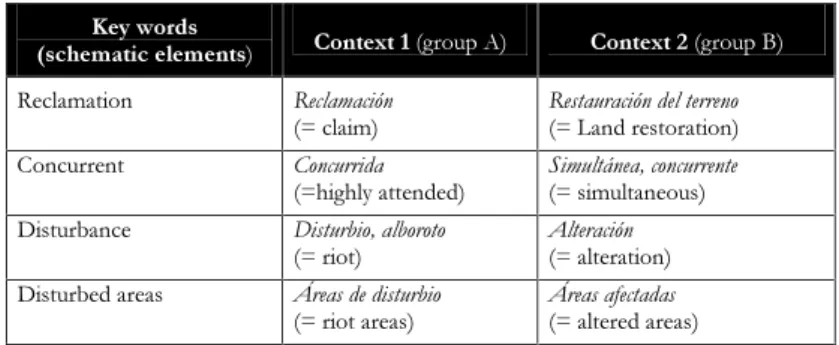
Let us consider two possible contexts, and their schematic elements, created by the false translation of key words by group A students, and by their correct interpretation in group B (figure 2). The terms translations have been obtained from their summaries, as students were asked to write them in Spanish.
Figure 2. Key words interpretation and mental contexts.
Once the message has reached the brain whether right or wrong its decoding process can be treated the same way as in a monolingual situation: reclamation has become claim, as far as the readers in group A go, and disturbance, riot. Roldán (1999) explains that for the cognitive linguist the notion of context, which determines meaning, takes into consideration linguistic and non-linguistic factors related to conventionalised background knowledge. Roldáns article develops Lakoff s concept of image schema to explain how a semantic domain consists of different image schemas that may be shared by different cultures, and how a term can activate different schemas. Its interpretation will depend on the domain where it is perspectivized at a given time (Roldán, 1999: 33-36).
.H\ZRUGV
VFKHPDWLFHOHPHQWV &RQWH[WJURXS$ &RQWH[WJURXS%
5HFODPDWLRQ 5HFODPDFLyQ FODLP
5HVWDXUDFLyQGHOWHUUHQR
/DQGUHVWRUDWLRQ &RQFXUUHQW &RQFXUULGD
KLJKO\DWWHQGHG
6LPXOWiQHDFRQFXUUHQWH
VLPXOWDQHRXV 'LVWXUEDQFH 'LVWXUELRDOERURWR
ULRW
$OWHUDFLyQ
DOWHUDWLRQ 'LVWXUEHGDUHDV ÉUHDVGHGLVWXUELR
ULRWDUHDV
ÉUHDVDIHFWDGDV
Fauconnier (1997: 34) calls mental spaces the domains that discourse builds up to provide a cognitive substrate for reasoning and for interfacing with the world. This may explain why intelligent mining engineering freshman students, by way of an example, may misinterpret apparently clear texts to experts in the field.
Mental spaces and connections are built up as discourse unfolds; they are a function of the language expressions that come in, the state of the cognitive construction when the language expression arises, and the context of the discourse; this includes social framing, pragmatic conditions such as relevance, and real-world events perceived by the participants. (Fauconnier, 1997: 36)
Thus, if we go back to our sample text, we can see that the students background knowledge (or lack of it) led them to misinterpret the terms reclamation, concurrent reclamation, disturbance, and disturbed areas. These turned to be false friends for many freshman students in group A, who contextualised them from a sociological perspective, rather than from a mining engineers point of view. They gave the text a new meaning: peoples protests due to the closing of a gold mine, instead of identifying concurrent reclamation activities proper of the end of mine works. New information is processed after being combined, compared, or contrasted to previously codified information; this is how it becomes meaningful (Bruner, 1991: 22-23). Contextual reference is essential in the construction of meaning, since new information is considered relevant in as much as the information being processed matches with our previous information. Cognitive environment for an individual is the sum of all his/her relevant experience, as Sperber and Wilson (1994: 151-213) hold. Group A students, in our study, had no experience about mine works and restoring the land; consequently, the specific terms related to such activities did not constitute a contextual reference to understand the entire passage; such information was not considered relevant, and, therefore, passed unnoticed to them. Once the graphic stimuli of the terms reclamation and disturbance had reached their brains, they interpreted their meanings according to their previous experience.
Conclusion
seemed to be the main reason accounting for the students understanding of the meaning of the text. By association and transfer mechanisms L2 learners identify cognates, but they should be aware of the possibility of being trapped by false friends clues, thus fouling up a texts meaning. We, as language teachers, should, therefore, help our students to become aware of the context in which words are found, and to expand such contexts, so as to avoid misinterpretations originated by form and sound similarity of words with different meanings in different languages.
Language has been viewed as a superficial manifestation of highly abstract, hidden cognitive constructions (McShane, 1991; Fauconnier, 1997; Gutt, 2000) that rest upon neural connections in the human brain. Today, no one denies the importance for cognitive linguistics to understand how the neurones manage to accomplish language comprehension and production, as it is the brain that receives language stimuli, interprets them and produces a response. Contemporary neuroscience tends to consider short-term connections among items stored in the brain, as well as long-term connections, as being instantiated when the right stimuli are received. Along this line, and from a mentalist complementary point of view, we have recalled Jackendoff s (2002) position, which holds that linguistic structures are functional characterisations that require neural instantiation. There should be no dissociation between mind and thought, brain and cognition; that is, between an abstract cognitive approach and a more mentalist emphasis based on neurobiological mappings and interfaces.
Dr. Pilar Durán Escribano is senior lecturer of English at the Escuela Técnica
Superior de Ingenieros de Minas (Universidad Politécnica de Madrid). Her main research interests are in the area of scientific discourse; she has published several papers in specialized journals and has collaborated in monographs on ESP didactics and research.
1 The text has been edited for practical reasons; the students were given a fragment from the original version, just two paragraphs longer.
2 The number in parenthesis refers to the question number in the original questionnaire included in appendix 1.
NOTAS
Aleksander, I. (1996). Impossible Minds: My Neurons My Consciousness. London: Imperial College Press.
Bruner, J. (1991). Actos de Significado. Más allá de la Revolución Cognitiva.
Madrid: Alianza Editorial.
Caramazza, A. & M. Miozzo (1997). The Relation between Syntactic and Phonological Knowledge in Lexical Access: Evidence from the Tip-of-the-Tongue Phenomenon.
Cognition 64: 309-343.
Carrell, P., J. Devine & D. Eskey (eds.) (1988). Interactive Approaches to Second Language Reading.
Cambridge: Cambridge University Press.
Cuenca, M. & J. Hilferty (1999).
Introducción a la lingüística cognitiva.
Barcelona: Ariel.
Durán, P. (1999). Análisis y evaluación del texto científico: aplicaciones didácticas a la enseñanza del IFA.
Madrid: UNED.
Ellis, R. (1994). The Study of Second Language Acquisition.
Oxford: Oxford University Press.
Fauconnier, G. (1997). Mappings in Thought and Language. Cambridge: Cambridge University Press.
Garrudo, F. (1996). Los nuevos caminos del análisis contrastivo in M. Martínez (ed.) (1996). Gramática contrastiva inglés-español, 11-24.
Huelva: Universidad de Huelva.
Goodman, K. (1997). The Reading Process in V. Edwards & D. Corson (eds). Encyclopedia of Language and Education, Vol 2: Literacy, 2-7.
The Netherlands: Kluwer Academic Publishers.
Gutt, E. (2000). Translation and Relevance. Cognition and Context.
Manchester: St Jerome Publishing.
Huckin, T. & L. Olsen (1991).
Technical writing and Professional Communication for Nonnativa Speakers of English. New York: McGraw-Hill.
Jackendoff, R. (1986). Conceptual Semantics. Versus44: 81-97.
Jackendoff, R. (2002). Foundations of Language. Brain, Meaning, Grammar, Evolution, New York: Oxford University Press.
Johnson-Laird, P. (1986). How is Meaning Mentally Represented?
Versus44: 81-97.
Leiguarda, A. M. (2003). Getting Students to Remember Structures: Brain-based Learning into Practice.
TESOL-Spain Newsletter 27: 17-19.
Lerchundi, M. A. & P. Moreno (1999). Los términos latinos en los textos técnicos en inglés in A. Bocanegra Valle, M. Carmen Lario de Oñate & P. López Zurita (eds.).
Enfoques teóricos y prácticos de las lenguas aplicadas a las ciencias y a las tecnologías, 309-312. Cádiz: Universidad de Cádiz (CD-ROM).
McShane, J. (1991). Cognitive Development. An Information Processing Approach. Oxford: Basil Blackwell.
Moss, G. (1992). Cognate Recognition: its Importance in Teaching ESP Reading Courses to Spanish Speakers. English for Specific Purposes 11: 141-157.
Pulvermüller, F. (1999). Words in the Brains Language. Behavioral and Brain Sciences 22: 253-279.
Roldán, A.M. (1999). Applications of Cognitive Theory to Interdisciplinary Work in LSP. Ibérica 1: 29-39.
Selinker, L. (1972). Interlanguage.
International Review of Applied Linguistics10: 209-231.
Selinker, L. (1992). Rediscovering Interlanguage. London: Longman.
Serra, M., E. Serrat, R. Solé, A. Bel & M. Aparici (2000). La Adquisición del Lenguaje, Barcelona: Ariel-Psicología.
Sperber, D. & D. Wilson (1994). La Relevancia. Comunicación y Procesos Cognitivos. Madrid: Visor-Lingüística y Conocimiento.
Taylor, J. R. (1995). Linguistic Categorization. Prototypes in Linguistic Theory. Oxford: Oxford University Press.
Van Patten, B. (1996). Input Processing and Grammar Instruction.
Norwood, New Jersey: Ablex.
Widdowson, H. G. (1996). Linguistics.
Appendix 1
Cuestionario sobre textualidad (Durán, 1999)
120%5(<$3(//,'26BBBBBBBBBBBBBBBBBBBBBBBBBBBBBBBBBBBBBBBBBBBBBB
7Ì78/2'(/7(;72BBBBBBBBBBBBBBBBBBBBBBBBBBBBBBBBBBBBBBBBBBBBBBBBB
'HVSXpVGHOHHUHOWH[WRFRQWHVWDDODVVLJXLHQWHVSUHJXQWDVPDUFDQGRFRQXQD;HOJUDGRGHDFXHUGR
(QFRQMXQWRKHFRPSUHQGLGRHOWH[WR
6XWHPiWLFDPHHUDFRQRFLGD
6XUHGDFFLyQUHVXOWDIiFLOGHOHHU
/DLQIRUPDFLyQHVWiELHQRUJDQL]DGD
'HPDVLDGDGHQVLGDGGHLQIRUPDFLyQQXHYD
&RQRFtDHOYRFDEXODULRJHQHUDOHQLQJOpV
&RQRFtDODWHUPLQRORJtDHQLQJOpV
+HSRGLGRGHGXFLUSRUHOFRQWH[WRSDODEUDV
GHVFRQRFLGDV
(OWH[WRPHKDUHVXOWDGRLQWHUHVDQWH
5HVXPHEUHYHPHQWHHQHVSDxROWRGDVODVLGHDV
IXQGDPHQWDOHVTXHUHFXHUGHVGHOWH[WR