Spatial variations at different observational scales and the seasonal
distributions of stream macroalgae in a Brazilian subtropical region
ROGÉRIO ANTONIO KRUPEK
1,4, CIRO CESAR ZANINI BRANCO
2and
CLETO KAVESKI PERES
3(received: August 31, 2011; accepted: June 01, 2012)
ABSTRACT – (Spatial variations at different observational scales and the seasonal distributions of stream macroalgae in a Brazilian subtropical region). We examined the relationships between environmental variations in lotic ecosystems with the seasonal dynamics of macroalgae communities at different spatial scales: drainage basin of two rivers (Rio das Pedras and Rio
Marrecas), shading (open and shaded stream segments), mesohabitat (riffles and pools), and microhabitats. Data collections were made on a monthly basis between January and December/2007. A total of 16 taxa were encountered (13 species and 3 vegetative
groups). All of the biotic parameters (richness, abundance, diversity, equitability, and dominance) were found to be highly variable at all of the spatial scales evaluated. On the other hand, abiotic variables demonstrated differences only at mesohabitat (in terms of current velocity) and shaded habitat (in terms of irradiance) scales. The seasonality of the macroalgae community
structure was strongly influenced by microhabitat variables (current velocity, substrate H’, and irradiance), demonstrating their importance over time and at different scales. Regional variables (temperature, oxygen saturation, specific conductance, pH, and turbidity) were found to have little influence on the temporal dynamics of the macroalgae communities evaluated.
Key words - heterogeneity, macroalgae, seasonal variations, stream
InTRoduCTIon
In addition to the influence of spatial heterogeneity
on abundance and species richness of aquatic organisms, river and stream habitats are subject to temporal variations (especially disturbance regimes) that generally have negative effects on biotic communities (Taniguchi
& Tokeshi 2004). Algal abundance can fluctuate
considerably due to seasonal changes in the physical environment or because of losses due to disturbances, among other factors. Consequently, differences in algal cover may vary considerably among different substrate types over time, even though the substrate itself remains
the same during the period under consideration (Downes
et al. 2000).
Studies seeking to understand influence of habitat
heterogeneity on the distributions of communities of aquatic organisms have only rarely taken timescales into consideration, and have almost exclusively examined communities of aquatic macro-invertebrates (e.g., Taniguchi & Tokeshi 2004, Subramanian &
Sivaramakrishnam 2005). No published studies of this type have investigated macroalgae communities in lotic environments.
In other hand, environmental variables that appear
to be driving temporal fluctuations in macroalgae
communities in lotic environments (Necchi Júnior & Pascoaloto 1993) include: water temperature (Sheath &
Burkholder 1985, Entwisle 1990, Sheath & Hambrook 1990), irradiance (Steinman & McIntire 1986, Steinman et al. 1989, DeNicola et al. 1992), current velocity (Reiter & Carson 1986, Necchi Júnior et al. 1991), specific condutance (Biggs 1990, Sheath & Cole
1992, Necchi Júnior et al. 1994, 1995), substrate type
(Biggs 1990, Gordon et al. 1992), and pH (Sheath &
Burkholder 1985, Sheath & Cole 1992). These papers focused largely on water quality, climatic conditions, and global characteristics of the habitat, and most
identified essentially regional characters (e.g., pH,
water temperature, conductivity) as the principal factors responsible for structuring lotic macroalgal communities and their seasonal variations.
In spite of these suppositions, there have been no studies of macroalgae communities in lotic environments
directly focusing on the influence of habitat heterogeneity
at different temporal scales. The initial hypothesis of the present work was therefore that seasonal variations within the habitat cause distinct effects on abundance and species richness of stream macroalgal communities when analyzed at different spatial scales (basin, shading, mesohabitat and microhabitat).
1. Universidade Estadual do Paraná, Departamento de Biologia,
Campus de União da Vitória, Praça Cel. Amazonas, Caixa Postal
291, 84600-000 União da Vitória, PR, Brazil.
2. Universidade Estadual Paulista, Departamento de Ciências Biológicas, Av. Dom Antônio, 2100, 19806-900 Assis, SP, Brazil.
3. Universidade Federal da Integração Latino-Americana, Av.
Tancredo Neves, 6731, Parque Tecnológico Itaipu, 85867-970 Foz
do Iguaçu, PR, Brazil.
MATeRIAl And MeThodS
The Pedras river (25°13’-25°26’ S and 51°13’-51°28’ W;
covering 330 km2) and Marrecas river (25°54’-26°21’ S and
52°54’-53°17’ W; covering 765 km2) hydrological basins
are located in the central-southern region of Paraná State in southern Brazil. Sampling of the macroalgae communities
and measurements of the environmental variables were undertaken on a monthly basis during the period between
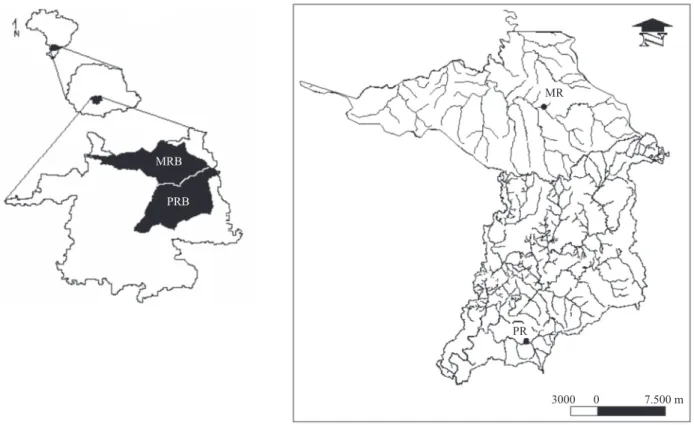
January and December/2007 in selected streams in each drainage basin (figure 1).
Two areas were chosen in each basins, one with heavy gallery forest vegetation that shaded the stream, and the other
without significant vegetation cover (open): i. Guabiroba
Figure 1. Details of the two drainage basins where the study was conducted indicating the sampling sites within the Pedras
river (PRB) and Marrecas river (MRB) drainage basins in the central-southern region of Paraná State, Brazil, during the period
between January and December/2007.
River: a second-order river located in the downstream portion
of the Pedras river basin (25°24’ S-51°22’ W), approximately
3.7 m wide. Two sampling sites were established, one open and one shaded, separated by 100 m; ii. Lageadinho River: a third-order river located in the downstream portion of the
Marrecas river basin (25°11’ S-51°21’ W), approximately
2.2 m wide. Two sampling sites were established, one open and one shaded, separated by 200 m.
The following spatial scales were evaluated: 1. Drainage
Basin scale (the Pedras river and Marrecas river basins); 2. Shading scale (open and shaded stream segments); 3. Mesohabitat scales (pools, with current velocity between 0 and 11.8 cm s-1; and riffles, with current velocity > 19.4 cm s-1);
4. Microhabitat scales (sampling units with predefined
circular areas, 0.05 m2) in which both biotic (abundance and
species richness) and environmental (luminosity, current velocity, depth, and substrate type) variables were, in fact, measured.
The stream segments examined were from 10 to 20 m long, and the quadrat technique was employed (Necchi Júnior et al. 1995). In each sampling unit (microhabitat scale)
we observed and recorded the presence/absence of each
macroalgal species and visually estimated their respective
abundances in terms of percentage cover. The fieldwork
and observations were made by a view-box, and specimens representative of each species were collected for subsequent laboratory analyses, following the procedures described by Necchi Júnior & Pascoalto (1993).
The mesohabitat scales were established in pool and riffle
stream regions with evident macroalgal populations. Whenever possible, 20 sampling units were established in each stream (10
sites each for the pool and riffle mesohabitats). Equal numbers
of sites without macroalgae (controls) were randomly sampled to compare their microhabitat characteristics.
The current velocities and irradiance were measured at each sampling site as close to substrate level as possible
MRB
PRB
MR
PR
(using a SWOFFER 2100 digital current meter and a Li-Cor
189 digital quantum radiometer/photometer with a Li-193S
spherical quantum sensor respectively). The water depth was
defined as the average distance between the sampling units and the water surface. The identifications of the different
types of substrates were based on their size classes, as proposed by Gordon et al. (1992). Two measures of substrate heterogeneity were considered: i. substrate richness, and; ii. substrate diversity, derived from the Shannon-Wiener diversity index, utilizing the numbers of types of substrates and their proportional percentage coverage.
The following environmental variables were used to characterize each of the sampling site: water temperature,
turbidity, specific conductivity, pH, and dissolved oxygen. All of these variables were measured in the field using a HORIBA
U-10 multi-parameter meter.
The materials collected in the field were preserved
in 4% formaldehyde and transported to the laboratory where they were examined using a Carl Zeiss – Jenamed 2
binocular microscope fitted with an ocular micrometer. Ten
measurements were taken of each algal structure analyzed.
The macroalgae were identified to the species (or infra-specific) level whenever possible.
The following variables of macroalgae community structure were analyzed in each of the streams and in each sampling unit: 1. Taxa richness (numbers of taxa per sample); 2. Macroalgae abundance (percentage coverage in each
sample); 3. The Shannon-Wiener diversity index: H’ = Σ
(pi) (log pi), where pi = percentage coverage of species i at that sample; 4. The Simpson dominance Index: C = å(Xi/Xo)
2
where Xi = percent cover of each species in the sampling unit,
and Xo = total macroalgae species abundance in the sampling
unit; 5. Equitability: J = H’/Hmax’, where H’ = the
Shannon-Wiener index and Hmax = Log S, where S = is the number of
species sampled.
The following statistical analyses were applied to the sample data: a) Factorial Analysis of Variance (ANOVA – type 3), to analyze possible variations in each of the biotic parameters at the different spatial scales (drainage basin, shading, mesohabitat) during the sampling period; b) Factorial Analysis of Variance (ANOVA – type 3), to analyze possible variations in each of the microhabitat variables (depth, current velocity, irradiance, substrate richness and diversity) during the sampling period; c) the Student t Test, to compare the sampling units in terms of the presence of algae (“with algae”) and the controls (“without algae”) to determine possible differences in the micro-environmental characteristics at each of the spatial scales evaluated; d) Multiple Linear Regression Analysis, to evaluate the
influences of all of the independent micro-environmental
variables on all of the dependent biotic parameters; e) Canonic Correspondence Analysis (CCA) to identify
possible influences of regional (or global) variables on the
distributions of the macroalgal communities.
ReSulTS
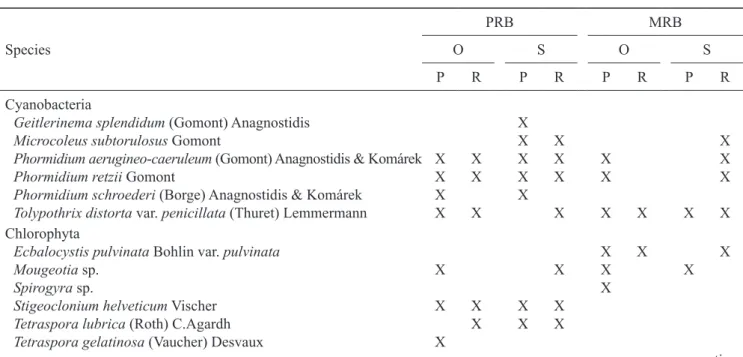
A total of sixteen taxa (13 species and three vegetative groups) were recorded in the streams in the two drainage basin studied during the period from
January to December/2007 (table 1).
Table 1. Macroalgae species encountered in different mesohabitats (P = pools; R = riffles) of streams (O = open; S = shaded)
within the drainage basins of the Pedras river (PRB) and Marrecas river (MRB), located in the central-southern region of Paraná
State, Brazil, during the period between January and December/2007.
Species
PRB MRB
O S O S
P R P R P R P R
Cyanobacteria
Geitlerinemasplendidum (Gomont) Anagnostidis X
Microcoleussubtorulosus Gomont X X X
Phormidiumaerugineo-caeruleum (Gomont) Anagnostidis & Komárek X X X X X X
Phormidium retzii Gomont X X X X X X
Phormidiumschroederi (Borge) Anagnostidis & Komárek X X
Tolypothrixdistorta var. penicillata (Thuret) Lemmermann X X X X X X X Chlorophyta
Ecbalocystis pulvinata Bohlin var. pulvinata X X X
Mougeotia sp. X X X X
Spirogyra sp. X
Stigeoclonium helveticum Vischer X X X X
Tetraspora lubrica (Roth) C.Agardh X X X
Tetraspora gelatinosa (Vaucher) Desvaux X
Each of the variables related to the macroalgae community structures showed unique types of variations during the seasonal periods studied (table 2), but generally only small variations at the different spatial scales
examined (except for abundance, which demonstrated wide variations at different scales) were observed.
All of the biotic variables analyzed demonstrated different types of temporal variations within the spatial
Table 2. Average values and standard deviations of the biotic variables (richness, abundance, diversity indices = H’; dominance = C; equitability = J) measured at different spatial scales within the drainage basins of the Pedras (PRB) and Marrecas (MRB) rivers, located in the central-southern region of Paraná State, Brazil, during the period between January and December/2007. (PRB = Rio das Pedras river basin; MRB = Rio Marrecas river basin).
Scale Richness Abundance H’ C J
Basins General 1.61 ± 0.85 10.90 ± 13.50 0.08 ± 0.12 0.84 ± 0.24 0.21 ± 0.33
RDP 1.95 ± 0.94 09.51 ± 11.40 0.12 ± 0.14 0.78 ± 0.24 0.31 ± 0.37
RM 1.27 ± 0.57 12.30 ± 15.40 0.03 ± 0.08 0.90 ± 0.23 0.11 ± 0.26
Open General 1.77 ± 0.95 10.90 ± 13.70 0.10 ± 0.14 0.78 ± 0.27 0.27 ± 0.35
RDP 2.25 ± 0.98 12.60 ± 13.40 0.16 ± 0.16 0.68 ± 0.27 0.40 ± 0.39
RM 1.29 ± 0.62 09.35 ± 14.00 0.04 ± 0.08 0.88+0.23 0.14 ± 0.27
Shaded General 1.45 ± 0.71 10.80 ± 13.50 0.05 ± 0.10 0.89 ± 0.20 0.16 ± 0.30
RDP 1.66 ± 0.81 06.41 ± 08.09 0.08 ± 0.11 0.87 ± 0.17 0.23 ± 0.33
RM 1.25 ± 0.53 15.20 ± 16.40 0.02 ± 0.07 0.91 ± 0.23 0.08 ± 0.25
POOL
Basins General 1.29 ± 0.74 02.67 ± 04.73 0.05 ± 0.11 0.84 ± 0.28 0.16 ± 0.31
Open 1.45 ± 0.88 02.51 ± 03.20 0.09 ± 0.13 0.77 ± 0.31 0.25 ± 0.37
Shaded 1.12 ± 0.53 02.84 ± 05.95 0.02 ± 0.07 0.92 ± 0.22 0.07 ± 0.23 PRB General 1.50 ± 0.82 04.37 ± 06.11 0.10 ± 0.13 0.79 ± 0.26 0.30 ± 0.39
Open 1.83 ± 0.93 03.60 ± 03.86 0.16 ± 0.14 0.66 ± 0.30 0.45 ± 0.41
Shaded 1.33 ± 0.65 05.13 ± 07.87 0.04 ± 0.09 0.93 ± 0.13 0.15 ± 0.31 MRB General 1.00 ± 0.51 00.98 ± 01.55 0.01 ± 0.04 0.90 ± 0.28 0.02 ± 0.10
Open 1.08 ± 0.66 01.42 ± 01.99 0.02 ± 0.06 0.88 ± 0.30 0.04 ± 0.14
Shaded 0.91 ± 0.28 00.55 ± 00.88 0.0 ± 0.0 0.91 ± 0.28 0.0 ± 0.0
RIFFLES
Basins General 1.93 ± 0.83 19,10 ± 14.50 0.10 ± 0.13 0.83 ± 0.21 0.27 ± 0.34
Open 2.08 ± 0.92 19,40 ± 14.90 0.12 ± 0.14 0.79 ± 0.23 0.29 ± 0.35
Shaded 1.79 ± 0.72 18.80 ± 14.40 0.09 ± 0.12 0.86 ± 0.19 0.24 ± 0.34
PRB General 2.33+0.91 14.60 + 13.20 0.14+0.15 0.76+0.23 0.33+0.35
Open 2.66 ± 0.88 21.60 ± 13.70 0.16 ± 0.17 0.70 ± 0.25 0.35 ± 0.37
Shaded 2.00 ± 0.85 07.69 ± 08.45 0.12 ± 0.12 0.82 ± 0.20 0.31 ± 0.34 MRB General 1.54 ± 0.50 23.60 ± 14.60 0.06 ± 0.10 0.90 ± 0.17 0.20 ± 0.33
Open 1.50 ± 0.52 17.20 ± 16.40 0.07 ± 0.10 0.88 ± 0.17 0.24 ± 0.33
Shaded 1.58 ± 0.51 30.00 ± 09.62 0.05 ± 0.10 0.91 ± 0.17 0.17 ± 0.34
Species
PRB MRB
O S O S
P R P R P R P R
Heterokontophyta
Vaucheriageminata (Vaucher) De Candolle X
Rhodophyta
Batrachospermumhelminthosum Bory X
Batrachospermum puiggarianum Grunow in Wit. et Nordstedt X
Kumanoa abili (Reis) Entwisle, Vis, Chiasson, Necchi Júnior &
Sherwood X X X X
Table 3. Summary of the results of ANOVA, demonstrating temporal differences in macroalgae community structures at the different spatial scales as evaluated during the period
between January and December/2007 in streams in the
central-southern region of Paraná State, Brazil.
Spatial scale F P
Species richnesses
Drainage basin 23.350 0.000
Open/Shaded 04.820 0.030
Pool/Riffles 20.600 0.000
Abundance
Drainage basin 02.130 0.147
Open/Shaded 00.005 0.942
Pool/Riffles 73.970 0.000
Richness, abundance,
diversity indices (H’)
Drainage basin 14.800 0.000
Open/Shaded 04.270 0.041
Pool/Riffles 04.130 0.045
Dominance (C)
Drainage basin 06.090 0.015
Open/Shaded 05.350 0.023
Pool/Riffles 00.110 0.731
Equitability (J)
Drainage basin 10.050 0.002
Open/Shaded 03.100 0.081
Pool/Riffles 02.810 0.096
Figure 2. Results of the Canonic Correspondence Analysis (CCA) for the four stream segments sample during the study period (A) and for the species encountered (B). The vectors
indicate the directions of the influences of the variables.
( = The Pedras river basin; open segment; = shaded segment; = Marrecas river basin; open segment; = shaded segment).
scales evaluated. Species richness and diversity indices
varied significantly at all spatial scales, while species abundance and equitability demonstrated significant
variations only at the mesohabitat and drainage basin
scales, respectively (table 3). Dominance showed significant seasonal variations in terms of the drainage
basin and shade conditions.
Different from observed for the biotic variables,
environmental variables demonstrated only low temporal variations at the spatial scales evaluated. Only current
velocity showed significant differences at the mesohabitat scale (F = 279.69; P < 0.001), and irradiance at shading
(F = 85.90; P < 0.001) and mesohabitat (F = 11.96; P < 0.001) scales. Similarly, there were little significant
differences between the sampling sites “with algae” and “without algae” in terms of all of the microhabitat
variables analyzed. Significant differences were found in the riffles mesohabitat for depth (t = -4.758; P < 0.001), substrate richness (t = -3.822; P < 0.001), and substrate
H’ (t = -2.028; p < 0.05).
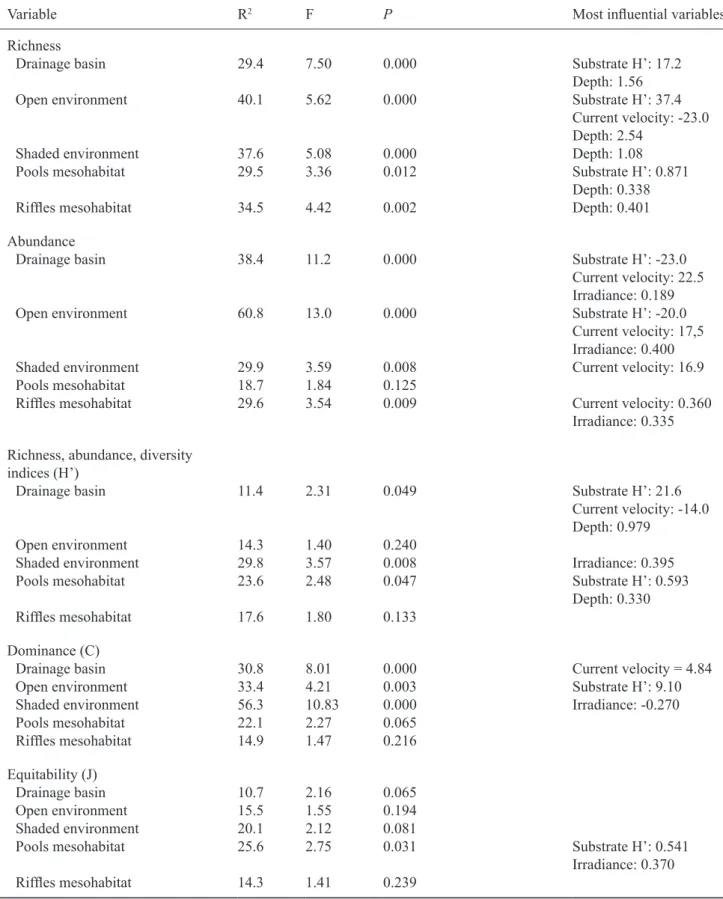
The Multiple Linear Regression Analysis revealed
numerous influences of microhabitat variables at different
scales on all of the biotic variables evaluated during the
different seasons (table 4). Richness was significantly related
to abiotic variables at all scales, while abundance was not
significantly related only to riffle mesohabitat (table 4). The Diversity and Dominance indices indicated some significant
relationships at different spatial scales, while Equitability
showed significant relationships with microhabitat variables only to riffle mesohabitat (table 4).
Canonic Correspondence Analyses (CCA; figure
2) performed with all of the regional variables showed
low explicability (13.1%); with significant correlations
Table 4. Summary of the Multiple Regression Analysis demonstrating the influences of the micro-environmental
variables examined on each of the structural variables of the macroalgal communities at different spatial scales within the drainage basins of the Pedras (PRB) and Marrecas (MRB) rivers, located in the central-southern region of Paraná State,
Brazil, during the period between January and December/2007. (R2 = determination coefficient; F = statistic significance;
P = significance level).
Variable R2 F P Most influential variables
Richness
Drainage basin 29.4 7.50 0.000 Substrate H’: 17.2
Depth: 1.56
Open environment 40.1 5.62 0.000 Substrate H’: 37.4
Current velocity: -23.0
Depth: 2.54
Shaded environment 37.6 5.08 0.000 Depth: 1.08
Pools mesohabitat 29.5 3.36 0.012 Substrate H’: 0.871
Depth: 0.338
Riffles mesohabitat 34.5 4.42 0.002 Depth: 0.401
Abundance
Drainage basin 38.4 11.2 0.000 Substrate H’: -23.0
Current velocity: 22.5 Irradiance: 0.189
Open environment 60.8 13.0 0.000 Substrate H’: -20.0
Current velocity: 17,5 Irradiance: 0.400
Shaded environment 29.9 3.59 0.008 Current velocity: 16.9
Pools mesohabitat 18.7 1.84 0.125
Riffles mesohabitat 29.6 3.54 0.009 Current velocity: 0.360
Irradiance: 0.335 Richness, abundance, diversity
indices (H’)
Drainage basin 11.4 2.31 0.049 Substrate H’: 21.6
Current velocity: -14.0
Depth: 0.979
Open environment 14.3 1.40 0.240
Shaded environment 29.8 3.57 0.008 Irradiance: 0.395
Pools mesohabitat 23.6 2.48 0.047 Substrate H’: 0.593
Depth: 0.330
Riffles mesohabitat 17.6 1.80 0.133
Dominance (C)
Drainage basin 30.8 8.01 0.000 Current velocity = 4.84
Open environment 33.4 4.21 0.003 Substrate H’: 9.10
Shaded environment 56.3 10.83 0.000 Irradiance: -0.270
Pools mesohabitat 22.1 2.27 0.065
Riffles mesohabitat 14.9 1.47 0.216
Equitability (J)
Drainage basin 10.7 2.16 0.065
Open environment 15.5 1.55 0.194
Shaded environment 20.1 2.12 0.081
Pools mesohabitat 25.6 2.75 0.031 Substrate H’: 0.541
Irradiance: 0.370
dISCuSSIon
In considering the stream macroalgal community structure, the present study indicated that differences in the biotic variables were much more evident at temporal rather than spatial scales.
The wide variations in the biotic parameters evaluated
in the present study demonstrated the strong influence
of temporal conditions on spatial characteristics and, consequently, on the structures of the macroalgal communities. Among the parameters evaluated, species
richness and diversity index showed significant seasonal
differences at all spatial scales, indicating that these variables were extremely sensitive to temporal scale variations – especially considering that very few environmental
variables demonstrated significant differences at those scales. Species abundance, in turn, showed significant
differences only at the mesohabitat scale. The absence
of significant differences in the percentage coverage of
macroalgae (differing from that observed in terms of species richness) is probably due to particular characteristics of that group, as a number of studies have reported macroalgae communities with generally low abundances (Branco &
Necchi Júnior 1996, Necchi Júnior et al. 2000, Borges & Necchi Júnior 2006, Krupek et al. 2007, Branco et al.
2009). This situation may be responsible for the similarities of abundance values observed at different scales.
The high dominance and low equitability values observed were perfectly coherent in terms of the group of organisms studied. Macroalgae communities commonly show one or just a few dominant species (Borges & Necchi
Júnior 2006). Seasonally, the predominance of one species
is probably due to some unique characteristic(s) of that taxon that makes it more tolerant to adverse and highly changeable environmental conditions (Stevenson 1997). These tolerant species are capable of supporting tolerant
of environmental changes, such as significant changes in water flow, and proliferate more rapidly and attain greater abundances (Borges & Necchi Júnior 2006).
Few significant differences were observed in local
environmental variables at different temporal scales. The differences in irradiance noted at the shading scales, and in current velocity at the mesohabitat scale would appear to be the principal factors responsible for the observed variations in the community structures of macroalgae.
Fluctuations in current velocity may have important
influences on fixed algae communities. These effects may
be positive (such as those related to nutrient delivery and greater oxygenation of the water), or negative (due to the
abrasive mechanical effects of water flow) (Gordon et al.
1992, Branco & Necchi Júnior 1997, Stevenson 1997),
and the differences observed between the mesohabitats
confirmed this statement. Similarly, irradiance can be
determinant in terms of the development of different species of macroalgae, affecting both abundance and species richness (Sheath & Burkholder 1985, Steinman and & McIntire 1987).
Microhabitat variables provoked different influences
on the seasonality of all of the biotic variables of the macroalgae communities at the different spatial scales evaluated showing that the stream macroalgal community structure are intimately related to microhabitat variables over time and at all spatial scales. These results suggested
that seasonality of these organisms is strongly influenced
by spatial heterogeneity produced over time on the characteristics of the microhabitat. The variables that most
influenced stream macroalgae seasonality were current velocity, water depth, and substrate H’ and, to a lesser degree, irradiance. The smaller influence of irradiance
may be due to factors related to the data collection process. As irradiance measurements depend directly on climatic conditions, – which can vary widely over time (changing in cloud cover within a single day, for example) – isolated
measures may contain errors and not faithfully reflect the true influence of this parameter. As such, water depth can
be considered an indirect measure of the amount of light reaching the river bottom (Krupek et al. 2008).
We observed an interesting relationship between
abundance and species richness and substrate H’. Species richness was positively influenced, and abundance negatively influenced, by substrate diversity in the
sampling units during the temporal sampling periods. It is widely accepted that spatial heterogeneity (as represented by river bottom substrate diversity) has a direct positive
influence on species richness (Dudley et al. 1986, Douglas
& Lake 1994, Robson & Barmuta 1998, Taniguchi &
Tokeshi 2004, Borges & Necchi Júnior 2006, Murdock & Dodds 2007). So much greater the diversity of substrates
present in a given location, the greater the diversity of niches and resources available to different species of macroalgae. In terms of abundance, however, this inverse relationship between substrate diversity and abundance may be closely related to the substrate particles sizes.
Higher substrate diversity sampling units will necessarily
mean the presence of smaller substrate particles, and as macroalgae usually demonstrate better development on larger particle substrates (McConnel & Sigler 1959, Tett et al. 1978, Uehlinger 1991, Cazaubon 1995, Cattaneo
et al. 1997, Downes et al. 2003), diminishing substrate
the development of higher abundance of the few algal
species tolerant of seasonal variations in water flow rates
(Cattaneo et al. 1997).
Regional variations had little influence on seasonal
patterns of macroalgae community distributions,
showing that they have relatively less influence on the
temporal distributions of macroalgae communities than microhabitat variables.
Acknowledgments – The authors thank CNPq for the doctoral grant awarded to RAK and for the research scholarship to
CCZB (Proc. 302354/2008-5).
ReFeRenCeS
Biggs BJF. 1990. Periphyton communities and their enviroments in New Zealand rivers. New Zealand Journal
of Marine and Freshwater Reserch 24:367-386. Borges FR, Necchi Júnior O. 2006. Patterns of spatial
distribution in macroalgal communities from tropical lotic ecosystems. Brazilian Journal of Botany29:669-680. Branco CCZ, Krupek RA, Peres CK. 2009. Ecological
distribution of stream macroalgal communities from mid-western region of Paraná State. Brazilian Archives
of Biology and Technology 52:379-386.
Branco CCZ, Necchi Júnior O. 1996. Distribution of stream
macroalgae in the eastern Atlantic rainforest of São Paulo
State, southeastern Brazil. Hydrobiologia 333:139-150.
Branco LHZ, Necchi Júnior O. 1997. Seasonality of
macroalgae in three tropical drainage basins in São Paulo
State, southeastern Brazil. Archiv fur Hydrobiologie
141:75-91.
Cattaneo A, Kerimian T, Roberge M, Marty J. 1997. Periphyton distribution and abundance on substrata of different size along a gradient of stream trophy.
Hydrobiology 354:101-110.
Cazaubon A, Rolland T, Loudiki M. 1995. Heterogeneity
of periphyton in French Mediterranean rivers.
Hydrobiologia300/301:105-114.
DeNicola DM, Hogland KD, Roemer SC. 1992. Influence
of canopy cover on spectral irradiance and periphyton assemblages in a prairie stream. Journal of North American Benthological Society11:391-404.
Douglas M, Lake PS. 1994. Species richness of stream
stones: an investigation of the mechanisms generating the species-area relationship. Oikos 69:387-396.
Downes BJ, Entwisle TJ, Reich P. 2003. Effects of flow
regulation on disturbance frequencies and in-channel bryophytes and macroalgae in some upland streams. River Reserch and Applications19:27-42.
Downes BJ, Lake PS, Schreiber ESG, Glaister A. 2000. Habitat structure, resources and diversity: the separate
effects of surface roughness and macroalgae on stream invertebrates. Oecologia 123:569-581.
Dudley TL, Cooper SD, Hemphill N. 1986. Effects of
macroalgae on stream invertebrate community. Journal of North American Benthological Society 5:93-106. Entwisle TJ. 1990. Macroalgae in the upper Yarra and Watts
River catchments: distribution and phenology. Australian Journal of Marine and Freshwater Reserch41:505-522.
Gordon ND, McMahon TA, Finlaylson BL. 1992. Stream
hydrology, an introduction for ecologists. John Wiley & Sons, Chichester.
Krupek RA, Branco CCZ, Peres CK. 2008. Variação sazonal
de alguns parâmetros físicos e químicos em três rios
pertencentes a uma bacia de drenagem na região centro-sul do Estado do Paraná, Sul do Brasil. Acta Scientiarum Biological Sciences30:431-438.
Krupek RA, Branco CCZ, Peres CK. 2007. Distribuição
ecológica das comunidades de macroalgas da bacia de drenagem do Rio das Pedras, região centro-sul do estado do Paraná, sul do Brasil. Revista Brasileira de Botânica 30:173-182.
McConnel WJ, Singler WF. 1959. Chlorophyll and productivity in a mountain river. Limnology and Oceanography 4:335-351.
Murdock JN, Dodds WK. 2007. Linking benthic algal
biomass to stream substratum topography. Journal of Phycology 43:449-460.
Necchi Júnior O, Pascoaloto D. 1993. Seasonal dynamics of macroalgal communities in the Preto River basin, São
Paulo, southeastern Brazil. Archiv fur Hydrobiologie
129:231-252.
Necchi Júnior O, Branco CCZ, Branco LHZ. 2000.
Distribution of stream macroalgae in São Paulo State,
southeastern Brazil. Algological Studies97:43-57. Necchi Júnior O, Dip MR, Góes RM. 1991. Macroalgae of
a stream in southeastern Brazil: composition, seasonal variation and relation to physical and chemical variables.
Hydrobiologia213:241-250.
Necchi Júnior O, Branco CCZ, Simões RCG, Branco LHZ.
1995. Distribution of stream macroalgae in northwest
region of São Paulo State, southeastern Brazil.
Hydrobiologia 299:219-230.
Necchi Júnior O, Pascoaloto D, Branco LHZ. 1994. Distribution of macroalgae in a tropical river basin from southeastern
Brazil. Archiv fur Hydrobiologie 129:459-471.
Reiter MA, Carlson RE. 1986. Current velocity in streams and
the composition of benthic algal mats. Canadian Journal of Fisheries and Aquatic Sciences43:1156-1162. Robson BJ, Barmuta LA. 1998. The effect of two scales
of habitat architecture of benthic grazing in a river. Freshwater Biology39:207-220.
Sheath RG, Cole KM. 1992. Biogeography of stream macroalgae in North American Journal of Phycology
28:448-460.
Sheath RG, Burkholder J. 1985. Characteristics of softwater stream in Rhode Island. II: Composition and seasonal
dynamics of macroalgae communities. Hydrobiologia
Sheath RG, Hambrook JA. 1990. Freshwater ecology. In
Biology of red algae. (KM Cole, RG Sheath, eds.) Cambridge University Press, Cambridge, p.423-453.
Steinman AD, McIntire CD, Gregory SVL, Lamberti GA.
1989. Effects of irradiance and grazing on lotic algal assemblages. Journal of Phycology25:478-485.
Steinman AD, McIntire CD. 1987. Effects of irradiance on the
community structure and biomass of algal assemblages in laboratory streams. Canadian Journal of Fisheries and
Aquatic Sciences 44:1640-1648.
Stevenson RJ. 1997. Scale-dependent determinants and consequences of benthic algal heterogeneity. Journal of
North American Benthological Society 16:248-262.
Subramanian KA, Sivaramakrishnan KG. 2005. Habitat and
microhabitat distribution of stream insect communities
of the Western Ghats. Current Science 89:976-987. Taniguchi H, Tokeshi M. 2004. Effects of habitat complexity
on benthic assemblages in a variable environment.
Freshwater Biology 49:1164-1178.
Tett P, Callegos C, Kelly MG, Hornberger GM, Cosby BJ. 1978. Relationships among substrate, flow, and benthic
microalgal pigment density in the Mechums river, Virginia. Limnological Oceanographyc 23:219-237. Uehlinger U. 1991. Spatial and temporal variability of
the periphyton biomass in a prealpine river (Necker,