Simone Armentano Bittencourt,1 Paola Lucena-Santos,2 João Feliz Duarte Moraes,3 Margareth da Silva Oliveira4
Sintomas de ansiedade e depressão em mulheres com e sem compulsão
alimentar participantes de programas de redução de peso
Anxiety and depression symptoms in women
with and without binge eating disorder enrolled
in weight loss programs
Abstract
Objectives: 1) To investigate the association between binge eating scores, anxiety and depression symptoms, and body mass index (BMI), and 2) to assess the presence of differences in severity of anxiety symptoms, severity of depression symptoms, and BMI in women with and without binge eating disorder.
Method: The sample comprised 113 women aged between 22 and 60 years (39.35±10.85) enrolled in weight loss programs in Porto Alegre, southern Brazil. The following instruments were
used: structured interview, Brazilian Economic Classiication
Criteria, Beck Anxiety Inventory, Beck Depression Inventory, and Binge Eating Scale. Data were analyzed using descriptive and inferential statistics.
Results: A positive association was found between binge eating scores and the severity of anxiety symptoms (p < 0.001) and
depression symptoms (p < 0.001). No signiicant association
was observed between BMI and binge eating scores (p = 0.341).
There were signiicant differences between women with and
without binge eating disorder with regard to severity of anxiety symptoms (p < 0.001) and severity of depression symptoms (p
< 0.001). Conversely, no signiicant differences were observed
between the groups concerning BMI (p = 0.103).
Conclusion: Our indings showed that binge eating is associated
with symptoms of anxiety and depression, but not with BMI.
Keywords: Anxiety, depression, feeding behavior, compulsive behavior.
Resumo
Objetivos: 1) Investigar a associação entre escores de compul-são alimentar, sintomas de ansiedade e de deprescompul-são e índice de
massa corporal (IMC); e 2) veriicar se existe diferença na inten -sidade dos sintomas de ansiedade, dos sintomas depressivos e no IMC em mulheres com e sem compulsão alimentar.
Método: A amostra foi composta de 113 mulheres com idade entre 22 e 60 anos (39,35±10,85), participantes de programas de redução de peso na cidade de Porto Alegre, sul do Brasil. Foram aplicados os seguintes instrumentos: entrevista
estrutu-rada, Critérios de Classiicação Econômica Brasil, Inventário de
Ansiedade de Beck, Inventário de Depressão de Beck e Escala de Compulsão Alimentar Periódica. Os dados foram analisados utilizando-se estatística descritiva e inferencial.
Resultados: Houve associação positiva entre os escores de compulsão alimentar e a intensidade dos sintomas de ansieda-de (p < 0,001) e ansieda-de ansieda-depressão (p < 0,001). Não foi observada
associação signiicativa (p = 0,341) entre IMC e escores de com
-pulsão alimentar. Houve diferença signiicativa entre mulheres
com e sem co mpulsão alimentar com relação à intensidade dos sintomas de ansiedade (p < 0,001) e depressão (p < 0,001).
Não foi encontrada diferença signiicativa entre os grupos com
relação ao IMC (p = 0,103).
Conclusão: Os achados deste estudo mostraram que a com-pulsão alimentar está associada a sintomas de ansiedade e de depressão, porém não está associada ao IMC.
Descritores: Ansiedade, depressão, comportamento alimentar, comportamento compulsivo.
1 Doutora, Psicologia, Pontifícia Universidade Católica do Rio Grande do Sul (PUCRS), Porto Alegre, RS, Brazil. 2 Acadêmica de Psicologia, PUCRS. Bolsista
de Iniciação Cientíica, Conselho Nacional de Desenvolvimento Cientíico e Tecnológico (CNPq). 3 Doutor, Gerontologia Biomédica, PUCRS. Professor adjunto,
Faculdades de Matemática, PUCRS e Universidade Federal do Rio Grande do Sul (UFRGS), Porto Alegre, RS, Brazil. 4 Doutora, Ciências da Saúde, Universidade
Federal de São Paulo (UNIFESP), São Paulo, SP, Brazil. Professora adjunta, Programa de Pós-Graduação em Psicologia, PUCRS. Bolsista de Produtividade em Pesquisa Nível 1D, CNPq.
Financial support: Grants from Conselho Nacional de Desenvolvimento Cientíico e Tecnológico (CNPq).
Submitted Oct 19 2010, accepted for publication Aug 22 2011. No conlicts of interest declared concerning the publication of this article.
Suggested citation: Bittencourt SA, Lucena-Santos P, Moraes JF, Oliveira MS. Anxiety and depression symptoms in women with and without binge eating disorder
Introduction
Obesity is a condition in which excess fat accumulates to the extent of having adverse effects on health. In 2006, there were approximately 1 billion and 600 million people aged 15 years and older with overweight worldwide, and at least 400 million adults with obesity. It is estimated that, by 2015, the number of overweight adults will reach approximately 2 billion and 300 million, and over 700 million adults will be obese. Overweight and obesity were originally considered diseases of developed countries, however their rates have been drastically increasing in developing countries, especially in urban areas.1
Overweight and obesity cause serious consequences to health, once a high body mass index (BMI) is an important risk factor for a variety of chronic conditions, such as: cardiovascular disease (cardiopathies and stroke), which is the main cause of death worldwide,
with 17 million of deaths every year; diabetes, which
has become a worldwide epidemic, with estimates
of a 50% increase in deaths from diabetes by 2015;
cancer (endometrium, breast, and colon), in addition to locomotor conditions (e.g. arthrosis).1
Obese adults and adolescents are openly discriminated in their professional and academic lives, increasing the risk for the development of psychiatric conditions in this population, e.g. depression, anxiety disorders, drug abuse, and eating behaviors.2
Several studies have been conducted with the aim of improving our understanding of obesity.3-5 The wide
interest in the topic is justiied by the alarming rates of
obesity in the general population, by the risks associated with the condition, and by the economic costs imposed on society.6 The impacts of obesity are strong, once
eating behaviors are multidetermined, regulated by interactions among physiologic, psychological, genetic and environmental factors to which each individual is exposed.7 In view of the multifactorial nature of
obesity, treatment is dificult, and the patient’s physical
and mental health and quality of life are frequently compromised. This is why most studies on obesity include the assessment of comorbidities and associated variables.8
Obesity is knowingly associated with high rates of psychopathologies, including depression, anxiety, eating disorders, personality disorders,9 and schizophrenia.10 For
example, it has long been known that the prevalence of people with overweight or obesity among patients with unipolar or bipolar depression is higher than in the general population, reaching 20 to 45% higher frequencies among obese patients.11 Tapia & Masson12 have pointed
out to the fact that obesity and depression independently
increase the risk of cardiovascular disease, which seems to suggest that the association between obesity and depression could further increase the incidence of cardiovascular conditions. With regard to the quality of life of obese individuals, the review conducted by Kushner & Foster,13 which had the aim of analyzing the impact of
obesity on quality of life, found that obesity has negative consequences on quality of life, both in terms of physical aspects and of psychosocial functioning.
Finally, a high prevalence of severe binge eating disorders (BEDs) is also observed in obese populations. In fact, BED patients account for the majority of people seeking assistance at health care services that offer weight loss programs.6
BED is characterized by recurrent episodes of compulsive eating behavior in the absence of other compensatory behaviors aimed at avoiding weight gain. During a binge episode, the subject experiences a feeling of loss of control combined with the intake of high amounts of food, even when not really hungry, resulting in great discomfort. Binge episodes are followed by strong subjective ill-being, characterized by feelings of anguish, sadness, guilt, shame, and self-loathing.14,15
BED has been widely studied, with a special focus on binge episodes, which are the main manifestation and form of evaluation of the disease, frequently accompanied by hyperphagia and social isolation.16
In Brazil, the prevalence of BED in the general
population ranges from 1.8 to 4.6%; in contrast,
approximately 30% of obese individuals seeking weight loss treatment present the disorder.15 In the majority
of cases, obese patients with BED do not lose clinically
signiicant amounts of weight with conventional weight
loss therapies,16 which may be explained, to a great
extent, by the comorbidities associated with the disorder. Individuals with BED seem to present psychopathological conditions at higher rates when compared with individuals without the disorder.16,17
The combination of binge eating and food restriction behaviors is frequent among obese patients, and can explain, at least in part, the recurrent failure of interventions aimed at treating obesity. Moreover, some other psychological aspects that also regulate feeding behaviors, e.g. depressive mood and anxiety, are
frequently present and can inluence treatment results.18
weight gain in the control group among obese individuals with current depressive or anxiety disorder, whereas individuals in the same group without mental disorders
lost some weight at the beginning of treatment; 2)
obese patients submitted to bariatric surgery and with a current diagnosis of depressive or anxiety disorder
lost signiicantly less weight when compared with obese
patients in the same group without a diagnosis of mental
disorder; and 3) patients presenting with binge eating at
baseline did not lose weight after 4 years of follow-up.19
These results underscore the importance of developing a better understanding of binge eating and related anxiety and/or depression symptoms in patients seeking weight
loss treatment, especially in view of the strong inluence
these symptoms have on treatment success.
Considering all the damage that obesity can potentially cause, the loss of weight comes up as a possible solution for the problem. Losing weight can
signiicantly reduce the risk for the development of most
comorbidities associated with obesity,5 and it is therefore
important that therapies speciically targeted at obesity
be developed and implemented in the public health care system in Brazil.20
Moreover, for the development and implementation
of effective therapies speciically aimed at weight loss,
it becomes extremely important to study in detail the psychiatric comorbidities most frequently associated with obesity in the literature. Attention should be given not
only to the identiication of behavioral and psychological
variables, but also to the implementation of interventions
tailored to the speciic characteristics of this population,
taking into consideration the high prevalence of such comorbidities. Appropriate interventions will have greater chances of succeeding and consequently reducing the risks associated with the obesity epidemic.
Taking into consideration the wide range of aspects related with obesity, the high prevalence of BED among patients enrolled in weight loss programs, and also
the dificulties faced by binge eaters while trying to
lose weight, the aims of the present study were 1) to investigate the association between binge eating scores, anxiety and depression symptoms, and body mass index (BMI), and 2) to assess the presence of differences in severity of anxiety symptoms, severity of depression symptoms, and BMI in women with and without BED.
Method
This is a cross-sectional and quantitative study. Data analysis was performed using descriptive and inferential statistics. The association between variables was also assessed.
Instruments
A structured interview was speciically designed for
the present study to collect sample characteristics.
The Brazilian Economic Classiication Criteria were
used to determine the economic status of participants.21
A questionnaire was applied and yielded a score that determined the economic status of each individual according to the following categories (from higher to lower income): A1, A2, B1, B2, C, D, and E.
The Brazilian version of the Beck Depression Inventory was used to measure severity of depression.22,23 The
instrument comprises 21 questions, each one with four answer options. Subjects should choose the answer that best described them. The total score is a sum of the scores obtained at each individual item. The following cutoff points have been established for psychiatric patients in Brazil: 0-11 (minimal depression), 12-19 (mild), 20-35 (moderate), and 36-63 (severe).
The Brazilian version of the Beck Anxiety Inventory was used to assess the severity of anxiety among participants.23,24 This scale also comprises 21 items that
subjects should rate using a four-point scale so as to
relect their symptoms. Again, the total score is a sum of
the scores obtained at each individual item. The following cutoff points have been established for psychiatric patients: 0-10 (minimal anxiety), 11-19 (mild), 20-30 (moderate), and 31-63 (severe).
Finally, the Binge Eating Scale25was used to assess
the presence and severity of binge episodes. The instrument has been translated into Brazilian Portuguese and validated for use in Brazil.26 The scale is a
Likert-style instrument comprising 62 statements arranged in 16 items. Subjects should select the response option that best describes their perception. Each statement is assigned scores from 0 to 3, which correspond to total absence (score 0) up to presence of severe compulsion (score 3). The total score (sum of individual scores) is
interpreted according to the following classiication25: ≤
17, absence of compulsive behavior (participants in this score category were allocated to the control/non-binging
group); 18-25, moderate binging; ≥ 26, severe binging
(participants in the two latter categories were allocated to the group with BED).
The following inclusion criteria were taken into consideration: being enrolled in weight loss programs in the municipality of Porto Alegre, southern Brazil, female sex (given the higher prevalence of eating disorders among females27; the male:female ratio has
been reported to range from 1:10 up to 1:2028), age
between 18 and 60 years,1 and at least 5 years of formal
the understanding of the instruments used in the study were excluded from the sample.
Ethical considerations
The present study was nested in a broader research project submitted and approved by the Research Ethics Committee of Pontifícia Universidade do Rio Grande do Sul (protocol no. 364/05-CEP). Prior to inclusion in the study, all patients were asked to sign an informed consent form containing the objectives of the study. All participants were informed of the purpose of the research
project and were given guarantees of conidentiality and
anonymity by the research team.
Following presentation and approval of the study at the different participating centers, the instruments included in the research protocol were applied individually by previously trained research team members.
Statistical analysis
Data were entered into the Statistical Package for the Social Sciences (SPSS) version 17.0. Descriptive and inferential analyses were conducted using the following statistical tests: Kolmogorov-Smirnov, Fisher’s exact test, Pearson’s chi-square test, Mann-Whitney test, and
Spearman’s correlation. Signiicance was set at 5%.
Results
The sample comprised 113 women enrolled in weight loss programs in the municipality of Porto Alegre, southern Brazil. Mean age was 39.35±10.85 years, and it ranged from 22 to 60 years.
Based on the scores of the Binge Eating Scale,
patients were irst classiied as non-binging, moderate
binging, or severe binging (Figure 1).
For the subsequent analyses, the sample was divided into two groups: patients with binge episodes and patients without binge episodes. The chi-square test showed that both groups were homogeneous with regard to the number of subjects (p = 0.301).
Approximately 18.6% (21 patients) of the sample
was not attending school; 76.1% (86) were working.
Again, according to the chi-square test, both groups were statistically similar with regard to education (p = 0.459) and
working status (p = 0.421). Also, no signiicant differences
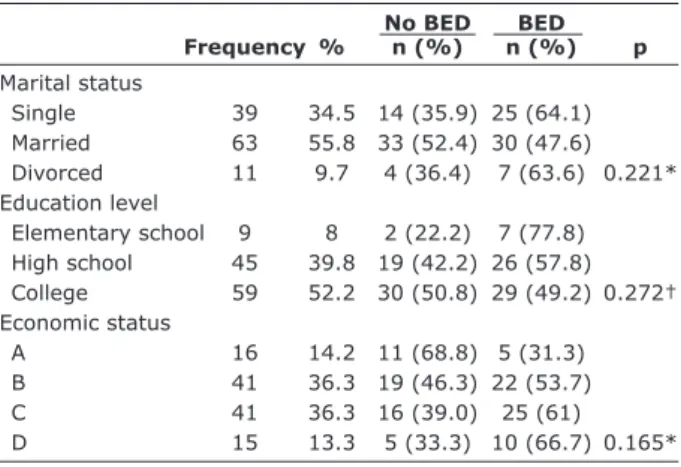
were observed between the groups in terms of marital status, education level, and economic status (Table 1).
Figure 1 – Classification of binge eating symptoms in a sample of women enrolled in weight loss programs
in Porto Alegre, southern Brazil No binging
45.1%
27.4% 27.4%
Moderate binging Severe binging
The following variables were tested for normality in both groups using the Kolmogorov-Smirnov test: age, anxiety, depression, and BMI (Table 2). Abnormal distributions were observed for all variables in at least one of the groups. Therefore, the Mann-Whitney test was used to compare groups, and Spearman correlation to assess associations between variables.
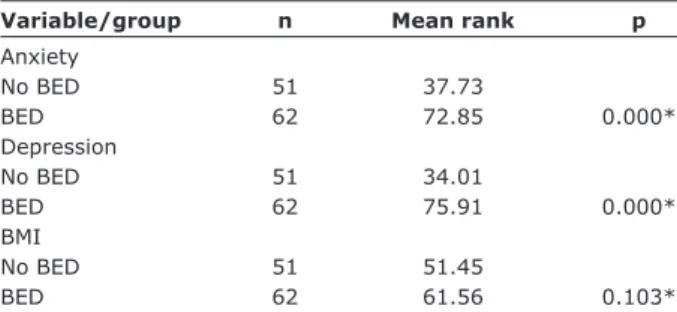
The Mann-Whitney test revealed statistically
signiicant differences between patients with and without
binge episodes in terms of severity of anxiety symptoms and severity of depression symptoms. Conversely, no
signiicant differences were observed in BMI between
patients with and without binge episodes (Table 3). BED = binge eating disorder.
* Pearson’s chi-square test. † Fisher’s exact test.
No BED BED
Frequency % n (%) n (%) p
Marital status
Single 39 34.5 14 (35.9) 25 (64.1)
Married 63 55.8 33 (52.4) 30 (47.6)
Divorced 11 9.7 4 (36.4) 7 (63.6) 0.221*
Education level
Elementary school 9 8 2 (22.2) 7 (77.8)
High school 45 39.8 19 (42.2) 26 (57.8)
College 59 52.2 30 (50.8) 29 (49.2) 0.272†
Economic status
A 16 14.2 11 (68.8) 5 (31.3)
B 41 36.3 19 (46.3) 22 (53.7)
C 41 36.3 16 (39.0) 25 (61)
D 15 13.3 5 (33.3) 10 (66.7) 0.165*
Table 1 – Sociodemographic characteristics of patients with and without BED
BAI = Beck Anxiety Inventory; BDI = Beck Depression Inventory; BED = binge eating disorder; BMI = body mass index.
* p value ≥ 0.200.
Variable No BED (p) BED (p)
Age 0.163 0.005
Anxiety (total BAI score) 0.001 0.200*
Depression (total BDI score) 0.007 0.200*
BMI 0.200* 0.011
Spearman correlation revealed a positive association between binge eating scores and severity of anxiety
symptoms (r = 0.598; p < 0.001) and severity of depression symptoms (r = 0.766; p < 0.001). No signiicant association was found between BMI and binge eating scores (r = 0.104; p = 0.082).
Discussion
Of the total sample, 54.8% presented binge episodes: 27.4% showed moderate binging, and 27.4% showed severe binging. These results are similar to those of a previous study29 conducted with morbidly obese patients,
which observed an overall BED prevalence of 56.7%, namely 25.4% with moderate binging and 31.3% with severe binging. In turn, higher rates of BED have been reported for patients seeking weight loss treatment,30
which is compatible with the characteristics of our sample.
Signiicant differences were observed in our study
between patients with and without BED with relation to severity of depression symptoms. Also, higher BED scores were associated with more severe depression symptoms. Similar results have been reported in a previous study designed to assess the prevalence of psychiatric disorders according to the presence of absence of BED in morbidly obese patients.29 In that
study, the group with BED showed a high prevalence of
major depression (42.1%), with a signiicant difference
(p = 0.001) between patients with and without the disorder.29 Another study31 carried out with obese patients
enrolled in weight loss programs found an association between depression and a higher chance of having BED (57%) when compared with patients without depression
(21%), also at a statistically signiicant difference (p
= 0.001). Moreover, Geliebter et al.32 concluded that
patients with BED presented higher depression scores when compared with patients without the disorder, and Jirik-Babb & Geliebter33 observed that obese women with
BED showed higher levels of both depression and anxiety when compared with women without BED.
In our study, signiicant differences were also
observed between the groups in relation to anxiety levels: higher anxiety levels were associated with increased binge eating scores. A previous study34 also
found signiicant differences between individuals with
and without BED with regard to depression (p < 0.001) and anxiety levels (p < 0.008), in both male and female patients, with higher levels among binge eaters than among controls.
Total BMI did not differ between patients with and
without BED, and no signiicant association was observed between BMI and binge eating scores. This indings
suggest that a higher BMI is not necessarily associated with BED, which is in accordance with the report by Jirik-Babb & Norring,34 who also did not observe differences
between patients with and without BED in relation to BMI.
Binge eaters account for a substantial part of the patients seeking weight loss programs. In this sense, the
indings of the present study underscore the paramount
importance of assessing anxiety and depression
symptoms in BED patients, as well as of deining intervention strategies to deal speciically with these
symptoms, which seem to affect treatment results. Further studies are warranted to further investigate these populations, preferably follow-up studies designed to investigate possible predictive factors of feeding behaviors, aimed at establishing causal relationships
and broadening our scientiic knowledge of the variables
associated with eating disorders.
References
1. Organización Mundial de la Salud. Obesidad y sobrepeso. 2006. (Nota Descritiva n. 311). http://www.who.int/media-centre/factsheets/fs311/es/index.html Accessed 2010 Jul 26. 2. Cordas TA, Ascecio RF, editores. Tratamento comportamental
da obesidade. Einstein (São Paulo). 2006;4(supl 1):S44-8.
3. Costa AC, Ivo ML, Cantero WB, Rognini JR. Obesidade em pacientes candidatos a cirurgia bariátrica. Acta Paul Enferm.
2009;22:55-9.
4. Pi-Sunver FX. The medical risks of obesity. Postgrad Med.
2009;121:21-33.
5. Mattos RS. Nasci de novo: sobrevivendo ao estigma da gor-dura. Um estudo de caso sobre obesidade [dissertação]. Rio
de Janeiro: Universidade do Estado do Rio de Janeiro; 2008.
6. Mancini MC, Aloe F, Tavares S. Apnéia do sono em obesos.
Arq Bras Endocrinol Metab. 2000;44:81-90.
7. Quaioti TC, Almeida SS. Determinantes psicobiológicos do comportamento alimentar: uma ênfase em fatores am-bientais que contribuem para a obesidade. Psicol USP.
2005;17:193-211.
BED = binge eating disorder; BMI = body mass index.
* Mann-Whitney’s test.
Variable/group n Mean rank p
Anxiety
No BED 51 37.73
BED 62 72.85 0.000*
Depression
No BED 51 34.01
BED 62 75.91 0.000*
BMI
No BED 51 51.45
BED 62 61.56 0.103*
Table 3 – Relationship between presence/absence of BED and severity of anxiety symptoms, severity
Correspondence
Margareth da Silva Oliveira
Av. Ipiranga, 6681 - Porto Alegre, RS - Brazil E-mail: [email protected]
8. Baptista MN, Vargas JF, Baptista AS. Depressão e qualidade de vida em uma amostra brasileira de obesos mórbidos. Aval
Psicol. 2008;7:235-47.
9. Pull CB. Current psychological assessment practices in obe-sity surgery programs: what to assess and why. Curr Opin
Psychiatry. 2010;23:30-6.
10. Allison DB, Newcomer JW, Dunn AL, Blumenthal JA, Fabrica-tore AN, Daumit GL, et al. Obesity among those with mental disorders: a National Institute of Mental Health meeting
re-port. Am J Prev Med. 2009;36:341-50.
11. Rihmer Z, Purebl G, Faludi G, Halmy L. Association of
obesity and depression. Neuropsychopharmacol Hung.
2008;10:183-9.
12. Tapia SA, Masson SL. Detección de síntomas depresivos en pacientes con sobrepeso y obesidad. Rev Chil Nutr.
2006;33:162-9.
13. Kushner RF, Foster GD. Obesity and quality of life. Nutrition.
2000;16:947-52.
14. American Psychiatric Association. Diagnostic and Statistical Manual of Mental Disorders - 4th edition (DSM-IV).
Washing-ton: APA; 1994.
15. Duchesne M, Appolinário JC, Rangé BP, Freitas S, Papel-baum M, Coutinho W. Evidências sobre a terapia cognitivo-comportamental no tratamento de obesos com transtorno da compulsão alimentar periódica. Rev Psiquiatr Rio Gd Sul.
2004;26:47-51.
16. Dobrow IJ, Kamenetz C, Devlin MJ. Aspectos psiquiátricos da
obesidade. Rev Bras Psiquiatr. 2002;24:63-7.
17. Napolitano MA, Head S, Babyak MA, Blumenthal JA. Binge eating disorder and night eating syndrome: psychological and
behavioral characteristics. Int J Eat Disord. 2001;30:193-203.
18. Bernardi F, Cichelero C, Vitolo MR. Comportamento de
re-strição alimentar e obesidade. Rev Nutr. 2005;18:85-93.
19. Legenbauer T, De Zwann M, Benecke A, Muhlhans B, Pe-trak F, Herpertz S. Depression and anxiety: their predictive function for weight loss in obese individuals. Obes Facts.
2009;2:227-34.
20. Sampaio VL. Overweight, obesity and mouth compulsion among low income women in the city of Carapicuíba-SP [tese]. São Paulo: Secretaria da Saúde do Estado de São
Paulo; 2009.
21. Associação Nacional de Empresas de Pesquisa. Critério de
Classiicação Econômica Brasil. 2008. www.anep.org.br. Ac -cessed 2010 Jul 26.
22. Beck AT, Steer RA. Beck depression inventory manual. San
Antonio: Psychology Corporation; 1993.
23. Cunha JA. Manual da versão em português das escalas Beck.
São Paulo: Casa do Psicólogo; 2001.
24. Beck AT, Steer RA. Beck anxiety inventory manual. San
An-tonio: Psychological Corporation; 1993.
25. Gormally J, Black S, Daston S, Rardin D. The assessment of binge eating severity among obese persons. Addict Behav.
1982;7:47-55.
26. Freitas S, Lopes CS, Coutinho W, Appolinario JC. Tradução e adaptação para o português da Escala de Compulsão
Alimen-tar Periódica. Rev Bras Psiquiatr. 2001;23:215-20.
27. Saikali CJ, Soubhia CS, Scalfara BM, Cordás TA. Imagem corporal nos transtornos alimentares. Rev Psiquiatr Clin.
2004;31:164-6.
28. Klein DA, Walsh BT. Eating disorders: clinical features and
pathophysiology. Physiol Behav. 2004;81:359-74.
29. Petribu K, Ribeiro ES, Oliveira FM, Braz CI, Gomes ML, Araujo DE, et al. Transtorno da compulsão alimentar periódica em uma população de obesos mórbidos candidatos a cirurgia bariátrica do Hospital Universitário Oswaldo Cruz, em
Recife-PE. Arq Bras Endocrinol Metab. 2006;50:901-8.
30. Pinheiro AP, Sullivan PF, Bacaltchuck J, Prado-Lima PA, Bu-lik CM. Genética em transtornos alimentares: ampliando os
horizontes de pesquisa. Rev Bras Psiquiatr. 2006;28:218-25.
31. Pagoto S, Bodenlos JS, Kantor L, Gitkind M, Curtin C, Ma Y. Association of major depression and binge eating disorder with weight loss in a clinical setting. Obesity (Silver Spring).
2007;15:2557-9.
32. Geliebter A, Hassid G, Hashim SA. Test meal intake in obese binge eaters in relation to mood and gender. Int J Eat Disord.
2001;29:488-94.
33. Jirik-Babb P, Geliebter A. Comparison of psychological char-acteristics of binging and nonbinging obese, adult female
outpatients. Eat Weight Disord. 2003;8:173-7.
34. Jirik-Babb P, Norring C. Gender comparisons in psychologi-cal characteristics of obese, binge eaters. Eat Weight Disord.