T
Márcia Ebling,1 Mary Sandra Carlotto2
Síndrome de
burnout
e fatores associados em proissionais da saúde
de um hospital público
Burnout syndrome and associated factors among health
professionals of a public hospital
Abstract
Objectives:To identify the prevalence of burnout syndrome (BS) dimensions and their relationship with sociodemographic data, working variables, psychosocial variables, job satisfaction,
hardiness, self-eficacy, and common mental disorders among
health professionals of a public hospital.
Method: This cross-sectional study assessed 234 health professionals working at a public hospital in southern Brazil. Participants answered the Maslach Burnout Inventory, the Job Satisfaction Questionnaire, the Hardiness Scale, The General
Self-Eficacy Scale, the Self-Reporting Questionnaire, and a questionnaire speciically designed for the present study to
assess sociodemographic and variables related to work. Data were analyzed using descriptive and inferential statistics.
Results: An association was identiied between the three
dimensions of BS and sociodemographic data, variables related to work, psychosocial variables, hardy personality traits, and common mental disorders.
Conclusion: The study allowed to deine a risk proile for
BS, namely male, young, undergraduate workers, with a low income, who see a large number of patients per day, physicians, government employees, absence of commitment, control
and challenge (hardy personality traits), low self-eficacy, job
dissatisfaction, presence of common mental disorders, and intention to change career, institution, or position at current institution.
Keywords: Psychological stress, health personnel, occupational health.
Resumo
Objetivos: Veriicar a prevalência das dimensões da síndrome
de burnout e sua relação com variáveis sociodemográicas, labo
-rais, psicossociais, de satisfação com o trabalho, de resistência
ao estresse, de autoeicácia e também com transtornos mentais comuns em proissionais de saúde de um hospital público. Método: Este estudo transversal avaliou 234 proissionais da
saúde de um hospital público na Região Sul do Brasil. Os parti-cipantes responderam ao Maslach Burnout Inventory, ao Ques-tionário de Satisfação no Trabalho, à Escala de Personalidade
Resistente ao Estresse, à Escala de Autoeicácia Geral Percebida,
ao Self-Reporting Questionnaire e a um questionário
desenvol-vido especiicamente para este estudo para coletar dados socio
-demográicos e laborais. Os dados foram submetidos a análise
descritiva e inferencial.
Resultados: Foi identiicada uma associação entre as três di
-mensões da síndrome de burnout e variáveis sociodemográicas,
laborais, psicossociais, traços de personalidade resistente ao es-tresse e transtornos mentais comuns.
Conclusões: O estudo permitiu estabelecer um peril de risco
para síndrome de burnout, a saber, trabalhadores do sexo
mascu-lino, jovens, em processo de formação (graduação), com menor remuneração, que atendem um maior número de pacientes por
dia, médicos, proissionais concursados, ausência de comprome
-timento, controle e desaio (traços de personalidade resistente ao estresse), menor autoeicácia, insatisfação com o trabalho, pre -sença de transtornos mentais comuns e desejo de abandonar a
proissão, a instituição ou seu cargo na instituição atual.
Descritores: Estresse psicológico, proissionais da saúde, saúde
ocupacional
1 Mestre em Saúde Coletiva, Universidade Luterana do Brasil (ULBRA), Canoas, RS, Brazil. 2 Doutora em Psicologia Social, Universidade de Santiago de
Compostela (USC), Santiago de Compostela, Spain. Professora, Programa de Pós-Graduação em Psicologia, Pontifícia Universidade Católica do Rio Grande do Sul (PUCRS), Porto Alegre, RS, Brazil.
This article originated from the Master’s thesis of the same title, presented at Universidade Luterana do Brasil (ULBRA), Canoas, RS, Brazil, in 2011.
Submitted June 19 2011, accepted for publication Sep 26 2011. No conlicts of interest declared concerning the publication of this article.
Suggested citation: Ebling M, Carlotto MS. Burnout syndrome and associated factors among health professionals of a public hospital. Trends Psychiatry
Introduction
Working in health care has some peculiarities that place a heavy burden of physical, cognitive and emotional demands on professionals. Excessive work,
high competitiveness, conlicts, having to deal with death, lack of organization at the service and conlicts
with colleagues are all variables that increase the risk of burnout or burnout syndrome (BS) in this population.1
BS is an essentially social manifestation that relects
the feelings of crisis and disorientation found in modern society, imposing tension on the most critical working
ields, such as health care.2 It is also considered to be
caused by chronic stress, typically observed at work environments, especially when excessive pressure and
conlicts are present and when there is a scarcity of
emotional rewards, recognition, and success.3
When regarded as a psychosocial phenomenon, BS is described as comprising three dimensions: emotional exhaustion, characterized by lack of energy
and enthusiasm and depletion of emotional resources;
depersonalization, described as negative (cold, distant) attitudes toward clients, colleagues, and the service/
organization; and reduced personal accomplishment, a
behavioral phenomenon manifested as a tendency of the worker to negatively evaluate themselves, showing dissatisfaction with their own performance at work.4
Conversely, when regarded as a subjective experience, BS is described as a combination negative feelings and behaviors that have noxious implications for the subject him/herself, for other workers, for institutions, and for the quality of health care provided.5
Several occupational problems have been observed among health care workers, but BS has been growing in relevance, providing grounds for concern among hospital managers, unions, and government organizations.6 Over
the past 35 years, BS has attracted the attention of investigators, workers and the general population all over the world.7
In Brazil, a 2008 study describing the state of the
art of scientiic production on BS identiied 28 articles
published in Brazilian journals and conducted with
Brazilian samples; however, only seven of them included
health professionals.8 Although BS is acknowledged as
a work-related condition by the Brazilian Ministry of Health,9 the characteristics of the syndrome and the risk
factors associated with its onset are little known.10
Studies have recommended the investigation of relationships between personal characteristics, personality traits, and work characteristics, so as to determine the effects of each of these variables on the
to be more adequate to understand factors related with the condition.12
The objective of the present study was to identify the prevalence of the three dimensions of BS (emotional exhaustion, depersonalization, and personal accomplishment) and their relationship with sociodemographic data, working variables, psychosocial
variables, job satisfaction, hardiness, self-eficacy, and
common mental disorders among health workers of a public hospital.
Methods
This was an observational, analytical, cross-sectional epidemiological study.13 Among the 256 health professions
working at the public hospital of a medium-size municipality in the Brazilian southern state of Paraná, 234 agreed
to participate in the study; 22 were excluded because
they were on a leave (pregnancy leave, sick leave, work accident, or vacation) or because they did not adequately respond the instruments or refused to participate.
Data were collected using a questionnaire speciically
designed to investigate sociodemographic data (sex, age, marital status, education level, children), working variables (professional activity, time working in the profession, time working at the institution, weekly working hours, other jobs, income, number of patients seen daily, and employment status), and psychosocial variables (intention to change career, institution, or position at the current institution). Additionally, the following self-report instruments were applied:
1. Maslach Burnout Inventory - Human Services Survey (MBI-HSS).14 This instrument has been
translated and validated into Brazilian Portuguese by Lautert.15 The MBI-HSS assesses the three dimensions
of SB: emotional exhaustion (nine statements);
professional accomplishment (eight statements), and
depersonalization (ive statements). The instrument
includes 22 statements at total, which have to be rated according to their frequency using a 7-point Likert-type scale.16 In the present study, an adapted 5-point scale
previously validated by Tamayo was used, as follows: 1 = never, 2 = rarely, 3 = sometimes, 4 = frequently, and 5 = always.17 MBI-HSS has shown adequate internal
consistency in the three dimensions, with a Cronbach’s alpha ranging from 0.84 for emotional exhaustion, through 0.73 for depersonalization, to 0.76 for reduced professional accomplishment.
distributed over three domains: hierarchical relation
satisfaction (11 statements; Cronbach’s alpha = 0.92), work environment satisfaction (ive statements; alpha = 0.86); work intrinsic satisfaction and professional growth opportunities (four statements; alpha = 0.77). A 5-point
Likert-type scale is used to rate each domain: 1 = totally
dissatisied, 2 = partially dissatisied, 3 = indifferent, 4 = partially satisied, and 5 = totally satisied.
3. Hardiness Scale.20 This instrument has been
adapted to Brazilian Portuguese by Mallar & Capitão.21
It comprises 50 statements that have to be rated from 0 to 3, as follows: 0 = completely false, 1 = somewhat true, 2 = mostly true, and 3 = completely true. The statements assess the three dimensions of the hardy
personality construct: commitment (16 statements; Cronbach’s alpha = 0.70), control (17 statements; alpha = 0.70), and challenge (17 statements; alpha =
0.70). The Hardiness Scale has shown an overall internal consistency of 0.90.21
4. General Self-Eficacy Scale.22 This instrument
was adapted to Brazilian Portuguese by Souza & Souza.23
It comprises 10 statements that have to be rated according their frequency using a 5-point Likert-type scale, as follows: 0 = totally disagree, 1 = disagree, 2 = neither agree nor disagree, 3 = agree, and 4 = totally agree. Internal consistency of this scale lies at 0.81.23
5. Self-Reporting Questionnaire (SRQ-20). This scale has been designed by Harding et al.24 to assess
the presence of common mental disorders and has been validated for use in Brazil by Mari & Willians.25 It comprises
20 yes/no questions on physical and psychological symptoms for the detection of minor psychiatric disorders (anxiety, depression, psychosomatic reactions,
irritability, and mental fatigue). Each afirmative answer corresponds to a score of 1 in the inal score (sum of all
scores). The scores obtained indicate the probability of the presence of non-psychotic disorders, and may range from 0 (no probability) to 20 (extreme probability). The instrument has shown a Cronbach’s alpha of 0.86, and a cutoff point of 7/8, independently of sex.25
Data were collected from May to August 2010. Participants were contacted at their departments, randomly selected by four interviewers, covering all working shifts.
The instruments illed by workers were placed in two
boxes, one for questionnaires and instruments and the other for signed informed consent terms.
The study was approved by the Research Ethics Committee of Universidade Luterana do Brasil (protocol no. CEP-2010-002H). Department chiefs and participants were informed of the voluntary, anonymous, and
conidential nature of the study, and were assured that
the data collected would not be used for individual or institutional evaluation purposes.
Data were analyzed using the Statistical Package for the Social Sciences (SPSS) version 17.0. Exploratory data analyses were conducted to assess data distribution, identify omissions and outliers, and possible entry errors. Data were analyzed using descriptive and inferential statistics (Pearson’s correlation, Student’s t test, and
analysis of variance [ANOVA]). Signiicance was set at
p < 0.05.
When assessing the prevalence of the three dimensions of BS, the cutoff points described by Shiron26
and subsequently used by Batista et al.27 were adopted. As
a result, individuals presenting symptoms at least once a week (minimum score of 4 = frequently) were considered to have BS (score 4 corresponds to score 6 in Tamayo’s original scale17). According to Batista et al.,27 the use of
that cutoff point is a valid alternative for the identiication of burnout levels in countries where speciic cutoff points
have not been validated.
Results
The health professionals included in the present sample had a mean age of 33.84±8.37 years. Most were female (70.9%), had completed high school (44.1%), lived with a partner (72.6%), had children (66.7%), did not have a second job (60.5%) and were paid up to three minimum wages (50.3%). Most of the participants were nurse technicians (59.4%), 28.2% worked at
inirmaries, and 49.6% were hired as employees (rather
than government employees). Mean weekly working hours were 40.8±8.68, and the professionals saw on average 16±14 patients every day. Mean time working at the institution was 20±30.04 months, compared to 91±77.44 months working in the profession.
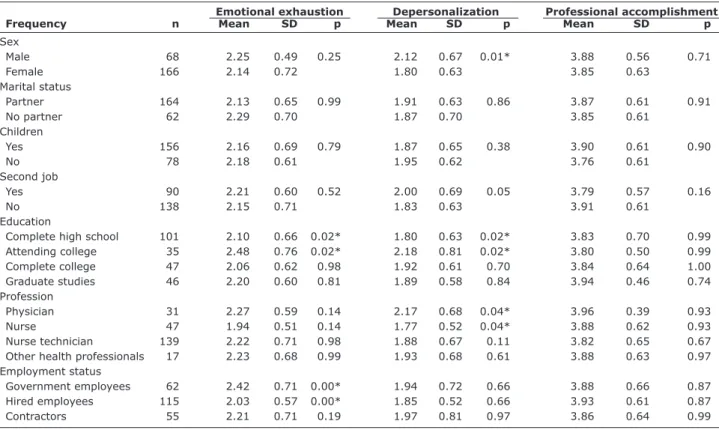
According to the cutoff points adopted in the present study, no high levels were observed for any of the three BS dimensions assessed. Conversely, when analyzing the association between BS dimensions and sociodemographic and working variables status, men presented higher means of depersonalization (Table 1). Also, participants attending college showed higher emotional exhaustion (2.48) and depersonalization (2.18) scores when compared with those who had completed high school, and physicians showed higher mean scores for depersonalization (2.17) when compared with nurses. Government employees also had higher emotional exhaustion scores (2.42) when compared with those hired as employees directly by the hospital (Table 1).
Variable Emotional exhaustion Depersonalization Professional accomplishment
Commitment -0.313† -0.238† 0.404†
Control -0.328† -0.288† 0.384†
Challenge -0.309† -0.269† 0.178†
Hierarchical relation satisfaction -0.433† -0.269† 0.263†
Work environment satisfaction -0.396† -0.225† 0.227†
Work intrinsic satisfaction and professional growth opportunities -0.437† -0.259† 0.268†
Self-eficacy -0.166* 0.047 0.387†
Table 4 – Correlations between burnout dimensions and hardiness, job satisfaction, and self-efficacy
SD = standard deviation.
* Signiicant difference at 5%.
Emotional exhaustion Depersonalization Professional accomplishment
Frequency n Mean SD p Mean SD p Mean SD p
Sex
Male 68 2.25 0.49 0.25 2.12 0.67 0.01* 3.88 0.56 0.71
Female 166 2.14 0.72 1.80 0.63 3.85 0.63
Marital status
Partner 164 2.13 0.65 0.99 1.91 0.63 0.86 3.87 0.61 0.91
No partner 62 2.29 0.70 1.87 0.70 3.85 0.61
Children
Yes 156 2.16 0.69 0.79 1.87 0.65 0.38 3.90 0.61 0.90
No 78 2.18 0.61 1.95 0.62 3.76 0.61
Second job
Yes 90 2.21 0.60 0.52 2.00 0.69 0.05 3.79 0.57 0.16
No 138 2.15 0.71 1.83 0.63 3.91 0.61
Education
Complete high school 101 2.10 0.66 0.02* 1.80 0.63 0.02* 3.83 0.70 0.99
Attending college 35 2.48 0.76 0.02* 2.18 0.81 0.02* 3.80 0.50 0.99
Complete college 47 2.06 0.62 0.98 1.92 0.61 0.70 3.84 0.64 1.00
Graduate studies 46 2.20 0.60 0.81 1.89 0.58 0.84 3.94 0.46 0.74
Profession
Physician 31 2.27 0.59 0.14 2.17 0.68 0.04* 3.96 0.39 0.93
Nurse 47 1.94 0.51 0.14 1.77 0.52 0.04* 3.88 0.62 0.93
Nurse technician 139 2.22 0.71 0.98 1.88 0.67 0.11 3.82 0.65 0.67
Other health professionals 17 2.23 0.68 0.99 1.93 0.68 0.61 3.88 0.63 0.97
Employment status
Government employees 62 2.42 0.71 0.00* 1.94 0.72 0.66 3.88 0.66 0.87
Hired employees 115 2.03 0.57 0.00* 1.85 0.52 0.66 3.93 0.61 0.87
Contractors 55 2.21 0.71 0.19 1.97 0.81 0.97 3.86 0.64 0.99
Table 1 – Association between burnout dimensions and sociodemographic and working variables
SD = standard deviation.
* Signiicant difference at 5%.
Emotional exhaustion Depersonalization Professional accomplishment
Mean SD p Mean SD p Mean SD p
Common mental disorders absent (n = 188) 2.02 0.57 0.00* 1.81 0.62 0.00* 3.93 0.60 0.00*
Common mental disorders present (n = 46) 2.78 0.69 2.24 0.69 3.57 0.56
Table 3 – Association between burnout dimensions and common mental disorders * Signiicant correlation at 5%.
† Signiicant correlation at 1%.
Frequency Emotional exhaustion Depersonalization Professional accomplishment
Age -0.198† -0.187† 0.142*
Patients seen daily 0.209† 0.176* -0.67
Income -0.005 0.149* 0.032
Intention to change career 0.276† 0.098 -0.138*
Intention to change institution 0.382† 0.132* -0.078
Intention to change position at the institution 0.332† 0.224† -0.154*
change career. Professional accomplishment showed association with age, with intention to change career and with intention to change position at the current institution.
Older age was associated with lower emotional exhaustion and depersonalization scores and with higher professional accomplishment scores. A larger number of patients seen daily resulted in a stronger feeling of professional non-achievement. Also, professionals with a lower income showed more distant attitudes toward their clients. Intention to change career, institution, or position at the current institution were associated with increased emotional exhaustion. Distant attitudes were only affected by intention to change institution and position at the current institution. Professional accomplishment decreased as intention to change career or position at the current institution increased.
With regard to the association between burnout dimensions and common mental disorders, higher mean scores were observed in the three dimensions among health workers carrying such disorders (Table 3).
In the analysis of hardiness, job satisfaction, and
self-eficacy scores, an association was observed between
hardiness and the three burnout dimensions (Table 4). Higher job satisfaction scores were associated with lower indices of emotional exhaustion and depersonalization and a higher degree of professional accomplishment. Results have also pointed toward a relationship between
self-eficacy and MBI-HSS dimensions, revealing that
a stronger perception of professional competence is associated with decreased feelings of emotional exhaustion and increased feelings of professional accomplishment.
Discussion
According to the cutoff points adopted in our analysis for the three dimensions covered by the MBI-HSS, no high levels were observed in the population assessed
in any dimension. This inding may be explained by
the current status of the institution investigated, where some professionals had only recently been hired and others were potentially leaving in the short term. Such a scenario brings up discussions on social desirability
and professionals’ dificulties in perceiving and admitting
the development of distant, cold, impersonal attitudes towards patients. It also calls into question the cutoff point adopted in the present study and the absence of a criterion to regulate time working in the profession during the selection of participants.
With regard to sociodemographic variables, men showed higher levels of depersonalization than women,
conirming the results of previous studies, such as those
by Maslach28 and Norlund et al.29 Such difference has been
explained by the cultural aspects involved in socialization processes. In the health care scenario, the idea of a stronger or easier involvement of women with the care and well-being of others continues to be prevalent.30
Our age results also conirmed the indings of
previous studies by Almeida et al.,31 Lautert,15 and
Rosa & Carlotto.32 Young workers usually have a poor
understanding of what they can and what they cannot do, which often results in professional frustration. They are attracted to the possibility of social elevation, but at the same time often have limited abilities, inadequate training, and are usually unaware of the existence and risk of BS.33 Rosa & Carlotto32 have explained the relationship
between age and depersonalization by referring to the scarcity of opportunities that workers have to manifest and understand feelings and situations experienced daily at a health care institution, which would then favor the burnout process, especially among young workers, who are starting their careers and usually want to show their full potential in order to be accepted at the institution.
Subjects attending college showed higher levels of emotional exhaustion and depersonalization. Working while attending college may contribute to emotional exhaustion, as a result of the need to deal with a double burden of demands, excessive activities, and strict shift schedules – not to mention the usual demands faced at personal and family levels. Conversely, having completed college has been observed to provoke more distant attitudes among workers, which can possibly be explained by the higher expectations commonly
observed in more qualiied professionals.34
Lower income resulted in higher depersonalization
scores, a inding that is similar to previous results
reported for hospitals in Turkey, where workers in adverse economic conditions also showed higher depersonalization scores.35
A positive association was observed between number of patients seen daily and the emotional exhaustion and depersonalization dimensions: a larger number of patients increase implies a larger number of tasks and demands. In addition, more continuous rather than more intermittent demands can make the health care professional more vulnerable to BS.35,36 Professional
practice is considered to be a predominantly emotional activity,37 i.e., it depends on the worker’s stability and
In the analysis of professional categories, physicians showed higher depersonalization scores. Grau et al.38
and Escribà-Agüir et al.39 have reported similar indings
and have suggested that the higher number of stressors referred by this category and the two most frequently reported stressors could explain such results (making mistakes with patients and aggressive behaviors shown by some patients).
With regard to employment status, government employees were found to present higher emotional exhaustion scores than those hired directly by the hospital. Pera & Serra-Prat40 have suggested that
government employees tend to be more susceptible to burnout as a result of their lower expectations regarding career advancement.
All the three dimensions of the Hardiness Scale
showed association with MBI-HSS. Our indings suggest
that personalities characterized by commitment (job
identiication), control (thinking and acting according
to one’s convictions, foreseeing stressful situations and avoiding/changing them) and challenge (seeing stressors as an opportunity for personal growth) are associated with higher levels of personal accomplishment and lower levels of exhaustion and distant attitudes. A hardy personality may therefore preserve health, enhance performance, and promote less stressful lifestyle changes.41
Our indings also evidenced a relationship between self-eficacy and the three dimensions of the MBI-HSS:
a stronger perception of professional competence was associated with lower emotional exhaustion and higher
professional accomplishment scores. Conidence in one’s
own abilities as tools to cope with an extensive array of demands and unexpected situations23 is an important
resource that can act as a mediator between stress and burnout.42
Increased job satisfaction scores in different arenas (hierarchical relation satisfaction, work environment satisfaction, and work intrinsic satisfaction) were associated with lower emotional exhaustion and depersonalization scores and higher professional accomplishment scores. According to Gil-Monte & Peiró,
a signiicant, consistent relationship has been observed
between BS and job satisfaction, both in the analysis of
overall scores and of speciic dimensions.43
When analyzing the tendency to leave the profession, it was possible to observe that a stronger desire to change institution or to change position at the current institution was associated with increased emotional exhaustion and depersonalization scores. Jourdain &
Chênevert have found similar indings and suggested
imposed by the position, whereas its relationship with depersonalization could be explained by the lack of psychological resources to deal with stressors, weakening the commitment of professionals toward their institution and profession.44 We have observed that the
stronger the desire to change profession, the lower the scores obtained for professional accomplishment. In this sense, it is possible to hypothesize that professionals not working within their preferred range of activities end up showing feelings of frustration and professional non-achievement.
Health workers presenting common mental disorders also showed higher emotional exhaustion and depersonalization scores and lower professional accomplishment scores. Silva & Menezes45 observed that
the presence of common mental disorders was associated with higher emotional exhaustion scores and lower professional accomplishment scores among community-based health agents. Another study conducted by Souza et al.46 found that common mental disorders
were signiicantly associated with high-demand jobs,
particularly with work environment characteristics such as managerial pressure, a high level of concentration required, excess of tasks, few opportunities to make decisions and to use one’s own abilities. Work conditions also seem to be directly related with the presence of anxiety and depressive states.47
Some limitations of the present study deserve to be mentioned. First, its cross-sectional design does not allow to safely establish a temporal or causal relationship between exposure and outcome. As a result, the possibility of reverse causation bias in our analysis should be taken into consideration, especially with regard to common mental disorders, job satisfaction, and intention to leave the profession, once all these variables could indeed lead to BS but also vice versa. The second limitation worth mentioning is related to the self-report measures collected, which could originate biases resulting from work expectations and the professionals’ efforts to preserve a favorable public image of themselves and of the institution, which may also have impacted the negative reactions of these professionals towards their patients. It is also necessary to take into account the status of the institution at the time of the investigation, once it was going through managerial and administrative changes, which may have had impacts on the workers’
responses. Also, our indings may have been affected by
or are usually absent from work for health reasons. In addition, some of the workers refused to answer the instruments, a phenomenon that has been interpreted by Heus & Diekstra49 as a sign suggestive of BS, once
such individuals see taking part in a survey as an excess task (probably as a result of exhaustion). Finally, the adoption of a cutoff point based on a theoretical burnout model that takes into consideration the frequency of symptoms, rather than normalized cutoff points, may also have partially affected our results.
Conclusion
Our indings allowed to outline a risk proile for BS,
namely male, young workers, still attending college, with a low income, who see a large number of patients per day, physicians, government employees, absence of commitment, control and challenge (hardy personality
traits), low self-eficacy, job dissatisfaction, presence
of common mental disorders, and intention to change career, current institution, or position at the current institution.
Our study points to a complex array of variables that can either prevent or cause BS. Therefore, new studies are warranted, with different designs, including other
variables and applying more speciic exclusion criteria,
e.g. a long time working in the profession and/or at the institution. Notwithstanding, our results underscore the importance of interventions aimed at analyzing the relationship between BS and sociodemographic variables, work status, psychosocial characteristics, and common mental disorders among different types of workers.
References
1. Rodriguez-Marín J. Psicología social de la salud. Madrid:
Sínteses; 1995.
2. Cebrià-Andreu J. El síndrome de desgaste profesional como
problema de salud pública. Gac Sanit. 2005;19:470.
3. Harrison BJ. Are you to burn out? Fund Raising Manage.
1999;30:25-8.
4. Maslach C, Jackson SE. The measurement of experienced
burnout. J Occup Behav. 1981;2:99-113.
5. Gil-Monte PR. El síndrome de quemarse por el trabajo
(burnout). Una enfermedad laboral en la sociedad del
bienestar. Madrid: Pirámide; 2005.
6. Taborda L, Chinazzo I, Carlotto MS. Síndrome de burnout em
proissionais da saúde de unidades básicas de saúde. Rev Inic Cient ULBRA. 2010;1:205-15.
7. Schaufeli BW, Leiter MP, Maslach C. Burnout: 35 years of
research and practice. Career Dev Int. 2009;14:204-20. 8. Carlotto MS, Câmara SG. Análise da produção cientíica sobre
a síndrome de burnout no Brasil. Psico. 2008;39:152-8.
9. Brasil, Ministério da Saúde. Doenças relacionadas ao
trabalho: manual de procedimentos para os serviços de
saúde. Brasília: Ministério da Saúde; OPAS/OMS; 2001.
10. Batista JBV. Síndrome de burnout em professores do ensino fundamental: um problema de saúde pública não percebido [tese]. Recife: Centro de Pesquisas Aggeu Magalhães,
Fundação Oswaldo Cruz; 2010.
11. Lent J. The impact of work setting, demographic factors, and personality factors on burnout of professional counselors
[dissertation]. Akron: University of Akron; 2010.
12. Burisch M. A longitudinal study of burnout: the relative importance of dispositions and experiences. Work Stress.
2002;16:1-17.
13. Grimes DA, Shulz KF. An overview of clinical research: the
lay of the land. Lancet. 2002;359:57-61.
14. Maslach C, Jackson SE. MBI: Maslach Burnout Inventory, Manual Research Edition. Palo Alto: University of California/
Consulting Psychologists; 1986.
15. Lautert L. O desgaste proissional: uma revisão da literatura
e implicações para a enfermeira. Rev Gaucha Enferm.
1997;18:83-93.
16. Maslach C, Leiter MP. The truth about burnout: how
organizations cause personal stress and what to do about it.
San Francisco: Jossey-Bass; 1997.
17. Tamayo MR. Relação entre a síndrome do burnout e os valores organizacionais no pessoal de enfermagem de dois hospitais
públicos [dissertação]. Brasília: Universidade de Brasília; 1997.
18. Meliá JL, Peiró JM. La medida de la satisfacción laboral en contextos organizacionales: el cuestionario de satisfacción
S20/23. Psicologemas. 1989;3:59-74.
19. Carlotto MS, Câmara SG. Propriedades psicométricas do Questionário de Satisfação no Trabalho (S20/23). Psico-USF.
2008;13:203-10.
20. Kobasa SC, Maddi SR, Khan S. Hardiness and health. A
prospective study. J Pers Soc Psychol. 1982;42:168-77.
21. Mallar SC, Capitão CG. Burnout e hardiness: um estudo de
evidência de validade. Psico-USF. 2004;9:19-29.
22. Schwarzer R, Jerusalem M. Generalized Self-Eficacy Scale.
In: Weinman J, Wright S, Johnston M. Measures in health psychology: a user’s portfolio. Causal and control beliefs.
Windsor: NFER-Nelson; 1995. p. 35-7.
23. Souza I, Souza MA. Validação da escala de auto-eicácia geral percebida. Rev Univ Rural (Cienc Hum). 2004;26:12-7.
24. Harding TW, Arango MV, Baltazar J, Climent CE, Ibrahim HHA, Ladrido-Ignacio L, et al. Mental disorders in primary health care: a study of their frequency and diagnosis in four
developing countries. Psychol Med. 1980;10:231-42.
25. Mari JJ, Willians P. A validity study of a psychiatric screening questionnaire (SRQ-20) in primary care in the city of São
Paulo. Br J Psychiatry. 1986;148:23-6.
26. Shiron A. Burnout in work organizations. In: Cooper CL, Robertson I, editors. International review of industrial and
organizational psychology. New York: Wiley & Sons; 1989. p.
25-48.
27. Batista JBV, Carlotto M, Coutinho A, Souto A, Silva
LG. Prevalência da síndrome de burnout e fatores
sociodemográicos e laborais em professores de escolas
municipais da cidade de João Pessoa, PB. Rev Bras Epidemiol.
2010;13:502-12.
28. Maslach C. Entendendo o burnout. In: Rossi AM, Perrewé PL, Sauter SL, organizadores. Stress e qualidade de vida no trabalho: perspectivas atuais de saúde ocupacional. São
Correspondence
Márcia Ebling
Av. Felipe Wandscheer, 5611/25, Bairro Cognópolis 85856-530 - Foz do Iguaçu, PR - Brazil
Tel.: +55-45-3573-5979, +55-45-8405-0551 E-mail: [email protected]
29. Norlund S, Reuterwall C, Höög J, Lindahl B, Janlert U,
Birgander LS. Burnout, working conditions and gender - results from the northern Sweden MONICA Study. BMC
Public Health. 2010;10:326.
30. Maslach C, Jackson SE. The role of sex and family variables
in burnout. Sex Roles. 1985;12:83 7-51.
31. Almeida KM, Souza LAS, Carlotto MS. Síndrome de burnout em funcionários de uma fundação de proteção e assistência
social. Rev Psicol Organ Trab. 2009;9:86-96.
32. Rosa C, Carlotto MS. Síndrome de burnout e satisfação no
trabalho em proissionais de uma instituição hospitalar. Rev SBPH. 2005;8:1-15.
33. Cherniss C. Professional burnout in the human service
organizations. New York: Praeger; 1980.
34. Schulz R, Greenley JR, Brown R. Organization, management, and client effects on staff burnout. J Health Soc Behav.
1995;36:333-45.
35. Demir A, Ulosoy M, Ulosoy MF. Investigation of factors
inluencing burnout levels in professional and private lives of nurses. Int J Nurs Stud. 2003;40:807-27.
36. Cordes CL, Dougherty TW. A review and an integration of
research on job burnout. Acad Manage Rev. 1993;18:621-56.
37. Rose J, Glass N. An Australian investigation of emotional work, emotional well-being and professional practice: an
emancipatory inquiry. J Clin Nurs. 2010;19:1405-14. 38. Grau A, Flichtentrei D, Suñer R, Prats M, Braga F. Inluencia
de factores personales, profesionales y transnacionales en el síndrome de burnout en personal sanitario hispanoamericano
y español (2007). Rev Esp Salud Publica. 2009;83:215-30.
39. Escribà-Agüir V, Artazcoz L, Pérez-Hoyos S. Efecto del
ambiente psicosocial y de la satisfacción laboral en el síndrome de burnout en médicos especialistas. Gac Sanit.
2008;22:300-8.
40. Pera G, Serra-Prat M. Prevalencia del síndrome del quemado y estudio de los factores asociados en los trabajadores de un
hospital comarcal. Gac Sanit. 2002;16:480-6.
41. Moreno JB, Garrosa HE, Gonzalez GJL. Personalidad
resistente, burnout y salud. Escr Psicol. 2000;4:64-77. 42. Schwarzer R, Hallum S. Perceived teacher self-eficacy as
a predictor of job stress and burnout: mediation analyses.
Appl Psychol Int Rev. 2008;57:152-71.
43. Gil-Monte PR, Peiró JM. Desgaste psíquico en el trabajo: el
síndrome de quemarse. Madrid: Síntesis; 1997.
44. Jourdain G, Chênevert D. Job demands - resources, burnout and intention to leave the nursing profession: a questionnaire
survey. Int J Nurs Stud. 2010;47:709-22
45. Silva ATC, Menezes PR. Burnout syndrome and common mental disorders among community-based health agents.
Rev Saude Publica. 2008;42:921-9.
46. Souza SF, Carvalho FM, Araujo TM, Porto LA. Fatores
psicossociais do trabalho e transtornos mentais comuns em
eletricitários. Rev Saude Publica. 2010;44:710-7.
47. Capitão CG, Mesquita KL. A depressão em trabalhadores de
uma frente de trabalho. Rev Psicol UnC. 2005;2:93-102.
48. McMichael AJ. Standardized mortality ratios and the healthy worker effect: scratching beneath the surface. J Occup Med.
1976;18:165-8.
49. Heus P, Diekstra RF. Do you teachers burnout more easily? A comparison of teachers with other social professions on work stress and burnout symptoms. In: Vanderbergue R, Huberman MA, editors. Understanding and preventing teacher burnout: a source book of international practice and
research. Cambridge: Cambridge University Press; 1999. p.