Endoscopic treatment of vesicoureteral reflux with
polyacrylate polyalcohol copolymer and dextranomer/
hyaluronic acid in adults
_______________________________________________
Akif Turk
1, Ahmet Selimoglu
2, Kadir Demir
3, Osman Celik
4, Erkin Saglam
5, Fatih Tarhan
51Urology Clinic, Aksehir Public Hospital, Konya; 2Urology Clinic, Biga Public Hospital, Canakkale;
3Urology Clinic, Sinop Atatürk Public Hospital, Sinop, 4Urology Clinic, Fatsa Public Hospital, Ordu and
5Urology Clinic, Kartal Training Hospital, Istanbul, Turkey
ABSTRACT
ARTICLE
INFO
______________________________________________________________ ______________________
Purpose: Aim of this study is to examine the effectiveness of dextranomer/hyaluronic acid copolymer and polyacrylate polyalcohol copolymer in endoscopic treatment of vesicoureteral reflux disease in adult patients with and without chronic renal failure.
Materials and Methods: Thirty two patients (12 female, 20 male) with a total of 50 renal units were treated for vesicoureteral reflux. There were 26 (81%) chronic renal failure patients. The success of treatment was evaluated by voiding cystouretrography at 3rd and 12th months after subureteric injection. The persistence of reflux was con-sidered as failure. Patients were divided into two groups according to injected material. Age, sex, grade of reflux and treatment results were recorded and evaluated.
Results: Reflux was scored as grade 1 in seven (14%), grade 2 in 16 (32%), grade 3 in 21 (42%) and grade 4 in six (12%) renal units. There was not patient with grade 5 reflux. Fourteen renal units (28%) were treated with dextranomer/hyaluronic acid copolymer (group 1) and 36 renal units (72%) were treated with polyacrylate polyalcohol copoly-mer (group 2). The overall treatment success was achieved at 40 renal units (80%). The treatment was successful at 11 renal units (79%) in group 1 and 29 renal units (81%) in group 2 (p = 0.71). There was not statistically significant difference between two groups with patients with chronic renal failure in terms of treatment success (p = 1.00).
Conclusions: The effectiveness of two bulking agents was similar in treatment of vesi-coureteral reflux disease in adult patients and patients with chronic renal failure.
Key words:
Kidney Failure, Chronic; dextranomer [Supplementary Concept]; Hyaluronic Acid; Injections; Vesico-Ureteral Reflux
Int Braz J Urol. 2014; 40: 379-83
_____________________
Submitted for publication: November 09, 2013
_____________________
Accepted after revision: February 19, 2014
INTRODUCTION
Treatment indications of vesicoureteral re-flux (VUR) disease in children are well defined. In adult patients, American Urology Association (AUA) recommends surgical treatment for patients with grade 3 or higher reflux, recurrent pyelone-phritis history and nephron loss (1,2). The recent surgical treatment modalities of VUR disease are open and endoscopic surgery. The endoscopic
tre-atment may be chosen as an alternative to open surgery because of low morbidity and mortality rates, lower cost, short term of hospital stay, and similar results to open surgery (3).
allergic reactions. After two weeks of injection, hyaluronic acid is absorbed from the injection field and dextranomer microparticles are left (4). It is the most used material worldwide (5). Overall success rates are reported between 70% and 90% in all patient groups in different studies (6). The complications are minimal such as urinary obs-truction (2.1%), macroscopic hematuria (12.5%), lumbar pain (6.2%) and urinary retention (4%) (7).
Synthetic and non-absorbable polyacryla-te polyalcohol (PPC) copolymer is a new mapolyacryla-terial. Sizes of particles are 320µm. A fibrotic capsule of 70µm remains after implantation. The bulging effect at ureteral orifice remains within years because it cannot be absorbed when it is injected to soft tissues. There is not foreign material reaction, cytotoxicity, necrosis and migration within a 1 year follow-up after injection of PPC in animal research models (8). The stability of fibrotic capsule and long time duration is an important advantage at long term success (8). The complication and success rates reported are similar to DxHA in pe-diatric population (8).
There are a lot of reports concerning treat-ment outcomes and comparison of materials used in endoscopic treatment of VUR in pediatric pa-tients. Reports about endoscopic treatment of VUR in adult patients are limited (9,10).
The aim of this study is to examine the effectiveness of absorbable synthetic DxHA co-polymer and non-absorbable PPC coco-polymer tis-sue injection materials in endoscopic treatment of VUR disease in adult patients and patients with chronic renal failure.
MATERIALS AND METHODS
Thirty two patients (12 female, 20 male) with a total of 50 renal units (RU) were treated for primary vesicoureteral reflux (VUR) between 2003 and 2010 in Kartal Training and Research Hospital, Turkey. The patients’ data were collec-ted retrospectively. There were bilateral VUR in 18 (56%) and unilateral VUR in 14 (44%) patients. There were 26 (81%) chronic renal failure patients who were candidates for renal transplantation.
The indication of treatment in patients with normal renal function was recurrent pyelo-nephritis. All of the patients were evaluated with
urine culture, kidney ultrasonography and voiding cystouretrography (VCUG). Six patients who have not renal failure were additionally evaluated with static renal scintigraphy (DMSA). Large spectrum antibiotic therapy was used for prophylaxis in all of the patients.
Subureteric injection was performed by three surgeons after routine cystoscopy at dorsal lithotomy position under general anesthesia. 22 F cystoscope with 3-5 F polyethylene ureteral ca-theter and 18-23 gauge needle were used for in-jection. Injection was made at 6 o’clock position and 0.5 cm away from orifice. A second access to subureteric field was made if the bulging effect was not adequate particularly in high grade re-fluxing units with wide ureteral orifices. Needle was pulled from tissue one minute after injection. DxHA was used between 2003 and 2005 while PPC was used between 2005 and 2010 in our hospital. Patients were evaluated with ultrasonography for hydronephrosis after one month postoperatively.
The success of treatment was evaluated by VCUG at 3rd and 12th months after subureteric injection. The persistence of reflux was conside-red failure even if there was a conside-reduction or not of the grade of reflux. Patients were divided into two groups according to injected material. One of the groups received DxHA (group 1) and the other PPC (group 2). Age, sex, grade of reflux and treatment results were recorded and evaluated. Mean follow--up time was 13.2 ± 0.5 months (12-15 months).
Exclusion criteria consisted of reflux se-condary to other anatomical malformation of uri-nary tract (complete ureteral duplication, uretero-cele ), previous surgical or endoscopic treatment, neourogenic bladder, suspected or confirmed dys-functional voiding and pediatric patients.
Data are presented as mean ± standard er-ror of mean values. Statistical calculations were performed using the chi-square and unpaired t tests using Prizm 2.01 (GraphPad Software, San Diego, CA). P < 0.05 was considered significant.
RESULTS
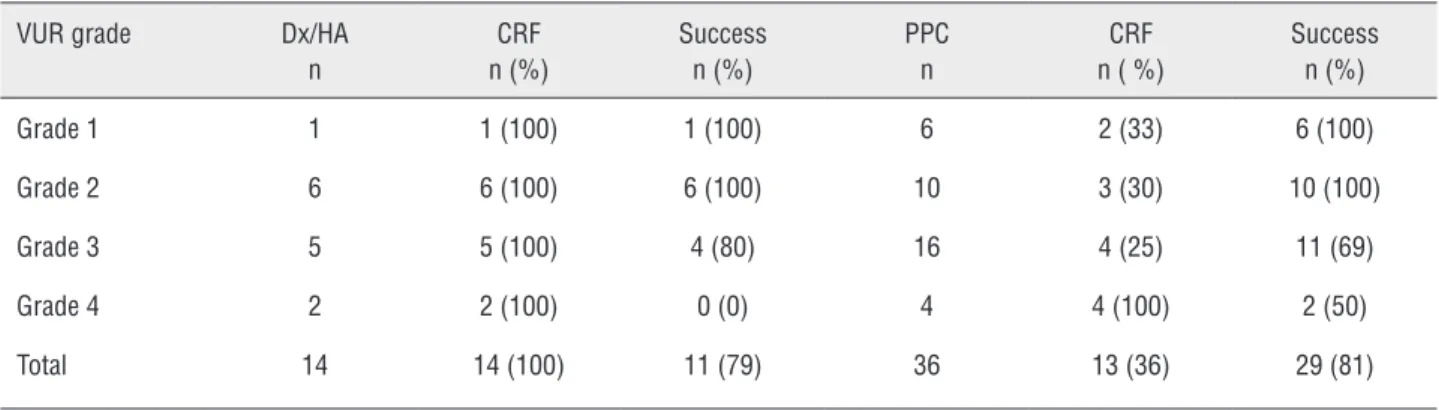
renal units, injection materials, rate of chronic re-nal failure and treatment success are presented in Table-1. According to International Reflux Clas-sification, reflux was scored as grade 1 in 7 RU (14%), grade 2 in 16 RU (32%), grade 3 in 21 RU (42%) and grade 4 in 6 RU (12%). There was no patient with grade 5 reflux (Table-1).
Fourteen RU (28%) were treated with DxHA (group 1) and 36 RU (72%) were treated with PPC (group 2). Mean injected material volu-me was 1.8 ± 0.1mL in group 1, and 1.1 ± 0.06mL in group 2 (p = 0.04).
The overall treatment success was achie-ved in 40 RU units (80%). The treatment was suc-cessful in 11 RU units (79%) in group 1 and 29 RU (81%) in group 2 (p = 0.71). There were similar results for grade 1-2 VUR patients in DxHA and PPC groups. Total success rate for grade 3 and 4 in DxHA group was 57%, and 65% in PPC group (p = 1.00). Treatment success rate of patients with CRF was recorded as 76.9% in PPC group. There was no statistical difference among patients with CRF in Dx/HA group (p = 1.00).
DISCUSSION
A meta-analysis reported treatment suc-cess rates with DxHA in pediatric patient popula-tion as 78.5% in grade 1-2 VUR, 72.5% in grade 3 VUR, 63% in grade 4 VUR and 53% in grade 5 VUR (11). In a European multicentre trial, DxHA injection was performed in 284 pediatric patients with 424 RU. 79% RU success rates were reported between 6 months and 3 years follow-up (12).
Arce et al. reported treatment success ra-tes as 69% in first injection, 81% in second in-jection by using DxHA in adult population and they found a decrease in success rates with incre-asing grades of reflux (9). In another study, 100% success rate was reported in low grades of reflux and 40-60% success rate in higher grades after repeated injections in adult patients (10). Moore and Bolduc reported higher success rates as 93% in adult patients. The cause of injection treatment failure was ureterocele in one patient and ureteral surgery history in two patients, but in this report, only one patient had grade 4 reflux (13). In a study with 19 adult female patients 79% success rates af-ter first injection and 96% afaf-ter repeated injections was reported (14). In 81 RU at 49 adult patients, polytetrafluoroethylene and DxHA were analyzed and 77.8% success rates with DxHA was reported (15). In another study with 21 adult renal trans-plant candidate patients, success rates after 1 year follow-up were reported as 82.7% in 29 RU (16). Again in study with adult CRF patients different types of injection materials were examined and success rate of DxHA injection was found as 61% in first injection and 65% when patients with de-crease in grade of reflux was added. Grade of reflux did not seem to affect the treatment success (17).
In our study, DxHA injection was perfor-med to 14 RU. We had a success rate of 79% at 1 year follow-up. No treatment success was found in grade 4 VUR disease. Our treatment and follow--up results were similar to other studies in litera-ture but were not similar in grade 4 VUR patients because in all of these patients VUR recurred in
Table 1 - VUR grades of renal units, injection materials, rate of chronic renal failure and treatment success. CRF: chronic renal failure, DxHA: dextranomer/hyaluronic acid copolymer, PPC: polyacrylate polyalcohol copolymer.
VUR grade Dx/HA n
CRF n (%)
Success n (%)
PPC n
CRF n ( %)
Success n (%)
Grade 1 1 1 (100) 1 (100) 6 2 (33) 6 (100)
Grade 2 6 6 (100) 6 (100) 10 3 (30) 10 (100)
Grade 3 5 5 (100) 4 (80) 16 4 (25) 11 (69)
Grade 4 2 2 (100) 0 (0) 4 4 (100) 2 (50)
our study. The cause of difference in success rate can be interpreted with not accepting a decrease in grade of reflux as success and not including the patients who had been treated after repeated injections to the study groups in our study. An important limitation of our study was the small number of patients in DxHA group. In addition, the number of patients with grade 4 VUR in this group was insufficient to make an accurate as-sessment of this issue. Another limitation can be the short follow-up period.
Studies with PPC are limited even in pe-diatric patient population. A multicenter trial in South America reported 2 year follow-up results of injection treatment at 82 pediatric primary VUR patients with 88 RU. They had 88.6% suc-cess rate (78 RU), 6.8% decrease in grade of VUR (6 RU) and 4.6% failure rate (4 RU) (18). Chertin et al. studied on 38 pediatric patients with 59 RU and reported a success rate of 95% in first 3 months of injection. In 21 patients the treatment was successful at the end of 1 year follow-up (19). In our study, 81% (29 RU) success rate was recorded by injection of PPC. Treatment success rates were found similar with other PPC injection studies with pediatric patients in literature. Ac-cording to our knowledge this is the first study that compared PPC and DxHA in adults and pa-tients with chronic renal failure.
When we compare treatment results of groups 1 and 2 in our study, overall success rates was similar. Treatment outcomes were similar in patients with CRF in both groups. There was a decrease in success rates in both groups with in-creasing grade of reflux.
CONCLUSIONS
In conclusion, the effectiveness of PPC and DxHA was similar in treatment of VUR di-sease in adult and chronic renal failure patients. According to our treatment results, both mate-rials may be used as first choice in treatment of VUR disease in renal transplantation candidate patients and patients with chronic renal failure. More studies with large patient population and longer follow-up are needed for PPC usage in adult patients.
CONFLICT OF INTEREST
None declared.
REFERENCES
1. Joyner BD, Atala A: Endoscopic substances for the treatment of vesicoureteral reflux. Urology. 1997; 50: 489-94. 2. Zilberman DE, Mor Y: Has the data efflux regarding the
promising outcome following injection of deflux changed the management of adult vesicoureteral reflux? Adv Urol. 2008: 361324.
3. Benoit RM, Peele PB, Docimo SG: The cost-effectiveness of dextranomer/hyaluronic acid copolymer for the management of vesicoureteral reflux. 1: substitution for surgical management. J Urol. 2006; 176: 1588-92; discussion 1592. 4. Tsai CC, Lin V, Tang L: Injectable biomaterials for incontinence
and vesico-ureteral reflux: current status and future promise. J Biomed Mater Res B Appl Biomater. 2006; 77: 171-8. 5. Chertin B, Kocherov S, Chertin L, Natsheh A, Farkas A,
Shenfeld OZ, et al.: Endoscopic bulking materials for the treatment of vesicoureteral reflux: a review of our 20 years of experience and review of the literature. Adv Urol. 2011; 2011: 309626.
6. Capozza N, Lais A, Nappo S, Caione P: The role of endoscopic treatment of vesicoureteral reflux: a 17-year experience. J Urol. 20040; 172: 1626-8; discussion 1629.
7. Scarpa AA, Del Rossi C, Casolari E, Gatti C, Scarpa AG: Endoscopic treatment of vesicoureteric reflux in paediatric patient: results of a long-term study. Acta Biomed. 2011; 82: 137-45.
8. Ormaechea M, Ruiz E, Denes E, Gimenez F, Dénes FT, Moldes J, et al.: New tissue bulking agent (polyacrylate polyalcohol) for treating vesicoureteral reflux: preliminary results in children. J Urol. 2010; 183: 714-7.
9. Arce J, Angerri O, Caffaratti J, Garat JM, Villavicencio H: Efficiency of endoscopic treatment for vesico-ureteric reflux in adults. BJU Int. 2009; 103: 71-4.
10. Basok EK, Yildirim A, Atsu N, Gocer S, Tokuc R: Endoscopic treatment of vesicoureteral reflux with polydimethylsiloxane in adults: do location and appearance of the ureteric orifice have a role in the success rates? Urol Int. 2008; 80: 279-82. 11. Elder JS, Shah MB, Batiste LR, Eaddy M: Part 3: Endoscopic
injection versus antibiotic prophylaxis in the reduction of urinary tract infections in patients with vesicoureteral reflux. Curr Med Res Opin. 2007; 23(Suppl 4): S15-20.
13. Moore K, Bolduc S: Treatment of vesicoureteral reflux in adults by endoscopic injection. Urology. 2011; 77: 1284-7. 14. Murphy AM, Ritch CR, Reiley EA, Hensle TW: Endoscopic
management of vesicoureteral reflux in adult women. BJU Int. 2011; 108: 252-4.
15. Natsheh A, Shenfeld OZ, Farkas A, Chertin B: Endoscopic treatment of vesicoureteral reflux in an adult population: Can we teach our adult urology colleagues? J Pediatr Urol. 2010; 6: 600-4.
16. Ozok U, Eroglu M, Imamoglu A, Bakirtaş H, Güvence N, Kiper A: Subureteral dextranomer/hyaluronic acid copolymer injection for vesicoureteral reflux in transplant candidates. J Endourol. 2005; 19: 1185-7.
17. Dirim A, Hasirci E, Turunc T, Aygun C, Ozkardes H: Single injection results of endoscopic treatment of vesicoureteric reflux with different tissue-bulking substances in patients with end stage renal failure. J Endourol. 2011; 25: 831-5. 18. Ormaechea M, Paladini M, Pisano R, Scagliotti M, Sambuelli
R, Lopez S, et al.: Vantris, a biocompatible, synthetic, non-biodegradable, easy-to-inject bulking substance. Evaluation of local tissular reaction, localized migration and long-distance migration. Arch Esp Urol. 2008; 61: 263-8. 19. Chertin B, Arafeh WA, Zeldin A, Kocherov S: Preliminary data on
endoscopic treatment of vesicoureteric reflux with polyacrylate polyalcohol copolymer (Vantris®): surgical outcome following single injection. J Pediatr Urol. 2011; 7: 654-7.
_______________________ Correspondence address:
Ahmet Selimoglu, MD Biga Public Hospital, Canakkale