Prostate cancer screening in Brazil: should it be done
or not?
_______________________________________________
Wilson F. S. Busato Jr.
1, Gilberto L. Almeida
1,21 Departamento de Urologia, UNIVALI – Itajai, SC, Brasil; 2 Instituto Catarinense de Urologia, Itajaí, SC,
Brasil
ABSTRACT
ARTICLE
INFO
______________________________________________________________ ______________________
The use of PSA in the screening, detection and prognosis of prostate cancer (PCa) has revolutionized the diagnosis and treatment of this disorder with an increase in detec-tion rates and PCa organ-confined. Despite these benefits and ease of implementadetec-tion, tracking PCa remains a matter of great controversy. We conducted a literature review and demographic and epidemiological data in Brazil feeling to assess the current state of screening and whether there is justification for population programs. the differences are valued between developed and underdeveloped countries as the incidence, mortal-ity, screening and access to health. an analysis of the advantages and disadvantages of screening is made as well as a critical analysis of existing studies on screening and some recommendations on a rational screening.
Keywords:
Prostatic Neoplasms; Mass Screening; Brazil
Int Braz J Urol. 2016; 42: 1069-80
_____________________ Submitted for publication: April 17, 2016
_____________________ Accepted after revision: May 26, 2016
_____________________ Published as Ahead of Print: September 12, 2016
INTRODUCTION
The use of prostatic specific antigen (PSA) for screening, detection and prognosis of prostate cancer (PCa) had a big impact on diagnosis and treatment of this disease. It was observed an in-crease of detection rate, and particularly an tre-mendous increase of detection of organ-confined disease (1-5). From 1986 to 1993, the incidence of PCa increased from 86 to 179 cases/100.000 white men and from 124 to 250 in black men. The rate of metastasis at diagnosis dropped from 15 to 6.6 cases/100.000 (6). Although with clear benefits and easy to perform, PCa screening is very contro-versial. In the north hemisphere countries, where
screening protocols were applied at populations at risk, it was observed an initial reduction of morbi-dity and mortality rates followed by a stagnation of these rates. This epidemiologic kinetics, althou-gh with low level of evidence, lead the American Urological Society to not recommend the use of vast screening of risk groups in North America (7).
worldwide validated. PCa screening rate (SPCa) is higher in comparison in USA and western Europe than in other countries, where it has been applied systematically (10). In under-developed countries, such as Brazil, there are no government SPCa ra-tes and the numbers are opportunistic, according to information of population studies derived from isolated municipal campaigns (11). In 2008, it was estimated that there were 899.000 new cases of PCa documented in the World and 258.000 deaths. The estimate for 2030 is 1.7 million cases with 500.000 deaths (12).
Internationally, it is observed a wide ran-ge of incidence and mortality rates, mainly due to early diagnosis based on PSA screening. Va-riation of incidence among countries may be up to 24 times and of mortality of up to 10 times (12). It is important to correlate those data with other populations, in particular in less developed countries, with different ethnic background and economical status, in a different historical mo-ment in terms of SPCa.
We performed a literature review of de-mographic and epidemiologic data from Brazil in order to evaluate the current status of SPCa trying to stablish the need or not of population scree-ning programs. This review may provide data for government and medical societies decisions for screening programs for underdeveloped countries.
Screening of prostate cancer in Brazil
Very little is known about SPCa in Brazil. Decisions are made mainly based on data collec-ted in other countries with a wide geographic ran-ge. A world analysis of PCa incidence by 100.000 inhabitants, according to six groups of countries, showed that USA, Australia and Northern Europe had the highest incidence (83.2 to 173.7), followed by Brazil (45.3 to 83.1). However, these data invert when applied to mortality rates. USA are the four-th group (7.5 to 11.5), but Brazil, Australia and Northern Europe remain in the second place, with 15.3 to 22 deaths by 100.000 inhabitants (12). That means that in North America there is a high incidence of PCa but with low mortality (11). Re-cently, a Spanish study, where the incidence and mortality are similar to USA, showed no benefit of screening on mortality, justifying the theory
that locals with low mortality do not benefit from screening (13). In Sweden and Denmark, with the same mortality rates than Brazil, screening lead to lowering of the rate more recently (2, 3).
It is known that under-notification is a serious problem in Brazil. Officially, the Natio-nal Institute of Cancer estimated in 2014 that the Southern region of Brazil was more affec-ted, with 91/100.00 inhabitants, followed by the Southeastern (88/100.000), Midwest (63/100.000), Northeastern (47/100.000) and Northern region (30/100.000) (14). Data of Sao Paulo Population Cancer Registry (2000-2005) showed a PCa rate of 337/100.00 in men with 60-64 years old and of 1.137/100.000 in men with 80-84 years (11). Other studies showed rates of 112/100.000 (Brasilia) and 99.3/100.000 (Goiania) (11, 15-19), higher than those published internationally. This wide varia-tion may reflect the differences of health access in our country, low notification and possibly any specific population variation still unknown.
In Brazil, there is no active population scre-ening such as those for breast and uterine cervix cancer. Some men are submitted to exams when spontaneously seek medical attention (16). In 2011, the National Health System of Brazil (SUS) paid 17 million gynecological consultations and only 2.6 million urological consultations (DATASUS). Male population from 45 to 75 years old, the target po-pulation for screening, was around 21 million in 2011 and SUS paid 3.9 million PSA exams (total and free). Since many of these exams referred to patients already diagnosed with PCa for follow-up purpose (around 1.7 million patients (17)), many men performed more than one exam/year without medical referral, a significant amount of patients performed the exam privately, and it is possible to infer that less than 15% of that population dose PSA. In Brazil, there are three major health syste-ms: the public one, responsible for 76% of medical care; complementary, including medical insurance companies responsible for 23% of population; and the private system, responsible for 1% (Health Mi-nistry, 2010).
of PSA dosage and rectal exam include: age <70 years, less than 8 years of schooling, per capita in-come lower than 0.5 minimum wages (11). Among other countries, these rates are much higher. In the US, around 67% of men ≥60 years old had collected PSA in the last 12 months. In another American study based on the 2000 census, 62% of men ≥65 years old dosed PSA in the last year (11). At Tirol, after PSA became available in public health system, 86.6% of men performed the exam. In Japan, screening is similar to ours, 10% of men perform the test. However, we cannot state that there is or there was SPCa in Brazil.
Prostate cancer is usually more aggressive in lower ages and in blacks/browns, the majority of our population (Brazilian Institute of Geogra-phy and Statistics, IBGE 2010: 97 million), diffe-rent from the USA population. Fortunately, we live in a country with high miscegenation. Accor-ding to Darcy Ribeiro (20), there is an “in common multi-ethnic genetic background” and it is very difficult to distinguish men according to race. A recent research by the Catholic University of Bra-silia showed that 45% of all Brazilians, black and whites, have 90% of African sub-saharan genes and that 86% present up to 10% of African sub--saharan genes, but European ancestry predomi-nates in 80% of individuals (21).
It should also be pointed out some aspects of men from rural zones. Even main global sta-tistics on cancer (Globocan) affirm that they only deal with only 30% of world population. In Bra-zil, rural population is 16%, or 30.4 million, and there are 15 million of men (IBGE-CENSUS 2010). Besides, men who live in small cities and those marginally to big cities, as well as those from slum dwells, have very little access to medical atten-tion. The timetable of public health services, the decoration with female and childish motives of public campaigns and the need of a second at-tendance for PSA collection and a third one for physician analysis of the results also contribute for those low number of men screened. At the eva-luation of AMS 2009 (Medical Assistance, 2009, IBGE), only 5.2% of public health services without hospitalization had clinical exams available (22).
We should also rethink the strategy to not screen men with less than 10 years of life
expec-tancy. We should rethink life expectancy in Brazil. According to IBGE, life expectancy in Brazilian at birth is 74.6 years; Santa Catarina is the state with higher life expectancy, 76.8 years. In the nineties, when most papers were published about survival of PCa, life expectancy was 66 years, and men died due to other causes not related to low morbi-dity and mortality of prostatic tumor (DATASUS). Moreover, these are data related to life expectancy at birth. We have to consider that, as long as we survive diseases and accidents, we prolong our life expectancy. According to SUS Health Natio-nal System table used to guide benefits, that takes into account life expectancy from a determined age, a person with 55 years old would have a life expectancy of more 25.5 years, a person with 65 years more 18 years and with 70 years of more 14.6 years (18). Therefore, it is a mistake to esti-mate life expectancy of a person over 65-year old, adding inherent risks to a period anterior to his/ her time line.
Several aspects must be discussed when we analyze screening above 70 years, such as co-morbidities and choice of treatment, aside from life expectancy. It is important to have in mind the aggressiveness of PCa. In a recent Swedish prospective study showed how low risk tumors treated conservatively presented a considerable risk of progression and death af-ter 15 to 29 years (20/1000 persons/year and 17.9/1000 persons/year) (23).
Does PSA-based screening have benefits?
Although with low rate of mortality, PCA kills many men in the World. In developed coun-tries, median survival from diagnosis in 5 years is 64%, while in under-developed countries is 41%. World mean is 58%, with 258.000 deaths/year (12). Which are the possible benefits?
Mortality reduction
Cancer Institute Statistics: http://seer.cancer.gov/ csr/1975_2005/). Recently, tendency analysis of incidence and mortality of PCa in the last decades showed distinct figures among countries (Figu-re-1). While USA and Canada have implemented screening programs and the detection rates raised to a maximum point, reaching a diagnostic plate-au, Brazil shows rising detection rates. Moreover, in those countries, the incidence increase of 7% per year of PCa reflects the real increase of in-cidence of the disease and not the extension of screening programs. And, more important, there was a reduction of mortality in the last decade. In relation to Brazil, mortality rates are still raising, showing that we are lagging behind in relation to screening. When we compare the curves, there is a difference of 20 years.
PLCO, with almost 77.700 participants, in their analysis of anticipation in 7 years of follow--up, showed a death incidence of 2/10.000
per-sons/year (50 deaths) among screened men versus 1.7 (44 deaths) in control group (9). They conclu-ded that PCa related mortality in screened men is so low that screening is not justified (LE: 1B). A recent Cochrane analysis did not show any re-duction on mortality in five randomized studies with a total of 341,342 participants, and stated that there is no reduction of mortality in up to 10 years of follow-up (24). However, these are small studies, with methodologic errors, with level of contamination and, mainly, follow-up inferior to 10 years. It is strange to realize that it was used studies with less than 10 years of follow-up to analyze a disease that does not kill before 10 years after diagnosis.
On the other hand, ERSPC, that included more than 162.000 men with 55 to 69 years old, found, in a follow-up of 11 years, a reduction of mortality of 21%, or 29% after adjustment. But the reduction was significant only for men between
Figure 1 - Incidence tendency and mortality of prostate cancer according to country (Adapted from Center et al. (12))
(blue: incidence; orange: mortality) Noth America Central America e The Caribbean
South America
1985 1985
1985 1985
1990 1990
1990 1990
1995 1995
1995 1995
2000 2000
2000 2000
2008 2008
2008 2008
Rate per 100,000
Rate per 100,000
200 200
200 200
100 100
100 100
10 10
10 United States
Argentina
Canada
Brazil
10
1 1
65 and 69 years old. They concluded indicating a reduction of 38% of relative risk (RR) in a follow-up of 11 years, but with no reduction for men ≥70 years old (1). An update of the data from Goteborg section with 14 years of follow--up showed a reduction of RR of 50% of mor-tality in the screened group and 41% reduction of metastasis (2). However, this reduction was accompanied by an important increase of over-treatment. At the initial report of ERSPC, in or-der to prevent 1 death, they had to screen 1410 men and to treat 48. In the last update, with 11 years of follow-up, it was necessary respectively 1055 and 37. In the Goteborg study of 14 years, it was necessary to screen 293 and to treat only 12 patients in order to avoid one death.
Reduction of cases with metastatic or more advanced disease
Sensitivity and specificity of PSA incre-ase for high grade PCA, showing that it is a bet-ter marker for aggressive tumors than for low grade tumors. With screening, there is a higher number of localized disease, lowering the num-ber of metastatic and high grade patients, in the order of 31% (25). Consequently, there is a re-duction of pathological fractures, bone pain and the need of treatment, with positive impact on quality of life of those men and families. Prior to PSA era, only 27% of PCa cases diagnosed were localized. In the present, 97 to 98% of all PCas diagnosed through screening are localized (1, 9, 26). Before PSA, 75% of patients died due to cancer or it contributed to death. Mean sur-vival time between diagnosis and death was 41 months (26).
The risk of metastatic PSA reduced 30 and 49% among men screened at ERSPC and Goteborg, respectively. In the last, 2.6% of scre-ened and 10.6% of patients of control group had diagnosis of metastatic disease (2). The absolute risk reduction is of 3.1 cases for every 100 pa-tients screened. Etzioni et al. (27) tried to sta-blish a reduction of metastatic cases after the introduction of PSA based screening program in a simulated model. With screening, the inciden-ce of metastasis reduinciden-ced from 77 cases/100.000 men in 1990 to 37 cases in 2000, corresponding
to a reduction of 80% of advanced disease (27). Many studies have shown a reduction of biochemical recurrence following radical pros-tatectomy in men diagnosed through screening (25) reducing the need of hormone therapy, ra-diotherapy and chemotherapy and their risks and complications as well as costs of theses auxiliary treatments.
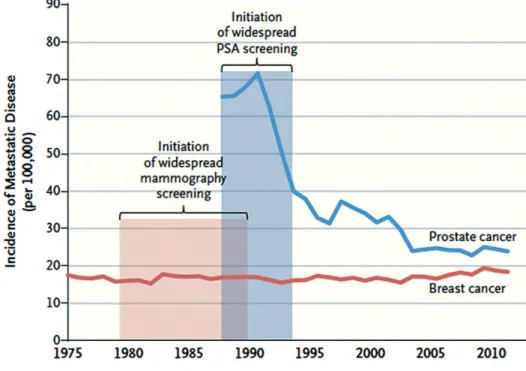
Recently, one study about evolution of me-tastasis in prostate and breast cancer at diagnosis showed that screening reduced advanced cases of PCa but not of breast cancer. Unlike mammogram, PSA is one of the most efficient markers for high risk diseases, and the reduction of more advanced cases was obtained by screening, and not from re-duction of risk factors (Figure-2) (28).
Determination of risk of prostate cancer throu-ghout life
Three key questions are empirical and still not answered: 1) In which age should we start ear-ly detection of PCa? 2) In which interval should we perform PSA and rectal exam? And 3) Until which age should we screen for PCa? There are evidences that determination of PSA at 40-45 ye-ars is related to future risk of PCa (29, 30). EUA suggests that PSA dosage may be used to define posterior periodicity (LE: B) (31). PSA >1.0ng/mL at 45 years old is associated to a significantly hi-gher risk of death related to PCa, as well as advan-ced or metastatic disease diagnosis even after 25 years of that dosage (21).
Medium level of PSA of healthy men (Ta-ble-1) varies according to age and several studies have shown that a higher PSA of a specific popu-lation according to age may be a better indicator for future development of PCa than other clinical risk factors, such as race, familiar history and sus-pect rectal exam (1, 4, 30, 32).
was associated with a very low chance to develop clinical tumor in the future. However, data obtained by the Malmo Preventive Project (30) indicate that screening should be applied in men even with basal PSA below medium, since 28% of metastatic PCa showed levels below medium for up to 27 years.
Even for men over 60 years old, PSA va-lue can predict future risk of PCa, development of metastasis and death at 85 years old. Men in that age group with PSA ≥2ng/mL has 26 more
times risk of death due to PCa than those with <2ng/mL (34, 35).
Frequency of screening
Basal PSA, obtained from 45 to 59 years of age, can help urologist/oncologist to plan interval of PSA and rectal digital exams. An evaluation of the Rotterdam section of ERSPC indicates evalua-tion every 2 to 4 years for men with PSA >1.0ng/ mL and of up to 8 years for values <1ng/mL. That study followed 1703 men with 55 to 65 years of age during 8 years with PSA ≤1.0ng/mL and diag-nosed only 8 cases of PCa (0.47%) (36). The inter-val varied in the ERSPC study, and most centers used an interval of 4 years, and the Goteborg arm, 2 years. The interval of 2 years resulted in a reduc-tion of death by PCa RR of up to 44% and of 43% for advanced disease. However, it increased the number of diagnosis of PCa and the incidence of low risk cancer, elevating overtreatment. Althou-gh there is still no clear definition of the precise
Figure 2 - incidence of metastatic cancer at diagnosis, USA, 1975-2012.
Breast cancer data (SEER) of women ≥40 years old, and prostate cancer (American Joint Committee Stage IV) of men ≥40 years of age (28).
Table 1 - PSA mean level in healthy men (29).
Age PSA (ng/mL)
30 - 49 0.6 a 0.78
50 - 59 0.7 a 1.23
60 - 64 1.2
interval the urologists must individualize it based on basal levels of PSA and on co-morbidities and life expectancy of their clients (1).
Does PSA-based screening have risks?
Diagnosis of low important disease (overdiagnosis)
Some fear that PSA based SPCa could lead to excessive diagnosis, and consequently, overtre-atment, with a sequence of unfavorable facts and events and lowering quality of life (5, 37). This is one of the reasons that made USPSTF be un-favorable to SPCa (4). In the last decades, a few steps were introduced in diagnosis and treatment of PCa. Only PCa locally advanced were operated at EDR. After the introduction of PSA, all tumors are treated and diagnosed without distinction, with overdiagnosis and overtreatment. After a se-quence of natural learning, many PCa diagnosed by PSA may and must be submitted to active sur-veillance.
Frequently, the studies report overdiagno-sis when analyzing PSA results as a whole, regar-dless age (38). Almost half unnecessary diagnosis by PSA are made in men older than 70 years, an
age group with very few indications of screening (Figure-3). In a simpler way, only controlling that practice would reduce in half overtreatment. Ano-ther measure would be to restrict screening in men >60 years old to those with PSA >1ng/mL, infor-ming those with lower age that an eventual PCa diagnosis would rarely cause death.
Recently, data from the Prostate Cancer In-tervention Trial (PIVOT) (4) were published. They randomized 731 men to radical prostatectomy (RP) and observation. Some conclusions regarding screening were made. After 10 years, mortality among participants with PSA ≤10ng/mL was 46% with RP vs. 44% for observation (RR 1.06; 95% CI, 0.87-1.29), but for men with basal PSA >0ng/mL it was 48% for RP vs. 62% for observation (RR, 0.79; 95% CI, 0.63-0.99). These data suggest that it could be adopted an increase in the traditional threshold for biopsy indication without prejudice to treatment, avoiding diagnosis with low PSA of a non-clinical significant disease (39).
Adverse effects of screening and treatment
Recent studies have shown a rate of mo-derate/severe adverse effects in men submitted to
biopsy (TURPB) relatively low, such as hemosper-mia (27%), pain (75), hematuria (6%), fever (6%), hematoquezia (2%), and risk of hospitalization of 0.5-1.3% (40, 41). However, population studies show that this hospitalization rate can reach 7% (42). Per-operatory mortality of PC is around 0.5% and absolute risk of urinary incontinence is 11%, and erectile dysfunction 43%. In the long term follow-up, surgical and radiotherapy complica-tions are similar (39).
Difficulties of the background studies Follow-up time
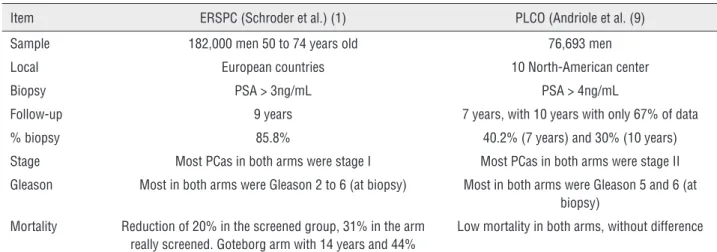
As referred above, grade D recommenda-tion of AUA and of United States Preventive Ser-vices Task Force (USPSTF) (43) was based mainly in two studies, with conflicting results (Table-2). ERSPC study had a great number of participants with an adequate follow-up and PLCO had half participants and partial publication of data (44, 45). Both studies had short duration. It is believed that any alteration of the natural slow history of PCa should occur only after 11.5 years (46). One of the long arms of ERSPC (Goteborg Trial) with 14 years of follow-up showed reduction of 44% of mortality among screened men. The great paradox is that AUA’s SPCa guidelines for more than a de-cade indicate that we must not screen men with life expectancy ≤10 years, but when it evaluated SPCa benefits they based on studies with shorter
follow-up. We must remember that those studies were planned 20 years ago, when the knowledge of natural history of PCa was a fraction of what is known nowadays.
Since most deaths occur in men over 70 years old (47) and both studies included men >50 years, ideal follow-up time to determine reduc-tion of mortality should be longer than 14 years, since many participants did not reach the group age when death occurs.
Tumor data
PLCO did not find advantages with scre-ening and involved a smaller number of pa-tients with more advanced disease and with Gleason score lower than ERSPC (1, 9). With a larger number of PCa with low or intermediate risk, the tendency is low mortality. It is known that for these groups screening is not essential. This “aggressiveness shift” may be revealed by the published low mortality (<0.3%). There were 174 tumor-specific deaths at PLCO. That fact was observed since almost half participants had at least two previous PSA exams, and those with PCa diagnosis were not included in neither study arms, being pre-selected.
Power of the study
We must remember that at analysis of strength of PLCO, 37.000 men should be initially
Table 2 - Comparison of two major studies of prostate cancer screening.
Item ERSPC (Schroder et al.) (1) PLCO (Andriole et al. (9)
Sample 182,000 men 50 to 74 years old 76,693 men
Local European countries 10 North-American center
Biopsy PSA > 3ng/mL PSA > 4ng/mL
Follow-up 9 years 7 years, with 10 years with only 67% of data
% biopsy 85.8% 40.2% (7 years) and 30% (10 years)
Stage Most PCas in both arms were stage I Most PCas in both arms were stage II Gleason Most in both arms were Gleason 2 to 6 (at biopsy) Most in both arms were Gleason 5 and 6 (at
biopsy) Mortality Reduction of 20% in the screened group, 31% in the arm
really screened. Goteborg arm with 14 years and 44%
Low mortality in both arms, without difference
evaluated in each arm during 10 years. However, only 67% of mortality data were available in that period. Besides, changes after the beginning of the protocol in 1995, such as reduction of access age to 55 years, resulted in reduction to accuracy and new calculations in order to maintain accu-racy, with the need of follow-up of more 13 years from the last modification, that occurred in 2011. Only these two aspects, according to statistics, reduce the power of the study in 50% (48).
Study contamination
One of the methodological bias of PLPO was that almost half candidates admitted in the group control of the study had already performed occasional PSA dosages. This situation is com-mon in regions where screening has already been implemented. This previous evaluation works as a “pre-selection” and a selection bias, since many PCas had already been identified, and therefore, were left aside from the study. One proof is the presence of lower number of patients with ad-vanced PCa and/or high Gleason score (≥7) than other publications (4).
It is accepted a maximum of 20% of con-tamination, but at PLCO almost half participants had performed a previous PSA exam. Therefore, under an epidemiologic point of view, we can affirm that PLCO compares two kinds of scree-ning: more and less intense (9).
What will happen if we stop screening?
If we suspend screening (Brazil never had screening) indiscriminately we will eliminate the risks but also the benefits (49). One of the rea-sons for the reduction of morbi-mortality of PCa of PSA-based screening was downstaging (36) at diagnosis. If we stop screening favorable effects will no longer persist (5). However, since 93% of deaths due to PCa occur in men >70 years old (50), period in in which a more number of high grade of PCa are diagnosed, the suspension of screening in men <65 years will increase morbi--mortality in that age group in a few years (51).
Bergdahl et al. (51) followed 13.423 men: half of them stopped screening at 69 years of age and half (control group) never were screened. In
the first 9 years of the last PSA all risk groups of PSA were more frequently diagnosed among those never screened, but after 9 years, the rates were the same, except for groups with low risk. The reduction of advanced and high risk PCa ob-served in the screened arm during the screening period lasted for 9 years. After that period, mor-tality rate of those screened reached that of the group never screened (51). Therefore, after 9 ye-ars, the welcome displacement of stage to less ad-vanced disease and with lower risk was lost. Also interesting, the authors noted a gradual drop of the protective effect of screening, starting after 4 years of the last PSA. The authors informed that, as a consequence of suspending screening at 69 years of age, men ≥78 years will have the same risk of advanced of high risk disease than those not screened.
Rational use of PSA
If the specialists do not agree if we should or not perform screening, we cannot expect pa-tients to decide for that measure with less infor-mation. AUA guidelines suggest that we should screen patients who understand and accept the risks. However, this approach could result in different health care management, since well--educated and informed men would ask for scre-ening and would be effective screened (37). And certainly that recommendation would not be ap-plied to the majority of the Brazilian population, in view of the disparity of socio-economic status of our population than that of USA.
More recent data indicate that the real discussion is not if we should perform PSA ba-sed screening of PCa but how to do it rationally. Most authors agree that annual screening of all men ≥50 years old is not justified (26, 44, 52-54). Screening programs must focus on the decision capacity of PCa experts (urologists and oncolo-gist) and not on basic health programs. Table-3 shows some guidelines that help perform a more smart screening.
CONFLICT OF INTEREST
REFERENCES
1. Schröder FH, Hugosson J, Roobol MJ, Tammela TL, Ciatto S, Nelen V, et al. Screening and prostate-cancer mortality in a randomized European study. N Engl J Med. 2009;360:1320-8. 2. Hugosson J, Carlsson S, Aus G, Bergdahl S, Khatami
A, Lodding P, et al. Mortality results from the Göteborg randomised population-based prostate-cancer screening trial. Lancet Oncol. 2010;11:725-32.
3. Schröder FH, Hugosson J, Roobol MJ, Tammela TL, Ciatto S, Nelen V, et al. Prostate-cancer mortality at 11 years of follow-up. N Engl J Med. 2012;366:981-90. Erratum in: N Engl J Med. 2012;366:2137.
4. Jacobsen SJ, Katusic SK, Bergstralh EJ, Oesterling JE, Ohrt D, Klee GG, et al. Incidence of prostate cancer diagnosis in the eras before and after serum prostate-specific antigen testing. JAMA. 1995;274:1445-9.
5. Kim EH, Andriole GL. Prostate-specific antigen-based screening: controversy and guidelines. BMC Med. 2015;13:61.
6. Stanford JL, Stephenson RA, Coyle LM, et al. Prostate cancer trends 1973-1995, SEER Program, National Cancer Institute. Bethesda, MD: NIH; 1999 pub99-4543.
7. Carter HB, Albertsen PC, Barry MJ, Etzioni R, Freedland SJ, Greene KL, et al. Early detection of prostate cancer: AUA Guideline. J Urol. 2013;190:419-26.
8. Moyer VA; U.S. Preventive Services Task Force. Screening for prostate cancer: U.S. Preventive Services Task Force recommendation statement. Ann Intern Med. 2012;157:120-34.
9. Andriole GL, Crawford ED, Grubb RL 3rd, Buys SS, Chia D, Church TR, et al. Mortality results from a randomized prostate-cancer screening trial. N Engl J Med. 2009;360:1310-9. Erratum in: N Engl J Med. 2009;360:1797.
10. Kitagawa Y, Mizokami A, Namiki M. Trends of clinical symptoms and prognosis of middle-aged prostate cancer patients after instigation of prostate specific antigen-based population screening. Prostate Int. 2013;1:65-8.
11. Santiago LM, Luz LL, da Silva JF, Mattos IE. Prevalence and factors associated with conducting screening tests for prostate cancer in the elderly in Juiz de Fora in the state of Minas Gerais, Brazil. Cien Saude Colet. 2013;18:3535-42. 12. Center MM, Jemal A, Lortet-Tieulent J, Ward E, Ferlay J,
Brawley O, et al. International variation in prostate cancer incidence and mortality rates. Eur Urol. 2012;61:1079-92. 13. Luján M, Páez Á, Angulo JC, Andrés G, Gimbernat H,
Redondo C, et al. Update of the results of the Spanish branch of the European Randomized Study on Screening for Prostate Cancer (ERSPC). Actas Urol Esp. 2015;39:405-13. 14. Instituto Nacional do Câncer. Estimativa 2014: Incidência
de câncer no Brasil. Rio de Janeiro (Brasil): INCA; 2013. [acessado em 2013 dez 26]. Available at. http://www2. inca.gov.br/wps/wcm/connect/agencianoticias/site/home/ noticias/2013/inca_ministerio_saude_apresentam_ estimativas_cancer_2014
15. Miranda PS, Côrtes Mda C, Martins ME, Chaves PC, Santarosa RC. Practice of precocious diagnosis for prostate cancer among professors of the school of medicine, Minas Gerais Federal University- Brazil. Rev Assoc Med Bras. 2004;50:272-5.
Table 3 - General measures that may help define guidelines for prostate cancer screening.
1. PSA dosed at 45-50 years old may identify risk groups and indicate screening interval 2. Reduce intensity of screening > 60 years old in men with PSA<2.0 ng/mL
3. There is little benefit to screen men>70 years old, with PSA≤3.0 ng/mL and with two or more co-morbidities 4. Smart screening in men 50-69 years old
5. Screening intervals from 2/2 years up to 7/7 years, individualized
6. Attention to familial prostate cancer, defined as two first-degree relatives or on first-degree relative and at least two of second-degree
7. Attention to screening in morbid obeses and blacks with good health 8. Population screening for all men is not justified
16. Lima CA, Silva AM, Kuwano AY, Rangel MR, Macedo-Lima M. Trends in prostate cancer incidence and mortality in a mid-sized Northeastern Brazilian city. Ver Assoc Med Bras. 2013;59:15-20.
17. Gomes R, Rebello LE, de Araújo FC, do Nascimento EF. [Prostate câncer prevention: a review of the literature]. Cien Saude Colet. 2008;13:235-46.
18. Instituto Brasileiro de Geografia e Estatística (IBGE). Diretoria de Pesquisas (DPE), Coordenação de População e Indicadores Sociais (COPIS). [acessado em 2013 dez 30]. Available at. http://www.ibge.gov.br/home/estatistica/ populacao/projecao_da_populacao/publicacao_UNFPA.pdf 19. Gonçalves-Silva AC, Murta-Nascimento C, Eluf-Neto J.
Assessing screening practices among health care workers at a tertiary-care hospital in Sao Paulo, Brazil. Clinics (Sao Paulo). 2010;65:151-5.
20. Ribeiro D. O povo brasileiro – A formação e o sentido do Brasil. 2a edição. São Paulo. Companhia das Letras. 1995. 21. Pena SD, Di Pietro G, Fuchshuber-Moraes M, Genro JP, Hutz
MH, Kehdy Fde S, et al. The genomic ancestry of individuals from different geographical regions of Brazil is more uniform than expected. PLoS One. 2011;6:e17063.
22. Instituto Brasileiro de Geografia e Estatística (IBGE). Diretoria de Pesquisas (DPE), Estatísticas da Saúde. Assistência Médico-Sanitária 2009. Access may 2016. http:// www.ibge.gov.br/home/presidencia/noticias/imprensa/ ppts/0000000220.pdf
23. Popiolek M, Rider JR, Andrén O, Andersson SO, Holmberg L, Adami HO, et al. Natural history of early, localized prostate cancer: a final report from three decades of follow-up. Eur Urol. 2013;63:428-35.
24. Ilic D, Neuberger MM, Djulbegovic M, Dahm P. Screening for prostate cancer. Cochrane Database Syst Rev. 2013;1:CD004720.
25. Crawford ED, Abrahamsson PA. PSA-based screening for prostate cancer: how does it compare with other cancer screening tests? Eur Urol. 2008;54:262-73.
26. Shteynshlyuger A, Andriole GL. Prostate cancer: to screen or not to screen? Urol Clin North Am. 2010;37:1-9.
27. Etzioni R, Gulati R, Falcon S, Penson DF. Impact of PSA screening on the incidence of advanced stage prostate cancer in the United States: a surveillance modeling approach. Med Decis Making. 2008;28:323-31.
28. Welch HG, Gorski DH, Albertsen PC. Trends in Metastatic Breast and Prostate Cancer--Lessons in Cancer Dynamics. N Engl J Med. 2015;373:1685-7.
29. Lilja H, Cronin AM, Dahlin A, Manjer J, Nilsson PM, Eastham JA, et al. Prediction of significant prostate câncer diagnosed 20 to 30 years later with a single measure of prostate-specific antigen at or before age 50. Cancer. 2011;117:1210-9.
30. Vickers AJ, Ulmert D, Sjoberg DD, Bennette CJ, Björk T, Gerdtsson A, et al. Strategy for detection of prostate cancer based on relation between prostate specific antigen at age 40-55 and long term risk of metastasis: case-control study. BMJ. 2013;346:f2023.
31. Heidenreich A, Bellmunt J, Bolla M, Joniau S, Mason M, Matveev V, et al. EAU guidelines on prostate cancer. Part 1: screening, diagnosis, and treatment of clinically localised disease. Eur Urol. 2011;59:61-71.
32. Heidenreich A, Abrahamsson PA, Artibani W, Catto J, Montorsi F, Van Poppel H, et al. Early detection of prostate cancer: European Association of Urology recommendation. Eur Urol. 2013;64:347-54.
33. Holmström B, Johansson M, Bergh A, Stenman UH, Hallmans G, Stattin P. Prostate specific antigen for early detection of prostate cancer: longitudinal study. BMJ. 2009;339:b3537.
34. Vickers AJ, Cronin AM, Björk T, Manjer J, Nilsson PM, Dahlin A, et al. Prostate specific antigen concentration at age 60 and death or metastasis from prostate cancer: case-control study. BMJ. 2010;341:c4521.
35. Carlsson S, Assel M, Sjoberg D, Ulmert D, Hugosson J, Lilja H, et al. Influence of blood prostate specific antigen levels at age 60 on benefits and harms of prostate cancer screening: population based cohort study. BMJ. 2014;348:g2296.
36. Aus G, Bergdahl S, Lodding P, Lilja H, Hugosson J. Prostate cancer screening decreases the absolute risk of being diagnosed with advanced prostate cancer--results from a prospective, population-based randomized controlled trial. Eur Urol. 2007;51:659-64.
37. Hayes JH, Barry MJ. Screening for prostate cancer with the prostate-specific antigen test: a review of current evidence. JAMA 2014;311:1143-9.
38. Draisma G, Etzioni R, Tsodikov A, Mariotto A, Wever E, Gulati R, et al. Lead time and overdiagnosis in prostate-specific antigen screening: importance of methods and context. J Natl Cancer Inst. 2009;101:374-83.
39. Wilt TJ, Brawer MK, Jones KM, Barry MJ, Aronson WJ, Fox S, et al. Radical prostatectomy versus observation for localized prostate cancer. N Engl J Med. 2012;367:203-13. Erratum in: N Engl J Med. 2012;367:582.
40. Rosario DJ, Lane JA, Metcalfe C, Donovan JL, Doble A, Goodwin L, et al. Short term outcomes of prostate biopsy in men tested for cancer by prostate specific antigen: prospective evaluation within ProtecT study. BMJ. 2012;344:d7894.
42. Loeb S, Carter HB, Berndt SI, Ricker W, Schaeffer EM. Complications after prostate biopsy: data from SEER-Medicare. J Urol. 2011;186:1830-4.
43. Carter HB, Albertsen PC, Barry MJ, Etzioni R, Freedland SJ, Greene KL, et al. Early detection of prostate cancer: AUA Guideline. J Urol. 2013;190:419-26.
44. Bailey SJ, Brewster SF. Prostate cancer: to screen or not to screen. Arch Esp Urol. 2011;64:406-18.
45. Schröder FH, Roobol MJ. ERSPC and PLCO prostate cancer screening studies: what are the differences? Eur Urol. 2010;58:46-52.
46. Vaz FP, Correia JAP. Rastreamento com PSA ainda deve ser realizado? In: Nardi AC, Sadi MV, Nardozza Jr A, Truzzi JC (eds). São Paulo: Sociedade Brasileira de Urologia, 2012-2013.
47. Vickers AJ, Sjoberg DD, Ulmert D, Vertosick E, Roobol MJ, Thompson I, et al. Empirical estimates of prostate cancer overdiagnosis by age and prostate-specific antigen. BMC Med. 2014;12:26.
48. Gulati R, Tsodikov A, Wever EM, Mariotto AB, Heijnsdijk EA, Katcher J, et al. The impact of PLCO control arm contamination on perceived PSA screening efficacy. Cancer Causes Control. 2012;23:827-35.
49. Gulati R, Tsodikov A, Etzioni R, Hunter-Merrill RA, Gore JL, Mariotto AB, et al. Expected population impacts of discontinued prostate-specific antigen screening. Cancer. 2014;120:3519-26.
50. Bechis SK, Carroll PR, Cooperberg MR. Impact of age at diagnosis on prostate cancer treatment and survival. J Clin Oncol. 2011;29:235-41.
51. Grenabo Bergdahl A, Holmberg E, Moss S, Hugosson J. Incidence of prostate cancer after termination of screening in a population-based randomised screening trial. Eur Urol. 2013;64:703-9. Erratum in: Eur Urol. 2015;68:e46.
52. Vemana G, Andriole GL. Bad habits may be hard to break. Eur Urol. 2013;63:426-7.
53. Heijnsdijk EA, Wever EM, Auvinen A, Hugosson J, Ciatto S, Nelen V, et al. Quality-of-life effects of prostate-specific antigen screening. N Engl J Med. 2012;367:595-605. 54. Squiers LB, Bann CM, Dolina SE, Tzeng J, McCormack
L, Kamerow D. Prostate-specific antigen testing: men’s responses to 2012 recommendation against screening. Am J Prev Med. 2013;45:182-9.