Vanessa Ceolin Poletto(a) Italo Medeiros Faraco Junior(b)
(a)Graduate Student in Pediatric Dentistry; (b)PhD, Department of Pediatric Dentistry – Lutheran University of Brazil, Canoas, RS, Brazil.
Corresponding author: Vanessa Ceolin Poletto
Rua Conde de Porto Alegre, 550 / 1402 - Bairro Floresta
Porto Alegre - RS - Brazil CEP: 90220-210
E-mail: [email protected]
Received for publication on Sep 09, 2009 Accepted for publication on Dec 01, 2009
Bibliometric study of articles published in
a Brazilian journal of pediatric dentistry
Abstract: This cross-sectional study aimed at evaluating the abstracts of all articles published in the “Jornal Brasileiro de Odontopediatria e Odontologia do Bebê” in order to collect data on the study design used, the most researched topics and the Brazilian states with the highest scien-tiic production. Copies were made of the abstracts of each article, total-ing 572 abstracts. Data categorization was done by two trained and in-dependent reviewers. The results showed that the most used study design were case report (33%) and cross-sectional study (30%). On the other hand, there were only 2.5% of randomized clinical trials and no system-atic review or meta-analysis. The most researched topics were cariology (15%) and restorative dentistry / dental materials (10%). The state with the greatest number of publications was São Paulo (40%), followed by Rio de Janeiro (17%). It was concluded that the majority of the articles published referred to studies with a low potential to establish scientiic evidence, indicating a need for conducting research based on better qual-ity methodology. Moreover, it was found that the assessed literature re-lected the trends observed in the clinical practice of Pediatric Dentistry in Brazil.
Descriptors: Bibliometrics; Dental research; Pediatric dentistry.
Introduction
Pediatric dentistry was deined several years ago as an age-deined specialty that comprises all dentistry aspects.1 It has also been described
as a specialty that, above all, provides preventive and global therapeu-tic dental care for children and adolescents, including those who require special care, comprising a wide range of activities.2,3 Therefore, pediatric
dentistry is becoming more and more committed to offer patients the latest scientiic advancements in health care by seeking useful and consis-tent information in the medical literature to guide clinical conducts.
Health care professionals usually base their decisions on professional experience, prevailing clinical practice, standard procedures, training or expert guidance, peer consultation and knowledge acquired in dental school, seminars and continuing education programs. Clinical experi-ence, technical expertise and critical judgment are essential but not sufi-cient. Due to the complexity of information, scientiic support to clinical practice must be sought in the medical literature and derived from meth-odologically validated tools.4-6
scientiic basis to professionals in their search for better quality of life standards for the population.
Hence the importance of bibliometrics, which is being increasingly used in analyses of scientiic pro-duction, and has become a statistical support device that allows mapping and generating different infor-mation and knowledge handling and management indicators, particularly in scientiic, technological and productivity-related information and communi-cation systems necessary to the planning, evaluation and management of a given scientiic community or country. It is also a quantitative instrument that al-lows minimization of the subjectivity inherent to in-formation indexation and retrieval, which produces knowledge in a given ield.7-10
Since some studies suggest that dental publica-tions present questionable results and evaluapublica-tions, several bibliometric studies have been conducted to identify and quantify the available publications, as well as to assess the validity of the evidence based Dentistry considering type, quality and availability of these publications.7,10-14
Based on the considerations above, the present study evaluated all the articles published in the “Jor-nal Brasileiro de Odontopediatria e Odontologia do Bebê” (JBP), and assessed the study design used, the area of interest of the research and the Brazilian state where the research was conducted.
Material and Methods
Study design
A cross-sectional study by direct observation of all the abstracts published in the “Jornal Brasileiro de Odontopediatria e Odontologia do Bebê” (1998-2007) was conducted.
Data collection
Selection of articles and data extraction
The abstract of each article was retrieved and copied, totaling 572 abstracts. They were separated by year and then subdivided into volume and issue number. Both the title and abstract were reviewed. Three items were evaluated for every abstract, as follows: study design, area of interest of the research and the Brazilian state where the research was con-ducted.
When it was not possible to characterize the three items of the research from the title and ab-stract alone, the whole article was retrieved and analyzed, so as to collect all the information neces-sary to complete the studied items. Data categori-zation was done by direct physical examination of the abstract of every reference, by two trained and independent reviewers. When there was disagree-ment in the evaluation of a given article, it was only classiied when a consensus was reached among the reviewers.
The preface, editorials, letters to the editor and organization-related communications were excluded because they were not relevant to the scope of this study.
Study design of the articles
The study design described in the article was de-termined in every abstract. The study type was clas-siied according to an adaptation of the classiica-tion proposed by Fletcher et al.15 (2005).
Area of interest of the study
With the purpose of evaluating the trends of the topics and subjects covered in the studies, each ab-stract was classiied according to the topic covered by the corresponding article. Our scope was limited to 24 areas of interest according to an adaptation of the classiication presented in the study by Nainar16
(2001).
State of origin of the publication
The Brazilian states where the study was con-ducted were identiied according to the origin of the authors. Thus, the total number of publications in each state, as well as the scientiic production of each state, was determined.
Data analysis
Results
Of the 572 articles analyzed, the most used study design was the case report, totaling 188 arti-cles (32.9%), and the cross-sectional study, with 170 articles (29.7%). Only 14 articles (2.4%) were ran-domized clinical trials. No examples of systematic review or meta-analysis were found (Table 1).
Table 2 shows the areas of interest of the sci-entiic articles. Cariology was the most researched topic, represented by 120 (15.3%) articles. The sec-ond most researched topic was restorative dentist-ry / dental materials and babies / pregnant women, with respectively 85 (10.8%) and 81 (10.3%) arti-cles. On the other hand, there were only 3 (0.4%) articles published on forensic odontology and laser.
Concerning the state with the greatest number of publications, it was found that São Paulo was re-sponsible for 40.5% of the publications, followed by Rio de Janeiro with 16.8% and Minas Gerais with 7.5% (Table 3).
Discussion
The health sciences are undergoing great changes in the way they produce, use and interpret knowl-edge, so professionals must constantly try to keep abreast of the latest advances. A great deal of
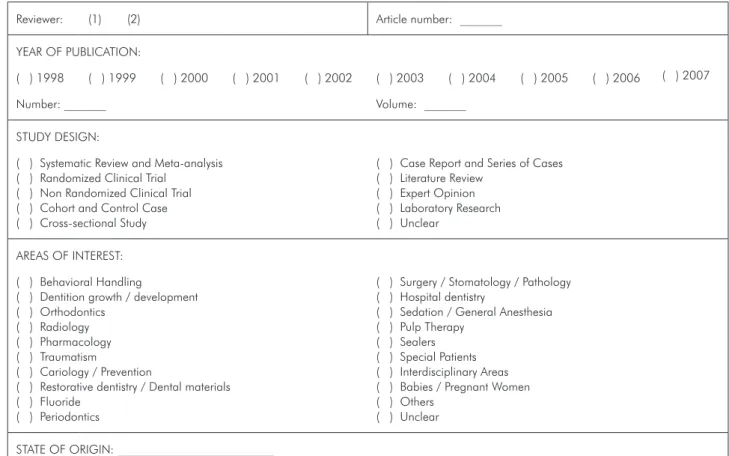
scien-Figure 1 - Data collection form.
Reviewer: (1) (2) Article number: _______
YEAR OF PUBLICATION:
( ) 1998 ( ) 1999 ( ) 2000 ( ) 2001 ( ) 2002 ( ) 2003 ( ) 2004 ( ) 2005 ( ) 2006 ( ) 2007
Number: _______ Volume: _______
STUDY DESIGN:
( ) Systematic Review and Meta-analysis ( ) Randomized Clinical Trial
( ) Non Randomized Clinical Trial ( ) Cohort and Control Case ( ) Cross-sectional Study
( ) Case Report and Series of Cases ( ) Literature Review
( ) Expert Opinion ( ) Laboratory Research ( ) Unclear
AREAS OF INTEREST:
( ) Behavioral Handling
( ) Dentition growth / development ( ) Orthodontics
( ) Radiology ( ) Pharmacology ( ) Traumatism
( ) Cariology / Prevention
( ) Restorative dentistry / Dental materials ( ) Fluoride
( ) Periodontics
( ) Surgery / Stomatology / Pathology ( ) Hospital dentistry
( ) Sedation / General Anesthesia ( ) Pulp Therapy
( ) Sealers ( ) Special Patients ( ) Interdisciplinary Areas ( ) Babies / Pregnant Women ( ) Others
( ) Unclear
STATE OF ORIGIN: __________________________
Table 1 - Frequency of study design types.
Study design (n) (%)
Case Report 188 32.9
Cross-sectional study 170 29.7
Literature Review 129 22.6
Laboratory Research 51 8.9
Randomized Clinical Trial 14 2.4
Non Randomized Clinical Trial 11 1.9
Expert Opinion 8 1.4
Cohort and Case Control 1 0.2
Systematic Review and Meta-Analysis 0 0
tiic research has been made available, which helps disseminate the results obtained.
The valuing of clinical conducts based on evi-dence is no longer considered a matter of philosophy, but the result of the evolution of health sciences and, at the same time, of a decrease in the importance of ancient dogmas,17 because it is in the scientiic
lit-erature that professionals seek relevant studies with methodological quality that provide the answers to their patients’ requests.
The bibliometric assessment of the studies pub-lished in the “Jornal Brasileiro de Odontopediatria e Odontologia do Bebê” showed a predominance of case reports (32.9%), a inding that agrees with the
Table 2 - Frequency of areas of interest.
Areas of Interest (n) (%)
Cariology / Prevention 120 15.3
Restorative Dentistry / Dental materials 85 10.8
Babies / Pregnant women 81 10.3
Growth and development / anomalies / eruptions 70 8.9
Special patients / syndromes 70 8.9
Orthodontics / malocclusion / deleterious habits 67 8.5
Surgery / stomatology / pathology 51 6.5
Behavioral handling / psychology 33 4.2
Dento-alveolar / facial trauma 32 4.1
Interdisciplinary areas 28 3.6
Pulp therapy 25 3.2
Fluoride 20 2.5
Periodontics 20 2.5
Radiology / medical imaging 18 2.3
Pharmacology / pain control / local anesthesia 11 1.4
Others 11 1.4
Health services and education 9 1.2
Child abuse / ill treatment 8 1.0
Sealers 7 0.9
Sedation / general anesthesia / hospital dentistry 5 0.6
Bruxism 4 0.5
Adolescents 4 0.5
Laser 3 0.4
Forensic odontology 3 0.4
Total 785 100.0
Table 3 - Frequency of states.
State (n) (%)
São Paulo 231 40.5
Rio de Janeiro 96 16.8
Minas Gerais 43 7.5
Rio Grande do Sul 39 6.8
Paraná 29 5.1
Pernambuco 24 4.2
Santa Catarina 22 3.9
Paraíba 15 2.6
Bahia 12 2.1
Distrito Federal 10 1.8
Mato Grosso do Sul 9 1.6
Pará 8 1.4
Goiás 6 1.1
Espírito Santo 4 0.7
Maranhão 4 0.7
Mato Grosso 4 0.7
Rio Grande do Norte 4 0.7
Ceará 3 0.5
Piauí 3 0.5
Sergipe 3 0.5
Alagoas 1 0.2
Total 572 100
study conducted by Suehiro et al.14 (2007).
This study design is the most basic descriptive study. It is generally used in the initial evaluation of little known problems, with characteristics that are not well understood. Its main advantages are low cost and ease of performance, but its scope is lim-ited because there is no control mechanism to attest to its eficiency, and because of the subjectivity in-volved in the appreciation of facts.5,15
Cross-sectional studies were found in 29.7% of the articles. No study of systematic review was found. Systematic reviews are strict reviews of spe-ciic clinical issues that summarize the original re-search, and meta-analysis, which consists on the combination of study indings, providing precise and concise estimates on a given topic.15 These data
papers, in accordance with the level of hierarchy of evidence-based dentistry.18
In a similar study, Luz et al.12 (2007) found that
the most published designs were original research and literature review, with only one meta-analysis study.
In 2000, Nainar17 found that 71% of the
publi-cations were descriptive studies and case reports. A percentage of 6% was found for articles of random-ized and controlled clinical trials. According to the same study, the “Pediatric Dentistry” had more lit-erature reviews and in vitro studies compared to the “Journal of Dentistry for Children”.
On the other hand, Oliveira et al.13 (2007), in
their evaluation of the design of the studies published from 1993 to 2003 in the “Journal of Brazilian Den-tistry”, found that 24% of the studies consisted of
in vitro laboratory research, whereas in the present
study laboratory research achieved only 8.9%. In the analysis of the areas of interest, there was a predominance of some topics in the journal evalu-ated by the present study, with cariology being the most researched area, representing 15.3% of the ar-ticles.
Nainar16 (2001) found a signiicant increase in
the number of publications on cariology, including caries diagnosis, etiopathogeny and epidemiology in a study conducted from 1989 to 1998. Most articles reviewed were on restorative dentistry and dental materials. The author noticed an increase in the number of publications on health services and phar-macological control research. Also, a decrease was found in the number of publications on behavior management, dental trauma, dentition growth and development, orthodontics and pulp therapy. In the present study, it was found that the areas of health services and education and behavioral handling to-taled respectively 1.2% and 4.2%.
The second most researched topic was restor-ative dentistry and dental materials, with a total 10.8% share. In a study by Yang et al.10 (2001), who
conducted a bibliometric assessment of the pediatric dentistry literature in Medline, a signiicant increase in the publication of articles on restorative dentistry, with 9% of publications on this topic, was also con-irmed.
Other areas that were found to be widely cov-ered in the present research were related to babies and pregnant women, dentition growth and devel-opment, and special patients, showing new trends in research in the pediatric dentistry ield.
The Brazilian scientiic production has increased signiicantly in the past decades,19 and the State of
São Paulo is the greatest responsible for this growth. Concerning the state of origin of the publications, the indings obtained showed that the State of São Paulo published 40.5% of the articles, corroborat-ing the study by Cavalcanti et al.20 (2004) and
Sue-hiro et al.14 (2007). Luz et al.12 (2007) found that
most articles were published by the states of Rio de Janeiro, São Paulo, Minas Gerais, Rio Grande do Sul and Pernambuco.
This difference in the number of publications from the Brazilian states is due to the disparity be-tween these states concerning the number of gradu-ate programs and master’s and doctorgradu-ate vacancies, and also to the amount of resources allocated to the several support agencies for scientiic research and initiation. The State of São Paulo ranks irst in re-sources allocated (R$ 353.9 million), whereas the State of Rio Grande do Sul is expected to be granted R$ 11.25 million for project development.21
The present study showed the trends in research on pediatric dentistry in Brazil and draws a pic-ture of the knowledge produced. Thus, some areas of interest where little research has been done were identiied, indicating that more research is needed on these topics. Also, it has become clear that sci-entiic studies are not being conducted under very strict conditions and should be improved to ensure that the knowledge produced on dentistry be based on evidence.
Conclusion
It was concluded that most articles refer to stud-ies with low potential to establish scientiic evidence, indicating a need for conducting dental research based on better quality methodology.
been done, indicating a need for more research on these topics.
Furthermore, the present study indentiied a dis-parity between the Brazilian states concerning
proj-ect development and scientiic production, relproj-ecting the lack of governmental incentive and support to scientiic and technological advancement in Brazil.
References
1. Olsen NH. Recent and current research in pedodontics. J Am Dent Assoc. 1959 May;58(5):33-6.
2. American Academy of Pediatric Dentistry. Definition of pe-diatric dentistry. Pediatr Dent. 1999;21(5):4.
3. Loevy HT, Goldberg AF. Dominant research interests of pe-diatric dentists: dental materials, craniofacial biology and cariology. Pediatr Dent. 1995 Sep-Oct; 17(5):375-6. 4. Forrest JL, Miller AS. Enhancing your practice through
evi-dence-based decision making. J Evid Base Dent Pract. 2001; 1(1):51-7.
5. Haynes RB, Sackett DL, Guyatt GH, Tugwell P. Clinical epi-demiology: how to do clinical practice research. Philadelphia: Lippincott Williams & Wilkins, 2006.
6. Mckibbon KA, Wilczynski N, Hayward RS, Walker-Dilks CJ, Haynes RB. The medical literature as a resource for health care practice. J Am Soc Inf Sci. 1995 Dec;46(10):737-42. 7. Kim MY, Lin J, White R, Niederman R. Benchmarking the
endodontic literature on MEDLINE. J Endod. 2001 Jul; 27(7):470-3.
8. Okubo Y. Bibliometric Indicators and analysis of research systems: methods and examples. Paris: OCDE/GD, 1997. 9. Pritchard A. Statistical bibliography or bibliometrics? J Doc.
1969 Dec;25(4):348-9.
10. Yang S, Needleman DMDH, Niederman DMDR. A bibliomet-ric analysis of the pediatbibliomet-ric dental literature in MEDLINE. Pediatr Dent. 2001 Sep-Oct;23(5):415-8.
11. Fabro AT, Yoo HHB, Queluz THAT. Perfil da atividade de pes-quisa publicada nos anais dos congressos brasileiros de pneu-mologia e tisiologia nos últimos vinte anos. J Bras Pneumol. 2006 Jul-Aug; 32(4):309-15.
12. Luz MP, Nascimento AL, Mendlowicz M, Appolinario JC, Fi-gueira I. Jornal Brasileiro de Psiquiatria: um estudo bibliomé-trico dos artigos publicados de 1995 a 2004. J Bras Psiquiatr. 2007;5(1):29-32.
13. Oliveira GJ, Oliveira ES, Leles CR. Tipos de delineamento de pesquisa de estudos publicados em periódicos odontológicos brasileiros. Rev Odonto Ciência. 2007 Jan-Mar; 22(55);42-7. 14. Suehiro ACB, Cunha NB, Oliveira EZ, Pacanaro SV. Produção
científica da Revista Psico-USF de 1996 a 2006. Psico USF. 2007 Jul-Dez;12(2):327-34.
15. Fletcher RH, Fletcher SW. Clinical Epidemiology: the essen-tials. Baltimore: Lippincott Williams & Wilkins, 2005. 16. Nainar SMH. Profile of pediatric dental literature: Thirty-year
time trends (1969-1998). ASDC J Dent Child. 2001;68(5-6):388-90, 303.
17. Nainar SMH. Profile of Journal of Dentistry for Children and Pediatric Dentistry Journal articles by evidence typology: Thirty-year time trends (1969-1998) and implications. Pediatr Dent. 2000 Nov-Dec;22(6):475-8.
18. Susin C, Rösing CK. Praticando odontologia baseada em evi-dência. Canoas: ULBRA, 1999.
19. Haddad AE. Brazilian Oral Research: combining scientific excellence and social impact. Braz Oral Res. 2008 Jul-Sep; 22(3):195-6.
20. Cavalcanti AL, Melo TRNB, Barroso KMA, Souza FEC, Maia AMA, Silva ALO. Perfil da pesquisa científica em odontologia realizada no Brasil. Pesq Bras Odontoped Clin Integr. 2004 May-Aug; 4(2):99-104.