Fillmann LS, Fillmann ÉEP, Fillmann HS, Oliveira JK, Parizotto JFB, Scolaro BL, Lima PCM. Melanoma anorretal: revisão do diagnóstico e tratamento baseado em um relato de caso. J Coloproctol, 2012;32(1): 84-8.
AbstRACt: Anorectal Melanoma is a rare and very aggressive tumor that should be part of the range of differential diagnoses of colorec-tal diseases. Today, the main discussion on the topic is about the best treatment, whether it should be more conservative or more aggressive. In order to review the main points on the subject, the authors report a case of a patient treated at the Coloproctology Service at the São Lucas Hospital, PUCRS.
Keywords: melanoma; neoplasms; anal canal; surgery; neoplasm staging.
Resumo: O melanoma anorretal é uma patologia de baixa frequência, porém de agressividade expressiva, devendo fazer parte da gama de diagnósticos diferenciais do Coloproctologista. A principal discussão sobre o tema versa hoje sobre a melhor forma de tratamento, seja
mais invasivo ou mais conservador. A im de revisar os principais pontos sobre o assunto, relataremos o caso de uma paciente atendida no
Serviço de Coloproctologia do Hospital São Lucas da PUCRS.
Palavras-chave: melanoma; neoplasias; canal anal; cirurgia; estadiamento de neoplasias.
Anorectal melanoma: review of diagnosis and treatment based on a
case report
Lúcio Sarubbi Fillmann1, Érico Ernesto Pretzel Fillmann1, Henrique Sarubbi Fillmann1, Jeferson Krawcyk de Oliveira2, José Francisco Benedetti Parizotto3, Bruno Lorenzo Scolaro3, Patrícia Cardoso Motta Lima3
1Coloproctologist, Service of Coloproctology, Hospital São Lucas da Pontifícia Universidade Católica do Rio Grande do Sul (PUCRS) – Porto Alegre (RS), Brazil; 2General Surgeon, Hospital São Lucas da PUCRS – Porto Alegre (RS), Brazil;
3Former residents, Service of Coloproctology, Hospital São Lucas da PUCRS – Porto Alegre (RS), Brazil.
Study carried out at the Service of Coloproctology at the Hospital São Lucas da PUCRS – Porto Alegre (RS), Brazil. Financing source: none.
Conlict of interest: nothing to declare.
Submitted on: 06/22/2010 Approved on: 10/31/2010
INtRoDuCtIoN
Anorectal melanoma (AM) is a rare malignant tumor of a very aggressive behavior. It represents less than 1% of the anorectal diseases and between 0.4 and 1.6% of melanomas in general1-3. Since the irst case reported by Moore in 1857, around 600 cas -es have been d-escribed2,4. The distribution is similar
in men and women, with a slight preference for fe-males, and the mean age of tumor presentation is in the sixth and seventh decades of life. The disease eti-ology is still uncertain. Common risk factors of cuta-neous melanoma, such as sun exposure, seem to have no relation with the development of AM. The disease
prognosis is guarded, with survival rates in ive years
of around 6%, despite the treatment2. It is related to
the tumor characteristics of fast dissemination and the fact of usually involving late diagnosis, a result of low clinical suspicion. In addition, most patients are suspected of presenting micrometastases at the diagnosis2,5. There is no consensus on the best thera-peutic strategy, although the early diagnosis seems to be the main factor for a successful treatment.
CAse RePoRt
ductal carcinoma – T1N0M0), and she had been
sub-mitted to modiied radical mastectomy (right side) in 2005; treated today with tamoxifen. She complained
of weakness, anorexia and weigh loss – 12 kg in 3 months. She denied any alteration to the bowel hab-it, bleeding on evacuation, pain or anal itching. She brought laboratorial exams that showed hemoglobin of 11.4 g/dL. At the general physical examination, she presented good physical state, with slightly
discol-ored mucosae and no other signiicant alteration. At
the proctologic examination, the anal inspection and rectal touch showed normal conditions. The anosco-py showed internal hemorrhoidal disease and hyper-pigmented papilla at the posterior midline (Figure 1),
measuring around 5 mm. Rectosigmoidoscopy was
not performed due to the high amount of feces. An excisional biopsy of the papilla was performed, whose initial diagnosis was melanocytic lesion with exten-sive pigmentary deposit (Figures 3 and 4). After the immunohistochemical study, which showed mate-rial with extensive proliferative activity, positive for
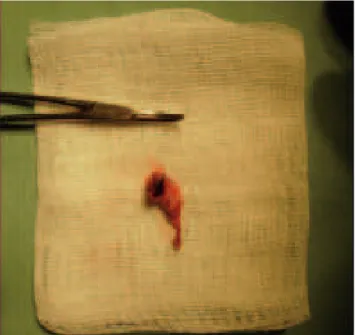
Melan-A, the surgical excision for a deinitive diagno -sis was suggested (Figure 2). In staging exams, com-puted tomography of thorax and abdomen presented normal results. The patient was submitted to wide lo-cal excision, with the diagnosis of invasive malignant melanoma, Breslow 2 mm, and free surgical margins
Figure 1. Hyperpigmented anal papilla at the posterior midline.
Figure 2. Specimen from the surgical excision for a deinitive
diagnosis.
Figure 3. Melanocytic lesion with extensive pigmentary deposit. HE 50x.
as the deinitive anatomopathological result. The his -tological aspect of the lesion, associated with its
which did not present lesion in the anal canal of rec-tum, but the presence of nodular images of 0.6 and
1.5 cm close to the bifurcation of iliac vessels on the
left and pre-sacral region, respectively, which could correspond to grafts with melanin or hemorrhage, as well as bilateral inguinal ganglia, with conglomerates
of 3.7 cm on the left. After that, the patient was sub -mitted to a lymphoscintigraphic analysis, with injec-tions of 99 m Tc-Phytate in the anal region close to the surgical scar. The result was absent sentinel lymph node in the inguinal region and small hyperabsorption of deep aspect in the bladder area, left to the midline,
a inding considered inconclusive. It was decided to
place the patient under observation. She remains un-der outpatient supervision, now asymptomatic, with-out signs of disease progress since she was submitted to the surgery, in November 2009.
DIsCussIoN
Malignant melanoma, a neoplasm of neuroecto-dermal origin, has the skin as its main primary site, although it may appear in other regions, such as retina, oral cavity, genitourinary tract and others4,6-8. It occurs
because the tumor transformation starts with the pre-cursor cells of melanocytes (melanoblasts), which are
present in the most varied types of epithelium, includ-ing the mucous surface4,9. This is the case of the
ano-rectal region, characterized by the diversity of coat-ings. The rectum has a typically glandular epithelium. On the other hand, the anal canal, below the pectineal line, is covered by a squamous epithelium. Right above the pectineal line is the transition zone, where both glandular and squamous cells are present. Mel-anocytes may appear in the three regions (rectum, anal canal and transition zone), although the occurrence of melanoma is more frequent in the transition zone and squamous epithelium1-8.
Most patients do not present symptoms, but, when present, they are: bleeding, pain, pruritus, anal secretion, alteration to bowel habit or bulging sensa-tion4. The association of this clinical presentation with
anorectal benign pathologies can cause confusion and delayed diagnosis. A polypoid lesion can be taken for a hemorrhoidal thrombus1 and 15 to 40% of the lesions
can be amelanotic, which does not contribute to easy detection. Some cases have been reported with
inci-dental indings at the anatomopathological analysis of
post-hemorrhoidectomy and lateral internal
sphinc-terotomy specimens6. The coloproctological
examina-tion with inspecexamina-tion, rectal touch and proctoscopy is extremely important, as it provides data such as size,
consistency, ixation and invasion of sphincter or ad -jacent structures1.
Most tumors have nodular, polypoid and ulcer-ated macroscopic presentation. The histological pat-tern at microscopy is similar to that found in cutane-ous melanoma: melanoma cells larger than normal melanocytes, with large and irregular nuclei, well or poorly clustered into nests. The higher the number of mitoses, the worse the diagnosis. In case of doubt or amelanotic lesions, the immunohistochemical
analy-sis is used: the expression of S-100 and HMB-45 anti
-bodies conirm the diagnosis of melanoma1.
AM can appear in three forms: limited to the primary site, disseminated to regional lymph nodes or with distant metastases. The dissemination can be local or via lymphatic or hematogenic pathways. In lymphatic dissemination, the lymph nodes most com-monly affected are those from the inguinal, obturator, mesenteric and para-aortic chains5,6,8. In hematogenic dissemination, the most frequent sites are: liver, lungs,
brain and bones. Around 40% of the patients may have metastatic disease at the diagnosis1.
The universal classiication of TNM estab -lished by the AJCC (American Joint Committee on Cancer) has been increasingly been used to classify melanomas4,10-12. The presence of ulceration, the
mi-totic index and Breslow index are used in the staging and evaluation of tumor (T) extension, classifying the tumor at different levels, according to the lesion depth (Box 1). The tumor thickness seems to be the most important predictive factor for recurrence1.
Imaging exams complement the diagnostic in-vestigation. Endoanal ultrasound, when available, may help in the surgical planning, as it evaluates the lesion extension, structures invaded and the level of sphincter involvement, as well as the chain of region-al lymph nodes2,4. Magnetic resonance imaging of
the pelvis enables to study the involvement of lymph nodes and the local extension of the disease4,13,14.
Computed tomography of abdomen and thorax is used to detect the organs most affected by distance metastases: liver and lungs.
The sentinel lymph node analysis, although not standardized, is feasible and can prevent unneces-sary ganglion emptying. It can also prevent substag-ing of those patients who are clinically node-negative, but that, at the specimen analysis, are pathologically node-positive2.
After staging, the most dificult part is performed:
the selection of the best therapeutic strategy. Many comparative studies have been conducted to establish a standardized treatment, but, due to the low incidence of an aggressive behavior of AM, no consensus has been reached in the literature.
The surgical treatment with curative intent should be proposed, considering the disease stage and the clinical conditions of each patient1. Most
fre-quent approaches include: Abdominoperineal Ampu-tation (APA) and Wide Local Excision (WLE). For a long time, the APA was considered the standard therapy, but several studies have demonstrated no
sig-niicant difference in survival when comparing it to
more conservative approaches (APA versus WLE) 1-8,15. Such evidence is supported by the fact that the
recurrence is almost always systemic, regardless of the initial surgical approach, reinforcing the idea that a high number of patients already presented the
mi-crometastatic disease at the initial diagnosis2. Local
recurrence is usually associated with the presence of metastasis in lymph nodes1-8. After reviewing some
cases, Homsi et al. concluded that, when technically viable, WLE should be the initial treatment of choice for patients without evidence of metastasis5. APA should be performed in case of larger tumors, recur-rences, disease with locoregional invasion or when a good local control is required. Weyandt et al.6,12,16
pro-posed a scheme in which the surgical approach is se-lected according to the tumor thickness, the Breslow Index6 (Table 1). Prophylactic inguinal emptying has
no indication and involves high morbidity1,4. Lymph
node emptying should be performed only if the lymph nodes are clinically affected and when a complete re-section (R0) is possible1.
Melanomas are characteristically radioresistant, but radiotherapy can be used in the palliative treat-ment for a better locoregional control. Chemotherapy can be applied as neoadjuvant or adjuvant therapy1-8.
Most common drugs are cisplatin, vinblastine, dacar-bazine, interferon and interleukin-2. Although increas-ingly used, therapies with immunostimulants such as interferon, vaccines and monoclonal antibodies have not shown high gains in survival4,17.
Despite the treatment options and attempts, the
prognosis remains guarded, with survival rates in ive years as low as 6% and mean survival of 25 months1-8,9,
regardless of the treatment type18,19. It shows an
intrinsi-cally aggressive and rapidly fatal disease, resulting in a limited number of cases with successful therapy.
<1 mm 1–2 mm 2.1–4 mm >4 mm
Box 1. Breslow Index, according to the American Joint
Committee on Cancer11.
LesIoN
tHICKNess tYPe oF suRGeRY
Breslow <1 mm WLE with preserved sphincter
and margins of 1 cm.
Breslow of 1–4 mm WLE with preserved sphincter and margins of 1 cm.
Breslow >4 mm APA or neoadjuvant therapy
followed by WLE if viable. Table 1. Surgical treatment according to Weyandt et al6,16.
ReFeReNCes
1. Duport C, Tiffet O, Perrot JL, Prévot N, Rey Y, Cambazard F. [Sentinel node mapping in anorectal melanoma]. Ann Chir
2006;131(9):550-2.
2. Olsha O, Mintz A, Gimon Z, Gold Deutch R, Rabin L, Halevy A, et al. Anal melanoma in the era of sentinel lymph node mapping: a diagnostic and therapeutic challenge. Tech
Coloproctol 2005;9(1):60-62.
3. Stoidis CN, Spyropoulos BG, Misiakos EP, Fountzilas CK, Paraskeva PP, Fotiadis CI. Diffuse anorectal melanoma; review of the current diagnostic and treatment aspects based
on a case report. World J Surg Oncol 2009;7:64.
4. Mariolis-Sapsakos T, Malamitsi J, Yakoumakis E, Orfanos F. Is sentinel node mapping useful in anorectal melanoma? Hell J Nucl Med 2008;11(1):39-42.
5. Homsi J, Garrett C. Melanoma of the anal canal: a case series. Dis Colon Rectum 2007;50(7):1004-10.
6. van’t Riet M, Giard RW, de Wilt JHW, Vles W. Melanoma of the anus disguised as hemorrhoids: surgical management
illustrated by a case report. Dig Dis Sci 2007;52(7):1745-7. 7. Hossne RS, Prado RG, Neto AB, Junior ED, Ferrari A.
Melanoma anorretal: relato de 2 casos e revisão da literatura.
Rev bras Coloproct 2007;27(3):317-21.
8. Annam V, Panduranga C, Kodandaswamy CR. Primary anorectal malignant melanoma – a case report and review of literature. J Gastrointest Canc 2008;39(1-4):1-3.
9. Wanebo HJ, Woodruff JM, Farr GH, Quan SH. Anorectal
melanoma. Cancer 1981;47(7):1891-900.
10. Brasil. Ministério da Saúde. INCA – Instituto Nacional do Câncer. Available from: www.inca.gov.br
11. AJCC – American Joint Committee on Cancer. Available from: www. cancerstaging.org
12. Towsend Jr. CM, Beuchamp RD, Evers BM, Mattox KL.
Sabiston textbook of surgery: the biological basis of modern surgical practice. Section V. Surgical Oncology. Chapter 30: Melanoma and Cutaneous Malignacies. 18th ed. Philadelphia:
Saunders-Elsevier; 2008. p. 767-79.
13. Ries LAG, Hankey BF, Miller BA, Hartman AM, Edwards
BK. Cancer statistics reviews 1973-88. Bethesda: National Cancer Institute; 1991. (NIH Publication nº 91-2789).
14. Tomicic J, Wanebo HJ. Mucosal melanomas. Surg Clin North
Am 2003;83(2):237-52.
15. Ishizone S, Koide N, Karasawa F, Akita N, Muranaka
F, Uhara H, Miyagawa S. Surgical treatment for anorectal malignant melanoma: report of five cases
and review of 79 Japanese cases. Int J Colorectal Dis 2008;23(12):1257-62.
16. Weyandt GH, Eggert AO, Houf M, Faulf F, Bröcker EB, Becker JC. Anoretal melanoma: surgical management guidelines according to tumour thickness. Br J Cancer 2003;89(11):2019-22.
17. Kim B, Sanguino AM, Hodges C, Papadopoulos NE,
Eton O, Camacho LH, et al. Biochemotherapy in patients with metastatic anorectal mucosal melanoma. Cancer
2004;100(7):1478-83.
18. Breslow A. Thickness, cross-sectional areas and depth of invasion in the prognosis of cutaneous melanoma. Ann Surg
1970;172(5):902-8.
19. Ross M, Pezzi C, Pezzi T, Hickey R, Balch C. Patterns of failure in anorectal melanoma. A guide to surgical therapy.
Arch Surgery 1990;125(3):313-6.
Correspondence to:
Patrícia Cardoso Motta Lima
Av. Protásio Alves, 7355, 904, Bloco 4
CEP: 91310-003 – Porto Alegre (RS), Brazil E-mail: [email protected]
CoNCLusIoN
AM is a rare and challenging pathology. The fast tu-mor dissemination associated with late diagnosis results in a dismal prognosis, with low cure rates and disease control. So far, the evidences are not enough to establish