Causes of hospitalization in the
National Healthcare System of
children aged zero to four in
Brazil
Beatriz Rosana Gonçalves de Oliveira
ICláudia Silveira Viera
INeusa Collet
IIRegina Aparecida Garcia de Lima
IIIIInstituição: Universidade Estadual do Oeste do Paraná - UNIOESTE.
II Universidade Federal da Paraíba – UFPB.
III Escola de Enfermagem de Ribeirão Preto da Universidade de São Paulo
- EERP/USP/Centro Colaborador da Organização Mundial da Saúde para o Desenvolvimento da Pesquisa em Enfermagem.
Correspondência: Beatriz Rosana Gonçalves de Oliveira.Rua Mato Grosso, 1637, apto. 1401, Cas-cavel, PR CEP: 85812-020. E-mail: [email protected]
Abstract
Introduction: Examining the causes of hospitalization of children improves the comprehension of the sickness proile and in the elaboration of health care planning requirements to prevent the worsening of disease, avoiding intaken hospitalization. Aim: Identifying on the oficial databases the truly causes of hospitalization amongst children aged zero to four as a matter of having a better understanding of which illnesses have been responsible for their intaken hospitalization in Brazil. Method: Quantitative, descriptive, exploratory and inferring approaching research, whose databases had been, collected together the National Health System Data (DATASUS), in the period between the years of 1998 to 2007. The databases have been transcript to tables, quantitatively organized, analyzed in a descriptive and inferring statistic way. Results have been indicating heterogeneous morbidity distribution within the regions of the country, prevailing as the number one cause of intaken hospitalization of children aged from zero to four, the ailments of the respiratory system followed after by human parasites infectious diseases. Conclusion: The considered databases allow a relection on how health services can organize them-selves in order to implement fully health attention to the outlined group-age of zero-to-four-child, focusing on the primary care, prioritizing the prevention of respira-tory acute distresses and human parasite infectious diseases, once these two groups are considered featuring-part of illnesses whose account are given due to ambulatory care sensitive causes and, may be restrained and/or minimized by the action-taking in the prime care.
Introduction
The Brazilian Public Health System (SUS) is characterized by the hierarchy; in which primary health care corresponds to the basic procedures that promoting of the health status for a given population, and the higher levels of health care are compounds by the ambulatory and hospital care of me-dium and high complexity1. The primary health care, relates to a set of diagnoses that could prevent intaken Hospitalization by appropriate health care. In other words, primary care sensitive conditions are health problems attended by the actions of the first level of care2. These hospitalization causes, should be avoided through timely and effective primary care. The focus of this study is to analyze the children hospitaliza-tions, in order to identify them by sensitive conditions to ambulatory care, from the primary health care model as widespread in the country.
Studying the hospitalization causes among children aged zero to four in Brazil, help us to understand the sickness proile in this age group and drawing up plans for health care to prevent the disease worsening so that hospitalizations are avoided. The idea is that the solvability of the primary health care should be relected in the in-taken Hospitalization decrease by a group of speciic causes. The intaken hospital for primary care causes are an indirect indica-tor of health system effectiveness, in that instance, assuming that hospitalizations resulting from these diseases that did not receive timely and effective health care, lea-ding to a worsening of clinical condition that required the hospitalization3. The indicator was created in the United States, during the 1990s, under the name of Ambulatory Care sensible; to assess the impact of inadequate access to primary care services4-6.
Preventable causes, according to the classiication proposed by São Paulo’s State System for Data Analysis (SEADE Founda-tion) are categorized as follows: reducible causes by immuno-prevention, for adequa-te pregnancy control, for proper birth care,
for prevention actions, early diagnosis and treatment and through partnerships with other sectors7.
In this study, we work with a grouping of data causes given by the National Health System Data (DATASUS), which can be clas-siied as reducible by prevention actions, early diagnosis and treatment, diseases for which treatments exist, even if they are hi-ghly complex procedures and whose failure in any of these steps can lead to intaken hospitalization. They are: infectious and parasitic diseases, endocrine glands and metabolism diseases, nervous system and sense organs diseases, circulatory, respira-tory, perinatal diseases and external causes8. The number of intaken hospitalizations is conceptualized as the average number of hospitalizations paid by the Public Health System (SUS) into groups with related cau-ses, considering the population of residents in a certain geographical area and a speciic period of time9.
This indicator allows analyzing popula-tion, geographical and temporal variations in proportion distributions of intaken hos-pitalizations for different causes, identifying unequal situations and trends that require action and speciic studies. The indicator can also contribute to conduct comparative analysis of hospital medical resources con-centration, as well as, subsidize planning processes, management and evaluation of public policies directed to hospital medical assistance9.
by the hospitalizations cumulative count of the same patient, same cause and analyzed period; the information system used, may not detect inconsistencies in the classiica-tion cause of morbidity reported9.
Using children hospitalization, only when a particular disease cannot be treated at the primary health care, should be the he-alth teams’ purpose in various departments according to numerous studies10-15 already made pointing out the consequences of children hospitalization.
Thus, this article aims to identify, in Bra-zil, the causes of hospitalization of children aged zero to four years old, during the years of 1998 to 2007, through oficial DATASUS data.
Method
Quantitative research approach, des-criptive, exploratory and inferential whose data were collected from the DATASUS we-bsite, through a form previously elaborated. The Data were obtained directly from the Ministry of Health website (www2.data-sus.gov.br/DATASUS/índex.php?area=02), choosing the item relating to health infor-mation, health indicators, basic data - 2008 and then indicators of morbidity and risk factors. The hospitalizations proportion (SUS) by causes groups, was the indicator chosen to obtain data, by region, for all cases groups, annually, during the period of ten years being the last available year 2007, comprising the study period from 1998 to 2007.
The Data were divided by age into two speciic groupings, children under 1 year old and children from 1 to 4 years old, sin-ce the age of children under ive years old, which we set out to analyze, has its data is in the DATASUS system dispose this way, separated into two age groups. However, we performed the grouping of the two age groups for data analysis.
The data were transcribed into tables, organized quantitatively and analyzed using descriptive statistics by constructing average tables, standard deviation and of
inferential statistics, t-student test to com-pare average of two independent samples, variance analysis to compare more than two samples and Pearson’s correlation, conside-ring in all 5% signiicance.
The group causes are presented in ac-cordance with the classiication given by the Hospital Information System of SUS (SIH), DATASUS16, as follows: infectious and parasitic diseases, neoplasias, mental and behavioral disorders, respiratory, digestive and genitourinary diseases, pregnancy, birth and puerperium, external causes and some others. Despite contrary opinions about this grouping, it was adopted inas-much as it is the way the Ministry of Health provides data for health statistics analysis and knowledge in Brazil.
The tables were constructed with refe-rence to the diseases grouping established in the site data provision, excluding those groupings for which the mentioned indexes were less or equal to 1%, neoplasias/cancer (1%) mental and behavioral disorders (0%), circulatory diseases (0.4%), pregnancy, childbirth and puerperium (0%). Was also excluded from the analysis, the other causes group with an average incidence percentage of 25.8% during the period, since it compri-ses a large variety of diagnocompri-ses, with small involvement percentages, which together represent this group of causes.
The data presented in this study are se-condary and are part of the doctoral resear-ch project entitled “Case-resolving capacity of health care services for children under five years with complaints of preventable diseases”, approved by the Ethics Committee in Research UNIOESTE, under the opinion #245/2009-CEP.
Results
Tabela 1 - Comparison of the hospitalizations (SUS) average proportion between the Brazilian regions, children 0-4 years by groups of diseases in the period 1998 to 2007 - Brazil, 2009.
Group of diseases Regions
North Nordeste South East South Central-West p-value
infecto-parasitic 31.7±1.7a 28.7±1.6b 15.1±1.1cd 15.5±1.2de 20.1±2.4f <0.0001
respiratory 37.7±2.7a 38.4±1.9a 40.2±1.3ac 44.2±3.7bc 42.7±1.4c <0.0001
digestive 5.8 ±0.5a 4.4±0.4ab 5.8±0.5a 6.6±1.3a 6.7 ±2.2ac 0,001
external causes 2.2±0.2a 1.8±0.1b 3.4±0.1c 2.8±0.2d 2.4±0.1a 0.00*
genitourinary 2.1 ±0.1a 1.8±0.2a 2.8±0.4b 2.1±0.2a 2.1±0.3a <0.0001
Source: Department of Health/SE/Datasus(National Health System) – Hospitals Information System of The National Health System (SUS) – SIH/ SUS 2009
Note: The letters correspond to the result of the Tukey test, which means that different letters indicate a statistically signiicant difference to the 5% level of
signii-cance.
Tabela 2 - Comparison of the intaken hospitalization average proportion with the NATIONAL HEALTH SYSTEM (SUS) amongst 0-to-4-year-old-children gender and group of disease, from 1998 through 2007, Brazil, 2009.
Group of diseases Male Female p-value
Infecto-parasitic 21,1±1,2 22,2±1,3 0,06
Respiratory 40,5±1,3 40,0±1,4 0,41
Digestive 6,3±0,7 4,6±0,7 0,00*
Genitourinary 2,5±0,3 2,0±0,3 0,00*
External causes 2,7±0,2 2,3±0,1 0,00*
*Signiicant at the level of 5%
of hospitalizations, infectious and parasitic diseases (21.6%) as the second leading cause of intaken hospitalization, digestive diseas-es (5.5%) ranks as the third cause, external causes (2.5%) as fourth in the events that lead to children hospitalization and genito-urinary diseases (2.2%), being the ifth and inal grouping of diseases. This comparison was performed by variance analysis through Tukey’s range test with 5% signiicance level. In all diseases groupings were obtained statistically signiicant difference.
For infectious and parasitic diseases the intake hospitalizations average in Northern and Northeast Region are higher than in the other regions. The lowest average obtained was from the Southeast Region.
For respiratory diseases, the average hospitalization in Northern and Northeast Region are lower than in the others, with the highest average in the Southern Region, followed by the Central-west and the lowest average was for the Northern Region.
Considering the digestive diseases, was found significant difference between the Northern regions, with the lowest average and Central-West Region, with the highest average.
Comparing the external causes by region it appears that only the Northern and Central-West ones can be considered statistically identical, therefore all others show differences, with a greater proportion in the Southeast Region.
Comparing the average number of hos-pitalizations related to genitourinary system disease, was found that only the Southeast Region showed signiicant differences, with an higher average than the others.
Still analyzing Table 1, now considered by regions, was found that the respiratory disease groups has most involvement as hospitalization cause, followed by the in-fectious and parasitic disease groups, to all regions.
statistically signiicant differences (p<0.05) were found for both the digestive and ge-nitourinary disease groups, of which both were higher in males.
Analyzing the hospitalizations study group in relation to other age groups (5-9, 10-19, 20-29, 30-39, 40-49, 50-59, 60-69 and 70 years or up), in table 3, statistically signi-icant difference were noted for all disease groups, in which the hospitalizations ave-rage, during the study period, were higher for children up to 4 years in the respiratory, infectious and parasitic disease groups and external causes and lower for the digestive and genitourinary tract disease groups.
Through the ratio of hospitalizations in the infecto-parasitic disease group be-tween children ages 0 to 4 years old and other age groups, we found that for every 3 children who were hospitalized, one adult is hospitalized for the same group of causes. For the respiratory diseases group the ratio obtained was 2.9, similar to the previous
group. Unlike the prevalent diseases of the digestive and genitourinary group wherein the ratio obtained was reverse, respectively 0.6 and 0.3, indicating that for each child over four years old, who are intake in the hospital, 0.6 0.3 Children from 0 to 4 years are hospitalized.
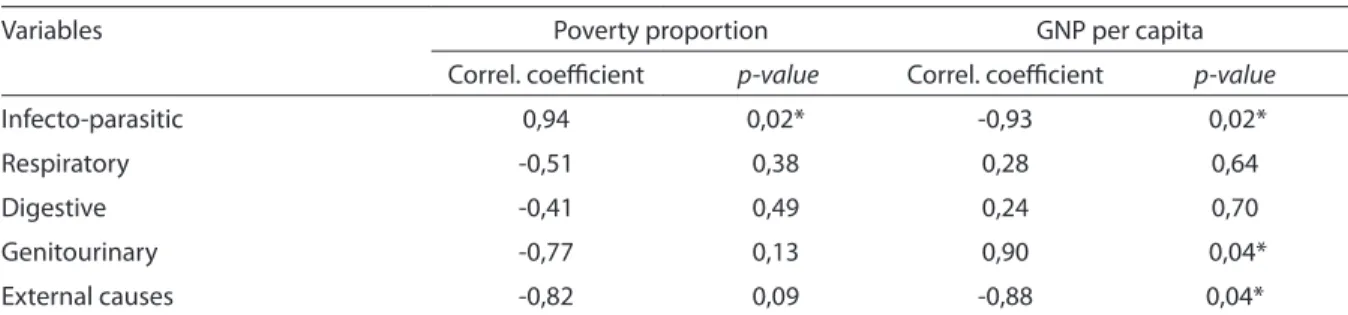
Observing Table 4, there is a signiicant correlation between the proportion of poor people and infectious disease groups and external causes. However, the correlation between the proportion of poor people and infecto-parasitic diseases is positive, which indicates that the higher the average number of hospitalizations, for this cause, the greater the proportion of poor people, whereas the correlation between the pro-portion of poor people and external causes is reversed, in other words, the higher the average intaken hospitalizations number, the lower is the proportion of poor people.
There is also a signiicant correlation between the Gross National Product (GNP)
Tabela 3 - Comparison of the hospitalization average proportion with the NATIONAL HEALTH SYSTEM (SUS) amongst 0-to-4-year-old-children and other, for groups of disease, in the period of 1998 through 2007, Brazil, 2009.
Group of Disease 4 years old or
younger
Older than 4 pvalue
Infecto-parasitic 21,6±1,2 7,3±0,7 0,00*
Respiratory 40,3±1,3 13,9±1,4 0,00*
Digestive 5,5±0,7 9,7±0,3 0,00*
Genitourinary 2,4±0,2 9,7±0,3 0,00*
External Causes 2,6±0,1 8,0±2,1 0,00*
*Signiicant to the level of 5%
Tabela 4 - Correlation amongst Gross National Product apiece and the proportion of poverty, for groups of disease, according economic and social indicators for regions, at the period of the study, Brazil, 2009.
Variables Poverty proportion GNP per capita
Correl. coeicient p-value Correl. coeicient p-value
Infecto-parasitic 0,94 0,02* -0,93 0,02*
Respiratory -0,51 0,38 0,28 0,64
Digestive -0,41 0,49 0,24 0,70
Genitourinary -0,77 0,13 0,90 0,04*
External causes -0,82 0,09 -0,88 0,04*
per capita (PPP) the genitourinary system and infecto-parasitic disease groups and external causes. However, the correlation between GNP per capita and infectious di-seases is negative, which indicates that the higher the average numbers of those hos-pitalizations, the lower the GNP per capita. The correlation between GNP per capita, genitourinary tract diseases and external causes is positive, in other words, the higher the average numbers of hospitalizations for these two reasons, higher the GNP per capita.
Discussion
It is relevant to note that the information analysis generated through secondary data, must be viewed with caution, mainly the data produced from various levels of the health system, whose limitations, from the origin to the processing, should be taken into consideration. We know that there were improvements much of in the quality of the information generated, as in the geographic coverage expansion. Meanwhile, the under-reporting problem persists. Nevertheless, we chose the oficial data systems to work with, because of its easiness of access and the availability to everyone, anytime, for who wants to contribute to the discussion presented in this study.
Another aspect to consider as metho-dology limitation, concerns the conceptu-alization of avoidable diseases, since there is variability in the literature list of diseases with different views on the thematic, re-lecting the dificulty of consensus. In these studies, various indicators are adopted by diverse local realities.
The morbidity pattern, the health care demand behavior, the lifestyle, socioeco-nomic conditions, the access of outpa-tient resources and the constitution of care networks in each region of the country, also affect the results. Within ten years, a tempo-ral analysis, was not presented, however a trend towards proportions stability, in the period, was noted, with small oscillations during the studied period, regarding the
proportion of occurrence, however without inversion of the morbidity causes which remained throughout this time.
Therewith regarding morbidity, the results indicate the respiratory diseases as the irst cause of hospitalization in children aged from zero to four years old, followed by infecto-parasitic diseases, in the country as a whole. However, was noticed a predo-minance of the latter causes group, in the North and Northeast region and a minor proportion in the Southeast region, conside-red more developed. Unlike, for respiratory diseases, notes predominated in the South and Central-West Region and minor pro-portion in the Northern region, suffering climatic inluence and regional disparities, regarding access to health services and health professionals, as living conditions.
The digestive diseases group affected more the Central-West Region and had less impact on Northeast region. For genitouri-nary system diseases, the Southeast region exceed, as well as external causes.
Gender does not inluence the causes groups involvement, unless in the gastroin-testinal and genitourinary diseases, where the boys were prevalent, unlike the research on infant mortality from preventable causes, which indicate a male overjet for all causes groups.
In correlation with all SUS hospital intaken, children are hospitalized the most due respiratory, infecto-parasitic diseases and external causes compared to other age groups and less from gastrointestinal and genitourinary diseases, what highlighting children organic fragility, which requires specific actions to prevent injuries like these.
hospitalization cause, and among them the pneumonia.
Was conducted, in 1994, a study18 about hospitalizations for preventable causes in children aged one to four years old in the Northeast region, found a hospitalization rate of 24.4%, mostly pneumonia (7.3%). According the research authors, the majority of hospitalizations occurred from preventa-ble causes or sensitive to ambulatory care. In studies19-20 conducted in Spain, to vali-date the causes of hospital intakes sensitive to primary care and measure the primary health effectiveness, the results pointed to the association rates of hospitalizations for these diseases with the characteristics of the primary care organization, municipality size and referral hospitals distance. It was found that 8.42% of those admissions were categorized as sensitive to primary care, the-se 15% were pneumonia and 6.4% urinary tract infections, for the ordinary population.
Another study21 held in a renowned hospital institute in the Northeast region of Brazil, focused on avoidable infant mor-tality, showed that proportional mormor-tality, according to underlying causes, was found as the third cause, 16.8%, and intestinal in-fectious diseases, with mortality coeficient of 26 per thousand hospitalizations.
In research22 on infant mortality and avoidability in Mato Grosso do Sul, Brazil, was found a predominance in males, for causes groups such as: infecto-parasitic diseases (9.4%), respiratory diseases (8.7%), predominantly for children under one year old. Analyzing the child mortality causes by avoidability parameter, was found that deaths avoidable through appropriate actions of early diagnosis and treatment corresponded to 10.4%, and through actions to promote health, linked to appropriate actions care were responsible for 11.2%, with a predominance of deaths from pneu-monia and intestinal infectious diseases and nutritional deiciencies,About the external causes, with proportional involvement average around 2% in our study, research23 conducted in Paraná, evaluating morbidity and mortality from external causes in
chil-dren under ifteen years old, showed that morbidity was 4.1% higher than we pre-viously found, with falls and car accidents as mainly responsible for hospitalizations.
Evaluating primary health care and hospitalizations for sensitive conditions to ambulatory care in Minas Gerais muni-cipalities, the authors1 found major male vulnerability to potentially preventable hospitalizations and greater probability of these hospitalizations causes in children under five years old, reflecting the child fragility and suggesting priority groups for the primary health care actions.
The analysis of the causes of morbidity in children shows that diarrheal and respi-ratory diseases remain serious problems and, when accompanied by malnutrition, endanger their lives24. Respiratory diseases, also, are the irst cause of outpatient consul-tations in emergency rooms and outpatient clinics, demanding qualiied attention from the health staff, with continuity until the problems complete resolved. Intestinal parasites follow with signiicant prevalence and along with diarrheal diseases interfere with the children proper development25.
The study26 on the relationship between causes of avoidable death with adequate health care and the SUS implementation, showed that for grouping of preventable causes by early diagnosis and treatment, the major risk in the irst period of study indi-cate that the health system reorganization, prioritizing primary care, may have passed on the incidence, and acting on its reduc-tion, reason why studying these indicators can be important to redirect health actions.
References
1. Oliveira AC, Simões RF, Andrade MV. A relação entre a atenção primária em saúde e as internações por condições sensíveis à atenção ambulatorial nos municípios mineiros. Disponível em: <http.www.anpec. org.br/encontro2007/artigos/AO7A048.pdf>. Acesso em: jan. 2009.
2. Nedel FB, Facchini LA, Martín-Mateo M, Vieira LAS, Thumé E. Programa saúde da família e condições sensíveis à atenção primária, Bagé (RS). Rev. Saúde Pública 2008; 42: 1041-52.
3. Caminal HJ, Casanova MC. La evaluación de la atención primaria y las hospitalizaciones por ambulatory care sensitive conditions. Marco conceptual. Aten. Primaria 2003; 31:61-5.
4. Caminal HJ, Starield B, Sánchez RE, Hermosilla PE, Martín-Mateo M. La atencion primaria de salud y lãs hospitalizaciones por ambulatory care sensitive conditions en Cataluña. Rev. Clin. Esp. 2001; 201: 501-7.
5. Starield B. Atenção primária: equilíbrio entre necessidades de saúde, serviços e tecnologia. Brasília: UNESCO, Ministério da Saúde; 2002
6. Bermúdez-Tamayo C, Márquez-Calderón S, Águila MMH, López EPM, Espinosa O. Características organizativas de la atencion primaria y hospitalización por los principales ambulatory care sensitive conditions. Aten. Primaria 2004; 33: 305-11.
7. FUNDAÇÃO SEADE. Fundação Sistema Estadual de Análise de Dados. São Paulo. A mortalidade infantil em São Paulo no primeiro semestre de 1990. Conjuntura Demográica 1991; 14/15: 35-151.
8. Malta DC, Duarte EC. Causas de mortes evitáveis por ações efetivas dos serviços de saúde: uma revisão da literatura. Ciência e Saúde Coletiva 2007; 12: 765-76.
9. REDE Interagencial de Informação para a Saúde - RIPSA. Indicadores básicos para a saúde no Brasil: conceitos e aplicações. 2. ed. Brasília: Organização Pan-Americana da Saúde; 2008.
10. Oliveira H. A enfermidade sob o olhar da criança hospitalizada. Cad. Saúde Pública 1993; 9: 326-332.
11. Lima RAG, Rocha SMM, Scochi CGS. Assistência à criança hospitalizada: relexões acerca da participação dos pais. Rev. Latino-am. Enfermagem 1999; 7: 33-39.
12. Oliveira BRG, Collet N. Criança hospitalizada: percepção das mães sobre o vínculo afetivo criança-família. Rev. Latino-am Enfermagem 1999; 7: 95-102.
13. Bretãs JRS. et al. Contribuições para o cuidado emocional à criança hospitalizada. Acta Paul. Enfermagem 2002; 15: 87-95.
14. Souza SV, Camargo D, Bulgacov YLM. Expressão da emoção por meio do desenho de uma criança hospitalizada. Psicol. Estud. 2003; 8: 101-09.
15. Rossi CS, Rodrigues BMRD. As implicações da hospitalização para a criança, sua família e equipe de enfermagem. Um estudo exploratório descritivo. Online Brazilian Journal of Nursing 2007; 6(3): online.
16. DATASUS. Ministério da Saúde/Secretaria de Atenção à Saúde (SAS): Sistema de Informações Hospitalares do SUS (SIH/SUS). DATASUS; 2009. Acesso em: fevereiro de 2009. Disponível em: <http://w3.datasus.gov.br/ datasus/datasus.php>.
17. Elias E, Magajewski F. A Atenção Primária à Saúde no sul de Santa Catarina. Rev Bras Epidemiol. 2008; 11: 633-47.
18. Silva AAM, Gomes UA, Tonial SR, Silva RA. Fatores de risco para hospitalização de crianças de um a quatro anos em São Luís, Maranhão, Brasil. Cad Saúde Pública 1999; 15: 749-57.
The DATASUS data are available and easily accessible. Thus, we believe that the continuous review of morbidity rates for preventable conditions can be a useful tool to monitor a common group of diseases behavior, detecting (surrogate marker) qua-lity conditions of the primary care network, can also provide information for the health priorities choice.
It is essential that actions in this regard continue to be performed so that it is possi-ble to reduce childhood morbidity from pre-ventable causes in the country. Thus, some challenges must be the guiding public
19. Calderón SM, Rodríguez MM, Milla EP, Ortiz J, Tamayo CB. Factores asociados a La hospitalización por procesos sensibles a cuidados ambulatórios en los municipios. Gac Sanit. 2003; 17: 360-67.
20. Bernúdez-Tamayo C, Márquez-Calderón S, Águila MMR, López EPM, Espinosa O. Características organizativas de la atención primaria y hospitalización por los principales ambulatory care sensitive conditions. Aten Primaria 2004; 33: 305-11.
21. Vidal AS, Frias PG, Barreto FMP, Vanderlei LCM, Felisberto E. Óbitos infantis evitáveis em hospital de referência estadual do nordeste brasileiro. Rev. Bras. Saúde Mater. Infant. 2003; 3: 281-89.
22. Gastaud ALGS, Iloner MR, Cunha RV. Mortalidade infantil e evitabilidade em Mato Grosso do Sul, Brasil, 2000 a 2002. Cad. Saúde Pública 2008; 24: 1631-40.
23. Martins CBG, Andrade SM. Causas externas entre menores de 15 anos em cidade do Sul do Brasil: atendimentos em pronto-socorro, internações e óbitos. Rev. Bras. Epidemiol. 2005; 8: 194-204.
24. Vasconcelos MJOB, Batista Filho M. Doenças diarréicas em menores de cinco anos no Estado de Pernambuco: prevalência e utilização de serviços de saúde. Rev. Bras. Epidemiol. 2008; 11: 128-38.
25. BRASIL. Ministério da Saúde. Secretaria de Atenção à Saúde. Departamento de Ações programáticas Estratégicas. Agenda de compromissos para a saúde integral da criança e redução da mortalidade infantil. Brasília: Ministério da Saúde; 2005.
26. Abreu DMX, César CC, França EB. Relação entre as causas de morte evitáveis por atenção à saúde e a implementação do Sistema Único de Saúde no Brasil. Rev. Panam Salud Publica 2007; 21: 282-91.