Preterm Preeclampsia and Timing of Delivery:
A Systematic Literature Review
Pré-eclâmpsia pré-termo e o melhor momento para a
resolução da gestação: revisão sistemática da literatura
José Paulo de Siqueira Guida
1Fernanda Garanhani Surita
1Mary Angela Parpinelli
1Maria Laura Costa
11Department of Obstetrics and Gynecology, Faculdade de Ciências
Médicas, Universidade Estadual de Campinas (UNICAMP), Campinas, SP, Brazil
Rev Bras Ginecol Obstet 2017;39:622–631.
Address for correspondence Maria Laura Costa, Rua Alexander Fleming, 101, 13083-881, Campinas, SP, Brazil
(e-mail: [email protected]).
Keywords
►
preeclampsia
►
delivery
►
prematurity
►
preterm
preeclampsia
Abstract
Introduction
Preeclampsia, a multifactorial disease with pathophysiology not yet
fully understood, is a major cause of maternal and perinatal morbidity and mortality,
especially when preterm. The diagnosis is performed when there is an association
between arterial hypertension and proteinuria or evidence of severity. There are
unanswered questions in the literature considering the timing of delivery once preterm
preeclampsia has been diagnosed, given the risk of developing maternal complications
versus the risk of adverse perinatal outcomes associated with prematurity. The
objective of this systematic review is to determine the best timing of delivery for
women diagnosed with preeclampsia before 37 weeks of gestation.
Methods
Systematic literature review, performed in the PubMed database, using the
terms
preeclampsia
,
parturition
and
timing of delivery
to look for studies conducted
between 2014 and 2017. Studies that compared the maternal and perinatal outcomes
of women who underwent immediate delivery or delayed delivery, in the absence of
evidence of severe preeclampsia, were selected.
Results
A total of 629 studies were initially retrieved. After reading the titles, 78 were
selected, and their abstracts, evaluated; 16 were then evaluated in full and, in the end,
6 studies (2 randomized clinical trials and 4 observational studies) met the inclusion
criteria. The results were presented according to gestational age range (
<
34 weeks
and between 34 and 37 weeks) and by maternal and perinatal outcomes, according to
the timing of delivery, considering immediate delivery or expectant management.
Before 34 weeks, the maternal outcomes were similar, but the perinatal outcomes were
signi
fi
cantly worse when immediate delivery occurred. Between 34 and 37 weeks, the
progression to severe maternal disease was slightly higher among women undergoing
expectant management, however, with better perinatal outcomes.
This revision is part of the Project Series, Guidelines and
Recommendations of the Federação Brasileira das Associações de Ginecologia e Obstetrícia – FEBRASGO, elaborated by the Specialized National Committees in Hypertension in Pregnancy.
received
December 8, 2016 accepted May 18, 2017 published online July 12, 2017
DOI https://doi.org/ 10.1055/s-0037-1604103. ISSN 0100-7203.
Introduction
Hypertensive disorders occur in 2 to 8% of pregnancies,1and
are a major cause of maternal morbidity and mortality, accounting for 25.7% of maternal deaths in Latin America.2
In Brazil, preeclampsia is the leading cause of severe mater-nal morbidity, and its primary complication, eclampsia, is the most prevalent cause of maternal death.3Preeclampsia can
present with various conditions ranging from mild forms of hypertension, sometimes with no need for antihypertensive drugs, to severe forms with possible serious complications, which require intensive care.4
Gestational hypertension is defined as the occurrence of systolic blood pressure levels>140 mm Hg or diastolic
blood pressure>90 mm Hg.5Preeclampsia is traditionally
diagnosed when, associated with gestational hypertension at a gestational age20 weeks, significant proteinuria appears
( 0.3 g in a 24-hour urine test), or there is end organ
damage: renal (serum creatinine>1.1 mg/dL), hepatic
(transaminases>70 U/L, bilirubin>1.2 mg/dL), cerebral
(headache, seizures, posterior reversible encephalopathy syndrome [PRES]), hematologic (thrombocytopenia
<100,000/mm3or lactic dehydrogenase600 U/L), or
pul-monary (pulpul-monary edema, dyspnea not attributable to another cause).6
Although it has been recognized as a disease for over one hundred years, the pathophysiology of preeclampsia is not yet fully understood.7Previous studies have demonstrated
Conclusions
When there is no evidence of severe preeclampsia or impaired fetal
well-being, especially before 34 weeks, the pregnancy should be carefully surveilled, and the
delivery, postponed, aiming at improving the perinatal outcomes. Between 34 and
37 weeks, the decision on the timing of delivery should be shared with the pregnant
woman and her family, after providing information regarding the risks of adverse
outcomes associated with preeclampsia and prematurity.
Resumo
Introdução
A pré-eclâmpsia, doença multifatorial e com
fi
siopatologia ainda não
totalmente estabelecida, é importante causa de morbimortalidade materna e
peri-natal, especialmente quando pré-termo. O diagnóstico é realizado quando há
asso-ciação entre hipertensão arterial e proteinúria ou evidência de gravidade. Existem
questionamentos na literatura se, frente ao diagnóstico de pré-eclâmpsia, a resolução
da gravidez deve ser imediata ou postergada, considerando o risco de desenvolvimento
de complicações maternas
versus
os resultados perinatais associados à prematuridade.
O objetivo desta revisão sistemática é estabelecer o melhor momento de resolução da
gestação em mulheres com pré-eclâmpsia antes das 37 semanas.
Metodologia
Revisão sistemática da literatura, realizada na base de dados PubMed,
usando os termos
preeclampsia parturition
e
timing of delivery
, para encontrar estudos
feitos entre 2014 a 2017. Foram selecionados estudos que comparassem os desfechos
maternos e perinatais de mulheres submetidas a resolução imediata ou a postergação
do parto, na ausência de evidência de pré-eclâmpsia grave.
Resultados
Foram localizados 629 artigos; após leitura dos títulos, 78 foram
sele-cionados. Realizada avaliação dos seus resumos, 16 foram avaliados na integralmente
e,
fi
nalmente, 6 estudos preencheram os requisitos de inclusão (2 ensaios clínicos
randomizados e 4 estudos observacionais). Os resultados foram apresentados
con-forme a faixa de idade gestacional (
34 semanas, e entre 34 e 37 semanas) e a
avaliação dos desfechos maternos e perinatais. Antes das 34 semanas, os resultados
maternos foram semelhantes; entretanto, os desfechos perinatais foram signi
fi
cati-vamente piores quando houve resolução imediata. Entre 34 e 37 semanas, a
pro-gressão para doença materna grave foi discretamente maior entre as mulheres
submetidas a conduta expectante; entretanto, os desfechos perinatais foram melhores
quando o parto foi postergado.
Conclusões
Na ausência de evidências de pré-eclâmpsia grave ou de prejuízo da
vitalidade fetal, o parto deve ser postergado, principalmente antes das 34 semanas,
com vigilância materna e fetal rigorosas. Entre 34 e 37 semanas, a decisão deve ser
compartilhada com a gestante e sua família, após esclarecimento sobre os desfechos
adversos associados à pré-eclâmpsia e prematuridade.
Palavras-Chave
►
pré-eclâmpsia
►
parto
►
prematuridade
histopathological differences between placentas of healthy women and those of women with preeclampsia,8and, for
several decades, it has been understood that the disease is mediated by endothelial dysfunction due to placental mal-perfusion.9 The hypothetical
“two-stage” model suggests that a poorly perfused placenta (stage 1: without clinical symptoms) due to inadequate uterine spiral artery remodel-ing releases antiangiogenic factors into the circulation (stage 2), and this determines the clinical manifestation of pre-eclampsia.10Delivery, and consequent removal of the
pla-centa, is the only effective treatment.7
Modern obstetric practices recommend taking maternal and fetal conditions into account in maternal-fetal care, to ensure the safe monitoring of the pregnancies and achieve the best outcomes for both mothers and newborns. Pre-eclampsia, a disease with a high association with morbidity and mortality,3,11is a classic example of this dichotomous
situation, in which it is sometimes necessary to postpone the delivery to protect maternal health.12Approximately 13% of
cases of preeclampsia develop before 34 weeks of gestation, and 32% develop between 34 and 37 weeks,13 and are
associated with high risk of maternal complications,14 as
well as a high rate of medically-indicated premature births.15–17
While immediate delivery in cases of preeclampsia at over 37 weeks of gestation improves the maternal and perinatal outcomes,18,19 the scienti
fic evidence is still inconclusive regarding the best timing of delivery in the event preterm preeclampsia is diagnosed, due to complications related to prematurity. The goal of the expectant management is to reduce the impact of medically-indicated premature births. However, maternal and fetal surveillance is necessary, and the presence of any serious signs should lead to delivery regardless of the gestational age.18,19
The objective of this review is to provide an update on the available evidence on the best timing of delivery once preterm preeclampsia has been diagnosed.
Methods
A systematic literature review was performed to investigate the best timing of delivery for women who develop pre-eclampsia before a gestational age of 37 weeks. The review considered 3 years, from January 2014 to February 2017, and we used the PubMed database. The Medical Subject Headings selected werepreeclampsia,parturitionandtiming of deliv-ery, combined in the following way: preeclampsia AND (parturition OR timing of delivery). Observational studies and clinical trials were included; systematic reviews, guide-lines and meta-analyses were excluded. The search was limited to studies published in English or Portuguese.
The research protocol for this review was created in accordance with the patient, intervention, comparison and outcome (PICO) strategy.20 For the research protocol, the “patients” were defined as women who developed pre-eclampsia before 37 weeks of gestation;“intervention”was defined as delivery within 24 hours of the diagnosis of preeclampsia; a“comparison”was made in relation to the
expectant management; and the “outcomes” considered were the maternal (progression to severe preeclampsia, eclampsia, hemolysis, elevated liver enzyme levels, and low platelet levels (HELLP) syndrome, other serious maternal morbidities, or maternal death) and fetal (prenatal death, admission to an intensive care unit [ICU], or respiratory disorders) outcomes. The current study followed all recom-mendations of the Preferred Reporting Items for Systematic Reviews and Meta-Analyses (PRISMA) Statement.21
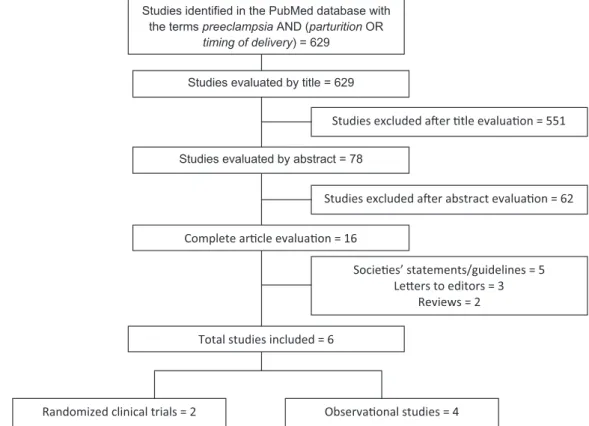
The search identified a total of 629 studies. After an analysis of the titles by 2 independent reviewers, 78 articles were selected. After carefully reading the abstracts of these articles, 16 were selected to be fully read and, afterwards, 6 were included in the analysis of this review, 4 of which were observational studies,13,14,22,23 and 2, clinical trials24,25
(►Fig. 1).
A brief description of each of the studies included is presented in►Table 1. The results are shown according to
the gestational age of preeclampsia onset (before 34 weeks and between 34 and 37 weeks).
Results
Preeclampsia Onset Prior to 34 Weeks
The observational studies showed that women with early-onset preeclampsia had more severe conditions upon devel-oping the disease,13 and were more frequently subject to
serious maternal morbidities such as renal failure, sepsis, the need for a hysterectomy or blood transfusion, and increased risk of maternal death,14with higher cesarean rates (70%).13
When preeclampsia was diagnosed before 30 weeks, there was an association with fetal growth restriction (FGR), and the interval to delivery was shorter.23Progression to severe
preeclampsia occurred in almost half (43%) of the women under expectant management.13
On perinatal outcomes, the observational studies pre-sented a high incidence of FGR,14 leading to lower birth
weights among women with preeclampsia; almost 1/3 (32%) were below the 10th percentile in weight for their gestation-al age. There was gestation-also a high rate of perinatgestation-al mortgestation-ality (80/1,000 live births).13
Onset of Preeclampsia between 34 and 37 Weeks
Among the women who developed preeclampsia between 34 and 37 weeks, the results of the observational studies had a wide range offindings: the progression to severe forms of the disease was as high as 51% and 35%13,23in 2 of the considered
studies, and as low as 5% in the other.22 The association
with the risk of complications, even though significantly lower when compared with the women with early-onset preeclampsia, was only observed in one of the studies evaluated.14 Among the clinical trials, one of them, with
703 women, showed that the option of expectant manage-ment added 5 to 10 days to the gestation, with no significant increase in maternal complications, such as HELLP syn-drome, thromboembolic events, placental abruption, eclampsia and maternal death.24 Another study involving
to other severe forms of the disease among women under expectant management (41% versus 3%).25
Considering the perinatal outcomes, one of the observa-tional studies identified significant weight gain at birth in the comparison between expectant management and imme-diate delivery, as well as a lower need for ICU admission and decreased risk of perinatal death.13One of the clinical trials
indicated similar perinatal outcomes in the two groups,25
while another showed an increased risk of significant neo-natal complications for newborns who were delivered im-mediately compared with cases in which expectant management was adopted.24
Discussion
Women with preterm preeclampsia had a greater risk of medically-indicated premature birth; however, if there were no signs of severe maternal complications or impaired fetal well-being during close surveillance, delaying delivery when preeclampsia is diagnosed before 37 weeks (and especially in cases of early-onset preeclampsia) improved the neonatal outcomes, without major harm to the maternal health.
Previous systematic reviews with a similar scope and different temporal profiles have confirmed the low number of clinical trials that compare expectant management and immediate delivery in relation to the maternal and perina-tal outcomes of preterm preeclampsia.26,27 Conducting
clinical trials for diseases with high morbidity and mortality and low frequency, as is the case of early-onset preeclamp-sia, can be challenging, due to the difficulties in implement-ing inclusion protocols and carryimplement-ing out the studies, in
addition to the ethical issues involved. In this context, it is important to consider the need for further studies, preferably multicenter ones, including various high and low-income settings.
Expectant management is possible for cases of pre-eclampsia when the gestational age at diagnosis is<37
weeks, and the major goal is improving perinatal outcomes, especially reducing neonatal complications; however, the management should be reevaluated if there are signs of progression to severe forms of preeclampsia, or if there is evidence of impaired fetal well-being (►Table 2). The
occur-rence of severe preeclampsia is diagnosed in the presence of any of the following criteria: systolic blood pressure
160 mm Hg; diastolic blood pressure 110 mm Hg,
with no response to treatment after 4 hours; eclampsia (seizures); and persistence, worsening or association of laboratory markers, such as platelet counts<100,000/
mm3, aspartate transaminase (AST)>70 U/L, and creatinine >1.1 mg/dL. Fetal growth restriction, oligohydramnios,
changes in the umbilical artery observed by Doppler assess-ment, and non-reassuring cardiotocography are indications of impaired fetal well-being, and demand surveillance. Clini-cal symptoms such as pulmonary edema and right hypo-chondrium pain not attributable to other causes, or brain disorders, such as headaches, and visual disorders (scotomas, obnubilation) are also considered reasons for interrupting the expectant management. In the absence of such clinical signs or laboratory or ultrasound findings, the delivery should reach term (37 weeks).18
Early-onset preeclampsia, before 34 weeks, occurs less frequently than the late-onset (after 37 weeks) form of the Studies identified in the PubMed database with
the terms preeclampsia AND (parturition OR
timing of delivery) = 629
Studies excluded aer tle evaluaon = 551 Studies evaluated by title = 629
Studies evaluated by abstract = 78
Total studies included = 6
Randomized clinical trials = 2 Observaonal studies = 4
Studies excluded aer abstract evaluaon = 62
Complete arcle evaluaon = 16
Sociees’ statements/guidelines = 5 Leers to editors = 3
Reviews = 2
Table 1 Studies included in this systematic review, with presentation of the type of study, number of participants and main findings
Authors, year, country
Type of study
Partic. Main findings
Owens et al, 2014, USA25
RCT 183 Expectant management: 75 cases; immediate delivery: 94 cases.
Progression to severe preeclampsia: 41% versus 3% (expectant management versus immediate delivery: significant difference).
Most common diagnostic criterion of severe preeclampsia: severe hypertension (>160110 mm Hg).
Newborn with weight below the 10th percentile: 15% versus 20% (expectant management versus immediate delivery: no significant difference).
Admission to neonatal ICU: 19% versus 21% (expectant management versus immediate delivery: no significant difference).
Respiratory distress syndrome: 8% versus 12% (expectant management versus immediate delivery: no significant difference).
Broekhuijsen et al, 2015, Holland24
RCT 703 Expectant management: 351 cases; immediate delivery: 352 cases.
Occurrence of maternal complications: 3.1% versus 1.1% (expectant management versus immediate delivery: no significant difference). HELLP syndrome: 2% versus 1% (expectant management versus immediate delivery: no significant difference).
Occurrence of perinatal complications: 1.7% versus 5.7% (expectant management versus immediate delivery: significant difference; relative risk: 3.3).
Admission to neonatal ICU: 3.7% versus 7.4% (expectant management versus immediate delivery: significant difference; relative risk: 2.0).
Transient tachypnea: 1.7% versus 5.7% (expectant management versus immediate delivery: significant difference; relative risk: 3.3).
Lisonkova et al., 2014, USA14
RO 670,120 Increased incidence of preeclampsia in the studied period (2000 to 2008),
from 2.9% to 3.1%. Early-onset preeclampsia¼0.3%, and late-onset¼2.7%, with a 4.5% increase in the incidence of early-onset preeclampsia.
The maternal mortality ratebamong women with early-onset preeclampsia was 4 times higher than for those with with late-onset (42.1 versus 11.2). Severe maternal morbiditycwas higher among women with early-onset preeclampsia (12.2 versus 5.5).
Increased risk of cardiovascular, respiratory, neurological, kidney and liver complications among women with early-onset compared with late-onset preeclampsia.
Pettit et al, 2015, Australia13
RO 696 Early; late; term.
Incidence: 13%; 32%; 55%.
Cesarean section rate: 70%; 55%; 44%. Severe hypertension: 43%; 35%; 31%. Fetal growth restriction: 32%; 18%; 15%. Perinatal mortality:a80, 10, 5
Helou et al, 2016, Australia22
RO 516 Incidence of preeclampsia: 3.5%.
Mean gestational age at delivery among women with preeclampsia: 36 weeks. Fetal growth restriction: 21.7%
Admission to neonatal ICU: 28.5%
In 77% of the cases of late-onset preeclampsia, the women underwent expectant management, with progression to severe preeclampsia in 5.2% of the cases.
McKinney et al, 2016, USA23
RO 199 Incidence of fetal growth restriction in women with late-onset preeclampsia:
31%.
Progression to severe preeclampsia: 51.1% (among normal fetuses) and 42.9% (among fetuses with growth restriction).
The interval to delivery was significantly shorter in women with fetal growth restriction (median [interquartile range] of 3 [1.6] days versus normal growth, 5 [2.12] days;p<0.001).
disease, but it is associated with higher maternal morbidity and mortality.14Early-onset preeclampsia is more frequently
observed in women suffering from chronic hypertension,28
and is also more frequent among primiparous women and those with diabetes.14 In women with previous
hyperten-sion, diagnosing preeclampsia can be challenging. Therefore, initial screening for proteinuria, seeking any pregestational disease, and knowledge of the initial blood pressure levels are important at the beginning of the antenatal care.28
Furthermore, women who develop early-onset preeclampsia are at a greater risk of developing several serious complica-tions, such as acute renal failure, respiratory morbidities, cardiomyopathies, sepsis and a chance of maternal death nine times higher.14
Preeclampsia that develops between 34 and 37 weeks, also called preterm late-onset preeclampsia, is more fre-quent than early-onset preeclampsia, but with reduced severity.13,14 Women aged between 20 and 34 years are
the most prone, as well as those with diabetes and those with male fetuses.14Smoking is associated with a lower incidence
of this condition in this gestational age range.14
In countries with socioeconomic development similar to Brazil, hypertensive disorders are the major reason for medically-indicated premature births, with increased rates of cesarean section (c-section).29Nevertheless, clinical trials
have shown that preterm labor induction, when indicated, could reduce the occurrence of c-sections by 40%.24,25
Therefore, when preeclampsia occurs, the route of delivery should preferably be vaginal. Induced labor should be con-sidered when there is maternal clinical stability, good fetal well-being, a favorable cervix, and the gestational age is>32 weeks. A multidisciplinary approach is required,
with the support of the anesthesia and neonatal teams.18
The decision toward immediate delivery should not be mistaken with an emergency or sudden delivery. It is impor-tant to establish that, when choosing immediate delivery, the studies considered“immediate”a delivery within 24 hours, prioritizing the maternal clinical condition, including the use of magnesium sulfate, intravenous antihypertensive drugs, or corticosteroid therapy, when indicated, as well as a programmed transfer to a center with maternal and neonatal ICUs.18,24,25
Current data support the idea that early-onset preeclamp-sia may be a more serious condition than late-onset pre-eclampsia. However, when it is possible to delay the timing of
the delivery beyond 34 weeks, there is a considerable improvement in perinatal outcomes. The study by Pettit et al, which had a significant number of cases (n¼696),13
showed that the women who developed early-onset pre-eclampsia had a mean gestational age at delivery of 33 weeks, compared with 38 weeks for late-onset (term preeclampsia), with higher incidence of c-sections (70%) among women with early-onset preeclampsia. The perinatal mortality rate in this group was 80/1,000, but dropped to 10/1,000 in cases of preterm late-onset preeclampsia (between 34–37 weeks), and to 5/1,000 in cases of term preeclampsia (37 weeks).
In cases of early-onset preeclampsia with FGR, it is essential that women be followed in a hospital with the resources to monitor the fetal well-being, and that is also equipped with a neonatal ICU. In such situations, the decision to transfer the patient or to use corticoids for fetal lung maturity should not be delayed, since the interval between diagnosis and delivery is usually very short, even among expectant management cases.23
A systematic review with a meta-analysis of clinical studies conducted up to 2014 was published in 2017.30It
showed that the maternal outcomes did not worsen, despite a significant difference in the occurrence of placental abruption in women who underwent expectant manage-ment after the diagnosis of early-onset preeclampsia. In terms of perinatal outcomes, the mortality rate in both groups was similar; however, there was a higher occurrence of complications, such as the need for ventilatory support, intraventricular hemorrhage and hypoxic-ischemic enceph-alopathy among the newborns of women who underwent an elective delivery before 34 weeks of gestation for severe preeclampsia compared with those undergoing expectant management. The results highlight the importance of larger studies to draw more definitive conclusions, especially considering the maternal outcomes. A similar conclusion was also reached in the latest Cochrane review on the subject.26
To evaluate preeclampsia outcomes and the ideal timing of delivery for women between the 34th and 37th weeks of gestation, a Dutch group conducted a major study (HYPITAT-II)24 that included 700 women randomized
into 2 groups: scheduled birth (labor induction or c-section) within 24 hours of the diagnosis of preeclampsia, and expectant management until 37 weeks of gestation. The women included in this study had been diagnosed with Table 2 How to talk with pregnant mothers and their families about the risks, benefits and uncertainties of immediate delivery versus expectant management when preterm preeclampsia is diagnosed (adapted from Chappell, Milne e Shennan, 2015)18
•Explain what is happening with her and her baby; clarify that she is not guilty of the occurrence of preeclampsia, which can happen to anyone. Explain that the team is available to answer her questions. Go over the symptoms that she must immediately report: headache, vomiting, abdominal pain, changes in vision such as blurred vision orflashes, sweating of the face, feet or hands, and reduced fetal movement.
•Explain why she is being hospitalized and the importance of staying, to improve outcomes in case of emergency.
•Inform her that preeclampsia is generally resolved with delivery and removal of the placenta. Say that as long as it is receiving nutrients, the best place for the baby is inside the mother, but if the situation changes, delivering the baby and receiving neonatal care may be better.
gestational hypertension or preeclampsia, with no evidence of severe features, and adequate fetal well-being. The mater-nal outcomes, including thromboembolic events, pulmonary edema, HELLP syndrome, eclampsia, placental abruption and maternal death, were similar between the two groups, with a mean period of seven days between diagnosis and birth among the expectant management group. In terms of peri-natal outcomes (Apgar score<7 at the 5th minute, cord
blood acidosis, neonatal ICU admission, perinatal death, neonatal infection, hypoglycemia, transient tachypnea, me-conium aspiration syndrome, pneumothorax, periventricu-lar leukomalacia, intraventricuperiventricu-lar hemorrhage, seizures, and necrotizing enterocolitis), there was a 3.3 times greater relative risk among women who underwent immediate delivery in comparison to those who had the delivery postponed. Thus, the authors established that there is no justification for immediate delivery when there is no severe maternal or fetal condition, given the perinatal complica-tions resulting from prematurity.
An American study published in 201425 with a design
similar to the Dutch study,24 but with far fewer included
cases (169), showed a progression to severe preeclampsia in 41% of the women under expectant management, compared with only 3% of those who underwent immediate delivery. Considering the perinatal outcomes, the birth weight reduc-tion was only around 300 g in the cases of immediate delivery, with no difference in the other studied outcomes. Therefore, the authors suggested that the timing of the delivery should be immediate, and that expectant manage-ment should only be considered in selected cases. Neverthe-less, the small number of women, associated with the single-center nature of the study, is a weak point of the study that must be considered.
As in the American study,25the study that preceded the
HYPITAT-II,24HYPITAT-I,19provided evidence that expectant
management in cases of preeclampsia after 36 weeks height-ened the risk of occurrence of maternal complications, without improvement in fetal outcomes. HYPITAT-II, which evaluated more women at more institutions, did not confirm thefindings of the initial study.
Two meta-analyses27,30published in 2017 demonstrated
that immediate delivery, if preeclampsia is diagnosed after 34 weeks, reduces the occurrence of maternal complications, including HELLP syndrome. With respect to the perinatal outcomes, after 34 weeks, 1 meta-analyses30did not observe
neonatal or fetal deaths in either group. However, it did not evaluate the occurrence of various significant complications among the newborns. The other meta-analysis27stated that
there were large differences among the studies that were selected, which did not enable further statistical evaluations, but the analysis showed a greater occurrence of respiratory distress and need for admission to an ICU among newborns whose birth occurred immediately after the diagnosis of preeclampsia compared with those whose mothers were under expectant management.
According to various studies, it is prudent to consider admission to a hospital that has intensive neonatal and adult care for women diagnosed with preeclampsia between 34
and 37 weeks, and close maternal and fetal surveillance, considering the risks of progression of the disease. Referral centers should provide adequate training on how to deal with severe cases, with special attention regarding how to provide adequate guidance to the woman and her family, considering information about outcomes and follow-up, sharing responsibility in the decision-making, especially between 34 and 37 weeks of gestation. Awareness of the relevant symptoms that should be promptly communicated to the care team is also key (►Table 2).18
As far as the follow-up of the women who choose the expectant management, the recommendations are blood pressure monitoring at least every six hours, and laboratorial tests every two days or less, at the physician’s discretion. The fetal well-being evaluation should entail an ultrasound with Doppler velocimetry at the time of admission and then weekly, or at shorter intervals, at the physician’s discretion. A cardiotocography should also be performed for fetal well-being assessment.18
The use of magnesium sulfate to prevent eclampsia has already been substantiated, and recent meta-analyses have proven its role in reducing seizures and potentially decreasing maternal mortality.31This effect has been con-firmed in studies outside the controlled environments of clinical trials, indicating that its use in the daily practice is associated with a reduction in eclampsia cases.32
Neverthe-less, there are known obstacles to its use, such as difficulty obtaining it in primary care facilities and lack of knowledge, or lack of well-established clinical protocols for its use,33
which impacts on its routine use to decrease preeclampsia complications.
More recently, studies showed that magnesium sulfate serves as a neuroprotective medication for fetuses in cases of imminent premature birth, especially under 32 weeks, re-ducing the occurrence of cerebral palsy.34–36 No maternal
complications associated with its use have been observed. The recommendation is to administer a loading dose of 4 g, followed by 1 g every hour. The infusion of magnesium sulfate, when used for fetal neuroprotection, should be stopped immediately after birth.
The clinical use of biomarkers for risk prediction, preclin-ical diagnosis, and to determine cases more prone to develop clinical complications is being extensively studied, with important breakthroughs in the last decade due to a better understanding of the pathophysiology of preeclampsia.37
The role of angiogenic and antiangiogenic biomarkers is unfolding, and technologies that enable their adequate and precise assessment are being developed, so that the results will ensure the predictive, diagnostic and prognostic ap-proaches.38The main biomarkers that have been studied are
placental growth factor (PlGF), soluble fms-like tyrosine kinase-1 (sFlt-1), and pregnancy-associated plasma protein A (PAPP-A). All are highly sensitive in diagnosing early-onset preeclampsia, but demonstrate worse results for identifying late-onset preeclampsia.39Many studies to determine the
best timing and how to implement those tests in the daily clinical practice are currently ongoing.40–42Future studies,
promise to improve the prediction of preeclampsia and its early management with measures that can reduce the mor-bidity and mortality associated with the disease.39
Preeclampsia can be a devastating event for many women, but most survive and may choose to become pregnant again. There is conflicting information in the literature regarding the chance of preeclampsia recurring in future gestations. Indi-vidual studies have shown that the occurrence of preeclampsia substantially increases the risk of recurrence in later gestations and, in such cases, the disease can develop earlier, with more severe complications.43,44However, a meta-analysis based on
individual participant data (IPD) showed that the rate of recurrence of preeclampsia was 21%, with this risk increasing if there was HELLP syndrome or FGR in the previous gestation. The study found that, in the event of recurrence, the forms of preeclampsia were less severe. However, it is relevant to note that few of the considered studies were from low or middle income settings.45It is essential, therefore, that these women
receive proper counseling considering the risks, taking into
account their personal medical history, and how the disease manifested and progressed in the previous gestation. Among cases of severe early-onset preeclampsia, other underlying conditions should also be investigated postpartum, such as antiphospholipid syndrome, and interventions such as low dose aspirin and calcium (in places of low dietary intake) should also be performed.46
In addition, women who have survived preeclampsia are at risk of developing cardiovascular diseases in the long term. A literature review published in 2015 evaluating the risk of acute myocardial infarction and strokes in women who had preeclampsia showed a greater risk of such out-comes, as well as an increased risk of developing chronic hypertension,47 reinforcing that preeclampsia is a disease
of endothelial dysfunction, which may not be resolved at the end of pregnancy.48 Therefore, the literature provides
evidence that preeclampsia is a risk factor for future cardiovascular disease, and that women who developed it should receive special care, similar to that provided for Table 3 Timing of delivery recommendations for women diagnosed with preeclampsia before 34 weeks
•Early-onset preeclampsia is less frequent than late-onset preeclampsia, but is more severe.
•It occurs more frequently in primiparas, and is associated with maternal comorbidities, such as chronic hypertension and diabetes.
•The difference between uncontrolled chronic hypertension and superimposed preeclampsia depends on early, adequate and quality antenatal care, with an investigation of the complications associated with hypertension, which should be performed as soon as possible, checking whether any target organs have been affected, such as: the kidneys (urea dosage, creatinine and proteinuria) the heart (electrocardiogram, chest X-ray and cardiological assessment, with other tests, if necessary) and the eyes (eye exam to identify hypertensive retinopathy).
•Women with early-onset preeclampsia are more prone to serious complications during pregnancy and the postpartum period, as well as to an increased risk of death.
•Early-onset preeclampsia is an important determining factor for medically-indicated preterm birth, with increased perinatal mortality arising from this condition.
•The latency time between the diagnosis of early-onset preeclampsia and the timing of the delivery is generally short (less than one week); therefore, measures such as antenatal corticosteroid therapy for fetal lung maturity and transfer to hospital units with more support (maternal and neonatal intensive care units) should not be delayed.
•There is no definitive evidence in the literature on the best timing of delivery. The decision upon expectant management should consider close maternal and fetal surveillance, and if there is impaired maternal or fetal health, delivery should be performed, with adequate measures for better clinical support, such as the use of magnesium sulfate to prevent eclampsia.
Table 4 Timing of delivery recommendations for women diagnosed with preeclampsia between 34 and 37 weeks
•Although late-onset preeclampsia is more frequent, it is less serious than early-onset preeclampsia, and generally affects younger women (aged between 21 and 34 years).
•Evidence suggests that expectant management is not associated with the development of major maternal complications.
•Immediate delivery increases the risk of perinatal complications, especially those associated with prematurity, but it does not increase neonatal mortality.
•The decision on the timing of delivery should be shared with the patient and her family, and expectant management may be an option when there are no serious maternal conditions or impaired fetal well-being.
•Women with late-onset preeclampsia should be treated in a hospital environment, under strict clinical, laboratory and ultrasound surveillance.
•Clinical surveillance should be performed daily, with subsequent control of blood pressure (at least every six hours); the symptoms of severity should be clearly explained to the patient and immediately considered by the care team.
•The laboratory assessment should be serial (two times per week), or whenever the patient’s clinical condition or symptoms worsen, searching for renal function, hepatic or hematological damages.
•The fetal well-being assessment should entail an ultrasound with Doppler velocimetry and cardiotocography at the time of admission and at least weekly, or at shorter intervals, depending on each case.
•Decompensated blood pressure, laboratory abnormalities (platelets<100,000; aspartate transaminase>70 U/L;
creatinine>1.1 mg/dL), clinical symptoms (epigastric or right hypochondrium pain, or neurological symptoms), or evidence
of impaired fetal well-being determine immediate delivery.
other risk factors, such as hypertension, dyslipidemia, obesity and smoking.49In the postpartum period, women
with a history of preeclampsia should be informed about the interventions that have an impact on such risk factors, such as physical exercise and quitting smoking. If pre-eclampsia is understood as an endothelial disease, it also implies increased risks of developing chronic kidney dis-ease during life, and this should also be assessed inj the postpartum period.50,51
The main recommendations found through this system-atic review regarding the timing of delivery in women with early-onset preeclampsia are presented in►Table 3, while
the recommendations for those who developed preeclamp-sia between 34 and 37 weeks are presented in►Table 4.
Conclusions
Preterm preeclampsia accounts for 3% to 25% of the cases of preeclampsia, but it is associated with serious maternal and perinatal complications.14,52Obstetricians must be able to
diagnose its occurrence and provide optimal and timely care to the mother and fetus, which includes a decision regarding the best timing of delivery. It is essential that this care be provided at a facility that has maternal and neonatal inten-sive care support. In cases of preterm preeclampsia, the studies examined in this review found that the expectant management is associated with better perinatal results. Therefore, it is suggested that the delivery be delayed when there are no maternal or fetal complications. Strict surveillance is important, and the decision should be shared with the mother, after providing her with clear information about the disease. New clinical trials, preferably multicenter ones, with standardization of the outcomes studied and inclusion of high- and low-income settings, are necessary to confirm thefindings presented to date.
Conflicts of Interest
The authors declare no conflicts of interest.
Contributions
The theme of this systematic review was defined by the Specialized Preeclampsia Committee. JPG and MLC performed the systematic literature review (indepen-dent assessment), and extracted data from each article included. FGS acted as a third reviewer, when there were any issues concerning the selection of the studies. JPG wrote thefirst version of the manuscript. MLC, MAP and FGS reviewed thefirst version, and then incorpo-rated the suggestions from the other co-authors and members of the Specialized Preeclampsia Committee. All authors read and agreed with thefinal version of the article.
Acknowledgments
National Specialized Preeclampsia Committee of the Bra-zilian Federation of Gynecology and Obstetrics Associa-tions: Ricardo Cavalli, Sergio Hofmeister de Almeida
Martins Costa, Leandro Gustavo de Oliveira, Elias Ferreira de Melo Júnior, Francisco Lázaro Pereira de Souza, Henri Augusto Korkes, Ione Rodrigues Brum, José Geraldo Lopes Ramos, Maria Laura Costa do Nascimento, Maria Rita de Figueiredo Lemos Bortolotto, Mário Dias Corrêa Junior, and Nelson Sass.
References
1 Duley L. The global impact of pre-eclampsia and eclampsia. Semin
Perinatol 2009;33(03):130–137
2 Say L, Chou D, Gemmill A, et al. Global causes of maternal death:
a WHO systematic analysis. Lancet Glob Health 2014;2(06): e323–e333
3 Giordano JC, Parpinelli MA, Cecatti JG, et al. The burden of
eclampsia: results from a multicenter study on surveillance of severe maternal morbidity in Brazil. PLoS One 2014;9(05):e97401
4 Tranquilli AL, Dekker G, Magee L, et al. The classification, diagnosis and management of the hypertensive disorders of pregnancy: A revised statement from the ISSHP. Pregnancy Hypertens 2014;4 (02):97–104
5 Lowe SA, Brown MA, Dekker GA, et al; Society of Obstetric
Medicine of Australia and New Zealand. Guidelines for the management of hypertensive disorders of pregnancy 2008. Aust N Z J Obstet Gynaecol 2009;49(03):242–246
6 Steegers EA, von Dadelszen P, Duvekot JJ, Pijnenborg R.
Pre-eclampsia. Lancet 2010;376(9741):631–644
7 Phipps E, Prasanna D, Brima W, Jim B. Preeclampsia: Updates in
Pathogenesis, Definitions, and Guidelines. Clin J Am Soc Nephrol 2016;11(06):1102–1113
8 Brosens I. A study of the spiral arteries of the decidua basalis in
normotensive and hypertensive pregnancies. J Obstet Gynaecol Br Commonw 1964;71:222–230
9 Roberts JM, Taylor RN, Musci TJ, Rodgers GM, Hubel CA,
McLaugh-lin MK. Preeclampsia: an endothelial cell disorder. Am J Obstet Gynecol 1989;161(05):1200–1204
10 Roberts JM, Hubel CA. The two stage model of preeclampsia:
variations on the theme. Placenta 2009;30(Suppl A):S32–S37
11 Souza JP, Gülmezoglu AM, Vogel J, et al. Moving beyond essential
interventions for reduction of maternal mortality (the WHO Multicountry Survey on Maternal and Newborn Health): a cross-sectional study. Lancet 2013;381(9879):1747–1755
12 Newman MG, Robichaux AG, Stedman CM, et al. Perinatal
out-comes in preeclampsia that is complicated by massive protei-nuria. Am J Obstet Gynecol 2003;188(01):264–268
13 Pettit F, Mangos G, Davis G, Henry A, Brown MA. Pre-eclampsia
causes adverse maternal outcomes across the gestational spec-trum. Pregnancy Hypertens 2015;5(02):198–204
14 Lisonkova S, Sabr Y, Mayer C, Young C, Skoll A, Joseph KS. Maternal
morbidity associated with early-onset and late-onset preeclamp-sia. Obstet Gynecol 2014;124(04):771–781
15 Vogel JP, Souza JP, Mori R, et al; WHO Multicountry Survey on
Maternal and Newborn Health Research Network. Maternal com-plications and perinatal mortality:findings of the World Health Organization Multicountry Survey on Maternal and Newborn Health. BJOG 2014;121(Suppl 1):76–88
16 Delorme P, Goffinet F, Ancel PY, et al. Cause of Preterm Birth as a Prognostic Factor for Mortality. Obstet Gynecol 2016;127(01): 40–48
17 Goldenberg RL, Culhane JF, Iams JD, Romero R. Epidemiology and
causes of preterm birth. Lancet 2008;371(9606):75–84
18 Chappell LC, Milne F, Shennan A. Is early induction or expectant
management more beneficial in women with late preterm pre-eclampsia? BMJ 2015;350:h191
19 Koopmans CM, Bijlenga D, Groen H, et al; HYPITAT study group.
hypertension or mild pre-eclampsia after 36 weeks’gestation (HYPITAT): a multicentre, open-label randomised controlled trial. Lancet 2009;374(9694):979–988
20 O’Sullivan D, Wilk S, Michalowski W, Farion K. Using PICO to align medical evidence with MDs decision making models. Stud Health Technol Inform 2013;192:1057
21 Liberati A, Altman DG, Tetzlaff J, et al. The PRISMA statement for
reporting systematic reviews and meta-analyses of studies that evaluate healthcare interventions: explanation and elaboration. BMJ 2009;339:b2700
22 Helou A, Walker S, Stewart K, George J. Management of
pregnan-cies complicated by hypertensive disorders of pregnancy: Could we do better? Aust N Z J Obstet Gynaecol 2016
23 McKinney D, Boyd H, Langager A, Oswald M, Pfister A, Warshak CR. The impact of fetal growth restriction on latency in the setting of expectant management of preeclampsia. Am J Obstet Gynecol 2016;214(03):395.e1–395.e7
24 Broekhuijsen K, van Baaren GJ, van Pampus MG, et al; HYPITAT-II
study group. Immediate delivery versus expectant monitoring for hypertensive disorders of pregnancy between 34 and 37 weeks of gestation (HYPITAT-II): an open-label, randomised controlled trial. Lancet 2015;385(9986):2492–2501
25 Owens MY, Thigpen B, Parrish MR, et al. Management of
pre-eclampsia when diagnosed between 34-37 weeks gestation: deliver now or deliberate until 37 weeks? J Miss State Med Assoc 2014;55(07):208–211
26 Churchill D, Duley L, Thornton JG, Jones L. Interventionist versus
expectant care for severe pre-eclampsia between 24 and 34 weeks’ gestation. Cochrane Database Syst Rev 2013;(07): CD003106
27 Cluver C, Novikova N, Koopmans CM, West HM. Planned early
delivery versus expectant management for hypertensive disor-ders from 34 weeks gestation to term. Cochrane Database Syst Rev 2017;1:CD009273
28 Seely EW, Ecker J. Chronic hypertension in pregnancy. Circulation
2014;129(11):1254–1261
29 Morisaki N, Togoobaatar G, Vogel JP, et al; WHO Multicountry
Survey on Maternal and Newborn Health Research Network. Risk factors for spontaneous and provider-initiated preterm delivery in high and low Human Development Index countries: a second-ary analysis of the World Health Organization Multicountry Survey on Maternal and Newborn Health. BJOG 2014;121 (Suppl 1):101–109
30 Wang Y, Hao M, Sampson S, Xia J. Elective delivery versus
expectant management for pre-eclampsia: a meta-analysis of RCTs. Arch Gynecol Obstet 2017;295(03):607–622
31 Duley L, Gülmezoglu AM, Henderson-Smart DJ, Chou D.
Magne-sium sulphate and other anticonvulsants for women with pre-eclampsia. Cochrane Database Syst Rev 2010;(11):CD000025
32 McDonald SD, Lutsiv O, Dzaja N, Duley L. A systematic review of
maternal and infant outcomes following magnesium sulfate for pre-eclampsia/eclampsia in real-world use. Int J Gynaecol Obstet 2012;118(02):90–96
33 Lotufo FA, Parpinelli MA, Osis MJ, Surita FG, Costa ML, Cecatti JG.
Situational analysis of facilitators and barriers to availability and utilization of magnesium sulfate for eclampsia and severe pre-eclampsia in the public health system in Brazil. BMC Pregnancy Childbirth 2016;16:254
34 Jacquemyn Y, Zecic A, Van Laere D, Roelens K. The use of
intravenous magnesium in non-preeclamptic pregnant women:
fetal/neonatal neuroprotection. Arch Gynecol Obstet 2015;291 (05):969–975
35 Locatelli A, Consonni S, Ghidini A. Preterm labor: approach to
decreasing complications of prematurity. Obstet Gynecol Clin North Am 2015;42(02):255–274
36 Pryde PG, Mittendorf R. Using prophylactic, but not tocolytic,
magnesium sulfate to reduce cerebral palsy related to prematur-ity: what dose, and what about infant mortality? J Perinat Med 2011;39(04):375–378
37 Acharya A, Brima W, Burugu S, Rege T. Prediction of
preeclamp-sia-bench to bedside. Curr Hypertens Rep 2014;16(11):491
38 Hagmann H, Thadhani R, Benzing T, Karumanchi SA, Stepan H. The
promise of angiogenic markers for the early diagnosis and pre-diction of preeclampsia. Clin Chem 2012;58(05):837–845
39 Anderson UD, Gram M, Åkerström B, Hansson SR. First trimester
prediction of preeclampsia. Curr Hypertens Rep 2015;17(09):584
40 Klein E, Schlembach D, Ramoni A, et al. Influence of the sFlt-1/ PlGF Ratio on Clinical Decision-Making in Women with Suspected Preeclampsia. PLoS One 2016;11(05):e0156013
41 Verlohren S, Galindo A, Schlembach D, et al. An automated
method for the determination of the sFlt-1/PIGF ratio in the assessment of preeclampsia. Am J Obstet Gynecol 2010;202 (02):161.e1–161.e11
42 Verlohren S, Herraiz I, Lapaire O, et al. The sFlt-1/PlGF ratio in
different types of hypertensive pregnancy disorders and its prognostic potential in preeclamptic patients. Am J Obstet Gyne-col 2012;206(01):58.e1–58.e8
43 Giannubilo SR, Landi B, Ciavattini A. Preeclampsia: what could
happen in a subsequent pregnancy? Obstet Gynecol Surv 2014;69 (12):747–762
44 Melamed N, Hadar E, Peled Y, Hod M, Wiznitzer A, Yogev Y. Risk for
recurrence of preeclampsia and outcome of subsequent preg-nancy in women with preeclampsia in theirfirst pregnancy. J Matern Fetal Neonatal Med 2012;25(11):2248–2251
45 van Oostwaard MF, Langenveld J, Schuit E, et al. Recurrence of
hypertensive disorders of pregnancy: an individual patient data metaanalysis. Am J Obstet Gynecol 2015;212(05):624. e1–624.e17
46 Costa ML. Preeclampsia: Reflections on How to Counsel About Preventing Recurrence. J Obstet Gynaecol Can 2015;37(10): 887–893
47 Lee G, Tubby J. Preeclampsia and the risk of cardiovascular disease
later in life–A review of the evidence. Midwifery 2015;31(12): 1127–1134
48 Charlton F, Tooher J, Rye KA, Hennessy A. Cardiovascular risk,
lipids and pregnancy: preeclampsia and the risk of later life cardiovascular disease. Heart Lung Circ 2014;23(03):203–212 49 Seely EW, Tsigas E, Rich-Edwards JW. Preeclampsia and future
cardiovascular disease in women: How good are the data and how canwe manage our patients? Semin Perinatol 2015;39(04):276–283 50 Facca TA, Kirsztajn GM, Sass N. Preeclampsia (marker of chronic
kidney disease): from genesis to future risks. J Bras Nefrol 2012; 34(01):87–93
51 van der Graaf AM, Toering TJ, Faas MM, Lely AT. From
preeclamp-sia to renal disease: a role of angiogenic factors and the renin-angiotensin aldosterone system? Nephrol Dial Transplant 2012; 27(Suppl 3):iii51–iii57
52 Browne JL, Vissers KM, Antwi E, et al. Perinatal outcomes after