Brazilian Women
’
s Health after 65 Years of Age
Saúde de brasileiras acima dos 65 anos de idade
Angela Maggio da Fonseca
1Vicente Renato Bagnoli
1Jose
fi
na Odete Polak Massabki
1Wilson Maça Yuki Arie
1Raymundo Soares Azevedo
2José Maria Soares Jr
1Edmund C. Baracat
11Gynecology and Obstetrics Departament, Hospital das Clínicas, Faculdade de Medicina, Universidade de São Paulo (FMUSP), São Paulo, Brazil
2Pathology Departament, Faculdade de Medicina, Universidade de São Paulo (FMUSP), São Paulo, Brazil
Rev Bras Ginecol Obstet 2017;39:608–613.
Address for correspondence José Maria Soares Júnior, MD, Professor, Gynecology Discipline, Departamento de Obstetrícia e Ginecologia, Hospital das Clínicas, FMUSP, São Paulo, SP, Brazil
(e-mail: [email protected]).
Keywords
►
aging
►
menopause
►
vasomotor symptoms
►
body mass index
►
sexual intercourse
Abstract
Purpose
The aim of this study was to evaluate the health aspects of Brazilian women
older than 65 years of age.
Design
This was a retrospective study that included 1,001 Brazilian women cared for
in the gynecological geriatric outpatient of
fi
ce of our institution. We report a
cross-sectional analysis of female adults aged over 65 years, including data on demographics,
clinical symptoms such as vasomotor symptoms, associated morbidities, physical
examination and sexual intercourse. We used the chi-squared test to assess the data.
Results
The age of the patients on their
fi
rst clinic visit ranged from 65 to 98 years, with a
mean age of 68.56
4.47 years; their mean age at the time of natural menopause was
48.76
5.07 years. The most frequent clinical symptoms reported during the analyzed
period were hot
fl
ashes (
n
¼
188), followed by arthropathy, asthenia, and dry vagina. The
most frequent associated morbidities after 65 years of age were systemic arterial
hypertension, gastrointestinal disturbance, diabetes mellitus, and depression, among
others. The assessment of the body mass index (BMI) found decreases in BMI with increased
age. At the time of the visit, 78 patients reported sexual intercourse. The majority of
women reporting sexual intercourse (89.75%,
n
¼
70) were between 65 and 69 years of
age, 8.97% (
n
¼
7) were between 70 and 74 years of age, and only 1.28% (
n
¼
1) of those
were aged older than 75 years.
Conclusions
Our
fi
ndings suggested that vasomotor symptoms can persist after
65 years of age. There was a signi
fi
cant decrease in sexual intercourse with increased
age. The cardiovascular disturbances in our study are health concerns in these women.
Resumo
Objetivo
Avaliar os aspectos de saúde das mulheres brasileiras após os 65 anos de
idade.
Métodos
O estudo foi retrospectivo, e incluiu 1.001 mulheres brasileiras atendidas no
ambulatório de ginecologia geriátrica de nossa instituição. Foi feita uma análise
transversal de mulheres com idade acima de 65 anos, incluindo dados demográ
fi
cos,
sintomas clínicos (sintomas vasomotores), morbidades associadas, bem como
received
December 23, 2016 accepted
May 11, 2017 published online August 10, 2017
DOI https://doi.org/ 10.1055/s-0037-1604200. ISSN 0100-7203.
Copyright © 2017 by Thieme Revinter Publicações Ltda, Rio de Janeiro, Brazil
Introduction
In 2002, the projections of the United Nations World Populations Prospects showed that in 2000 there were 600 million people in the global population older than 60 years of age, and estimated that number would double by 2015, reaching to 2 billion individuals by 2050. According to the Brazilian Institute of Geography and Statistics (IBGE, in the Portuguese acronym), the life expectancy at birth in Brazil has jumped from 42.7 years for those born in the 1930s to 74.8 years in 2014, a level that is similar to countries like the Dominican Republic and Nicaragua, which is low compared with developed countries. Moreover, data on Brazilian women older than 65 years of age are scarce, and the teaching hospital of our institution cares for patients from allfive regions of the country. Therefore, all data may be of interest in order to understand the health aspects of women older than 65 years age.1–3
Some investigators described the disturbance in the qual-ity of health in patients older than 65 years,4particularly due to cardiovascular disease and depression, which may limit the physical activity and contribute to reclusion from society and avoidance of medical consultations, which might aggra-vate these diseases. In addition, other factors such as race, education, culture, and feeding aspects may explain the disturbances in the wellbeing of women in this period of life. However, few data regarding menopausal symptoms and sexual intercourse have been reported in the Brazilian population in this age group.4–6In fact, those factors may also influence the quality of life. Therefore, the aim of this study was to evaluate the health aspects, as well as the gynecologic disturbances and sexual intercourse of Brazilian women older than 65 years without any previous gyneco-logical treatment.
Patients and Methods
Study Participants
The protocol of this study was designed with a specific questionnaire and patient chart of the included patients who came to the gynecological screening.
This retrospective study initially included 1,325 Brazilian women older than 65 years who visited the gynecologic geriatric outpatient office of our institution from 1983 to 2010. Data were obtained from their medical records.
Eligibility Criteria
In order to be included, the patients had to be older than 65 years of age and have enough chart data for the analysis of the study variables. We excluded patients who had a surgically induced menopause (ovariectomy or/and hysterectomy) or menopause before the age of 40 years, which is considered an early menopause. After applying these criteria, 1,001 women were included, with ages ranging from 65 to 98 years. These women were stratified into the following 4 groups: from 65 to 69 years; from 70 to 74; from 75 to 79; and 80 years or older. The study was approved by the Ethics Committee for the Analysis of Research Projects of our institution.
Methods
Study Variables
Individual interviews were conducted to obtain data. We elaborated a questionnaire and patient chart to investigate the health aspects and the performance of sexual inter-course. The following variables were included in the present study: the patient’s age at thefirst clinic visit; the age at natural menopause; the clinical symptoms during the ana-lyzed period; the vasomotor symptoms, as assessed by the
alterações no exame físico e queixas em relação à atividade sexual. Utilizamos o teste
qui-quadrado para avaliar os dados.
Resultados
A idade das pacientes na primeira visita clínica variou de 65 a 98 anos,
com média etária de 68,56
4,47 anos. A média etária de entrada na menopausa foi
de 48,76
5,07 anos. Os sintomas clínicos mais frequentes relatados durante o
período analisado foram os sintomas vasomotores (
n
¼
188), seguidos de artropatia,
astenia e vagina seca. As morbidades associadas mais frequentes após os 65 anos foram
hipertensão arterial sistêmica, distúrbios gastrintestinais, diabete melito e depressão,
entre outras. A avaliação do índice de massa corporal (IMC) mostrou redução
deste parâmetro antropométrico com o progredir da idade. No momento da visita,
78 pacientes relataram ter relações sexuais. A maioria das mulheres que relatou ter
relações sexuais (89,75%,
n
¼
70) estava entre 65 e 69 anos, 8,97% (
n
¼
7) tinham
entre 70 e 74 anos, e apenas 1,28% (
n
¼
1) eram mais velhas do que 75 anos de idade.
Conclusões
Nossos achados sugerem que os sintomas vasomotores podem persistir
após os 65 anos. Houve uma diminuição signi
fi
cativa na relação sexual com o aumento
da idade. Os distúrbios cardiovasculares em nosso estudo são preocupações de saúde
nestas mulheres.
Palavras-chave
►
envelhecimento
►
menopausa
►
sintomas
vasomotores
►
índice de massa
corporal
Kupperman Menopausal Index (KMI) and age; the personal background and its relationship with the family background; the relationship between the Quetelet index, or body mass index (BMI–weight in Kg/ height in m2), and age; the age at the time of the patient’sfirst sexual relationship; and sexual intercourse at the time of the visit.7,8
We included data on smoking and physical activity in our interview. Regular physical activity was defined as 40 minutes of activity at least 3 times a week. The patients with cancer and the disease were controlled in our sample. The number of cases of breast cancer was too low to influence our data.
Statistical Analysis
We determined the means and standard deviations of all of the variables. We used the chi-squared test to assess the relation-ship between the aforementioned categorical variables; values ofp<0.05 were considered statistically significant. All statis-tical analyses were conducted using the Statisstatis-tical Package for the Social Sciences (SPSS, SPSS Inc., Chicago, Il, US) software, version 16.01.
Results
The regional composition of the patients at the teaching hospital seems to mirror the geographic distribution of the Brazilian population: 23.3% were form the North, 14.1% were from the Northeast, 27.5% were from the Midwest, 17.3% were from the Southeast, and 17.3% were from the South. Thesefive macro regions together form Brazil.9Thus, our study sample is representative of the Brazilian population. Moreover, our study included the patients invited for gynecological screening.
At thefirst clinic visit, the patients were aged between 65 to 98 years (►Fig. 1); their mean age at the time of natural menopause was 48.765.07 years. The number of patients with smoking habits was 72, and all of those patients were younger than 69 years. Not all patients reported performing regular physical activity.
Clinical Symptoms
In 910 patients, the most frequent self-reported clinical symp-toms during the analyzed period were hotflashes (n¼188, 20.66%); arthropathy (n¼147, 16.15%); asthenia (n¼71, 7.80%); dry vagina (n¼57, 6.26%); urinary incontinence (n¼39, 4.29%); breast pain (n¼20, 2.20%); pelvic pain (n¼18, 1.98%); depression (n¼14, 1.54%); vertigo (n¼13, 1.48%); body pain (n¼12, 1.32%); and genital bleeding (n¼9, 0.99%) (►Table 1).
Relationship between Hot Flashes by KMI and Age
As shown in►Table 1, the hotflashes, which were measured by KMI, decreased over time, and older women had fewer symptoms, demonstrating the association between hotflashes and the patients’age at thefirst clinic visit (p¼0.001).
Personal Background and its Relationship with Family Background
The most frequent comorbidities during the analyzed period were systemic arterial hypertension (n¼500, 57.08%);
Table 1 Clinical symptoms
Clinical symptoms Age groups (years old)
Total 65 to 69 70 to 74 75 to 79 80 or more
n n % n % n % n %
Hotflashes 188 143 76.08 36 19.14 6 3.19 3 1.59
Arthropathy 147 88 59.87 33 22.44 21 14.28 5 3.41
Asthenia 71 57 80.28 10 14.08 2 2.82 2 2.82
Dry vagina 57 49 85.97 7 12.28 1 1.75 – –
Urinary incontinence 39 25 64.11 7 17.95 4 10.25 3 7.69
Breast pain 20 15 75.00 2 10.00 3 15.00 – –
Pelvic pain 18 15 83.34 2 11.11 1 5.55 – –
Depression 14 8 57.15 6 42.85 – – – –
Vertigo 13 6 46.16 4 30.76 3 23.08 – –
Body pain 12 6 50.00 6 50.00 – – – –
Genital bleeding 9 5 55.56 3 33.33 1 11.11 – –
gastrointestinal disturbance (n¼237, 27.02%); diabetes mel-litus (n¼141, 16.02%); depression (n¼136, 15.54%); ar-thropathy (n¼116, 13.20%); heart problems (n¼48, 5.50%); liver diseases (n¼31, 3.53%); breast cancer (n¼28, 3.20%); stroke (n¼20, 2.29%); and deep venous thrombosis (n¼19, 2.17%;►Table 2). Only arthropathy showed signifi -cant differences with age.
This study showed that women with a family background of systemic arterial hypertension (p<0.001), heart prob-lems (p<0.001), diabetes mellitus (p<0.001), depression (p<0.001), arthropathy (p<0.001), breast cancer (p<0.001), or stroke (p<0.001) had a higher tendency of developing those diseases.
Relationship between Body Mass Index and Age
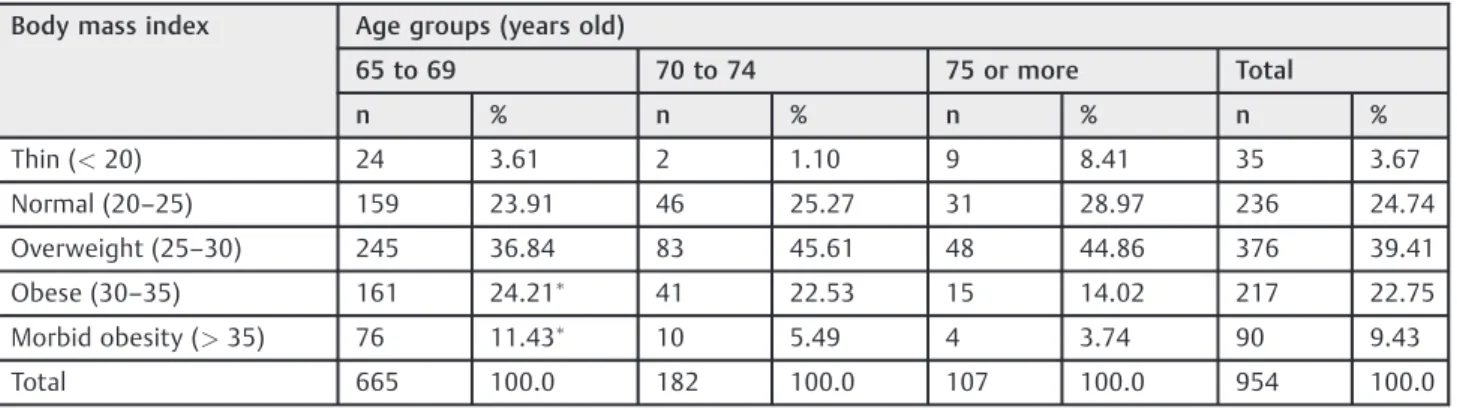
The BMI calculated during the first clinical visit in 954 women indicated that 35 (3.67%) were thin (BMI<20); 236 (24.74%) had normal weight (BMI between 20 and 25); 376 (39.41%) were overweight (BMI between 25 and 30); 217 (22.75%) were obese (BMI between 30 and 35); and 90 (9.43%) were morbidly obese (BMI>35;►Table 3).
When assessing the BMI across different age groups, it decreased as the age increased, showing a statistically sig-nificant difference (p¼0.001).
Sexual Intercourse
The ages at the time of thefirst sexual relationships for 657 women ranged from 12 years (minimum) to 49 years (maximum), with a mean age of 20.54.85 years; at the time of the visit, 78 patients reported performing sexual intercourse regularly, and the majority of the women (n¼70, 89.75%) were between 65 and 69 years of age; 7 (8.97%) were between 70 and 74 years of age; and only 1 (1.28%) patient older than 75 years of age reported regular sexual intercourse. All of the patients who performed regular sexual intercourse had a partner. Moreover, the patients who did not perform regular intercourse reported that it was due to a health issue of their partners and psychological problems. There was a significant decrease in sexual intercourse as the age increased (p<0.001). Addi-tionally, the patients denied homosexual or bisexual behaviors, as well as performing masturbation.
Table 3 Body mass index according to age groups (years)
Body mass index Age groups (years old)
65 to 69 70 to 74 75 or more Total
n % n % n % n %
Thin (<20) 24 3.61 2 1.10 9 8.41 35 3.67
Normal (20–25) 159 23.91 46 25.27 31 28.97 236 24.74
Overweight (25–30) 245 36.84 83 45.61 48 44.86 376 39.41
Obese (30–35) 161 24.21 41 22.53 15 14.02 217 22.75
Morbid obesity (>35) 76 11.43 10 5.49 4 3.74 90 9.43
Total 665 100.0 182 100.0 107 100.0 954 100.0
Notes:p¼0.001 compared with other age intervals; the Chi-square test was applied. Table 2 Reported associated comorbidities
Affections Age groups (years old)
65 to 69 70 to 74 75 to 79 80 or more Total p
n % n % n % n % n %
Systemic arterial hypertension 353 57.87 90 52.63 39 59.09 18 62.07 500 57.08 0.585
Gastrointestinal disturbance 165 26.96 44 25.88 18 27.69 10 33.33 237 27.02 0.865
Diabetes mellitus 101 16.48 33 19.30 4 6.06 3 10.00 141 16.02 0.068
Depression 94 15.44 28 16.47 11 16.67 3 10.00 136 15.54 0.830
Arthropathy 63 10.31 37 21.51 7 10.61 9 30.00 116 13.20 <0.01
Heart problems 32 5.27 9 5.29 6 9.09 1 3.33 48 5.50 0.576
Liver diseases 25 4.08 4 2.35 2 3.03 – – 31 3.53 0.503
Breast cancer 21 3.44 4 2.37 1 1.52 2 6.67 28 3.20 0.819
Stroke 12 1.97 4 2.37 3 4.55 1 3.33 20 2.29 0.927
Deep venous thrombosis 10 1.64 6 3.55 3 4.55 – – 19 2.17 0.999
Discussion
Knowledge of female evolution and behavior during different periods of life, mainly after 65 years of age, is important due to special clinical and psychological aspects, as well as due to the association of diseases during this period. In fact, these factors may interfere with the intensity of the symptoms related to hypoestrogenism and cause an increase in sexual disturbances.2Our patients presented with a large number of comorbidities, and a low number of women were having sexual intercourse. Ourfindings may suggest that Brazilian patients older than 65 years of age have poor health.
We tried tofind a cause for the high number of health disturbances in our patients. One possibility may be the age at menopause, which is a time of many changes in the psychophysical and social functioning of women, with reduced ovarian hormonal activity and estrogen levels. However, the menopausal age of our women was similar to those of other studies.10,11
Fonseca et al11observed that older women during meno-pause have fewer and less intense hotflashes than younger women. However, we found that 188 women reported vasomotor symptoms during this period. We expected that a low number of patients would present with these types of symptoms. A recent systematic review of vasomotor symp-toms showed that a considerable proportion of older women complained of them.12Another study demonstrated that the hot flashes are related to emotional factors, marital and social stata, and stress.13
The associated diseases may explain this high number of patients with vasomotor symptoms: we observed a large number of women with systematic arterial hypertension and diabetes mellitus. Those conditions may influence the cardiovascular symptoms, and may also be associated with endothelial dysfunction.10Other causes may be psychological factors due to depression, emotional problems, or physical disturbances.14–19 In fact, we observed a large number of patients with arthropathy that may limit their physical activity and worsen their quality of life. Moreover, our data showed that not all patients performed regular physical activity. The clinical conditions of the patients with cancer and other diseases were compensated in our study. The number of smokers was too low to negatively influence our data.
In the general population, the yearly incidence of depres-sion is10 to 25%, and it occurs in different levels according to race and culture. The predisposition to develop depression in response to stress is associated with the gene sequence of the short allele of the gene encoding the serotonin trans-porter.14 Regardless of the mechanism, we found a high number of patients with depression, which decreases the quality of life.14–18
Fonseca et al11observed that68% of the patients were overweight or obese during the climacterium. According to Lynch et al,20the excess weight may affect the overall health and the quality of life of women. Analyzing women older than 65 years of age in our sample, we could observe a tendency toward a decrease in BMI, which was probably due to alterations in metabolism. However, we observed a large
number of diabetic patients, which is a health concern during the analyzed period of life. Additionally, McMinn et al21 reported that weight loss may increase morbidity and mor-tality after 65 years of age. Physiological changes related to anorexia of aging, including weight loss, bone loss, and a lower metabolic basal index, as well as taste, smell and signs of advanced gastric satiety would be responsible for the weight loss. In our study, we believe that the number of associated comorbidities may be another cause.
In the present study, only 78 women maintained sexual intercourse after 65 years of age, with the majority of these patients being between 65 and 69 years old. Different aspects, such as a drop in hormonal levels, vaginal drying, genital atrophy with pain, partners with clinical problems, fear of vascular problems and fear of meeting their partners’ expectations contribute to the progressive decline in sexual activity.22–24 In addition, associated comorbidities, such as depression and vasomotor symptoms, may influence the sexual activity of these women after 65 years of age, as well as the health problems of their partners or problems in the marriage. Smith et al25evaluated sexual activity in midlife women, and their study showed a high percentage of patients who do not perform sexual activity. The main reasons for this result were physical fatigue and sexual difficulties felt by the couples. In addition, the sexual function of postmenopausal women can be improved by a sexual enhancement program.26
Finally, the limitations of our study were: a) the fact that it was a retrospective study; b) the loss of data from the records; and c) no specific quality of life or sexuality ques-tionnaire were applied. The strength of our study was the large number of patients included.
Conclusion
Ourfindings suggested that vasomotor symptoms can persist after 65 years of age. There was a significant decrease in sexual intercourse as the age increased. The cardiovascular distur-bances in our study are health concerns. Aging in good physical and psychological conditions is not an easy task for the women and the institutions and people who are part of this process, such as their families, health professionals, social services, and government agencies. The analysis of our observations con-tributes to the knowledge of female aging and, consequently, to improve the quality of life of these women.
References
1 United Nations. [Internet]. World Populations Prospects: the 2002 revision, highlights. New York: United Nations; 2003 [cited 2004 Jan 21]. (ESA/P/WP. 180). Available from: http://www.un.org/esa/ population/publications/wpp2002
2 World Health Organization. World Health Statistics Annual –
Statistics of Seniors. Geneva: WHO; 2014.
3 Instituto Brasileiro de Geografia e Estatística. População. Rio de Janeiro: IBGE; 2014
5 Randolph JF Jr, Sowers M, Gold EB, et al. Reproductive hormones in the early menopausal transition: relationship to ethnicity, body size, and menopausal status. J Clin Endocrinol Metab 2003; 88(04):1516–1522
6 Ranzijn R, Luszcz M. Measurement of subjective quality of life of elders. Int J Aging Hum Dev 2000;50(04):263–278
7 Kupperman HS, Wetchler BB, Blatt MH. Contemporary therapy of the menopausal syndrome. J Am Med Assoc 1959;171:1627–1637
8 Quételet A. Antropométrie ou mesure des différentes facultés de l’homme. Brussels: C. Muquardt; 1870
9 Bagnoli VR, Fonseca AM, Arie WM, et al. Metabolic disorder and obesity in 5027 Brazilian postmenopausal women. Gynecol Endocrinol 2014;30(10):717–720
10 Makara-Studzińśka MT, Kryś-Noszczyk KM, Jakiel G.
Epidemiol-ogy of the symptoms of menopause - an intercontinental review. Przegl Menopauz 2014;13(03):203–211
11 Da Fonseca AM, Bagnoli VR, Souza MA, et al. Impact of age and body mass on the intensity of menopausal symptoms in 5968 Brazilian women. Gynecol Endocrinol 2013;29(02):116–118
12 Zeleke BM, Davis SR, Fradkin P, Bell RJ. Vasomotor symptoms and urogenital atrophy in older women: a systematic review. Climac-teric 2015;18(02):112–120
13 Huicochea-Gómez L, Sievert LL, Cahuich-Campos D, Brown DE. An investigation of life circumstances associated with the experience of hotflashes in Campeche, Mexico. Menopause 2017;24(01): 52–63
14 Vousoura E, Spyropoulou AC, Koundi KL, et al. Vasomotor and depression symptoms may be associated with different sleep disturbance patterns in postmenopausal women. Menopause 2015;22(10):1053–1057
15 Palacios S, Henderson VW, Siseles N, Tan D, Villaseca P. Age of menopause and impact of climacteric symptoms by geographical region. Climacteric 2010;13(05):419–428
16 van Dam RM, Li T, Spiegelman D, Franco OH, Hu FB. Combined impact of lifestyle factors on mortality: prospective cohort study in US women. BMJ 2008;337:a1440
17 European Society of Hypertension-European Society of Cardi-ology Guidelines Committee. 2003 European Society of Hyper-tension-European Society of Cardiology guidelines for the management of arterial hypertension. J Hypertens 2003; 21(06):1011–1053
18 American Psychiatric Association. Diagnostic and statistical man-ual of mental disorders, text revised. Washington (DC): American Psychiatric Association; 2003
19 Coleman MP. Trends in breast cancer incidence, survival, and mortality. Lancet 2000;356(9229):590–591, author reply 593
20 Lynch CP, McTigue KM, Bost JE, et al. Excess weight and physical health-related quality of life in postmenopausal women of di-verse racial/ethnic backgrounds. J Womens Health (Larchmt) 2010;19(08):1449–1458
21 McMinn J, Steel C, Bowman A. Investigation and management of unintentional weight loss in older adults. BMJ 2011;342:d1732
22 Wellings K, Collumbien M, Slaymaker E, et al. Sexual behaviour in context: a global perspective. Lancet 2006;368(9548):1706–1728
23 Syme ML, Cohn TJ. Examining aging sexual stigma attitudes among adults by gender, age, and generational status. Aging Ment Health 2016;20(01):36–45
24 Zeleke BM, Bell RJ, Billah B, Davis SR. Vasomotor and sexual symptoms in older Australian women: a cross-sectional study. Fertil Steril 2016;105(01):149–55.e1
25 Smith RL, Gallicchio L, Flaws JA. Factors affecting sexual activity in midlife women: results from the Midlife Health Study. J Womens Health (Larchmt) 2017;26(02):103–108