Subclinical Hypothyroidism and Intracytoplasmic
Sperm Injection Outcomes
Hipotireoidismo subclínico e resultados de Injeção
intracitoplasmática de espermatozoide
Marcela de Alencar Coelho Neto
1Wellington de Paula Martins
1Anderson Sanches de Melo
1Rui Alberto Ferriani
1Paula Andrea Navarro
11Department of Obstetrics and Gynecology, Faculdade de Medicina de Ribeirão Preto, Universidade de São Paulo (DGO-FRMP-USP), Ribeirão Preto, SP, Brazil
Rev Bras Ginecol Obstet 2016;38:552–558.
Address for correspondence Marcela A. Coelho Neto, MD, Universidade de São Paulo, Av. Bandeirantes 3900, 8 andar, HCRP, Campus Universitário, 14049-900, Ribeirão Preto, SP, Brazil (e-mail: [email protected]).
Keywords
►
thyrotropin (TSH)
►
subclinical
hypothyroidism
►
intracytoplasmic
sperm injection (ICSI)
►
live birth
►
miscarriage
Abstract
Purpose
Whether preconception elevated concentrations of thyroid-stimulating
hormone (TSH) compromises reproductive outcomes in patients undergoing assisted
reproduction techniques (ARTs) remains unclear. This study therefore compared the
reproductive outcomes in patients with TSH concentrations of
<
2.5 mIU/L, 2.5
–
4.0
mIU/L, and 4.0
–
10.0 mIU/L undergoing controlled ovarian stimulation (COS) for in vitro
fertilization (IVF)/intracytoplasmic sperm injection (ICSI).
Methods
This retrospective cohort study evaluated the medical records of all women with
measured TSH concentrations who underwent IVF/ICSI between January 2011 and
Decem-ber 2012. The patients were divided into three groups: TSH
<
2.5 mIU/L (group 1); THS
2.5
and
<
4.0 mIU/L (group 2); and THS
4 mIU/L and
<
10.0 mIU/L (group 3). Patients who
were administered levothyroxine for treating hypothyroidism were excluded from the analysis.
The primary endpoints were clinical pregnancy, miscarriage, live birth and multiple pregnancy
rates.
Results
During the study period, 787 women underwent IVF/ICSI. Sixty were excluded
because their TSH concentrations were unavailable, and 77 were excluded due to their use
of levothyroxine. The prevalence of patients presenting elevated concentrations of TSH was
of 5.07% (using a TSH threshold of 4.0 mIU/L) and of 29.99% (using a TSH threshold of 2.5
mIU/L). Patient characteristics, type of COS, and response to COS did not differ among the
three groups, and there were no differences in clinical pregnancy (24.4% versus 25.9%
versus 24.2%,
p
¼
0.93); miscarriage (17.1% versus 14.3% versus 12.5%,
p
¼
0.93); live
birth (20.2% versus 22.2% versus 21.2%,
p
¼
0.86); and multiple pregnancy rates (27.0%
versus 21.4% versus 25.0%,
p
¼
0.90) respectively.
Conclusion
Response to COS, live birth, and miscarriage rates were not altered in women
with elevated concentrations of TSH undergoing IVF/ICSI, regardless of using a TSH threshold
of 2.5 mIU/L or 4.0 mIU/L. These
fi
ndings reinforce the uncertainties related to the impact of
subclinical hypothyroidism on reproductive outcomes in women undergoing COS for ARTs.
received June 14, 2016 accepted
September 29, 2016 published online November 16, 2016
DOI http://dx.doi.org/ 10.1055/s-0036-1593986. ISSN 0100-7203.
Copyright © 2016 by Thieme-Revinter Publicações Ltda, Rio de Janeiro, Brazil Original Article
Introduction
Female infertility accounts for 37% of infertile couples, with 25% of these women having ovulatory disorders.1Women with thyroid dysfunction may experience ovulatory disor-ders, menstrual irregularities, infertility and even increased pregnancy morbidity.2Elevated concentrations of thyroid stimulating hormone (TSH) in asymptomatic patients may also increase the likelihood of pregnancy complications,3–5 neonatal mortality4and miscarriage.6,7
Until recently, human reproduction societies did not recom-mend the measurement of TSH concentration in asymptomatic ovulatory women,8,9but the new guideline published by the American Society for Reproductive Medicine (ASRM) endorses dosing TSH in infertile women attempting pregnancy.7 The American Thyroid Association (ATA) recognizes that the preva-lence of thyroid dysfunction is higher in subfertile women,5 while the Endocrine Society recommends measuring TSH in patients at“high risk”of thyroid illness, including asymptomatic infertile ones.3 Furthermore, there is no consensus among endocrinologists and gynecologists regarding the cut-off
TSH concentrations for patients pursuing pregnancy, whether
<2.5 mIU/L3or<4.0/4.5 mIU/L.7,10–14
For patients who will undergo assisted reproduction techniques (ARTs), the high estradiol levels induced by controlled ovarian stimulation (COS) may alter thyroid func-tion by increasing the concentrafunc-tions of TSH, with hypothy-roid women being most affected.15–17 Nevertheless, it is unclear whether the preconceptional concentration of TSH or the elevations in TSH concentration during COS are rele-vant in infertile women undergoing ARTs.18 This study, therefore, has compared reproductive outcomes in patients with serum TSH concentrations of<2.5 mIU/L, 2.5–4.0 mIU/ L, and 4.0–10.0 mIU/L undergoing COS for in vitro fertiliza-tion (IVF)/intracytoplasmic sperm injecfertiliza-tion (ICSI).
Methods
Study Design
This retrospective cohort study evaluated all women who underwent IVF/ICSI at the fertility clinic of the university hospital of the Faculdade de Medicina de Ribeirão Preto,
Resumo
Objetivos
Se concentrações elevadas de hormônio estimulante da tireoide (TSH)
antes do parto comprometem resultados reprodutivos em pacientes submetidas a
técnicas de reprodução assistida (TRA) é incerto. Este estudo comparou resultados
reprodutivos de pacientes com concentrações de TSH
<
2,5 mIU/L; 2,5
–
4,0 mIU/L e
4,0
–
10,0 mIU/L submetidas a estimulação ovariana controlada (EOC) para fertilização
in vitro (FIV)/injeção intracitoplasmática de espermatozoide (ICSI).
Métodos
Este estudo de coorte retrospectiva avaliou prontuários médicos de todas
as pacientes que tinham registro de concentrações de TSH submetidas a FIV/ICSI entre
janeiro de 2011 e dezembro de 2012. As pacientes foram divididas em três grupos:
aquelas com TSH
<
2,5 mIU/L (grupo 1); entre 2,5 e 4,0 mIU/L (grupo 2) e entre 4,0
mIU/L e 10,0 mIU/L (grupo 3). As pacientes que estavam em uso de levotiroxina para
tratamento de hipotireoidismo foram excluídas da análise. Os desfechos primários
foram taxas de gravidez clínica, de abortamento, de nascido vivo e de gravidez
múltipla.
Resultados
Durante o período do estudo, 787 mulheres foram submetidas a FIV/ICSI.
Sessenta foram excluídas por causa da indisponibilidade das concentrações de TSH, e
77 foram excluídas porque estavam usando levotiroxina. A prevalência de pacientes
apresentando elevação das concentrações de TSH foi de 5,07% (usando um limite de
TSH de 4,0 mIU/L) e 29,99% (usando um limite de TSH de 2,5 mIU/L). As características
das pacientes, tipo de EOC e reposta à EOC não diferiram entre os três grupos, nem
houve diferenças nas taxas de gravidez clínica (24,4% versus 25,9% versus 24,2%,
p
¼
0,93); abortamento (17,1% versus 14,3% versus 12,5%,
p
¼
0,93); nascido vivo
(20,2% versus 22,2% versus 21,2%,
p
¼
0,86); e taxas de gestação múltipla (27,0%
versus 21,4% versus 25,0%,
p
¼
0,90), respectivamente.
Conclusão
Resposta à EOC, taxa de nascido vivo e de abortamento não foram
alteradas em mulheres submetidas a FIV/ICSI com concentrações elevadas de TSH
independente de usar um limite de 2,5 ou 4,0 mIU/L. Estes achados reforçam as
incertezas relacionadas ao impacto do hipotireoidismo subclínico nos resultados
reprodutivos de mulheres submetidas a EOC para TRA.
Palavras-chave
►
tireotropina (TSH)
►
hipotireoidismo
subclínico
►
injeção
intracitoplasmática
de espermatozoide
(ICSI)
►
nascido vivo
Universidade de São Paulo, Brazil, between January 2011 and December 2012. Data were obtained from medical records. The study protocol was approved by the Institution-al Review Board.
Participants
Women who had undergone IVF/ICSI between January 2011 and December 2012 were eligible if they had serum TSH concentrations evaluated by a third-generation assay re-ported in their medical records. Patients in treatment with levothyroxine for hypothyroidism were excluded from the analysis.
In spite of the fact that the concentrations of TSH4.0 mIU/ L and<10 mIU/L in asymptomatic patients are classically used to define subclinical hypothyroidism,6,10–14,19 patients with TSH<4.0 mIU/L were divided into two subgroups (TSH<2.5 mIU/L and TSH 2.5–4.0 mIU/L). For comparison, three groups were divided: those with TSH<2.5 (group 1); TSH>2.5 mIU/L and>4.0 mIU/L (group 2); and TSH>4.0 mIU/L and<10.0 mIU/L (group 3).
COS, Oocyte Retrieval, Fertilization and Embryo Transfer
Menstruation was programmed with combined oral contra-ceptives administered in the previous menstrual cycle. All women were subjected to COS monitored by transvaginal ultrasound (TVUS)20 according to one of the following protocols:
In the standard long protocol, gonadotropin-releasing hor-mone (GnRH) agonists (leuprolide acetate 0.5 mg/day, Lupron, Famar L’Aigle, Saint-Remy-Sur-Avre, France) were introduced during the mid-luteal phase of the previous cycle, followed by 150–300 IU/day of gonadotropins (Gonal-F, Merck Serono, Geneva, Switzerland, or Puregon, Organon, Oss, Holland) for thefirst six days. Subsequently, the daily dose of gonadotro-pins was adjusted according to follicular growth.
In the flexible antagonist protocol, gonadotropins (150–300 IU/day) were administered for thefirst six days, with a subsequent daily dose adjusted according to follicular growth. Gonadotropin-releasing hormone antagonists 0.25mg/day (Ganirelix, Orgalutran, Organon, Dublin, Ireland, or Cetrorelix, Cetrotide, Merck Serono, Geneva, Switzerland) were introduced on the day the average diameter of the largest follicle was14 mm.
In the clomiphene citrate (CC) (Clomid, Medley, Campinas, Brazil, or Indux, EMS, Campinas, Brazil) plus gonadotropins (Menopur, Ferring GmbH, Kiel, Germany) plus antagonist protocol, offered to women with a low antral follicle count (AFC6),21CC (100 mg/day) was administered for thefirst five days. Gonadotropins (150 IU/day) were administered on days 2 and 4, and daily after day 6. Gonadotropin-releasing hormone antagonists were introduced when the average diameter of the largest follicle was14 mm.
Recombinant (Ovidrel, Merck Serono, Modugno, Italy) or urinary (Choriomon, IBSA Institut Biochimique, S.A., La-mone, Switzerland) human chorionic gonadotropin (hCG) was administered when at least two follicles measuring 18 mm in diameter were present. Oocytes were retrieved 34
to 36 hours after hCG administration, and the luteal phase was supported by micronized progesterone, 600 mg/day (Utrogestan, Besins Manufacturing Belgium, Drogenbos, Belgium). Cycles were suspended due to poor response when no follicle reached a diameter of 10 mm after ten days of COS or after 4 to 5 days of additional treatment without any follicle measuring at least 18 mm in diameter.22 The obtained oocytes were incubated at 37°C in 5% CO2 and 95% humidity for 2–3 hours, and later on denuded by hyaluronidase. Mature oocytes were subjected to ICSI 3 to 4 hours after oocyte retrieval. Fertilization was evaluated 16 to 18 hours after the ICSI and defined as the presence of two pronuclei and two polar bodies.
Embryo quality was assessed 43 to 45 hours after the ICSI (day 2 embryos with 4 symmetrical blastomeres of normal size,<10% of fragmentation, without multinucleation, were considered of top quality), or 67 to 69 hours after the ICSI (day 3 embryos with 8 symmetrical blastomeres of normal size,<10% of fragmentation, without multinucleation, were considered of top quality).23
The rate of clinical pregnancy was defined as the number of patients with embryos exhibiting a heartbeat on TVUS 4 to 5 weeks after embryo transfer divided by the number of cycles100. The miscarriage rate was defined as the per-centage of patients with clinical pregnancy who could not continue a pregnancy at 20 weeks of gestation. The live birth rate was defined as the percentage of patients with clinical pregnancy who delivered a live birth. Multiple pregnancy rates were defined as the percentage of patients with clinical pregnancy who delivered more than one live birth.
Variables and Data Sources
For most of the assessed parameters, the unit of analysis was a woman who started COS. However, the unit of analysis was pregnant women for subjects who presented miscarriage, live birth, and multiple pregnancies. The primary endpoints of this study were clinical pregnancy, miscarriage, live birth and multiple pregnancy rates. The following parameters were assessed: age, body mass index (BMI), duration of infertility, indication for ICSI, baseline AFC, number of re-trieved oocytes, and number of mature oocytes (MII). The characteristics of COS included duration, total dose of re-combinant follicle stimulating hormone (r-FSH), GnRH ago-nist versus antagoago-nist protocols, and cycles with CC. Other parameters included number of suspended cycles due to poor response, numbers of cycles with embryo transfer and top quality embryo transfer, as well as numbers of cycles with oocyte and embryo cryopreservation, and number of positive pregnancy tests.
Potential Sources of Bias
Statistical Analyses
The number of women undergoing COS for IVF/ICSI during the study period who fulfilled the eligibility criteria deter-mined the sample size. The normality of distribution of continuous variables was analyzed by the Kolmogorov-Smir-nov test. Continuous variables with normal distribution were summarized as meanstandard deviation (SD) and com-pared among groups by ANOVA. Continuous variables with-out normal distribution were summarized as median (interquartile range) and compared by Kruskal-Wallis tests. Binary data were presented as ratio and proportion, and compared by Chi-squared (χ2) tests. The level of significance was defined asp<0.05. Statistical analyzes were performed using the Statistical Package for Social Sciences software (SPSS, version 18.0, SPSS Inc., Chicago, IL, US).
As an additional analysis, the power of this study to detect differences of 10% in clinical pregnancy and live birth rates among women with TSH<2.5 mIU/L and TSH2.5 mIU/L was determined.
Results
Participants
During the study period, 787 women underwent IVF/ICSI in our clinic. Sixty patients were excluded due to the absence of TSH measurements, and 77 were excluded because they were using levothyroxine for the treatment of hypothyroid-ism. All 650 women were followed until a negative pregnan-cy test or the end of pregnanpregnan-cy.
Descriptive Data
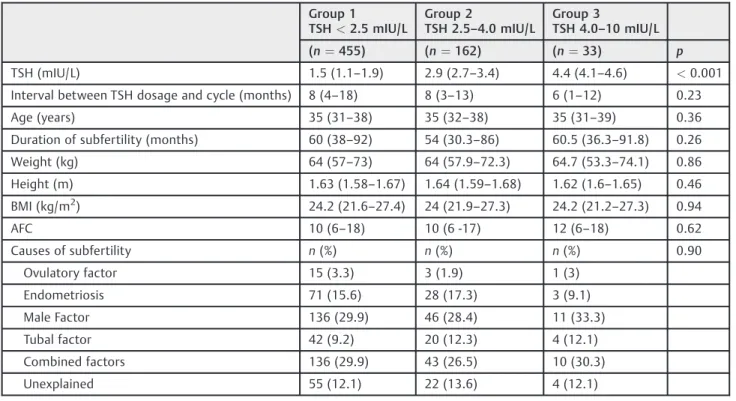
The prevalence of patients presenting elevated concentra-tions of TSH was of 5.07% (using a TSH threshold of 4.0 mIU/ L) and 29.99% (using a threshold of 2.5 mIU/L). Of the 650 included patients, 455 (70.0%) had TSH<2.5 mIU/L, 162 (24.92%) had TSH concentrations of 2.5–4.0 mIU/L, and 33 (5.07%) had TSH >4.0 mIU/L and<10.0 mIU/L (►Table 1). None of the patients had TSH concentrations>10.0 mIU/L. The time between TSH measurement and the cycle was reported in►Table 1. Indications for ICSI included ovulatory disorders (2.92%); endometriosis (15.69%); male infertility (31.12%); tubal factor (10.15%); combined factors of sub-fertility (29.07%); and unexplained insub-fertility (12.46%) (►Table 1).
The three subgroups were similar in age, weight, height, BMI, duration of infertility, indications for ICSI and AFC (►Table 1). The distribution of COS protocols did not differ significantly among the three groups (►Table 2).
Main Results
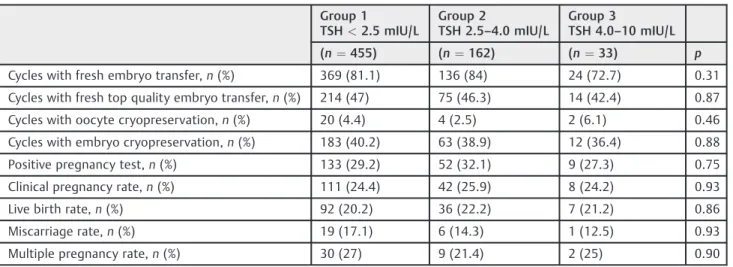
Parameters of ovarian response were similar in the three subgroups, including total dose of r-FSH used during the COS, length of COS, number of retrieved oocytes, and number of mature oocytes (MII) (►Table 2). Moreover, there was no significant difference in cycles suspended due to poor response, cycles with embryo transfer, cycles with top quali-ty embryo transfer, cycles with oocyte cryopreservation and cycles with embryo cryopreservation (►Table 3). Similar reproductive outcomes were observed among these three
Table 1 Characteristics of the patients included in the study
Group 1
TSH<2.5 mIU/L
Group 2
TSH 2.5–4.0 mIU/L
Group 3
TSH 4.0–10 mIU/L
(n¼455) (n¼162) (n¼33) p
TSH (mIU/L) 1.5 (1.1–1.9) 2.9 (2.7–3.4) 4.4 (4.1–4.6) <0.001
Interval between TSH dosage and cycle (months) 8 (4–18) 8 (3–13) 6 (1–12) 0.23
Age (years) 35 (31–38) 35 (32–38) 35 (31–39) 0.36
Duration of subfertility (months) 60 (38–92) 54 (30.3–86) 60.5 (36.3–91.8) 0.26
Weight (kg) 64 (57–73) 64 (57.9–72.3) 64.7 (53.3–74.1) 0.86
Height (m) 1.63 (1.58–1.67) 1.64 (1.59–1.68) 1.62 (1.6–1.65) 0.46
BMI (kg/m2) 24.2 (21.6–27.4) 24 (21.9–27.3) 24.2 (21.2–27.3) 0.94
AFC 10 (6–18) 10 (6 -17) 12 (6–18) 0.62
Causes of subfertility n(%) n(%) n(%) 0.90
Ovulatory factor 15 (3.3) 3 (1.9) 1 (3)
Endometriosis 71 (15.6) 28 (17.3) 3 (9.1)
Male Factor 136 (29.9) 46 (28.4) 11 (33.3)
Tubal factor 42 (9.2) 20 (12.3) 4 (12.1)
Combined factors 136 (29.9) 43 (26.5) 10 (30.3)
Unexplained 55 (12.1) 22 (13.6) 4 (12.1)
Abbreviations: AFC, antral follicle count; BMI, body mass index; TSH, thyroid-stimulating hormone.
groups, including clinical pregnancy, live birth, miscarriage, and multiple pregnancy rates (►Table 3).
Additional Analysis
The present study had a power of 80% to detect a difference of 10% in clinical pregnancy rates and live birth rates among women with TSH<2.5 mIU/L and2.5 mIU/L.
Comment
This study showed that women undergoing COS for ARTs had similar reproductive outcomes, including live birth, clinical
pregnancy, miscarriage, and multiple pregnancy rates, re-gardless of serum TSH concentrations (<2.5 mIU/L; 2.5–4.0 mIU/L; and 4.0–10.0 mIU/L). The response to COS, as evaluated by the total dosage of FSH, the duration of COS and the number of retrieved and mature oocytes, was also similar among these groups.
Concentrations of TSH>4.0 mIU/L were considered altered in the present study, reflecting concerns regarding overdiagnosis and overtreatment when the threshold of 2.5 mIU/L is chosen. Moreover, there is insufficient evidence that TSH concentrations between 2.5 and 4.0 mIU/L affect
Table 3 Reproductive outcomes of assisted reproduction cycles
Group 1
TSH<2.5 mIU/L
Group 2
TSH 2.5–4.0 mIU/L
Group 3
TSH 4.0–10 mIU/L
(n¼455) (n¼162) (n¼33) p
Cycles with fresh embryo transfer,n(%) 369 (81.1) 136 (84) 24 (72.7) 0.31
Cycles with fresh top quality embryo transfer,n(%) 214 (47) 75 (46.3) 14 (42.4) 0.87
Cycles with oocyte cryopreservation,n(%) 20 (4.4) 4 (2.5) 2 (6.1) 0.46
Cycles with embryo cryopreservation,n(%) 183 (40.2) 63 (38.9) 12 (36.4) 0.88
Positive pregnancy test,n(%) 133 (29.2) 52 (32.1) 9 (27.3) 0.75
Clinical pregnancy rate,n(%) 111 (24.4) 42 (25.9) 8 (24.2) 0.93
Live birth rate,n(%) 92 (20.2) 36 (22.2) 7 (21.2) 0.86
Miscarriage rate,n(%) 19 (17.1) 6 (14.3) 1 (12.5) 0.93
Multiple pregnancy rate,n(%) 30 (27) 9 (21.4) 2 (25) 0.90
Abbreviation: TSH: thyroid-stimulating hormone.
Notes: Clinical pregnancy rate: number of patients with embryos exhibiting a heartbeat on transvaginal ultrasound (TVUS) 4 to 5 weeks after embryo transfer divided by the number of cycles100.
Miscarriage rate: number of patients who miscarried divided by the number of patients who had clinical pregnancy100. Live birth rate: number of patients who delivered a live birth divided by the number of patients who had clinical pregnancy100. Multiple pregnancy rates: number of patients who delivered more than one live birth divided by the number of patients who had clinical pregnancy100.
pdetermined by Chi-squared test.
Table 2 Characteristics of controlled ovarian stimulation (COS) and parameters related to ovarian response
Group 1
TSH<2.5 mIU/L
Group 2
TSH 2.5–4.0 mIU/L
Group 3
TSH 4.0–10 mIU/L
(n¼455) (n¼162) (n¼33) p
COS protocol 0.77
Antagonist,n(%) 292 (64.2) 108 (66.7) 21 (63.6)
Agonist,n(%) 100 (22) 32 (19.8) 9 (27.3)
CCþAntagonist,n(%) 63 (13.8) 22 (13.6) 3 (9.1)
Total dose of FSH (IU) 1650 (1,200–2,325) 1,600 (1,213–2,225) 1,427 (1,206–1,856) 0.08
Length of COS (days) 9 (8–11) 9 (8–11) 9 (8–10.8) 0.83
Number of retrieved oocytes 5 (3–10) 6 (2–10) 5 (3–9) 0.88
Number of mature oocytes (MII) 4 (2–7) 4 (2–7.5) 3.5 (2–6) 0.67
Suspension due to poor response,n(%) 19 (4.2) 5 (3.1) 2 (6.1) 0.69
Abbreviations: CC, clomiphene citrate; COS, controlled ovarian stimulation; FSH, follicle-stimulating hormone; IU, international unities; MII, mature oocytes in metaphase II; TSH, thyroid-stimulating hormone.
pregnancy and miscarriage rates.7,24Data to support treating patients with TSH concentrations between 2.5 mIU/L and 4.0–4.5 mIU/L are scarce,7 and only a few studies have evaluated the association between periconceptional TSH concentration and pregnancy outcomes among euthyroid patients.25In the present study, clinical pregnancy, miscar-riage and live birth rates were similar when 2.5 mIU/L and 4.0 mIU/L were used as TSH cut-off values, which was consistent with previous findings.14,26–30 Regarding miscarriage, the ASRM’s new guideline points that there is evidence that TSH>4.0 mIU/L is associated with an increase in miscar-riage rates.7As seen in the present study, Karmon et al25 found similar clinical pregnancy and delivery rates among women with TSH concentrations of 0.4–2.49 mIU/L and 2.5– 4.99 mIU/L undergoing intrauterine insemination.
Guidelines of the American Association of Clinical Endo-crinologists (AACE) and the ATA,31and those of the Endo-crine Society3recommend that infertile patients undergoing ARTs must be treated with levothyroxine to maintain TSH concentrations<2.5 mIU/L. In this study, 24.92% of women undergoing IVF/ICSI had TSH concentrations between 2.5 and 4.0 mIU/L. Although retrospective studies have shown that untreated women were at an increased risk of adverse pregnancy outcomes, few well-designed studies have evalu-ated whether these patients would have benefited from levothyroxine treatment.4,5 Moreover, until very recently there was no consensus about measuring TSH in asymptom-atic infertile women.8,9In the present study, reproductive outcomes were not compromised in women with TSH2.5 and<10 mIU/L undergoing ARTs. Nothing can be said about reproductive outcomes in patients presenting TSH concen-trations above 10.0 mIU/L, once none of the included patients in this study presented them.
Although human reproduction societies have reported that subfertile women are no more likely to have thyroid disease,7,9the Endocrine Society has stated that the prev-alence of thyroid disease is 1 to 43% higher in subfertile patients.3In our study, the prevalence of patients present-ing concentrations of TSH between 4.0 and 10.0 mIU/L was of 5.07% (33/650). If the threshold of TSH is lowered to 2.5 mIU/L, it will result in a prevalence of 30%, more than a 5-fold increase.14
Our study is limited by its retrospective design. Serum TSH concentrations were not available in8% of the women who underwent ARTs in the study period. However, until very recently, there was no consensus about the routine assessment of TSH concentrations for asymptomatic infertile patients according to the treatment guidelines for ARTs.8,9In the present study, assay bias should be taken into account, once measure-ments of TSH were not standardized.32 TSH concentrations were measured by ultra-sensitive methodology, but once data were obtained by reviewing medical records, it was not possible to mention information regarding the coefficient of variation of the assays. Ideally, for each patient, TSH concentration should have been assessed more than once to exclude laboratory errors or transient elevations of TSH to make an adequate diagnosis. Free thyroxine concentrations were not available in the medical records of the majority of the patients in this cohort, but in
asymptomatic patients with mildly elevated TSH concentra-tions the yield of this test is low.27 Ourfindings cannot be generalized, but they may encourage large prospective studies evaluating the potential impact of TSH concentrations on reproductive outcomes after ARTs.
In conclusion, response to COS, live birth, and miscarriage rates were not worse in women with elevated TSH concen-trations (2.5–10.0 mIU/L) undergoing IVF/ICSI. Thesefi nd-ings reinforce the uncertainties related to the impact of elevated concentrations of TSH on reproductive outcomes in women undergoing COS for ARTs, and the need for well-designed prospective studies evaluating this important issue.
Acknowledgments
The study was performed in a fertility clinic at the university hospital of the Faculdade de Medicina de Ribeirão Preto, University of São Paulo, Ribeirão Preto, Brazil.
Marcela Coelho Neto receivedfinancial support from a scholarship granted by Coordenação de Aperfeiçoamento de Pessoal de Nível Superior (CAPES). The other authors received a salary from their institutions and were funded by two Brazilian official agencies: Conselho Nacional de Desenvolvimento Científico e Tecnológico (CNPq) and Fundação de Apoio ao Ensino, Pesquisa e Assistência (FAEPA). The funders had no role in the design of the study, data collection and analysis, decision to publish, or preparation of the manuscript.
The authors would like to thank the staff of the Laboratório de Reprodução Assistida, particularly Sandra Aparecida Cavichiollo, Marisa Blanco, Maria Cristina Pici-nato, Cristiana Padovan Ribas and Ricardo Perussi e Silva, for technical assistance.
References
1 Unuane D, Tournaye H, Velkeniers B, Poppe K. Endocrine disorders & female infertility. Best Pract Res Clin Endocrinol Metab 2011; 25(6):861–873
2 Poppe K, Velkeniers B, Glinoer D. The role of thyroid autoimmu-nity in fertility and pregnancy. Nat Clin Pract Endocrinol Metab 2008;4(7):394–405
3 De Groot L, Abalovich M, Alexander EK, et al. Management of thyroid dysfunction during pregnancy and postpartum: an Endo-crine Society clinical practice guideline. J Clin Endocrinol Metab 2012;97(8):2543–2565
4 van den Boogaard E, Vissenberg R, Land JA, et al. Significance of (sub)clinical thyroid dysfunction and thyroid autoimmunity before conception and in early pregnancy: a systematic review. Hum Reprod Update 2011;17(5):605–619
5 Stagnaro-Green A, Abalovich M, Alexander E, et al; American Thyroid Association Taskforce on Thyroid Disease During Pregnancy and Postpartum. Guidelines of the American Thyroid Association for the diagnosis and management of thyroid disease during pregnancy and postpartum. Thyroid 2011;21(10):1081–1125
reproduction technologies: systematic review and meta-analysis of RCTs. Hum Reprod Update 2013;19(3):251–258
7 Practice Committee of the American Society for Reproductive Medicine. Subclinical hypothyroidism in the infertile female population: a guideline. Fertil Steril 2015;104(3):545–553
8 Practice Committee of American Society for Reproductive Medi-cine. Diagnostic evaluation of the infertile female: a committee opinion. Fertil Steril 2012;98(2):302–307
9 National Institute for Health and Care Excellence (NICE) [Internet]. Fertility: assessment and treatment for people with fertility prob-lems: clinical guideline. 2013 [cited 2015 May 12]. Available from:
<
https://www.nice.org.uk/guidance/cg156/resources/fertility-problems-assessment-and-treatment-35109634660549> 10 Hollowell JG, Staehling NW, Flanders WD, et al. Serum TSH, T(4),
and thyroid antibodies in the United States population (1988 to 1994): National Health and Nutrition Examination Survey (NHANES III). J Clin Endocrinol Metab 2002;87(2):489–499
11 Kim CH, Ahn JW, Kang SP, Kim SH, Chae HD, Kang BM. Effect of levothyroxine treatment on in vitro fertilization and pregnancy outcome in infertile women with subclinical hypothyroidism undergoing in vitro fertilization/intracytoplasmic sperm injec-tion. Fertil Steril 2011;95(5):1650–1654
12 Magri F, Capelli V, Gaiti M, et al. Impaired outcome of controlled ovarian hyperstimulation in women with thyroid autoimmune disease. Thyroid 2013;23(10):1312–1318
13 Mintziori G, Goulis DG, Gialamas E, et al. Association of TSH concentrations and thyroid autoimmunity with IVF outcome in women with TSH concentrations within normal adult range. Gynecol Obstet Invest 2014;77(2):84–88
14 Reh A, Grifo J, Danoff A. What is a normal thyroid-stimulating hormone (TSH) level? Effects of stricter TSH thresholds on pregnancy outcomes after in vitro fertilization. Fertil Steril 2010;94(7): 2920–2922
15 Busnelli A, Somigliana E, Benaglia L, Sarais V, Ragni G, Fedele L. Thyroid axis dysregulation during in vitro fertilization in hypo-thyroid-treated patients. Thyroid 2014;24(11):1650–1655
16 Gracia CR, Morse CB, Chan G, et al. Thyroid function during controlled ovarian hyperstimulation as part of in vitro fertiliza-tion. Fertil Steril 2012;97(3):585–591
17 Reinblatt S, Herrero B, Correa JA, et al. Thyroid stimulating hormone levels rise after assisted reproductive technology. J Assist Reprod Genet 2013;30(10):1347–1352
18 Benaglia L, Busnelli A, Somigliana E, et al. Incidence of elevation of serum thyroid-stimulating hormone during controlled ovarian hyperstimulation for in vitro fertilization. Eur J Obstet Gynecol Reprod Biol 2014;173:53–57
19 Surks MI, Ortiz E, Daniels GH, et al. Subclinical thyroid disease: scientific review and guidelines for diagnosis and management. JAMA 2004;291(2):228–238
20 Martins WP, Vieira CV, Teixeira DM, Barbosa MA, Dassunção LA, Nastri CO. Ultrasound for monitoring controlled ovarian
stimula-tion: a systematic review and meta-analysis of randomized controlled trials. Ultrasound Obstet Gynecol 2014;43(1):25–33
21 Figueiredo JB, Nastri CO, Vieira AD, Martins WP. Clomiphene com-bined with gonadotropins and GnRH antagonist versus conventional controlled ovarian hyperstimulation without clomiphene in women undergoing assisted reproductive techniques: systematic review and meta-analysis. Arch Gynecol Obstet 2013;287(4):779–790
22 Peñarrubia J, Fábregues F, Manau D, et al. Previous cycle cancella-tion due to poor follicular development as a predictor of ovarian response in cycles stimulated with gonadotrophin-releasing hor-mone agonist-gonadotrophin treatment. Hum Reprod 2005; 20(3):622–628
23 Alpha Scientists in Reproductive Medicine and ESHRE Special Interest Group of Embryology. The Istanbul consensus workshop on embryo assessment: proceedings of an expert meeting. Hum Reprod 2011;26(6):1270–1283
24 Weghofer A, Barad DH, Darmon S, Kushnir VA, Gleicher N. What affects functional ovarian reserve, thyroid function or thyroid autoimmunity? Reprod Biol Endocrinol 2016;14(1):26
25 Karmon AE, Batsis M, Chavarro JE, Souter I. Preconceptional thyroid-stimulating hormone levels and outcomes of intrauterine insemination among euthyroid infertile women. Fertil Steril 2015;103(1):258–63.e1
26 Chai J, Yeung WY, Lee CY, Li HW, Ho PC, Ng HY. Live birth rates following in vitro fertilization in women with thyroid autoimmu-nity and/or subclinical hypothyroidism. Clin Endocrinol (Oxf) 2014;80(1):122–127
27 Michalakis KG, Mesen TB, Brayboy LM, et al. Subclinical elevations of thyroid-stimulating hormone and assisted reproductive tech-nology outcomes. Fertil Steril 2011;95(8):2634–2637
28 Aghahosseini M, Asgharifard H, Aleyasin A, Tehrani Banihashemi A. Effects of Thyroid Stimulating Hormone (TSH) level on clinical pregnancy rate via In Vitro Fertilization (IVF) procedure. Med J Islam Repub Iran 2014;28:46
29 Green KA, Werner MD, Franasiak JM, Juneau CR, Hong KH, Scott RT Jr. Investigating the optimal preconception TSH range for patients undergoing IVF when controlling for embryo quality. J Assist Reprod Genet 2015;32(10):1469–1476
30 Weghofer A, Himaya E, Kushnir VA, Barad DH, Gleicher N. The impact of thyroid function and thyroid autoimmunity on embryo quality in women with low functional ovarian reserve: a case-control study. Reprod Biol Endocrinol 2015;13:43
31 Garber JR, Cobin RH, Gharib H, et al; American Association of Clinical Endocrinologists and American Thyroid Association Task-force on Hypothyroidism in Adults. Clinical practice guidelines for hypothyroidism in adults: cosponsored by the American Associ-ation of Clinical Endocrinologists and the American Thyroid Association. Endocr Pract 2012;18(6):988–1028