ACUTE EFFECTS OF DIFFERENT WEIGHT TRAINING
METHODS ON ENERGY EXPENDITURE IN TRAINED MEN
Rodrigo Ramalho Aniceto1,2 Raphael Mendes Ritti-Dias1 Christopher B. Scott3 Fábio Fellipe Martins de Lima2 Thaliane Mayara Pessôa dos Prazeres1,2 Wagner Luiz do Prado1,2
1. Physical Education Post-graduate Program, University of Pernambuco/ Federal University of Paraíba, Recife, Brazil
2. Nutrition and Exercise Research Group, University of Pernambuco, Recife, PE, Brazil.
3. Exercise, Health and Sport Sciences, University of Southern Maine, Gorham, USA.
Mailing address:
Wagner Luiz do Prado,
Escola Superior de Educação Física, Universidade de Pernambuco. Rua Arnóbio Marques, 310. Santo Amaro, 50100-130. Recife, PE, Brasil.
E-mail: [email protected]; [email protected]
ABSTRACT
Introduction: The Weight training has been widely used as strategy of reduction and weight con-trol, so the energy expenditure (EE) contributes significantly to this process. Objective: To compare the acute effects of the circuit method (CM) with the traditional method (TM) on the EE. Methods: This research had a randomized crossover design; the sample consisted of ten adult men recreationally trained aged between 18 to 29 years. There were two experimental sessions with seven-day wash out: in CM the exercises were performed by alternating segment in form of stations, during TM the exercises were performed in consecutive sets. Both training methods followed the same sequence of eight exercises with the same total work: 60% of 1RM, 24 sets/stations and ten repetitions. The collection of blood lactate was performed at rest and the every three sets/stations. The expired air was collected per 30 minutes before and ~31 minutes during all the training sessions. The aerobic exercise (AEEE, kj) and of rest interval (RIEE, kj) EEs were estimated by indirect calorimetry by mea-suring oxygen consumption and the anaerobic EE (AEE, kj) by blood lactate concentration ([La]). The total EE (TEE, kj) was recorded by the sum of AEE, RIEE and AEE. Results: Data showed that the AEE was greater in TM than the CM; however, the AEEE, RIEE and the TEE were not significantly different between the methods. The TM presented higher [La] than the CM. Conclusion: We conclude that the CM and TM produces similar EE during and post-workout, however, one realizes that the TM uses more anaerobic system than the MC.
Keywords: energy metabolism, lactate, oxygen consumption, resistance training.
INTRODUCTION
Weight training (WT) is used with the purpose to increase mus-cular mass, resistance, strength and musmus-cular power of its practi-tioners1-2; however, recently WT has been widely used for weight reduction and control3. In order to meet these expectations, the prescription of this kind of training involves the manipulation of many variables, such as muscular actions, number of sets and re-petitions, load intensities, velocity of the movement performance, recovery interval, selection and order of the exercises, besides the weekly frequency1-2.
The circuit method (CM) and traditional method (TM) are fair-ly used in different population groups. The studies show that CM promotes improvement in cardiorespiratory fitness, cardiovascular response, functional capacity, muscular strength and local muscular resistance, besides altering body composition4-6. On the other hand, TM is usually associated with increase in muscular mass, muscular strength and power7-8.
WT promotes increase of energy expenditure (EE), being an important component in prescription, especially in situations when body mass modulation is an aim. Studies have compared the EE between CM and TM9-11; however, until the present moment, the results are inconclusive, since the investigations have not stan-dardized the conditions tested and the EE estimation, it has been exclusive measured by the oxygen consumption (VO2). However,
such technique is only able to quantify aerobic EE, and WT is an activity essentially anaerobic with great participation of anaerobic glycolytic processes. Thus, the energy estimation from this system becomes essential. Therefore, the blood lactate concentration ([La]) appears as an alternative12-14.
Thus, the aim of the study was to compare the acute effects of the CM and TM on the total EE of the weight training session. Our hypothesis is that when total work is standardized, the total EE is higher in TM than in CM.
MATERIALS AND METHODS
Experimental outlining
This research has crossed (crossover) and random outlining. The present study was approved by the Ethics Committee in Research of the University of Pernambuco (# 226/10). Prior to any test, the indi-viduals signed a free and clarified consent form, when the aims and of the research and applied procedures were presented and they were informed about the possible risks and benefits of the study.
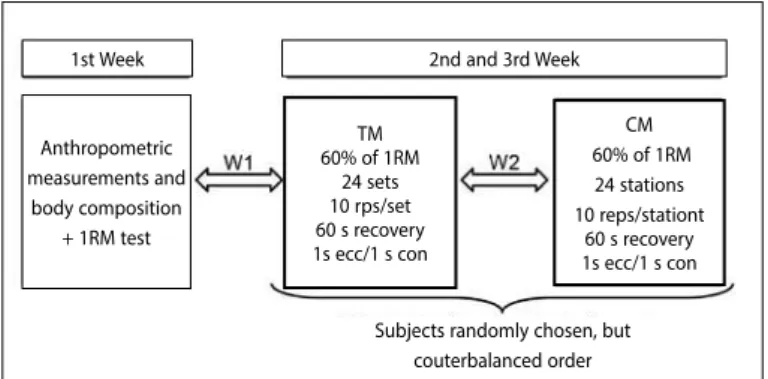
The experimental outlining of the study is presented in figure 1. After five to seven days from the anthropometric measurements, body composition evaluation and 1RM test, the subjects were randomly (randomizer.org) submitted to two experimental sessions with interval of seven days (wash out). Each session consisted in the performance of one of the two training methods: TM or CM. The
ORIGINAL ARTICLE
182
TM –traditional method; CM – circuit method; 1 s ecc/1 s con – performance velocity with one second in the eccen-tric phase and one second in the conceneccen-tric phase ; W1 – wash out of five to 10 days; W2 – wash out of seven days Figure 1. Experimental outlining.
only difference between the methods was the organization of the exercise sessions, since during the CM the volunteers performed the exercises alternated by segment (trunk, upper or lower limbs) in stations, while during TM the exercises were performed in three consecutive sets for each muscle group.
Sample
The sample was composed of 10 adult recreationally trained men. The sample was selected through announcement (posters/in-vitations) in the university campus. The inclusion criteria were: to be a man aged between 18 and 30 years; to be apt for physical activity practice (PAR-Q); to have regularly practiced WT for at least six months and maximum two years, with minimum frequency of three times per week; and to present body mass index between 18.5 kg/m² and 29.9 kg/m². Individuals who made use of food supplements, medication, alcohol or smoked during the experimental procedures; presented any osteomuscular or cardiovascular aggravation; and had performed any physical exercise 48 hours before the experimental sessions were excluded. The sample size determination was performed with the
softwareG*Power 3.1 and based on a pilot study, using mean and standard deviation of EE of the training sessions and one correlation coefficient of 0.5, obtaining hence an effectsize of 1.16. Thus, using power of 0.80 (two-tailed) and α of 0.05, the sample size was esti-mated in eight individuals.
PROCEDURES
Anthropometric measurements and body composition
A Filizola
®
, scale was used for weight (kg); wooden stadiometer for height (cm); Lange scientific adipometer for skinfolds measure-ment. Body mass index (BMI) was calculated dividing weight by height to the square (kg/m2). The used protocol for prediction of body density was the three skinfolds (chest, abdominal and mid-thigh) by Jackson and Pollock15. Fat percentage was estimated (%F) with the Siri’s equation.One-repetition maximum test
One 1RM test, followed by the protocol previously described by Kraemer et al.16 was performed. Warm-up of five to 10 repetitions was performed using 40 to 60% of estimated maximum load. After one-minute recovery the volunteers performed three to five repetitions with 60 to 80% of estimated maximum load. After two minutes three to five attempts with progressive load were performed, with intervals
of three minutes between attempts, to identify the 1RM. This process of load increase continued until fail in the attempt occurred. Standard instructions were given before the test. The test order followed the same order as in the experimental sessions. The subjects were told to refrain from performing physical exercise 24 hours before the test and to eat two hours before the test.
Familiarization with the metronome
After the 1RM test, a familiarization session with the metrono-me (Korg MA-30) was performed, using a set of 10 repetitions in all exercises, following the same performance order of the exercises of the sessions.
Blood lactate concentration
Blood samples from the earlobe (25µL) were collected in heparin-ized tubes before (baseline) and at every three sets or stations (three min, seven min, 11 min, 15 min, 19 min, 23 min, 27 min, 31 min). All samples were immediately transferred to sterile plastic tubes (eppendorfs) containing 50 μL of sodium fluorite at 1%, being later analyzed in mmol·L-1 using a lactate analyzer (YSI 1500 Sport Lactate
Analyzer, Yellow Springs, OH).
Direct gas analysis
The expired air was collected for 30 minutes before and during the entire exercise session (approximately 32 minutes), using a por-table gas analyzer (Cosmed K4b2, Rome, Italy) with breath-by-breath
reading, and the oxygen uptake (VO2, mL·min-1) when the carbon dioxide (VCO2, mL·min-1) were analyzed. Before each experimental session the equipment was calibrated accordingly, following the manufacturer’s recommendations. The environmental conditions were controlled and temperature was kept between 22 and 24ºC and relative humidity between 40 and 60%.
Resting metabolic rate and aerobic and anaerobic energetic expenditure
The resting metabolic rate (RMR, kj) has been calculated using the equation by Weir17, being obtained by indirect calorimetry with the individual at rest after night fasting of 10-12 hours. The VO2 and the VCO2 were collected for 30 minutes; however, only the 10 final minutes were considered as measurement or the RMR. Estimation of aerobic energy expenditure (AEE, kj) and the rest interval (RIEE, kj) the indirect calorimetry method was acquired through the VO2, being the caloric values of 21.1 kj and 19.6 kj, respectively. The values obtained were multiplied by each liter of O2 consumed18-19. The anaerobic energy expenditure (AEE, kj) was analyzed through the [La], being calculated by the delta of the variation (∆) between the previous and subsequent measures (e.g.: ∆1= [La]3min - [La]basal, ∆2= [La]7min - [La]3min), all deltas were summed and the value multiplied by the body mass (kg) and by 3 ml of O212, 20. This conversion for O2 equivalent was converted to Joules, where 1 L of O2= 21.1 kj18-19. The total energy expenditure (TEE, kj) was obtained by the sum of the the expenditures (TEE= AEE+AEEE+RIEE).
Experimental protocols
The individuals arrived at the laboratory between seven and eight in the morning and remained seated at supine position for 15 minutes, RMR was measured right after it. Subsequently, a standard
1st Week 2nd and 3rd Week
Anthropometric measurements and
body composition + 1RM test
TM 60% of 1RM
24 sets 10 rps/set 60 s recovery 1s ecc/1 s con
CM 60% of 1RM
24 stations 10 reps/stationt
60 s recovery 1s ecc/1 s con
TM – tradtional method; CM – circuit method [La] –rest blood lactate concentration, at each three sets or stations during the exercises (3 min, 7 min, 11 min 15 min, 19 min, 23 min, 27 min, 31 min).
Figure 2. Experimental protocol.
Table 1. Total work of the exercises performed in the weight training sessions (N = 10).
Exercises Total work (kg)
Bench press 1.418.40 ± 364.05
Leg press 45º 4.395.60 ± 1261.59
Seated row 1.634.40 ± 323.19
Leg curl 792.00 ± 103.57
Triceps pulley 691.20 ± 134.21
Leg extension 1.150.20 ± 215.07
Biceps curl 655.20 ± 149.68
Adductor chair 909.00 ± 155.13
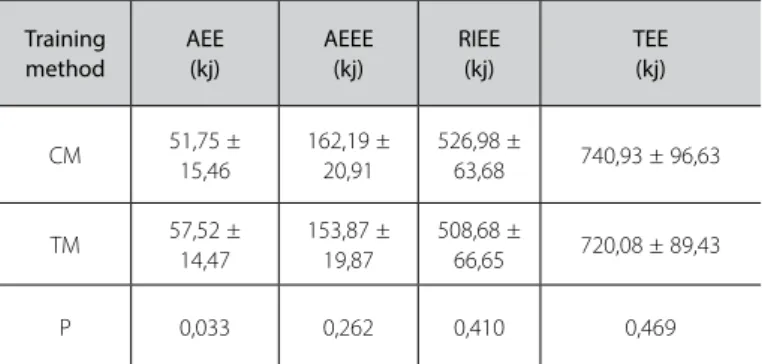
Table 2. Energetic expenditure during the weight training sessions (N = 10).
Training method
AEE (kj)
AEEE (kj)
RIEE (kj)
TEE (kj)
CM 51,75 ± 15,46 162,19 ± 20,91 526,98 ± 63,68 740,93 ± 96,63
TM 57,52 ±
14,47
153,87 ± 19,87
508,68 ±
66,65 720,08 ± 89,43
P 0,033 0,262 0,410 0,469
CM – circuit method; TM – traditional method; AEE – anaerobic energy expenditure; AEEE – exercise aerobic energy expenditure; RIEE – rest interval energy expenditure; TEE – total energy expenditurel. snack was ingested (a bun of 50 g with a slice of cheese of 30 g
and a glass of fruit juice of 200 ml) with energy density of 350 kcal (Carbohydrates: 61.7%; Proteins: 13.44% and Lipids: 24.86%). After rest of 30 minutes (seated), the VO2 and the [La] of the exercise sessions (figure 2) were measured. All sessions followed the same exercise order: bench press, leg press 45º, seated row, leg curl, triceps pulley, leg extension, biceps curl, and adductor chair.
In both methods (TM and CM) total work was standardized: 60% of 1RM, 24 sets/stations, 10 repetitions and performance velocity with one second in the eccentric phase and one sec-ond in the concentric phase, being the work:rest ratio 1:3 (20 seconds: 60 seconds). The work was calculated multiplying load by the number of sets and repetitions, being total work equal to the sum of all exercises14. Moreover, positioning, exercise per-formance technique and range of motion were standardized. The individuals stopped ingesting caffeine 24 hours before the experimental protocols.
Statistical analysis
Data normality and homogeneity were confirmed by the Sha-piro-Wilk and Levene tests, respectively. Paired Student’s t test was used to compare CM and TM concerning RMR, AEEE, RIEE, AEE and TEE; and two-way ANOVA (conditions x moments) with post-hoc by Newman-Keuls to compare the [La] measurements (2 x 9). Data are presented in mean ± standard deviation with significance level adopted of p<0.05. The analyses were performed in the SPSS 16.0 and STATISTICA 5.1.
RESULTS
After the research was announced, 21 individuals volunteered to participate in it; however, six did not meet the inclusion criteria, five did not conclude all the experimental sessions. Thus, the final sample was composed of 10 volunteers aged 21.30 ± 3.33 years, weight 80.46 ± 6.84 kg, height 176.55 ± 5.11 cm, BMI 25.88 ± 2.85 kg/m2, body fat 19.98 ± 4.30 % and training time 13.10 ± 6.38 months.
According to the standardization of the experimental sessions, there was no difference between the methods for total work per-formed (table 1), and exercise session duration, being 33.20 ± 1.35 minutes for the CM and 33.11 ± 1.26 minutes for the TM (p= 0.833). The RMR was similar in both methods, CM (13.35 ± 3.50 kj) and TM (12.42 ± 2.81 kj), demonstrating that the subjects initiated the ex-perimental sessions with the same energy expenditure. Concerning
the EE of the exercise sessions, table 2 demonstrates that the AEE is higher in TM than in CM (11.15%); however, the AEEE, RIEE and TEE did not present differences between methods.
Figure 3 presents the data of the lactate mean concentration, at each three sets for TM and three stations for CM, it was observed there were no differences in the baseline values between methods. From the third minute until the end of the sessions (31 minutes) both methods increased [La], and the highest values were observed
CM – circuit method; TM – traditional method; *Significantly different from the baseline lactate; †Significantly different between methods.
Figure 3. Blood lactate mean concentration during the weight training sessions.
Mask Snack La measurements
Expired air continuously collected
Exercises protocols TM or CM
CM TM
Time (min)
Lac
ta
184
in response to thee TM, except for minutes 19 and 23. The peak in [La] occurred in the 27th minute (12.89 ± 2.54 mmol•L-1) and 31st
minute (11.08 ± 2.54 mmol•L-1) for the TM and CM, respectively, demonstrating tendency to stabilization from the 23rd minute in both training methods.
DISCUSSION
The initial hypothesis of the present study was that TM resul-ted in higher EE during the exercise, especial due to its metabo-lic characteristics, greater contribution to the anaerobic way with consequent increase of lactate production, which would lead to increase of VO2 in the recovery interval for lactate removal and ATP resynthesis. The hypothesis was partially proved, since the volunte-ers presented higher anaerobic energy expenditure in response to the TM when compared with the CM; however, differences between the methods have not been verified for the TEE.
Many studies have shown the effect of acute variables of WT on the EE, such as performance velocity14, rest interval21, load intensity14, number of sets22, number of repetitions18, training volume23 and muscular mass involved24. Thus, it is worth men-tioning that in the present study the experimental sessions were identical compared with the training variables, the only difference between the methods was the training design.
Elliot et al.9 and Pichon et al.11, demonstrated that the CM produces higher EE that the TM, results different from the ones found in the present study; nevertheless, it can be observed that the previously cited studies, did not equip the tested methods, since the intensity variables and volume were different. When EE was made relative by work performed (work: expenditure ratio), Pichon et al.11 observed that the TM despite generating lower work, resulted in higher energy expenditure than the CM. Additionally, the studies mentioned before used only the VO2 measurement to estimate TEE and without estima-tion of the anaerobic EE, limiting such findings and possible comparisons.
In the present study, [La] was higher in the TM than in the CM; therefore, it is speculated that due to its structural characteristics, the TM presents higher local production of lactate (due to the consecutive sets) and lower removal. This metabolic phenomenon is related to the types of muscular fiber: type I (oxidative) and type II (glycolytic). Due to a dif-ferent recruiting pattern of muscular fibers, it is possible that in response to the CM, the higher lactate production by type II fibers was compensated for greater removal of this lactate by the type I fibers, a fact which ay have been accelerated by the increase of blood flow25-26.
In the TM this phenomenon seems to be attenuated, de-spite the lactate produced being removed by its own oxida-tion in the active muscle, via intramuscular lactate shuttle – MCT126. Thus, it seems that in the CM the extracellular lactate shuttle (cell to cell) via MCTs was determinant for the reduc-tion of [La]. This hypothesis is corroborated by the study by van Hall et al.27, who measured the lactate balance between upper and lower limbs during 40 minutes of continuous
ex-ercise in skiing, using both limbs, the data showed that the arms produced lactate, while the legs removed it.
The RIEE was the component which contributed the most to the TEE in both methods. The EE obtained in one minute represents a great part of the fast component of the excessive post-exercise oxygen consumption (EPOC), a significant amount of the O2 incre-ased is used to restore the cellular ATP and CP supplies used during the muscular contraction, and resaturation of oxyhemoglobin and oxymyoglobin28. In that recovery period, the energy comes almost exclusively from the aerobic way, with the lactate and the fat being the main oxidized substrates in the mitochondrial respiration29. The-refore, the TM could have induced more RIEE than the CM, since the TM obtained higher [La] and could have recruited more muscle fibers due to the consecutive sets8, and needs hence higher velocity in the ATP-CP resynthesis.
Another aspect which affects the EE in the WT is the muscle damage. Thus, besides greater lactate production, it was expected that the TM induced to greater muscle damage when compared with the CM. Deminice et al.30 after having compared the TM per-formed with three sets, 10 repetitions, 75% of 1RM and 90 secon-ds of rest interval and the CM with similar work and without rest interval, observed that the methods are not significantly different compared with muscle damage, although both have presented increase in the creatine kinase enzymatic activity post-exercise. Thus, it seems that when the subjects are trained and the training me-thods are standardized by work, both CM and TM produce similar responses related to muscle damage. However, our study presents some limitations, since it was not possible to analyze intervenient variables, such as hormone rates and body temperature, which can help explain our findings.
CONCLUSION
CM and TM produce similar TEE, when they are standardized by total work and the AEE is estimated. However, it is observed that TM uses more the anaerobic way than CM. Summing up, in the perspective of the exercise prescription, both TM and CM should be used with the aim to maximize EE; however, TM is suggested for improvement of anaerobic metabolism. Nevertheless, our investi-gations should be carried out in different populations, especially in obese subjects. Finally, it is worth mentioning the importance for these studies to standardize the tested conditions and use methodological procedures suitable for EE analysis and provide hence greater comparison ability among the results.
ACKNOWLEDGEMENTS
The authors thank the Coordination for the Improvement of Higher Level Personnel (CAPES) for the Master’s scholarship, as well as the National Council for Scientific and Technological Development (CNPq) and the Support to Sciences and Techno-logy Foundation of Pernambuco State (FACEPE) for the scientific initiation scholarships and Valedourado company, for the juice donation for the standard snack.
REFERENCES
1. American College of Sports Medicine. Position stand: progression models in resistance training for healthy adults. Med Sci Sports Exerc 2009;41:687-708.
2. Bird SP, Tarpenning KM, Marino FE. Designing resistance training programmes to enhance muscular fitness: a review of the acute programme variables. Sports Med 2005;35:841-51.
3. American College of Sports Medicine. Position stand: appropriate physical activity intervention strate-gies for weight loss and prevention of weight regain for adults. Med Sci Sports Exerc 2009;41:459-71. 4. Alcaraz PE, Sánchez-Lorente J, Blazevich AJ. Physical performance and cardiovascular responses to an
acute bout of heavy resistance circuit training versus traditional strength training. J Strength Cond Res 2008;22:667-71.
5. Ferreira FC, De Medeiros AI, Nicioli C, Nunes JED, Shiguemoto GE, Prestes J, et al. Circuit resistance training in sedentary women: body composition and serum cytokine levels. Appl Physiol Nutr Metab 2010;35:163-71.
6. Jacobs PL, Nash MS, Rusinowski JW. Circuit training provides cardiorespiratory and strength benefits in persons with paraplegia. Med Sci Sports Exerc 2001;33:711-7.
7. Alcaraz PE, Perez-Gomez J, Chavarrias M, Blazevich AJ. Similarity in adaptations to high-resistance circuit vs. traditional strength training in resistance-trained men. J Strength Cond Res 2011;25:2519-27. 8. Brentano MA, Cadore EL, Da Silva EM, Ambrosini AB, Coertjens M, Petkowicz R, et al. Physiological
adaptations to strength and circuit training in postmenopausal women with bone loss. J Strength Cond Res 2008;22:1816-25.
9. Elliot D, Goldberg L, Kuehl K. Effect of resistance training on excess post-exercise oxygen consumption. J Appl Sport Sci Res 1992;6:77-81.
10. Murphy E, Schwarzkopf R. Effects of standard set and circuit weight training on excess post-exercise oxygen consumption. J Appl Sport Sci Res 1992;6:88-91.
11. Pichon C, Hunter G, Morris M, Bond R, Metz J. Blood pressure and heart rate response and metabolic cost of circuit versus traditional weight training. J Strength Cond Res 1996;10:153-6.
12. Scott CB. Contribution of blood lactate to the energy expenditure of weight training. J Strength Cond Res 2006;20:404-11.
13. Hunter GR, Seelhorst D, Snyder S. Comparison of metabolic and heart rate responses to super slow vs. traditional resistance training. J Strength Cond Res 2003;17:76-81.
14. Mazzetti S, Douglass M, Yocum A, Harber M. Effect of explosive versus slow contractions and exercise intensity on energy expenditure. Med Sci Sports Exerc 2007;39(8):1291-301.
15. Jackson AS, Pollock ML. Generalized equations for predicting body density of men. Br J Nutr 1978;40:497-504.
16. Kraemer W, Fry A, Ratamess N, French D. Strength testing: development and evaluation of metho-dology. In: Maud P, Foster C, editors. Physiological assessment of human fitness. Champaign: Human Kinetics, 2006; 119-50.
17. Weir JB. New methods for calculating metabolic rate with special reference to protein metabolism. J Physiol 1949;109:1-9.
18. Scott CB, Croteau A, Ravlo T. Energy expenditure before, during, and after the bench press. J Strength Cond Res 2009;23:611-8.
19. Scott CB, Leary MP, Tenbraak AJ. Energy expenditure characteristics of weight lifting: 2 sets to fatigue. Appl Physiol Nutr Metab 2011;36:115-20.
20. di Prampero PE, Ferretti G. The energetics of anaerobic muscle metabolism: a reappraisal of older and recent concepts. Respir Physiol 1999;118:103-15.
21. Haltom RW, Kraemer RR, Sloan RA, Hebert EP, Frank K, Tryniecki JL. Circuit weight training and its effects on excess postexercise oxygen consumption. Med Sci Sports Exerc 1999;31:1613-8.
22. Haddock BL, Wilkin LD. Resistance training volume and post exercise energy expenditure. Int J Sports Med 2006;27:143-8.
23. Kang J, Hoffman JR, Im J, Spiering BA, Ratamess NA, Rundell KW, et al. Evaluation of physiological respon-ses during recovery following three resistance exercise programs. J Strength Cond Res 2005;19:305-9. 24. Farinatti PT, Castinheiras Neto AG. The effect of between-set rest intervals on the oxygen uptake during and after resistance exercise sessions performed with large- and small-muscle mass. J Strength Cond Res 2011;25:3181-90.
25. Gladden LB. Muscle as a consumer of lactate. Med Sci Sports Exerc 2000;32:764-71. 26. Gladden LB. A lactatic perspective on metabolism. Med Sci Sports Exerc 2008;40:477-85. 27. van Hall G, Jensen-Urstad M, Rosdahl H, Holmberg HC, Saltin B, Calbet JA. Leg and arm lactate and
substrate kinetics during exercise. Am J Physiol Endocrinol Metab 2003;284:E193-205.
28. Bahr R. Excess postexercise oxygen consumption-magnitude, mechanisms and practical implications. Acta Physiol Scand 1992;605:1-70.
29. Scott CB. Quantifying the immediate recovery energy expenditure of resistance training. J Strength Cond Res 2011;25:1159-63.