Studies in non-Gaussian Analysis
by
Jos´
e Luis da Silva
A thesis submitted to the
Mathematics Department at the University of Madeira for the degree of Doctor of Philosophy
University of Madeira Funchal, Madeira
Portugal
Contents
Contents 1
1 Introduction 4
Acknowledgments . . . 9
2 Preliminaries 10 2.1 Nuclear triples and kernel theorem . . . 10
2.2 Fock spaces over Hilbert spaces . . . 14
2.3 Holomorphy on locally convex spaces . . . 17
2.3.1 Holomorphic functions . . . 17
2.3.2 Spaces of entire functions . . . 20
3 Generalized functions in infinite dimensional analysis 24 3.1 Measures on linear topological spaces . . . 25
3.2 Concept of generalized functions in infinite dimensional non-Gaussian analysis . . . 29
3.2.1 Appell polynomials associated to the measure µ . . . . 31
3.2.2 The dual Appell system and description of P′ µ(N′) . . 34
3.3 Spaces of test and generalized functions . . . 37
3.3.1 Test functions on a linear space with measure . . . 37
3.3.2 Generalized functions . . . 38
3.4 Characterization theorems . . . 41
3.4.1 Normalized Laplace transform - Sµ . . . 41
3.4.2 Convolution - Cµ . . . 42
4 Generalized Appell Systems 47 4.1 Generalized Appell polynomials . . . 48
4.1.2 Properties and description of polynomials . . . 49
4.2 The dual generalized Appell system . . . 55
4.2.1 Definitions and properties . . . 55
4.2.2 Description of generalized functions . . . 59
4.3 Construction and characterization of test function spaces . . . 60
4.3.1 Test function spaces . . . 60
4.3.2 Description of test functions . . . 63
4.4 Characterization of generalized functions . . . 67
4.5 The Wick product . . . 72
4.6 Change of measure . . . 75
5 Poisson Analysis 78 5.1 Measures on configuration spaces . . . 80
5.1.1 The configuration space over a manifold . . . 80
5.1.2 Poisson measures . . . 82
5.2 The Fock space isomorphism of Poisson space . . . 84
5.3 Extrinsic geometry on Poisson space . . . 87
5.3.1 Annihilation operator on Poisson space . . . 87
5.3.2 Creation operator on Poisson space . . . 90
5.4 Intrinsic geometry on Poisson space . . . 93
5.5 Relation between intrinsic and extrinsic Dirichlet forms . . . 99
5.6 Closability of intrinsic Dirichlet forms . . . 102
6 Analysis on compound Poisson spaces 107 6.1 Compound Poisson measures . . . 108
6.2 Isomorphism between compound Poisson and Poisson spaces . 110 6.3 Annihilation and creation operators on compound Poisson space113 6.4 The special case of Gamma measure . . . 117
6.4.1 Definition and properties . . . 117
6.4.2 Chaos decomposition of gamma space . . . 119
7 Differential Geometry on compound Poisson space 123 7.1 The group of diffeomorphisms and compound Poisson mea-sures . . . 125
7.2 Intrinsic geometry on compound Poisson spaces . . . 128
7.2.1 The tangent bundle of Ω . . . 128
7.2.2 Integration by parts on compound Poisson space . . . . 131
7.3 Representations of the Lie algebra of vector fields . . . 134
7.4 Dirichlet forms on compound Poisson space . . . 137
7.4.1 Definition of the intrinsic Dirichlet form . . . 137
7.4.2 Intrinsic Dirichlet operators . . . 138
7.5 Identification of the diffusion process on compound Poisson space . . . 141
7.6 Marked Poisson measures . . . 143
7.6.1 Definitions and measurable structure . . . 144
7.6.2 The projective limit . . . 145
7.6.3 Marked Poisson measure . . . 149
Chapter 1
Introduction
Gaussian analysis and in particular white noise analysis have developed to a useful tool in applied mathematics, Stochastics, and mathematical physics. For a detailed exposition of the theory and for many examples of applications we refer the reader to the monographs [BK95], [HKPS93], [Hid80], [Kon91], [Kuo96], and [Oba94] and the introductory articles [Kuo92], [Str94], and [Wes93]. However, in applications there are many situations where non-Gaussian analysis appear as well, see e.g., [AKR98a], [AKR98b], [AKR97] and references therein. The subject of this thesis is to study non-Gaussian analysis and its applications. For an overview of the different topics treated in this thesis we refer to the list of contents. We also refer to the introductions of the corresponding chapters for a detailed overview of the results obtained in this thesis. In addition, this thesis might serve as a guide for the reader to the following papers on the subject: [KSS97], [KSSU98], [KSSU97], [KSS98b], [KSS98a].
The first approach to study non-Gaussian analysis in infinite dimensions was recently proposed in [AKS93] and developed in [ADKS96]. For smooth probability measures on infinite dimensional linear spaces a biorthogonal de-composition is a natural extension of the orthogonal one that is well known in Gaussian analysis. This biorthogonal “Appell” system has been constructed for smooth measures also by Yu. L. Daletskii [Dal91]. For a detailed descrip-tion of its use in infinite dimensional analysis we refer to [ADKS96].
(A.1) the measure µ has an characteristic functional which is analytic on some open neighborhood of zero,
(A.2) µ is non-degenerate, i.e., if ϕ is a polynomial with ϕ = 0 µ-a.e., then
ϕ ≡0.
No further conditions such as quasi-invariance of the measure or smooth-ness of the logarithmic derivative was required. The main advantage of using conditions (A.1) and (A.2) (instead of the conditions used in [ADKS96]) is the possibility to cover a bigger class of measures which contains in particu-lar the example of Poisson measures. Let us stress that in applications the latter case is of special interest. For example, using Poisson measures we can describe the free Bose gases of non-zero density, see e.g., [AKR97], and references therein.
This thesis consists of three main parts:
1. generalization of Gaussian analysis using generalized Appell systems, 2. further developments of Poisson and compound Poisson analysis, 3. introduction and study of a differentiable structure on compound
con-figurations spaces.
For a given measure µwhich satisfies conditions (A.1) and (A.2) we con-struct an Appell biorthogonal system Aµ as a pair (Pµ,Qµ) of Appell
poly-nomials Pµ and a canonical system of generalized functions Qµ, properly
associated to the measure µ. This framework enables us to obtain spaces of test and generalized functions as well as their characterizations. This will be worked out in Chapter 3.
In Chapter 4 we consider a class of measures satisfying the conditions (A.1) and (A.2). We introduce a transformation α on the nuclear space NC such
that αis an invertible holomorphic functions on a neighborhood of zero with
α(0) = 0. For any such measure µ we construct an generalized Appell sys-tem Aµ,α as a pair (Pµ,α,Qµ,α) of generalized Appell polynomialsPµ,α and a
system of generalized functions Qµ,α associated to the measureµ. It is worth
• Defineαbyα(ϕ) := log(1 +ϕ) and the Poisson measureπ; it produces the system of generalized Charlier polynomials which is orthogonal with respect to π, see Chapter 5 , Section 5.2 for more details.
• For α given by α(ϕ) := ϕ/(ϕ−1) and the Gamma measure µG we
obtain the system of generalized Laguerre polynomials and these are orthogonal polynomials with respect to µG, cf. Chapter 6, Section 6.4.
Let us mention that these two examples are of special type. More pre-cisely, in these cases the biorthogonal system reduces to an orthogonal one, the Pµ,α-system coincides with the Qµ,α-system. We would like to draw the
reader’s attention to the second choice of αgiven above. In fact, this special case of generalized Appell system produces concrete analysis and geometry on the Gamma space, see Section 6.4. Up to now, we are able to produce a Fock type decomposition of the L2 space, but is still not clear how to obtain a representation of the creation and annihilation operators on Gamma space. Moreover, the differential geometry on the corresponding configuration space seems to be very interesting. This considerations will be implemented in forthcoming paper [KSU99].
The central results of Chapter 4 are:
• description and characterization of test function spaces and proof that the test function spaces are independent of the transformation α, see Theorem 4.3.9,
• description and characterization theorems for generalized functions, in particular, we prove that for fixed measure µ and all transformations
α the space of generalized functions are the same, cf. Theorem 4.4.3, • we extend the Wick product and the corresponding Wick calculus in
the present setting,
• we provide formulas for the change of the generalized Appell system under a transformation of the measure.
many papers on Poissonian analysis from different points of view, see e.g., [BLL95], [CP90], [IK88], [NV90], [NV95], [Pri95], [Us95], and many others. In this thesis we will use the general methods developed in Chapter 4 to produce, e.g., the Fock space isomorphism for Poisson space as well as natural operations on Poisson space. Therefore, we refer to the cited references for related considerations of analysis on Poisson spaces.
In Chapter 5 we start giving a detailed construction of the Poisson mea-sures on the configuration space ΓX over a Riemannian manifold X, cf.
Sec-tion 5.1 for details. Moreover, we also give a useful integral characterizaSec-tion of the Poisson measure, the so-called Mecke’s identity (cf. [Mec67, Satz 3.1] or see (5.8) below) which is useful in computations in Poissonian analysis.
There are essentially two procedures to realize “geometry” over the con-figuration space ΓX equipped with Poisson measure. One is the so-called
external geometry, namely the geometry obtained by transportation via the Fock space isomorphism, see Section 5.3. The other one is theinternal geom-etry corresponding to a lifting procedure of the differential geometry on the underlying manifold X, see [AKR98a], [KSSU98]. We develop the details in Section 5.4.
These two (external and internal) geometries are connected in a non tri-vial way, see [AKR98a, Theorem 5.2]. In Section 5.5 we investigate this connection for the case of interacting particle systems and show that even for the interacting case there is a transparent relation between the intrinsic and the extrinsic Dirichlet form, see Theorem 5.5.3.
As a consequence of the mentioned relation we prove the closability of the pre-Dirichlet form (EΓ
µ,FCb∞(D,Γ)) on L2(ΓX, µ), where µ is a
tem-pered grand canonical Gibbs measure, see Section 5.5. The closability is crucial (for physical reasons, see [AKR97]) for applying the general theory of Dirichlet forms including the construction of a corresponding diffusion pro-cess (cf. [MR92]). It models an infinite particle system with (possibly) very singular interactions cf. [AKR98b].
In Subsection 7.2.2 we prove that the compound Poisson measure πτ σ on
the compound configuration space ΩX is the right “volume element”
corre-sponding to the introduced differential geometry on ΩX.
In fact, the results on analysis and geometry on compound Poisson spaces are connected with the possibility to establish an unitary isomorphism be-tween the compound Poisson space and the Poisson space, see Section 6.2 for the corresponding description. Hence, this unitary isomorphism is the bases of our considerations in Chapter 6 as well as in Chapter 7. We also give the corresponding representation of the associated Lie algebra of compactly supported vector fields and exhibit explicit formulas for the corresponding generators, see Section 7.3.
In Section 7.4 we identify the diffusion process corresponding to the Dirichlet form on compound Poisson space. It comes out that this process is nothing but the equilibrium process (or distorted Brownian motion on ΩX)
together with the corresponding marks.
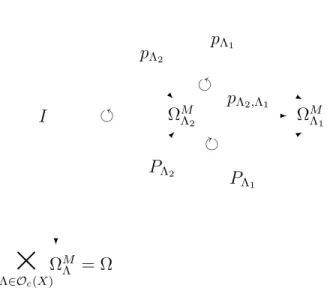
Finally in Section 7.6 we prove in detail the existence of a marked Poisson measure over the marked Poisson space ΩM
X, whereM is a complete separable
metric space with a probability measure. Hence all the results obtained in Chapter 7 extend with obvious changes to marked Poisson spaces.
We would like to point out that most of the results presented in this thesis have already been published, see e.g., [KSS97], [KSSU98], [KSSU97], [KSS98b], [KSS98a] as well as they have been announced in international con-ferences in Marseille’95, ’96, ’97, Kiev’96, Madeira Math Encounters X, XI, XII, XIII, XIV, XV, Stochastic Analysis and its Applications Barcelona’97 and Paris’98, and Seminar on Stochastic Analysis Bonn’98. Here we present a systematic exposition of this circle of ideas.
Acknowledgments
First of all I want to thank Prof. Dr. Ludwig Streit for his guidance in this project. Without his scientific and academical advice this thesis would never have been possible. It is a pleasure to thank him for introducing me into the world of science. He offered me the opportunity to get in contact with various scientists from different countries.
I have profited greatly from working with Prof. Dr. Yuri G. Kondratiev and I am extremely grateful for all he taught me about Gaussian and non-Gaussian analysis, his willingness in answering questions, his contribution for my scientific education, and more.
I am indebted to Prof. Dr. Georgi Us for many helpful discussions and fruitful collaboration. It is a great pleasure to thank my colleagues and friends Martin Grothaus, Tobias Kuna, and Markus Wiengarn, with whom I shared this exciting work, for their daily help in technical and scientific ques-tions. I thank my colleagues and friends M´ario Cunha, Cust´odia Drumond, Peter Leukert, and Werner Westerkamp for their support and successful joint work.
I have profited from many helpful discussions with Prof. Dr. Sergio Albe-verio, Prof. Dr. Yuri Berezanski, Dr. Nick Kachanovsky, Dr. Eugene Lytvy-nov, Prof. Dr. Robert Minlos, Prof. Dr. Michael R¨ockner, and Dr. Gennady Shchepan’uk.
It is a great pleasure to thanks Prof. Dr. Philippe Blanchard, Prof. Dr. Jos´e da Costa, Prof. Dr. Ana Bela Cruzeiro, Prof. Dr. Margarida de Faria, Prof. Dr. Ricardo Lima, Prof. Dr. Gueorgui Litvinchuk, Prof. Dr. Rui Vilela Mendes, Prof. Dr. Alexei Rebenko, Prof. Dr. J¨urgen Poffhoff, Prof. Dr. Rita Vasconcelos, and Prof. Dr. Jean Claude Zambrini for their support and help. I owe special thanks to B¨arbel Jahns and Hanne Litschwesky for encour-agement and support during my stay in Bielefeld. It is a pleasure to thank my parents who always supported me. Finally, I thank Adelina Gouveia for her patience and her support during these last (and first!) three years.
Chapter 2
Preliminaries
In this chapter we shall collect the most important properties of nuclear spaces, Fock spaces over Hilbert spaces, and some facts about holomorphic functions over a locally convex topological vector space, see Sections 2.1, 2.2, and 2.3 below, respectively. We will not reproduce full details in the men-tioned subjects but rather give the convenient descriptions for our purpose. Hence, the results concerning nuclear triples and kernel theorem are best summarized in [BK95], [GV68], [HKPS93]. About topologies in co-nuclear spaces we refer to the books [K¨ot71], [RR73], [Sch71], and [Tr`e67] for details, proofs, and examples. In Section 2.2 we define the Fock space over a Hilbert space and define on it the creation, annihilation, and second quantization operators which play an important role in the further chapters. Detailed description of Fock spaces can be founded in [BK95, Chapter 2 Section 2], [HKPS93, Appendix A.2], [Oba94], and [RS75a]. The standard references for holomorphy in locally convex spaces are [Din81], [Bar85], and [Col82].
2.1
Nuclear triples and kernel theorem
We start with a real separable Hilbert space H with inner product (·,·) and norm | · |. For a given separable nuclear space N densely and continuously embedded into H we can construct the nuclear triple
The dual pairing h·,·i of N′ and N then is realized as an extension of the
inner product in H
hf, ξi= (f, ξ), f ∈ H, ξ ∈ N.
Instead of reproducing the abstract definition of nuclear spaces (see e.g., [GV68], [RR73], [Sch71], and [Tr`e67]) we give a complete and convenient characterization in terms of projective limits of decreasing chains of Hilbert spaces Hp, p∈N.
Theorem 2.1.1 The nuclear Fr´echet space N can be represented as
N = \
p∈N
Hp,
where {Hp, p ∈N} is a family of Hilbert spaces such that for all p1, p2 ∈ N
there exists p ∈ N such that the embeddings ιp,p1 : Hp ֒→ Hp1, ιp,p2 : Hp ֒→
Hp2 are of Hilbert-Schmidt class. The space N is dense in each Hp for any
p ∈ N. The topology of N is given by the projective limit topology, i.e., the
coarsest topology on N such that for all p ∈ N the canonical embeddings
N ֒→ Hp are continuous.
The Hilbert norms onHp are denoted by | · |p, ∀p∈N. These norms are
compatible, i.e., if a sequence converges to zero with respect to a norm | · |p
and is Cauchy with respect to a norm | · |q, then it also converges to zero
with respect to | · |q. A basis of open neighborhoods of zero in the projective
limit topology is given by the sets
U(p, ε) = {ξ ∈ N | |ξ|p < ε}, for anyp∈Nand anyε >0.
Without loss of generality we always suppose that the system of norms is ordered, i.e., ∀p∈N, ∀ξ ∈ N : |ξ| ≤ |ξ|p and that the norms are increasing
|ξ|1 ≤ |ξ|2 ≤. . .≤ |ξ|p ≤ |ξ|p+1 ≤. . . , ξ ∈ N.
In this case the nuclearity of N means that for any p∈N there exists q∈N
such that the embedding ιq,p :Hq ֒→ Hp is nuclear, i.e., for any basis (ek)k∈N
of Hq the sum
∞ X
k=1
It is sufficient to require for any p∈N the existence of q′ ∈N such that the
embedding ιq′,p :Hq′ ֒→ Hp is Hilbert-Schmidt, i.e.,
kιq′,pk2
HS =
∞ X
k=1
|ιq′,pek|2p <∞,
because the composition of two Hilbert-Schmidt operators is nuclear, see e.g., [GV68]. In the present situation N is a countably Hilbert space in the sense of [GV68].
By general duality theory the dual spaceN′ can be written as
N′ = [
p∈N
H−p,
with inductive limit topology τindby using the dual family of spaces{H−p :=
H′
p, p ∈ N}. The inductive limit topology (with respect to this family) is
the finest topology on N′ such that for all p∈N the embeddingsH
−p ֒→ N′
are continuous. It is convenient to denote the norm on H−p by | · |−p.
Remark 2.1.2 Let us mention that in our setting the inductive limit topol-ogy τind coincides with the Mackey topology τ(N′,N) (i.e., the strongest
topology in N′ such that(N′, τ(N′,N))′ =N with the projective limit
topol-ogy) and the strong topology β(N′,N) (i.e., a basis of open neighborhoods of
zero is given by
Uβ(0, A) ={x∈ N′| |hx, ξi|< ε, ∀ξ∈A, A⊂ N bounded}).
This fact is also known as the reflexivity of countable Hilbert spaces. We refer to [BK95, Chapter 1 Section 1], [HKPS93, Appendix 5] and also [Sch71, Chapters 2, 4] for more details.
Further we want to introduce the notion of tensor powers of a nuclear space, see e.g., [RS75b] or [Gui72]. The simplest way to do this is to start from usual tensor powers H⊗n
p , n ∈N of Hilbert spaces. More precisely, let
(ej)j∈N be an orthonormal basis in Hp. Let us construct a formal product
eα :=eα1 ⊗. . .⊗eαn, (2.2)
where α = (α1, . . . , αn) ∈ Nn, in other words, we consider the ordered
assuming that they form the orthogonal basis of this space. The separable Hilbert space obtained as a result is called the n-th tensor product of the space Hp and is denoted by H⊗pn, n ∈N. Since there is no danger of
confu-sion we will preserve the notation (·,·)p, (resp. | · |p) and (·,·)−p (resp. | · |−p)
for the inner product (resp. norm) onH⊗n
p andH⊗−np. Vectors fromH⊗pnhave
the form
f = X
α∈Nn
fαeα, fα ∈R, |f|2p =
X
α∈Nn
|fα|2,
and
(f, g)p =
X
α∈Nn
fαgα, g =
X
α∈Nn
gαeα, gα ∈R.
Using the definition
N⊗n := pr lim
p∈N H
⊗n p ,
one can prove (see e.g., [Sch71]) that N⊗n is a nuclear space which is called
the n-th tensor power of N.
The dual space of N⊗n can be written
N′⊗n = ind lim p∈N H
⊗n
−p.
Thus we have introduced nuclear triples pr lim
p∈N H
⊗n
p =N⊗n⊂ H⊗n ⊂ N′⊗n = ind limp
∈N H
⊗n
−p, n∈N. (2.3)
Most important for the applications we have in mind in the abstract non Gaussian analysis theory (cf. Chapter 3 and followings) is the followingkernel theorem, see e.g., [BK95, Chapter 1 Section 2] and [GV68, Chapter I]. Below the kernel theorem is stated for the nuclear triples (2.3) which is sufficient later on, nevertheless this theorem holds also for Hilbert triples (or rigged Hilbert spaces), H+⊂ H0 ⊂ H−, where the embeddingH+ ֒→ H0 is
Hilbert-Schmidt and the pairing h·,·i of H− and H+ is realized as an extension of the inner product (·,·)0 inH0.
Theorem 2.1.3 Suppose that the nuclear triples (2.3) are given. Let Fn be
an n-linear form
which is Hp-continuous, i.e.,
|Fn(ξ1, ..., ξn)| ≤C|ξ1|p|ξ2|p. . .|ξn|p,
for some p ∈ N and C > 0. Then for all p′ > p such that the embedding ip′,p : Hp′ ֒→ Hp is Hilbert-Schmidt there exists a unique Φ(n) ∈ H⊗n
−p′ such that
Fn(ξ1, . . . , ξn) =hΦ(n), ξ1⊗ · · · ⊗ξni, ξ1, ..., ξn ∈ N,
and the following norm estimate holds
|Φ(n)|−p′ ≤Ckip′,pkn
HS
using the Hilbert-Schmidt norm of ip′,p.
Corollary 2.1.4 Let N × · · · × N ∋(ξ1, ..., ξn)7→F (ξ1, ..., ξn)be a n-linear
form which is H−p-continuous, i.e.,
|Fn(ξ1, . . . , ξn)| ≤C|ξ1|−p|ξ2|−p. . .|ξn|−p
for some p ∈ N and C > 0. Then for all p′ < p such that the embedding ip,p′ : Hp ֒→ Hp′ is Hilbert-Schmidt there exists a unique Φ(n) ∈ H⊗p′n such that
Fn(ξ1, ..., ξn) =hΦ(n), ξ1⊗ · · · ⊗ξni, ξ1, ..., ξn∈ N
and the following norm estimate holds
Φ(n)p′ ≤Ckip,p′k
n HS.
2.2
Fock spaces over Hilbert spaces
We now proceed to describe the Fock space. LetHbe a real separable Hilbert space, and let HC be the complexified Hilbert space ofHwith inner product
(f1, f2)HC = (f1,f¯2) = (g1, g2) + (h1, h2) +i(h1, g2)−i(g1, h2),
for f1, f2 ∈ HC, f1 =g1 +ih1, f2 =g2+ih2, g1, g2, h1, h2 ∈ H.
{1, . . . , n}. Then for any n ∈ N and σ ∈ Sn we define a unitary opera-tor Uσ,n on H⊗Cn by the formula
Uσ,n(f1⊗. . .⊗fn) := fσ1⊗. . .⊗fσn,
on a total set of elements of the formf1⊗. . .⊗fn∈ H⊗Cn. It is easy to verify
directly that, for the operator
Pn :=
1
n!
X
σ∈Sn
Uσ,n,
we have P2
n = Pn, Pn∗ = Pn and, therefore, it is an orthogonal projector
in H⊗n
C . The closed subspace of H⊗
n
C onto which Pn projects is denoted by
ExpnH, the n-th symmetric tensor power of the Hilbert space HC.
If in Theorem 2.1.3 (resp. Corollary 2.1.4) we start from a symmetric
n-linear form Fn on N⊗n i.e., Fn(ξσ1, . . . , ξσn) = Fn(ξ1, . . . , ξn) for any
per-mutation σ ∈ Sn, then the corresponding kernel Φ(n) can be localized in Expp′H ⊂ H⊗p′n,C. For f1, . . . , fn ∈ HC let ˆ⊗ also denote the symmetrization
of the tensor product
f1⊗ · · ·ˆ ⊗ˆfn:=Pn(f1⊗ · · · ⊗fn) =
1
n!
X
σ∈Sn
fσ1 ⊗ · · · ⊗fσn.
All the above quoted theorems also hold for complex spaces, in particular the complexified space NC. By definition an element ξ ∈ NC decomposes into
ξ =ζ+iθ,ζ, θ ∈ N.
The Fock space (Boson or symmetric) ExpHoverHis defined as a Hilbert orthogonal sum
ExpH:=
∞ M
n=0
ExpnH, Exp0H:=C,
and, hence, consists of the sequences F = (f(n))∞
n=0 (fn∈ExpnH) for which
kFk2ExpH=
∞ X
n=0
n!|f(n)|2 <∞.
The subspaces ExpnH are often called n-particle subspaces, Exp0H is called
interested inL2-analysis, we skip this procedure and refer to [BK95], [Hid80], [HKPS93], and [Oba94] for the corresponding construction.
Let us now introduce a series of objects in the Fock space which are relevant in what follows.
Denote by Expf inHthe subspace of finite vectors from ExpH, i.e., vectors of the formF = (f(0), f(1), . . . , f(n),0,0, . . .). Obviously, Exp
f inH is dense in
ExpH.
For any f ∈ HC and n ∈ N let f⊗n := f ⊗. . .⊗f ∈ ExpnH be given.
The vectors
Expf := (1, 1
1!f, . . . , 1
n!f
⊗n, . . .),
are called coherent states (or exponential vectors) corresponding to the one-particle statef. For any set L ⊂ HC which is total inHCthe set of coherent
states {Expf|f ∈ L} ⊂ ExpH is also total in ExpH, see e.g. [Gui72, Chapter 2] and [BK95]. According to the definition of ExpH, we have
(Expf1,Expf2)ExpH =e(f1,f2)HC,
and
kExpfk2ExpH=e|f|2HC, f
1, f2, f ∈ HC.
Next we introduce creation and annihilation operators on the Fock space ExpH, see e.g., [HKPS93, Appendix A.2] and [RS75a]. Consider f(n) ∈ ExpnH of the form
f(n) =f1⊗ˆ. . .⊗ˆfn, fi ∈ H, i= 1, . . . , n. (2.4)
Leth∈ H. Then theannihilation operator a−(h) ofhacts onf(n) as follows:
a−(h)f(n) :=
n
X
j=1
(h, fj)f1⊗ˆ. . .⊗ˆfj−1⊗ˆfj+1⊗ˆ. . .⊗ˆfn∈Expn−1H. (2.5)
This definition is independent of the particular representation off(n)in (2.4), hence a−(h) is well-defined. Then we extend (2.5) by linearity to a dense
subspace of ExpnH consisting of finite linear combinations of elements of
the form (2.4). One easily finds the following inequality for such elements (cf. [RS75a])
|a−(h)f(n)| ≤√n|h||f(n)|, (2.6) which shows that the extension of a−(h) to Exp
nH as a bounded operator
to Expf inH which, therefore, give us a densely defined operator on ExpH denoted again by a−(h). So the adjoint operator of a−(h) exists, which we denote by a+(h) and called creation operator. The action of the creation operator on elements f(n) ∈ Exp
nH is given by
a+(h)f(n) =h⊗ˆf(n)∈Expn+1H.
For the creation operator we also have an estimate |a+(h)f(n)| ≤√n+ 1|h||f(n)|.
As before, this estimate give us the possibility to deduce thata+(h) is densely defined on ExpH. Hence,a−(h) anda+(h) are closable and we use the same notation for their closures. In Chapter 4 we will obtain explicit representa-tions for these operators on L2 with respect to the Poisson measure.
Finally we would like to introduce the second quantization operator on ExpH. For any contractionB inH it is possible to define an operator ExpB
as a contraction in ExpH which in any n-particle subspace ExpnH is given
byB⊗ · · · ⊗B (n times). LetAbe a positive self-adjoint operator inHwith domain of essential selfadjointness D. Furthermore, suppose that N ⊂ D
and that A leaves N invariant. Then we have a contraction semigroupe−tA,
t ≥0 and it is possible to introduce thesecond quantization operator dExpA
as the generator of the semigroup Exp(e−tA), t≥0, i.e.,
Exp(e−tA) = exp(−tdExpA),
see e.g., [RS75a].
2.3
Holomorphy on locally convex spaces
We shall collect some facts from the theory of holomorphic functions in lo-cally convex topological vector spaces E (over the complex field C), see e.g., [Bar85], [Col82], and [Din81].
2.3.1
Holomorphic functions
Let L(En) be the space of n-linear mappings from En intoC and L
s(En) the
subspace of symmetric n-linear forms. Also let Pn(E) denote the set of all
Definition 2.3.1 Let U ⊂ E be open and F : U → C a function. Then F
is said to be G-holomorphic (or Gˆateaux-holomorphic) if and only if for all
θ0 ∈ U and for all θ ∈ E the mapping
C∋λ7→F(θ0 +λθ)∈C,
is holomorphic in some neighborhood of 0∈C.
If F is G-holomorphic, then there exists for every η ∈ U a sequence of homogeneous polynomials n1!d\nF(η) such that
F(θ+η) =
∞ X
n=0 1
n!
\
dnF(η)(θ),
for all θ from some open neighborhood V of zero. Of course, d\nF(η)(θ) is
the n-th partial derivative ofF atη in directionθ.
Definition 2.3.2 Let F :U →C be a G-holomorphic function. Then 1. F is said to be holomorphic, if and only if for all η∈ U there exists an
open neighborhood V of zero such that
V ∋ θ 7→ ∞ X
n=0 1
n!
\
dnF(η)(θ),
converges uniformly on V to a continuous function.
2. F is holomorphic at θ0 if and only if there is an open set U containing
θ0 such that F is holomorphic on U.
3. F is called entire if and only if F is holomorphic on E.
Useful in applications is the following proposition which follows from the above considerations, see [Din81, Chapter 2, Lemma 2.8].
Let us consider the special caseE =NC. In order to have uniqueness in
the characterization of distributions spaces we must not discern between dif-ferent restrictions of one function. Hence we consider germs of holomorphic functions at zero, i.e., we identify F and ˜F if there exists an open neigh-borhood of zero U ⊂ NC such that F(ξ) = ˜F(ξ) for all ξ ∈ U. Thus we
define
Definition 2.3.4 Hol0(NC)as the algebra of germs of complex-valued func-tions F on NC which are holomorphic at zero equipped with the inductive topology given by the following family of norms
np,l,∞(F) = sup |θ|p≤2−l
|F(θ)|, p, l∈N.
A direct consequence of Proposition 2.3.3 is the following corollary. Corollary 2.3.5 Let F :NC →Cbe given. Then F ∈Hol0(NC)if and only if there exists p∈N, ε >0, and C >0 such that
1. for all ξ0 ∈ NC with |ξ0|p ≤ ε and for all ξ ∈ NC the function of one complex variable C∋λ7→F(ξ0+λξ)∈C is holomorphic at zero, and
2. for all ξ ∈ NC with |ξ|p ≤ε we have |F(ξ)| ≤C.
Later on we need also the space Hol0(NC,NC) of vector-valued
holomor-phic functions from NC to NC.
Definition 2.3.6 A mapping F :NC→ NC belongs to Hol0(NC,NC) if and only if it is G-holomorphic and for each η in NC there exists p∈N such that the function
θ 7−→ ∞ X
n=0 1
n!
\
dnF(η)(θ),
converges and defines a continuous function on some | · |p-neighbourhood of
zero.
If F : NC → NC is holomorphic at 0 ∈ NC, then for every η ∈ NC there
exists a sequence of homogeneous polynomials 1
n!d\nF(η) such that V ∋θ 7→
∞ X
n=0 1
n!
\
dnF(η) (θ), (2.7)
2.3.2
Spaces of entire functions
In this subsection we introduce some spaces of entire functions which will be useful later on. Let Ek
min(NC′) be the set of all entire functions on NC′ of a
minimal type whose order of growth is at most k ∈ [1,2]. This means that, as a set, Ek
min(NC′) consists of the functions entire on eachH−p,C, p∈N and
such that for all ϕ ∈ Ek
min(NC′), p ∈ N, and every ε > 0 there exists C > 0
such that
|ϕ(z)| ≤Cexp(ε|z|k
−p), for allz∈ H−p,C,
i.e., these are the functions of a minimal type on each H−p,C with the order
of growth at most k. The space Ek
min(NC′) is endowed with the projective
limit topology with respect to the countable system of norms
m−p,l,k(ϕ) = sup z∈H−p,C
{|ϕ(z)|exp(−1/l|z|k
−p)}, p, l∈N, (2.8)
which is a ordered system. Since the first axiom of countability holds for Ek
min(NC′) with this topology, it suffices to describe convergent sequences of
functions from this space in order to define the topology under consideration. It follows from (2.8) that ϕn ∈ Emink (NC′) converges to zero inEmink (NC′) if and
only if the following two conditions holds:
1. for anyp∈N and ε >0 there exists C >0 such that |ϕn(z)| ≤Cexp(ε|z|k−p), z ∈ H−p,C, n∈N,
2. as n→0, ϕn converges to 0 uniformly on every ball
{z ∈ H−p,C||z|−p ≤R}, R >0,
in each H−p,C,p∈N.
Let us introduce one more space of entire functions. Denote byEk
max(NC)
the set of functions on NC with the following properties:
1. each function is entire on some Hp,C, p∈N,
2. as an entire function onHp,C, it has finite type for the order of growth
In other words, for Φ∈ Ek
max(NC),∃p > 0 and constantsC, K >0 such that
the following estimate should holds
|Φ(η)| ≤Cexp(K|η|k
p), η∈ NC.
The spaceEk
max(NC) is topologize by the inductive limit topology with respect
to the family of norms
Mp,l,k(Φ) = sup η∈NC
{|Φ(η)|exp(−l|η|kp)}, p, l ∈N.
Hence a sequence (Φn)∞n=1 ⊂ Emaxk (NC) converges to zero if and only if they
are entire functions on the common Hilbert spaceHp,C, there exists a uniform
bound
|Φn(η)| ≤Cexp(K|η|kp), η∈ Hp,C, n∈N,
and that Φn converges uniformly to 0 as n→ ∞ on every ball inHp,C.
Remark 2.3.7 Let us mention that the spaceEk
min(NC′)(resp.Emaxk (NC)) ad-mits the following representation in terms of projective limit (resp. inductive limit) of the family of normed spaces Ek
2−l(H−p,C), p, l ∈ Z (resp. E2kl(Hp,C),
p, l ∈ Z). More precisely, the set of all entire functions on each H−p,C (resp. on some Hp,C) of growth k ∈ [1,2] and type 2−l (resp. 2l) with norm
given by
np,l,k(ϕ) := sup z∈H−p,C
|ϕ(z)|exp(−2−l|z|k
−p), ϕ ∈ E2k−l(H−p,C),
(resp. np,l,k(ϕ) := sup z∈Hp,C
|ϕ(z)|exp(−2l|z|kp), ϕ∈ E2kl(Hp,C)). The space of entire functions on N′
C (resp.NC) of growth k and minimal type (resp. maximal type) is naturally introduced by
Emink (NC′) = pr lim
p,l∈N E
k
2−l(H−p,C),
(resp.Emaxk (NC) = ind lim
p,l∈N E
k
2l(Hp,C)).
We now give an equivalent description of Ek
min(NC′) and Emaxk (NC). The
in a convenient form. Letϕ ∈ Ek
min(NC′) and z ∈ NC′, then there exist kernels
ϕ(n) ∈ N⊗ˆn
C such that
hz⊗n, ϕ(n)i= 1
n!
\
dnϕ(0)(z),
i.e.,
ϕ(z) =
∞ X
n=0
hz⊗n, ϕ(n)i. (2.9)
Let Eβ
p,q denote the space of all functions of the form (2.9) such that the
following Hilbert norm
|||ϕ|||2p,q,β :=
∞ X
n=0
(n!)1+β2nq|ϕ(n)|2p, p, q ∈N, (2.10)
is finite for all β ∈ [0,1]. (By|ϕ(0)|
p we simply mean the complex modulus
for all p). The space E−−βp−,q with the norm |||ϕ|||−p,−q,−β is defined
analo-gously. The following two theorems gives a description of the above intro-duced spaces of entire functions Ek
min(NC′), and Emaxk (NC). For the proof we
refer to [KSWY95], [Oue91], and [Wes95].
Theorem 2.3.8 The following topological identity holds:
pr lim
p,q∈N
Eβ p,q=E
2 1+β
min (NC′).
The proof is based on the following two lemmata which show that the two systems of norms are in fact equivalent.
Lemma 2.3.9 Let ϕ ∈Eβ
p,q be given, then ϕ ∈ E
2 1+β
2−l (H−p,C) for l = 1+qβ. Moreover
np,l,k(ϕ)≤ |||ϕ|||p,q,β, k = 1+2β. (2.11)
Lemma 2.3.10 For any p′, q ∈N there exist p, l ∈N such that
E
2 1+β
2−l (H−p,C)⊂Eβp′,q, i.e., there exists a constant C >0 such that
|||ϕ|||p′,q,β ≤Cnp,l,k(ϕ), ϕ ∈ Ek
The above results also imply the following theorem, see also [Oue91, Proposition 8.6] for related results.
Theorem 2.3.11 If β∈[0,1) then the following topological identity holds:
ind lim
p,q∈N E
−β
−p,−q =Emax2/(1−β)(NC). If β = 1 we have
ind lim
p,q∈N E
−1
−p,−q = Hol0(NC).
Chapter 3
Generalized functions in
infinite dimensional analysis
Non-Gaussian analysis was already introduced in [AKS93] for smooth proba-bility measures on infinite dimensional linear spaces. The method used was biorthogonal decomposition which is a natural extension of the chaos decom-position that is well known in Gaussian analysis. This biorthogonal “Appell” system has been constructed for smooth measures by Yu. L. Daletski [Dal91]. For a detailed description of its use in infinite dimensional analysis and for the proof of the results which were announced in [AKS93] we refer to [ADKS96]. These results are based on quasi-invariance of the measures and smoothness of the logarithmic derivatives. Here we would like to mention that this ap-proach does not cover the important case of Poisson measures, see Chapter 5 for more details of Poisson measures.
Kondratiev et al. [KSWY95] considered the case of non-degenerate mea-sures on the dual of a nuclear space with analytic characteristic functionals for which no further condition such as quasi-invariance of the measure or smooth-ness of the logarithmic derivative was required. In this case the important example of Poisson measures is now accessible. Again for a given measure µ
with analytic Laplace transform they construct an Appell biorthogonal sys-tem Aµ as a pair (Pµ,Qµ) of Appell polynomials Pµ and a canonical system
of generalized functions Qµ, properly associated to the measure µ. Hence
within this framework they obtained:
• characterization theorems for generalized as well as test functions were obtained analogously as in Gaussian analysis, see [KLP+96] for more references;
• extension of the Wick product and the corresponding Wick calculus (see [KLS96] for this notion) as well as a full description of positive distributions (as measures).
In this chapter we will recall this construction under the same assumptions on the measure µ (cf. Assumptions 3.1.3 and 3.1.6 below) as well as the aforementioned results. In the next chapter we are going to generalize them along the lines presented here.
3.1
Measures on linear topological spaces
Given the triple (2.1) we would like to introduce probability measures on the vector space N′. In N′ we consider the σ-algebra C
σ(N′) generated by
the cylinder sets on N′. Let us describe this more precisely. Consider the
following collection of finite dimensional subsets from N: L :={L|L⊂ N, dimL <∞}.
For any L ∈ L and every A ∈ B(L) (i.e., the Borel σ-algebra on L) we introduce the set
C(L, A) :={x∈ N′|PL(x)∈A}, (3.1)
which is called the cylinder set from N′ with coordinate L. Here P
L is an
orthogonal projector ontoLdefined in Hwhich extends toN′ by continuity.
Then we define the σ-algebra C(L,N′) with a fixed coordinate L using the
cylinder sets C(L, A) by
C(L,N′) :={C(L, A)|A ∈ B(L)}.
Finally the σ-algebra of cylinder setsCσ(N′) is defined by
Cσ(N′) :=σ
[
L∈L
C(L,N′)
Remark 3.1.1 It is sometimes convenient to introduce cylinder sets (3.1) by employing the “coordinate” method. To this end we choose an orthonormal basis (ek)nk=1 in L which is also orthonormal in N. Then for any x∈ N′ we
have
PL(x) = n
X
k=1
hx, ekiek,
which implies the following representation for C(L, A), A∈ B(Rn):
C(L, A) ={x∈ N′|(hx, e1i, . . . ,hx, eni)∈A}.
Moreover, if we replace the vectors ek by arbitrary vectors ξk ∈ N, then the
set obtained as a result
{x∈ N′|(hx, ξ1i, . . . ,hx, ξ
ni)∈B}, B ∈ B(Rn).
will be cylinder too.
Let us consider one more topology on N′, the so-called weak topology
Bσ(N′). It is given by the following system of base neighborhoods of zero
U(0;{ξ1, . . . , ξn}) :={x∈ N′||hx, ξji|<1, n∈N, j = 1, . . . n},
for any ξ1, . . . , ξn ∈ N and x∈ N′. The weak topology Bσ(N′) is consistent
with the duality of the triple (2.1) in the following sense: a set of linear functionals overN′ coincides withN in this topology, i.e., an arbitrary
func-tional x of this kind admits a representationx(ξ) = (x, ξ), for some ξ ∈ N, and an arbitrary vector ξ∈ N generates (according to this formula) a linear Bσ(N′)-continuous functional onN′.
Remark 3.1.2 In the case of a countable Hilbert space N (which is in fact the case we handle), we have that the σ-algebras Bσ(N′) and Bβ(N′)
gener-ated by the weak and strong topology on N′, respectively and the σ-algebra
generated by the cylinder sets Cσ(N′) coincide, i.e.,
Cσ(N′) =Bσ(N′) =Bβ(N′).
Thus we will consider this σ-algebra as the natural σ-algebra on N′. We
We will restrict our investigations to a special class of probability mea-sures µ on Cσ(N′) which satisfy two additional assumptions, see
Assump-tions (3.1.3) and (3.1.6) below. The first one concerns some analyticity of the Laplace transform
lµ(θ) :=
Z
N′
exphx, θidµ(x) =:Eµ(exph·, θi), θ ∈ NC.
Here we also have introduced the convenient notion of expectation Eµ of a
µ-integrable function.
Assumption 3.1.3 The measure µ has an analytic Laplace transform in a neighborhood of zero. That means, there exists an open neighborhoodU ⊂ NC of zero, such that lµ is holomorphic on U, i.e., lµ∈ Hol0(NC). This class of analytic measures is denoted by Ma(N′).
An equivalent description of analytic measures is given by the following lemma.
Lemma 3.1.4 The following statements are equivalent. 1. µ∈ Ma(N′),
2. ∃pµ∈N, ∃C >0 :
Z
N′h
x, θindµ(x)
≤n!Cn|θ|npµ, θ ∈ Hpµ,C,
3. ∃p′µ∈N, ∃εµ >0 :
Z
N′
exp(εµ|x|−p′
µ)dµ(x)<∞.
The proof can be found in [KSW95].
Forµ∈ Ma(N′) the estimate in statement 2 of the above lemma allows
to define the moment kernelsMµ n ∈ N′
ˆ
⊗nofµ. This is done by extending the
above estimate by a simple polarization argument and applying the kernel theorem (cf. Theorem 2.1.3). The kernels are determined by
lµ(θ) =
∞ X
n=0 1
n!hM
µ
n, θ⊗ni, (3.2)
or equivalently
hMnµ, θ1⊗ˆ. . .⊗ˆθni=
∂n
∂t1. . . ∂tn
Moreover, if p > pµ is such that the embedding ιp,pµ :Hp ֒→ Hpµ is
Hilbert-Schmidt, then there exists C >0 such that |Mµ
n|−p ≤(nC
ιp,pµ
HS)
n ≤n!(eCι p,pµ
HS)
n. (3.4)
Definition 3.1.5 A function ϕ :N′ →C of the form
ϕ(x) =
N
X
n=0
hx⊗n, ϕ(n)i, x∈ N′, N ∈N,
is called a smooth continuous polynomial (for short ϕ ∈ P(N′)) if and only
if ϕ(n) ∈ N⊗ˆn
C , ∀n ∈ N0 := N∪ {0}. For any n ∈ N, h·⊗n, ϕ(n)i is called smooth continuous monomial.
Now we are ready to formulate the second assumption on µ.
Assumption 3.1.6 For all ϕ ∈ P(N′) with ϕ = 0 µ-a.e. we have ϕ ≡ 0.
In the following a measure with this property will be called non-degenerate.
Remark 3.1.7 1. Assumption 3.1.6 can be formulated as follows. For any continuous polynomial ϕ ∈ P(N′) with
Z
A
ϕ(x)dµ(x) = 0, for allA∈ Cσ(N′),
we have ϕ≡0.
2. A sufficient condition can be obtained by regarding admissible shifts of the measure µ. If µ(·+ξ) is absolutely continuous with respect toµfor all ξ ∈ N, i.e., there exists the Radon-Nikodym derivative
ρµ(ξ, x) =
dµ(x+ξ)
dµ(x) ∈L 1(
N′, µ), x∈ N′,
Example 3.1.8 (Gaussian measures) In Gaussian Analysis (especially white noise analysis) the Gaussian measure γH corresponding to the Hilbert space H is considered. Its Laplace transform is given by
lγH(θ) =e
1
2|θ|2, θ∈ NC,
hence γH ∈ Ma(N′). It is well known that γH is N-quasi-invariant
(more-over H-quasi-invariant) see e.g., [Sko74]. Due to the previous remark γH
satisfies also Assumption 3.1.6.
Example 3.1.9 (Poisson measures) Let us consider the classical (real) Schwartz triple
S(R)⊂L2(R)⊂S′(R).
The Poisson white noise measure π is defined as a probability measure on
Cσ(S′(R)) with Laplace transform
lπ(θ) = exp
Z
R
(eθ(t)−1)dt
, θ ∈S(R),
see e.g., [GV68]. It is not hard to see that lπ is a holomorphic function on
S(R), so Assumption 3.1.3 is satisfied. But to check Assumption 3.1.6, we need additional considerations. We will prove this fact in the next chapter in the context of the construction of generalized Appell systems.
Remark 3.1.10 In Chapter 5 we will return to Poisson measures and give detailed analysis as well as its applications, for instances intrinsic and ex-trinsic geometry on Poisson spaces.
3.2
Concept of generalized functions in
infi-nite dimensional non-Gaussian analysis
We will chooseP(N′) as our minimal test function space (see, for instance,
[KMP65] for a discussion in which sense this space is minimal). First we have to ensure that P(N′) is densely embedded in L2(µ). This is fulfilled because of our Assumption 3.1.3 (see [Sko74, Section 10 Theorem 1]). The space P(N′) may be equipped with various different topologies, but there
exists a natural one such that P(N′) becomes a nuclear space, see [BK95].
The topology on P(N′) is chosen such that is becomes isomorphic to the
topological direct sum of tensor powersNC⊗ˆn see e.g., [Sch71, Chapter II-6.1,
Chapter III-7.4]
P(N′)≃
∞ M
n=0 NC⊗ˆn,
via
ϕ(x) =
∞ X
n=0
hx⊗n, ϕ(n)i ←→ϕ~ = (ϕ(n))∞n=0.
Note that only a finite number of ϕ(n) are non-zero. The notion of con-vergence of sequences in this topology on P(N′) is the following: for any ϕ ∈ P(N′) such that
ϕ(x) =
N(ϕ)
X
n=0
hx⊗n, ϕ(n)i,
let
pn:P(N′)→ NC⊗ˆn,
denote the mapping pn defined by pn(ϕ) := ϕ(n). A sequence (ϕj)∞j=1 of smooth continuous polynomials converge to ϕ ∈ P(N′) if and only if the N(ϕj) are bounded and
pnϕj −→
j→∞ pnϕ in N
ˆ
⊗n
C for alln ∈N.
Now we can introduce the dual space P′
µ(N′) of P(N′) with respect to
L2(µ).As a result we have constructed the triple P(N′)⊂L2(µ)⊂ Pµ′(N′).
The (bilinear) dual pairing hh·,·iiµ between Pµ′(N′) and P(N′) is connected
to the (sesquilinear) inner product on L2(µ) by
Since the constant function 1 ∈ P(N′) we may extend the concept of
expectation from random variables to generalized functions: for any Φ ∈ P′
µ(N′)
Eµ(Φ) :=hhΦ,1iiµ.
The main goal of this section is to provide a description for P′
µ(N′), see
Theorem 3.2.11 below (here we mention that in the next chapter we are going to present a generalization of the approach exhibited in this section where this is a special case). The simplest approach to this problem seems to be the use of so called Appell polynomials.
3.2.1
Appell polynomials associated to the measure
µ
Because of the holomorphy of the Laplace transform lµ and the fact that
lµ(0) = 1, there exists a neighborhood of zero inNC
U0 ={θ ∈ NC|2q0|θ|p0 <1},
where p0, q0 ∈N, p0 ≥p′µ, 2−q0 ≤εµ (p′µ, εµ from Lemma 3.1.4 - 3) such that
lµ(θ)6= 0 for any θ ∈ U0. Thus the normalized exponential
eµ(θ;z) :=
exphz, θi
lµ(θ)
, for anyθ ∈ U0, z ∈ NC′, (3.5)
is well defined. We use the holomorphy of θ 7→ eµ(θ;z) to expand it in a
power series inθ similar to the case corresponding to the construction of one dimensional Appell polynomials, see e.g., [Bou76]. We have in analogy to [AKS93], [ADKS96]
eµ(θ;z) =
∞ X
n=0 1
n!
\
dne
µ(0;z) (θ),
where dn\e
µ(0;z) is a n-homogeneous continuous polynomial. Sinceeµ(θ;z)
is not only G-holomorphic but also holomorphic we know thatθ7→eµ(θ;z) is
also locally bounded. Thus Cauchy’s inequality for Taylor series (cf. [Din81, Chapter 2] may be applied. Hence we choose ρ≤2−q0, p≥p
0 and estimate the n-th coefficient in Taylor’s series by
1
n!|
\
dne
µ(0;z) (θ)| ≤
1
ρn sup
|θ|p=ρ
|eµ(θ;z)||θ|np ≤
1
ρn sup
|θ|p=ρ
1
lµ(θ)
exp(ρ|z|−p)|θ|np,
for anyz ∈ H−p,C. This inequality extends by polarization [Din81, Chapter 1
Theorem 1.5] to an estimate sufficient for the kernel theorem. Thus we have a representation
\
dne
µ(0;z)(θ) =hPnµ(z), θ⊗ni,
where
Pnµ :NC′ −→ N′
ˆ
⊗n
C .
The kernel theorem really gives a little more: Pµ
n(z) ∈ H
ˆ
⊗n
−p′,C for any p′
(> p ≥p0) such that the embedding operator
ιp′,p :Hp′,C֒→ Hp,C,
is Hilbert-Schmidt. Thus we have
eµ(θ;z) =
∞ X
n=0 1
n!hP
µ
n(z), θ⊗ni, for any θ ∈ U0, z ∈ NC′. (3.7)
We will also use the notation
Pnµ(ϕ(n))(·) :=hPnµ(·), ϕ(n)i, ϕ(n)∈ N
ˆ
⊗n
C , n∈N,
which is called Appell polynomial. Thus for any measure satisfying Assump-tion 3.1.3 we have defined the Pµ-system
Pµ={hPµ
n(·), ϕ(n)i|ϕ(n) ∈ N
ˆ
⊗n
C , n∈N0}.
The following proposition summarize some useful properties of the Appell polynomials Pµ
n (·).
Proposition 3.2.1 The system of Appell polynomials has the following pro-perties.
(P1) For any z∈ N′
C and n∈N
Pnµ(z) =
n
X
k=0
n k
z⊗k⊗ˆPnµ−k(0). (3.8)
(P2) For every z ∈ N′
C and Mnµ as defined in (3.3) we have
z⊗n =
n
X
k=0
n k
(P3) For all z, w ∈ N′
C and Mnµ as above
Pnµ(z+w) = X
k+l+m=n
n!
k!l!m!P
µ k(z) ˆ⊗P
µ
l (w) ˆ⊗Mmµ
=
n
X
k=0
n k
Pkµ(z) ˆ⊗w⊗(n−k). (3.10)
(P4) Further we observe
Eµ(hPmµ(·), ϕ(m)i) = 0, form 6= 0, ϕ(m)∈ N
ˆ
⊗m
C . (3.11)
(P5) For all p > p0 such that the embedding ιp,p0 : Hp ֒→ Hp0 is Hilbert–
Schmidt and for all ε > 0 small enough (ε ≤ (2q0eki
p,p0kHS)−1) there
exists a constant C(p, ε)>0 with
|Pnµ(z)|−p ≤C(p, ε)n!ε−n exp(ε|z|−p), z ∈ H−p,C. (3.12)
Remark 3.2.2 Notice that formula (3.8) together with
1
lµ(θ)
=
∞ X
n=0 1
n!hP
µ
n(0), θ⊗ni, θ ∈ NC, |θ|q < δ >0, q∈N,
can also be used as an alternative definition of the polynomials Pµ n(·).
The proof of the above proposition will be given in a more general frame-work in Chapter 4 (cf. Proposition 4.1.1), therefore we postpone its proof to Chapter 4.
The following lemma describes the set of polynomials P(N′).
Lemma 3.2.3 For any ϕ ∈ P(N′) there exists a unique representation
ϕ(x) =
N
X
n=0 hPµ
n(x), ϕ(n)i, ϕ(n) ∈ N
ˆ
⊗n
C , (3.13)
and vice versa, any functional of the form (3.13) is a smooth continuous polynomial.
3.2.2
The dual Appell system and description of
P
µ′(
N
′)
To give an internal description of the type (3.13) for P′
µ(N′) we have to
construct an appropriate system of generalized functions, the Qµ-system.
We propose to construct the Qµ-system using differential operators (this
approach has the advantage to cover the important example of Poisson mea-sures, cf. Example 3.1.9. In [ADKS96] they constructed such Qµ-system but
for smooth logarithmic derivative of the measure µ, therefore the Poisson measure π is not covered, see Example 3.1.9).
Definition 3.2.4 Let Φ(n) ∈ N′⊗ˆn
C be given. We define a differential opera-tor D(Φ(n)) (of order n and constant coefficients Φ(n))
D(Φ(n)) :P(N′)−→ P(N′),
which acts on smooth continuous monomials h·⊗m, ϕ(m)i, ϕ(m) ∈ N⊗ˆm
C , m ∈
N
(D(Φ(n))h·⊗m, ϕ(m)i)(x) :=
m! (m−n)!hx
⊗(m−n)⊗ˆΦ(n), ϕ(m)i for m≥n
0 for m < n
,
(3.14)
x∈ N′and extend by linearity from smooth continuous monomials to P(N′).
Lemma 3.2.5 The operator D(Φ(n)) is a continuous linear operator from P(N′) to P(N′).
Remark 3.2.6 For Φ(1) ∈ N′ we have the usual Gˆateaux derivative as e.g.,
in white noise analysis [HKPS93]:
(D(Φ(1))ϕ)(x) = (DΦ(1)ϕ)(x) :=
d
dtϕ(x+tΦ
(1))
|t=0, ϕ ∈ P(N′).
Moreover we have D((Φ(1))⊗n) = (D
Φ(1))n, thus D((Φ(1))⊗n) is a differential
operator of order n.
Proof of Lemma 3.2.5. By definition P(N′) is isomorphic to the
topolo-gical direct sum of tensor powers N⊗ˆn
C , i.e.,
P(N′)≃
∞ M
n=0 N⊗ˆn
Via this isomorphism D(Φ(n)) transforms each componentN⊗ˆm
C , m≥n by
ϕ(m) 7→ n! (m−n)!(Φ
(n), ϕ(m))
H⊗ˆn,
where the contraction (Φ(n), ϕ(m))
H⊗ˆn ∈ N
⊗(m−n)
C is defined by
hx⊗(m−n),(Φ(n), ϕ(m))H⊗ˆni:=hx⊗(m−n)⊗ˆΦ(n), ϕ(m)i, (3.15)
for all x∈ N′. It is easy to verify that
|(Φ(n), ϕ(m))H⊗ˆn|q ≤ |Φ(n)|−q|ϕ(m)|q, q ∈N,
which guarantees that (Φ(n), ϕ(m))
H⊗ˆn ∈ N⊗
(m−n)
C and shows at the same
time that D(Φ(n)) is continuous on each component. This is sufficient to ensure the stated continuity of D(Φ(n)) on P(N′).
In view of Lemma 3.2.5 it is possible to define the adjoint operator
D(Φ(n))∗ :P′
µ(N′)−→ Pµ′(N′), Φ(n) ∈ N′
ˆ
⊗n
C .
Further we introduce the constant function 1 ∈L2(µ) ⊂ P′
µ(N′) such that
1 (x)≡1 for allx∈ N′, so
hh1, ϕiiµ=
Z
N′
ϕ(x)dµ(x) = Eµ(ϕ), ϕ ∈ P(N′).
Definition 3.2.7 For any Φ(n) ∈ N′⊗ˆn
C we define a generalized function
Qµ
n(Φ(n))∈ Pµ′(N′) by
Qµn(Φ(n)) :=D(Φ(n))∗1.
We want to introduce an additional formal notation which stresses the linearity of Φ(n) 7→Qµ
n(Φ(n))∈ Pµ′(N′):
hQµn,Φ(n)i:=Qµn(Φ(n)).
Example 3.2.8 The simplest non trivial case can be studied using finite dimensional real analysis. We consider the nuclear ”triple”
where the dual pairing between a ”test function” and a ”generalized function” degenerates to multiplication. OnRwe consider a measure dµ(x) :=ρ(x)dx
whereρis a positiveC∞-function onRsuch that Assumptions 3.1.3 and 3.1.6 are fulfilled. In this setting the adjoint of the differentiation operator is given
by
d dx
∗
f(x) =−
d
dx +β(x)
f(x), f ∈C∞(R),
where β is the logarithmic derivative of the measure µ given by
β(x) = ∇
R
ρ(x)
ρ(x) =
ρ′(x) ρ(x).
This enables us to calculate the generalized functions Qµ
n. One has
Qµn(x) =
d dx
∗n
1 = (−1)n
d
dx +β(x) n
1 = (−1)nρ (n)(x)
ρ(x) ,
where the last equality can be seen by simple induction (forρ notC∞-function
this construction produces generalized functions Qµ
n even in this one
dimen-sional case). If ρ(x) = √1
2π exp(−
1 2x
2) is the Gaussian density, then Qµ
n is related to
the n-th Hermite polynomial:
Qµ
n(x) = 2−n/2Hn 2−1/2x
.
Now we are ready to define theQµ-system.
Definition 3.2.9 We define the Qµ-system in P′
µ(N′) by
Qµ:={Qµn(Φ(n))|Φ(n) ∈ NC′⊗ˆn, n∈N0},
and the pair Aµ= (Pµ,Qµ) will be called the Appell system generated by the
measure µ.
The Appell system Aµ has the following central property.
Theorem 3.2.10 The system of Appell polynomials Pµ and the dual Appell
system Qµ are biorthogonal with respect to µ and
hhQµn(Φ(n)), Pmµ(ϕ(m))iiµ=δm,nn!hΦ(n), ϕ(n)i, (3.16)
for any Φ(n) ∈ N′⊗ˆn
C and all ϕ(m) ∈ N
ˆ
⊗m
Now we are going to characterize the spaceP′
µ(N′).
Theorem 3.2.11 For any Φ ∈ P′
µ(N′) there exists a unique sequence
(Φ(n))∞
n=0, where Φ(n) ∈ N′ ˆ
⊗n
C , n∈N0 such that
Φ =
∞ X
n=0
Qµn(Φ(n))≡
∞ X
n=0
hQµn,Φ(n)i, (3.17)
and vice versa, every series of the form (3.17) generates a generalized func-tion in P′
µ(N′).
We will prove this property is more general form in the next chapter (cf. Theorem 4.2.7), see also [KSWY95, Theorem 19].
3.3
Spaces of test and generalized functions
3.3.1
Test functions on a linear space with measure
In this subsection we will construct the test function space (N)1 and study its properties. On the space of continuous polynomials P(N′) we can define
a system of norms using the Appell decomposition from Lemma 3.2.3. Let
ϕ(·) =
N
X
n=0
hPnµ(·), ϕ(n)i ∈ P(N′),
be given, then ϕ(n) ∈ H⊗ˆn
p,C for each p ≥ 0, n ∈ N0. Thus we may define for
any p, q ∈N a Hilbert norm on P(N′) by
kϕk2p,q,µ :=
∞ X
n=0
(n!)22nq|ϕ(n)|2p.
The completion of P(N′) with respect to k·k
p,q,µ is denoted by (Hp)1q,µ, i.e.,
(Hp)1q,µ :=P(N′)
k·kp,q,µ
.
Definition 3.3.1 We define the test function space as
(N)1µ:= pr lim
p,q∈N
This space has the following properties, see [KSWY95, Section 3.3] for proofs and Chapter 4 for its generalizations.
Theorem 3.3.2 The space of test functions (N)1
µ is a nuclear space. The
topology (N)1
µ is uniquely defined by the topology on N. It does not depend
on the choice of the family of norms {| · |p, p∈N}.
Theorem 3.3.3 There exists p′, q′ > 0 such that for all p ≥ p′, q ≥ q′ the
topological embedding (Hp)1q,µ ⊂L2(µ) holds.
Corollary 3.3.4 The space (N)1
µ is continuously and densely embedded in
L2(µ).
Theorem 3.3.5 Any test function ϕ in (N)1
µ has a uniquely defined
exten-sion to N′
C as an element of Emin1 (NC′).
In this construction one surprising moment was the following.
Theorem 3.3.6 For all measuresµ∈ Ma(N′)we have the topological
iden-tity
(N)1µ =Emin1 (N′).
Since this last theorem states that the space of test functions (N)1
µ is
iso-morphic toE1
min(N′) for all measuresµ∈ Ma(N′), we will drop the subscript
µ. The test function space (N)1 is the same for all measuresµ∈ M
a(N′).
3.3.2
Generalized functions
In this subsection we will introduce and study the space of generalized func-tions (N)−1
µ , i.e., the dual space of the space of test functions (N)1. The
space (N)−1
µ of generalized functions can be viewed as a subspace ofPµ′(N′),
since P(N′)⊂(N)1 topologically, i.e.,
(N)−µ1 ⊂ Pµ′(N′).
Let us introduce the Hilbert subspace (H−p)−−q,µ1 of Pµ′(N′) for which the
norm
kΦk2−p,−q,µ :=
∞ X
n=0
is finite. Here we used the canonical representation Φ =
∞ X
n=0
Qµn Φ(n)
∈ Pµ′(N′),
from Theorem 3.2.11. The space (H−p)−−1q,µ is the dual space of (Hp)1q,µ with
respect to L2(µ) (because of the biorthogonality ofPµ- and Qµ-systems). By
the general duality theory
(N)−µ1 := [
p,q∈N
(H−p)−−1q,µ,
is the dual space of (N)1 with respect to L2(µ). So, we have the topological nuclear triple
(N)1 ⊂L2(µ)⊂(N)−µ1.
The action of a generalized function Φ =
∞ X
n=0
Qµn(Φ(n))∈(N)−µ1,
on a test function
ϕ=
∞ X
n=0
hPnµ, ϕ(n)i ∈(N)1,
is given by
hhΦ, ϕiiµ=
∞ X
n=0
n!hΦ(n), ϕ(n)i.
For a more detailed characterization of the singularity of the generalized functions in (N)−1
µ we will introduce some subspaces in this space. For
β ∈[0,1] we define
(H−p)−−βq,µ :=
(
Pµ′(N′)∋Φ =
∞ X
n=0
Qµn(Φ(n))|
∞ X
n=0
(n!)1−β2−qn|Φ(n)|2−p <∞ )
,
and also
(N)−µβ := [
p,q∈N
(H−p)−−βq,µ.
It is clear that the singularity increases with increasing β. Thus (N)−0 ⊂(N)−β1 ⊂(N)−β2 ⊂(N)−1, for any β
1 ≤β2. We will also consider (N)β