389 389 389 389 389 Mem Inst Oswaldo Cruz, Rio de Janeiro, Vol. 92(3): 389-393, May/Jun. 1997
Analysis of Respiratory Syncytial Virus in Clinical Samples
by Reverse Transcriptase-Polymerase Chain Reaction
Restriction Mapping
Angel Valdivia
+,
Clara Savón, Danay Chacón, Luis Sarmiento, Luis Morier,
Anselmo Otero, Yudira Soto, Suset Oropesa, Angel Goyenechea
Instituto de Medicina Tropical “Pedro Kourí”, Apartado 601, Marianao 13, La Habana, Cuba
The aim of this study was to develop a polymerase chain reaction (PCR) for the detection of respi-ratory syncytial virus (RSV) genomes. The primers were designed from published sequences and se-lected from conserved regions of the genome encoding for the N protein of subgroups A and B of RSV. PCR was applied to 20 specimens from children admitted to the respiratory ward of “William Soler” Pediatric Hospital in Havana City with a clinical diagnosis of bronchiolitis. The PCR was compared with viral isolation and with an indirect immunofluorescence technique that employs monoclonal anti-bodies of subgroups A and B. Of 20 nasopharyngeal exudates, 10 were found positive by the three assayed methods. In only two cases, samples that yielded positive RNA-PCR were found negative by indirect immunofluorescence and cell culture. Considering viral isolation as the “gold standard” nique, RNA-PCR had 100% sensitivity and 80% specificity. RNA-PCR is a specific and sensitive tech-nique for the detection of the RSV genome. Technical advantages are discussed.
Key words: respiratory syncytial virus - polymerase chain reaction - restriction mapping - diagnosis
Respiratory syncytial virus (RSV) is well rec-ognized as the single most important pathogen ac-counting for acute viral infection of the lower res-piratory tract in infants and young children. Out-breaks of RSV infection usually occur during the winter and early spring (Spence & Barrat 1968, Kim et al. 1973, Mufson et al. 1973, Sung et al. 1987). Rapid detection of RSV is mandatory for early diagnosis, isolation measures, and, if neces-sary, antiviral therapy. Several rapid diagnostic methods, including the enzyme immunoassay and immunofluorescence, which rely on detection of the RSV antigen in respiratory secretions, have been increasingly used for that purpose (Smith et al. 1991). There are two subgroups, A and B, of RSV. These were originally defined serologically (Anderson et al. 1985, Mufson et al. 1985). The polymerase chain reaction (PCR) has been used for detection of many pathogens and the technique is very sensitive and specific. Many of its applica-tions for the detection of microbiological patho-gens have been described (Wright & Wynford-Thomas 1990, Stoker 1990), and although it has been shown that the technique can be used for clinical samples, there is lack of prospective
clini-+Corresponding author. Fax: +53-7-21.5957
Received 29 March 1996 Accepted 22 January 1997
cal evaluations. Recently some groups have car-ried out reverse transcriptase PCR for the detec-tion of RSV genomes (Paton et al. 1992, Cubie et al. 1992). In the present study, we developed a specific RNA-PCR for RSV, which may be used for diagnostic purposes. The specificity and sen-sitivity of selected primers were evaluated using the “Long” standard strain and other respiratory viruses.
MATERIALS AND METHODS
Viruses and cells- The “Long” strain of RSV and strains of parainfluenza 3, adenovirus 3, measles and influenza types A were obtained from the clinical virology laboratory of the Institute of Tropical Medicine “Pedro Kourí”. HEp2 two cell line was grown in minimum essential medium (MEM) containing 10% fetal calf serum, 1% glutamine, 100 U/ml penicillin and 100 µg/ml streptomycin sulfate.
Processing of clinical specimens - Twenty na-sopharyngeal exudates were obtained from chil-dren admitted to the respiratory ward of “William Soler” Pediatric Hospital in Havana City. All samples were suspended in a final volume of 2 ml of MEM containing antibiotics. For PCR analysis, 500 µl were used in a 1.5 ml tube, and the samples stored at -70oC until being tested.
speci-390 390 390 390
390 RSV in Clinical Samples by RT-PCR • A Valdivia et al.
mens were centrifuged at 2,000 rpm for 10 min and processed as follows:
Viral isolation - Briefly, two glass tubes cov-ered with monolayers of HEp-2 cells, were inocu-lated with 0.2 ml of supernatant from each sample. The supernatant from these samples was subcul-tured three times on HEp-2 cells, until a cytopathic effect (CPE) was observed.
Indirect immunofluorescence assay (IFA) - The infected cells displaying CPE were harvested by scraping each monolayer into 2 ml of MEM and the cells were collected by centrifugation at 2,000 rpm for 10 min at 4oC. The cells were washed twice with phosphate buffered saline (PBS), pH 7.4, resuspended in PBS to 200,000 cells/ml and spotted at 80 cells/250 x microscopic field on 12-well fluorescent antibody slides (Flow Laborato-ries, McLean, VA).
The slides were allowed to air dry, and the cells were fixed with ice-cold acetone for 10 min. Each slide was previously washed with PBS and drained. The cells were firstly incubated at 37oC with the monoclonal antibodies. After 60 min of incuba-tion at 37oC, the slides were washed twice with PBS for 5 min each. The cells were then treated with fluorescein-conjugated goat anti mouse se-rum (BIOCEN, Cuba) for 60 min, at 37oC, washed as described above, mounted and viewed with a 25X oil immersion objective using a fluorescent microscope with epiillumination (Ernst Leitz, Wetzler, West Germany). The monoclonal anti-bodies were used at a dilution of 1:1000. These monoclonals have identified three types of epitopes in the G molecule (Garcia-Barreno et al. 1989, Garcia et al. 1994): (a) variable epitopes, (b) sub-group specific epitopes, and (c) conserved epitopes, shared by subgroups A and B. These monoclonals were 021/1G, 021/19G, 021/686G, 021/786G and they were provided by Professor JA Melero, De-partment of Molecular Biology, National Center of Microbiology, Virology and Sanitary Immunol-ogy, Madrid, Spain.
The plaque test assay - It was performed as described by Kisch and Johnson (1963). The nucleic acid extraction, cDNA (reaction) and PCR were performed as described by Cane and Pringle (1991, 1992).
Nucleic acid extraction - All small-scale RNA extractions were carried out in 1.5 ml microfuge tubes. Half a ml from nasopharyngeal exudate samples were centrifuged in a microfuge for 5 min. The cell pellet was resuspended in 0.5 ml of 3.5 M urea, 200 mM NaCl, 10 mM Tris-HCL pH 7.8, 5 mM EDTA, 0.75 mM MgCl2, 0.5% SDS and 0.35% NP40. Then 0.5 ml of chloroform-phenol (1:1) (buffered with 150 mM NaCl, 10 mM Tris-HCL PH 7.8, 1 mM EDTA) was added, the
mix-ture vortexed for about 5 sec and centrifuged for 10 min. The aqueous layer was extracted again with phenol-chloroform and then 1 ml of ethanol was added; the nucleic acids were precipitated at -20oC for 20 hr, pelleted, washed with 0.5 ml of 70% ethanol, vacuum-dried and resuspended in 20 µl of distilled water.
cDNA reaction - Preparation of cDNA was car-ried out with approximately 50 ng of RNA (spec-trophotometrically quantified) in a 20 µl volume containing 100 ng of each primer. The target RNA was mixed with both primers and placed at 65oC. After 15 min, the solution was placed on ice and the following were added: 100 mM Tris-Hydro-chloride, pH 8.3; 500 mM KCl; 25 mM MgCl2; 25 mM (each) dATP, dCTP, dGTP, and dTTP; 20 U RNA sin (Boehringer Mannhein GmbH, Ger-many) and 5 U of AMV reverse transcriptase (Boehringer Mannhein GmbH, Germany). Incu-bation was carried out at 42oC for 30 min. Finally, the reaction mixture was placed at 95oC for 5 min and kept on ice until the PCR was carried out. The cDNA reaction and the PCR were performed us-ing the recommended strict protocol with all pre-cautions to prevent contamination (Kwok & Higuchi 1989, Kitchin & Bootman 1993).
Polymerase chain reaction - PCR mixture was made up to a volume of 100 µl, containing 100 mM Tris-hydrochloride; pH: 8.3; 500 mM KCl; 25 mM MgCl2; distilled water and 2.5 U of Taq DNA polymerase (Boehringer Mannhein GmbH, Germany). Two drops of mineral oil were added to prevent evaporation. The amplification was car-ried out in 30 cycles in a Perkin-Elmer Cetus Ther-mal cycler. Each cycle consisted of denaturation at 93oC for 1.5 min, annealing of the primer at 55oC for 1.5 min, and chain elongation at 72oC for 1.5 min.
Controls - Distilled water, mixed buffer solu-tions, full-time open vial with final buffer mixture, a nasopharyngeal exudate from an asymptomatic individual and HEp-2 RNA were included as nega-tive controls. RNA from a RSV reference strain (“Long”) was prepared as positive control.
391 391 391 391 391 Mem Inst Oswaldo Cruz, Rio de Janeiro, Vol. 92(3), May/Jun. 1997
to previous reports (Cane & Pringle 1991, 1992). All negative samples were subjected to a second amplification reaction with 1 µl of the initial am-plification reaction containing all the components described above.
Selection of the primers - The primers origi-nally designed to amplify between nucleotides 858 and 1135 of the human RSV N gene (Collins et al. 1985) have been previously described (Cane & Pringle 1991), namely:
N1: 5'GGAACAAGTTGTTGAGGTTTATGAATATGC 3' N2: 5'CTTCTGCTGTCAAGTCTAGTACACTGTAGT 3'
The oligonucleotides were prepared with an applied Biosystems 380B DNA synthesizer and purified by HPLC on reverse phase column.
Comparison of RNA-PCR sensitivity with the plaque test assay and IFI - The “Long” strain was cultured on HEp2 cells in flasks with a surface area of 25 cm2, containing 5 ml of MEM, 5% fetal calf serum, 1% glutamine, 100 U/ml penicillin and 100
µg/ml streptomycin sulfate. When extensive CPE was present, the cells were detached into the tissue culture medium by shaking with sterile glass beads, then 10-fold serial dilution of this strain were made. Half a ml of each was put in three different tubes. All tubes were centrifuged at 2,000 rpm. The cell pellet was tested in parallel by plaque test assay, immunofluorescence test and RNA-PCR. PCR products from this experiment were transferred to a nylon membrane (HybondN+, Amershan, Bucks, UK) in a Southern blot experiment (Maniatis et al. 1989) using the same primers as for amplification detection. This experiment was carried out as fol-lows: the reaction was carried out at a final vol-ume of 50 µl, containing: 100 ng of each primer, 1 µl of polynucleotide kinase enzyme (11 U/µl) (Boehringer Mannhein, GmbH, Germany), 5 µl of enzyme buffer (10X), and 50 UCi of Gamma p-32 ATP. The volume was completed to 50 µl with distilled water. The tube was placed at 37º C for 1 hr, and afterwards at 80ºC during 10 min in order to inactive the enzyme. The marked primers were hybridated with the PCR products transferred by nylon membrane. This was performed to evalu-ate the ability of the RNA-PCR method over South-ern blot.
RESULTS
Identification of the isolated strains with monoclonal antibodies by IFA - All clinical speci-mens positive by cell culture were identified to subgroup A.
Specificity of the primer - The specificity of the primer was further tested on isolates of a variety of respiratory viruses. The extracted nucleic acid was subjected to RNA-PCR. Specific
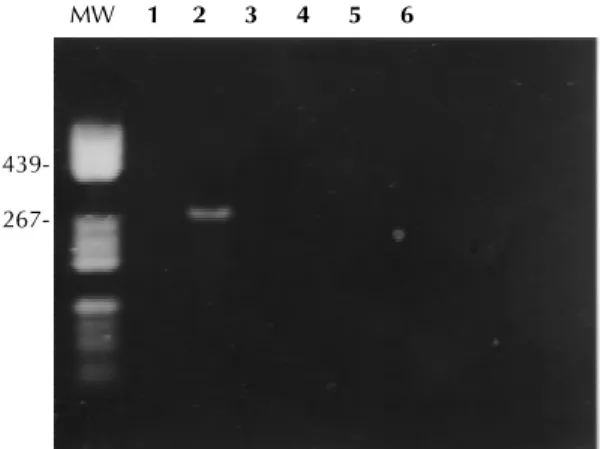
amplifica-tion of parainfluenza 3, adenovirus 3, measles and influenza types A were not yielded. We also in-cluded one nasopharyngeal exudate from asymp-tomatic patient (Fig. 1). Twenty clinical samples were tested by the RNA-PCR method, using the selected primers. The products were analyzed by electrophoresis on a 2% agarose gel. All positive clinical samples by RNA-PCR generated a spe-cific amplified product of 277 bp. All positive clini-cal samples showed a restriction patterns NP4 that belonged to subgroup A thus, these results were similar to those obtained by the antigenic charac-terization using IFA with monoclonal antibodies.
MW 1 2 3 4 5 6
439-
267-Fig. 1: specificity of the polymerase chain reaction for other respiratory viruses. Position of samples on the gel - 1: nasopha-ryngeal exudate from an asymptomatic patient. 2: “Long” strain. 3: adenovirus type 3. 4: measles. 5: influenza type A. 6: parainfluenza virus type 3. The molecular weight of some bands are indicated in base pairs.
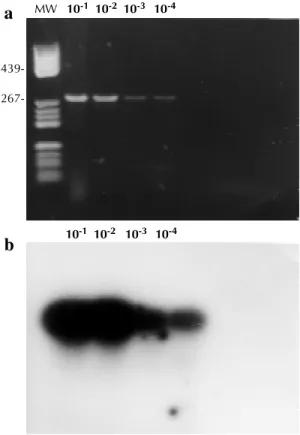
Sensitivity - (a) RNA-PCR detected the RSV up to 10-4 dilution (Fig. 2a); (b) the plaque test assay detected RSV up to 10-3 ;(c ) the immunofluores-cence test detected RSV up to 10-3 dilution and (d) by the Southern blot analysis the same dilution (10-4) was detected as by RNA-PCR (Fig. 2b).
392 392 392 392
392 RSV in Clinical Samples by RT-PCR • A Valdivia et al.
DISCUSSION
A set of primers, previously used for molecu-lar epidemiology studies (Cane & Pringle 1991, 1992, Cane et al. 1992), was used for this method. In this work it was demonstrated that the sensitiv-ity for detection of PCR products employing aga-rose gel electrophoresis with ethidium bromide was similar to the sensitivity obtained with the South-ern blot technique. Therefore, we recommend that the Southern blot technique may be used only in cases in which it is necessary to confirm the diag-nosis, this will avoid isotopic risk for a reliable di-agnosis.
With respect to the identification of RSV, the restriction analysis of PCR products yielded results which were confirmed by the immunofluorescence detection by monoclonal antibodies.
The determination of the sensitivity was car-ried out by the plaque test. Those dilutions that did not form plaques, were positive by the RNA-PCR. A good correlation of RNA-PCR with standard cell culture procedure and false positive results in RNA-PCR have been observed by different authors (Paton et al. 1992, Cubie et al. 1992). We found two samples that were positive by RNA-PCR but negative by the culture method, possibly reflect-ing the presence of some non infectious viral par-ticles in such specimens. These samples were also negative by IFA and positive by RT-PCR. These could be explained because the RT-PCR have higher sensitivity than IFA, thus we consider that these two cases could be false negative results of the cell culture and IFA techniques.
Fig. 2. a: sensitivity of detection of respiratory syncytial virus (“Long” strain) by polymerase chain reaction (PCR). Lane 1 to 4: PCR products from ten fold serial dilution of infected cells. b: gel was blotted to nylon membrane (Hybond-N-Amersham) and subsequently analyzed by Southern blot hy-bridization. The sizes of some PBR 322/Hae III’s bands of interest are reflected in base pairs.
MW 10-1 10-2 10-3 10-4
439-
267-a
10-1 10-2 10-3 10-4
b
TABLE I
Detection of respiratory syncytial virus in clinical samples
Techniques Samples Positives
Viral isolation 20 10
Immunofluorescence 20 10
Polymerase chain reaction 20 12
Fig. 3: restriction endonuclease digestion with Hind III (left) and Bgl II (right) of amplified products from the two positive samples by RNA-polymerase chain reaction and negative by immunofluorescence and cell culture. PBR 322/Hae III is also shown.
Hind III MW Bgl II
TABLE II
Comparison of the results obtained by viral isolation, immnufluorescence and polymerase chain reaction
Viral isolation
+ - +
-+ 10 0 + 10 2
IFA PCR
- 0 10 - 0 10
393 393 393 393 393 Mem Inst Oswaldo Cruz, Rio de Janeiro, Vol. 92(3), May/Jun. 1997
These findings emphasize the recognized sen-sitivity of RNA-PCR over conventional methods. Our study showed that RNA-PCR for the de-tection of RSV in clinical samples was sufficiently sensitive to allow direct visualization of the re-solved PCR product on a 2% agarose gel without the need for nested amplification or Southern hy-bridization except to further confirm the identity of amplified products. The ease of the interpreta-tion of PCR results and the ability to perform the test on archival samples are additional advantages. We also proved its feasibility for the diagnosis of RSV, considering that RNA-PCR will provide re-liable results in a shorter period (1 versus 28 to 35 days) than the classical isolation procedures. This is of great relevance for monitoring children un-der specific therapy. If the technique is applied properly, sensitivity and specificity are the major advantages of the PCR for diagnostic purposes.
ACKNOWLEDGEMENTS
To Dr Robert Shope and Orquidea Biart for critical review of the manuscript, JA Melero for providing the monoclonal antibodies, and Pilar Perez Breña for pro-viding the primers.
REFERENCES
Anderson LJ, Heirholzer JC, Tsou C, Hendry RM, Fernie BN, Stone Y, Mcintosh K 1985.Antigenic charac-terization of respiratory syncytial virus strains with monoclonal antibodies. J Infect Dis 151: 626-633. Cane PA, Pringle CR 1991. Respiratory syncytial virus
heterogeneity during and epidemic: analysis by lim-ited nucleotide sequencing (SH gene) and restric-tion mapping (N gene). J Gen Virol 72: 349-357. Cane PA, Pringle CR 1992. Molecular epidemiology
of respiratory syncytial virus: rapid identification of subgroup A lineages. J Virol Methods 40: 297-306.
Cane PA, Matthews DA, Pringle CR 1992. Analysis of relatedness of subgroup A respiratory syncytial vi-ruses isolated worldwide. Virus Research 25: 15-22.
Collins PL, Anderson K, Langer SJ, Wertz GW 1985. Correct sequence for the major nuclecapsid protein mRNA of respiratory syncytial virus. Virol 146: 69-77.
Cubie HA, Inglis JM, Leslie EE, Edmunds AT 1992. Detection of respiratory syncytial virus in acute bron-chiolitis in infants. J Med Virol 38: 283-287. Garcia-Barreno B, Palomo C, Peñas C, Delgado T,
Perez-Breña P, Melero JA 1989. Marked differences in the antigenic structure of human respiratory syn-cytial virus F and G glycoprotein. J Virol 63: 925-932.
Garcia O, Martin M, Dopazo J, Arbiza J, Frabasile S, Russi J, Hortal M, Perez-Breña P, Martinez I, Garcia-Barren B, Melero JA 1994. Evolutionary pattern of human respiratory syncytial virus (Subgroup A):
Cocirculating lineages and correlation of genetic and antigenic changes in the G glycoprotein. J Virol 68: 5448-5459.
Johnson PR, Collins PL 1989. The 1B (NS2), 1C (NS1) and N proteins of human respiratory syncytial virus (RSV) of antigenic subgroups A and B: sequence conservation and divergence within RSV genomic RNA. J Gen Virol 70: 1539-1547.
Kim HW, Arrobio JO, Brandt CD, Jeffries BC, Pyles G, Reid JL, Chanock RM, Parrot RH 1973. Epide-miology of respiratory syncytial virus in Washing-ton, D.C. Importance of the virus in different respi-ratory tract disease syndromes and temporal distri-bution of infection. Am J Epidemiol 98: 216-225. Kisch AL, Johnson KM 1963. A plaque assay for respi-ratory syncytial virus. Proc Soc Exp Biol Med 112: 583-589.
Kitchin PA, Bootman JS 1993. Quality control of the polymerase chain reaction. Med Virol 3: 107-114. Kwok S, Higuchi R 1989. Avoiding falses positives
with PCR. Nature 339: 237-238.
Maniatis T, Frisch EF, Sambrook J 1989. Molecular Cloning, p. 9-31. A Laboratory Manual. Cold Spring Harbor Laboratory Press.
Mufson MA, Levine HD, Wash RE, Mocega-Gonzalez HE, Krause HE 1973. Epidemiology of respiratory syncytial virus infection among infants and chil-dren in Chicago. Am J Epidemiol 98: 289-300. Mufson MA, Orvell C, Rafnar B, Norrby E 1985. Two
distinct subtypes of human respiratory syncytial virus. J Gen Virol 66: 2111-2124.
Parrot RH, Kim HW, Brandt CD, Beem MO, Richardson L, Gerin JL, Chanock RM 1979. Respiratory syncy-tial virus, p. 695-708. In EH Lennette & NJ Schmidt (eds), Diagnostic Procedure for Viral, Rickettsial and Chlamydial Infection. Amer Pub Health Ass, Washington, D.C.
Paton AW, Paton JC, Lawrence AJ, Harris RJ 1992. Rapid detection of respiratory syncytial virus in nasopharyngeal aspirates by reverse transcription and polymerase chain reaction amplification. J Clin Microbiol 30: 901-904.
Smith CM, Creutz C, Huang YT 1991. Detection of respiratory syncytial virus in nasopharyngeal secre-tions by shell vial technique. J Clin Microbiol 29: 463-465.
Spence L, Barrat N 1968. Respiratory syncytial virus associated with acute respiratory infections in Trinidadian patients. Am J Epidemiol 88: 257-266.
Stoker NG 1990. The polymerase chain reaction and infectious diseases: hopes and realities. Trans R Soc Trop Med Hyg 84: 775-758.
Sung RYT, Murray HGS, Chan RCK, Davies DP, French GL 1987. Seasonal patterns of respiratory syncytial infection in Hong Kong: a preliminar report. J In-fect Dis 156: 527-528.
394 394 394 394