Antibodies against
b
2-glycoprotein I complexed with an oxidised
lipoprotein relate to intima thickening of carotid arteries in primary
antiphospholipid syndrome
P.R.J. AMES
1, J. DELGADO ALVES
2, L.R. LOPEZ
3, F. GENTILE
4, A. MARGARITA
5,
L. PIZZELLA
6, J. BATUCA
2, G. SCENNA
5, V. BRANCACCIO
5, & E. MATSUURA
71
Academic Department of Rheumatology, Leeds General Infirmary, Leeds, UK,2Department of Pharmacology, Faculty of Medical Sciences, New University of Lisbon, Lisbon, Portugal,3Corgenix, Inc, Westminster, Colorado, USA,4Department of Health Sciences (SpeS), Molise University, Campobasso, Italy,5Angiology and Coagulation Units Cardarelli Hospital, Naples, Italy,6Department of Animal, Agricultural & Environmental Sciences (SAVA), Molise University, Campobasso, Italy, and
7Department of Cell Chemistry, Graduate School of Medicine, Dentistry and Pharmaceutical Sciences, Okayama University,
Okayama, Japan
Abstract
To explore whether antibodies against b2-glycoprotein I (b2GPI) complexed to 7-ketocholesteryl-9-carboxynonanoate
(oxLig-1) and to oxidised low-density lipoproteins (oxLDL) relate to paraoxonase activity (PONa) and/or intima media thickness (IMT) of carotid arteries in primary antiphospholipid syndrome (PAPS). As many as 29 thrombotic patients with PAPS, 10 subjects with idiopathic antiphospholipid antibodies (aPL) without thrombosis, 17 thrombotic patients with inherited thrombophilia and 23 healthy controls were investigated. The following were measured in all participants:b2GPI –
oxLDL complexes, IgG anti-b2GPI – oxLig-1, IgG anti-b2GPI – oxLDL antibodies (ELISA), PONa, (para-nitrophenol
method), IMT of common carotid (CC) artery, carotid bifurcation (B), internal carotid (IC) by high resolution sonography. b2GPI – oxLDL complex was highest in the control group (p,0.01), whereas, IgG anti-b2GPI – oxLig1 and IgG
anti-b2GPI – oxLDL were highest in PAPS (p,0.0001). In healthy controls,b2GPI – oxLDL complexes positively correlated to
IMT of the IC (p¼0.007) and negatively to PONa after correction for age (p,0.03). PONa inversely correlated with age (p¼0.008). In PAPS, IgG anti-b2GPI – oxLig-1 independently predicted PONa (p¼0.02) and IMT of B (p¼0.003), CC,
(p¼0.03) and of IC (p¼0.04). In PAPS, PONa inversely correlated to the IMTof B, CC and IC (p¼0.01, 0.02 and 0.003, respectively). IgG anti-b2GPI – oxLig-1 may be involved in PAPS related atherogenesis via decreased PON activity.
Keywords: Carotid arteries, oxidation, primary antiphospholipid syndrome
Introduction
Thrombosis is the main vascular feature of the primary antiphospholipid syndrome (PAPS), but some evidence suggests that vascular damage in PAPS may include also atherosclerosis (Ames et al. 2005). Most of the human data relating antiphospholipid antibodies (aPL) to atherosclerosis derive from studies on APS related to systemic lupus erythematosus, where aPL are variably associated with greater intima-media thickness (IMT) and/or focal plaques of carotid arteries although not
predictive of atherosclerosis in regression models (Manzi et al. 1999, Asanuma et al. 2003, Roman et al. 2003). Nevertheless, mice immunised with aPL and with b2GPI, the target antigen of aPL, develop
atherosclerosis (George et al. 1998) and aPL titre independently predicted IMT of carotid arteries, an acceptable and reliable surrogate marker of sub-clinical atherosclerosis, in patients with PAPS (Ames et al. 2002).
An imbalance between oxidative stress and antioxidant defence contributes to atherogenesis. We previously
ISSN 1740-2522 print/ISSN 1740-2530 onlineq2006 Taylor & Francis DOI: 10.1080/17402520600554930
demonstrated enhanced oxidative stress (Ames et al. 1998) as well as lower antioxidant defence measured as decreased paraoxonase activity (PONa) in PAPS (Delgado Alves et al. 2002). PON is the enzyme that accounts for most of the capacity of high-density lipoprotein to degrade oxidised phospholipids into inactive metabolites minimizing the chance of low-density lipoprotein (LDL) oxidation (Leviev and James 2000). Of further interest is the knowledge thatb2GPI
binds to Cu2þ
–oxidised LDL (oxLDL) (Kobayashi et al. 2003) and that macrophages uptake this complex much faster in the presence of an antibody towards oxLDL–
b2GPI (Hasunuma et al. 1997). More recently, this
concept has been extended to the complex ofb2GPI with
7-ketocholesteryl-9-carboxynonanoate (oxLig-1), the very oxLDL-derived moiety that bindsb2GPI (Liu et al.
2002). As antibodies towards b2GPI – oxLig-1 are
associated with arterial thrombosis in APS (Lopez et al. 2003) we herein explored whether antibodies towards antib2GPI–oxLig-1 bore any atherogenic potential in
primary APS.
Methods
Patients
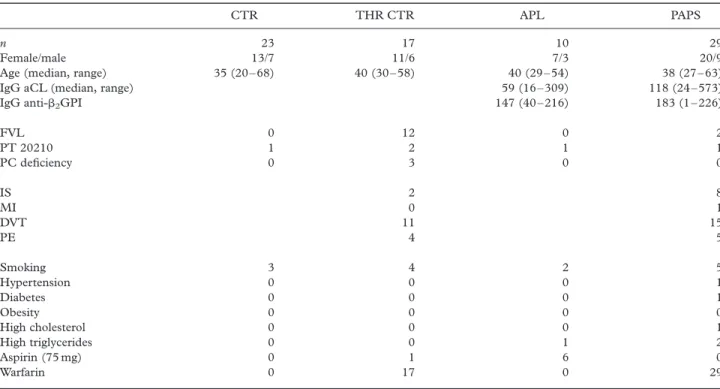
The study populations were drawn from consecutive patients attending the Coagulation Unit of the Cardarelli Hospital in Naples (Italy) who gave informed consent before entering the study, carried out according to the revised Declaration of Helsinki. All APS patients met the Sapporo Criteria for PAPS (Wilson et al. 1999). They were evaluated for a thrombotic event and were found to be positive for lupus anticoagulant (LA) and anticardiolipin (aCL) antibodies on two separate occasions 6 weeks apart. Patients with idiopathic aPL were detected because of the presence of a LA on routine clotting screen for minor surgical procedures or for health checks and never suffered any vascular manifestation of APS. Seventeen patients with inherited thrombophi-lia who underwent vascular occlusions served as a thrombotic control group. Vascular events were diagnosed by MRI, doppler ultrasound, ECG and echocardiogram according to vascular bed involved. Twenty-three healthy hospital personnel served as a normal control group. None of the participants were on lipid lowering agents or antioxidant drugs at the time of the study. Plasma from patients and controls were kept at 808C until analysis. Their demo-graphics and clinical features are presented in Table I.
Antiphospholipid antibodies
IgG aCL antibodies were measured by ELISA (Cambridge Life Sciences, UK). A normal range had been determined from 60 healthy hospital personnel with a cut-off of 5 GPL U/ml being five standard errors
above the geometric mean (4.1; SEM 0.2; 95% CI 3.7, 4.5). IgG anti-b2GPI antibodies were measured by
ELISA (Corgenix, Westminster, Co.). As many as 120 serum samples from healthy blood bank donors were tested for IgG anti-b2GPI antibodies to establish the
cut-off of the assay at 20 units. Intra and inter assay coefficient of variability was 4.1 and 3%, respectively. LA was screened by activated partial thromboplastin time, dilute Russel viper venom time and kaolin clotting time. After detecting an inhibitor by mixing studies, the platelet neutralisation procedure in the activated partial thromboplastin time and dilute Russel viper venom time was used to confirm the presence of a LA in accordance to published guidelines (Greaves et al. 2000).
Monoclonal antibodies
The following monoclonal antibodies were employed as described in the assays reported below. WB-CAL-1 is an IgG2a murine monoclonal antibody against human b2GPI derived from a NZW £ BXSB F1
mouse, a model of spontaneous APS (Hashimoto et al. 1992). EY2C9 is a human monoclonal IgM
anti-b2GPI antibody established from peripheral blood
lymphocytes of a patient with APS (Ichikawa et al. 1994). These two antibodies bind only to b2
GPI-negatively charged phospholipid (or oxLDL) com-plexes but not with monomeric (free) b2GPI in
solution. ID2 is a murine IgG monoclonal antibody specific for human apolipoprotein B-100 that reacts equally well with native and oxLDL. IS-4 is another human monoclonal IgG anticardiolipin established from peripheral blood lymphocytes of patients with APS (Zhu et al. 1999).
Measurement ofb2GPI – oxLDL complexes
The monoclonal antibody against b2GPI
(WB-CAL-1) was adsorbed on a microtiter plate (Immulon 2HB, Dynex Technology, Inc., Chantilly, VA) by incubating overnight 50ml/well at a concentration of 50ml/ml dissolved in PBS buffer, pH 7.4, between 2 and 48C. In this assay, WB-CAL-1 capturesb2GPI –
oxLDL complexes via its specificity for b2GPI. The
plate was blocked with PBS-1% skim milk for 1 h. Then, 100ml of samples diluted 1:25 in PBS skim milk containing 10 m mol/l MgCl2were added to the wells
and incubated for 2 h at room temperature. MgCl2
dissociates intermediate b2GPI – oxLDL complexes
the reaction stopped with 0.36 N sulphuric acid. Optical density was read at 450 nm (650 nm refer-ence). The coefficient of variation ranged between 7.2 and 12.3% for weak and 4.5 – 8.9% for moderate and strong reactive samples. The concentration ofb2GPI –
oxLDL complexes in U/ml was calculated against a reference curve built with 2-fold serial dilutions of a
b2GPI – oxLDL complex solution. The complexes
were prepared in advance by incubating equal amounts of Cu2þ
– oxLDL and purified human
b2GPI, pH 7.4, for 12 h at 378C. The unit value
derives arbitrarily from the protein concentration of the b2GPI – oxLDL used in the reference curve.
A normal cut-off value for the assay was established testing samples from 100 healthy blood donors (meanþ3SD).
Measurement of IgG anti-b2GPI – oxLig-1 antibodies
OxLig-1 (7-ketocholesteryl-9-carboxynonanoate) is a Cu2þ-derived LDL ligand for b2GPI prepared as
previously described (Liu et al. 2002). Fifty microliter of 100mg/ml of oxLig-1 in ethanol were adsorbed by evaporation on a plain polystyrene plate (Immulon 2HB) followed by blocking with 1% BSA for 1 h at room temperature and then washed. Subsequently, 50ml of 30mg/ml ofb2GPI in PBS with 3% BSA was
added to oxLig-1-coated wells to allow complex formation. The b2GPI – oxLig-1 complex represents
the capture antigen for patient antibodies. Finally, 50ml of plasma samples diluted 1:100 in PBS with 3% BSA were added to the wells and incubated for 1 h at
room temperature. Wells were washed four times with PBS 0.05% polysorbate 20 between steps. Diluted HRP-conjugated antihuman IgG was added and left to incubate for 1 h. Colour was developed with tetramethylbenzidine-H2O2, and the reaction stopped
with 0.36 N sulphuric acid. Optical density was read at 450 nm (650 nm reference). The coefficient of variation ranged between 7.4 and 12.6% for weak and 5.5 – 9.9% for moderate and strong reactive samples. The EY2C9 IgM monoclonal anti-b2GPI
was used in this assay as a reference human antibody reacting to the b2GPI of the antigenic substrate to
select strong reactive samples to be used as control samples. However, the IgGb2GPI – oxLig-1
concen-tration of patient samples (in U/ml) was calculated against a standard curve prepared from a selected positive sample. A normal cut-off value for the assay was established by testing 100 serum samples from healthy blood donors (meanþ3SD).
Measurement of IgG anti-b2GPI – oxLDL antibodies
LDL was isolated and oxidised as previously described (Kobayashi et al. 2003). OxLDL (50mg/ml in ethanol, 50ml well) was adsorbed by evaporation on plain polystyrene plates (Immulon 1B) and the plates blocked with 1% BSA. Serum samples (diluted 1:100) were incubated in the wells with or without
b2GPI (25mg/ml) for 1 h followed by the addition of
HRP-labelled antihuman IgG. Further steps were performed as in ELISA for anti-b2GPI – oxLig-1. The
mean OD of the blank wells was employed to correct Table I. Demographics and clinical features of the study populations.
CTR THR CTR APL PAPS
n 23 17 10 29
Female/male 13/7 11/6 7/3 20/9
Age (median, range) 35 (20 – 68) 40 (30 – 58) 40 (29– 54) 38 (27 – 63)
IgG aCL (median, range) 59 (16 – 309) 118 (24 – 573)
IgG anti-b2GPI 147 (40 – 216) 183 (1 – 226)
FVL 0 12 0 2
PT 20210 1 2 1 1
PC deficiency 0 3 0 0
IS 2 8
MI 0 1
DVT 11 15
PE 4 5
Smoking 3 4 2 5
Hypertension 0 0 0 1
Diabetes 0 0 0 1
Obesity 0 0 0 0
High cholesterol 0 0 0 1
High triglycerides 0 0 1 2
Aspirin (75 mg) 0 1 6 0
Warfarin 0 17 0 29
the raw OD of individual samples. OD variation among plates was normalised using a positive control. A sample was considered to be positive when its antibody titre was higher than three standard deviations above the mean OD of plasma samples from 150 normal subjects (blood donors).
Paraoxonase activity
Serum PON activity was measured as previously described (Delgado Alves et al. 2002). Briefly, PON (1.0 mM) freshly prepared in 300ml of 50 mM glycine buffer containing 1 mM calcium chloride (pH 10.5) was incubated at 378C with 5ml of serum for 15 min in 96 well plates (Polysorp, Nunc, Life Technologies, Paisley, UK). Para-nitrophenol formation was mon-itored at 412 nm and activity expressed as nmol of para-nitrophenol per ml serum per minute. For graphical purposes baseline PONa activity was set at 100% with percentage decrements thereafter.
Effect of monoclonal antiphospholipid antibodies on paraoxonase activity
The possible inhibitory effect of aPL on PON activity was explored. Dose dependency was performed by incubating doubling dilutions (2, 4, 8 and 16 fold) of IS4 supernatant (starting at 10 g/ml, the maximum supernatant concentration), WB-CAL-1 and EY2C9 with 50ml of pooled sera from five healthy subjects as a source of PON. PON activity was then measured every 30 min for 4.5 h, because specific paraoxon hydrolysis starts at about 2 h from its incubation with PON. As controls we used irrelevant human IgG (Sigma-Aldrich, Poole, UK) at the same concentration. The possible effect of b2GPI and
b2GPI – oxLDL on PON was also investigated.
All experiments were run in triplicate.
Carotid intima-media thickness measurement
All participants underwent a detailed ultrasound evaluation of the carotid arteries performed by an experienced angiologist (AM), using an Aloka 2000 sonograph equipped with a 5 – 10 MHz linear transdu-cer. The image acquisition followed the Atherosclero-sis Risk in Communities Study protocol (Heiss et al. 1991). Images were obtained with the patient in the supine position with the neck slightly extended. Transverse and longitudinal views of the right and left common carotid (CC) arteries (10 mm distal to the carotid bifurcation), right and left carotid bifurcation (B) and internal carotid (IC) arteries were taken. The means of three measurements taken 1 cm apart at the three different sites were computed for each region, right and left measurements were averaged for the purpose of statistical analysis. Plaques, defined as the presence of focal, severe wall thickening (IMT . 2 mm), wall irregularities and calcification,
were also looked for. Intra-reader reproducibility was assessed in two ways. Firstly, the same carotid measurement was performed twice on 20 individuals yielding a coefficient of agreement of 97%. Secondly, the same IMT measurements were performed six times on one individual over a two-month period, yielding a coefficient of variability between 3 and 4% according to carotid segment under study.
Statistics
Non-parametric tests were employed throughout because of the small numbers in groups. Comparisons across groups were assessed by Kruskall – Wallis analysis of variance with Dunns post hoc as appro-priate. Univariate relationships between variables were examined by Spearman rank and implemented where described by multiple regression analysis.
Results
PON activity,b2GPI – oxLDL complexes, anti-b2GPI –
oxLDL and anti-b2GPI – oxLig-1 in study groups
PON activity (n mol/ml/min) was not different across the groups, being 0.96^0.25 in normal controls, 0.90^0.340 in thrombotic controls, 0.87^0.40 in idiopathic aPL and 78^0.35 in APS patients. Plasma levels of b2GPI – oxLDL complexes were highest in
the control group (Figure 1A), whereas, those of IgG anti-b2GPI – oxLDL (Figure 1B) and anti-b2GPI –
oxLig-1 (Figure 1C) were highest in the APS and aPL groups. These variables showed no gender differences in any of the groups, and no differences were noted between patients with arterial or venous thrombosis in the PAPS group.
Relationship amongst variables in the normal control group
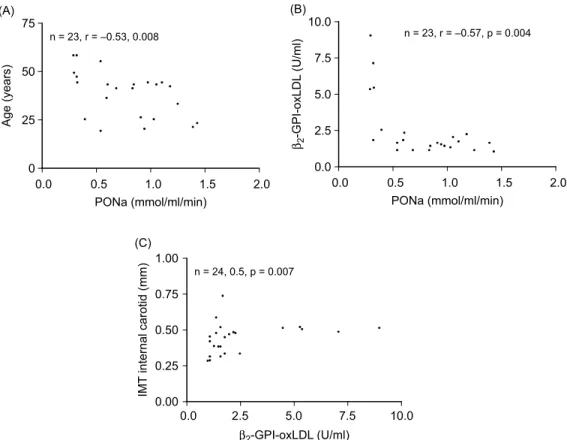
Several variables in this group were age related: PONa (Figure (2A)), b2GPI – oxLDL complexes (r¼0.61,
p¼0.001) IgG anti-b2GPI – oxLig-1 (r¼0.46,
p¼0.02) and IMT of all carotid segments (p¼0.0001). b2GPI – oxLDL negatively correlated
to PONa (Figure 2B), positively to the IMT of the IC artery (Figure 2C) and to IgG anti-b2GPI – oxLig-1
(r¼0.51,p¼0.01). After correction for age,b2GPI –
oxLDL maintained its correlation with PONa only (r¼20.46,p¼0.03).
Relationship amongst variables in the thrombotic control group
b2GPI – oxLDL complexes correlated to the IMT of
the common (r¼0.54, p¼0.02) and the IC artery (r¼0.53, p¼0.03) and negatively to PONa (r¼20.51, p¼0.03). Only a trend was seen with age (r¼0.47,p¼0.07), IMT of all carotid segments
Figure 1. Median plasma levels ofb2GPI – oxLDL (A), of IgG anti-b2GPI – oxLDL (B) and of anti-b2GPI – oxLig-1 (C) in the four study groups. CTR: normal controls; THR CTR; thrombotic controls; aPL: non-thrombotic idiopathic antiphospholipid antibody subjects; APS: thrombotic primary antiphospholipid antibody syndrome patients.
Relationship amongst variables in the aPL group
IgG anti-b2GPI – oxLig-1 correlated to the IMT of the
B (r¼0.8,p¼0.002) and a trend was noted for the CC (r¼0.52, p¼0.08). No other correlations were noted because of the limited size of this group.
Relationship amongst variables in the APS group
Because two patients in this group did not have all variables measured, resulting analysis and data refer to 28 patients. With regards to antibody subtypes IgG
anti-b2GPI– oxLig-1 positively correlated to IgG anti-b2GPI
(r¼0.49, p¼0.007) and to IgG aCL (r¼0.61, p¼0.0005). In decreasing order of strength PONa
inversely correlated to IgG anti-b2GPI – oxLig-1
(r¼20.51, p¼0.004), to IgG aCL (r¼20.53, p¼0.003) and to IgG anti-b2GPI (r¼20.41,
p¼0.02). Of these, only IgG anti-b2GPI –oxLig-1
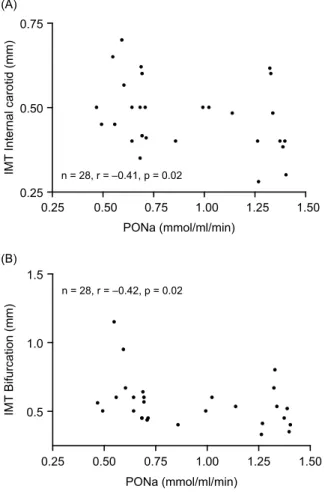
independently predicted PONa (b¼0.44,p¼0.02) in a multiple regression that took into account the effect of age and sex. In addition, PONa inversely correlated to the IMTof the IC (Figure 3A) and of the B (Figure 3B). IgG anti-b2GPI– oxLig-1 positively correlated to IMT
of all carotid segments (Figure 4A –C). In a multiple regression model that included IgG anti-b2GPI –
oxLig-1, IgG anti-b2GPI, and IgG anti-b2GPI – oxLDL as
independent variables and IMTas a dependent variable,
and after correction for age and sex, IgG anti-b2GPI–
oxLig-1 independently predicted IMT of B (b¼0.40,
p¼0.01), CC (b¼0.36,p¼0.02) and IC (b¼0.55,
p¼0.003).
Effect of antiphospholipid antibodies on paraoxonase activity
PON activity in the presence of IS4 was significantly reduced after 3 h of incubation at the starting concentration of 10 g/ml compared with the same concentration of irrelevant human IgG or PBS (p,
0.001)(Figure 4). WB-CAL-1 (the murine IgG antihu-manb2GPI) and EY2C9 (the human IgM anti-b2GPI)
had no effect at any concentration on PON nor did
b2GPI and b2GPI–oxLDL complexes at any
concen-tration (Figure 5). In dose-dependency experiments IgG aCL (IS4) significantly inhibited PON activity at the starting concentration of 10 g/ml and at 1:2 and 1:4 dilutions compared to 1:8 and 1:16 dilutions (p,0.001,
,0.001 and,0.01, respectively).
Discussion
Oxidation of LDL plays an important role in athero-sclerosis, as oxLDL may induce vasoconstriction, expression of adhesion molecules and cellular prolifer-ation (Kugiyama et al. 1990, Lehr et al. 1991, Sakai et al. 1994). On the other hand, immunisation of hyperch-olesterolemic rabbits with oxLDL suppresses athero-sclerosis (Palinski et al. 1995) therefore an immune response to oxidised LDL (oxLDL) may modulate atherogenesis (Horkko et al. 2000). An inverse relationship between oxLDL and IgG anti– oxLDL has been noted in the general population, and it was implied that anti-oxLDL helps to remove oxLDL from the bloodstream (Shoji et al. 2001). However, data contrast on this issue. One study described an inverse and independent relationship between anti-oxLDL titre and IMT of carotid arteries in healthy subjects (Fukumoto et al. 2000), whereas, IgG– oxLDL titre positively associated with IMT of the CC artery in another study (Hulthe et al. 2001). That is, both the antigen and the corresponding antibody seem to have a relation with IMT. Similar conflicting information is available for SLE, where oxLDL appeared to be related to arterial thrombosis (Amengual et al. 1997) or venous thrombosis (Hayem et al. 2001) in SLE-related APS, whereas, more recently oxLDL related to disease activity (Gomez-Zumaquero et al. 2004).
The approach used in the present study is a step ahead of the oxLDL/anti-oxLDL system. b2GPI
complexes with oxLDL and more specifically with the 7-ketocholesteryl-9-carboxynonanoate (oxLig-1) moieties from oxLDL and antibodies against the latter complex, IgG anti-b2GPI – oxLig-1, identified arterial
disease in SLE related APS (Lopez et al. 2003). The relation of this antigen/antibody system with IMT of Figure 3. Relationship between PON activity and IMT of IC (A)
carotid arteries or PON has been investigated neither in PAPS nor in a normal population.
Median plasma levels of the antigen, b2GPI –
oxLDL complexes, were higher in our control populations and lower in antiphospholipid subjects, whereas, the antibodies IgG anti-b2GPI – oxLDL and
IgG anti-b2GPI – oxLig-1 were greatest in the PAPS
group, though they did not identify patients with arterial thrombosis. With regards to PONa we did not confirm our previous report of low activity in PAPS (Delgado Alves et al. 2002) probably due to different control populations bearing different genetic poly-morphisms that partly govern the enzymatic activity of PON (Leviev and James 2000). Notwithstanding, PONa showed several interesting relationships. In the
control group, b2GPI – oxLDL inversely related to
PONa, indicating that as more LDL becomes oxidised, more oxLDL is buffered byb2GPI. This is
likely due to an age related decrement of the antioxidant capacity of PON (Milochevitch and Khalil 2001) given the lack of effect of b2GPI – oxLDL on
PONa in our in vitro experiments and the loss of correlation between b2GPI – oxLDL and IMT of
carotid segments after correction for age. We cannot discount the possibility that IgG anti-b2GPI – oxLig-1
appears as an attempt to clear b2GPI – oxLDL,
in a fashion similar to that described between oxLDL and IgG oxLDL in normal subjects (Shoji et al. 2001). The data of our thrombotic control group partially replicate those of our normal control group and altogether they suggest thatb2GPI – oxLDL, IgG
anti-b2GPI – oxLig-1 and anti b2GPI – oxLDL might
have a role in vascular ageing in normal people. The PAPS group shows picture almost specular to that of the control groups. In fact, PONa negatively related to IgGb2GPI – oxLig-1, to IgGb2GPI and IgG
aCL, in keeping with our hypothesis that PONa inhibition participates in APS related vascular damage (8, 32). Here, we extend this concept, in that elevated IgG anti-b2GPI – oxLig-1 together with low PONa
were positive and negative correlates of the IMT of carotid artery segments and because IgG aCL inhibited PONain vitro. The latter effect was limited to IS4, the monoclonal IgG aCL, whereas, WB-CAL-1, the monoclonal IgG anti-b2GPI was devoid of such effect.
Figure 4. Relationship between IgG anti-b2GPI – oxLig-1 and IMT of CC (A), B (B) and IC in PAPS.
Figure 5. Effect of monoclonal antibodies IS4, WB-CAL-1 and of
This is in keeping with the inhibitory effects of IS4 on PONa in SCID mice, where no effect was seen for
anti-b2GPI of either isotype (of a different source from the
ones used here (Delgado Alves et al. 2005)). Further studies are required to elucidate the interaction between aPL and PON.
With consideration to the small numbers of our groups, we suggest the following sequence of events. In normal people, an age related decrease of PONa allows for oxidation of LDL that is buffered byb2GPI and
eventually an antibody develops to clear this ternary complex. By contrast, in PAPS, aPL interference with PONa tilts the oxidant/antioxidant balance towards enhanced lipid peroxidation (Ames et al. 1998) that in turn contributes to arterial thickening. Although, this study was not devised to demonstrating premature vascular damage in PAPS, it provides further evidence for PON and IgG anti-b2GPI – oxLig-1 implication in
an atherogenic pathway that may represent a target for therapeutic intervention.
References
Amengual O, Atsumi T, Khamashta MA, Tinahones F, Hughes GRV. 1997. Autoantibodies against oxidised low-density lipoprotein in antiphospholipid syndrome. Br J Rheumatol 369:964– 968.
Ames PRJ, Margarita A, Delgado Alves J, Tommasino C, Iannaccone L, Brancaccio V. 2002. Anticardiolipin antibody titre and plasma homocysteine level independently predict intima media thickness of carotid arteries in subjects with idiopathic antiphospholipid antibodies. Lupus 11:208 – 214. Ames PRJ, Margarita A, Sokoll KB, Iannaccone L, Brancaccio V.
2005. Atherosclerosis in primary antiphospholipid syndrome. Preliminary data. Ann Rheum Dis 64:315 – 317.
Ames PRJ, Nourooz-Zadeh J, Tommasino C, Alves J, Brancaccio V, Anggard EE. 1998. Oxidative stress in primary antiphospholipid syndrome. Thromb Haemos 79:447– 449.
Asanuma Y, Oeser A, Shintani AK, Turner E, Olsen N, Fazio S, Linton MF, Raggi P, Stein CM. 2003. Premature coronary-artery atherosclerosis in systemic lupus erythematosus. N Engl J Med 349:2407– 2415.
Delgado Alves J, Ames PRJ, Donohue S, Stanyer L, Nourooz-Zadeh J, Ravirajan C, Isenberg DA, Noorouz-Zadeh J. 2002. Antibodies to high-density lipoprotein andb-2-glycoprotein I are inversely correlated with paraoxonase activity in systemic lupus erythematosus and primary antiphospholipid syndrome. Arthritis Rheum 46:2686– 2694.
Delgado Alves J, Mason LJ, Ames Paul RJ, Chen PP, Rauch J, Levine JS, Subang R, Isenberg DA. 2005. Antiphospholipid antibodies are associated with enhanced oxidative stress, decreased plasma nitric oxide and paraoxonase activity in an experimental mouse mode. Rheumatology, In press.
Fukumoto M, Shoji T, Emoto M, Kawagishi T, Okuno Y, Nishizawa Y. 2000. Antibodies against oxidised LDL and carotid artery intima-media thickness in a healthy population. Arterioscler Thromb Vasc Biol 20:703 – 707.
George J, Afek A, Gilburd B, Blank M, Levy Y, Aron-Maor A, Levkovitz H, Shaish A, Goldberg I, Kopolovic J, Harats D, Shoenfeld Y. 1998. Induction of early atherosclerosis in LDL-receptor-deficient mice immunized with b-2-glycoprotein I. Circulation 98:1108 – 1115.
Gomez-Zumaquero JM, Tinahones FJ, De Ramon E, Camps M, Garrido L, Soriguer FJ. 2004. Association of biological markers
of activity of systemic lupus erythematosus with levels of anti-oxidised low-density lipoprotein antibodies. Rheumatology. Greaves M, Cohen H, Machin SJ, Mackie I. 2000. Guidelines on
the investigation and management of the antiphospholipid syndrome. Br J Haematol 109:704– 715.
Hashimoto Y, Kawamura M, Ichikawa K, et al. 1992. Antic-ardiolipin antibodies in NZW£BXSB F1 mice: A model of antiphospholipid syndrome. J Immunol 42:1309– 1311. Hasunuma Y, Matsuura E, Makita Z, Katahira T, Nishi S, Koike T.
1997. Involvement of b 2-glycoprotein I and anticardiolipin antibodies in oxidatively modified low-density lipoprotein uptake by macrophages. Clin Exp Immunol 107:569– 573. Hayem G, Nicaise-Roland P, Palazzo E, de Bandt M, Tubach F,
Weber M, Meyer O. 2001. Anti-oxidised low-density-lipoprotein (OxLDL) antibodies in systemic lupus erythematosus with and without antiphospholipid syndrome. Lupus 10:346 – 351. Heiss G, Sharrett AR, Barnes R, Chambless LE, Szklo M. 1991.
Alzola C for the ARIC investigators. Carotid atherosclerosis measured by B-mode ultrasound in populations: Associations with cardiovascular risk factor in the ARIC study. Am J Epidemiol 134:250 – 256.
Horkko S, Binder CJ, Shaw PX, Chang MK, Silverman G, Palinski W, Witztum JL. 2000. Immunological responses to oxidised LDL. Free Radic Biol Med 28:1771– 1779.
Hulthe J, Bokemark L, Fagerberg B. 2001. Antibodies to oxidised LDL in relation to intima-media thickness in carotid and femoral arteries in 58-year-old subjectively clinically healthy men. Arterioscler Thromb Vasc Biol 21:101 – 107.
Ichikawa K, Khamashta MA, Koike T, et al. 1994. 2-glycoprotein reactivity on monoclonal anticardiolipin antibodies from patients with the antiphospholipid syndrome. Arthritis Rheum 37:1453 – 1461.
Kobayashi K, Kishi M, Atsumi T, Bertolaccini ML, Makino H, Sakairi N, Yamamoto I, Yasuda T, Khamashta MA, Hughes GR, Koike T, Voelker DR, Matsuura E. 2003. Circulating oxidised LDL forms complexes withb-2-glycoprotein I: Implication as an atherogenic autoantigen. J Lipid Res 44:716 – 726.
Kugiyama K, Kerns S, Morrisett J, Roberts R, Henry P. 1990. Impairment of endothelium-dependent arterial relaxation by lysolecithin in modified lipoproteins. Nature 344:160 – 162. Lehr H, Hubner C, Nolte D, Finckh B, Biesiegel U, Kohlschutter A,
Messmer K. 1991. Oxidatively modified human low-density lipoprotein stimulates leucocyte adherence onto the microvas-cular endotheliumin vitro. Res Exp Med 191:85 – 90.
Leviev I, James RW. 2000. Promoter polymorphisms of human paraoxonasePON1gene and serum paraoxonase activities and concentrations. Arterioscler Thromb Vasc Biol 20:516 – 521. Liu Q, Kobayashi K, Furukawa J, Inagaki J, Sakairi N, Iwado A,
Yasuda T, Koike T, Voelker DR. 2002. Matsuura EV-carboxyl variants of 7 ketocholesteryl esters are ligands for b -2-glycoprotein I and mediate antibody-dependent uptake of oxidised LDL by macrophages. J Lipid Res 43:1486– 1495. Lopez D, Kobayashi K, Merrill JT, Matsuura E, Lopez LR. 2003.
IgG autoantibodies againstb-2-glicoprotein I complexed with a lipid ligand derived from oxidised low-density lipoprotein are associated with arterial thrombosis in antiphospholipid syn-drome. Clin Dev Immunol 10:203 – 211.
Manzi S, Selzer F, Sutton-Tyrrell K, Fitzgerald SG, Rairie JE, Tracy RP, Kuller LH. 1999. Prevalence and risk factors of carotid plaque in women with systemic lupus erythematosus. Arthritis Rheum 42:51 – 60.
Milochevitch C, Khalil A. 2001. Study of the paraoxonase and platelet-activating factor acetylhydrolase activities with aging. Prostaglandins Leukot Essent Fatty Acids 65:241 – 246. Palinski W, Miller E, Witztum JL. 1995. Immunisation of
Roman MJ, Shanker BA, Davis A, Lockshin MD, Sammaritano L, Simantov R, Crow MK, Schwartz JE, Paget SA, Devereux RB, Salmon JE. 2003. Prevalence and correlates of accelerated atherosclerosis in systemic lupus erythematosus. N Engl J Med 349:2399– 2406.
Sakai M, Miyazaki A, Hakamata H, Sasaki T, Yui S, Yamazaki M, Shichiri M, Oriuchi S. 1994. Lysophosphatidylcholine plays an essential role in the mitogenic effect of oxidised low-density lipoprotein on murine macrophages. J Biol Chem 269:31430– 31435.
Shoji T, Nishizawa Y, Fukumoto M, Shimamura K, Kimura J, Kanda H, Emoto M, Kawagishi T, Morii H. 2001. Inverse
relationship between circulating oxidised low density lipoprotein (oxLDL) and anti-oxLDL antibody levels in healthy subjects. Atherosclerosis 148:171 – 177.
Wilson WA, Gharavi AE, Koike T, et al. 1999. International consensus statement on preliminary classification criteria for definite antiphospholipid syndrome: Report of an international workshop. Arthritis Rheum 42:1309– 1311.