VARIABILITY OF THE CONSERVED V3 LOOP TIP MOTIF IN HIV-1 SUBTYPE B ISOLATES COLLECTED FROM BRAZILIAN AND FRENCH PATIENTS
Rejane-Maria Tomasini-Grotto1, Brigitte Montes2, Denise Triglia1, Carla Torres- Braconi3, Juliana Aliano-Block3, Paolo M. de A. Zanotto3, Maria- Inès de M. C. Pardini1, Michel Segondy2
1
Divisão Hemocentro, Faculdade de Medicina de Botucatu, Universidade Estadual Paulista, São Paulo, SP, Brasil; 2 Departement
de Biologie & Pathologie, Laboratoire de Virologie, Centre Hospitalier Universitaire (CHU), Montpellier, France; 3 Laboratório de
Evolução Molecular e Bioinformatica, Instituto de Ciências Biomédicas, Universidade de São Paulo, São Paulo, SP, Brasil.
Submitted: July 24, 2009; Returned to authors for corrections: September 18, 2009; Approved: March 16, 2010.
ABSTRACT
The diversity of the V3 loop tip motif sequences of HIV-1 subtype B was analyzed in patients from
Botucatu (Brazil) and Montpellier (France). Overall, 37 tetrameric tip motifs were identified, 28 and 17 of
them being recognized in Brazilian and French patients, respectively. The GPGR (P) motif was
predominant in French but not in Brazilian patients (53.5% vs 31.0%), whereas the GWGR (W) motif was
frequent in Brazilian patients (23.0%) and absent in French patients. Three tip motif groups were
considered: P, W, and non-P non-W groups. The distribution of HIV-1 isolates into the three groups was
significantly different between isolates from Botucatu and from Montpellier (P < 0.001). A higher
proportion of CXCR4-using HIV-1 (X4 variants) was observed in the non-P non-W group as compared
with the P group (37.5% vs 19.1%), and no X4 variant was identified in the W group (P < 0.001). The
higher proportion of X4 variants in the non-P non-W group was essentially observed among the patients
from Montpellier, who have been infected with HIV-1 for a longer period of time than those from
Botucatu. Among patients from Montpellier, CD4+ cell counts were lower in patients belonging to the
non-P non-W group than in those belonging to the P group (24 cells/µL vs 197 cells/µL; P = 0.005). Taken
together, the results suggest that variability of the V3 loop tip motif may be related to HIV-1 coreceptor
usage and to disease progression. However, as analyzed by a bioinformatic method, the substitution of the
V3 loop tip motif of the subtype B consensus sequence with the different tip motifs identified in the
present study was not sufficient to induce a change in HIV-1 coreceptor usage.
Key words: HIV-1; V3 loop; Genetic diversity; Brazil; France
INTRODUCTION
The human immunodeficiency virus type 1 (HIV-1)
displays a high genetic variability, particularly in the envelope
gene (env) which encodes the glycoproteins gp120 and gp 41
that play a key role in virus entry into the target cells. The
envelope glycoprotein gp120 consists of five variable regions
(V1-V5) intercalated with five conserved regions (C1-C5). In
HIV-1 subtype B, the third variable region (V3) is 35 amino
acids long (6) and shows as consensus sequence
CTRPNNNTRKSIHIGPGRAFYTTGEIIGDIRQAHC. The
presence of two cysteine residues flanking the sequence leads
to a disulphide-bond which results in a loop conformation. The
tip of the V3 loop consists of a conserved amino acid sequence
with predominance of the GPGR motif in subtype B (14). The
substitution of the proline for a tryptophan creating the GWGR
motif has been found in Brazilian strains (B-Br variant) (3, 11).
This motif can alter the protein secondary structure leading to
changes in viral antigenicity (16).
The V3 sequence plays a major role in virus tropism by
determining which coreceptor, CXCR4 or CCR5, will be used
for virus entry (19). It is also highly associated with the virus
ability to induce syncitia formation in cell culture.
Non-syncytium-inducing (NSI) variants, which use CCR5 as
coreceptor (R5 viruses), predominate in the asymptomatic
phase, whereas syncytium-inducing (SI) variants, using
CXCR4 as coreceptor (X4 viruses), emerge in advanced
infected patients, preceding CD4+ cell decline and clinical
worsening (1, 5, 20, 21). It has been shown that SI/X4 viruses
are more cytopathicin vitro, and replicate to higher levels than
NSI/R5 viruses (15, 24). Different coreceptor usage and switch
from NSI to SI phenotype have been associated with amino
acid substitutions in the V3 loop. On the basis of the V3 loop
sequence, a bioinformatic tool, the position-specific scoring
matrix (PSSM) was created to predict the viral phenotype (4,
18, 19). This tool demonstrated a high sensitivity to identify X4
viruses in HIV-1 subtype B isolates (17).
The aim of this study was to explore the variability of the
tip motif in the V3 loop in HIV-1 subtype B strains obtained
from HIV-1-infected patients in Brazil (Botucatu) and France
(Montpellier), in relation with virological, immunological and
clinical parameters.
MATERIALS AND METHODS
Patients
Subjects included in the study were 100 Brazilian and 86
French patients followed up in the university hospitals of
Botucatu (São Paulo state, Brazil) and Montpellier (France),
respectively. All these patients were infected with HIV-1
subtype B. Patients from Botucatu were HIV-1 infected
patients who were tested for viral load and gave an informed
consent to be included in the Viral Genetic Diversity Network
(VGDN) project (http://www.lemb.icb.usp.br/vgdn/www).
Patients from Montpellier were patients for which the V3 loop
was sequenced to determine the R5 or X4 coreceptor tropism;
most of these patients had advanced HIV-1 infection and
multiple resistance to antiviral drugs and were eligible for
treatment with the CCR5 inhibitor maraviroc. The
characteristics of the patients are presented in Table 1.
Table 1. Demographic, virological, immunological and clinical characteristics of HIV-1 subtype B-infected patients from
Botucatu and Montpellier.
Characteristics Botucatu
(N = 100)
Montpellier
(N = 86) P
Age, y [median (IQR)] 39 (34-46) 44 (40-50) <0.001
Sex, Male [N (%)] 51 (51.0) 73 (84.9) <0.001
HIV-1 risk factors [N (%)] Heterosexual
MSM IDU
Transfusion/hemophilia Unknown
24 (24.0) 26 (26.0) 17 (17.0) 6 (6.0) 27 (27.0)
11 (12.8) 63 (73.2) 6 (7.0) 4 (4.7) 2 (2.3)
<0.001
Treatment [N (%)] Naive
Discontinuation On treatment
9 (9.0) 6 (6.0) 85 (85.0)
14 (16.3) 14 (16.3) 58 (67.4)
0.005
Duration of HIV-1 infection, y [median (IQR)] 6 (2-9) 11 [8-15] <0.001
CDC stage B or C, [N (%)] 47 (47.0) 64 (74.4) <0.001
CD4+ cell count, cells/µL [median (IQR)] 332 (189-455) 186 (58-307) <0.001
Viral load, log copies/mL [median (IQR)] 2.73 (1.70-4.14) 4.65 (4.23-5.21) <0.001
HIV-1 subtyping
HIV-1 subtyping was determined by phylogenetic analysis
of pol (reverse transcriptase and protease genes) and env
sequences using the NCBI genotyping program
(http://www.ncbi.nlm.nih.gov/projects/genotyping/formpage.cg
i). HIV-1 isolates were considered as belonging to subtype B
when both pol and env sequences clustered within clade B in
the phylogenetic trees.
V3 loop sequencing
V3 loop was amplified by RT-PCR on viral RNA
extracted from EDTA plasma samples. PCR on DNA extracted
from EDTA blood was used for patients with a low or
undetectable RNA plasma viral load. Nucleic acid extraction
was carried out using the QIAamp DNA or RNA Blood Mini
Kit (Qiagen, Valencia, CA, USA) in Botucatu, and the MagNA
Pure Compact Nucleic Acid Isolation Kit I on the MagNA Pure
Compact extractor (Roche Diagnostics, Meylan, France) in
Montpellier. Primers used for nested amplification were ED5
and ED12 (V1 through V5) for the first round, and ED31 and
ED33 (C2 through C3) for the nested-PCR (13) in Botucatu,
and P0 and P2 (V1 through V5) for the first round (25) and
ES7 and ES8 (V3 through V5) for the nested PCR (13), in
Montpellier. Sequencing of the nested PCR products was
performed using the BigDye Terminator Cycle Sequencing
Ready Reaction kit version 3.1 (Applied Biosystems), with the
nested primers in separated reactions as sequencing primers.
Sequences were analyzed on the ABI Prism 3100 (Botucatu)
or 310 (Montpellier) DNA Sequencer (Applied Biosystems,
Foster City, CA, USA).
Sequences were analyzed with the sequence analysis
program BioEdit (www.mbio.ncsu.edu/BioEdit/bioedit.html) to
create contig sequence, to obtain the protein sequence in the
correct frame, and to define the tip motif. Genotypic prediction
of coreceptor tropism was based on the PSSM method
(ubik.microslu.washington.edu/computing/pssm/) described by
Jensen et al. (19). This bioinformatic tool for scoring V3 loop
aminoacid sequences reliably predicts CXCR4 usage: known
R5 viruses have low scores (< -5), R5X4 dual tropic viruses
have intermediate scores, and X4 viruses have high scores.
Relationship between tip motif sequences and coreceptor tropism
In silico analysis of the impact of the V3 loop tip motif
sequence was performed by analyzing, using PSSM, the HIV-1
subtype B V3 loop consensus sequence (GPGR tip motif) and
the V3 loop sequences obtained by replacing the tip motif of
the V3 consensus sequence by the different tip motifs
identified in the present study.
Data analysis
Differences among groups were compared using
Kruskal-Wallis test and chi-square tests for continuous and categorical
variables, respectively. Two-tailed Fisher’s exact test was used
for two-by-two contingency tables. All statistical tests were
done by Statgraphics Plus software version 5.1 (Manugistics,
Rockville, MD, USA). P < 0.05 was considered to be
significant.
RESULTS
V3 loop tip motif diversity
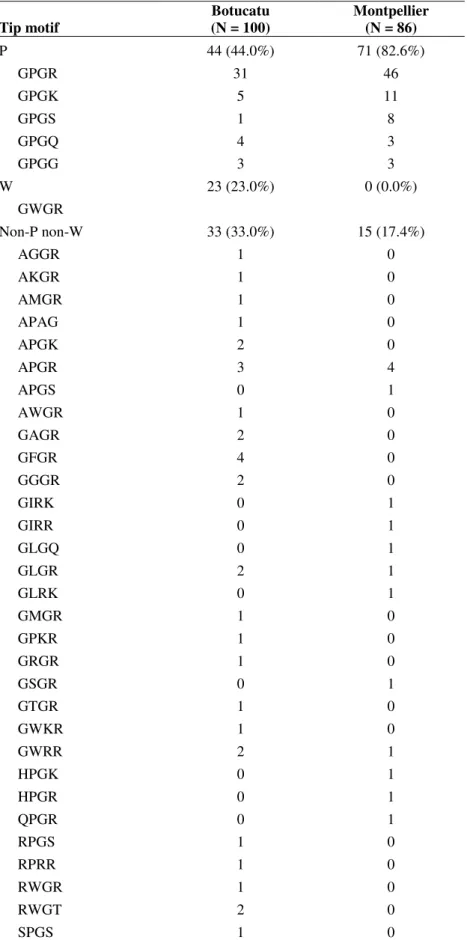
Overall, 37 tetrameric tip motifs were identified. As
shown in Table 2, the diversity in tip motif was higher in
HIV-1 subtype B strains from Botucatu (28 variants) than in those
from Montpellier (17 variants). The GPGR (P) motif was
predominant in Montpellier but not in Botucatu (53.5% vs
31.0%). On the other hand, the GWGR (W) motif was frequent
in HIV-1 isolates from Botucatu (23.0%) and absent in HIV-1
isolates from Montpellier. Three tip motif groups were
considered: P, W, and non-P non-W groups. The distribution of
HIV-1 strains into the three groups was significantly different
between strains from Botucatu and from Montpellier (P <
0.001), a higher proportion of strains from Botucatu (33.0% vs
Table 2. Tip motif distribution in HIV-1 subtype B isolates from Botucatu and Montpellier.
Tip motif
Botucatu (N = 100)
Montpellier (N = 86) P
GPGR GPGK GPGS GPGQ GPGG
44 (44.0%) 31
5 1 4 3
71 (82.6%) 46 11 8 3 3 W
GWGR
23 (23.0%) 0 (0.0%)
Non-P non-W AGGR AKGR AMGR APAG APGK APGR APGS AWGR GAGR GFGR GGGR GIRK GIRR GLGQ GLGR GLRK GMGR GPKR GRGR GSGR GTGR GWKR GWRR HPGK HPGR QPGR RPGS RPRR RWGR RWGT SPGS
33 (33.0%) 1 1 1 1 2 3 0 1 2 4 2 0 0 0 2 0 1 1 1 0 1 1 2 0 0 0 1 1 1 2 1
Relationship between tip motif and virological, immunological and clinical parameters
Coreceptor tropism: Nineteen (19.0%) patients from Botucatu and 21 (24.4%) patients from Montpellier were
infected with a X4 variant (P = 0.37). As shown in Table 3, the
highest proportion of X4 variants was observed in the non-P
non-W group, whereas none X4 variant was observed in the W
group.
When this parameter was analysed within the two patient
populations (Table 4), it was observed a significant higher
proportion of X4 variant in the non-P non-W group among the
patients from Montpellier. Among the patients from Botucatu,
no X4 variants were observed in the W group, and the
proportion of X4 variant was not significantly different
between the P and non-P non-W groups (20.4% vs 30.3%; P =
0.42).
Viral load: As shown in Table 3, patients infected with group W viruses had lower viral loads than those infected with
P or non-P non-W viruses. However, this difference may be
explained by the lower viral load levels among patients from
Botucatu as compared with patients from Montpellier. Indeed,
in patients from Botucatu, there was no significant difference
in viral load levels observed between the different tip motif
groups (Table 4). Differences in viral load levels between the
different tip motif groups were significant neither among
patients from Botucatu nor among patients from Montpellier.
No difference in viral load levels was observed between
patients infected with R5 or X4 variants (4.18 vs 4.16 log
copies/mL; P = 0.81).
Table 3. Relationships between tip motif groups and demographic, virological, immunological and clinical characteristics of patients infected with HIV-1 subtype B.
Tip motif group
Characteristics P
(N=115)
W (N=23)
non-P non-W
(N=48) P
Age, y [median (IQR)] 43 (38-50) 35 (31-41) 40 (28-45) 0.005
Sex, Male [N (%)] 85 (73.9) 9 (39.1) 30 (62.5) 0.004
HIV risk group [N (%)] Heterosexual MSM IDU
Transfusion/hemophilia Unknown
19 (16.5) 65 (56.5) 8 (7.0) 7 (6.1) 16 (13.9)
6 (26.1) 4 (17.4) 7 (30.4) 1 (4.4) 5 (21.7)
10 (20.8) 20 (41.7) 8 (16.7)
2 (4.2) 8 (16.7)
0.02
Treatment [N (%)] Naive
Discontinuation On treatment
17 (14.8) 12 (10.4) 86 (74.8)
3 (13.0) 2 (8.7) 18 (78.3)
3 (6.3) 6 (12.5) 39 (81.2)
0.66
Duration of HIV-1 infection, y [median (IQR)]
9.0 (5.0-13)
4.0 (2.0-7.0)
9.0 (3.5-11.0)
<0.001
CDC stage B or C [N (%)] 71 (61.7) 10 (43.5) 30 (62.5) 0.24
HIV-1 X4 variant [N (%)] 22 (19.1) 0 (0.0) 18 (37.5) <0.001
CD4+ cell count, cells/µ L [median (IQR)]
246 (125-381) 378 (237-540) 248 (89-418) 0.19
Viral load, log copies/mL [median (IQR)]
4.26 (3.26-4.95)
2.68 (1.70-4.31)
3.71 (1.74-4.50)
0.003
CD4+ cell count: Overall, the differences in CD4+ cell
counts between patients belonging to the different tip motif
groups were not significant (Table 3). However a significant
difference was observed among the patients from Montpellier,
with lower CD4+ cell counts in the non-P non-W group as
compared with the P group (Table 4). A such difference was
not observed among the patients from Botucatu. A relationship
was observed between the level of CD4+ T cells and the
coreceptor tropism. Indeed, CD4+ T cell counts were higher in
patients infected with R5 variants than in those infected with
X4 variants (264 vs 169 cells/µL; P = 0.01).
Clinical stage: No significant difference was observed in the proportion of patients belonging to the stages B or C among
the different tip motif groups. This lack of difference was
observed in both the French and Brazilian patient populations.
A higher proportion of patients belonging to CDC stages B or
C was observed in patients infected with X4 variants as
compared with those infected with R5 variants, but the
difference was not significant (67.5% vs 57.5%, P = 0.25).
Table 4. Relationships between tip motif groups and demographic, virological, immunological and clinical characteristics among HIV-1 subtype B-infected patients from Botucatu and Montpellier.
Brazil France
Characteristics P N=44 W N=23 non-P non-W N=33
P P N=71
non-P non-W N=15
P
Age, y, [ median (IQR)] 39.5
(36.5-48.5)
35.0 (31.0-41.0)
38.5 34.5-44.0)
0.09 44.0
(39.0-50.0)
44.0 (41.0-53.0)
0.59
Sex, Male [N (%)] 27 (61.4) 9 (39.1) 15 (45.5) 0.17 58 (81.7) 15 (100) 0.11
HIV-1 risk factors [N (%)] Heterosexual MSM IDU Transfusion/hemophilia Unknown 9 (20.5) 15 (34.1) 3 (6.8) 3 (6.8) 14 (31.8) 6 (26.1) 4 (17.4) 7 (30.4) 1 (4.4) 5 (21.7) 9 (27.3) 7 (21.2) 7 (21.2) 2 (6.1) 8 (24.2) 0.44 10 (14.1) 50 (70.4) 5 (7.0) 4 (5.6) 2 (2.8) 1 (6.7) 13 (86.7) 1 (6.7) 0 (0) 0 (0) 0.69
Treatment [N (%)] Naive Discontinuation On treatment 4 (9.1) 1 (2.3) 39 (88.6) 3 (13.0) 2 (8.7) 18 (78.3) 2 (6.1) 3 (9.1) 28 (84.8) 0.60 13 (18.3) 11 (15.5) 47 (66.2) 1 (6.7) 3 (20.0) 11 (73.3) 0.53
Duration of HIV-1 infection, y [median (IQR)] 6.0 (3.5-9.5) 4.0 (2.0-7.0) 6.0 (2.0-10.0)
0.16 11 .0
(8.0-16.0)
10.0 (9.0-13.0)
0.78
CDC stage B or C [N (%)] 19 (43.2) 10 (43.5) 18 (54.5) 0.57 52 (73.2) 12 (80.0) 0.75
HIV-1 X4 variant [N (%)] 9 (20.4) 0 (0.0) 10 (30.3) 0.02 13 (18.3) 8 (53.3) 0.007
CD4+ cell count, cells/µ L [median (IQR)] 312 (213-455) 378 237-540) 323 (173-451)
0.95 197
(89-332)
24 (7.0-233)
0.005
Viral load, log copies/mL [median (IQR)] 3.23 (1.70-4.23) 2.68 (1.7-4.31) 2.48 (1.70-3.99)
0.88 2.73
(1.70-4.14)
3.04 (1.70-4.46)
0.60
IQR, interquartile range; MSM, men who have sex with men; IDU, injection drug use.
Impact of the V3 loop tip motif on the coreceptor tropism The subtype B consensus V3 sequence was analyzed by
PSSM as a R5 sequence with a score of -12.35. All the
sequences obtained by susbtituting the tip motif of the
consensus sequence with the different tip motifs were analyzed
as R5 sequences with scores ranging from -9.04 (RPRR tip
motif) to -14.06 (AWGR tip motif), the score being -13.39 for
the sequence substituted with the GWGR motif of the B-Br
variant.
DISCUSSION
Subtype B is the most prevalent HIV-1 subtype in western
(3, 10, 22). GPGR is the most frequently encountered sequence
at the tip of the V3 loop in HIV-1 subtype B, whereas the
GPGQ sequence predominates among all the other HIV-1
strains (2). In the present study, we have investigated the
variability of this tip motif among Brazilian and French
patients infected with HIV-1 subtype B. The GPGR motif was
highly predominant in French patients and was less frequent in
Brazilian patients who showed a higher diversity in tip motif
distribution.
A subtype B variant (B-Br) with the GWGR tip motif has
been identified in a high proportion of patients infected with
HIV-1 subtype B in Brazil and this variant has been recognized
as predominant in several studies (7, 23). In the present study,
the B-Br variant was identified in a lower proportion (23%) of
subtype B-infected patients from Botucatu, but a similar
proportion (20%) has been reported in a study conducted in the
São Paulo area (8).
The tip motif represents a target for neutralizing antibodies
(26). Therefore, sequence variation in this motif may have an
impact on virus infectivity and disease progression. A slower
progression to AIDS has been observed in patients infected
with the B-Br variant as compared with those infected with
subtype B strains harbouring the GPGR tip motif (8, 12, 23). It
has been suggested that the difference observed in disease
progression could be due to an avidity of the anti-V3 antibodies
greater for the GWGR than for the GPGR motif (9). In the
present study however, patients from Botucatu infected with a
B-Br variant did not present significant differences in CD4+
cell count, viral load or clinical stage, as compared with those
infected with the other subtype B variants. This observation
might be explained by the fact that these disease progression
indicators have only limited relevance in the group of patients
from Botucatu which is characterized by a relative recent
HIV-1 infection (median, 6 years), and a high frequency (85.0%) of
treatment with highly active antiretroviral therapy. However,
no X4 viruses were identified among patients infected with
B-Br variants, and it is well recognized that X4 viruses are
associated with a rapid disease progression and a poor
prognosis (1, 5, 20, 21). Therefore, the lower progression of
HIV-1 disease in patients infected with a B-Br variant observed
in different studies could be, at least in part, due to a lack of X4
virus emergence in this variant population. However, this
hypothesis merits further investigation at a larger scale.On the
other hand, since the group of Brazilian patients includes
patients that were recently infected, it cannot be excluded that
the lack of X4 viruses associated with the B-Br variant may be
only a temporal matter. On the other hand, it was observed a
significant difference in CD4+ cell count between the P group
and the non-P non-W group among the patients from
Montpellier but not among those from Botucatu. This
difference may be explained by the higher proportion of X4
viruses in the non-P non-W group as compared with the P
group in the patients from Montpellier. The longer duration of
HIV-1 infection in patients from Montpellier, by allowing the
switch from R5 to X4 viruses, may explain this difference
between French and Brazilian patients. This observation
suggests that, compared with subtype B strains belonging to the
P group, those belonging to the non-P non-W group are more
prone to switch to X4 viruses. Thus, patients infected with
viruses belonging to the non-P non-W group could present an
increased risk for emergence of X4 viruses at an advanced
stage of their HIV-1 infection, and the lower CD4+ cell counts
observed in the non-P non-W group of French patients might
be explained by the higher cytopathogenic potential of the X4
viruses.
Within the non-P non-W group, the risk of emergence of
X4 viruses might be different according to the individual tip
motif sequences. However the sample sizes of the individual
tip motif sequences were too small to analyse their association
with coreceptor tropism.
We have analyzed the impact of the V3 tip motif sequence
on the coreceptor tropism by substituting the different tip
motifs identified in our patients to the tip motif of the HIV-1
subtype B V3 loop consensus sequence and by analysing these
sequences using the PSSM tool. None of the tip motifs was
able to induce a change in the coreceptor tropism, but
substitutions with the different tip motifs led to changes in the
sequence may have a real but limited impact on the virus
coreceptor tropism and it might be hypothesized that the
emergence of mutations leading to a switch to a X4 phenotype
is favoured by a molecular environment involving the tip motif
sequence.
The groups of Brazilian and French patients included in
the present study were very different in terms of demographic,
epidemiologic, genetic, clinical and therapeutic characteristics.
This population heterogeneity could introduce a bias, and thus
caution must be taken in comparing the two patient groups.
However, the relationships between tip motif and biological or
clinical parameters were analyzed within each patient group,
and a relationship was found between the tip motif and the
coreceptor tropism in both Brazilian and French patients.
Therefore, the results indicate that genetic diversity in the tip
motif might be related to the capacity of HIV-1 to switch from
R5 to X4 phenotype. Analysis of the HIV-1 strains from
Botucatu indicates that, compared to group P viruses, those
displaying the GWGR motif seem to be protected against
switch to a X4 phenotype, whereas analysis of HIV-1 strains
from Montpellier suggests that compared to group P viruses,
those displaying a non-P non-W tip motif seem to be at higher
risk for switching to a X4 phenotype.
In summary, diversity in the V3 loop tip motif of HIV-1
subtype B was higher in Brazilian than in French patients.
Genetic variability in this short motif might be related to viral
pathogenicity and disease progression. Genetic diversity in the
V3 loop tif motif and its possible clinical implication merit to
be further investigated in the other HIV-1 subtypes and
recombinant forms.
ACKNOWLEDGEMENTS
This research received partial support from the
Brazil-France Cooperation Program (ANRS/Programa Nacional de
DST/AIDS).
REFERENCES
1. Berger, E.A.; Murphy, P.M.; Farber, J.M. (1999). Chemokine receptors as HIV-1 coreceptors: roles in viral entry, tropism, and disease. Annu.
Rev. Immunol. 17, 657-700.
2. Blouin, J.C.; Guzman, E.A.; Foley, T.B. (1996). Global variation in the HIV-1 V3 region. In: Myers, G.; Korber, B.; Foley, B.; Jeang, K.T.; Mellors, J.W.; Wain-Hobson, S. (eds) Human retroviruses and AIDS: a compilation and analysis of nucleic acid and amino acid sequences. Los
Alamos National Laboratory, Los Alamos, New Mexico; 1996. p. 77-201.
3. Bongertz, V.; Bou-Habib, D.C.; Brigido, L.F.M.; Caseiro, M.; Chequer, P.J.; Couto-Fernandez, J.C.; Ferreira, P.C.; Galvão-Castro, B.; Greco D, Guimarães, M.L.; Linhares de Carvalho, M.I.;., Morgado, M.G.; Oliveira, C.A.; Osmanov ,S.; Ramos, C.A.; Rossini, M.; Sabino, E.; Tanuri, A.; Ueda, M. (2000). HIV-1 diversity in Brazil: genetic, biologic, and immunologic characterization of HIV-1 strains in three potential HIV vaccine evaluation sites. Brazilian Network for HIV Isolation and Characterization. J. Acquir. Immune Defic. Syndr. 23, 184-193. 4. Brumme, Z.L.; Dong, W.W.; Yip, B.; Wynhoven, B.; Hoffman, N.G.;
Swanstrom, R.; Jensen, M.A.; Mullins, J.I.; Hogg, R.S.; Montaner, J.S.; Harrigan, P.R. (2004). Clinical and immunological impact of HIV envelope V3 sequence variation after starting initial triple antiretroviral therapy. AIDS 18,F1-F9.
5. Callaway, D.S.; Ribeiro, R.M.; Nowak, M.A. (1999). Virus phenotype switching and disease progression in HIV-1 infection. Proc. Biol. Sci. 266, 2523-2530.
6. Cann, A.J.; Churcher, M.J.; Boyd, M.; O'brien, W.; Zhao, J.Q.; Zack, J.; Chen, I.S. (1992). The region of envelope gene of human immunodeficiency virus type 1 responsible for determination of cell tropism. J. Virol. 66, 305-309.
7. Casseb, J.; Hong, M.A.; Gonsalez, C.; Brigido, L.F.; Duarte, A.J.; Michael-Hendry, R. (1998). Two variants of HIV-1 B serotype are transmitted heterosexually in São Paulo, Brazil. Braz. J. Med. Biol. Res. 31, 1243-1246.
8. Casseb, J.; Komninakis, S.; Abdalla, L.; Brigido, L.F.; Rodrigues, R.; Araujo, F.; Veiga, A.P.; de Almeida, A.; Flannery, B.; Hendry, R.M.; Duarte, A.J. (2002). HIV disease progression: is the Brazilian variant subtype B' (GWGR motif) less pathogenic than US/European subtype B (GPGR)? Int. J. Infect. Dis. . 6, 164-169.
9. Casseb, J.; Montanheiro, P.; Komninakis, S.; de Brito, A.; Duarte, A.J. (2004). Human immunodeficiency virus type 1 Brazilian subtype B variant showed an increasing avidity of the anti-V3 antibodies over time compared to the subtype B US/European strain in São Paulo, Brazil. Mem. Inst. Oswaldo Cruz 99, 69-71.
10. Couto-Fernandez, J.C.; Janssens, W.; Heyndrickx, L.; Motte, J.; Fransen, K.; Peeters, M.; Delaporte, E.; Galvão-Castro, B.; Piot, P.; van der Groen, G. (1994). Genetic and antigenic variability of HIV type 1 in Brazil. AIDS. Res. Hum. Retroviruses 10, 1157-1163.
11. Covas, D.T.; Biscaro, T.A.; Kashima, S.; Duarte, G.; Machado, A.A. (1998). High frequency of the GWG (Pro Trp) envelope variant of HIV-1 in southeast Brazil. J. Acquir. Immune Defic. Syndr. 19, 74-79.
L.A.; Duarte, A.J.; Casseb, J. (2006) Women infected with HIV type 1 Brasilian variant, subtype B (B'-GWGR motif) have slower progression to AIDS, compared with patients infected with subtype B (B-GPGR motif). Clin. Infect. Dis. 43, 1476-1481.
13. Delwart, E.L.; Herring, B.; Rodrigo, A.G.; Mullins, J.I. (1995). Genetic subtyping of human immunodeficiency virus using a heteroduplex mobility assay. PCR methods Appl. 4: S202-S216.
14. Foley, B.; Korber, B. (1992). Global variation in the HIV-1 V3 region. In: Myers, G.; Korber, B.; Hahn, B.H.; Jeang, K.T.; Mellors, J.W.; McCutchan, F.E.; Henderson LE, Pavlakis GN (eds), Human retroviruses and AIDS. Los Alamos National Laboratory, New Mexico. p 77-108.
15. Fouchier, R.A.; Meyaard, L.; Brouwer, M.; Hovenkamp, E.; Schuitemaker, H. (1996). Broader tropism and higher cytopathicity for CD4+ T cells of a syncytium-inducing compared to a non-syncytium-inducing HIV-1 isolate as a mechanism for accelerated CD4+ T cell decline in vivo. Virology 219, 87–95.
16. Galvão-Castro, B.; Couto-Fernandez, J.C.; Mello, M.A.; Linhares de Carvalho, M.I.; Castello-Branco, L.R.; Bongertz, V.; Ferreira, P.C.; Morgado, M.; Sabino, E.; Tanuri, A. (1996). A nationwide effort to systematically monitor HIV-1 diversity in Brazil: preliminary results. Brazilian Network for the HIV-1 Isolation and Characterization. Mem. Inst. Oswaldo Cruz 91, 335-338.
17. Garrido, C.; Roulet, V.; Chueca, N.; Poveda, E.; Aguilera, A.; Skrabal, K.;Zahonero, M.; Carlos, S.; Garcia,F.; Faudon, J.C.; Soriano, V.; de Mendoza, C. (2008). Evaluation of eight different bioinformatics tools to predict viral tropism in different human immunodeficiency virus type 1 subtypes. J. Clin. Microbiol. 46, 887-891.
18. Jensen, M.A.; Coetzer, M.; van't Wout, A.B.; Morris, L.; Mullins, J.I.; (2006). A reliable phenotype predictor for human immunodeficiency virus type 1 subtype C based on envelope V3 sequences. J. Virol. 80, 4698-4704.
19. Jensen, M.A.; Li, F.S.; van't Wout, A.B.; Nickle, D.C.; Shriner, D.; He,
H.X.; McLaughlin, S.; Shankarappa, R.; Margolick, J.B.; Mullins, J.I. (2003). Improved coreceptor usage prediction and genotypic monitoring of R5-to-X4 transition by motif analysis of human immunodeficiency virus type 1 env V3 loop sequences. J. Virol. 77, 13376-13388.
20. Koot, M,.; van Leeuwen, R.; de Goede, R.E.; Keet, I.P.; Danner, S.; Eeftinck Schattenkerk, J.K.; Reiss, P.; Tersmette, M.; Lange, J.M.; Schuitemaker, H. (1999). Conversion rate towards a syncytium-inducing (SI) phenotype during different stages of human immunodeficiency virus type 1 infection and prognostic value of SI phenotype for survival after AIDS diagnostic. J. Infect. Dis. 179, 254-258.
21. Kupfer, B.; Kaiser, R.; Rockstroh, J.K.; Matz, B.; Schneweis, K.E. (1998). Role of HIV-1 phenotype in viral pathogenesis and its relation to viral load and CD4+ T cell count. J. Med. Virol. 56, 259-263.
22. Louwagie, J.; Delwart, E.L.; Mullins, J.I.; McCutchan, F.E.; Eddy, G.; Burke, D.S. (1994). Genetic analysis of HIV-1 isolates from Brazil reveals presence of two distinct genetic subtypes. AIDS Res. Hum. Retroviruses 10, 561-567.
23. Santoro-Lopes, G.; Harrison, L.H.; Tavares, M.D.; Xexéo, A.; Dos Santos, A.C.; Schechter, M. (2000). HIV disease progression and V3 serotypes in Brazil: is B different from B'? AIDS Res. Hum. Retroviruses 16, 953-958.
24. Van‘t Wout, A.B.; Blaak, H.; Ran, L.J.; Brouwer, M.; Kuiken, C.; Schuitemaker, H. (1998). Evolution of syncytium inducing and non-syncytium inducing biological virus clones in relation to replication kinetics during the course of HIV-1 infection. J. Virol. 72, 5099-5107. 25. Wang, N.; Zhu, T.; Ho, D.D. (1995). Sequence diversity of V1 and V2
domains of gp120 from human immunodeficiency virus type 1: lack of correlation with viral phenotype. J. Virol. 69, 2708-2715.