Vol. 1, No. 6, 1980
Status of Malaria Eradication Programs
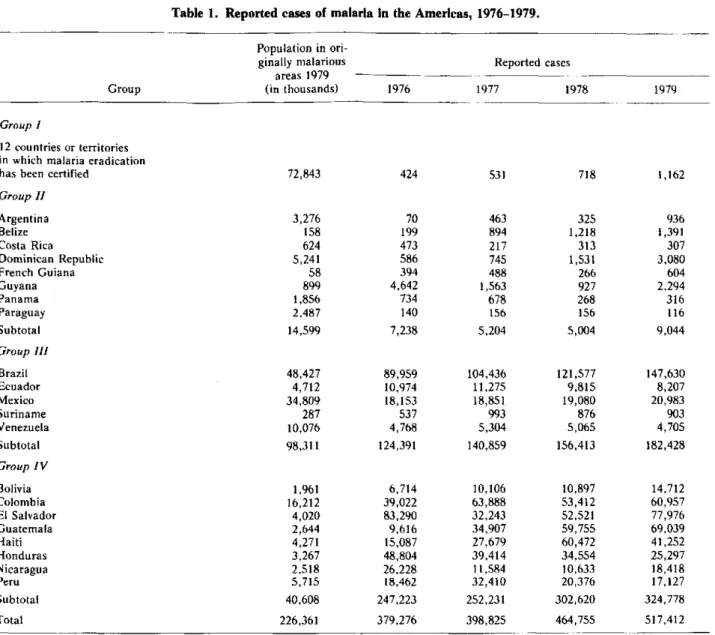
In recent years malaria has shown a rising trend in the Region of the Americas (Table 1). At year-end 1979 the situation could be classified as follows:
Group 1. In 12 countries or territories (Chile, Cuba,
Dominica, Grenada and Carriacou, Guadeloupe, Ja-maica, Martinique, Puerto Rico, Saint Lucia, Trinidad and Tobago, the United States of America, and the Vir-gin Islands) the disease had been eradicated. This group has a population of 72.8 million inhabitants in originally malarious areas (32.2 per cent of the total inhabitants of the originally malarious area of the Americas). No ma-jor problems in the maintenance of eradication occurred during the year, although cases continued to be imported into these countries and territories.
Group II. Eight countries or territories interrupted
or almost eliminated malaria transmission (Argentina, Belize, Costa Rica, Dominican Republic, French Gui-ana, GuyGui-ana, Panama, and Paraguay). In this group, which has a population of 14.6 million inhabitants in originally malarious areas (6.4 per cent of the total), 9,044 cases were reported in 1979. In many countries there was an increase relative to the previous year. In some countries, imported cases were more numerous ow-ing to the increased exchange of population with other countries whereas, in others, the lack or delay in the provision of funds for operations and surveillance forced
a reduction of the program or the postponement of cor-rective measures. In Argentina, Belize, Dominican Re-public, French Guiana, and Guyana the epidemiological situation deteriorated during the year.
Group III. Five countries (Brazil, Ecuador, Mexico,
Suriname, and Venezuela) vigorously pursued the eradi-cation campaign, which received appropriate adminis-trative and financial support. This group has a popula-tion of 98.3 million inhabitants in originally malarious areas (43.4 per cent of the total) and reported 182,428 cases of malaria in 1979. During the year, Mexico shifted an area with a population of 5.3 million inhabitants from the consolidation to the maintenance phase, and another, with 2 million inhabitants, from the attack to the consoli-dation phase. Brazil, Ecuador, and Venezuela continued to make steady progress; in contrast, no significant ad-vance was made in Suriname in 1979.
Group IV. In the eight remaining countries (Bolivia,
Colombia, El Salvador, Guatemala, Haiti, Honduras, Nicaragua, and Peru) the total number of residents in the originally malarious areas amounted to 40.6 million (18 per cent of the total). Although the final goal of the program is eradication, the immediate objective is to re-duce mortality and morbidity from malaria in areas in which transmission persists, as well as to prevent a re-surgence of the disease in areas in which transmission
IN THIS ISSUE . . .
* Status of Malaria Eradication Programs
* Diseases Subject to the International Health Regulations * Toxic-Shock Syndrome
* Outbreak of Bartonellosis in Ecuador * Health Examination of Food Handlers
* Jungle Yellow Fever in Goiás, Brazil
* Isolation of O-lactamase-producing Neisseria gonorrhoeae in Panama
* Reports on Meetings and Seminars * Courses
Table 1. Reported cases of malaria in the Americas, 1976-1979.
Population in
ori-ginally malarious Reported cases areas 1979
Group (in thousands) 1976 1977 1978 1979
Group I
12 countries or territories in which malaria eradication
has been certified 72,843 424 531 718 1,162
Group II
Argentina 3,276 70 463 325 936
Belize 158 199 894 1,218 1,391
Costa Rica 624 473 217 313 307
Dominican Republic 5,241 586 745 1,531 3,080
French Guiana 58 394 488 266 604
Guyana 899 4,642 1,563 927 2,294
Panama 1,856 734 678 268 316
Paraguay 2,487 140 156 156 116
Subtotal 14,599 7,238 5,204 5,004 9,044
Group III
Brazil 48,427 89,959 104,436 121,577 147,630
Ecuador 4,712 10,974 11,275 9,815 8,207
Mexico 34,809 18,153 18,851 19,080 20,983
Suriname 287 537 993 876 903
Venezuela 10,076 4,768 5,304 5,065 4,705
Subtotal 98,311 124,391 140,859 156,413 182,428
Group IV
Bolivia 1,961 6,714 10,106 10,897 14,712
Colombia 16,212 39,022 63,888 53,412 60,957
El Salvador 4,020 83,290 32,243 52,521 77,976
Guatemala 2,644 9,616 34,907 59,755 69,039
Haiti 4,271 15,087 27,679 60,472 41,252
Honduras 3,267 48,804 39,414 34,554 25,297
Nicaragua 2.518 26,228 11,584 10,633 18,418
Peru 5,715 18,462 32,410 20,376 17,127
Subtotal 40,608 247,223 252,231 302,620 324,778
Total 226,361 379,276 398,825 464,755 517,412
has already been interrupted. In Bolivia, all the areas that were in the consolidation phase were shifted back into the attack phase. PAHO analyzed the programs of Colombia, Haiti, Honduras, and Nicaragua and cooper-ated with the national authorities in preparing opera-tional plans tailored to local epidemiological conditions. Honduras and Peru decided to incorporate malaria con-trol activities into their general health services while, in other countries, malaria control was the responsibility of autonomous malaria eradication services. In Honduras and Peru, control and case-detection activities were re-duced because of administrative problems due to organi-zational changes; it was therefore very difficult to evalu-ate the status of malaria in those countries. In 1979 the countries in this group reported 324,778 cases, or 62.7 per cent of the total in the Region.
As of 31 December 1979 the estimated population
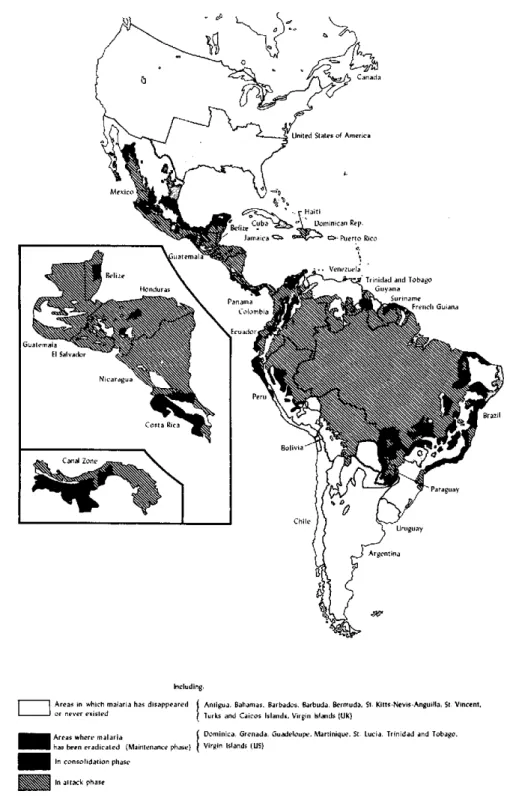
of the Americas was 600,363,000 inhabitants, of which 226,361,000 (37.7 per cent) were living in originally ma-larious areas. Of the last-mentioned, 1 13,092,000 (50.5 per cent) live in areas in which the disease has been erad-icated (maintenance phase); 57,280,000 (25.3 per cent) in areas in which transmission has been interrupted, al-though the reservoir of parasites has not been exhausted and focal transmission may exist (consolidation phase); and 55,989,000 (24.7 per cent) in areas in which trans-mission has not yet been interrupted (attack phase) (Fig-ure 1).
Obstacles to the Progress of the Program
substan-Figure 1. Status of the malaria program in the Americas, 31 December 1979.
Including:
Areas in whch malaria has disappeared Anigua. ihama. Barbado Barbadosarbuda. eruda. St. Kitts-Nevis-Anguilla., St Vincent. or n exis e iv r lurks and nd Caios slands, Virgin Islands (UK)
Arr here malaria ph Dominica, Grenada. Guadeloupe. Martiniqur.e, St. Lucia., Trinidad and Tobago. has benn eradíicaed (Main.enac. phase)l Virgn Islads (US)
eIn consolidation phasr
l
In attack phasretial progress achieved in the 1960s waned in the 1970s. At the end of 1969 the population in areas in the consoli-dation and maintenance phases amounted to 67.9 per cent of the total of the originally malarious area. This figure rose to 75.3 per cent at the end of 1979, which is tantamount to an increase of only 7.4 per cent in the last 10 years.
Generally speaking, three principal types of problems are hampering the progress of the malaria program, es-pecially in the Group IV countries, namely:
1. Technicalproblems: Physiological resistance of the
vector to insecticides, as in the Central American coun-tries and Haiti; evasive behavior of the vectors (the spray-ing of houses is not completely effective because of the lack of vector contact with the insecticide), as in west-ern Venezuela and in eastwest-ern Colombia with Anopheles
nuñeztovari; and Plasmodium falciparunm resistance to
chloroquine, as occurs in Brazil, Colombia, Ecuador, French Guiana, Guyana, Panama, Suriname, and Ven-ezuela.
2. Economics related to development: All the
coun-tries of the Americas are actively promoting economic development projects. Agricultural settlement of new lands and the construction of highways, hydroelectric plants, dams, and the like always bring immigrants and workers to areas in which living conditions are precari-ous. In the last 20 years the geographic extension of the malarious area has increased as and when new land areas have been opened up to development projects and reset-tlement.
3. Budgetary problems: The funds assigned by the
Governments to the malaria program have progressively
increased in the past 20 years. However, this increase has been offset by the rising cost of personnel, supplies, equipment, and means of transportation. In addition, in some countries the appearance of technical problems such as vector resistance to DDT and other insecticides and parasite resistance to drugs has made it necessary to apply different or supplementary measures that are much more expensive. Furthermore, the increase in the malarious areas, new population settlements, and fre-quent outbreaks of the disease among immigrants are problems whose solution calls for a large amount of funds that, as a rule, are not easy to obtain. In many countries the present level of financing is barely suf-ficient to protect the areas in which malaria has been eradicated and, at the same time, to solve problems in areas in which transmission persists. Because of finan-cial constraints many countries plan their activities by
order of priority or use their resources solely to prevent epidemic outbreaks or to deal with emergency situations.
Table 2 summarizes the principal problems by their geographic distribution.
(Source: Parasitic Diseases and Vector
Control Unit, Division of Disease Prevention and Control, PAHO.)
Table 2. Types of problems and distribution, by country, 1979.a
Insecticides
Population No. of
Countries and (problem Areas Types Years of cases in Principal
areas areas) km2 used coverage this area vectors Causes of the problem
BOLIVIA
1. Department of Beni (Guayaramerin) De-partment of Tarija (Bermejo)
COLOMBIA
2. Western Caribbean region; central region of Magdalena River Valley; Pacific Coast middle and southern region; Catatumbo; central region of the eastern Piedmont. of the eastern Cordillera; Upper Caquetá and Sarare; Meta River (Upper Vaupés)
88,972 27,639 DDT
849,280 125,509 DDT Malathion Propoxur
21 3,682 Anopheles darlingi A.
pseudopuncti-pennis
13-20 22,269 A. darlingi A. punctimacula A. nuñeztovari A. albimanus A.
pseudopuncti-pennis A. neivai A. albitarsis
Makeshift housing; land settlement; parasite resis-tance to chloroquine; population movement
Table 2. (Continued).
ECUADOR
3. Esmeraldas; Napo
EL SALVADOR 4. Pacific Coast
GUATEMALA 5. Pacific Coast
HAITI
6. Cité Simone O. Duvalier; Jacmel; Coma Valley; Gross-Morne; southeast of the country; Petit-Goave; Bois Neuf
HONDURAS
7. Southern areas of Jamastrán, Talanga and Cedros Valleys
MEXICO
8. Basin of the Fuerte, Sinaloa, Humaya, and Tamazula Rivers 9. Huicot
10. Balsas River basin 11. Costa Chica of
Gue-rrero and Oaxaca coast
12. The Isthmus, north-eastern slope of Gulf of Mexico and State of Oaxaca
13. Tapachula-Suchiate 14. Center of state
of Chiapas
NICARAGUA 15. Pacific region;
central region; Atlantic region; Zelaya
PANAMA 16. Jaqué
Calovebora St. Catalina
PERU
17. Col. San Lorenzo; Bigote, Chinchipe, Bagua
Santiago, Ene-Satipo Lower Marañón
VENEZUELA 18. Western and
southerri areas
Total
352,601 69,605 DDT Fenitro-thion
-.. 7,500 DDT
833,052 11,456 Clorfoxim
1,720,150 3,645 DDT
273,635 5,436 Malathion DDT
3,554,580 162,547 DDT
... 30,138 DDT
Malathion Propoxur
7,658 4,871 DDT
214,300 142,950 DDT
599,455 139,946 DDT
8,493,683 731,242
-12 1
17
5,174 A. punetimacula A. albimanus
... A. albimanus
... 32,732 A. albimanus
13 20,529 A. albimanus
9 17,079b A. albimanus A.
pseudopuncti-pennis
22 7,021 A. pseudopuncti-pennis A. albimanus
16 5 7
... A. albimanus
21 75 A. albimanus
16-22 5,895 A. pseudopuncti-pennis A. rangeli A. albimanus A. benarrochi
32 2,666 A. nuñeztovari A. darlingi
- 117,122
-Land settlement; make-shift housing; parasite resistance to chloroquine
Vector resistance to DDT and propoxur
Vector resistance to insecticides
Vector resistance to DDT; population movement
Vector resistance to chlorinated, phosphorus, and carbamate insecticides
Internal migration; make-shift housing, temporary housing; alteration to houses; vector resis-tance to DDT; damage to sprayed surfaces
Vector resistance to DDT, malathion, and propoxur
Migration; makeshift housing; parasite resis-tance; population move-ment
High vulnerability; makeshift housing; labor migration; temporary housing; damage to sprayed surfaces
Exophilia of the vector; population move-ment;
anthropological problems
... Data not available.
aThere are special regions with problems of all kinds such as that of the Amazon basin which comprises areas in Bolivia, Colombia, Ecuador, Peru, and large tracts of Brazil; in the last-mentioned country, for example, a large-scale plan of socioeconomic development that includes the con-struction of many road and land settlement projects requires malaria control activities to be carried out as a long-term program.